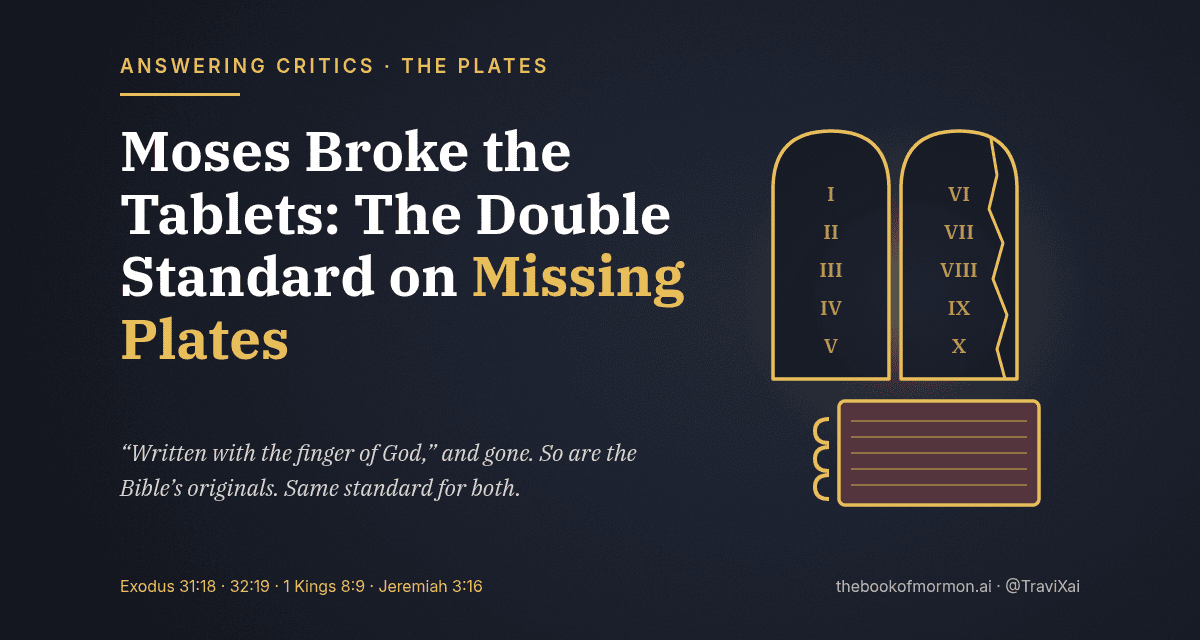

Critics say no plates means no proof. The stone tablets God wrote with His own finger are gone too, and so is every original page of the Bible. Here’s what Scripture says happened to them, and why the standard has to cut both ways.
“Where are the gold plates?” I hear it almost every week on X, usually followed by the same smug line: no plates, no proof. Fine. Let’s use that standard. Where are the tablets?
I mean the actual stones the Bible says were “written with the finger of God.” Where is the Ark that held them? Where is one original page of any book of the Bible? Nobody has any of it, and nobody’s faith in the Bible has collapsed because of it. That’s the whole point.
The first exhibitWritten with the finger of God
If any object in history deserved to be kept under glass, it was this one. Exodus says God handed Moses two stone tablets and wrote on them Himself:
And he gave unto Moses, when he had made an end of communing with him upon mount Sinai, two tables of testimony, tables of stone, written with the finger of God.
Exodus 31:18 (KJV)
The tablets “were written on both their sides,” and “the writing was the writing of God, graven upon the tables” (Exodus 32:15–16). Moses repeats it in Deuteronomy 9:10. No scribe, no copyist, no translator. If you wanted physical proof that God has spoken, you couldn’t ask for better.
The first set didn’t make it to the camp
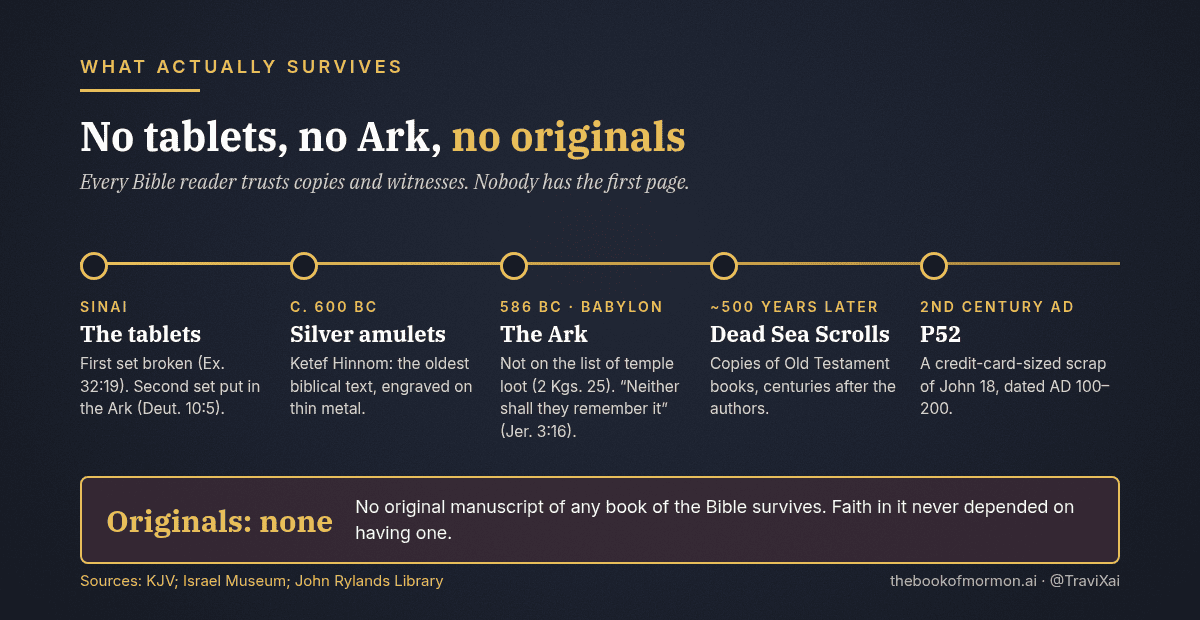
Then Moses saw the golden calf, “and he cast the tables out of his hands, and brake them beneath the mount” (Exodus 32:19). He reminds Israel later that he broke them “before your eyes” (Deuteronomy 9:17). The one document the Bible says God engraved with His own finger was smashed by His own prophet the day it reached the people. Nobody gathered the pieces for a museum. The text just moves on.
The second set went into a box
God told Moses to “hew thee two tables of stone like unto the first,” and He wrote the words again (Exodus 34:1). This time they had a destination. Moses says he “put the tables in the ark which I had made; and there they be, as the Lord commanded me” (Deuteronomy 10:1–5). “There they be” is the last eyewitness word we get on them. Hold on to that line.
The ArkA box nobody was allowed to open
Critics love to say the plates were hidden. Look at how the Bible’s tablets were kept. The Ark wasn’t a display case. Even the Levites who carried it “shall not touch any holy thing, lest they die,” and “shall not go in to see when the holy things are covered, lest they die” (Numbers 4:15, 20).
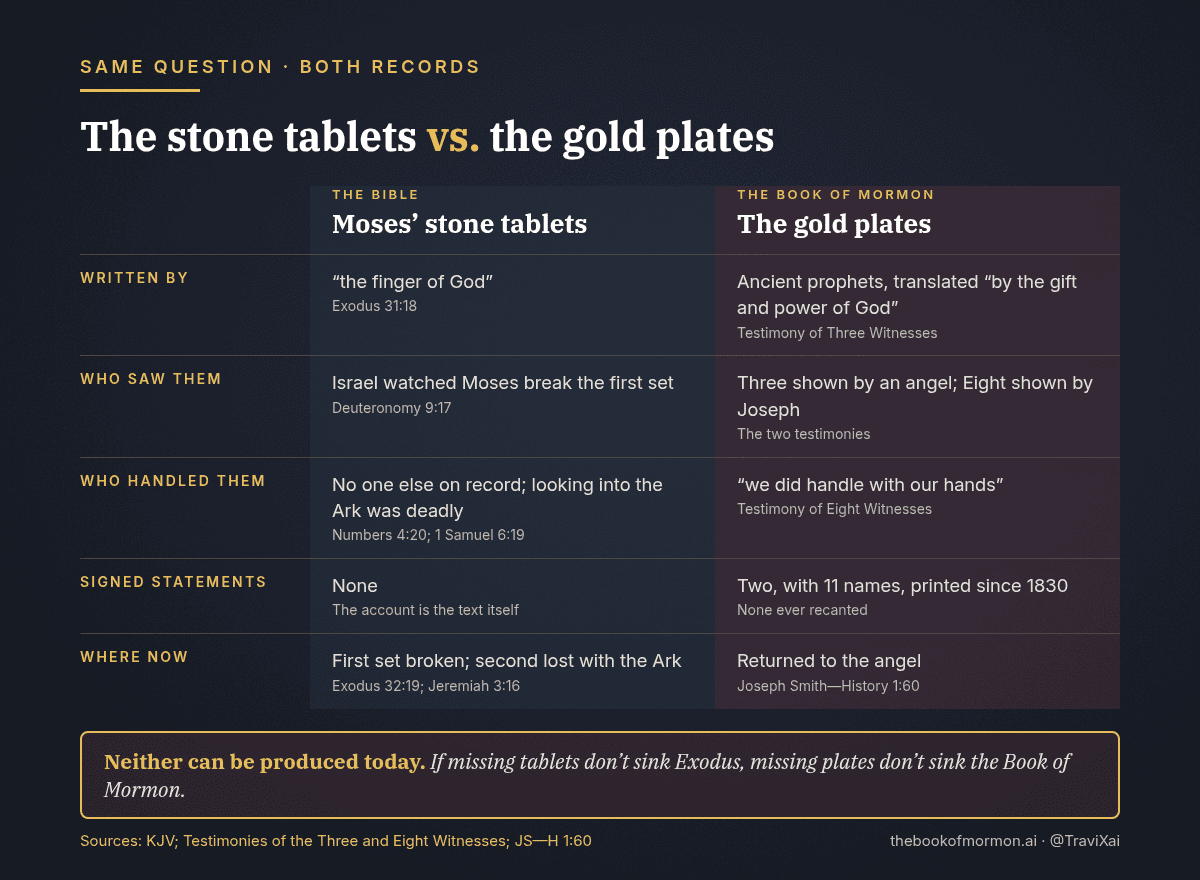
That wasn’t an empty threat. When Uzzah reached out to steady the Ark, “God smote him there for his error; and there he died by the ark of God” (2 Samuel 6:6–7). The men of Beth-shemesh were struck down “because they had looked into the ark of the Lord” (1 Samuel 6:19). So nobody was passing the tablets around to heft, and nobody signed anything like the Eight Witnesses’ “we did handle with our hands.” Looking at them could get you killed.
Even the contents went missing
Hebrews says the Ark held the pot of manna, Aaron’s rod, “and the tables of the covenant” (Hebrews 9:4). By Solomon’s day, two of the three were gone:
There was nothing in the ark save the two tables of stone, which Moses put there at Horeb, when the Lord made a covenant with the children of Israel, when they came out of the land of Egypt.
1 Kings 8:9 (KJV)
Then the Ark itself disappears
When Babylon stripped the temple, 2 Kings lists the loot down to the spoons, and the Ark isn’t on the list (2 Kings 25:13–17). Jeremiah even prophesied that “they shall say no more, The ark of the covenant of the Lord: neither shall it come to mind” (Jeremiah 3:16). Jewish tradition in 2 Maccabees 2:4–8 says Jeremiah, “being warned of God,” hid it in a cave, and “that place, it shall be unknown until the time that God gather his people again together.” A prophet puts the sacred object away at God’s command until God brings it back. Sound familiar?
Nobody throws out Exodus because the tablets are gone. Nobody calls Jeremiah a fraud because he couldn’t produce the Ark. They read the record, trust the people who wrote it, and believe.
The originalsNo autographs, no exceptions
It isn’t just the tablets. There is no original manuscript of any book of the Bible. Not Genesis, not Isaiah, not Matthew, not one letter of Paul. Bart Ehrman, a New Testament scholar who left his evangelical faith long ago, put it bluntly:
Not only do we not have the originals, we don’t have the first copies of the originals. We don’t even have copies of the copies of the originals, or copies of the copies of the copies of the originals.
Bart D. Ehrman, Misquoting Jesus (2005), Introduction
He adds that this doesn’t mean we have no clue what the originals said (his clarification), and he’s right. Scholars rebuild the text from copies. That’s my point. Every Bible reader trusts copies and the people who made them.
The inerrantists already settled this
In 1978, evangelical scholars faced this head-on. The Chicago Statement on Biblical Inerrancy says inspiration “strictly speaking, applies only to the autographic text of Scripture,” meaning the originals nobody has. Then Article X says this:
WE DENY that any essential element of the Christian faith is affected by the absence of the autographs. We further deny that this absence renders the assertion of Biblical inerrancy invalid or irrelevant.
The Chicago Statement on Biblical Inerrancy, Article X (1978)
Read that again. The most conservative wing of Protestant Christianity officially declared that missing originals don’t touch the faith. I agree. I’m only asking for the same courtesy when the subject is the plates.
The best they have is a scrap
The oldest piece of the New Testament anyone can point to is P52, a papyrus in Manchester that the John Rylands Library says “only measures 8.9 x 6.0 cm,” about the size of a credit card, with a few lines of John 18. Its first editor dated it to AD 100–150, and the library notes “recent research points to a date nearer to 200 CE” (Rylands, Greek P 457). Nobody calls John’s Gospel a hoax because its oldest surviving witness is smaller than a phone.
The oldest Bible text is on metal
Here’s one for the “metal plates are ridiculous” crowd. The Israel Museum says two tiny silver amulets from Ketef Hinnom in Jerusalem “bear the oldest copies of biblical text known to us today,” the priestly blessing of Numbers 6:24–26, and are “some five hundred years older than the Dead Sea Scrolls” (Israel Museum). The oldest surviving words of the Bible were engraved on thin rolled metal. More on that in Part 9: Could the Plates Work?.
The platesSame question, a longer witness list
Now put the gold plates next to all that. The plates come with something the tablets never had: signed statements from people other than the prophet. Three men testified that “an angel of God came down from heaven” and “laid before our eyes” the plates (Testimony of Three Witnesses). Eight more saw them with no angel and no vision, and picked them up:
That Joseph Smith, Jun., the translator of this work, has shown unto us the plates of which hath been spoken, which have the appearance of gold; and as many of the leaves as the said Smith has translated we did handle with our hands; and we also saw the engravings thereon, all of which has the appearance of ancient work, and of curious workmanship.
The Testimony of Eight Witnesses
They “did handle” them and “hefted” them, then gave their names “unto the world,” printed in the Book of Mormon since 1830. Emma Smith said she “once felt of the plates” as they lay on her table in a linen cloth (Emma Smith’s last testimony).
Israel did watch Moses break the tablets. But nobody left a signed statement about handling them, and the Bible tells you why. The plates had eleven named witnesses who put their names on it in print.
And they never took it back
Oliver Cowdery, David Whitmer, and Martin Harris all fell out with Joseph and were out of the Church by 1838, angry and public about it. That’s exactly when a con falls apart. Not one of them denied what he saw. Cowdery and Harris came back. Whitmer never did, and in 1881 he still published that he had “never at any time denied that testimony” (Part 10: The Witnesses Who Never Recanted).
Where are they now?
Joseph said that when his work was done, “the messenger called for them, I delivered them up to him; and he has them in his charge until this day” (Joseph Smith—History 1:60). Critics laugh at that. But the tablets’ story ends the same way: “and there they be,” and then they leave human hands. What’s left is the record and the witnesses. Same ending, but one gets a pass and the other gets mocked.
The standardNo plates, no proof? Then no tablets, no Sinai
So let’s run the critic’s rule all the way through. If no plates means no proof, then no tablets means no Sinai, no Ark means no covenant, and no autographs means no Bible. Nobody believes that, including the people who post it. They only pull it out for us.
The Bible never asked anyone to believe because they could inspect the stones. “These are written, that ye might believe that Jesus is the Christ” (John 20:31). Its standard is witnesses: “In the mouth of two or three witnesses shall every word be established” (2 Corinthians 13:1). The plates have three, then eight more. And Jesus told Thomas what He thinks of “show me or I won’t believe”:
Jesus saith unto him, Thomas, because thou hast seen me, thou hast believed: blessed are they that have not seen, and yet have believed.
John 20:29 (KJV)
Paul says the word was moved off stone on purpose, “not in tables of stone, but in fleshy tables of the heart” (2 Corinthians 3:3; compare Jeremiah 31:33). God never meant faith to rest on a rock you could pick up.
How I know
People ask how I know the Book of Mormon is true. The same way I know the Bible is true. God told me, and I choose to believe Him. I’ve never held a tablet or a plate. I asked, which is what both books tell you to do (James 1:5; Moroni 10:4–5). If that isn’t good enough, tell me how you know Exodus is true without the tablets.
If no plates means no proof, then no tablets means no Sinai and no autographs means no Bible. Nobody believes that. They just save it for us.
Believe the Bible. I do. Just stop using a standard on the Book of Mormon that your own Bible can’t pass. So who cares? If everyone held their own beliefs to the same standard they hold others to, the world would be a better place.
SummaryKey takeaways
- The Bible says the first tablets were “written with the finger of God,” and Moses broke them in front of Israel (Exodus 31:18; 32:19; Deuteronomy 9:17).
- The second set went into the Ark, where touching or looking could be fatal, and the Ark later vanished from the record (Numbers 4:15, 20; 1 Samuel 6:19; Jeremiah 3:16).
- No original manuscript of any Bible book survives. The oldest New Testament piece, P52, is a credit-card-sized scrap of John.
- The Chicago Statement on Biblical Inerrancy denies that “any essential element of the Christian faith is affected by the absence of the autographs.”
- The plates had eleven signed witnesses. The Eight “did handle” them, and none of the eleven ever denied his testimony, even after leaving the Church.
Next time someone asks, “Where are the gold plates?”, answer with a question: “Where are the tablets?” For quick, sourced answers on the gold plates, the Three and Eight Witnesses, and Bible inerrancy, open Galatians18. And for more like this every day, follow me on X at @TraviXai.
Sources
- Bible (KJV, churchofjesuschrist.org): Exodus 24:18 · Exodus 31:18 · Exodus 32:15–19 · Exodus 34:1, 28 · Numbers 4:15, 20 · Deuteronomy 9:10, 17 · Deuteronomy 10:1–5 · 1 Samuel 6:19 · 2 Samuel 6:6–7 · 1 Kings 8:9 · 2 Kings 25:13–17 · Jeremiah 3:16 · Jeremiah 31:33 · John 20:29–31 · 2 Corinthians 3:3 · 2 Corinthians 13:1 · Hebrews 9:4 · James 1:5
- Restoration scripture (churchofjesuschrist.org): Testimony of Three Witnesses · Testimony of Eight Witnesses · Joseph Smith—History 1:60 · Moroni 10:4–5
- 2 Maccabees 2:4–8 (KJV Apocrypha): kingjamesbibleonline.org
- International Council on Biblical Inerrancy, The Chicago Statement on Biblical Inerrancy (1978), Articles VI and X: text at Midwestern Baptist Theological Seminary
- Bart D. Ehrman, Misquoting Jesus: The Story Behind Who Changed the Bible and Why (HarperSanFrancisco, 2005), Introduction; and his clarification, “Misquoting Misquoting Jesus” (Ehrman Blog)
- John Rylands Research Institute and Library, University of Manchester, Papyrus Greek P 457 (P52)
- Israel Museum, Jerusalem, “Priestly Benediction” on amulets (Ketef Hinnom)
- Galatians18: The Gold Plates · The Three and Eight Witnesses · Is the Bible Infallible?
- Related on this site: Part 10: The Witnesses Who Never Recanted · Part 9: Could the Plates Work? · Emma Smith’s Last Testimony · Psalm 145 and the Missing Verse · Books the Bible Quotes That Aren’t in the Bible
- Featured image, timeline, and comparison card: original graphics by thebookofmormon.ai (no photographs or likenesses of real people).