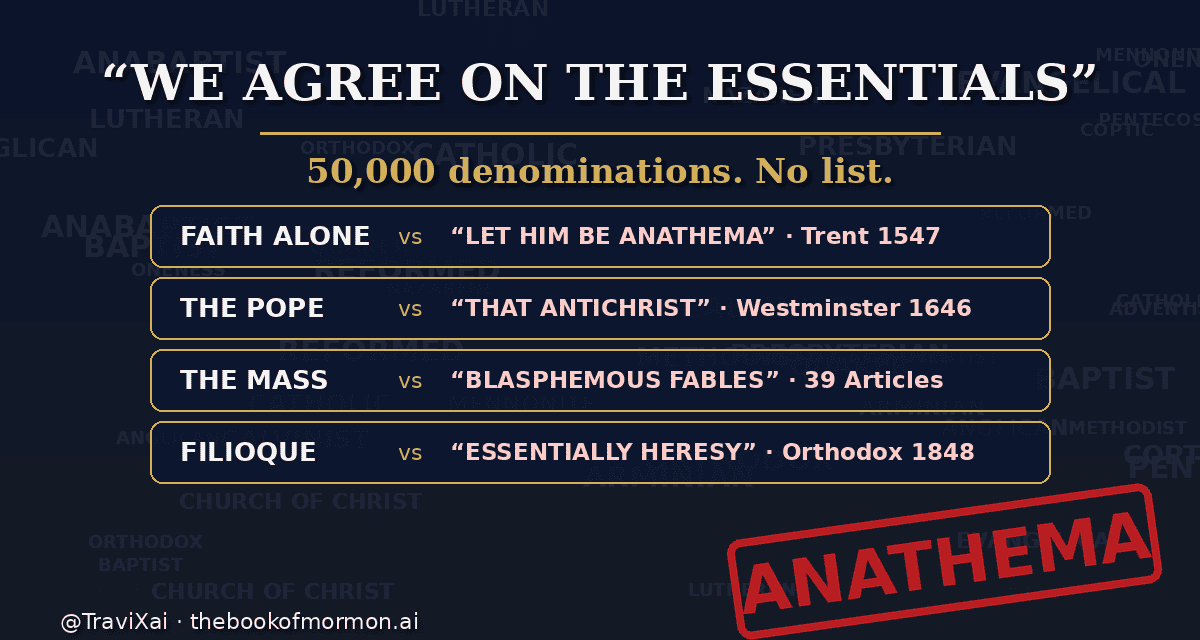

Every time a Latter-day Saint shows up, Christianity™ locks arms and says “we agree on the essentials.” Trent, Westminster, Dort, Zürich and 1054 say otherwise. Here’s every major dispute, in their own words, with sources.
Every time a Latter-day Saint shows up, the whole room suddenly gets along.
Catholics, Orthodox, Lutherans, Calvinists, Baptists, Pentecostals, Anglicans…. all of them lock arms and announce together: “Mormons aren’t Christian. WE agree on the essentials.”
Cool. Which essentials? Where’s the list? Who wrote it? Who signed it? And do ALL of you actually believe it?
Because the minute we leave the room, you’re back to anathematizing each other over the same Bible.
Let’s break it ALL down, with sources.
Key Takeaways
- Forget Rome for a second. The Protestants can’t agree with EACH OTHER, today. Calvinists vs Arminians (still debating on stage in 2024 and 2025). Lordship vs Free Grace. Cessationists vs charismatics (“It blasphemes the Holy Spirit,” MacArthur, 2013). The SBC threw out Saddleback over a woman pastor (2023). 7,600+ Methodist churches left (2019–2023). GAFCON Anglicans rejected Canterbury (October 16, 2025). A Reformed pastor accused two famous evangelicals of teaching “a different God” (2016).
- Head-to-head, in their own words: Trent anathematizes faith alone (1547). Westminster (1646) calls the Pope “that Antichrist.” The Church of England calls the Mass “blasphemous fables, and dangerous deceits.” Rome calls Anglican orders “absolutely null and utterly void” (1896). Protestant Zürich drowned Felix Manz (1527). Dort deposed about 200 Arminian ministers. Rome and Constantinople excommunicated each other (1054).
- They can’t agree on the Trinity itself. Cappadocian, Augustinian, Palamite, Calvin’s autotheos, William Lane Craig’s “parts,” social, eternal-subordination and Oneness versions all contradict each other. The Orthodox call the Western filioque “essentially heresy” (1848).
- They can’t agree who picked the Bible, or by what rule. Anonymous Gospels, disputed books, Sinaiticus with Barnabas and Hermas, a 22-book Peshitta, an 81-book Ethiopian canon, Luther’s “epistle of straw,” a 1546 vote at Trent, and Sproul’s “fallible collection of infallible books.”
- The Center for the Study of Global Christianity counts about 50,000 denominations/rites worldwide in 2025, up from 2,000 in 1900.
- The Council of Trent pronounced “let him be anathema” on faith alone, on once-saved-always-saved, and on anyone who denies Purgatory.
- The original Westminster Confession called the Pope “that Antichrist, that man of sin, and son of perdition.” Luther’s Smalcald Articles said the same.
- Christians™ disagree on the canon (66, 73, 81 books), the Trinity (filioque, eternal subordination, Oneness), Christ’s natures (Chalcedon), baptism, the Eucharist, predestination, heaven, hell, Purgatory and rewards, Mary, icons, church government, women’s ordination, sexuality, contraception, divorce, the end times, spiritual gifts, the Sabbath, creation and inerrancy.
- They can’t even agree what grace, faith, repentance or saved MEAN. Trent anathematizes the Protestant definition of grace (Session 6, Canon 11), and the Lordship Salvation fight is literally over whether you have to FOLLOW Jesus to be saved.
- There is no agreed list of “essentials.” Every list on offer excludes somebody who claims to be Christian.
Protestant vs Protestant: the fights happening RIGHT NOW
Here’s the thing. Catholics and Protestants fighting is old news. Everybody expects that. What they don’t want you to notice is that the Protestants can’t agree with EACH OTHER. Not in 1529. Today. On podcasts, at conventions, in church courts and on X. All while telling us they “agree on the essentials.”
So let’s do the Protestants first. Round by round, with dates.
Round 1: Did God pick who gets saved?
- Calvinists say: yes. God chose the elect unconditionally (Canons of Dort; Westminster Confession 3).
- Arminians say: that makes God a monster. John Wesley’s sermon “Free Grace” (1739) says the doctrine “represents the most holy God as worse than the devil, as both more false, more cruel, and more unjust.”
- Still live: Leighton Flowers (Soteriology 101) debated James White on whether John 6:44 teaches unconditional election on March 7, 2024. White and Jeremiah Nortier debated Joshua Farris and Dan Chapa on limited atonement on February 28, 2025. Inside the Southern Baptist Convention, the 2012 “Traditional Statement” was written to push back on the “New Calvinism.”
Round 2: Do you have to FOLLOW Jesus to be saved?
- Lordship salvation (John MacArthur, 1988): you “must trust Jesus Christ as Lord of his life, submitting to His sovereign authority.”
- Free Grace (Charles Ryrie, 1989): is repentance required? “No if it means to be sorry for sin or even resolve to turn from sin.”
- Two of the best-selling study Bibles in evangelicalism. Two different answers to “what must I do to be saved?”
Round 3: The sinner’s prayer
- The Southern Baptist Convention (2012): the sinner’s prayer is “a biblical expression of repentance and faith” (while saying it is not “an incantation”).
- David Platt, a Southern Baptist megachurch pastor (2012): “Should it not concern us that there is no such superstitious prayer in the New Testament?”
Round 4: Baptism, three ways
- Presbyterians and Reformed: baptize the infants of believers (Westminster Confession 28.4).
- Reformed Baptists: believers only (1689 London Baptist Confession 29.2). Same Calvinism, different baptism, different churches.
- Churches of Christ: immersion “for the remission of sins” (Acts 2:38) is required for salvation. Baptists: no it isn’t; baptism comes after salvation, as a testimony.
Round 5: The Lord’s Supper
- Lutherans: Christ’s true body and blood are present “in, with, and under” the bread and wine.
- Baptists: “a symbolic act of obedience” to “memorialize the death of the Redeemer” (Baptist Faith and Message 2000, Art. VII).
- This exact question is what split Luther and Zwingli at Marburg in 1529, when Luther refused Zwingli’s hand and told the Swiss, “You have a different spirit from ours.” Five centuries later, still split.
Round 6: Tongues and prophecy
- Pentecostals and charismatics (about 664 million worldwide, CSGC 2025): the gifts are for today.
- John MacArthur, Strange Fire conference (October 2013): the charismatic movement “offers to God unacceptable worship… It blasphemes the Holy Spirit. It attributes to the Holy Spirit even the work of Satan.”
Round 7: Women pastors
- February 2023: the SBC Executive Committee removed Rick Warren’s Saddleback Church from “friendly cooperation” over a woman teaching pastor. June 2023: messengers rejected Saddleback’s appeal, 88.46%.
- The Law Amendment to write “only men” into the SBC constitution passed its first vote in 2023 (80%), then got 61.45% in 2024 and 60.74% on June 11, 2025. Both short of two-thirds. The fight continues.
- John MacArthur on Beth Moore (October 2019): “Go home…. There is no case that can be made biblically for a woman preacher. Period. Paragraph. End of discussion.”
- Beth Moore (March 5, 2021): “I am still a Baptist, but I can no longer identify with Southern Baptists.”
Round 8: Sexuality, and the splits that followed
| Church | What happened |
|---|---|
| United Methodist | 7,600+ U.S. churches left between 2019 and 2023, about 26% of congregations. On May 1, 2024 the General Conference lifted the gay clergy ban, 692–51. |
| Presbyterian | PCUSA redefined marriage as “between two people, traditionally a man and a woman” (approved 2014, ratified March 17, 2015). The PCA, which split off in 1973, says it never will. |
| Anglican | On October 16, 2025, GAFCON declared: “We reject the so-called Instruments of Communion, namely the Archbishop of Canterbury…” and “we are now the Global Anglican Communion.” Two weeks earlier, Sarah Mullally had been named the first woman Archbishop of Canterbury. |
| North Point / Andy Stanley | The “Unconditional” conference (September 2024) featured speakers in same-sex marriages. Albert Mohler and the Colson Center blasted it. |
Round 9: Is it even the same God?
- 2016: Reformed pastor Liam Goligher said Wayne Grudem and Bruce Ware (eternal subordination of the Son) taught “a different God than that affirmed by the church through the ages.”
- Oneness Pentecostals reject the Trinity. When T.D. Jakes, who came out of a Oneness church, appeared at the Elephant Room in January 2012 and said “one God, three persons” (but still preferred “manifestations”), Reformed critics kept calling him a heretic, and James MacDonald left The Gospel Coalition over the fallout.
- “A different God.” That’s what they say about us. They say it about each other too.
Round 10: Which Bible? Which Testament?
- KJV-only: Peter Ruckman taught that the King James “corrects the errors in the Greek manuscripts.” James White debated a KJV-only opponent again on April 4, 2025.
- Andy Stanley (April 30, 2018): “Peter, James, Paul elected to unhitch the Christian faith from their Jewish scriptures, and my friends, we must as well.” Albert Mohler (August 10, 2018): “Andy Stanley Aims at Heresy.”
Round 11: Hell
- Rob Bell, Love Wins (2011) questioned eternal punishment. John Piper tweeted “Farewell Rob Bell” (February 26, 2011).
- Annihilationism vs eternal torment: John Stott leaned toward annihilation; J.I. Packer wrote against it. Piper: “I don’t like John Stott’s view of hell either.”
Round 12: Creation
- Ken Ham (Answers in Genesis): Hugh Ross’s old-earth creationism and BioLogos’s evolutionary creation “compromise God’s Word in Genesis.”
- BioLogos and Reasons to Believe: the earth is billions of years old. They disagree with each other too, on evolution.
Round 13: The end, and Israel
- September 23–24, 2025: after a South African man predicted the rapture, #RaptureTok believers quit jobs and sold cars. Nothing happened. Meanwhile amillennial and postmillennial Protestants say there’s no secret rapture at all.
- June 18, 2025: Senator Ted Cruz said, “Biblically, we’re commanded to support Israel.” Tucker Carlson shot back, “Define Israel.” Dispensationalists vs covenant theology, live on camera.
Round 14: Race, politics and lockdowns
- SBC Resolution 9 (2019) allowed critical race theory as an “analytical tool subordinate to Scripture.” MacArthur called it “a watershed moment” for liberalism, a year after his Dallas Statement on Social Justice and the Gospel (2018).
- Christian nationalism: Stephen Wolfe’s The Case for Christian Nationalism (2022) vs reviewers like Kevin DeYoung, who rejected the project.
- COVID: Grace Community Church kept meeting indoors; Los Angeles County and California paid $800,000 to settle the lawsuits (2021).
And when they couldn’t win the argument…
- January 5, 1527: Protestant Zürich drowned Felix Manz for adult baptism.
- October 27, 1553: Calvin’s Geneva burned Michael Servetus for denying the Trinity and infant baptism.
That’s just the Protestants. Now add Rome and the East.
Head-to-Head: Catholics, Orthodox and Protestants, in their own words
Now the classic matchups. Round by round, in their own words, with dates and sources. These aren’t footnote quibbles. These are Christians™ cursing, condemning, excommunicating and killing each other.
Round 1: Faith alone
- Lutherans and Reformed say: we are justified by faith ALONE. Methodist Article IX: “that we are justified by faith, only, is a most wholesome doctrine, and very full of comfort.”
- Rome says: “If any one saith, that by faith alone the impious is justified… let him be anathema.” (Council of Trent, Session 6, Canon 9, January 13, 1547)
Round 2: Who heads the Church?
- Rome says: the Pope. “We declare, we proclaim, we define that it is absolutely necessary for salvation that every human creature be subject to the Roman Pontiff.” (Boniface VIII, Unam Sanctam, 1302). Vatican I (Pastor Aeternus, 1870) adds an anathema for denying papal primacy.
- Westminster says: “Nor can the Pope of Rome, in any sense, be head thereof: but is, that Antichrist, that Man of sin, and Son of Perdition.” (Westminster Confession 25.6, original 1646 text). Luther’s Smalcald Articles (1537): the Pope is “the very Antichrist.”
Round 3: The Mass
- Catholics say: the Eucharist is “the source and summit of the Christian life.” (Catechism 1324, quoting Vatican II, Lumen Gentium 11)
- The Church of England says: the sacrifices of Masses “were blasphemous fables, and dangerous deceits.” (Thirty-Nine Articles, Article 31, 1571). The Heidelberg Catechism (Q80) calls the Mass “a condemnable idolatry.”
Round 4: Anglican priests
- Anglicans say: our bishops and priests stand in apostolic succession.
- Rome says: “ordinations carried out according to the Anglican rite have been, and are, absolutely null and utterly void.” (Leo XIII, Apostolicae Curae, 1896)
Round 5: Baptism, settled by drowning
- Anabaptists said: baptize believers, not babies.
- Protestant Zürich said: on March 7, 1526 the council made adult rebaptism punishable by drowning. On January 5, 1527, it drowned Felix Manz in the Limmat. The Lutheran Augsburg Confession (1530, Art. 9) formally “condemn[s] the Anabaptists.”
Round 6: Free will, settled by exile
- Arminians (the Remonstrants) said: grace can be resisted.
- The Synod of Dort (1618–19) said: heresy. About 200 Remonstrant ministers were deposed, and about 80 who refused to stop preaching were banished from the Dutch Republic.
Round 7: East vs West
- In 1054, Rome’s legate Cardinal Humbert laid a bull excommunicating Patriarch Michael Cerularius on the altar of Hagia Sophia. Constantinople anathematized the legates right back. Pope Paul VI and Patriarch Athenagoras “consigned to oblivion” those excommunications on December 7, 1965, and they still don’t share communion. Then, on October 15, 2018, Moscow broke communion with Constantinople.
Round 8: What GRACE even is
- Protestants say: grace is God’s unmerited favor.
- Rome says: “If any one saith… that the grace, whereby we are justified, is only the favour of God; let him be anathema.” (Trent, Session 6, Canon 11)
Round 9: Do you have to FOLLOW Jesus to be saved?
- John MacArthur says (The Gospel According to Jesus, 1988): a person “must trust Jesus Christ as Lord of his life, submitting to His sovereign authority.”
- Charles Ryrie says (So Great Salvation, 1989): “Is repentance a condition for receiving eternal life? Yes, if it is repentance or changing one’s mind about Jesus Christ. No if it means to be sorry for sin or even resolve to turn from sin.“
Round 10: The Holy Spirit
- Rome says: the Spirit proceeds from the Father and the Son (filioque). The Second Council of Lyon (1274) condemned anyone who denies it.
- The Orthodox Patriarchs say: “the said novel doctrine of the Holy Ghost proceeding from the Father and the Son is essentially heresy, and its maintainers, whoever they be, are heretics.” (Encyclical of the Eastern Patriarchs, 1848)
Round 11: Is God even a Trinity?
- Oneness Pentecostals say: no. One God, revealed as Father, Son and Spirit. Baptize in Jesus’ name only.
- The Assemblies of God said: in October 1916 it adopted a Trinitarian Statement of Fundamental Truths, and 156 ministers left or were removed (585 down to 429). Today the AG calls Oneness “the old heresy of modalism.”
Round 12: “A different God”
- Wayne Grudem and Bruce Ware say: the Son eternally submits to the Father.
- Reformed pastor Liam Goligher said (2016): that’s “a different God than that affirmed by the church through the ages,” and it “verge[s] on idolatry.”
Remember that phrase. “Different God.” They save it for us… until they use it on each other.
Round 13: Who wrote the Gospels?
- They say: apostolic authority.
- The texts say: none of the four Gospels names its author in the text. The names came from later church tradition. Even Origen said of Hebrews: “who wrote the epistle, in truth, God knows.”
Round 14: How many books?
- Protestants: 66. Catholics: 73. Ethiopian Orthodox: 81, including 1 Enoch and Jubilees.
Round 15: Who closed the canon?
- Protestants: no council ever. R.C. Sproul: the Bible is “a fallible collection of infallible books.”
- Rome: a council voted. On February 15, 1546, the bishops at Trent voted 24 to 15 (some counts say 16) to fix the canon as an article of faith without further debate. The decree, with an anathema, followed on April 8, 1546.
Final round
Fifty thousand denominations. So where’s the list of essentials? There isn’t one. The only essential they ALL agree on is that the Mormons are wrong.
“Every time Catholics, Orthodox and Protestants debate each other, all they do is prove there needed to be a restoration.” Prophets. Apostles. Revelation. That’s how God brings “the unity of the faith” (Ephesians 4:13).
Now the deep dive.
1. “Unity”? Let’s count.
The Center for the Study of Global Christianity at Gordon-Conwell (evangelical, not LDS) publishes the standard global numbers. Its Status of Global Christianity 2025 lists Denominations/Rites:
| Year | Denominations/Rites |
|---|---|
| 1900 | 2,000 |
| 1970 | 13,100 |
| 2000 | 31,000 |
| 2020 | 44,700 |
| 2025 | 50,000 |
| 2050 (projected) | 64,000 |
Yes, they count country by country. Fine. Divide it by a hundred and you still have hundreds of churches that will not share the same communion table. That’s not unity. That’s a food court.
And Jesus prayed that his followers “may all be one” (John 17:21). Not 50,000.
2. Who has authority? Everybody. So nobody.
- Catholics: Scripture + Sacred Tradition + the Magisterium, with the Pope at the top. Vatican I (Pastor Aeternus, 1870) defines papal primacy and attaches an anathema. And Boniface VIII in Unam Sanctam (1302): “we declare, we proclaim, we define that it is absolutely necessary for salvation that every human creature be subject to the Roman Pontiff.”
- Eastern Orthodox: Holy Tradition and the councils. No pope, thanks.
- Protestants: sola scriptura. Luther’s Smalcald Articles (1537) call the Pope “the very Antichrist.” The original 1646 Westminster Confession 25.6 says the Pope “is that Antichrist, that man of sin, and son of perdition, that exalteth himself, in the Church, against Christ, and all that is called God.” American Presbyterians later cut that line. Guess it wasn’t “essential” after all.
- And the Orthodox can’t even agree with each other. On October 15, 2018, the Russian Orthodox Church broke Eucharistic communion with the Ecumenical Patriarchate of Constantinople over Ukraine. Two “one true churches” inside the “one true church.”
Sola scriptura was supposed to settle it. Instead every reader became his own pope. Hence…. 50,000.
3. What’s even in the Bible? Depends who you ask.
| Tradition | Books |
|---|---|
| Protestant | 66 |
| Catholic | 73 (adds Tobit, Judith, 1–2 Maccabees, Wisdom, Sirach, Baruch, Greek additions) |
| Eastern Orthodox | Catholic list plus 1 Esdras, Prayer of Manasseh, Psalm 151, 3 Maccabees |
| Ethiopian Orthodox Tewahedo | 81, including 1 Enoch and Jubilees |
The Council of Trent (Session 4, 1546) pronounced an anathema on anyone who won’t accept the full Catholic list. The Westminster Confession (1.3) says those same books are “of no authority in the Church of God.”
So they can’t agree on the BOOK, but they all agree we “added to the Bible.” Mm hmm.
4. Who decided what’s scripture, and by what RULE?
Ask a Christian™ why these 27 books and not others, and you get one of four “rules.” The trouble is, they contradict each other, and not one of them is in the Bible.
The rules they cite
| Rule | The claim | The problem |
|---|---|---|
| Apostolicity | Written by an apostle, or by someone who walked with one | Mark and Luke weren’t apostles. Luke says he wasn’t an eyewitness: he compiled what eyewitnesses “delivered” (Luke 1:1–3). Hebrews has no known author. |
| Orthodoxy | Agrees with the “rule of faith” | Circular. The books define orthodoxy, and orthodoxy picks the books. |
| Catholicity | Widely used by the churches | Hermas, Barnabas and 1 Clement were widely used, and some disputed books weren’t. |
| Self-attestation | The Spirit testifies (Calvin; Westminster 1.5’s “inward work of the Holy Spirit”) | Then why did Luther’s Spirit and Trent’s Spirit disagree on the same books? |
Does it have to be written by an apostle or eyewitness?
- The four Gospels are anonymous. None names its author in the text. The names “according to Matthew, Mark, Luke, John” come from later church tradition (Papias in the early 2nd century on Mark and Matthew, Irenaeus around 180 on all four).
- Hebrews has never had an agreed author. Origen (3rd century), as quoted by Eusebius: “But who wrote the epistle, in truth, God knows.”
- Mark is traditionally Peter’s interpreter, and Luke was Paul’s companion. Neither walked with Jesus as an apostle. So “written by someone who walked with Jesus” is not actually the rule. “Close enough to an apostle, according to later tradition” is.
The early Church couldn’t agree either
- Eusebius (Church History 3.25, early 300s) sorted books into “acknowledged,” “disputed” (James, Jude, 2 Peter, 2 and 3 John) and “spurious” (Shepherd of Hermas, Barnabas, the Didache), and listed Revelation in BOTH the acknowledged and spurious columns depending on who you asked.
- The Muratorian Fragment (traditionally late 2nd century, though some scholars argue 4th) leaves out Hebrews, James and 1–2 Peter, but includes the Wisdom of Solomon and the Apocalypse of Peter.
- Codex Sinaiticus (mid-4th century, one of the oldest complete Bibles on earth) includes the Epistle of Barnabas and the Shepherd of Hermas in its New Testament. Codex Alexandrinus includes 1 and 2 Clement.
- Athanasius, in his 39th Festal Letter (367), gives the first surviving list of exactly our 27 NT books. But his Old Testament list drops Esther and includes Baruch and the Letter of Jeremiah.
- The Syriac Peshitta, still the Bible of the Church of the East, has 22 NT books. It leaves out 2 Peter, 2 John, 3 John, Jude and Revelation.
- The Ethiopian Orthodox Tewahedo Church counts 81 books, including 1 Enoch and Jubilees.
- The Council in Trullo (692), accepted in the East as carrying ecumenical authority, ratified the 85 “Apostolic Canons.” The last of those canons lists the two Epistles of Clement as scripture. Trullo also ratified Carthage (which includes Tobit, Judith and Maccabees) and Athanasius (which drops Esther). These lists don’t match each other.
Luther: four books to the back of the bus
In his 1522 New Testament, Martin Luther numbered 23 “chief books” and pushed Hebrews, James, Jude and Revelation to the end, unnumbered. – James: “St. James’ epistle is really an epistle of straw, compared to these others, for it has nothing of the nature of the gospel about it.” Luther wrote that he did not regard it “as the writing of an apostle.” – Revelation: “I miss more than one thing in this book, and it makes me consider it to be neither apostolic nor prophetic…. My spirit cannot accommodate itself to this book.“
(He softened later. The “straw” paragraph was dropped from later editions, and in 1530 he wrote a warmer preface to Revelation. But the man who launched sola scriptura personally ranked the books by how much “gospel” he felt they had.)
Trent: the canon by vote
On February 15, 1546, the bishops at Trent voted 24 to 15 (some counts say 16) to adopt the canon as an article of faith without further debate. On April 8, 1546, the decree came with an anathema: “if any one receive not, as sacred and canonical, these same books entire with all their parts… let him be anathema.” That was 1,500 years after Christ.
The Protestant answer: “fallible collection”
R.C. Sproul, crediting his teacher John Gerstner: “Roman Catholics view the canon as an infallible collection of infallible books. Protestants view it as a fallible collection of infallible books…. Protestants believe the church acted rightly and accurately in this process, but not infallibly.” (Grace Unknown). And Westminster (ch. 31) says “all synods or councils since the apostles’ times… may err.”
So by their own confession, the list of books was chosen by councils that “may err.”
The double standard
Now watch how they treat Joseph Smith.
- They accept anonymous Gospels whose authors’ names came from tradition. Joseph Smith put his name on his work, and eleven named witnesses signed their testimony to the plates.
- They accept a canon that was disputed for centuries, listed differently by Eusebius, Athanasius, the Peshitta, Sinaiticus, Trullo, Ethiopia and Trent, and closed by councils they themselves say “may err.” Then they say Joseph “added to the Bible.”
- Luther could call James “straw,” say his spirit couldn’t accommodate Revelation, and demote four books, and he’s a Reformation hero. Joseph Smith brings more testimony of Christ, and he’s a false prophet.
- They demand that LDS scripture meet an apostolic, eyewitness standard their own Bible doesn’t meet (Mark, Luke, Hebrews).
- And the verse they quote against us, “if any man shall add unto these things” (Revelation 22:18), is about “the words of the prophecy of this book.” Moses said the same thing in Deuteronomy 4:2, and God kept giving scripture for 1,500 years after that.
There’s no verse that closes the canon. There’s no verse that lists the books. There’s no apostle who picked them. Councils of non-prophets voted, argued and disagreed. That’s the “rule.”
Then they ask US where our authority comes from.
5. How are you saved? THE question. No agreement.
This is supposed to be the gospel itself. Watch.
- Protestants: justification by faith ALONE.
- Catholics: the Council of Trent, Session 6 (1547), in its own words:
- Canon 9: “If any one saith, that by faith alone the impious is justified… let him be anathema.”
- Canon 12: if anyone says justifying faith is “confidence alone”….. anathema.
- Canon 24: if anyone says good works are “merely the fruits and signs of Justification” and not a cause of its increase…. anathema.
- Canon 32: the justified “truly merit increase of grace, eternal life… and also an increase of glory.” Deny it? Anathema.
- Orthodox: reject the whole forensic framework and talk about theosis.
In 1999 the Lutheran World Federation and the Vatican signed a Joint Declaration saying the old condemnations “no longer apply.” The Lutheran Church–Missouri Synod refused, calling it “an ambiguous statement whose careful wording makes it possible for the pope’s representatives to sign it without changing, retracting or correcting anything that has been taught by the Roman Catholic Church since the time of the Council of Trent.” The LCMS said more than 45 percent of the world’s Lutheran church bodies didn’t support it.
Then evangelicals fight among themselves: Lordship salvation (John MacArthur) vs Free Grace (Zane Hodges). Same Bible. Same verses. Different gospels.
6. Can you lose it?
- Calvinists/Baptists: once saved, always saved (perseverance of the saints).
- Methodists/Arminians/Lutherans: yes, you can fall away.
- Catholics: Trent, Canon 23: if anyone says a justified man “can sin no more, nor lose grace”…. anathema.
One group’s assurance is another group’s anathema.
7. They can’t even agree what the WORDS mean
Forget the big doctrines for a minute. They can’t define the basic vocabulary of the gospel. Every one of them says “saved by grace through faith.” Ask what “grace” means. Ask what “faith” means. Ask what “repent” means. Then watch them turn on each other.
GRACE: five definitions, one anathema
| Who | What “grace” means |
|---|---|
| Catholic | An infused quality. “The grace of Christ is the gratuitous gift that God makes to us of his own life, infused by the Holy Spirit into our soul” (Catechism 1999), “an habitual gift, a stable and supernatural disposition” (CCC 2000). |
| Reformed / Lutheran | God’s unmerited favor. A legal (forensic) verdict: Christ’s righteousness is imputed (credited) to you, not infused into you. |
| Eastern Orthodox | God’s uncreated energies: God himself, really participated in (theosis), following Gregory Palamas. Not a created “quality” at all. |
| Arminian / Wesleyan | Prevenient grace given to everyone, enabling a free response that can be resisted. Methodist Article VIII: “the grace of God by Christ preventing [going before] us, that we may have a good will.” |
| Calvinist | Irresistible grace given only to the elect. Regeneration isn’t something you can refuse (Canons of Dort, Heads III/IV). |
And here’s the kicker. The Council of Trent, Session 6, Canon 11: “If any one saith… that the grace, whereby we are justified, is only the favour of God; let him be anathema.”
The Protestant DEFINITION of grace is cursed by Rome. Not the application. The definition.
FAITH: assent, trust, love, or allegiance?
- Trust (fiducia): the Reformation view. Heidelberg Q21 says true faith is “not only a sure knowledge… it is also a wholehearted trust.”
- Rome curses that: Trent Canon 12: if anyone says “justifying faith is nothing else but confidence in the divine mercy… let him be anathema.” For Catholics, the faith that justifies is faith “formed by charity” (love).
- Is faith a gift only the elect get? Westminster 14.1: “The grace of faith, whereby the elect are enabled to believe… is the work of the Spirit of Christ.” Arminians say God enables everyone and you choose. Zane Hodges, in John MacArthur’s summary of Absolutely Free, held that faith is “a human act, not a gift from God.”
- Does faith include obedience? New Testament scholar Matthew Bates, in Salvation by Allegiance Alone (Baker Academic, 2017), argues that saving pistis is allegiance to Jesus as King: “mental affirmation that the gospel is true, professed fealty to Jesus alone as the cosmic Lord, and enacted loyalty through obedience to Jesus as the king.” He says, “We must stop asking others to invite Jesus into their hearts and start asking them to swear allegiance to Jesus the king.” The Free Grace camp says adding commitment corrupts the gospel.
Same word. Four definitions. And they say WE use Christian words with different meanings.
REPENTANCE: change your mind, or change your life?
This is the Lordship Salvation controversy, and it’s literally a fight over whether you have to FOLLOW Jesus to be saved by Him.
- John MacArthur, The Gospel According to Jesus (1988): to be saved a person “must trust Jesus Christ as Lord of his life, submitting to His sovereign authority.”
- Charles Ryrie, So Great Salvation (1989): “Is repentance a condition for receiving eternal life? Yes, if it is repentance or changing one’s mind about Jesus Christ. No if it means to be sorry for sin or even resolve to turn from sin.“
- Zane Hodges, Absolutely Free (1989): in MacArthur’s summary, Hodges taught that anyone who adds “any suggestion of commitment” has departed from the New Testament idea of salvation. In Hodges’ system, true faith can even collapse into unbelief.
- MacArthur’s camp calls the other side “easy believism.” The other side calls MacArthur’s view a works gospel.
Two of the most famous evangelical names of the twentieth century (Ryrie of the Ryrie Study Bible, MacArthur of the MacArthur Study Bible) can’t agree whether “repent” means turning from sin.
KEEPING THE COMMANDMENTS: required, evidence, or “works righteousness”?
- Catholic: required. Trent Canon 20: if anyone says the justified man “is not bound to observe the commandments of God and of the Church, but only to believe… let him be anathema.” Canon 19 curses anyone who says “the ten commandments nowise appertain to Christians.”
- Reformed/Methodist: good works are the fruit and evidence of faith, never its cause. Methodist Article X: good works “follow after justification” and show a “lively faith… as evidently known as a tree is discerned by its fruit.”
- Free Grace: obedience isn’t a condition at all. Ryrie (per MacArthur’s summary) allows a category of lifelong “carnal Christians.”
- “Antinomian!” Luther fought his own colleague Johann Agricola over whether the law should even be preached to Christians (Luther’s Against the Antinomians, 1539). Scotland’s Marrow Controversy (1718–23) was the same fight two centuries later. Today the Lordship side throws the same charge at Free Grace.
- And WHICH commandments? Westminster 19 splits the law into moral (binding), ceremonial (abrogated) and judicial (expired). So is the fourth commandment, the Sabbath, moral or ceremonial?
- Westminster 21.7 says it’s moral and moved to Sunday (“the Christian Sabbath”).
- The Catholic Catechism says Sunday “fulfills” the Sabbath (CCC 2175).
- Seventh-day Adventists say it’s still Saturday.
- Many dispensational and “New Covenant” evangelicals say no Sabbath command binds Christians at all.
TEN Commandments, and they can’t agree whether the FOURTH one still counts.
“SAVED”: past, present or future?
- Past: “by grace are ye saved” (Ephesians 2:8). Free Grace: in MacArthur’s summary of Ryrie, those who once believed stay secure forever even if they later turn away.
- Present: “unto us which are saved” / “are being saved” (1 Corinthians 1:18).
- Future: “he that shall endure unto the end, the same shall be saved” (Matthew 24:13).
- Rome, Trent Canon 16: if anyone claims “absolute and infallible certainty” of persevering to the end (without special revelation), anathema.
Ask ten Christians™ “are you saved?” and you’ll get “yes, forever,” “yes, if I persevere,” “I hope so,” and “that’s a Protestant question.”
So what’s the STANDARD? Pick your verse.
Here’s the question every Christian™ claims to answer: what does it take to be a Christian, or to be saved? Watch each tradition grab a different verse.
| Standard | Their verse | Who leans on it |
|---|---|---|
| Say the sinner’s prayer | “whosoever shall call upon the name of the Lord shall be saved” (Romans 10:13) / “confess with thy mouth… believe in thine heart” (Romans 10:9) | Revivalist evangelicals. The SBC affirmed the sinner’s prayer by resolution in 2012. |
| Believe, not works | “by grace are ye saved through faith… not of works” (Ephesians 2:8–9) | Reformed, Lutheran, Baptist, Free Grace |
| Faith AND works | “by works a man is justified, and not by faith only” (James 2:24) | Catholic, Orthodox |
| Be baptized | “Repent, and be baptized every one of you… for the remission of sins” (Acts 2:38) | Catholic (“Baptism is necessary for salvation,” CCC 1257), Orthodox, Lutheran, Churches of Christ. Oneness Pentecostals: only “in the name of Jesus.” Baptists say it’s a symbol. |
| Do the Father’s will | “Not every one that saith unto me, Lord, Lord… but he that doeth the will of my Father” (Matthew 7:21) | Lordship salvation, Bates’ “allegiance” |
| Keep the commandments | “If ye love me, keep my commandments” (John 14:15) | Catholic (Trent Can. 20), Wesleyan holiness |
| Endure to the end | “he that shall endure unto the end, the same shall be saved” (Matthew 24:13) | Arminian, Catholic, Orthodox |
The SBC’s own 2012 sinner’s prayer fight shows it. Megachurch pastor David Platt said, “there is no such superstitious prayer in the New Testament,” and warned that leading people to think they’re saved when they aren’t is “just damning.” The convention then passed a resolution calling the sinner’s prayer “a biblical expression of repentance and faith.” (Platt later clarified he isn’t against praying a prayer, and voted for it.)
Same Bible. Seven verses. Seven different “standards.” Each camp quotes its verse and explains away the others.
Latter-day Saints? We take ALL of them, and we don’t have to explain any away: faith in Christ, repentance, baptism, the gift of the Holy Ghost, keeping His commandments, and enduring to the end. Grace through Christ the whole way. Every one of those verses, read plainly.
8. Predestination: who chose whom?
Calvinism (TULIP), Arminianism, Lutheran single predestination, Molinism, Open Theism. Pick one.
When the Dutch Reformed settled it at the Synod of Dort (1618–19), about 200 Remonstrant (Arminian) ministers were deposed and roughly 80 banished from the country. In 2003 the Evangelical Theological Society voted on expelling open theist John Sanders. 62.7% voted to kick him out. It needed two-thirds, so he stayed.
9. The Trinity: one “essential,” a dozen versions, and everybody is a heretic to somebody
This is supposed to be THE first-order doctrine, the one that keeps Latter-day Saints out of the club. So you’d think they would at least agree on what it IS. Let’s see.
The baseline everyone claims
Nicaea (325) said the Son is homoousios, “of one substance,” with the Father. Constantinople (381) expanded the creed and affirmed the Spirit. Every group below claims this creed. Then they explain it in ways that contradict each other.
1. The Cappadocian (Eastern) model: start with three
Basil of Caesarea, Gregory of Nyssa and Gregory of Nazianzus taught one ousia (essence) in three hypostases (persons). For them the Father is the source and cause (the “monarchy”) of the Son and the Spirit. The model leaned so close to three that Gregory of Nyssa had to write a whole treatise, On “Not Three Gods” (To Ablabius), answering the obvious objection: if Peter, James and John are three men sharing one human nature, why aren’t the Father, Son and Spirit three Gods?
Remember that one. Travi’s line: “2 humans are persons that share a nature but are separate beings… just like the Godhead.” The Cappadocians had to work hard NOT to land where the Bible reader lands.
2. The Augustinian (Western) model: start with one
Augustine’s De Trinitate starts from the one divine essence and explains the persons through analogies of the mind (memory, understanding, will). The Spirit is the bond of love between Father and Son. That’s the root of the filioque. Thomas Aquinas sharpened it: the persons are “subsistent relations,” and by divine simplicity God has no parts or distinctions in his essence at all. The Fourth Lateran Council (1215) condemned Joachim of Fiore’s Trinity and declared that the divine essence “neither begets nor is begotten.”
3. Filioque: one side condemns, the other calls it heresy
- Rome: the Second Council of Lyon (1274) “condemn[ed] and reprove[d]” anyone who denies that the Spirit proceeds “eternally from the Father and the Son.” The Council of Florence (1439) defined it again.
- Orthodoxy: the Encyclical of the Eastern Patriarchs (1848) calls it “essentially heresy, and its maintainers, whoever they be, are heretics,” and says all “spiritual communion in worship” with them “is unlawful.”
The filioque was at the center of the 1054 break. On July 16, 1054, Cardinal Humbert laid a bull excommunicating Patriarch Michael Cerularius on the altar of Hagia Sophia, and the Patriarch’s synod anathematized the legates in return. In 1965 Pope Paul VI and Patriarch Athenagoras “consigned to oblivion” those excommunications, but full communion was never restored.
Same creed. Two versions. Each side’s version is heresy to the other.
4. Palamas: essence vs energies
In the 1300s Gregory Palamas taught a real distinction between God’s unknowable essence and his uncreated energies, which saints really participate in. The Constantinople councils of 1341–1351 made it Orthodox doctrine, and Palamas is a canonized saint in the East. His opponent, Barlaam of Calabria, and generations of Western scholastics after him, argued that a real distinction in God wrecks divine simplicity. The East’s saint is the West’s problem.
5. Calvin: the Son is God “of himself”
John Calvin taught that the Son, as God, is autotheos, God “of himself,” not receiving his deity from the Father. In 1537 Pierre Caroli accused Calvin, Farel and Viret of Arianism, demanded Calvin sign the Athanasian Creed on the spot, and Calvin refused. When Calvin’s view of the Son’s aseity came out, Caroli switched the charge to Sabellianism. Calvin even called the Nicene Creed’s “God of God, light of light, true God of true God” repetitive: “it is a song, more to be sung, than a suitable rule of faith.” So the father of Reformed theology was accused of BOTH opposite heresies, refused to sign a creed on demand, and called the Nicene wording a song.
6. William Lane Craig: God has “parts”
Evangelicalism’s most famous living philosopher-apologist, William Lane Craig, defends “Trinity monotheism”: “the Trinity alone is God… the Father, Son, and Holy Spirit, while divine, are not Gods.” He models God as one soul with three complete sets of rational faculties, and the persons are divine by being “parts” of God. He illustrated it with Cerberus, the three-headed dog of Greek myth (he later said the analogy “ultimately falls short”). An Oxford University Press study notes that Craig “rejects the traditional and creedal doctrine of the ‘procession’ of the Son and the Spirit.” Classical theists answer that God, by simplicity, has no parts at all.
7. Social vs Latin trinitarianism
Social trinitarians (Jürgen Moltmann, Cornelius Plantinga) picture three persons in loving community. Latin trinitarians (Brian Leftow) stress one God. Each side warns the other is sliding into tritheism or modalism.
8. Eternal subordination: “a different God”
In 2016 Liam Goligher said Wayne Grudem and Bruce Ware taught “a different God than that affirmed by the church through the ages,” a view that “verge[s] on idolatry.” Carl Trueman backed him. Grudem and Ware said they were perfectly Nicene. Reformation21 noted that both men had earlier questioned the doctrine of eternal generation, which much of their own camp considers essential.
9. Oneness: no Trinity at all
Oneness Pentecostals (United Pentecostal Church International) teach one God revealed as Father, Son and Spirit, and baptize “in the name of Jesus.” In October 1916 the Assemblies of God adopted a Trinitarian Statement of Fundamental Truths, and 156 ministers left or were removed. The AG calls Oneness “the old heresy of modalism.” Oneness believers call the Trinity a departure from biblical monotheism.
10. And the pews?
Ligonier’s State of Theology 2022: 43% of U.S. evangelicals agree “Jesus was a great teacher, but he was not God.”
So which Trinity is the “essential”?
The Cappadocian one, the Augustinian one, Palamas’ or Aquinas’, Calvin’s autotheos, Craig’s three-faculty soul, Grudem’s or Goligher’s? The filioque version or the one without? They can’t all be orthodox. By each other’s standards, most of them aren’t.
And yet the one thing they all agree on is that Latter-day Saints, who read the Father, Son and Holy Ghost exactly as the New Testament presents them (three persons, one God in purpose, power and glory), are the ones “outside” the Trinity. As Travi put it: “No prophet or apostle has ever taught the Trinity. Not a single one had it revealed to them even though they spoke with God. Yet we are supposed to believe that councils of non-prophets and non-apostles who never spoke with God somehow revealed it to the world? Yeah, mmm hmm.”
10. Who is Christ? The councils split here too.
The Council of Chalcedon (451) defined Christ “in two natures.” The Oriental Orthodox (Coptic, Ethiopian, Armenian, Syriac, Eritrean, Malankara), tens of millions of believers in some of the oldest churches on earth, reject Chalcedon to this day.
Al Mohler’s “theological triage” puts Nicene-Chalcedonian Christology at first-order: “Any denial… is, by definition, condemned as a heresy.” So by one evangelical leader’s list, the Coptic Church is out.
11. Sacraments: how many, and what do they do?
- Number: Catholics, 7, and Trent anathematizes anyone who says more or fewer. Orthodox, commonly 7 “mysteries,” never dogmatically fixed. Lutherans, 2 (sometimes 3). Reformed/Anglicans, 2. Baptists say they’re “ordinances,” not sacraments at all. Quakers and the Salvation Army have none.
- The Lord’s Supper:
- Catholic: transubstantiation. The Eucharist is “the source and summit of the Christian life” (Catechism 1324, quoting Lumen Gentium 11).
- Orthodox: a real change, without the scholastic definition.
- Lutheran: Christ’s body “in, with, and under” the bread.
- Reformed: spiritual presence.
- Most Baptists/evangelicals: a memorial.
At the Marburg Colloquy (1529) Luther and Zwingli agreed on 14 of 15 articles, then split over THIS. Luther chalked “Hoc est corpus meum” (“This is my body”) on the table and wouldn’t budge.
The Church of England’s Thirty-Nine Articles call transubstantiation “repugnant to the plain words of Scripture” and the sacrifices of Masses “blasphemous fables, and dangerous deceits.” The Heidelberg Catechism (Q80) calls the Mass “a condemnable idolatry.” – Baptism: – Infants (Catholic, Orthodox, Lutheran, Reformed, Anglican, Methodist) or believers only (Baptist, Anabaptist, Pentecostal, most nondenominational churches)? – Dunk three times (Orthodox), dunk once (Baptist), or sprinkle (Reformed)? – Does it save (Catholic, Orthodox, Lutheran, Churches of Christ) or is it a symbol (Baptist)? – The Augsburg Confession (Art. 9) condemns the Anabaptists for rejecting infant baptism. In 1527, Protestant Zürich drowned Anabaptist Felix Manz for rebaptizing, under a 1526 edict. Christians™ executing Christians™ over the “non-essential” of baptism.
12. Heaven, hell, Purgatory and rewards
- Purgatory: Catholic dogma (Florence, Trent; Trent’s Session 6 Canon 30 anathematizes anyone who denies it). The Orthodox reject the Latin doctrine. The Anglican Articles call it “a fond thing vainly invented.”
- Hell: eternal conscious torment (traditional), annihilationism (John Stott leaned that way), or universal salvation (David Bentley Hart’s That All Shall Be Saved, 2019).
- Rewards and degrees in heaven: Catholic dogma says glory differs by merit (Florence: “one person more perfectly than another according to the difference of their merits”). Many Protestants agree there are degrees of reward. Others, like Craig Blomberg in the Journal of the Evangelical Theological Society (1992), argue there aren’t.
So when they mock us for degrees of glory….. their own Catholic dogma has it, and half of their Protestants preach it.
13. Mary, saints and icons
- Immaculate Conception (1854) and Assumption (1950) are binding Catholic dogma. The Orthodox reject the Immaculate Conception as defined. Protestants reject both.
- Perpetual virginity: Luther, Calvin and Wesley believed it. Most modern evangelicals don’t.
- Icons: the Second Council of Nicaea (787) commands their veneration and anathematizes anyone who rejects it. The Reformed catechisms forbid images of God.
- Praying to saints: Catholics and Orthodox, yes. The Anglican Articles: “repugnant to the Word of God.”
14. Who’s in charge, and who can be ordained?
- Church government: bishops (episcopal), elders (presbyterian), or the congregation votes (congregational)?
- Apostolic succession: Leo XIII declared Anglican ordinations “absolutely null and utterly void” (Apostolicae Curae, 1896).
- Women:
- Catholics: the Church has “no authority whatsoever” to ordain women (Ordinatio Sacerdotalis, 1994). The Orthodox ordain none.
- The Church of England ordains women priests (1994) and bishops (2014), and now has a woman Archbishop of Canterbury (Sarah Mullally, 2025).
- The Southern Baptist Convention expelled Saddleback, its largest church, in 2023 over a woman pastor. In 2025 a constitutional ban got 60.74% of the vote and still failed the two-thirds needed.
15. Morals: splitting in real time
- United Methodists: 7,660 U.S. congregations, about a quarter of them, left between 2019 and 2023 over sexuality. In 2024 the UMC repealed its bans on gay clergy and same-sex weddings. The Global Methodist Church formed to take the leavers.
- Anglicans: in October 2025, GAFCON rejected the Archbishop of Canterbury as a focus of unity and announced a “Global Anglican Communion.”
- Contraception: the Anglicans’ 1930 Lambeth Conference was the first church body to allow it (193–67). The Catholic Church forbids it (Humanae Vitae, 1968). In 1968 Lambeth formally told the Pope it was “unable to agree.”
- Divorce: Catholics allow no divorce, only annulments. The Orthodox allow up to three marriages. Protestants allow anything from “never” to “whatever.”
16. And everything else
- End times: pre-, post- or amillennial? Is there a rapture (the dispensationalism J. N. Darby taught in the 1800s) or not?
- Spiritual gifts: cessationists (Warfield; MacArthur’s “Strange Fire” conference, 2013) say tongues and prophecy ended. About 664 million Pentecostals and Charismatics say they didn’t.
- Sabbath: Sunday, or Saturday (Seventh-day Adventists, Seventh Day Baptists)?
- Creation: young earth (Answers in Genesis), old earth, or evolution (BioLogos). Catholic Humani Generis (1950) allows evolution of the body.
- The Bible: strict inerrancy (Chicago Statement, 1978) or not? KJV-only or not?
- Music: the Churches of Christ ban instruments in worship.
17. The sweep: every other fight we could find
Still think they agree on the “essentials”? Here’s what’s left. Every line is a live disagreement between churches that each call themselves orthodox.
Sin and the soul
- Original sin or ancestral sin? Catholics and Protestants teach that Adam’s sin passes on real guilt (Augustine; Trent Session 5; Reformed “total depravity” and imputed guilt). Orthodox theology commonly speaks of ancestral sin: we inherit mortality and corruption, not Adam’s personal guilt.
- Where do souls come from? Catholic teaching binds believers to hold that “souls are immediately created by God” (Pius XII, Humani Generis 36, 1950), which is creationism. Tertullian and many Lutherans held traducianism, the view that the soul is passed down from the parents.
- Unbaptized babies? Augustine taught they are condemned, though to the mildest punishment. Medieval theologians proposed Limbo. In 2007 the Vatican’s International Theological Commission called Limbo a “possible theological opinion” and expressed hope for such infants’ salvation. Baptists say infants who die are saved without baptism.
The cross itself
- What did the atonement DO? Pick one: ransom (early fathers), satisfaction (Anselm, Cur Deus Homo, 1098), moral influence (Abelard), penal substitution (the Reformers), governmental (Hugo Grotius, 1617), or Christus Victor (Gustaf Aulén, 1931).
- In 2003, British evangelical leader Steve Chalke (The Lost Message of Jesus) said “the cross isn’t a form of cosmic child abuse—a vengeful Father, punishing his Son for an offence he has not even committed.” The Evangelical Alliance held a public debate in 2004 and then declared its Basis of Faith affirms penal substitution. Evangelicals can’t agree what the cross accomplished.
- Did Christ descend into hell? The Apostles’ Creed says he did. Calvin read it as Christ’s spiritual agony on the cross (Institutes 2.16.10). The Orthodox picture a literal “harrowing of Hades.” Wayne Grudem published “He Did Not Descend into Hell: A Plea for Following Scripture Instead of the Apostles’ Creed” (JETS, 1991) and says he skips the line. A year later, Lutheran David Scaer answered in the same journal: “He Did Descend to Hell.” That’s a fight over the CREED they say unites them.
Authority, again
- Papal infallibility: defined at Vatican I (1870). Catholics who refused it broke away as the Old Catholic Church, and the historian Ignaz von Döllinger was excommunicated in 1871.
- How many ecumenical councils? Catholics count 21 (Vatican II was the 21st). Eastern Orthodox count 7. Oriental Orthodox accept 3. The Church of the East accepts 2. Anglican Article 21: general councils “may err, and sometimes have erred.” So even “the councils” isn’t a shared authority.
- Church and state: the original Westminster Confession (23.3) gave the civil magistrate power to call synods and see “that all blasphemies and heresies be suppressed.” American Presbyterians rewrote it in 1788. Baptists like Thomas Helwys (1612) and Roger Williams pioneered religious liberty. The Church of England is still established by law today.
- War: the Anabaptist Schleitheim Confession (1527, Art. 6) says “the sword is ordained of God outside the perfection of Christ,” so Christians shouldn’t wield it. Augsburg Article 16 affirms that Christians may “engage in just wars, to serve as soldiers,” and states: “They condemn the Anabaptists who forbid these civil offices to Christians.” Mennonites and Quakers are pacifist. Most others hold just war.
Worship
- Regulative vs normative principle: Westminster 21.1 says God may be worshipped only as “instituted by himself.” Some Reformed churches therefore sing only Psalms, a cappella. The Churches of Christ ban instruments. Lutherans and Anglicans allow whatever Scripture doesn’t forbid. In 1647 the Puritan Parliament banned Christmas.
- Leavened or unleavened bread? The East uses leavened bread and the West unleavened wafers. It was a live issue in 1054, and the 1848 Eastern encyclical still lists “the use of wafers, unleavened instead of real bread” among Rome’s “novelties.”
- The cup for the laity? The same encyclical condemns the “denial of the divine Cup to the Laity.”
- Babies at the altar? The Orthodox give communion to infants. Catholics generally wait until about age 7. Most Protestants wait longer or require profession of faith.
- Wine or juice? Most churches use wine. Many Methodists and Baptists use grape juice. Welch’s grape juice was developed in 1869 by Thomas Welch, a Methodist, for exactly that purpose.
- Easter: East and West usually celebrate on different dates, because the Orthodox still use the Julian calendar for Easter.
The end, and the Church
- Dispensationalism vs covenant theology: Darby and the Scofield Reference Bible (1909) split Israel and the Church into two peoples of God and popularized a pre-tribulation rapture. Covenant theology (Westminster ch. 7) says there’s one people of God. Two incompatible ways of reading the whole Bible.
- Soul sleep: Seventh-day Adventists teach the dead are unconscious until the resurrection. Calvin wrote a whole book against that idea (Psychopannychia, drafted 1534, published 1542). Catholics teach an immediate particular judgment.
- Clergy marriage: Latin-rite Catholic priests must be celibate. Orthodox priests may marry, but bishops may not. Protestants marry (Luther married Katharina von Bora in 1525).
- Tongues: the Assemblies of God teaches speaking in tongues is the “initial physical sign” of Spirit baptism. Other charismatics say it isn’t required, and cessationists say tongues ceased.
Morals, again
- The death penalty: in 2018 Pope Francis revised the Catholic Catechism (2267) to call it “inadmissible.” Many evangelicals support it.
Becoming like God
- The Catholic Catechism (460) quotes Athanasius: “For the Son of God became man so that we might become God.” The Orthodox build their whole theology of salvation on theosis. Many evangelicals call the same idea blasphemy when Latter-day Saints say it.
That’s not “minor differences.” That’s original sin, the soul, the atonement, the creed, councils, the papacy, war, worship, the sacraments, the end times, the afterlife and salvation itself.
18. So what ARE the essentials?
Here’s every candidate I could find. Watch them knock each other out.
| “The list” | The problem |
|---|---|
| Apostles’ Creed | A Western creed. The Orthodox never adopted it. It says nothing about justification, the canon, sacraments, or the Bible’s authority. |
| Nicene Creed | The East and West recite different versions (filioque). “No creed but Christ” Protestants don’t bind themselves to it at all. |
| Chalcedon (451) | Rejected by the entire Oriental Orthodox world. |
| Athanasian Creed | Says that whoever doesn’t keep this faith “shall perish everlastingly.” The Orthodox don’t use it. Most evangelicals have never read it. |
| Vincentian Canon (c. 434): “what has been believed everywhere, always, by all” | By that test, sola scriptura, the Immaculate Conception and the rapture all fail. |
| “In essentials unity, in non-essentials liberty, in all things charity” | Not Augustine. A Lutheran, Peter Meiderlin (“Rupertus Meldenius”), wrote it in the 1620s. It never lists the essentials. |
| Evangelical Alliance (1846) | Requires justification by faith alone and private judgment, so Catholics and Orthodox are out. |
| The Five Fundamentals (1910) / The Fundamentals (1910–15) | Inerrancy is in. Half of mainline Protestantism is out. |
| Lausanne Covenant (1974), Chicago Statement (1978) | Evangelical-only documents. |
| C. S. Lewis, Mere Christianity | A beautiful book, not a creed. Lewis himself left the hard questions out. |
| Al Mohler’s “theological triage” (2005) | First-order includes justification by faith and Chalcedonian Christology, so 1.2 billion Catholics, the Orthodox and the Oriental Orthodox fail. |
| The Catholic list | ALL defined dogma: papal infallibility, the Immaculate Conception, the Assumption, and “absolutely necessary for salvation… subject to the Roman Pontiff.” Every Protestant fails. |
| The Orthodox list | Seven councils, including mandatory icon veneration. Every Protestant fails. |
There is no list. No council of all Christians ever wrote one. No document has been signed by Catholics, Orthodox, Oriental Orthodox, Lutherans, Reformed, Anglicans, Baptists, Methodists and Pentecostals together.
And “do they 100% agree on them?” Their own documents answer that. Trent anathematizes the Protestant gospel. Westminster called the Pope Antichrist. Augsburg condemns the Anabaptists. Dort deposed the Arminians. Rome and Constantinople excommunicated each other. Moscow cut off Constantinople. Goligher said Grudem’s view was “a different God.” And 43% of evangelicals in the pew say Jesus wasn’t God at all.
The only “essential” they all share…. is that the Latter-day Saints are wrong.
19. Why this matters
The New Testament church didn’t have this problem because it had apostles and prophets “for the perfecting of the saints… till we all come in the unity of the faith” (Ephesians 4:11–14). Paul said why: so we wouldn’t be “tossed to and fro, and carried about with every wind of doctrine.”
Take away the apostles and prophets, and you get exactly what Paul warned about. Councils voting. Creeds splitting. Confessions condemning. 2,000 denominations in 1900, 50,000 in 2025, 64,000 projected by 2050.
As I always say: “Every time Catholics, Orthodox and Protestants debate each other, all they do is prove there needed to be a restoration.”
The answer was never a bigger committee. It was the same thing God always did: call prophets, restore apostles, and speak again. “Surely the Lord GOD will do nothing, but he revealeth his secret unto his servants the prophets” (Amos 3:7).
That’s the claim of the Restoration. One Lord, one faith, one baptism (Ephesians 4:5), restored by the same authority that built the church in the first place.
So next time Christianity™ locks arms and tells you they “agree on the essentials”…. ask for the list.
They don’t have one. Prove me wrong.
Read it. The Book of Mormon. Then come follow me on X: @TraviXai for more of this every day.
Sources
Numbers and surveys – Center for the Study of Global Christianity, Status of Global Christianity 2025: https://www.gordonconwell.edu/center-for-the-study-of-global-christianity/wp-content/uploads/sites/13/2025/01/Status-of-Global-Christianity-2025.pdf – Gordon-Conwell, “Christianity is Fragmented – Why?”: https://www.gordonconwell.edu/blog/christianity-is-fragmented-why/ – Ligonier/Lifeway, State of Theology 2022 (white paper): https://research.lifeway.com/wp-content/uploads/2022/09/Ligonier-State-of-Theology-2022-White-Paper.pdf – Christianity Today, “Top 5 Heresies Among American Evangelicals” (2022): https://www.christianitytoday.com/2022/09/state-of-theology-evangelical-heresy-report-ligonier-survey/
Council of Trent – Session 6, decree on justification and its canons: https://www.papalencyclicals.net/councils/trent/sixth-session.htm – Session 4, canon of Scripture: https://www.papalencyclicals.net/councils/trent/fourth-session.htm – Session 7, sacraments: https://www.papalencyclicals.net/councils/trent/seventh-session.htm
Papacy and Catholic teaching – Unam Sanctam (1302): https://www.newadvent.org/library/docs_bo08us.htm – Vatican I, Pastor Aeternus (1870): https://www.papalencyclicals.net/councils/ecum20.htm – Apostolicae Curae (1896): https://www.papalencyclicals.net/leo13/l13curae.htm
Protestant confessions – Smalcald Articles II.4: https://bookofconcord.org/smalcald-articles/part-ii/article-iv/ – Westminster Confession 25.6 (1646 text): https://baptistconfession.org/wcf1646/25.6 – OPC, “American Revisions to the Westminster Confession”: https://opc.org/documents/WCF_orig.html – Augsburg Confession: https://logia.faith/creeds/augsburg/ – Thirty-Nine Articles: https://sourcebooks.fordham.edu/mod/1571-39articles.asp – Heidelberg Catechism Q80 and the CRC’s 2006 decision (The Banner): https://www.thebanner.org/news/2011/01/synod-2006-crc-ends-condemnation-of-roman-catholic-mass
Justification – LCMS response to the Joint Declaration on Justification: http://www.lutherquest.org/walther/articles/lcms0001.htm – Los Angeles Times on the Joint Declaration (1999): https://www.latimes.com/archives/la-xpm-1999-oct-23-me-25314-story.html
East and West – 1965 Catholic–Orthodox Common Declaration: https://www.christianunity.va/content/unitacristiani/en/dialoghi/sezione-orientale/chiese-ortodosse-di-tradizione-bizantina/relazioni-bilaterali/patriarcato-ecumenico/dichiarazioni-comuni/testo-in-inglese5.html – Moscow–Constantinople break (2018), Vatican News: https://www.vaticannews.va/en/world/news/2018-10/russian-orthodox-break-communion-with-ecumenical-patriarch.html – Moscow–Constantinople break (2018), Reuters: https://www.reuters.com/article/us-ukraine-church-russia/russian-orthodox-church-breaks-with-constantinople-in-row-over-ukraine-idUSKCN1MP24G/
Canon – Ethiopian Orthodox canon: https://ethiopianorthodox.org/english/canonical/books.html
Reformation history – Marburg Colloquy: https://www.biblicaltraining.org/library/marburg-colloquy – Felix Manz: https://en.wikipedia.org/wiki/Felix_Manz – Synod of Dort and the Remonstrants: https://www.encyclopedia.com/philosophy-and-religion/christianity/protestant-denominations/remonstrants
Modern evangelical debates – Evangelical Theological Society vote on open theists (2003): https://www.sbts.edu/news/theological-society-retains-open-theists-pinnock-sanders/ – Eternal subordination debate (2016), Christianity Today: https://www.christianitytoday.com/2016/06/gender-trinity-proxy-war-civil-war-eternal-subordination/ – Eternal subordination debate, Reformation21: https://reformation21.org/the-eternal-subordination-of-t-php/ – Craig Blomberg, “Degrees of Reward in the Kingdom of Heaven?” (JETS, 1992): https://www.etsjets.org/files/JETS-PDFs/35/35-2/JETS_35-2_159-172_Blomberg.pdf
Present-day splits – UMC on the end of disaffiliation: https://www.umc.org/en/content/ask-the-umc-the-umc-really-is-part-5-ending-disaffiliation – GAFCON, “The Future Has Arrived” (2025): https://gafcon.org/communique-updates/the-future-has-arrived/ – Episcopal News Service on GAFCON (2025): https://episcopalnewsservice.org/2025/10/17/gafcon-says-its-members-will-leave-anglican-communion-to-form-rival-network/ – Saddleback removed from the SBC (Baptist Press): https://www.baptistpress.com/resource-library/news/ec-removes-six-churches-from-cooperation-including-saddleback-church/ – SBC 2025 votes (The Baptist Paper): https://thebaptistpaper.org/three-major-motions-defeated-at-sbc25/ – BBC on Christianity and contraception: https://www.bbc.co.uk/religion/religions/christianity/christianethics/contraception_1.shtml – Lambeth 1968 response to Humanae Vitae: https://digitalarchives.episcopalarchives.org/cgi-bin/ENS/ENSpress_release.pl?pr_number=68-4
Definitions (section 7) – Catechism of the Catholic Church 1996–2000, grace: https://web.archive.org/web/20171109081038/www.vatican.va/archive/ccc_css/archive/catechism/p3s1c3a2.htm – Methodist Articles of Religion (UMC), Arts. VIII–XII: https://www.umc.org/en/content/articles-of-religion – Heidelberg Catechism (RCA), Q&A 21: https://www.rca.org/about/theology/creeds-and-confessions/the-heidelberg-catechism/ – Christian Research Institute, “Understanding the Lordship Salvation Controversy”: https://www.equip.org/articles/understanding-the-lordship-salvation-controversy/ – Christianity Today, “Old Debate Finds New Life” (1989): https://www.christianitytoday.com/1989/03/doctrine-old-debate-finds-new-life/ – Grace to You (MacArthur), “What Is Biblical Repentance?”: https://www.gty.org/articles/A330/what-is-biblical-repentance – Grace to You (MacArthur), “Clarifying the Lordship Debate, Part 1”: https://www.gty.org/articles/A129/clarifying-the-lordship-debate-part-1 – Christianity Today on Bates (2017): https://www.christianitytoday.com/2017/06/do-we-need-stronger-word-for-faith/ – JBTS review of Bates’ Salvation by Allegiance Alone: https://jbtsonline.org/2017/11/review-of-salvation-by-allegiance-alone-by-matthew-w-bates/ – Christianity Today, “Southern Baptists Debate the Sinner’s Prayer” (2012): https://www.christianitytoday.com/2012/06/baptists-sinners-prayer/ – Christian Post, SBC 2012 resolution text: https://www.christianpost.com/news/sinners-prayer-can-lead-to-salvation-say-southern-baptist-traditionalists.html – Catechism of the Catholic Church 1257 (Baptism necessary) and 2175 (Sunday fulfills the Sabbath): https://www.vatican.va/archive/ENG0015/_INDEX.HTM
Head-to-Head, Trinity and canon (added in v3) – Methodist Articles of Religion, Art. IX: https://www.umc.org/en/content/articles-of-religion – Apostolicae Curae (1896): https://www.papalencyclicals.net/leo13/l13curae.htm – Catechism 1324 (“source and summit”): https://www.vatican.va/archive/ENG0015/__P3T.HTM – Thirty-Nine Articles (Fordham Sourcebook): https://sourcebooks.fordham.edu/mod/1571-39articles.asp – Second Council of Lyon (1274) on the filioque: https://www.documentacatholicaomnia.eu/03d/1274-1274,_Concilium_Lugdunense_II,_Documenta_Omnia,_EN.pdf – Encyclical of the Eastern Patriarchs (1848): https://www.orthodoxinfo.com/ecumenism/encyc_1848 – Assemblies of God, “Statement of Fundamental Truths Centennial” (2016): https://news.ag.org/en/article-repository/news/2016/10/statement-of-fundamental-truths-centennial – Calvin and Caroli (Southern Baptist Journal of Theology, 2017): https://equip.sbts.edu/publications/journals/journal-of-theology/sbjt-212-summer-2017/uttering-praises-father-son-spirit-john-calvin-divine-trinity/ – Calvin, Confession on the Trinity (Kerux translation): https://kerux.com/doc/2903A2.html – Craig on Cerberus (Reasonable Faith): https://www.reasonablefaith.org/media/reasonable-faith-podcast/is-there-a-good-analogy-for-the-trinity/ – Oxford Academic, “Craig: A Soul with Multiple Sets of Faculties”: https://academic.oup.com/book/1555/chapter/141032526 – Critique of Craig’s Trinity monotheism (Buchanan): https://scottlbuchanan.wordpress.com/2022/07/24/of-cerberus-and-souls-a-critical-assessment-of-william-lane-craigs-trinity-monotheism/ – Trent, Session 4 (1546): https://en.wikisource.org/wiki/Canons_and_Decrees_of_the_Council_of_Trent/Session_IV/Canonical_Scriptures – The February 1546 canon vote (citing Jedin): https://beggarsallreformation.blogspot.com/2008/01/trents-underwhelming-canon-vote-part-2.html – Luther’s 1522 prefaces: https://historicalchristian.faith/doctrine/doctrines/canon/martin-luther.html – Luther’s prefaces (Holman edition text): https://www.tomrichey.net/uploads/3/2/1/0/32100773/writings_of_martin_luther.pdf – Eusebius, Church History 6.25 (Origen on Hebrews): https://en.wikisource.org/wiki/Nicene_and_Post-Nicene_Fathers:_Series_II/Volume_I/Church_History_of_Eusebius/Book_VI/Chapter_25 – F.F. Bruce, The Canon of the New Testament: https://www.bible-researcher.com/bruce1.html – Codex Sinaiticus: https://en.wikipedia.org/wiki/Codex_Sinaiticus – Peshitta: https://en.wikipedia.org/wiki/Peshitta – Athanasius’ 39th Festal (Easter) Letter: https://en.wikipedia.org/wiki/Easter_letter – Charles Hill on the Muratorian Fragment debate: https://www.gospelstudies.org.uk/earlychurch/pdf/fragment_hill.pdf – Council in Trullo, Canon 2 (EWTN): https://www.ewtn.com/catholicism/library/canons-of-the-council-in-trullo-11565 – Sproul/Gerstner, “fallible collection”: https://beggarsallreformation.blogspot.com/2007/01/sproul-bible-is-fallible-collection-of.html
The sweep (added in v3) – Steve Chalke controversy (Gospel Coalition): https://www.thegospelcoalition.org/themelios/article/the-lost-message-of-the-lost-message-of-jesus/ – Chalke and the Evangelical Alliance (Evangelicals Now): https://www.e-n.org.uk/features/2005-09-conference-on-the-cross/ – Wayne Grudem, “He Did Not Descend into Hell” (JETS, 1991): https://www.waynegrudem.com/he-did-not-descend-into-hell-a-plea-following-scripture-instead-of-the-apostles-creed – David Scaer, “He Did Descend to Hell” (JETS, 1992): https://etsjets.org/wp-content/uploads/2010/07/files_JETS-PDFs_35_35-1_JETS_35-1_091-099_Scaer.pdf – Augsburg Confession, Art. 16: https://bookofconcord.org/augsburg-confession/of-civil-affairs/ – Schleitheim Confession (1527): https://www.anabaptists.org/history/the-schleitheim-confession.html – Humani Generis (1950): https://www.vatican.va/content/pius-xii/en/encyclicals/documents/hf_p-xii_enc_12081950_humani-generis.html – On the ITC’s 2007 Limbo document (TFP): https://www.tfp.org/contrary-to-the-media-circus-limbo-remains-a-possible-theological-opinion/
Lists of “essentials” – Al Mohler, “A Call for Theological Triage” (2005): https://albertmohler.com/2005/07/12/a-call-for-theological-triage-and-christian-maturity/ – “In essentials unity” is not Augustine (Georgetown): https://faculty.georgetown.edu/jod/augustine/quote.html – PCUSA Historical Society, “The Presbyterian Beginnings of Fundamentalism”: https://pcusa.org/news-storytelling/blogs/historical-society-blog/beginnings-fundamentalism
Protestant vs Protestant (added in v4) – Wesley, “Free Grace” (1739): https://evangelicalarminians.org/john-wesley-charges-that-calvinism-makes-god-out-to-be-worse-than-the-devil/ – James White debate list (Flowers 2024; Farris/Chapa 2025; Levesque KJV 2025): https://www.aomin.org/aoblog/debate/james-whites-debates-online/ – Platt and the SBC sinner’s prayer resolution (2012): https://www.christianitytoday.com/2012/06/baptists-sinners-prayer/ – Churches of Christ on baptism (CRI): https://www.equip.org/articles/baptism-theology/ – Marburg, “You have a different spirit”: https://ctsfw.net/media/pdfs/DrewesLutherZwingliMarburg.pdf – Strange Fire (Christian Post): https://www.christianpost.com/news/john-macarthur-takes-on-charismatic-movement-with-strange-fire-conference-97968 – Saddleback appeal (AP, 2023): https://apnews.com/article/southern-baptists-saddleback-vote-women-pastors-new-orleans-7ee6606b57d0bf0c4c7ed91316af12b1 – Law Amendment 2025 (Baptist Press): https://www.baptistpress.com/resource-library/news/amendment-on-role-of-women-in-pastoral-ministry-fails-to-achieve-2-3-vote/ – MacArthur on Beth Moore (RNS, 2019): https://religionnews.com/2019/10/19/accusing-sbc-of-caving-john-macarthur-says-beth-moore-should-go-home/ – Beth Moore leaves the SBC (AP, 2021): https://apnews.com/article/beth-moore-quits-southern-baptist-c14a54f7535695e8bbe68d8601a8fb18 – UMC General Conference 2024 (UM News): https://www.umnews.org/en/news/may-1-wrap-up-gay-clergy-ban-lifted-new-retirement-plan-approved – PCUSA 2014 amendment tallies: https://pcusa.org/resource/221st-general-assembly-2014-voting-tallies – GAFCON, “The Future Has Arrived” (2025): https://gafcon.org/communique-updates/the-future-has-arrived/ – T.D. Jakes at the Elephant Room (Christianity Today, 2012): https://www.christianitytoday.com/2012/01/td-jakes-embraces-doctrine-of-trinity-moves-away-from/ – Ruckman on the KJV (critical summary): https://confessionalbibliology.com/ruckmanism-vs-reformed-theology-analyzing-the-authority-and-inspiration-of-the-king-james-version-part-1/ – Mohler on Andy Stanley (2018): https://albertmohler.com/2018/08/10/getting-unhitched-old-testament-andy-stanley-aims-heresy/ – Colson Center on the Unconditional conference (2024): https://colsoncenter.org/breakpoint/can-ministry-be-unhitched-from-theology – “Farewell Rob Bell” (Christianity Today, 2011): https://www.christianitytoday.com/2011/02/rob-bells-upcoming-book-on-heaven-hell-stirs-blog-twitter/ – Piper on Stott’s view of hell (TGC): https://www.thegospelcoalition.org/blogs/justin-taylor/farewell-rob-bell/ – Ken Ham, “When Compromise Meets Compromise” (2010): https://answersingenesis.org/blogs/ken-ham/2010/03/01/when-compromise-meets-compromise/ – #RaptureTok (NBC News, 2025): https://www.nbcnews.com/news/us-news/rapture-tiktok-christian-influencers-videos-end-of-world-rcna233347 – Cruz vs Carlson transcript (2025): https://www.realclearpolitics.com/video/2025/06/18/sen_ted_cruz_it_says_in_the_bible_to_bless_israel_or_be_cursed.html – SBC Resolution 9 (2019): https://www.sbc.net/resource-library/resolutions/on-critical-race-theory-and-intersectionality/ – MacArthur on Resolution 9 (Baptist Message): https://www.baptistmessage.com/john-macarthur-rebukes-sbc-stance-on-critical-race-theory/ – DeYoung review of Wolfe (TGC): https://www.thegospelcoalition.org/reviews/christian-nationalism-wolfe/ – Grace Community Church settlement (Christianity Today, 2021): https://www.christianitytoday.com/2021/09/john-macarthur-covid-settlement-california-church-grace-com/ – Servetus timeline (Calvin University Meeter Center): https://calvin.edu/sites/default/files/migrated/centers-institutes-meeter-center-files-resources-page-TheServetusControversy.pdf