
Critics quote Deuteronomy 18:22 like a one-strike rule and aim it at Joseph Smith’s Independence temple. Fine. Run the same test on Elisha, Jonah, Isaiah, and Micah first, then read what D&C 84 actually says.
Deuteronomy 18:22 is the favorite verse of every critic who has never read 2 Kings 3. The pitch goes like this: Joseph Smith said a temple would be built in Independence, Missouri, “in this generation.” It wasn’t. One miss, false prophet, thread over. Go home, Mormons.
Great. I love a test. But a test has to be a test, not target practice. So let’s run Deuteronomy 18:22 the way the critic runs it: one strike, no conditions. On everybody. Then let’s read what Doctrine and Covenants 84 actually says, and what the Lord said about it in writing.
Part IThe test, and what it quietly assumes
When a prophet speaketh in the name of the LORD, if the thing follow not, nor come to pass, that is the thing which the LORD hath not spoken, but the prophet hath spoken it presumptuously: thou shalt not be afraid of him.
Deuteronomy 18:22
Before the argument starts, the critic makes two assumptions and hopes you don’t notice.
Assumption one: Deuteronomy is beyond question
He treats Deuteronomy as God’s word, preserved word for word, with zero original manuscripts of it on earth. No autograph. No tablets. No ark (see Moses Broke the Tablets). I read Deuteronomy as scripture too. I just want the critic to admit he takes it on faith, then hold every prophet in it to the rule he holds Joseph to.
Assumption two: one strike, no conditions
He reads the verse as a mechanical rule: not fulfilled on schedule, prophet disqualified. No conditions, no repentance, no enemies, no “unless.” The rest of the Old Testament disagrees. Loudly.
Part IIElisha promised Moab
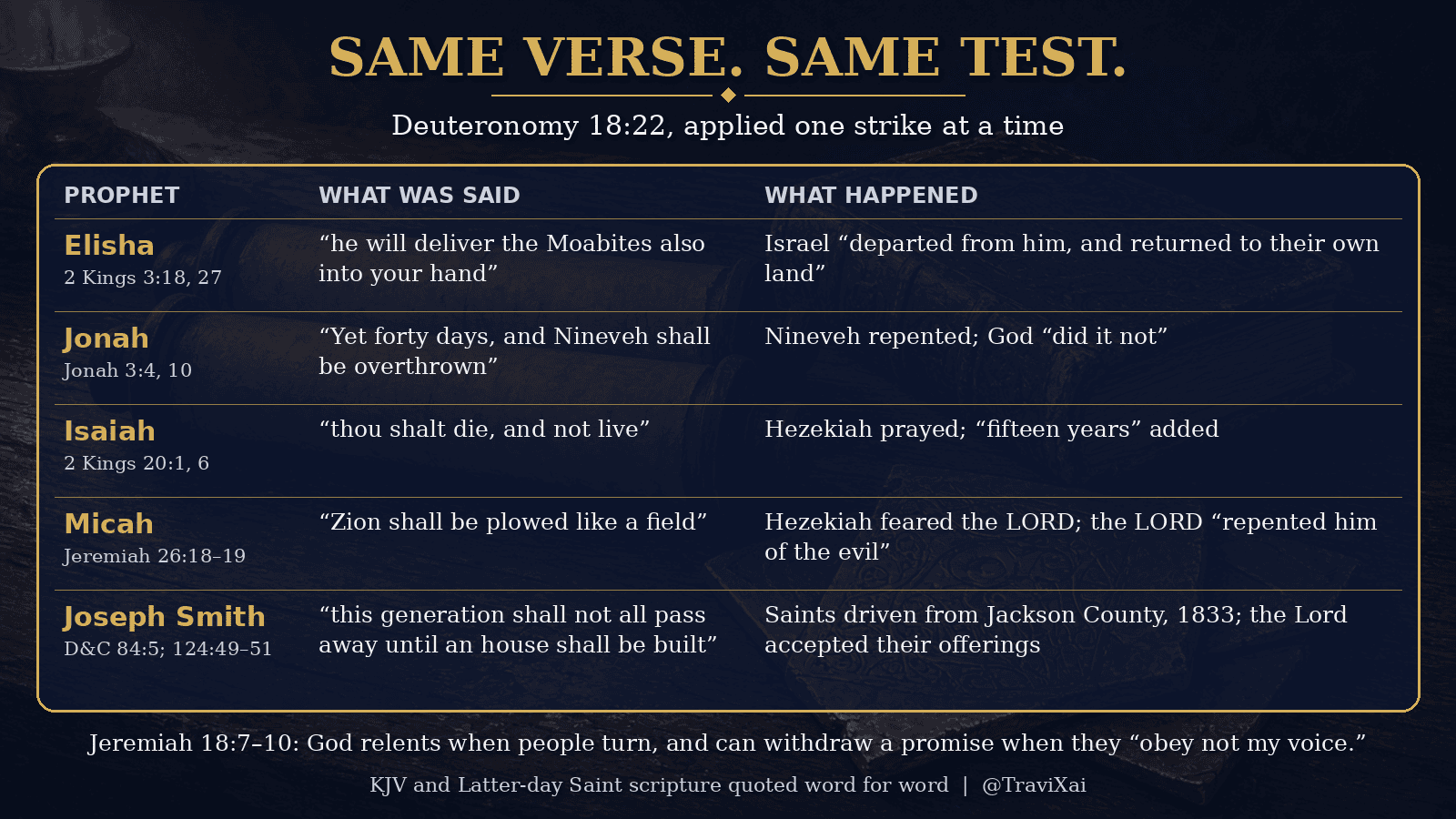
Israel, Judah, and Edom march against Moab and run out of water. They go to Elisha, the hand of the LORD comes on him, and he says:
And this is but a light thing in the sight of the LORD: he will deliver the Moabites also into your hand. And ye shall smite every fenced city, and every choice city, and shall fell every good tree, and stop all wells of water, and mar every good piece of land with stones.
2 Kings 3:18–19
Much of it happened. The water came (v. 20). Israel routed Moab, beat down cities, stopped wells, felled trees (vv. 24–25). Then came Kir-haraseth:
Then he took his eldest son that should have reigned in his stead, and offered him for a burnt offering upon the wall. And there was great indignation against Israel: and they departed from him, and returned to their own land.
2 Kings 3:27
Israel went home. The king of Moab was still standing on the wall of his city when the armies left. The promise that “he will deliver the Moabites also into your hand” ended with Israel packing up and walking away.
Run the critic’s rule on that and Elisha “hath spoken it presumptuously.” Nobody says that. Christians who hit verse 27 slow down and read the context. Good. I’m only asking for the same patience when the name on the prophecy is Joseph Smith.
Part IIIJonah, Hezekiah, and Micah
Jonah: forty days, no “unless”
Jonah’s whole recorded sermon to Nineveh is one sentence: “Yet forty days, and Nineveh shall be overthrown” (Jonah 3:4). No “unless.” No “if ye repent.” Nineveh fasted in sackcloth, and then:
And God saw their works, that they turned from their evil way; and God repented of the evil, that he had said that he would do unto them; and he did it not.
Jonah 3:10
Nineveh stood. And Jonah wasn’t surprised, he was mad, because he knew God would do exactly that: “for I knew that thou art a gracious God, and merciful, slow to anger, and of great kindness, and repentest thee of the evil” (Jonah 4:2).
Isaiah to Hezekiah: “thou shalt die, and not live”
Isaiah walks in and tells a sick king, “Thus saith the LORD, Set thine house in order; for thou shalt die, and not live” (2 Kings 20:1). Hezekiah prays and weeps, and before Isaiah leaves the middle court the word changes: “I have heard thy prayer, I have seen thy tears: behold, I will heal thee” and “I will add unto thy days fifteen years” (2 Kings 20:5–6). One-strike rule? Isaiah is done before lunch.
Micah: an unfulfilled prophecy used to defend a prophet
My favorite, because the Bible makes the argument for me. When the priests wanted Jeremiah dead, the elders of the land cited Micah.
Micah had said, “Zion shall be plowed like a field, and Jerusalem shall become heaps” (Jeremiah 26:18). Then the elders asked:
Did Hezekiah king of Judah and all Judah put him at all to death? did he not fear the LORD, and besought the LORD, and the LORD repented him of the evil which he had pronounced against them?
Jeremiah 26:19
Micah’s prophecy didn’t happen in Hezekiah’s day, and the elders used that fact to save a prophet’s life, not to stone one.
God states the rule Himself
At what instant I shall speak concerning a nation, and concerning a kingdom, to pluck up, and to pull down, and to destroy it; If that nation, against whom I have pronounced, turn from their evil, I will repent of the evil that I thought to do unto them.
Jeremiah 18:7–8
And it runs the other way too. When God speaks of a kingdom “to build and to plant it,” and it “obey not my voice,” then “I will repent of the good, wherewith I said I would benefit them” (Jeremiah 18:9–10). Hold onto that.
Evangelical scholars agree. Craig Keener, in Christianity Today: “most prophecies in the Bible about his short-range purposes are conditional, whether stated as such or not.” The Christian Research Institute defends Jonah the same way: his prophecy “was not in error, because implied in the prophecy was a condition under which the predicted judgment would not take place” (CRI). Implied. Remember that word too.
Part IVWhat D&C 84 said, and what happened
Here is the text critics quote, from a revelation given in Kirtland, Ohio, on September 22–23, 1832:
Verily this is the word of the Lord, that the city New Jerusalem shall be built by the gathering of the saints, beginning at this place, even the place of the temple, which temple shall be reared in this generation. For verily this generation shall not all pass away until an house shall be built unto the Lord, and a cloud shall rest upon it, which cloud shall be even the glory of the Lord, which shall fill the house.
Doctrine and Covenants 84:4–5
Then came Jackson County
By the summer of 1833 about 1,200 Saints lived in Jackson County. On July 20, 1833, vigilantes destroyed the Church’s printing office and tarred and feathered Bishop Edward Partridge. By November the Saints were driven out, one group of women and children “leaving a trail of blood behind them after the sharp prairie grass cut the bare feet of the children” (Church History Topics, “Jackson County Violence”). A temple doesn’t get built on land you’ve been driven off at gunpoint.
The condition was written in the same revelation
Here’s what critics leave out. The very revelation they quote put the whole Church on notice:
Which vanity and unbelief have brought the whole church under condemnation. And this condemnation resteth upon the children of Zion, even all. And they shall remain under this condemnation until they repent and remember the new covenant, even the Book of Mormon and the former commandments which I have given them, not only to say, but to do according to that which I have written—
Doctrine and Covenants 84:55–57
The next verse adds, “otherwise there remaineth a scourge and judgment to be poured out upon the children of Zion” (D&C 84:58). That is Jeremiah 18:9–10 all over again.
In June 1834 the Lord said it plainly: “were it not for the transgressions of my people, speaking concerning the church and not individuals, they might have been redeemed even now,” and “it is expedient in me that mine elders should wait for a little season for the redemption of Zion” (D&C 105:2, 9). And in January 1841:
…when I give a commandment to any of the sons of men to do a work unto my name, and those sons of men go with all their might and with all they have to perform that work, and cease not their diligence, and their enemies come upon them and hinder them from performing that work, behold, it behooveth me to require that work no more at the hands of those sons of men, but to accept of their offerings.
Doctrine and Covenants 124:49
Verse 51 names the case: “those whom I commanded to build up a city and a house unto my name, in Jackson county, Missouri, and were hindered by their enemies” (D&C 124:51).
“Never understood to be conditional”?
CRI says Latter-day Saint predictions “were never understood to be conditional at all.” Really? Jonah’s condition was implied, by CRI’s own word. Ours was written into the same revelation in 1832, and again in 1834 and 1841. If an implied condition rescues Jonah, a written one can’t sink Joseph. And the long-range promise stands. We still believe “Zion (the New Jerusalem) will be built upon the American continent” (Articles of Faith 1:10).
Part VOne standard, both directions
So here are the critic’s two options, and he only gets to pick one.
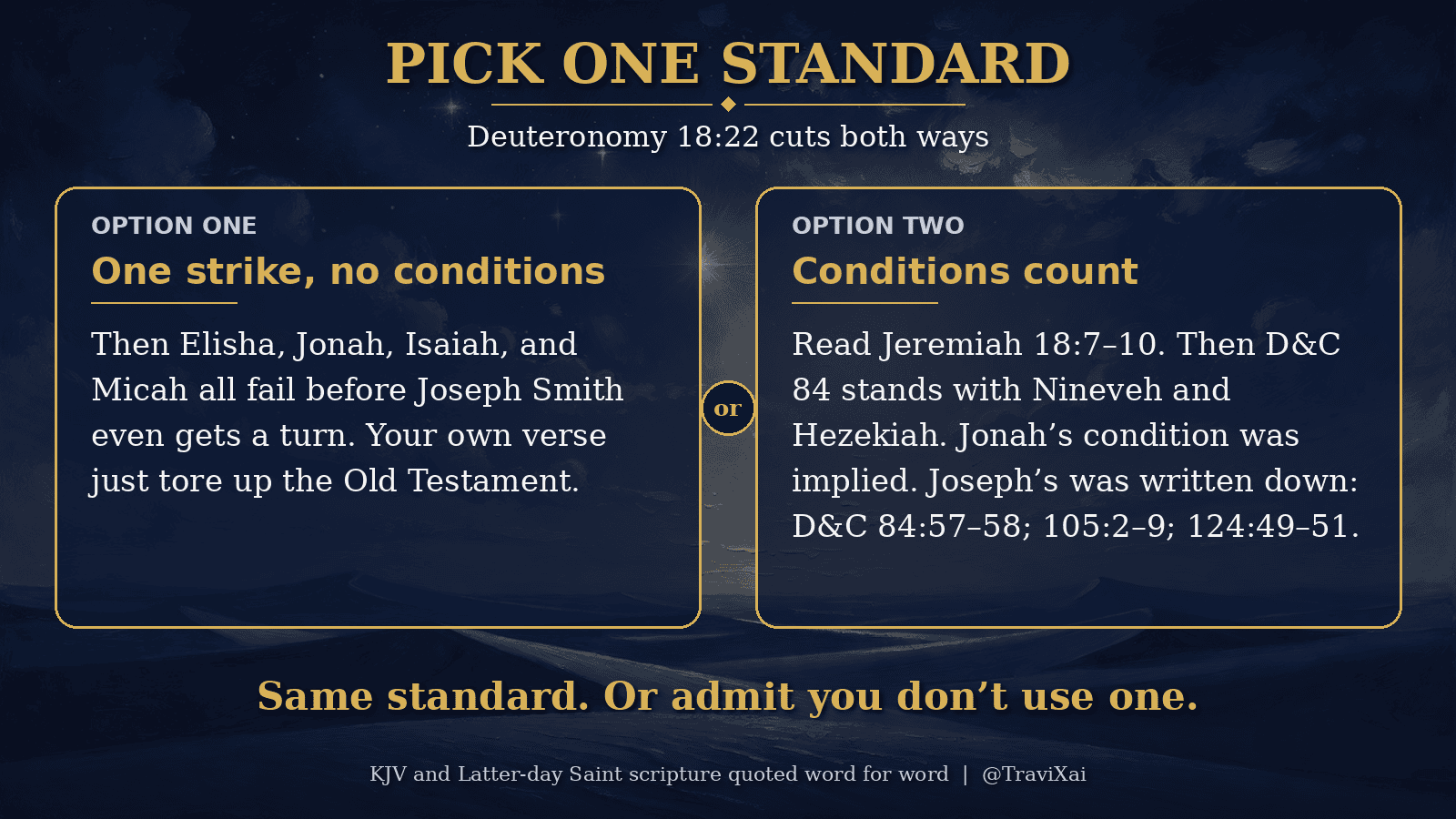
Option one: Deuteronomy 18:22 is a one-strike rule. Then Elisha, Jonah, Isaiah, and Micah all fail before Joseph even gets a turn, and you just ripped a chunk out of the Old Testament with your own verse.
Option two: prophecies carry conditions, exactly as Jeremiah 18 says. Then D&C 84 sits next to Nineveh and Hezekiah, with one difference: its conditions are written down, not implied.
And grade the hits too. On Christmas Day 1832, three months after D&C 84, Joseph dictated a revelation about wars “beginning at the rebellion of South Carolina” and said “the Southern States shall be divided against the Northern States” (D&C 87:1, 3), almost three decades before Fort Sumter. More in Joseph Smith’s Fulfilled Prophecies (2026 Edition).
Pick the test. Apply it to everybody. Aim it only at Joseph and it isn’t a prophecy test, it’s cherry-picking (more in The Hypocritical Book of Mormon Denier). Same standard, or admit you don’t use one.
SummaryKey takeaways
- Deuteronomy 18:22 is real scripture and a real test. But the critic reads it as a one-strike, no-conditions rule, and the Old Testament doesn’t.
- Elisha promised Moab would be delivered into Israel’s hand; after Kir-haraseth, Israel “departed from him, and returned to their own land” (2 Kings 3:27). Nobody calls Elisha a false prophet.
- Jonah’s forty days, Isaiah’s “thou shalt die,” and Micah’s Zion prophecy all went unfulfilled as spoken, and the Bible explains why: God relents when people repent (Jeremiah 18:7–10; Jeremiah 26:19).
- Jeremiah 18:9–10 says promises to “build and to plant” can be withdrawn when a people obey not His voice. D&C 84:55–58, 105:2–9, and 124:49–51 apply that same principle to the Jackson County temple, in writing.
- Evangelical defenders call Jonah’s condition “implied.” The condition on D&C 84 is written in the revelation itself. One standard, both directions.
Next time someone drops Deuteronomy 18:22 like a mic, thank them for it, then hand them 2 Kings 3 and Jonah 3 and ask them to grade those first. For quick, sourced answers on Deuteronomy 18 and the false-prophet charge, the “failed prophecies” list, Joseph’s fulfilled prophecies, and Bible inerrancy, open Galatians18. And for more like this every day, follow me on X at @TraviXai.
Sources
- King James Bible (Church of Jesus Christ of Latter-day Saints edition): Deuteronomy 18:20–22 · 2 Kings 3:13–27 · Jonah 3:4–10 · Jonah 4:1–2 · 2 Kings 20:1–6 · Jeremiah 18:7–10 · Jeremiah 26:17–19
- Doctrine and Covenants: D&C 84:1–5 · D&C 84:54–58 · D&C 87:1–3 · D&C 105:1–10 · D&C 124:49–51 · Articles of Faith 1:10
- Joseph Smith Papers: Revelation, 22–23 September 1832 [D&C 84]
- Church History Topics: “Jackson County Violence” (Church of Jesus Christ of Latter-day Saints)
- Craig Keener, “When Political Prophecies Don’t Come to Pass”, Christianity Today, November 11, 2020 (quoted only for the conditional-prophecy principle)
- Christian Research Institute, “The Prophet Jonah: Jonah’s ‘False Prophecy’”
- Galatians18: Deuteronomy 18: Was Joseph a False Prophet? · Joseph Smith’s “Failed Prophecies” List · Joseph’s fulfilled prophecies · Bible inerrancy
- Featured image and in-article graphics: original graphics by thebookofmormon.ai (painterly backgrounds; no photographs or likenesses of real people).