
No crosses on the steeples, none on the jewelry. Critics read that as rejecting Calvary. Here’s the real reason, in a prophet’s words and all four standard works.
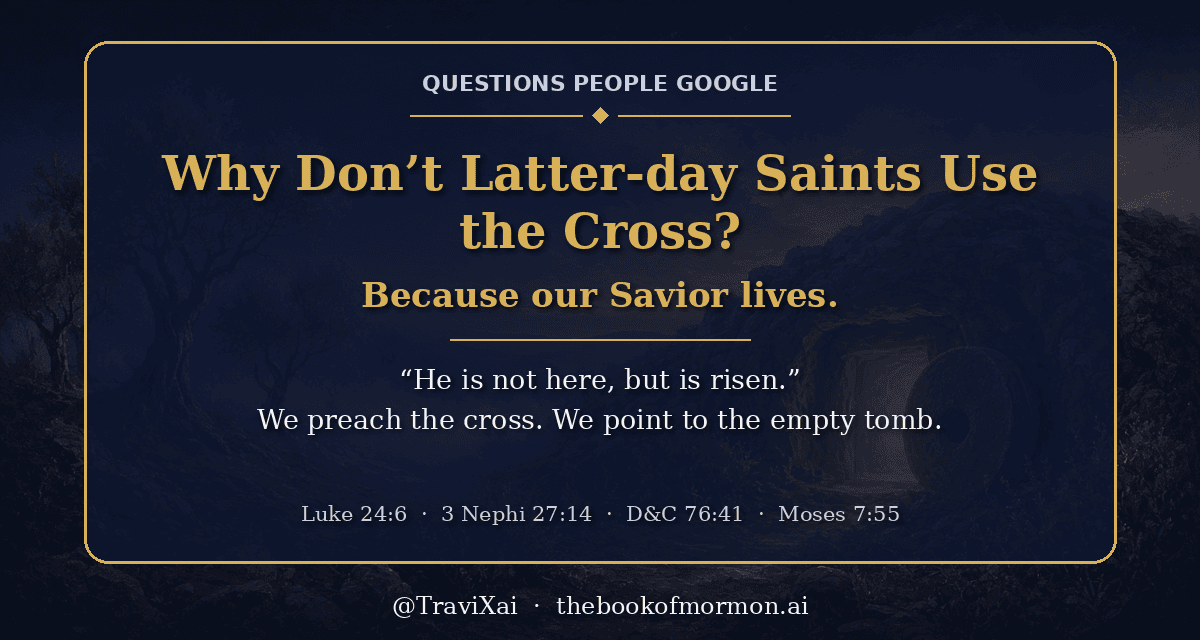
Latter-day Saints don’t use the cross as a symbol because they emphasize the living, resurrected Christ, not because they reject the Crucifixion. President Gordon B. Hinckley put it this way: “because our Savior lives, we do not use the symbol of His death as the symbol of our faith.” Our scriptures preach the cross, from 1 Corinthians 1:18 to 3 Nephi 27:14.
The prophet’s answerThe answer a prophet actually gave
This question has an official, on-the-record answer, so we don’t have to guess. President Gordon B. Hinckley said a Protestant minister once asked him the same thing during an open house for the Mesa Arizona Temple. Here’s his answer:
But for us, the cross is the symbol of the dying Christ, while our message is a declaration of the Living Christ.
Gordon B. Hinckley, “The Symbol of Our Faith,” Ensign, April 2005
He finished the thought plainly: “And so, because our Savior lives, we do not use the symbol of His death as the symbol of our faith.” Then he said what Latter-day Saints offer in its place: “the lives of our people must become the most meaningful expression of our faith and, in fact, therefore, the symbol of our worship.” He tied that to Jesus’ own words, “If ye love me, keep my commandments” (John 14:15).
That isn’t a rejection of the cross. It’s a choice about which moment of the gospel to put on the steeple. Every Christian church makes that choice somehow. Ours points to the morning the tomb was empty.
Four witnessesAll four standard works preach the cross
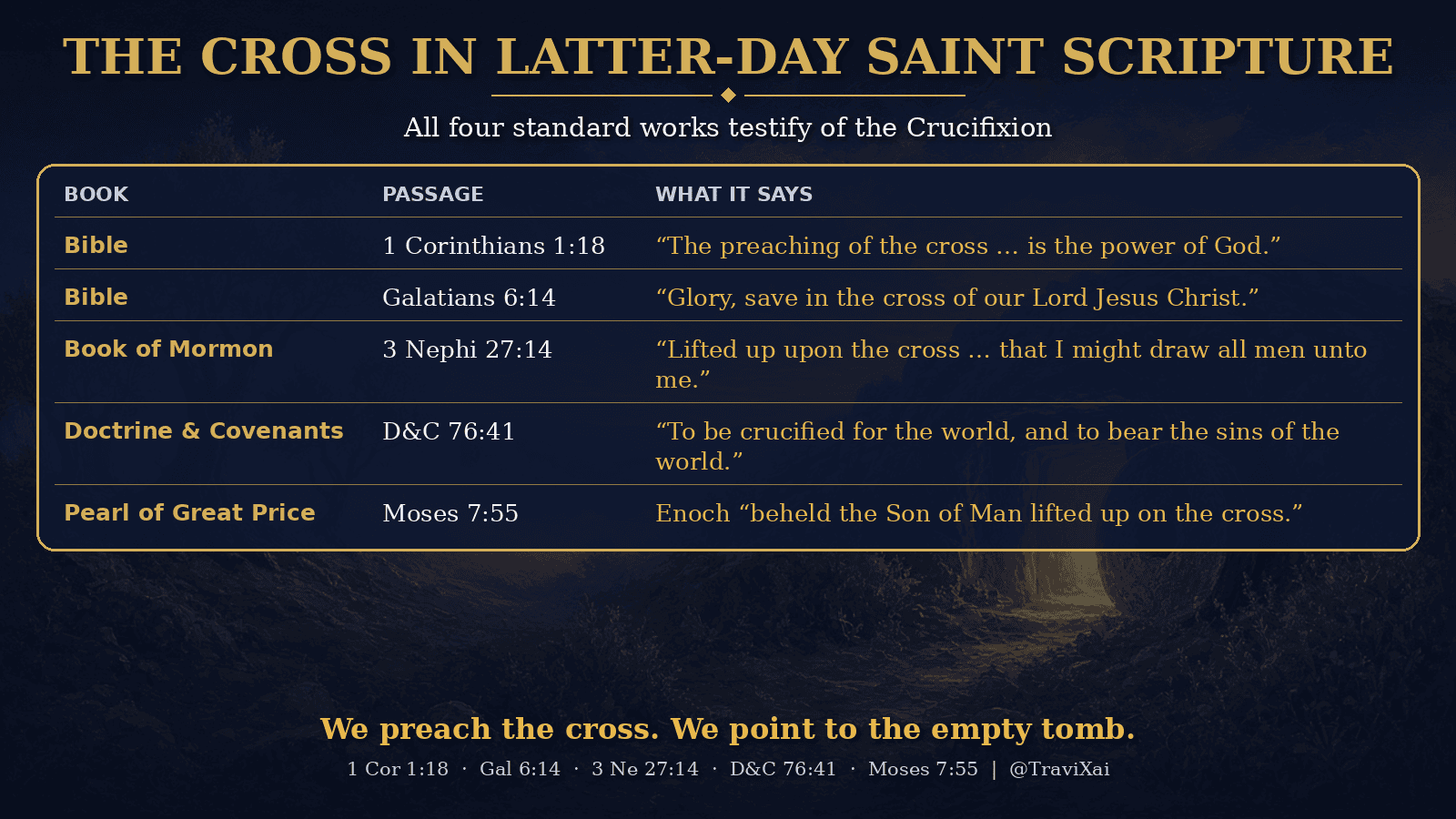
Anyone who thinks Latter-day Saints ignore the Crucifixion hasn’t read our scriptures. Paul’s words are ours: “the preaching of the cross is to them that perish foolishness; but unto us which are saved it is the power of God” (1 Corinthians 1:18), and “God forbid that I should glory, save in the cross of our Lord Jesus Christ” (Galatians 6:14). The Book of Mormon has the risen Lord Himself explain why He went there:
And my Father sent me that I might be lifted up upon the cross; and after that I had been lifted up upon the cross, that I might draw all men unto me.
3 Nephi 27:14
The Doctrine and Covenants defines the gospel itself this way: Jesus came “to be crucified for the world, and to bear the sins of the world, and to sanctify the world” (D&C 76:41). And in the Pearl of Great Price, thousands of years before Calvary, Enoch “beheld the Son of Man lifted up on the cross, after the manner of men” (Moses 7:55).
Every SundayWe remember His body and blood every week
The center of every Latter-day Saint sacrament meeting is the bread and water, blessed with prayers the Book of Mormon preserves word for word. Members eat “in remembrance of the body of thy Son” (Moroni 4:3) and drink “in remembrance of the blood of thy Son, which was shed for them” (Moroni 5:2). That’s a weekly covenant built around His death. We just don’t wear it as jewelry.
The empty tombWhy the empty tomb is the right symbol
The angels at the tomb asked the women a question that could be the whole answer to this post:
Why seek ye the living among the dead? He is not here, but is risen.
Luke 24:5–6
Paul said that without the Resurrection, “then is our preaching vain, and your faith is also vain” (1 Corinthians 15:14). Joseph Smith’s testimony in D&C 76 says the same thing in the present tense: “this is the testimony, last of all, which we give of him: That he lives!” (D&C 76:22).
That’s also why the Church’s symbol, introduced by President Russell M. Nelson in April 2020, shows Thorvaldsen’s Christus: the resurrected Lord with the wounds still in His hands, arms open. Same Savior. Same wounds. Risen.
HistoryThe first Christians didn’t use the cross much either
Here’s something many Christians don’t know: the cross wasn’t a common Christian emblem for roughly the first three centuries. Early Christians more often used images like the fish and the anchor, and the cross became widespread in Christian art after Constantine in the fourth century. So declining to make the cross the main symbol isn’t a departure from the earliest church. If anything, it’s closer to it. I cover what else a first-century believer would and wouldn’t recognize in What Church Would a First-Century Christian Recognize?.
Check the premiseThe presuppositions baked into the question
Before this question can be answered fairly, the person asking has to justify a few assumptions packed inside it:
- That not using a symbol means rejecting what it stands for. The Church uses no cross on its buildings, yet its scriptures, sacrament prayers, and hymns center on the Crucifixion. A symbol and a doctrine aren’t the same thing.
- That the cross has always been the Christian symbol. It wasn’t for roughly the first three centuries. Making it the test of real Christianity holds the apostles to a fourth-century standard.
- That Latter-day Saints care more about Gethsemane than Calvary. Both are scriptural. The Savior bled in the garden (Luke 22:44; D&C 19:18) and was “lifted up upon the cross” (3 Nephi 27:14). Latter-day Saints teach both.
FAQQuick answers
Why don’t Latter-day Saints use the cross?
Because they choose to emphasize the living, resurrected Christ. President Gordon B. Hinckley said, “because our Savior lives, we do not use the symbol of His death as the symbol of our faith.”
Do Latter-day Saints believe in the Crucifixion?
Yes. All four standard works testify of it, including 1 Corinthians 1:18, 3 Nephi 27:14, D&C 76:41, and Moses 7:55, and the weekly sacrament remembers His body and blood.
Can a Latter-day Saint wear a cross?
There’s no rule against it, but the Church doesn’t use the cross as its symbol, so most members don’t.
What is the symbol of the LDS Church?
Since 2020 the Church’s symbol has featured Thorvaldsen’s Christus, the resurrected Christ, under an arch with the Church’s name. President Hinckley taught that members’ lives should be “the symbol of our worship.”
Did early Christians use the cross?
Not widely at first. Images like the fish and the anchor were more common, and the cross became a widespread Christian symbol in the fourth century, after Constantine.
Do Latter-day Saints believe Jesus suffered in Gethsemane and on the cross?
Yes. His suffering began in Gethsemane, where “his sweat was as it were great drops of blood” (Luke 22:44), and was completed on the cross. Nephi saw that He “was lifted up upon the cross and slain for the sins of the world” (1 Nephi 11:33).
How do Latter-day Saints remember Christ’s death?
Every Sunday in the sacrament of bread and water, as He asked: “this do in remembrance of me” (Luke 22:19).
Are there crosses in Latter-day Saint chapels or temples?
No. Chapels and temples don’t display crosses. Members are taught to show their faith in Christ through the sacrament, their covenants and the way they live.
SummaryKey takeaways
- The reason is the Resurrection: “because our Savior lives,” in President Hinckley’s words.
- All four standard works testify of the cross (1 Cor 1:18; 3 Ne 27:14; D&C 76:41; Moses 7:55).
- The weekly sacrament remembers His body and the blood “which was shed for them” (Moroni 4–5).
- The cross wasn’t a common Christian emblem until the fourth century.
Next time someone asks where the cross is, show them 3 Nephi 27:14 and Luke 24:6. For quick, sourced answers, open Galatians18, and follow me on X at @TraviXai.
Sources
- Gordon B. Hinckley, “The Symbol of Our Faith,” Ensign, April 2005
- King James Bible: Luke 22:44 · Luke 24:5–6 · John 14:15 · 1 Corinthians 1:18 · 1 Corinthians 15:14 · Galatians 6:14
- Book of Mormon: 3 Nephi 27:14 · Moroni 4:3 · Moroni 5:2
- Doctrine and Covenants and Pearl of Great Price: D&C 19:18 · D&C 76:22 · D&C 76:41 · Moses 7:55
- Featured image and in-article graphic: original graphics by thebookofmormon.ai (painterly backgrounds; no photographs or likenesses of real people).