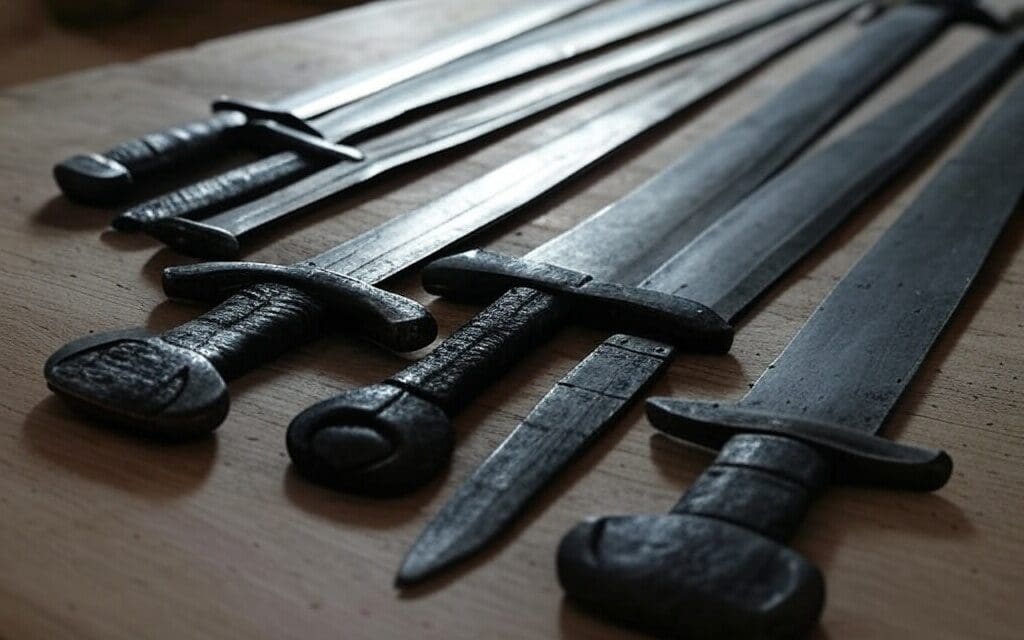

For more than a century critics said Nephi's "most precious steel" proved the Book of Mormon was a fraud, because Israelites in 600 BC supposedly knew nothing of steel. Then archaeologists found a steel sword a few miles from Jerusalem, dated to Laban's lifetime.
Every list of Book of Mormon “anachronisms” has an item about steel. The argument goes like this: the book says a Jerusalem official named Laban owned a sword with a steel blade around 600 BC, but steel is a much later technology, so Joseph Smith must have been projecting his own world back onto the ancient one. Case closed.
It’s a reasonable-sounding objection. It’s also one of the best examples of why “we haven’t found it yet” is a weak argument. Let’s look at what the Book of Mormon actually says, what the Bible says, and what archaeology has turned up since 1830.
What the Book of Mormon actually says
Steel shows up in only five verses, and it’s worth reading them instead of relying on summaries. The first, and the one critics usually quote, is Nephi’s description of the sword he finds on the drunken Laban:
And I beheld his sword, and I drew it forth from the sheath thereof; and the hilt thereof was of pure gold, and the workmanship thereof was exceedingly fine, and I saw that the blade thereof was of the most precious steel.
1 Nephi 4:9
Then, out in the Arabian wilderness, Nephi’s hunting bow breaks:
And it came to pass that as I, Nephi, went forth to slay food, behold, I did break my bow, which was made of fine steel; and after I did break my bow, behold, my brethren were angry with me because of the loss of my bow, for we did obtain no food.
1 Nephi 16:18
After the family reaches the promised land, Nephi lists the metals he taught his people to work, steel among them:
And I did teach my people to build buildings, and to work in all manner of wood, and of iron, and of copper, and of brass, and of steel, and of gold, and of silver, and of precious ores, which were in great abundance.
2 Nephi 5:15
A few generations later, Jarom gives a similar list of metals and tools (also in iron and copper, and brass and steel), and in the much older Jaredite record a rebel named Shule made swords out of steel for his followers.
Notice something about that list. The first two references are in the Old World, in Jerusalem and Arabia, around 600 BC. The rest are brief mentions of metalworking in the New World. Critics have mostly aimed at the first one, because if steel in Jerusalem in Lehi’s day was impossible, the book has a problem in its opening chapters.
The critics were confident
This wasn’t a fringe complaint. Scripture Central collects some of the older statements. One nineteenth-century writer said Laban’s sword was steel “when it is a notorious fact that the Israelites knew nothing of steel for hundreds of years afterwards.” As late as 1964, another critic wrote: “No one believes that steel was available to Laban or anyone else in 592 B.C.”
That’s a clear, testable claim. If archaeology never found steel in Judah around 600 BC, critics could keep saying it. If it did, the claim had to come off the list.
Then a sword turned up near Jericho
In the 1980s, the archaeologist Avraham Eitan excavated a site called Vered Jericho, a short distance from Jerusalem. On the floor of a building he found an iron sword about a meter long, dated to the late seventh century BC, the reign of King Josiah. Josiah was king when Lehi was a young man. The Israel Museum’s display sign describes the blade as “iron hardened into steel, attesting to substantial metallurgical know-how.” Eitan’s metallurgical analysis concluded that “the iron was deliberately hardened into steel.”
Read that again next to Nephi’s description. A long sword, in Judah, in Laban’s generation, with a blade deliberately turned into steel. Nephi says Laban’s blade was of the most precious steel and the hilt was gold, which fits a wealthy official owning a high-end version of a weapon that already existed.
It goes further back than Jericho, too. Scholars now recognize that Near Eastern smiths were carburizing iron, deliberately working carbon into it to produce steel, centuries before Nephi was born. Scripture Central notes that tools and blades of iron hardened into steel have been found across the region from as early as the thirteenth to tenth centuries BC.
So the claim that “the Israelites knew nothing of steel” didn’t age well. In Matthew Roper’s 2025 study of the long list of claimed anachronisms, steel is one of the items that has moved from “problem” to “confirmed.” I covered his full results in The Shrinking List of Book of Mormon Anachronisms.
The King James Bible has a “bow of steel” too
Nephi’s broken bow raises a second question. A bow made entirely of steel would be a strange weapon. But here’s the fun part: the King James Bible has steel bows, and nobody calls the Bible a fraud for it.
He teacheth my hands to war; so that a bow of steel is broken by mine arms.
2 Samuel 22:35 (KJV)
Psalm 18:34 repeats the same line, and Job adds another:
He shall flee from the iron weapon, and the bow of steel shall strike him through.
Job 20:24 (KJV)
Jeremiah even asks, Shall iron break the northern iron and the steel?
The Hebrew word the KJV translators rendered “steel” in these verses refers to bronze, and modern translations usually say “bronze.” Scripture Central’s KnoWhy on Nephi’s bow explains that the older English word “steel” had a broader range of meaning that could include hardened metals generally. A “bow of bronze” in the ancient Near East most likely meant a composite bow of wood, horn, and sinew, reinforced or decorated with metal at key points. That kind of bow was expensive, powerful, and also prone to warping and breaking when moved into a hot, dry climate. That’s exactly where Nephi’s broke.
So the English vocabulary in 1 Nephi 16:18 matches the English vocabulary of the King James Bible for the same kind of object. If the KJV can say “bow of steel” without anyone accusing David of time travel, the Book of Mormon can too.
What about steel in the New World?
The later references are a fair question, and I’m not going to pretend they’ve been settled in the same way the Laban sword has. Nephi and Jarom list steel alongside iron, copper, brass, gold, and silver, and archaeology in the Americas hasn’t yet produced a clear Nephite steel workshop. Here’s what I’d point out:
- The Book of Mormon never describes steel as common. The mentions are few and early, and steel doesn’t become a regular feature of later Nephite warfare. The later war chapters are full of swords, cimeters, slings, and armor, not steel.
- The book’s own translation vocabulary uses KJV-style English, and as we just saw, KJV “steel” doesn’t always mean what a modern metallurgist means by the word.
- Lehi’s group came from a culture that knew how to make steel. Nephi’s statement that he taught his people to work it is a claim about a skill brought from the Old World, not a claim about a booming steel industry.
That’s an open question, not a refutation. And the history of this exact topic should make anyone cautious about declaring the question closed. The Old World “impossibility” lasted about 150 years before a shovel answered it.
The lesson of the steel sword
The most useful thing about the steel debate isn’t the sword. It’s the pattern. A critic picks a detail, declares it impossible because nobody has found it, and treats the silence as proof. Then the evidence turns up and the critic moves to the next detail. That has happened again and again with the Book of Mormon, from cement to barley to the place name Nahom.
None of that proves the book is true by itself. But it should make us humble about arguments from silence, and it should make critics more careful about what they call “a notorious fact.”
Want the bigger picture? Read The Best Book of Mormon Evidences, in One Place and Is the Book of Mormon an Ancient Document?
For short, shareable answers, see the Galatians 1:8 app on horses, steel, wheat, and other anachronisms, metallurgy and swords, and Book of Mormon historicity.
- Scripture Central, “Book of Mormon Evidence: Laban’s Steel Sword”: scripturecentral.org
- Scripture Central, KnoWhy, “What Was the Sword of Laban Like?”: scripturecentral.org
- Scripture Central, KnoWhy #548, “Why Did Nephi’s ‘Fine Steel’ Bow Break?”: scripturecentral.org
- FAIR, Matthew Roper on the carburized iron sword near Jericho, with the Israel Museum display text: fairlatterdaysaints.org
- Matthew Roper, Anachronisms: Accidental Evidence in Book of Mormon Criticisms, Interpreter 65 (2025): interpreterfoundation.org
- Scriptures quoted: 1 Nephi 4:9; 16:18; 2 Nephi 5:15; Jarom 1:8; Ether 7:9; 2 Samuel 22:35, Job 20:24, and Jeremiah 15:12 (KJV), all from churchofjesuschrist.org