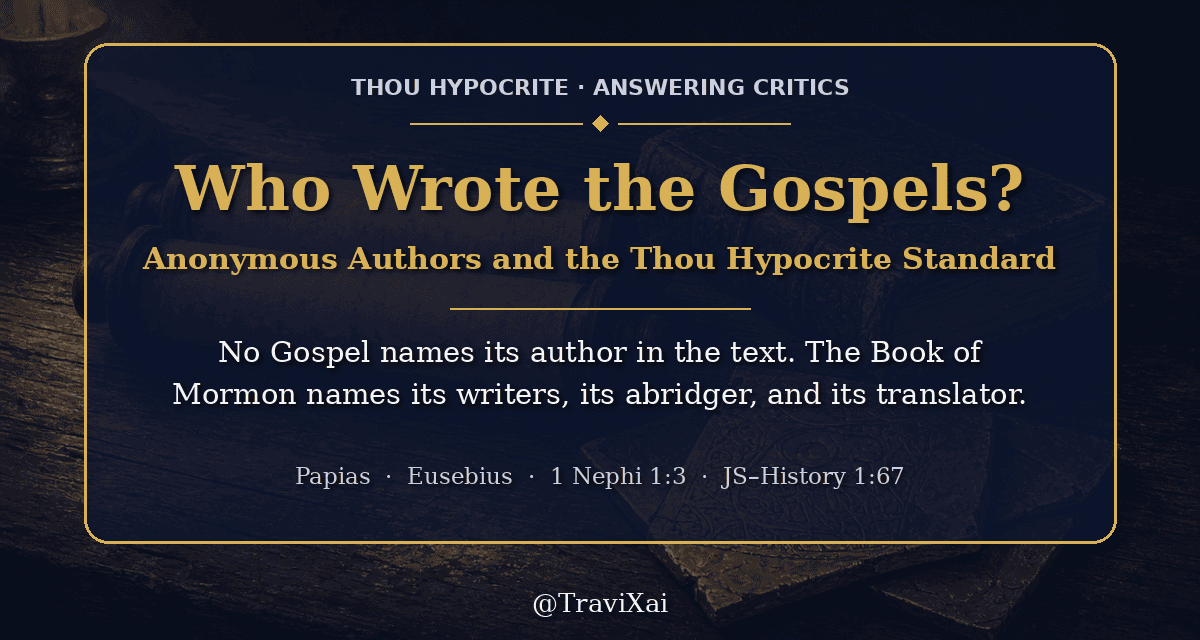

Critics say nobody knows who really wrote the Book of Mormon. Not one of the four Gospels names its author in the text. Here’s where the names Matthew, Mark, Luke, and John came from, and which book actually signs its name.
“Nobody even knows who really wrote the Book of Mormon. Joseph? Spalding? Rigdon? Pick one.” I hear it every week, usually from someone holding a Bible. So here’s my question back: who wrote the Gospel of Matthew? Not who tradition says wrote it. Who does the book say wrote it? Open to Matthew 1:1 and look for the name. It isn’t there.
This is part of my Thou Hypocrite series, where we take an argument critics use on the Book of Mormon and apply it, word for word, to the Bible. I gave authorship one short section in The Hypocritical Book of Mormon Denier, and I did Hebrews on its own in Who Wrote Hebrews? This one goes after the big four: Matthew, Mark, Luke, and John.
Part IThe rule critics bring
The authorship argument has two rules: disputed authorship is a red flag by itself, and a book is only trustworthy if you can trace it to known eyewitnesses. Fine, I’ll accept both. But a rule you only apply to the other guy’s book isn’t a rule, it’s a weapon. Jesus had a word for that:
Thou hypocrite, first cast out the beam out of thine own eye; and then shalt thou see clearly to cast out the mote out of thy brother’s eye.
Matthew 7:5
Part IIOpen the Gospels and look for a signature
None of the four Gospels names its author in the text. Bart Ehrman, no friend of either of us, calls “the texts themselves are completely anonymous” (Ehrman). Check for yourself:
- Matthew never says “I, Matthew.” When Matthew shows up, he’s written about in the third person: “he saw a man, named Matthew, sitting at the receipt of custom” (Matthew 9:9).
- Mark never names himself anywhere in the book.
- Luke says “me” but never his name, writing to “most excellent Theophilus” (Luke 1:3), and so does Acts (Acts 1:1).
- John points to “the disciple whom Jesus loved” and never puts a name on him.
Luke even tells you he wasn’t an eyewitness:
Even as they delivered them unto us, which from the beginning were eyewitnesses, and ministers of the word;
Luke 1:2
And John’s Gospel ends with somebody other than the beloved disciple vouching for him:
This is the disciple which testifieth of these things, and wrote these things: and we know that his testimony is true.
John 21:24
Who is “we”? The text doesn’t say. Compare Paul, who warned about fake letters “as from us” (2 Thessalonians 2:2) and then signed the real one: “The salutation of Paul with mine own hand, which is the token in every epistle: so I write” (2 Thessalonians 3:17). Paul signed. The Gospel writers didn’t.
Part IIIWhere the names came from
The headings “According to Matthew,” “According to Mark,” and so on are titles attached to the books, not words inside them. Ehrman points out that the manuscripts carrying those titles “do not start appearing until around 200 CE” (Ehrman).
To be fair, scholars argue about how early the titles started. Martin Hengel argued the names had to be attached early so the churches could tell the Gospels apart. Michael Wolter turned that logic around and dated the titles “not earlier than the first half of the second century” (Wolter on Hengel). Either way, the names come from titles and tradition, not from the authors.
Around the middle of the second century, Justin Martyr quoted the Gospels but didn’t name them. He called them “the memoirs composed by them, which are called Gospels,” and said “the memoirs of the apostles” were read on Sunday (First Apology 66–67). The first writer to name all four is Irenaeus, in the late second century: Matthew “among the Hebrews,” Mark “the disciple and interpreter of Peter,” Luke “the companion of Paul,” and John “who also had leaned upon His breast” (Against Heresies 3.1.1).
Part IVPapias, link by link
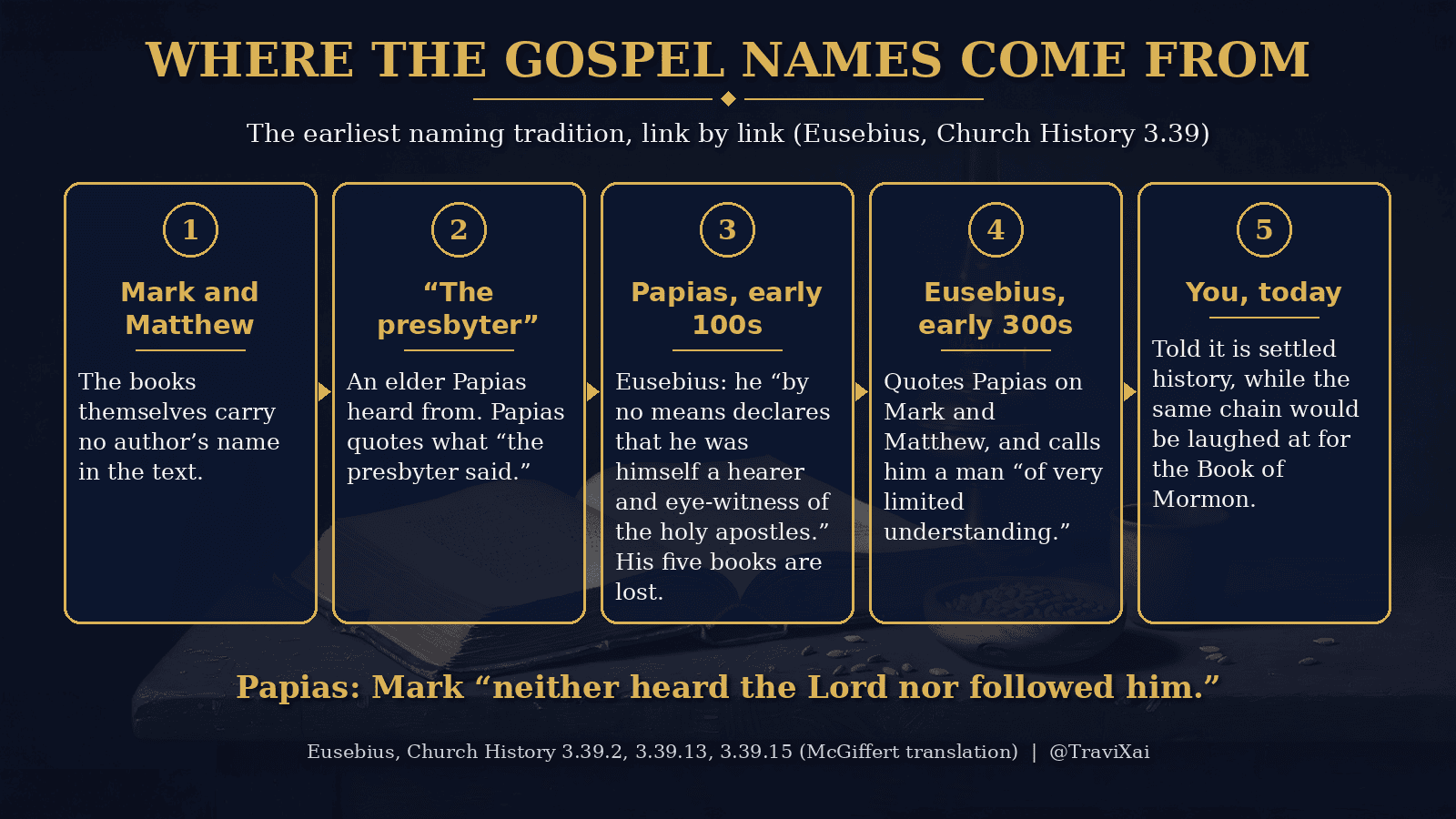
Papias was “bishop of the parish of Hierapolis,” a contemporary of Polycarp and Ignatius, so the early 100s (Eusebius, Church History 3.36.2). He wrote five books. All five are lost. What we have is what Eusebius quoted from them in his Church History, written in the early 300s. Here’s the passage Gospel-authorship arguments lean on:
This also the presbyter said: Mark, having become the interpreter of Peter, wrote down accurately, though not in order, whatsoever he remembered of the things said or done by Christ. For he neither heard the Lord nor followed him, but afterward, as I said, he followed Peter …
Eusebius, Church History 3.39.15 (quoting Papias)
So then Matthew wrote the oracles in the Hebrew language, and every one interpreted them as he was able.
Eusebius, Church History 3.39.16 (quoting Papias)
Apply the Book of Mormon standard, one link at a time:
- It’s secondhand. Papias is passing on what “the presbyter said.” Eusebius himself says Papias “by no means declares that he was himself a hearer and eye-witness of the holy apostles” (3.39.2).
- It names a non-eyewitness. The earliest tradition about Mark says he “neither heard the Lord nor followed him.”
- It doesn’t clearly describe the Matthew we have. Papias says Matthew wrote “in the Hebrew language.” Our Matthew is in Greek, and scholars still argue about what Papias meant.
- The historian who preserved it didn’t think much of the source. Eusebius wrote that Papias “appears to have been of very limited understanding” (3.39.13). His reason? Papias taught a literal thousand-year reign of Christ “on this very earth” (3.39.12), which Latter-day Saints happen to believe: Christ “will reign personally upon the earth” (Article of Faith 10) and “dwell in righteousness with men on earth a thousand years” (D&C 29:11).
And one more thing about Papias: he openly preferred oral tradition to books. “I did not think that what was to be gotten from the books would profit me as much as what came from the living and abiding voice” (3.39.4). The man critics lean on for the Gospel names was not a sola scriptura guy.
Picture that chain for the Book of Mormon: an unsigned book, a name supplied by a bishop who got it from an unnamed elder, his books lost, his words kept only by a historian two centuries later who called him “of very limited understanding.” Critics would laugh it off the internet. For the Gospels, it gets called settled history.
Part VBible alone can’t tell you who wrote the Bible
Here’s the presupposition hiding under the whole conversation. The Bible-only Christian says scripture alone is the final authority, and then the moment you ask who wrote four of its most important books, he has to leave scripture and go to tradition: Papias, Irenaeus, Eusebius, the titles copyists put on manuscripts. Those names come from the same post-apostolic tradition he says can’t add a word to his doctrine. (I go through more of these problems in Sola Scriptura: 8 Problems With “Bible Only”.)
And “the early church agreed” doesn’t rescue the rule. On Hebrews, Origen’s answer was “who wrote the epistle, in truth, God knows,” and Christians kept it anyway (see Who Wrote Hebrews?). Authorship was never what made a book scripture for them, so it can’t suddenly become the test for ours.
Part VIThe book that signs its name
Now turn to the book critics call anonymous. The Book of Mormon starts with a name and a claim of personal authorship:
And I know that the record which I make is true; and I make it with mine own hand; and I make it according to my knowledge.
1 Nephi 1:3
That’s Paul’s “mine own hand,” in chapter one. “And now I, Mormon, make a record of the things which I have both seen and heard, and call it the Book of Mormon” (Mormon 1:1). “Behold I, Moroni, do finish the record of my father, Mormon” (Mormon 8:1). The small books sign in too: “Nephi gave me, Jacob, a commandment” (Jacob 1:1), “I, Enos” (Enos 1:1), “I, Jarom” (Jarom 1:1), “I, Omni” (Omni 1:1).
The title page names the abridger, “An Account Written by the Hand of Mormon upon Plates Taken from the Plates of Nephi,” and the translator: “Translated by Joseph Smith, Jun.” (Title Page). We know the scribe and the date he started: “On the 5th day of April, 1829, Oliver Cowdery came to my house,” and two days later “I commenced to translate the Book of Mormon, and he began to write for me” (Joseph Smith—History 1:66–67).
Then there are the witnesses, and this time we know who “we” is. The Three Witnesses signed as Oliver Cowdery, David Whitmer, and Martin Harris (Testimony of Three Witnesses). The Eight signed their names too, and called “Joseph Smith, Jun., the translator of this work” (Testimony of Eight Witnesses). Eleven named men, and as I showed in The Witnesses Who Never Recant, not one of them ever denied it.
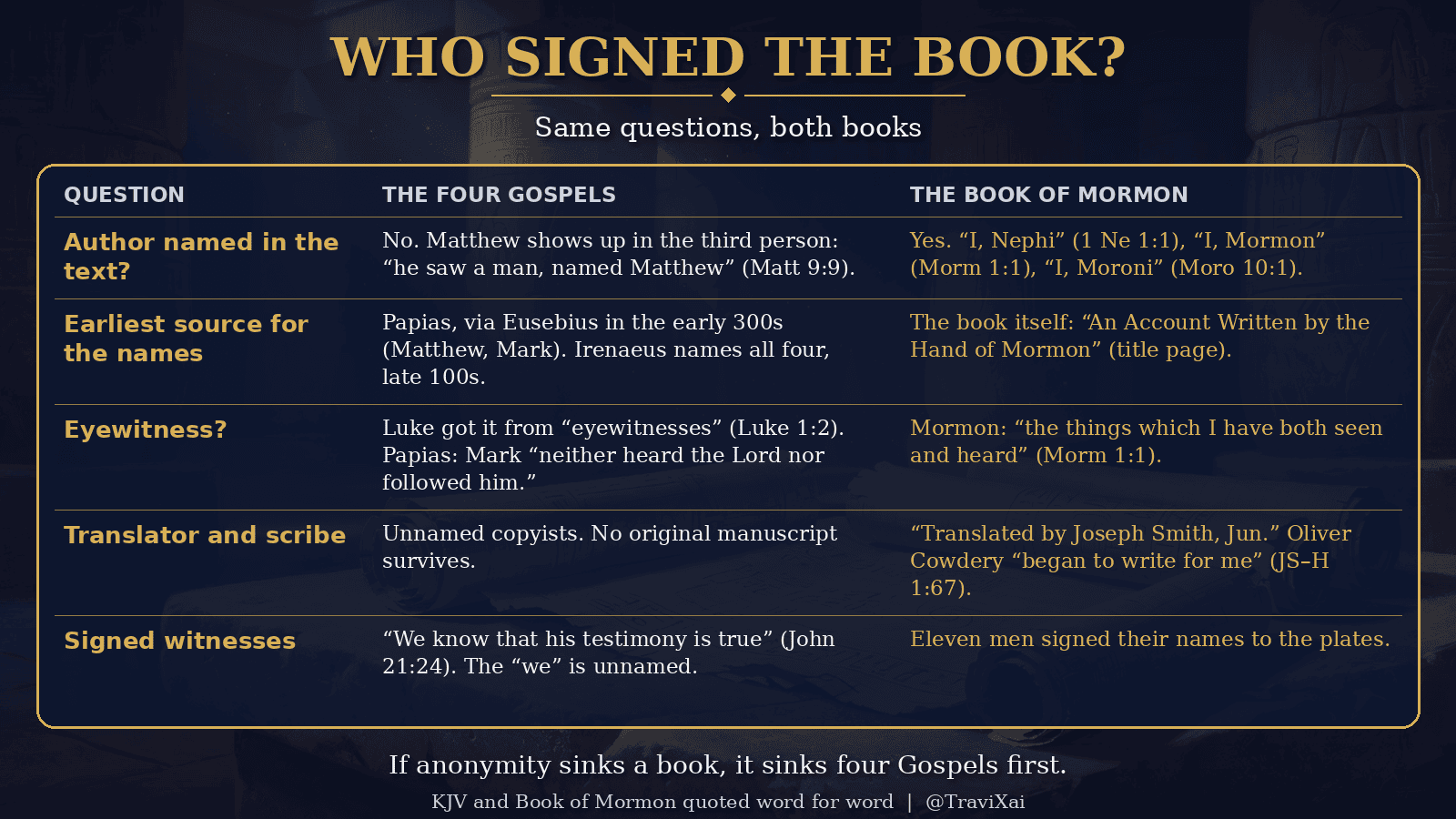
So “Joseph? Spalding? Rigdon?” isn’t an authorship problem. The book names its authors, abridger, translator, scribe, and witnesses. The critic just doesn’t believe them. That’s a faith question, not a paper-trail question, and on paper the Book of Mormon wins by a mile.
Part VIIHow I actually know
This isn’t an attack on the Gospels. I love them, I call them Matthew, Mark, Luke, and John like everybody else, and the traditional names may well be right. Latter-day Saints believe “the Bible to be the word of God as far as it is translated correctly” (Article of Faith 8).
But I don’t believe the Gospels because Papias passed along a name. I believe them because God told me they’re true, the same way I know the Book of Mormon is true. John even told us why he wrote: “these are written, that ye might believe that Jesus is the Christ, the Son of God” (John 20:31). The test he set is belief, not a signature.
The Book of Mormon gives the same test. James says “If any of you lack wisdom, let him ask of God” (James 1:5), and Moroni promises that if you “ask God, the Eternal Father, in the name of Christ, if these things are not true,” with “real intent,” then “he will manifest the truth of it unto you, by the power of the Holy Ghost” (Moroni 10:4).
So here’s my offer to any critic. If anonymous authorship and secondhand tradition don’t stop you from trusting the Gospels, stop using authorship against a book that signs its name on page one. If they do matter, apply them to Matthew first.
SummaryKey takeaways
- No Gospel names its author in the text. Matthew appears in the third person (Matthew 9:9); Luke got his material from “eyewitnesses” (Luke 1:2).
- The titles were attached to the books. Titled manuscripts appear around AD 200; Justin Martyr (mid-100s) calls them “memoirs of the apostles” without names; Irenaeus (late 100s) is the first to name all four.
- The earliest naming tradition is Papias, known only through Eusebius. It’s secondhand, says Mark “neither heard the Lord nor followed him,” and Eusebius called Papias “of very limited understanding.”
- The Book of Mormon names its authors (“I, Nephi,” “I, Mormon,” “I, Moroni”), its abridger, its translator, its scribe, and eleven witnesses. Critics don’t lack names. They reject them.
Next time someone says nobody knows who wrote the Book of Mormon, hand them Matthew 1:1 and ask them to find the author’s name. Then hand them 1 Nephi 1:3. For quick, sourced answers on the Three and Eight Witnesses, the Spalding manuscript theory, the gold plates, and Bible inerrancy, open Galatians18. And for more like this every day, follow me on X at @TraviXai.
Sources
- King James Bible (Church of Jesus Christ of Latter-day Saints edition): Matthew 7:5 · Matthew 9:9 · Luke 1:1–4 · Acts 1:1 · John 20:30–31 · John 21:24–25 · 2 Thessalonians 2:2 · 2 Thessalonians 3:17 · James 1:5
- Book of Mormon and Pearl of Great Price: Title Page · Testimony of Three Witnesses · Testimony of Eight Witnesses · 1 Nephi 1:1–3 · Jacob 1:1 · Enos 1:1 · Jarom 1:1 · Omni 1:1 · Mormon 1:1 · Mormon 8:1 · Moroni 10:4–5 · Joseph Smith—History 1:66–67 · Articles of Faith 1:8–10 · D&C 29:11
- Eusebius, Church History, Book 3 (chapters 36 and 39, Papias; trans. A. C. McGiffert, NPNF 2nd series vol. 1, New Advent) and Church History, Book 6 (6.25.14, Origen on Hebrews)
- Irenaeus, Against Heresies, Book 3, chapter 1 (New Advent)
- Justin Martyr, First Apology, chapters 66–67 (New Advent)
- Bart Ehrman, “When Did the Gospels Get Their Names?” (The Bart Ehrman Blog, November 17, 2014)
- Michael Wolter on Martin Hengel and the Gospel titles, translated in “Michael Wolter, Martin Hengel, and the Titles of the Gospels” (German for Neutestamentler, January 5, 2015)
- Galatians18: The Three and Eight Witnesses · The Spaulding Manuscript · The Gold Plates · Is the Bible Infallible?
- Featured image and in-article graphics: original graphics by thebookofmormon.ai (painterly backgrounds; no photographs or likenesses of real people).