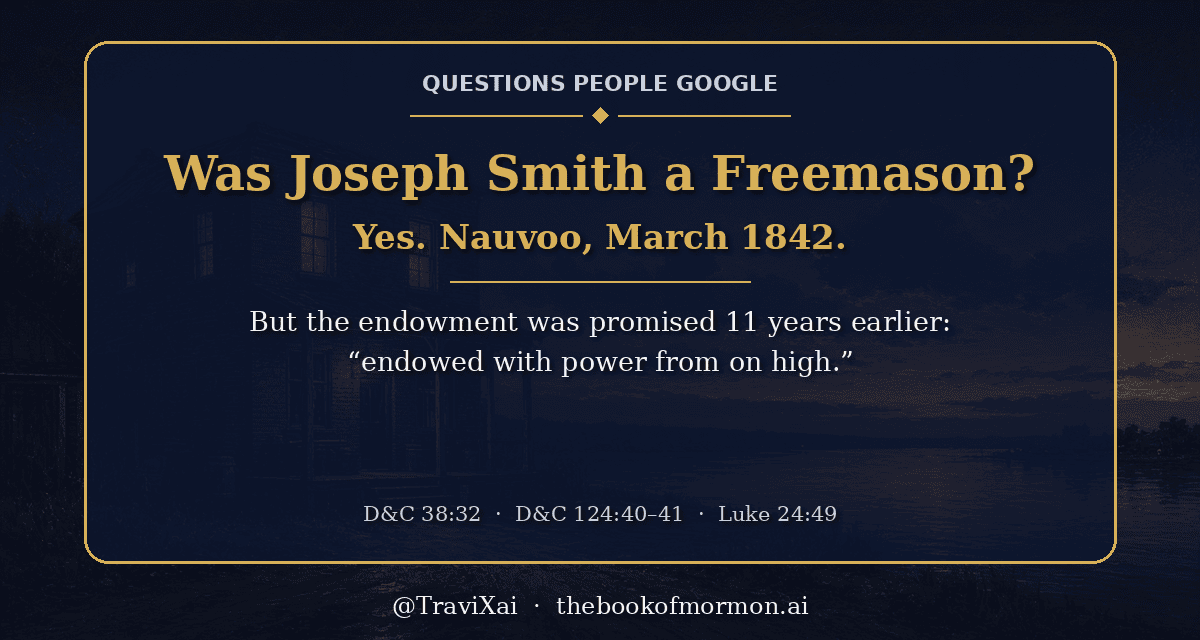

Yes, Joseph Smith became a Freemason in 1842. Here’s the history from the Church’s own records, and why that doesn’t mean the temple was borrowed from a lodge.
Yes. Joseph Smith became a Freemason in Nauvoo, Illinois, on March 15–16, 1842. The Church’s own history says so, and notes he introduced the temple endowment soon after. It also says there are “stark differences” in content and intent. The endowment was promised by revelation from 1831 on (D&C 38:32; 95:8; 124:40–41), and washing, clothing and anointing go back to Exodus 29. The first men endowed were all Masons, and they testified it came by revelation.
The historyYes, Joseph Smith joined the Masons
There’s no reason to dodge this one. The Church’s own history says so. According to the Church History Topics article “Masonry,” on March 15, 1842, Illinois Grand Master Abraham Jonas installed the officers of the new Nauvoo Lodge “and initiated Joseph and Sidney Rigdon to the degree of ‘Entered Apprentice’ in the upper-floor space above Joseph’s Red Brick Store. The next day, Jonas passed Joseph and Sidney as ‘Fellow Craft’ and raised them as ‘Master Masons’” (Masonry).
He wasn’t the first Latter-day Saint Mason. The same article notes that “Heber C. Kimball, Hyrum Smith, and others belonged to Masonic lodges in the 1820s.” Masonry was common in America then; the article mentions that George Washington and Benjamin Franklin were Masons.
Why did Joseph join? The Church is candid: “Historical sources do not explain Joseph Smith’s motives for joining the Freemasons.” It suggests he may have sought political allies and protection after betrayal in Missouri, and that Latter-day Saint Masons likely encouraged him.
The real questionThe question behind the question
Most people who search this aren’t asking about lodge history. They’re asking whether Joseph copied the temple endowment from Masonry. The Church answers that directly too: “Soon after he became a Mason, Joseph introduced the temple endowment. There are some similarities between Masonic ceremonies and the endowment, but there are also stark differences in their content and intent.”
Out of respect for what Latter-day Saints hold sacred, this post doesn’t describe temple ceremonies. It doesn’t need to. The history and the scriptures answer the copying claim on their own.
ChronologyThe endowment was promised before Joseph ever joined
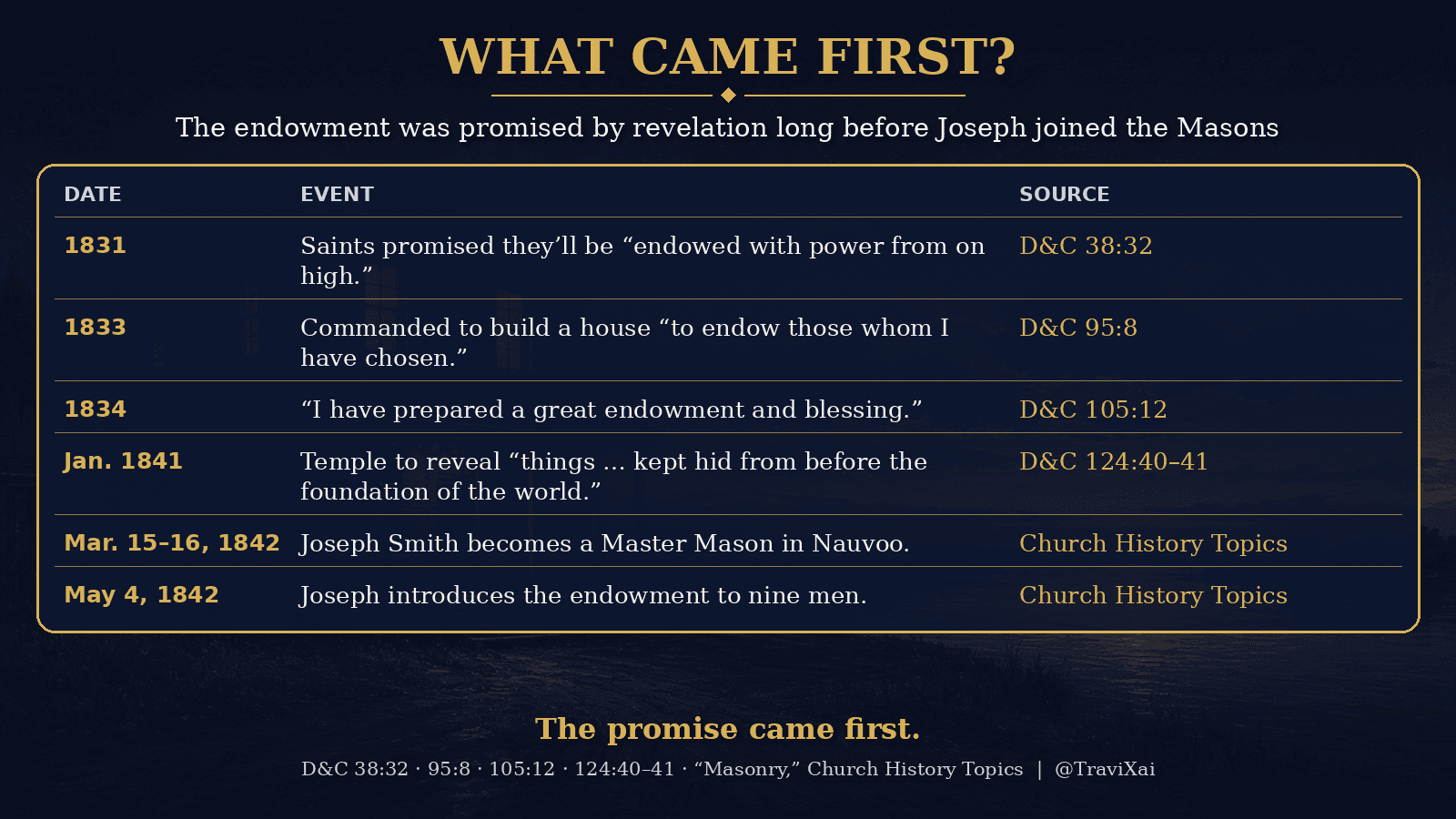
If the endowment were a Masonic idea, you’d expect it to appear only after Joseph joined in 1842. Instead, the revelations promise it for more than a decade before:
- 1831: “there you shall be endowed with power from on high” (D&C 38:32).
- 1833: “build a house, in the which house I design to endow those whom I have chosen with power from on high” (D&C 95:8).
- 1834: “I have prepared a great endowment and blessing to be poured out upon them” (D&C 105:12).
- January 1841, more than a year before Joseph became a Mason: “let this house be built unto my name, that I may reveal mine ordinances therein unto my people; For I deign to reveal unto my church things which have been kept hid from before the foundation of the world” (D&C 124:40–41).
The phrase itself is biblical. The risen Jesus told His apostles to “tarry ye in the city of Jerusalem, until ye be endued with power from on high” (Luke 24:49).
Exodus 29Ritual washing, clothing and anointing are older than Masonry
Critics often treat any ritual with symbolic clothing or ceremony as a Masonic fingerprint. But the Bible had it first. God told Moses, “Aaron and his sons thou shalt bring unto the door of the tabernacle of the congregation, and shalt wash them with water. And thou shalt take the garments, and put upon Aaron the coat … Then shalt thou take the anointing oil, and pour it upon his head, and anoint him” (Exodus 29:4–7; see Leviticus 8:6–7).
The Church’s article notes that Masonic rituals themselves “appear to have originated in early modern Europe,” with “no known Masonic documents before about 1400,” and that “aspects of these ceremonies bear resemblance to religious rites in many cultures, ancient and modern.” Masonry built its story around Solomon’s temple and Hiram, the craftsman Solomon “fetched … out of Tyre” (1 Kings 7:13–14). If two things share roots in the ancient temple, similarity doesn’t prove one copied the other.
Abraham described seeking “the blessings of the fathers, and the right whereunto I should be ordained to administer the same” (Abraham 1:2). Latter-day Saints believe the temple restores that kind of ancient priesthood blessing.
What they saidWhat the first Latter-day Saint Masons concluded
The men who knew both best were the nine men Joseph first endowed on May 4, 1842, all of whom were Masons. Heber C. Kimball wrote to Parley P. Pratt, “We have received some precious things through the Prophet on the priesthood,” noting “there is a similarity of priesthood in masonry,” and that Joseph believed Masonry was “taken from priesthood but has become degenerated” (quoted in Masonry). Joseph Fielding wrote that Masonry “seems to have been a Stepping Stone or Preparation for something else.”
In other words, the people with the most firsthand knowledge saw the similarities and still testified that the endowment came by revelation. The Church article concludes: “the endowment did not simply imitate the rituals of Freemasonry. Rather, Joseph’s encounter with Masonry evidently served as a catalyst for revelation.”
SubstanceReal differences in purpose and access
The Church article lists differences that go beyond form:
- Purpose: Masonic ceremonies aim at “making better men, who in turn make a better society.” In the temple, “men and women covenant with God to obey His laws for the purpose of gaining exaltation through the Atonement of Jesus Christ.” The power is in Christ and His priesthood ordinances: “in the ordinances thereof, the power of godliness is manifest” (D&C 84:20).
- Content: Masonic rituals draw on Masonic legends; the endowment “draws primarily upon the revelations and inspired translations given to Joseph Smith.”
- Women: “most Masonic groups excluded women,” but Joseph “taught that it was essential that Latter-day Saint women receive the endowment.”
- Access: Joseph hoped to give it “even to the weakest of the Saints,” and thousands received it in Nauvoo.
The relationship didn’t last. Illinois’s Grand Lodge withdrew the Nauvoo Lodge’s dispensation in October 1843 and severed ties in October 1844, and witnesses noted there were Masons in the mob that killed Joseph and Hyrum. After arriving in Utah, “Latter-day Saints did not establish new Masonic lodges.” Today the Church has no connection to Freemasonry.
Book of MormonWhat about “secret combinations”?
Some critics say the Book of Mormon’s warnings about secret combinations were aimed at Masons, since it came out in 1830 during an anti-Masonic movement. Read what the book actually condemns. The Gadianton robbers had “secret signs” and “secret words” so “that whatsoever wickedness his brother should do he should not be injured by his brother … And thus they might murder, and plunder, and steal” (Helaman 6:22–23). Moroni warns against combinations “built up to get power and gain” that shed “the blood of his saints” (Ether 8:22–23).
The Book of Moses traces the same thing to Cain: “from the days of Cain, there was a secret combination, and their works were in the dark” (Moses 5:51). These are criminal conspiracies to murder for gain, not a charitable fraternity. Joseph joining a lodge in 1842 is itself evidence that he didn’t see the two as the same thing.
Check the premiseThe presuppositions baked into the question
Before this question can be answered fairly, the person asking has to justify a few assumptions packed inside it:
- That “Joseph was a Mason” is a hidden fact the Church avoids. The Church publishes the dates, the lodge, and the degrees in its own Church History Topics article.
- That similarity proves copying. The endowment was promised by revelation from 1831 to 1841 (D&C 38:32; 95:8; 124:40–41), before Joseph joined. Ritual washing and anointing appear in Exodus 29, thousands of years before Masonry.
- That Masonry is ancient and the endowment is new. The Church notes there are “no known Masonic documents before about 1400” and that Masonic rituals “appear to have originated in early modern Europe.”
- That the people closest to it were fooled. The first men endowed were all Masons. They saw the similarities and still testified the endowment came by revelation.
FAQQuick answers
Was Joseph Smith a Freemason?
Yes. He was initiated in the Nauvoo Lodge on March 15, 1842, and raised to Master Mason the next day, according to the Church History Topics article “Masonry.”
Did Joseph Smith copy the temple endowment from the Masons?
The Church acknowledges “some similarities” but “stark differences in their content and intent.” The endowment was promised by revelation years earlier (D&C 38:32; 95:8; 124:40–41), and the first Latter-day Saints endowed, all Masons, testified it came by revelation.
Were other early Latter-day Saints Masons?
Yes. Heber C. Kimball, Hyrum Smith and others were Masons in the 1820s, before joining the Church. The Nauvoo Lodge became the largest in Illinois.
Is the Church of Jesus Christ of Latter-day Saints connected to Freemasonry today?
No. After the Saints reached Utah, “Latter-day Saints did not establish new Masonic lodges,” and the Church has no affiliation with Freemasonry.
Is the Book of Mormon anti-Masonic?
The Book of Mormon condemns “secret combinations” formed to murder and plunder for “power and gain” (Helaman 6:22–23; Ether 8:22–23). It doesn’t name Masonry, and Joseph Smith later joined a Masonic lodge.
When did Joseph Smith become a Freemason?
In March 1842, when he was initiated into the Nauvoo Lodge, a few weeks before he first administered the temple endowment in May 1842.
Are there similarities between the temple and Masonic ritual?
Some, in symbols and wording. Latter-day Saints believe the endowment was revealed to restore ancient temple worship, and Masonry itself claims roots in Solomon’s temple. Shared symbols don’t make the endowment a copy, any more than shared imagery makes Revelation a copy of Ezekiel.
Can Latter-day Saints be Freemasons today?
Yes. The Church has no rule against it, and the Grand Lodge of Utah dropped its ban on Latter-day Saint members in 1984.
SummaryKey takeaways
- Joseph Smith joined the Nauvoo Masonic Lodge in March 1842; the Church publishes this openly.
- The endowment was promised by revelation from 1831, more than a decade before he became a Mason.
- Washing, clothing and anointing are biblical (Exodus 29), far older than Masonry.
- The temple’s purpose is covenants with God through Jesus Christ, offered to women and men alike.
Read the Church’s full article, “Masonry,” and D&C 124:40–41 for yourself. For quick, sourced answers, open Galatians18, and follow me on X at @TraviXai.
Sources
- King James Bible (churchofjesuschrist.org): Exodus 29:4–9 · Leviticus 8:6–7 · 1 Kings 7:13–14 · Luke 24:49
- Book of Mormon: Helaman 6:22–26 · Ether 8:22–25
- Doctrine and Covenants and Pearl of Great Price: D&C 38:32 · D&C 84:19–22 · D&C 95:8 · D&C 105:11–12 · D&C 124:40–41 · Moses 5:49–51 · Abraham 1:2
- “Masonry,” Church History Topics, churchofjesuschrist.org (source of all dates, the Kimball and Fielding quotations, and the quoted analysis)
- Further reading listed by the Church: Steven C. Harper, “Freemasonry and the Latter-day Saint Temple Endowment Ceremony,” in Laura Harris Hales, ed., A Reason for Faith: Navigating LDS Doctrine and Church History (Provo, UT: Religious Studies Center, BYU, 2016).
- Featured image and in-article graphic: original graphics by thebookofmormon.ai (painterly backgrounds; no photographs or likenesses of real people).