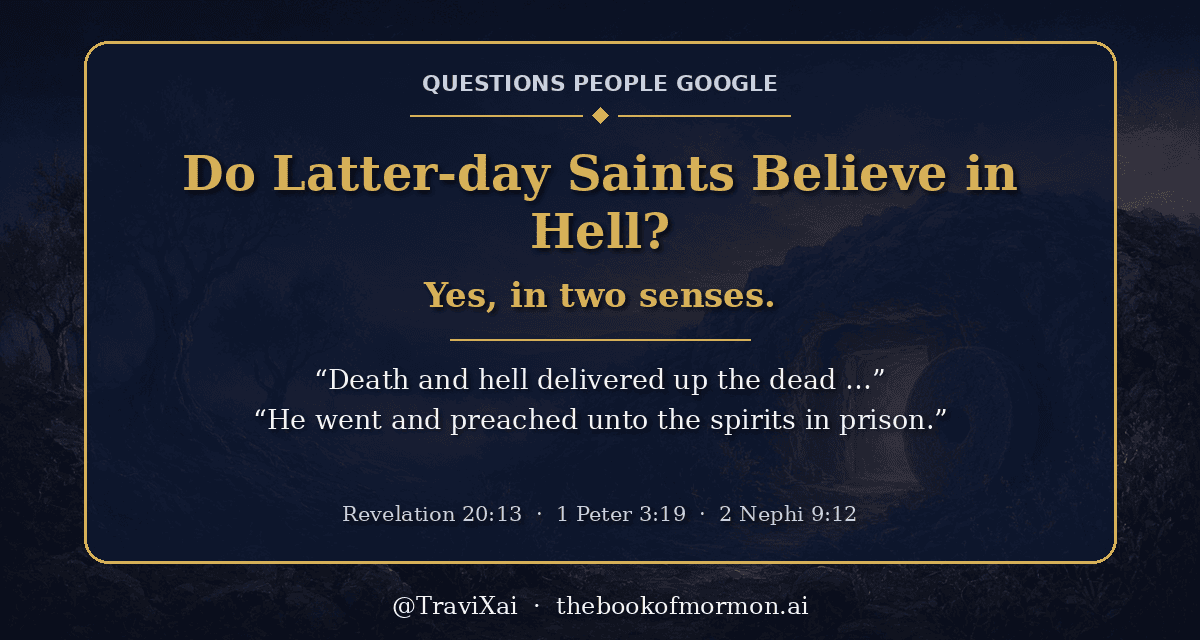

Some people think Latter-day Saints don’t believe in hell at all. We do, in two different senses. Here’s what the Bible, the Book of Mormon and modern revelation say.
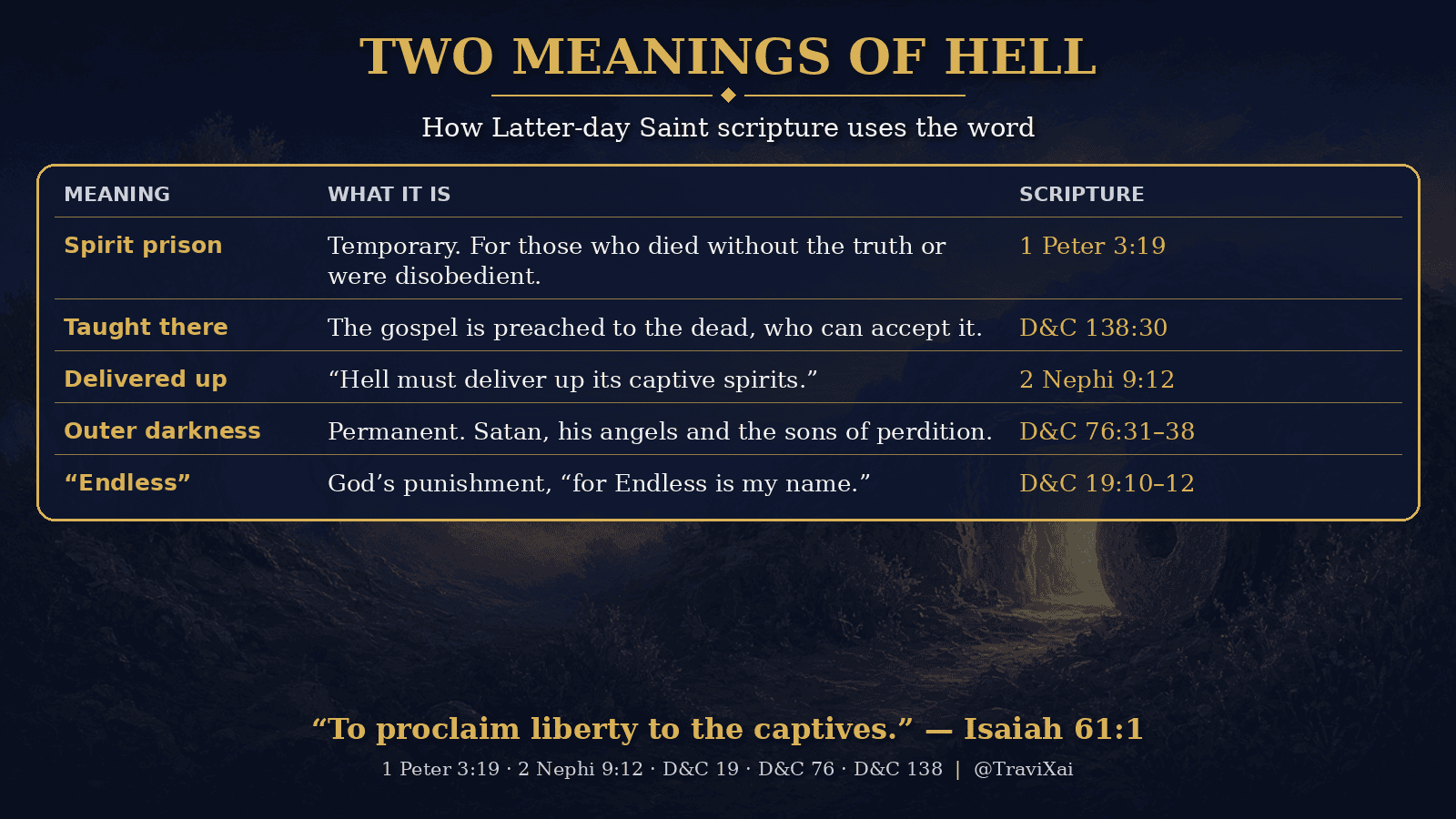
Yes. Latter-day Saints believe in hell in two senses. First, spirit prison: a temporary place after death for those who died without the truth or were disobedient, where the gospel is preached (1 Peter 3:19; D&C 138:30). At the resurrection, “hell must deliver up its captive spirits” (2 Nephi 9:12). Second, outer darkness: the permanent state of Satan and the sons of perdition, who knew God’s power and defied it (D&C 76:31–38).
Two sensesYes. Hell has two meanings
The Church’s Topics and Questions entry “Hell” explains: “Latter-day revelations speak of hell in at least two ways. First, it is another name for spirit prison, a temporary place in the postmortal world for those who died without a knowledge of the truth or those who were disobedient in mortality. Second, it is the permanent location of Satan and his followers and the sons of perdition, who are not redeemed by the Atonement of Jesus Christ” (Hell).
Both meanings are in the Bible. Revelation says “death and hell delivered up the dead which were in them” (Revelation 20:13), so there is a hell that gives up its prisoners. Then “death and hell were cast into the lake of fire. This is the second death” (Revelation 20:14).
1 Peter 3Spirit prison: real, but not the end
At death, Alma taught, “the spirits of all men … are taken home to that God who gave them life.” The righteous go to “a state of happiness, which is called paradise,” while the wicked are “cast out into outer darkness; there shall be weeping, and wailing, and gnashing of teeth, and this because of their own iniquity … thus they remain in this state … until the time of their resurrection” (Alma 40:11–14). Notice the last phrase: until the resurrection.
Peter wrote that Christ, “being put to death in the flesh, but quickened by the Spirit,” “went and preached unto the spirits in prison; which sometime were disobedient … in the days of Noah” (1 Peter 3:18–20). “For for this cause was the gospel preached also to them that are dead” (1 Peter 4:6). Isaiah foresaw the Messiah would “proclaim liberty to the captives, and the opening of the prison to them that are bound” (Isaiah 61:1).
The Pearl of Great Price describes the same prison for those who died in the Flood: “a prison have I prepared for them,” and the Chosen One “suffereth for their sins; inasmuch as they will repent in the day that my Chosen shall return unto me, and until that day they shall be in torment” (Moses 7:38–39).
In 1918 President Joseph F. Smith saw how this works: the Lord “organized his forces and appointed messengers … and thus was the gospel preached to the dead” (D&C 138:30), including “those who had died in their sins, without a knowledge of the truth” (D&C 138:32). This is why Latter-day Saints do baptisms for the dead.
2 Nephi 9Hell must deliver up its captives
Jacob taught one of the most hopeful passages in scripture: “O how great the goodness of our God, who prepareth a way for our escape from the grasp of this awful monster; yea, that monster, death and hell” (2 Nephi 9:10). “Death and hell must deliver up their dead, and hell must deliver up its captive spirits, and the grave must deliver up its captive bodies … and it is by the power of the resurrection of the Holy One of Israel” (2 Nephi 9:12).
This doesn’t make sin harmless. Those who reject the gospel and don’t repent remain in spirit prison until the last resurrection: “These are they who are thrust down to hell. These are they who shall not be redeemed from the devil until the last resurrection” (D&C 76:84–85). The Church’s “Hell” entry says they “will remain in spirit prison until the end of the Millennium, when they will be freed from hell and punishment and be resurrected to a telestial glory.”
D&C 19What “eternal punishment” means
Many Christians read “everlasting punishment” as punishment that never ends for everyone in hell. In an early revelation to Joseph Smith, the Lord explained the phrase: “it is not written that there shall be no end to this torment, but it is written endless torment … For, behold, I am endless, and the punishment which is given from my hand is endless punishment, for Endless is my name. Wherefore— Eternal punishment is God’s punishment. Endless punishment is God’s punishment” (D&C 19:6–12).
The same revelation explains why the suffering matters: “I, God, have suffered these things for all, that they might not suffer if they would repent; But if they would not repent they must suffer even as I; Which suffering caused myself, even God, the greatest of all, to tremble because of pain, and to bleed at every pore” (D&C 19:16–18). Christ’s Atonement is the way out. Refusing it has real, painful consequences.
Outer darknessThe permanent hell
There is also a hell with no exit. It belongs to Satan and his angels and to “the sons of perdition,” those “who know my power, and have been made partakers thereof, and suffered themselves through the power of the devil to be overcome, and to deny the truth and defy my power” (D&C 76:31). For them, “there is no forgiveness in this world nor in the world to come” (D&C 76:34), and they are “the only ones on whom the second death shall have any power” (D&C 76:37). They “go away into everlasting punishment … where their worm dieth not, and the fire is not quenched” (D&C 76:44), and must “abide a kingdom which is not a kingdom of glory” (D&C 88:24).
Jesus described a “great gulf fixed” between the righteous and the wicked after death (Luke 16:26). Latter-day Saints believe Christ Himself bridged that gulf for those willing to repent, by preaching to the spirits in prison (1 Peter 3:19; D&C 138:29–30).
Check the premiseThe presuppositions baked into the question
Before this question can be answered fairly, the person asking has to justify a few assumptions packed inside it:
- That Latter-day Saints don’t believe in hell. We do, in two senses: temporary spirit prison and the permanent state of Satan and the sons of perdition (D&C 76:31–38, 84–85).
- That everyone in hell stays there forever. Revelation 20:13 says hell delivers up its dead, and 2 Nephi 9:12 says “hell must deliver up its captive spirits.”
- That “eternal punishment” must mean punishment with no end for all. D&C 19:10–12 explains that “Endless” is God’s name: “Eternal punishment is God’s punishment.”
- That believing in mercy after death makes repentance unimportant. Those who won’t repent suffer “even as I” (D&C 19:17) and stay in prison until the last resurrection (D&C 76:85).
FAQQuick answers
Do Latter-day Saints believe in hell?
Yes. The Church teaches that hell has two meanings: a temporary spirit prison for those who died without the truth or were disobedient, and the permanent state of Satan, his angels and the sons of perdition.
What is spirit prison?
A temporary state after death where spirits who didn’t receive the gospel in life are taught it and can repent (1 Peter 3:19; 4:6; D&C 138:30–32). Those who accept it can enter paradise.
What is outer darkness?
The permanent condition of Satan, his angels and the sons of perdition, who knew God’s power and denied and defied it (D&C 76:31–38). It is “a kingdom which is not a kingdom of glory” (D&C 88:24).
Is hell forever according to Latter-day Saints?
For most people, no: “hell must deliver up its captive spirits” at the resurrection (2 Nephi 9:12). For the sons of perdition, yes; they are “the only ones on whom the second death shall have any power” (D&C 76:37).
What does “eternal punishment” mean in Latter-day Saint scripture?
D&C 19:10–12 says, “Endless is my name. Wherefore— Eternal punishment is God’s punishment. Endless punishment is God’s punishment.” It names whose punishment it is, not necessarily how long each person suffers.
Did Jesus preach to the dead?
Yes. Peter says Christ “went and preached unto the spirits in prison” (1 Peter 3:19), and “for this cause was the gospel preached also to them that are dead” (1 Peter 4:6).
Who are the sons of perdition?
Those who have known God’s power, then deny it and defy Him, “having denied the Holy Spirit after having received it” (D&C 76:35). They are the only ones who receive no kingdom of glory.
Do Latter-day Saints believe everyone is saved in the end?
No. Nearly everyone receives a kingdom of glory after the resurrection, but the unrepentant suffer first. Christ said, “if they would not repent they must suffer even as I” (D&C 19:17), and sons of perdition receive no glory.
SummaryKey takeaways
- Hell means both a temporary spirit prison and the permanent state of the sons of perdition.
- Christ preached to the spirits in prison (1 Peter 3:19), and the gospel is still taught there (D&C 138).
- “Hell must deliver up its captive spirits” at the resurrection (2 Nephi 9:12).
- Sin is real and painful; Christ suffered so we wouldn’t have to if we repent (D&C 19:16–18).
Read 1 Peter 3–4 alongside D&C 138 and see how they fit. For quick, sourced answers, open Galatians18, and follow me on X at @TraviXai.
Sources
- King James Bible (churchofjesuschrist.org): Isaiah 61:1 · Luke 16:26 · 1 Peter 3:18–20 · 1 Peter 4:6 · Revelation 20:13–14
- Book of Mormon: 2 Nephi 9:10–12 · Alma 40:11–14
- Doctrine and Covenants and Pearl of Great Price: D&C 19:6–12 · D&C 19:16–18 · D&C 76:31–38 · D&C 76:44 · D&C 76:84–85 · D&C 88:24 · D&C 138:29–32 · Moses 7:38–39
- “Hell,” Topics and Questions, churchofjesuschrist.org
- Featured image and in-article graphic: original graphics by thebookofmormon.ai (painterly backgrounds; no photographs or likenesses of real people).