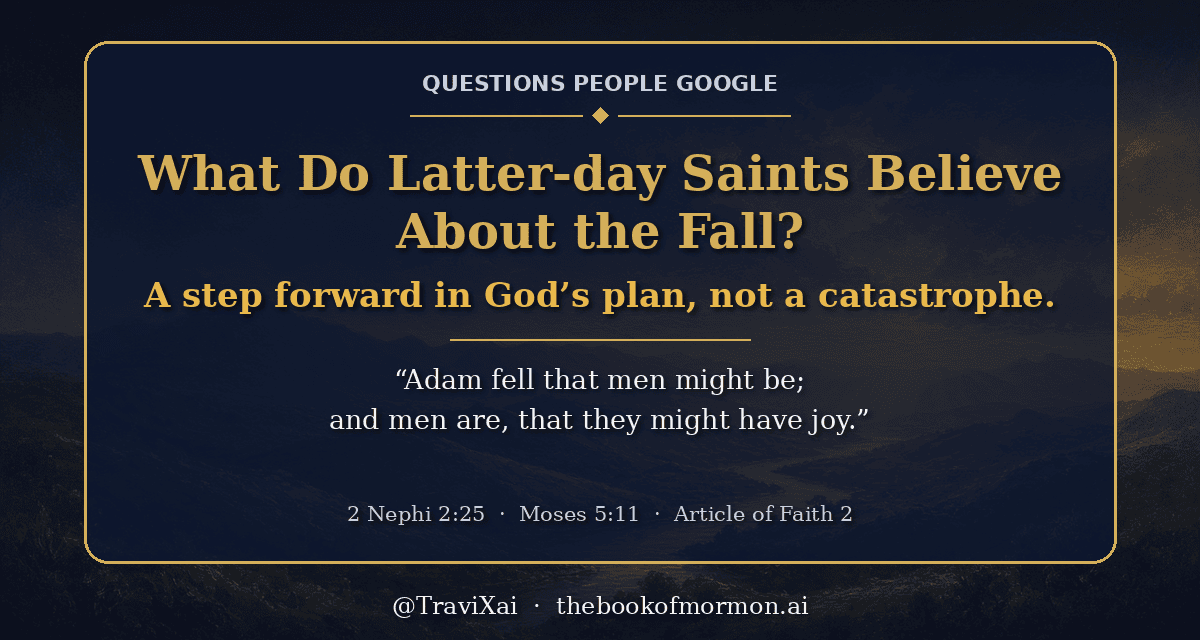

Most of Christianity calls it a catastrophe. Restoration scripture calls it the step that made families, agency and joy possible.
Latter-day Saints believe the Fall of Adam and Eve was a real, necessary step in God’s plan. “Adam fell that men might be; and men are, that they might have joy” (2 Nephi 2:25). Without it they “would have had no children” (2 Nephi 2:23). It brought physical and spiritual death, which Jesus Christ overcomes: “as in Adam all die, even so in Christ shall all be made alive” (1 Corinthians 15:22). There is no inherited guilt: “men will be punished for their own sins, and not for Adam’s transgression” (Article of Faith 2).
The short answerThe Fall moved God’s plan forward
Latter-day Saints believe the Fall of Adam and Eve was real, had real consequences (physical death and separation from God’s presence), and was a necessary step in our Father’s plan. The Book of Mormon puts it in seven words: “Adam fell that men might be; and men are, that they might have joy” (2 Nephi 2:25).
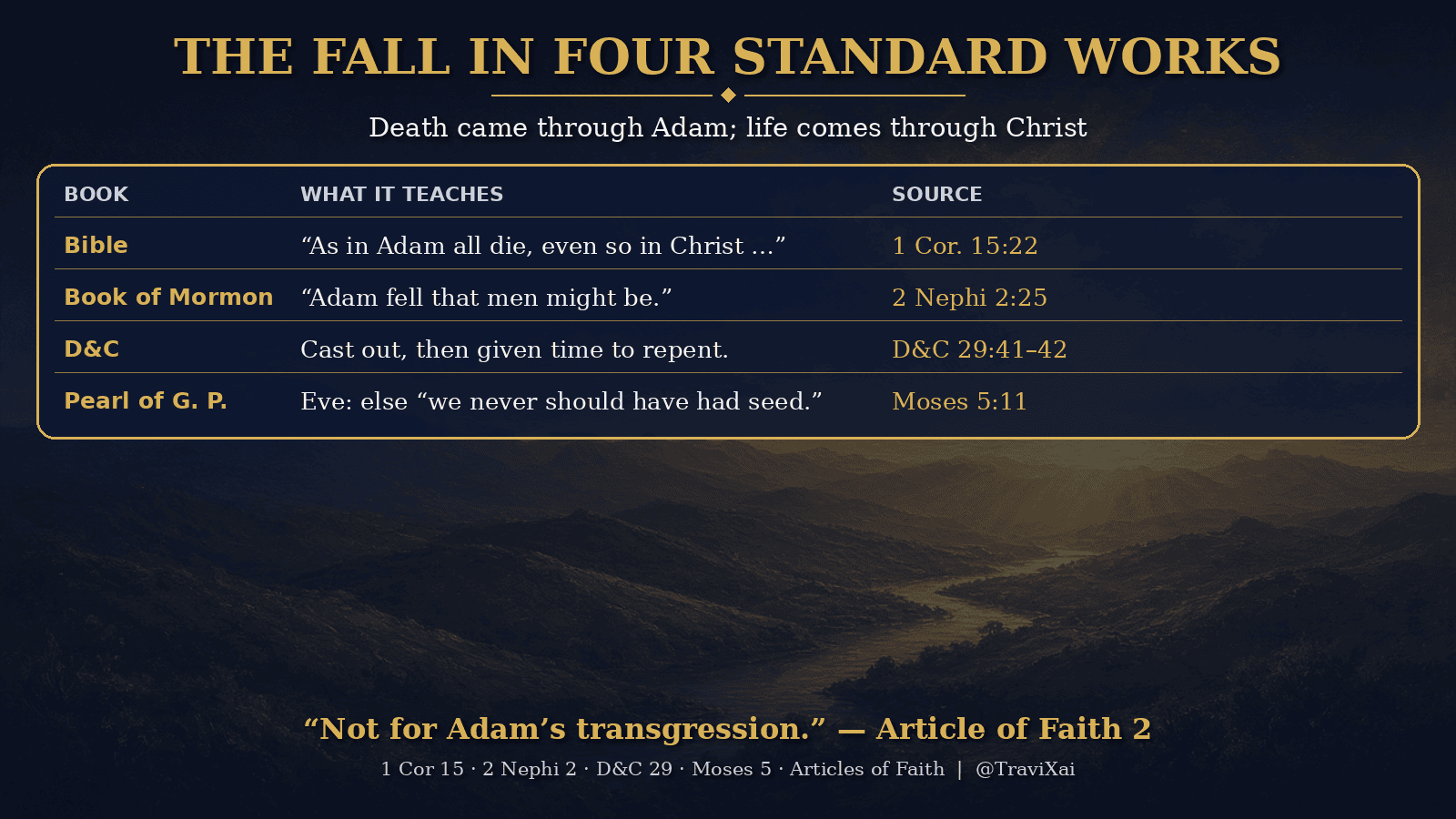
Without the Fall, Adam and Eve “would have had no children; wherefore they would have remained in a state of innocence, having no joy, for they knew no misery; doing no good, for they knew no sin” (2 Nephi 2:22–23). And through Jesus Christ the Fall is fully answered: “as in Adam all die, even so in Christ shall all be made alive” (1 Corinthians 15:21–22).
Eve was glad, not ashamedMoses 5:10–11
The Pearl of Great Price records what Adam and Eve themselves said after leaving the garden. Adam: “Blessed be the name of God, for because of my transgression my eyes are opened, and in this life I shall have joy, and again in the flesh I shall see God.” Eve “was glad, saying: Were it not for our transgression we never should have had seed, and never should have known good and evil, and the joy of our redemption, and the eternal life which God giveth unto all the obedient” (Moses 5:10–11).
That is why Latter-day Saints honor Eve as a wise and courageous mother of all living, not the villain of the story. Her choice opened mortality, family, and the path home.
A real choice, with opposition“Thou mayest choose for thyself”
In the restored text of Genesis, God’s command carries a striking phrase: “thou shalt not eat of it, nevertheless, thou mayest choose for thyself, for it is given unto thee; but, remember that I forbid it” (Moses 3:17). Lehi explains why: “it must needs be that there was an opposition; even the forbidden fruit in opposition to the tree of life … Wherefore, the Lord God gave unto man that he should act for himself” (2 Nephi 2:15–16).
Scripture calls it a “transgression,” and it had real effects: Adam “became spiritually dead,” cut off from God’s presence, yet the Lord gave him time and sent “angels to declare unto them repentance and redemption, through faith on the name of mine Only Begotten Son” (D&C 29:40–42). Mortality “became a state for them to prepare; it became a preparatory state” (Alma 42:9–10). We still have to put off “the natural man,” which “is an enemy to God, and has been from the fall of Adam” (Mosiah 3:19).
No original sinArticle of Faith 2
Latter-day Saints reject the idea that babies inherit Adam’s guilt. “We believe that men will be punished for their own sins, and not for Adam’s transgression” (Article of Faith 2). The Lord told Adam, “Behold I have forgiven thee thy transgression in the Garden of Eden. Hence came the saying abroad among the people, that the Son of God hath atoned for original guilt, wherein the sins of the parents cannot be answered upon the heads of the children” (Moses 6:53–54). That is why children are not baptized until they are accountable. See Why Do Latter-day Saints Baptize at 8?.
“As gods, knowing good and evil”The Fall points toward exaltation
After the Fall, God Himself said: “Behold, the man is become as one of us, to know good and evil” (Genesis 3:22). Latter-day Saints take that seriously. The Fall began the mortal schooling through which God’s children can become like Him. Joseph Smith taught it plainly in the King Follett sermon: “God himself was once as we are now, and is an exalted man,” and “you have got to learn how to be gods yourselves … the same as all gods have done before you, namely, by going from one small degree to another … from grace to grace, from exaltation to exaltation.”
This is not a new or fringe idea. It has been taught for nearly two centuries: our Father passed through what we pass through; He had a Father; and His faithful children, always remaining His children, may inherit what He has, including eternal increase and worlds without number. The Fall is the doorway into that journey. See What Is the Plan of Salvation? and What Is the Premortal Life?.
Christ answers the FallBorn again
The Fall makes a Savior necessary. “By reason of transgression cometh the fall, which fall bringeth death … even so ye must be born again into the kingdom of heaven, of water, and of the Spirit, and be cleansed by blood, even the blood of mine Only Begotten” (Moses 6:59). “The Messiah cometh in the fulness of time, that he may redeem the children of men from the fall” (2 Nephi 2:26).
Check the premiseThe presuppositions baked into the question
Before this question can be answered fairly, the person asking has to justify a few assumptions packed inside it:
- That the Fall was a disaster that ruined God’s plan. “All things have been done in the wisdom of him who knoweth all things” (2 Nephi 2:24).
- That every baby is born guilty of Adam’s sin. Article of Faith 2; Moses 6:54: “the Son of God hath atoned for original guilt.”
- That Eve is to blame. Eve “was glad” and saw the path to redemption and eternal life (Moses 5:11).
- That the Fall had no consequences. It brought physical and spiritual death (D&C 29:41; Alma 42:9), which only Christ overcomes.
FAQQuick answers
Do Latter-day Saints believe the Fall was good?
They believe it was necessary and part of God’s plan: “Adam fell that men might be; and men are, that they might have joy” (2 Nephi 2:25). It also brought real death, which Christ overcomes.
Do Latter-day Saints believe in original sin?
No. “Men will be punished for their own sins, and not for Adam’s transgression” (Article of Faith 2).
Was eating the fruit a sin or a transgression?
Scripture calls it a “transgression” (Moses 5:10–11; D&C 29:40–41; Article of Faith 2).
What would have happened without the Fall?
Adam and Eve “would have had no children” and would have stayed in innocence, “having no joy, for they knew no misery” (2 Nephi 2:22–23).
How does Jesus Christ overcome the Fall?
“As in Adam all die, even so in Christ shall all be made alive” (1 Corinthians 15:22); He came “that he may redeem the children of men from the fall” (2 Nephi 2:26).
Do Latter-day Saints blame Eve for the Fall?
No. They honor her. Eve rejoiced: “Were it not for our transgression we never should have had seed, and never should have known good and evil, and the joy of our redemption” (Moses 5:11).
Did God plan for a Savior before the Fall?
Yes. Christ is “the Lamb slain from the foundation of the world” (Revelation 13:8).
Why did God allow opposition?
Lehi taught, “it must needs be, that there is an opposition in all things” (2 Nephi 2:11). Without it there could be no choice, no growth and no joy.
SummaryKey takeaways
- The Fall was a necessary part of God’s plan (2 Nephi 2:22–25).
- Eve rejoiced in it (Moses 5:11).
- No original sin: Article of Faith 2; Moses 6:54.
- Mortality is the school for becoming like our Father (Genesis 3:22).
- Christ redeems all from the Fall (1 Corinthians 15:22).
Read 2 Nephi 2 and Moses 5 side by side. For quick, sourced answers, open Galatians18, and follow me on X at @TraviXai.
Sources
- King James Bible (churchofjesuschrist.org): Genesis 3:22 · 1 Corinthians 15:21–22
- Book of Mormon: 2 Nephi 2:15–27 · Mosiah 3:19 · Alma 42:9–10
- Doctrine and Covenants: D&C 29:40–42
- Pearl of Great Price: Moses 3:17 · Moses 5:10–11 · Moses 6:53–59 · Article of Faith 2
- Joseph Smith, King Follett sermon, April 7, 1844, History of the Church 6:305–306
- Featured image and in-article graphic: original graphics by thebookofmormon.ai (painterly backgrounds; no photographs or likenesses of real people).