
Peter called it “the restitution of all things.” Here is what Latter-day Saints believe was lost, what came back, and who brought it.
The question often assumes nothing was ever lost, or that a restoration is just another reform movement. Scripture says otherwise. The Restoration is God bringing back priesthood authority, ordinances, scripture and plain truths through Joseph Smith, beginning in 1820. Peter said heaven would receive Christ “until the times of restitution of all things” (Acts 3:21). The authority came back from the men who had held it: “Upon you my fellow servants, in the name of Messiah I confer the Priesthood of Aaron” (D&C 13:1).
What it isRestored, not reformed
The Restoration is the Latter-day Saint belief that after the apostles died, priesthood authority, essential ordinances and many plain truths were lost from the earth. God then restored them, beginning in 1820, through Joseph Smith and the messengers who had held them anciently. The Lord described the result in 1831 as “the only true and living church upon the face of the whole earth, with which I, the Lord, am well pleased, speaking unto the church collectively and not individually” (D&C 1:30).
That is different from a reformation. A reformer works with what is already there and tries to fix it. A restoration assumes something was actually gone and had to be given back by someone with the right to give it. The Articles of Faith say why that matters: “a man must be called of God, by prophecy, and by the laying on of hands by those who are in authority,” and the Church should have “the same organization that existed in the Primitive Church, namely, apostles, prophets, pastors, teachers, evangelists, and so forth” (Articles of Faith 5–6).
The BibleThe Bible predicts a loss and a return
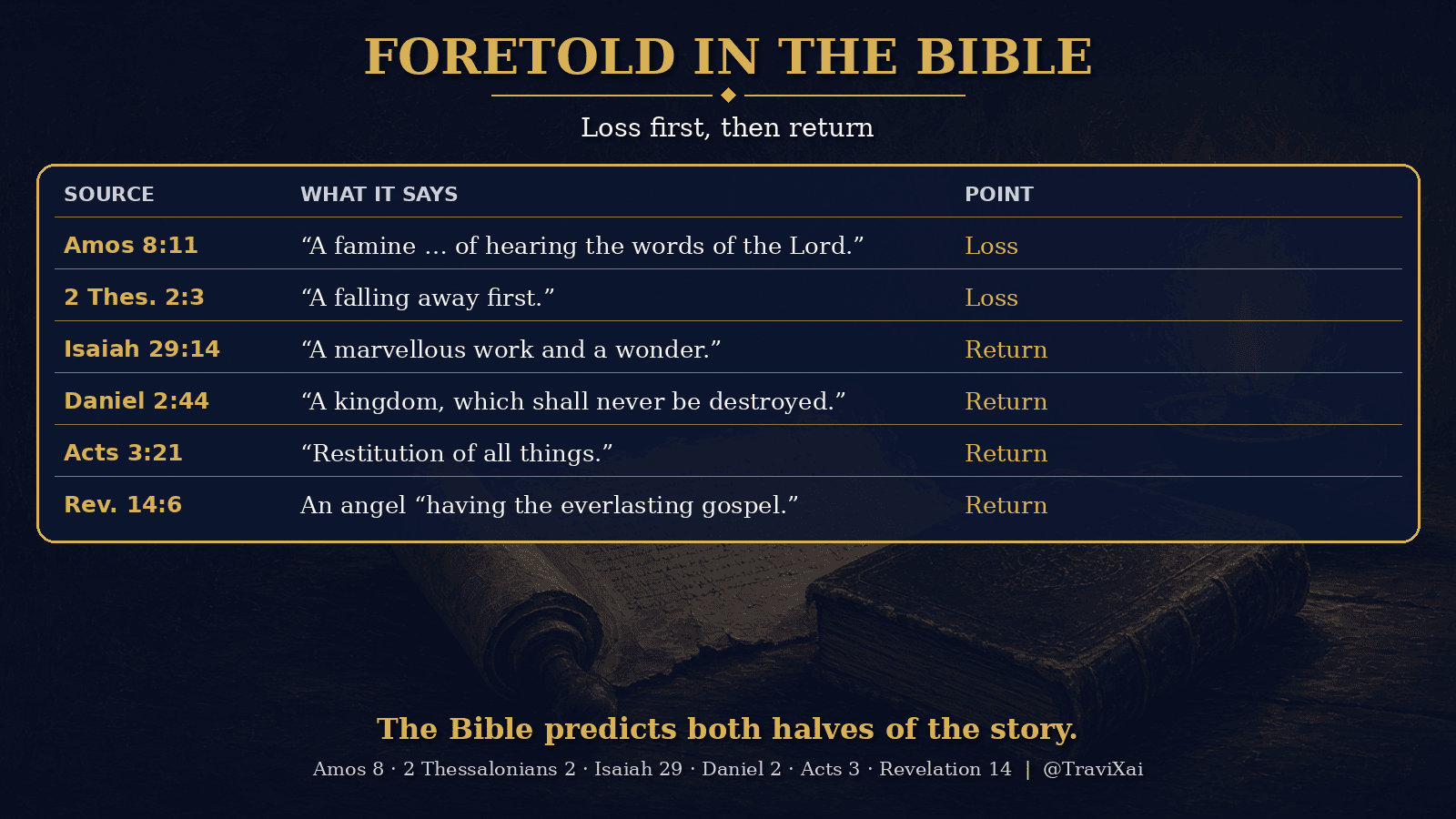
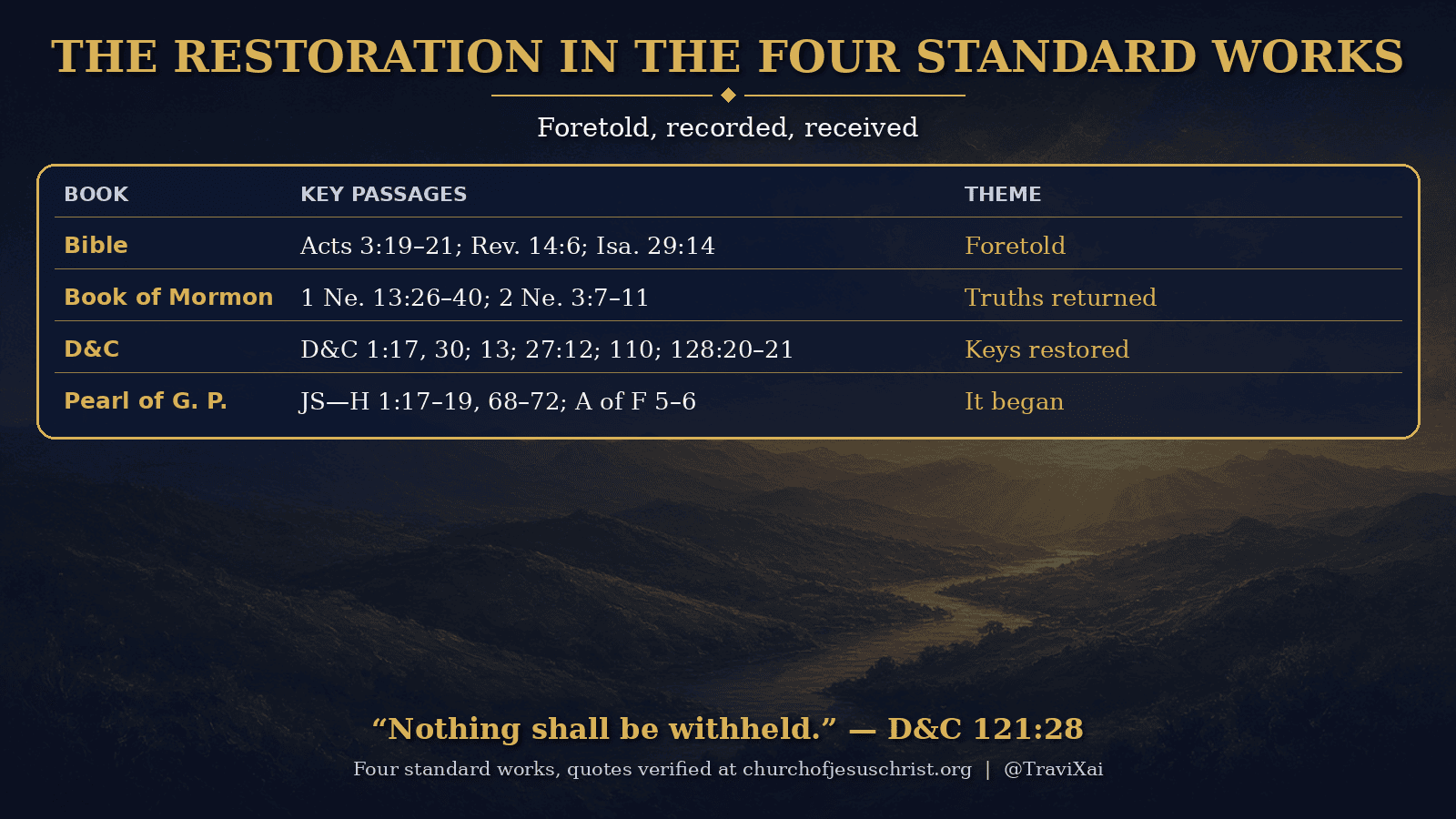
Peter, preaching at the temple after Pentecost, said heaven must receive Jesus Christ “until the times of restitution of all things, which God hath spoken by the mouth of all his holy prophets since the world began” (Acts 3:19–21). A restitution means something was taken away. Amos foretold “a famine in the land, not a famine of bread, nor a thirst for water, but of hearing the words of the Lord: … they shall run to and fro to seek the word of the Lord, and shall not find it” (Amos 8:11–12). Paul said the Second Coming would not come “except there come a falling away first” (2 Thessalonians 2:3). See The Great Apostasy in the New Testament’s Own Words.
Then the return. Isaiah, speaking of a people who “with their lips do honour me, but have removed their heart far from me, and their fear toward me is taught by the precept of men,” promised: “I will proceed to do a marvellous work among this people, even a marvellous work and a wonder” (Isaiah 29:13–14). Daniel saw that “the God of heaven set up a kingdom, which shall never be destroyed” (Daniel 2:44). John saw “another angel fly in the midst of heaven, having the everlasting gospel to preach unto them that dwell on the earth, and to every nation, and kindred, and tongue, and people” (Revelation 14:6–7). Latter-day Saints see that angel in Moroni.
The Book of MormonWhat was taken, and the seer who would return it
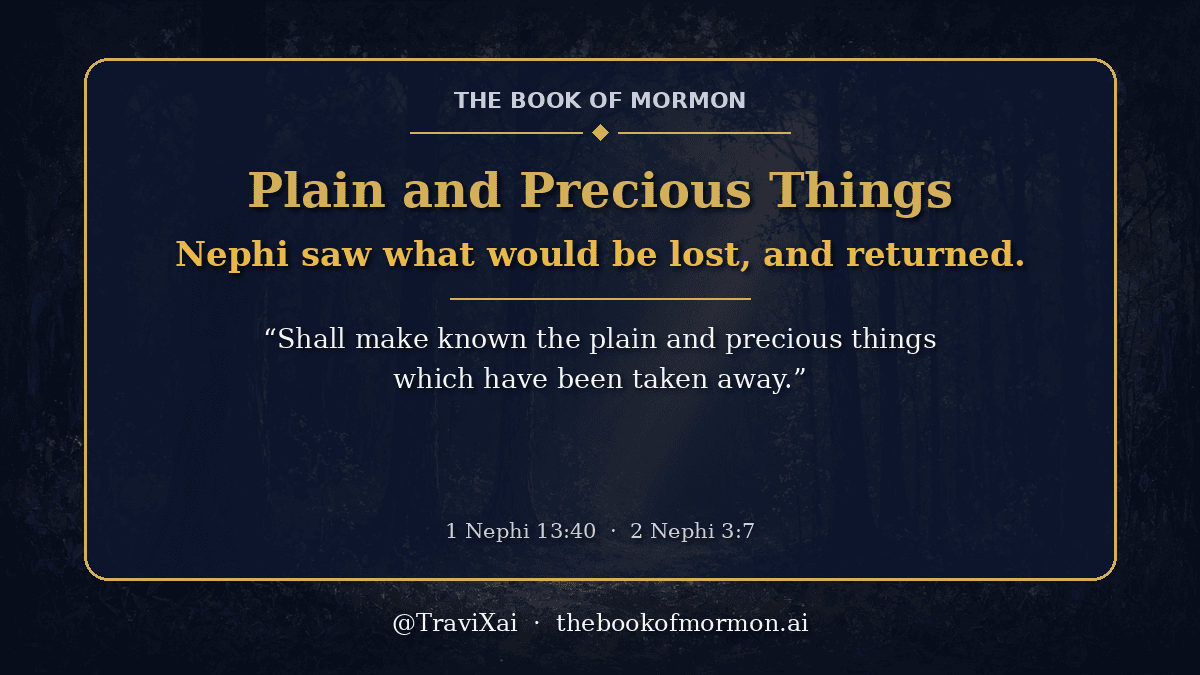
About 600 BC, Nephi saw the Bible go out from the apostles and then saw a loss: “they have taken away from the gospel of the Lamb many parts which are plain and most precious; and also many covenants of the Lord have they taken away,” so that “an exceedingly great many do stumble” (1 Nephi 13:26–29). He also saw the remedy: “These last records … shall establish the truth of the first, which are of the twelve apostles of the Lamb, and shall make known the plain and precious things which have been taken away from them” (1 Nephi 13:40). The Book of Mormon does not replace the Bible. It confirms it.
Joseph of Egypt had prophesied the man: “A choice seer will I raise up out of the fruit of thy loins … And unto him will I give commandment that he shall do a work … even to the bringing of them to the knowledge of the covenants which I have made with thy fathers” (2 Nephi 3:7), with power “not to the bringing forth my word only … but to the convincing them of my word, which shall have already gone forth among them” (2 Nephi 3:11). Verse 15 even gives his name: Joseph, after his father.
The Doctrine and CovenantsAuthority handed back by those who held it
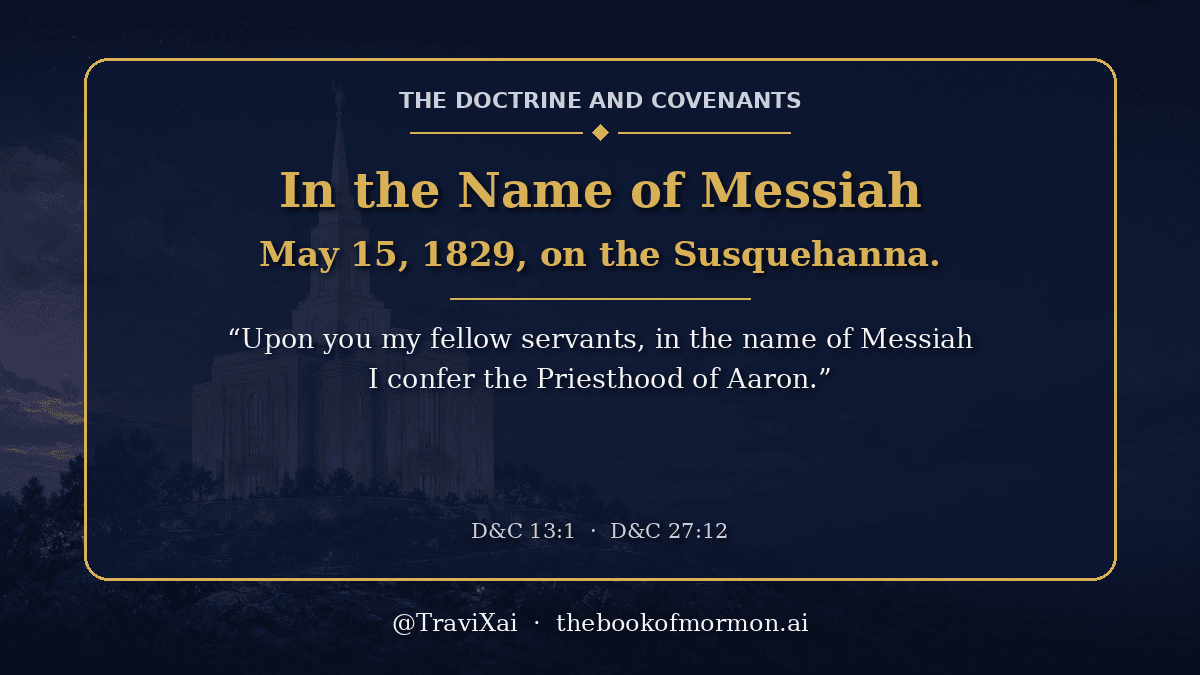
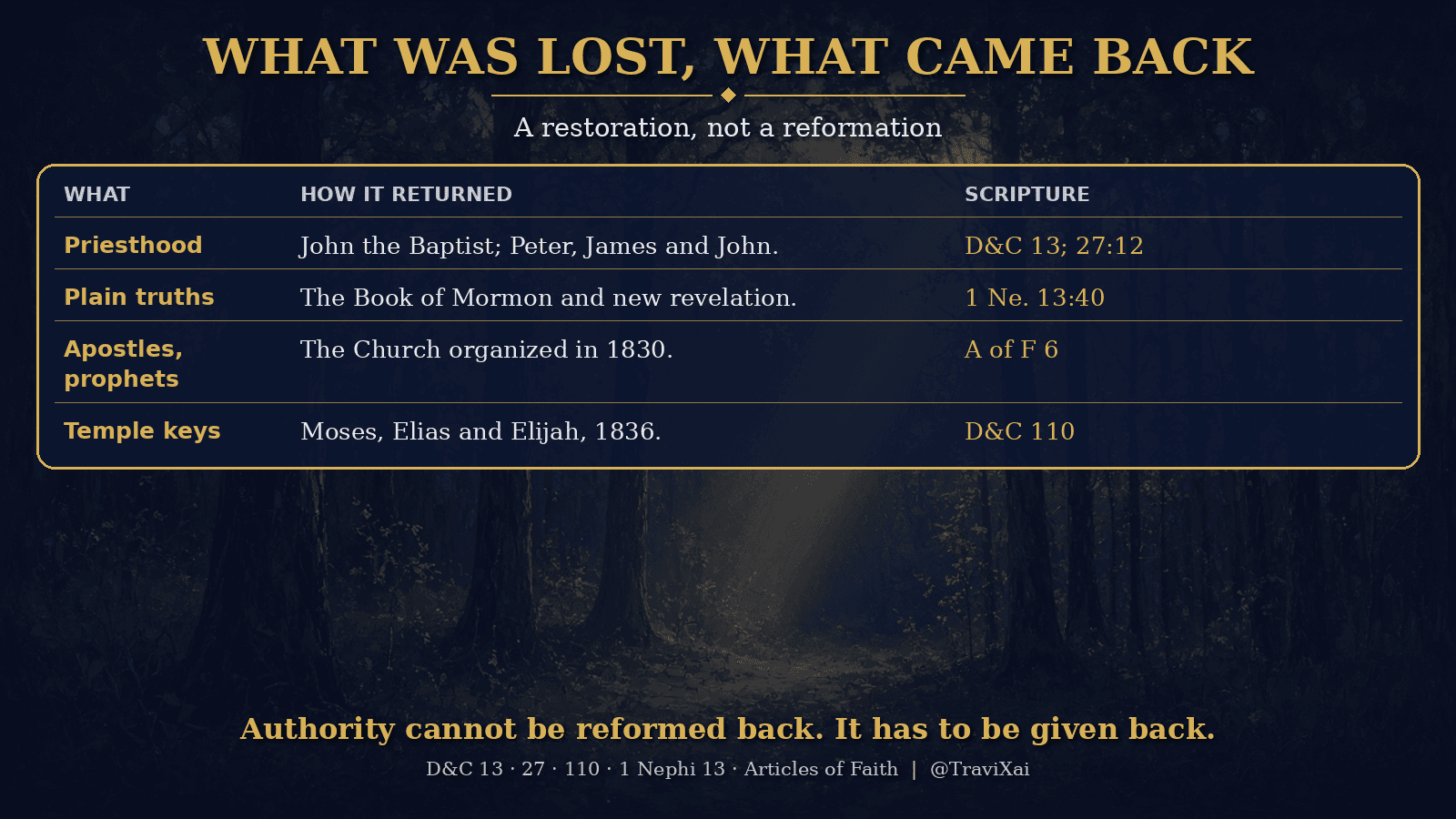
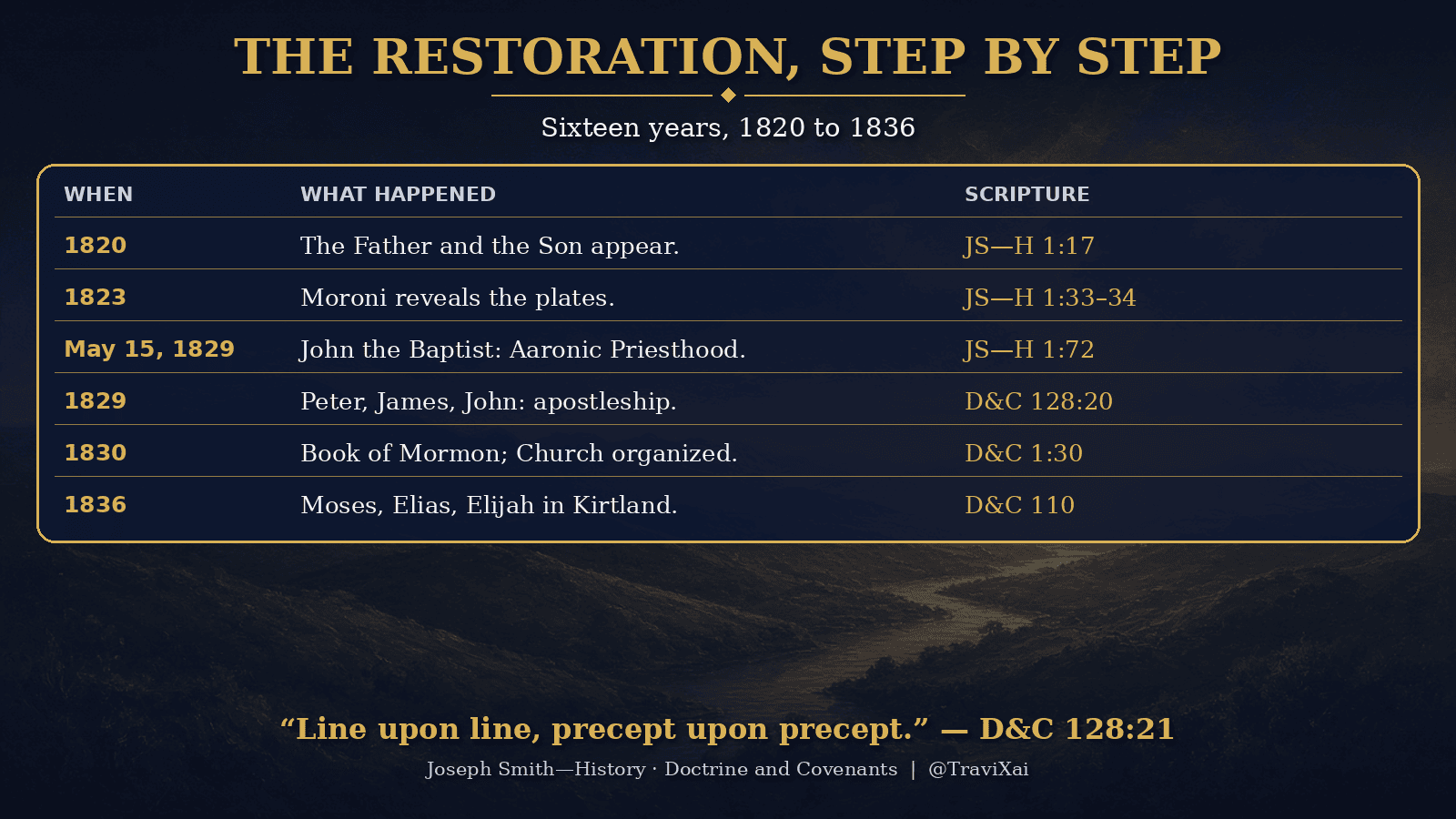
The Lord says why He started: “I the Lord, knowing the calamity which should come upon the inhabitants of the earth, called upon my servant Joseph Smith, Jun., and spake unto him from heaven” (D&C 1:17). Then He sent the authority back with the men who had last held it. John the Baptist: “Upon you my fellow servants, in the name of Messiah I confer the Priesthood of Aaron, which holds the keys of the ministering of angels, and of the gospel of repentance, and of baptism by immersion for the remission of sins” (D&C 13:1). Peter, James and John, “by whom I have ordained you and confirmed you to be apostles, and especial witnesses of my name, and bear the keys of your ministry” (D&C 27:12). See What Is the Priesthood?.
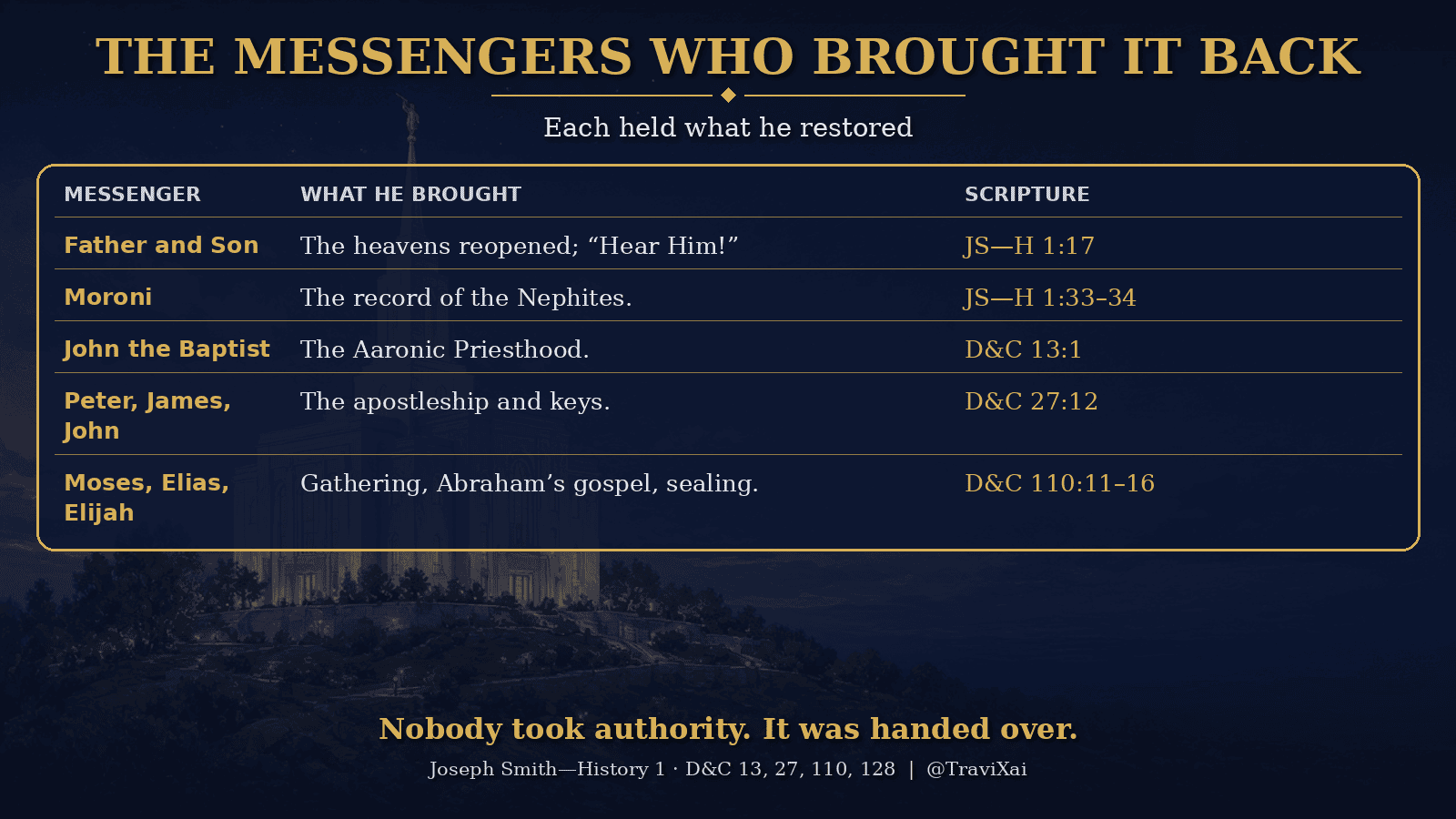
In 1842 Joseph looked back over it all: “Glad tidings from Cumorah! Moroni, an angel from heaven, declaring the fulfilment of the prophets … The voice of Peter, James, and John … declaring themselves as possessing the keys of the kingdom, and of the dispensation of the fulness of times!” It came “line upon line, precept upon precept; here a little, and there a little” (D&C 128:20–21). In 1836 Moses, Elias and Elijah finished the keys in the Kirtland Temple (D&C 110:11–16). See What Is the Gathering of Israel?. The Lord had promised that from the restored keys “shall the gospel roll forth unto the ends of the earth, as the stone which is cut out of the mountain without hands” (D&C 65:2). That is Daniel 2, fulfilled.
The Pearl of Great PriceWhere it began
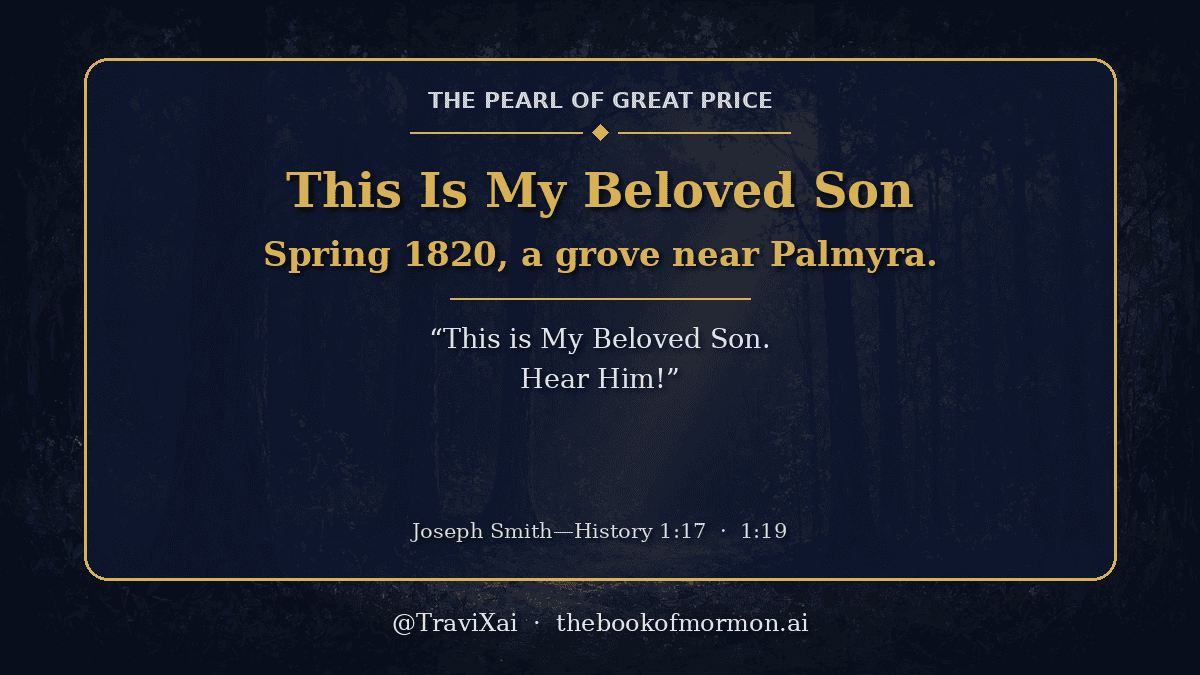
In the spring of 1820 a fourteen-year-old asked God which church to join. “When the light rested upon me I saw two Personages, whose brightness and glory defy all description, standing above me in the air. One of them spake unto me, calling me by name and said, pointing to the other—This is My Beloved Son. Hear Him!” Joseph was told to join none of the churches: “they draw near to me with their lips, but their hearts are far from me, they teach for doctrines the commandments of men, having a form of godliness, but they deny the power thereof” (Joseph Smith—History 1:17–19). Those are Isaiah 29:13, Matthew 15:9 and 2 Timothy 3:5, quoted back. See What Is the First Vision?.
Nine years later, while translating, Joseph and Oliver Cowdery prayed about baptism, and “a messenger from heaven descended in a cloud of light.” He said “his name was John, the same that is called John the Baptist in the New Testament, and that he acted under the direction of Peter, James and John, who held the keys of the Priesthood of Melchizedek … It was on the fifteenth day of May, 1829” (Joseph Smith—History 1:68–72).
Doctrine restoredNot just authority. Truths about God.
The Restoration brought back more than offices. It restored what the creeds had lost: that the Father and the Son are two glorified Personages (Joseph Smith—History 1:17), that we are His literal children, and that His children may become like Him. The Lord promised a dispensation in which “nothing shall be withheld, whether there be one God or many gods, they shall be manifest,” according to what “was ordained in the midst of the Council of the Eternal God of all other gods before this world was” (D&C 121:28–32).
Joseph taught that openly in 1844, in the King Follett sermon and the Sermon in the Grove: God was once as we are, the Father has a Father, and the exalted inherit eternal increase and the work of creation. That chain has an order that never reverses. Our Father in Heaven is always our Father and always above us. In the words of D&C 121:32, He is “the Eternal God of all other gods.” Restoring that truth is the Restoration’s boldest claim, and Latter-day Saints should not water it down. See Was God Once a Man? The King Follett Discourse.
Check the premiseThe presuppositions baked into the question
Before this question can be answered fairly, the person asking has to justify a few assumptions packed inside it:
- That the church Christ founded never lost anything. Amos 8:11–12 and 2 Thessalonians 2:3 predict a loss, and Acts 3:21 a “restitution.” Nothing is restituted that was never taken.
- That authority can be passed on by reading the Bible. Scripture shows it given by ordination from those who hold it (Hebrews 5:4; Acts 8:18–19). That is why John the Baptist and Peter, James and John came back (D&C 13; 27:12).
- That the Restoration rejects the Bible. The Book of Mormon’s stated purpose is to “establish the truth of the first” (1 Nephi 13:40).
- That “restoration” just means Joseph’s own reform movement. Reformers worked from the existing church. Joseph claimed heavenly messengers, dated and witnessed (Joseph Smith—History 1:72; D&C 128:20).
FAQQuick answers
What is the Restoration of the gospel?
God’s return of priesthood authority, ordinances, scripture and truth to the earth through Joseph Smith, beginning with the First Vision in 1820 (Acts 3:21; Joseph Smith—History 1:17).
Why did the gospel need to be restored?
After the apostles died, authority and plain and precious truths were lost (1 Nephi 13:26–29; 2 Thessalonians 2:3; Amos 8:11–12).
When did the Restoration begin?
With the First Vision in the spring of 1820, and it continued through 1836 and beyond, “line upon line” (D&C 128:21).
Who restored the priesthood?
John the Baptist restored the Aaronic Priesthood on May 15, 1829, and Peter, James and John restored the Melchizedek Priesthood and the apostleship (D&C 13:1; 27:12; JS—H 1:72).
Is the Restoration in the Bible?
Yes. Acts 3:21 (“restitution of all things”), Revelation 14:6, Isaiah 29:14, Daniel 2:44 and Ephesians 1:10.
What is the dispensation of the fulness of times?
The final dispensation, in which God gathers “together in one all things in Christ” and restores every earlier key and power (Ephesians 1:10; D&C 128:18–21).
Is the Restoration finished?
No. Latter-day Saints believe God “will yet reveal many great and important things” (Article of Faith 9), and that it continues until Christ comes.
What doctrines did the Restoration bring back?
A Godhead of distinct Personages, our divine parentage, temple ordinances, sealing, and eternal progression, with the Father always our Father (JS—H 1:17; D&C 121:28–32; D&C 132:19–20).
SummaryKey takeaways
- The Bible foretells both the loss and the “restitution of all things” (Amos 8:11; Acts 3:21).
- It began with the Father and the Son in 1820 (JS—H 1:17).
- Authority was handed back by those who held it (D&C 13; 27:12; 110).
- The Book of Mormon restores plain and precious truths and confirms the Bible (1 Nephi 13:40).
- It restored true doctrine of God, including eternal progression, with the Father always above us.
Read Joseph Smith—History 1 in one sitting. For quick, sourced answers, open Galatians18, and follow me on X at @TraviXai.
Sources
- King James Bible (churchofjesuschrist.org): Isaiah 29:13–14 · Daniel 2:44 · Amos 8:11–12 · Acts 3:19–21 · Acts 8:18–19 · Ephesians 1:10 · 2 Thessalonians 2:3 · 2 Timothy 3:5 · Hebrews 5:4 · Revelation 14:6–7
- Book of Mormon: 1 Nephi 13:26–29 · 1 Nephi 13:40 · 2 Nephi 3:7 · 2 Nephi 3:11 · 2 Nephi 3:15
- Doctrine and Covenants: D&C 1:17 · D&C 1:30 · D&C 13:1 · D&C 27:12 · D&C 65:2 · D&C 110:11–16 · D&C 121:28–32 · D&C 128:18–21 · D&C 132:19–20
- Pearl of Great Price: Joseph Smith—History 1:17–19 · Joseph Smith—History 1:33–34 · Joseph Smith—History 1:68–72 · Articles of Faith 5–6 · Article of Faith 9
- Featured image and in-article graphic: original graphics by thebookofmormon.ai (painterly backgrounds; no photographs or likenesses of real people).