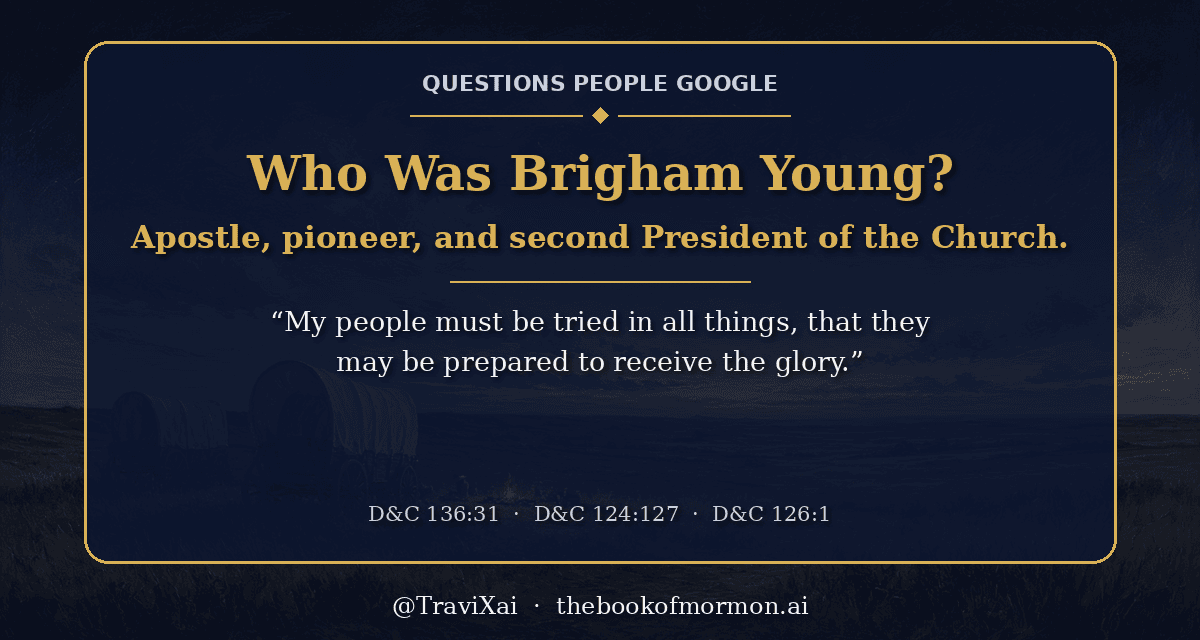

He took a church that had just lost its founder and moved it across a continent. Here is his life, his revelation, and the parts critics raise.
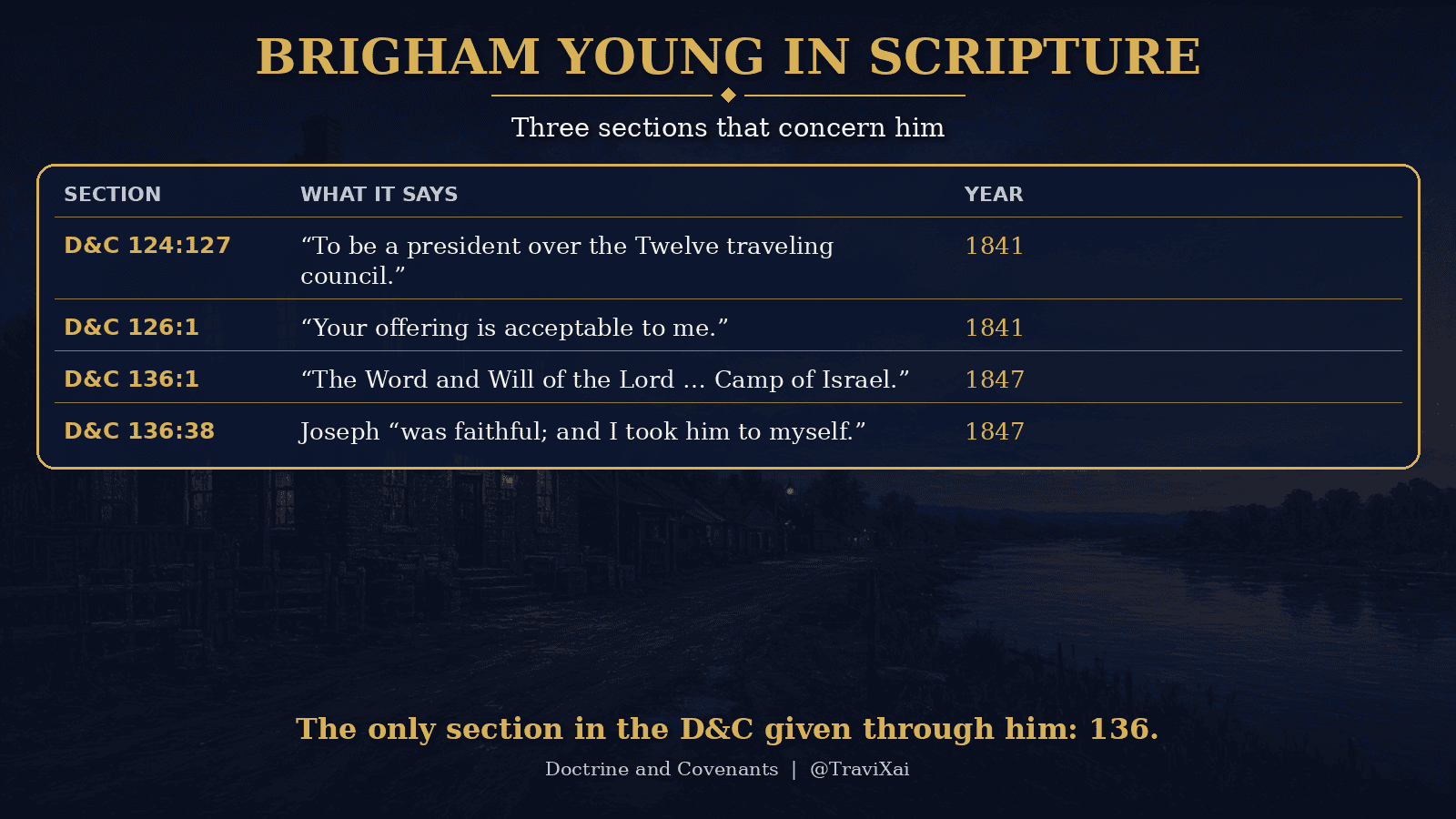
The question often comes loaded with one of two assumptions: that he was a power-grabber, or that a prophet must be flawless. Neither survives the record. Brigham Young (1801–1877) was an original apostle, President of the Quorum of the Twelve by revelation (D&C 124:127), and the second President of the Church. He led the Saints west after Joseph Smith’s death, under “The Word and Will of the Lord concerning the Camp of Israel” (D&C 136:1), and founded hundreds of settlements. He also made mistakes, and this post names them.
His lifeFrom Vermont carpenter to President
Brigham Young was born June 1, 1801, in Whitingham, Vermont, and worked as a carpenter, painter and glazier in upstate New York. He read the Book of Mormon soon after it was published, studied it for about two years, and was baptized on April 14, 1832. That fall he met Joseph Smith in Kirtland. He marched with Zion’s Camp in 1834 and in 1835 was called as one of the original Twelve Apostles.
He led the Saints’ escape from Missouri in 1838–39 while Joseph was in jail, then served a mission in England that brought thousands of converts. When he got home the Lord said, “My servant Brigham, it is no more required at your hand to leave your family as in times past, for your offering is acceptable to me. I have seen your labor and toil in journeyings for my name” (D&C 126:1–3, July 9, 1841). That year the Lord also named him “a president over the Twelve traveling council” (D&C 124:127).
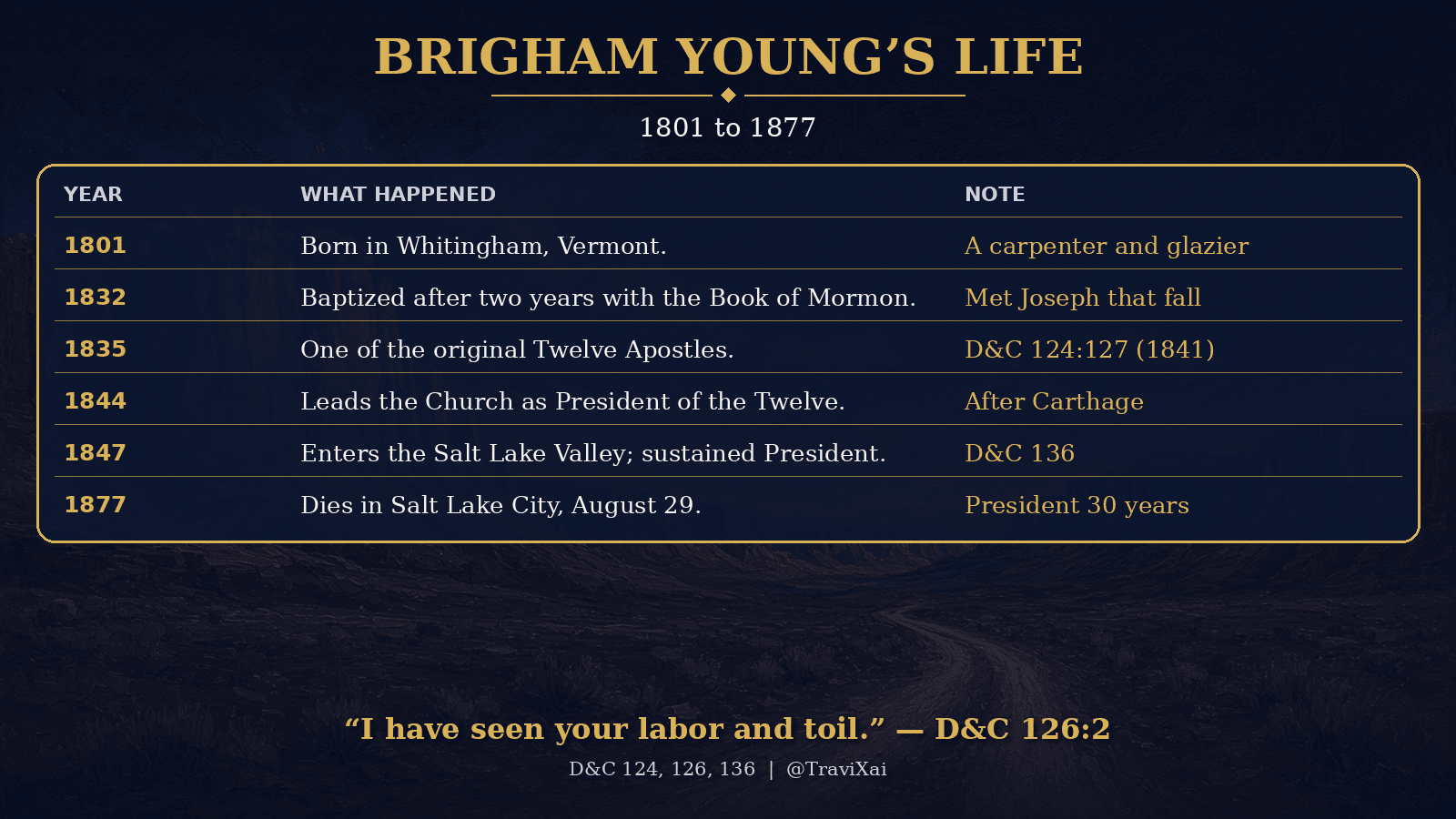
After Joseph and Hyrum were killed at Carthage in June 1844, the Twelve, with Brigham Young as their President, led the Church as a quorum. In February 1846 the Saints left Nauvoo. At Winter Quarters he received section 136, and on July 24, 1847, he entered the Salt Lake Valley. That December the First Presidency was reorganized with him as President. He led the Church for thirty years and died in Salt Lake City on August 29, 1877. See How Is a Prophet Chosen?.
What he builtAn exodus, then a commonwealth
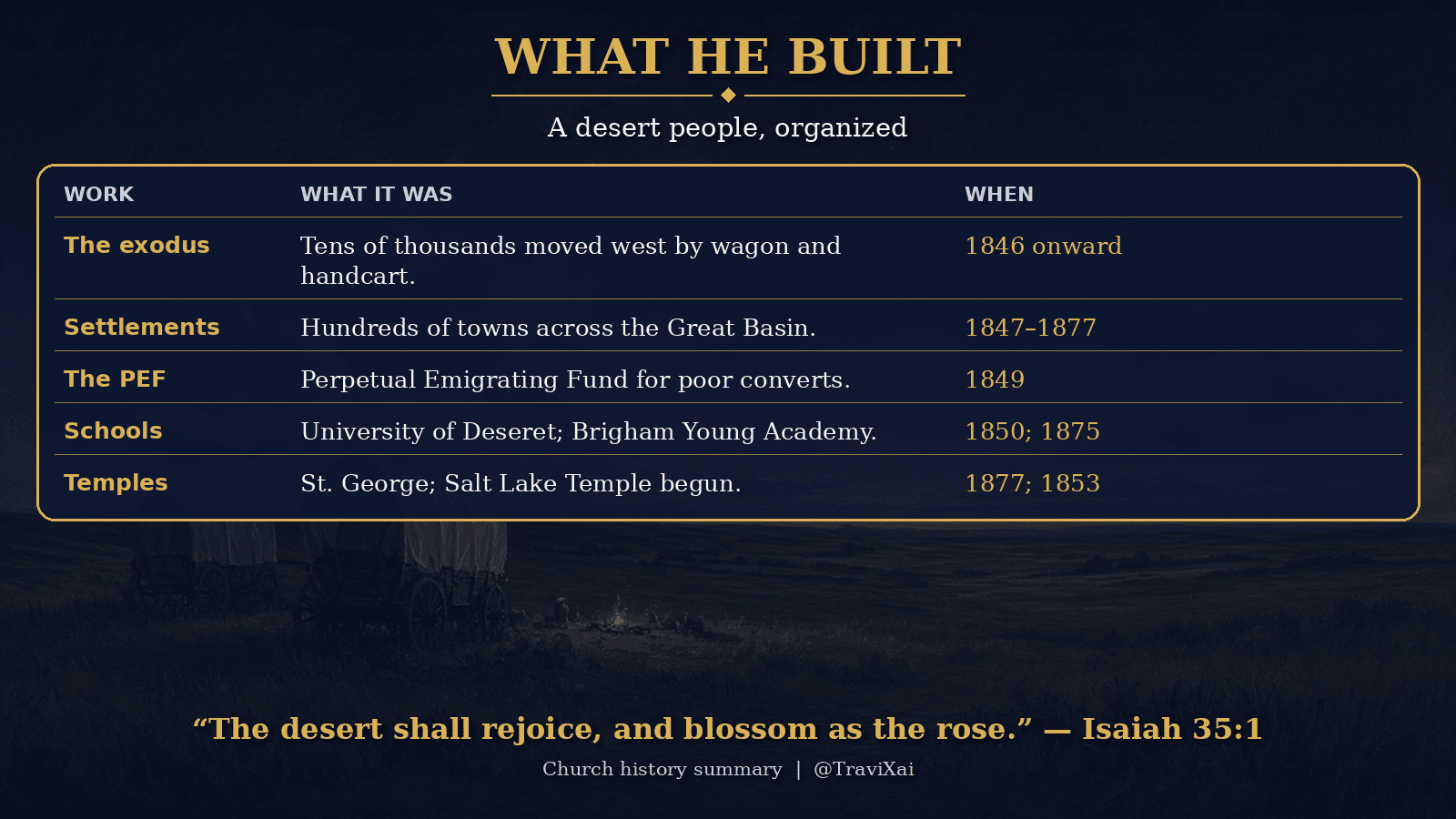
Under his direction tens of thousands of Latter-day Saints crossed the plains by wagon and handcart. He founded hundreds of settlements from Idaho to Arizona and Nevada, set up the Perpetual Emigrating Fund in 1849 to bring poor converts from Europe, served as the first governor of Utah Territory, founded the University of Deseret in 1850 and Brigham Young Academy in 1875, began the Salt Lake Temple in 1853 and dedicated the St. George Temple in 1877. Historians who are not Latter-day Saints still rank him among the great colonizers in American history.
The BibleA modern exodus
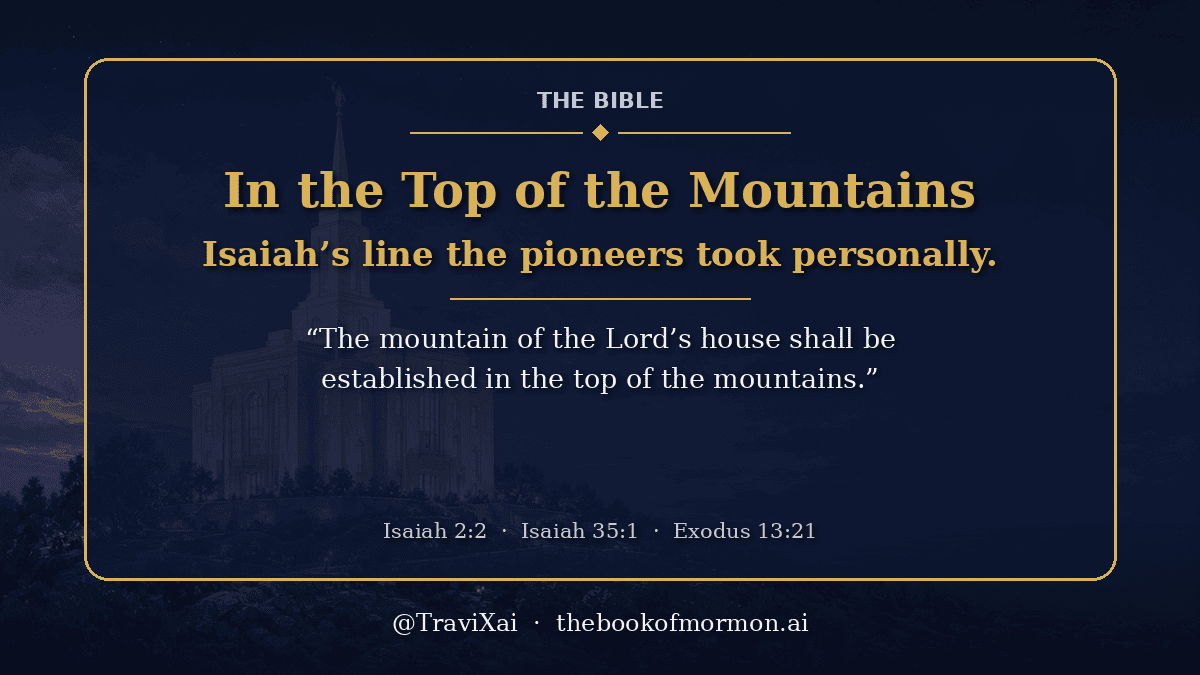
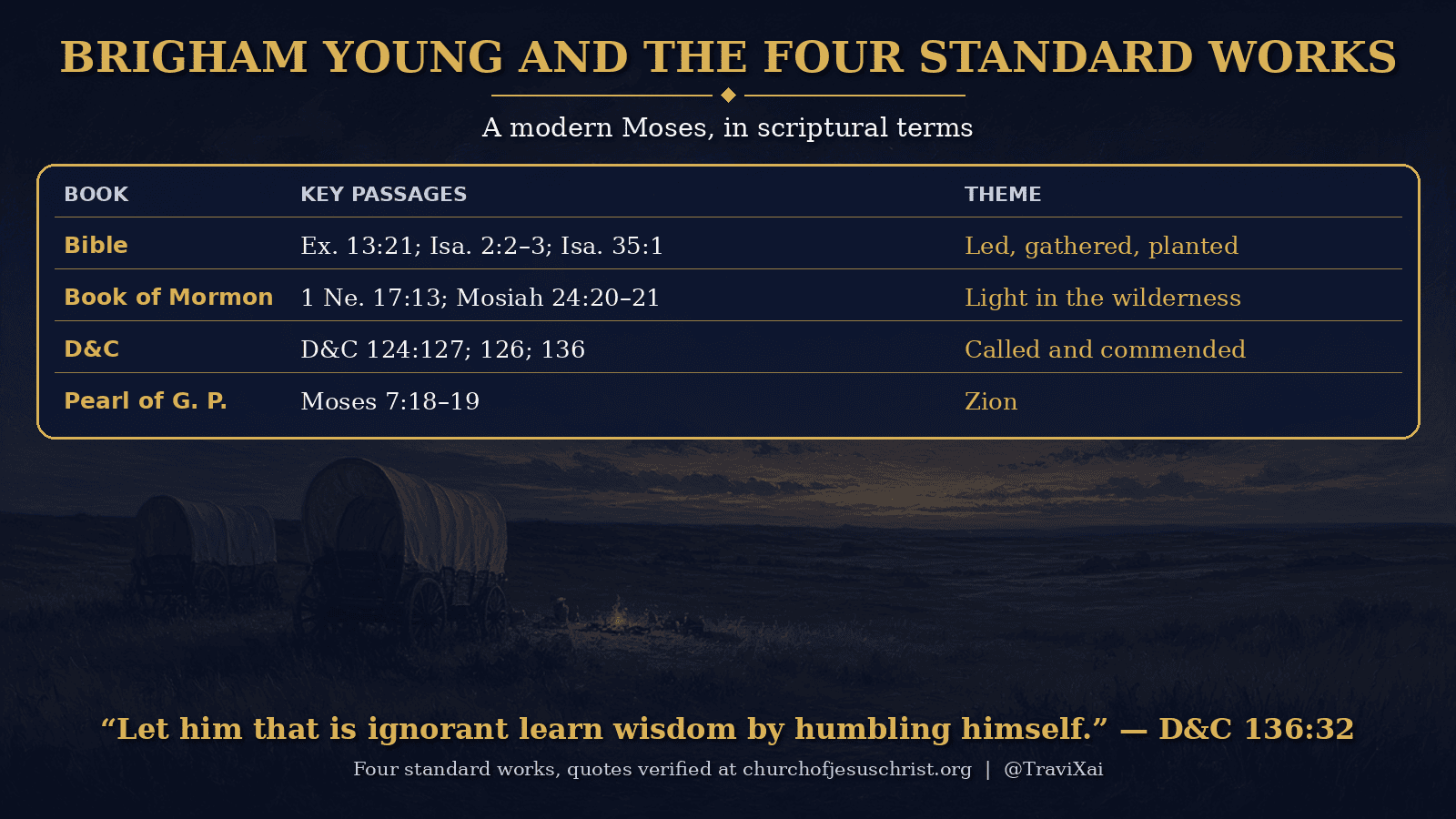
Brigham Young is often called the American Moses, and the Saints themselves called their wagon company “the Camp of Israel.” The biblical pattern was a people led by God through the wilderness: “the Lord went before them by day in a pillar of a cloud, to lead them the way; and by night in a pillar of fire” (Exodus 13:21). Latter-day Saints have long seen their settlement in the Rocky Mountains in Isaiah: “in the last days, … the mountain of the Lord’s house shall be established in the top of the mountains, and shall be exalted above the hills; and all nations shall flow unto it” (Isaiah 2:2–3), and “the desert shall rejoice, and blossom as the rose” (Isaiah 35:1).
The Book of MormonThe wilderness pattern
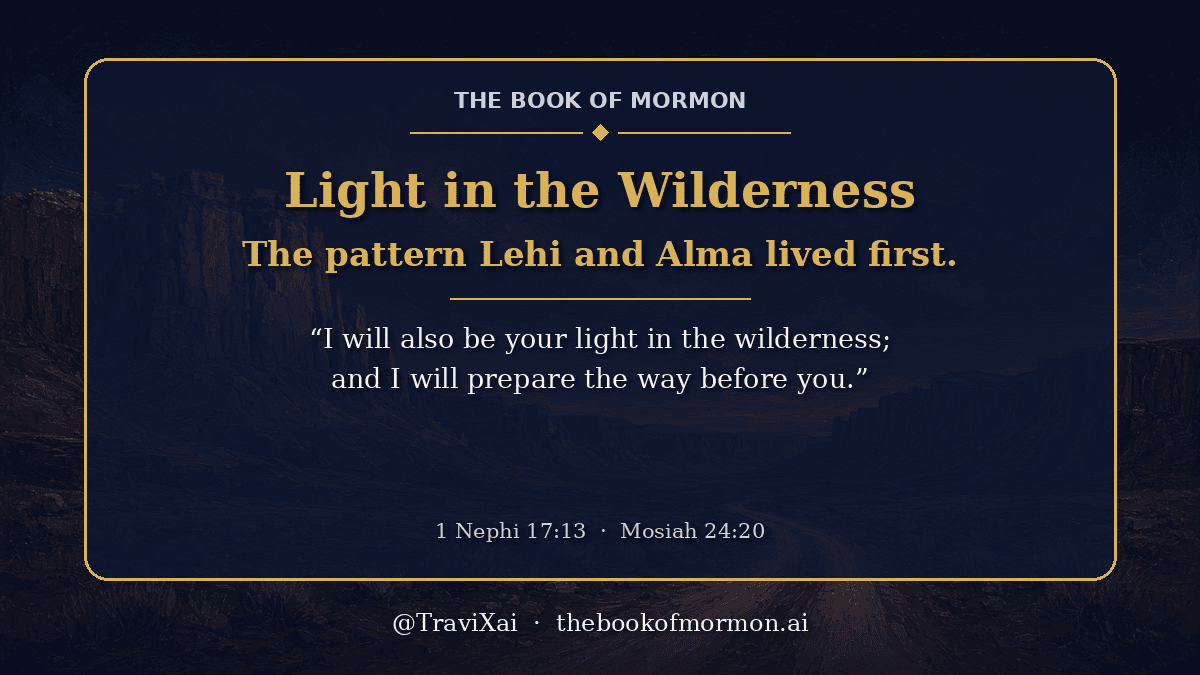
The Book of Mormon Brigham Young read in 1830 is full of the same story. The Lord told Lehi’s family, “I will also be your light in the wilderness; and I will prepare the way before you, if it so be that ye shall keep my commandments … and ye shall know that it is by me that ye are led” (1 Nephi 17:13). Alma led a persecuted people out of bondage: “Alma and his people departed into the wilderness … and in the valley of Alma they poured out their thanks to God because he had been merciful unto them, and eased their burdens” (Mosiah 24:20–21). The pioneers lived out the book they believed in. See What Is the Book of Mormon About?.
The Doctrine and CovenantsSection 136: the word and will of the Lord
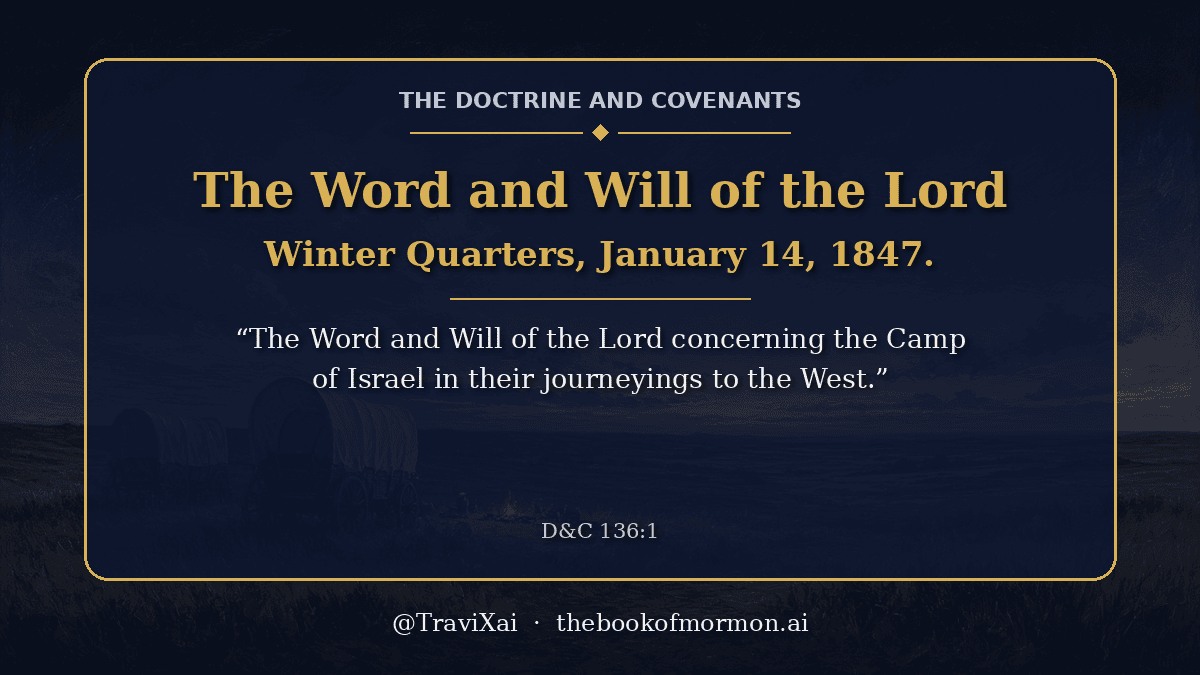
Section 136 is the only revelation in the Doctrine and Covenants given through Brigham Young, at Winter Quarters on January 14, 1847. “The Word and Will of the Lord concerning the Camp of Israel in their journeyings to the West: Let all the people … be organized into companies, with a covenant and promise to keep all the commandments … with captains of hundreds, captains of fifties, and captains of tens, with a president and his two counselors at their head, under the direction of the Twelve Apostles. And this shall be our covenant—that we will walk in all the ordinances of the Lord” (D&C 136:1–4). The organization is Mosaic too (Exodus 18:21).
It also explains the suffering: “My people must be tried in all things, that they may be prepared to receive the glory that I have for them, even the glory of Zion … Let him that is ignorant learn wisdom by humbling himself and calling upon the Lord his God” (D&C 136:31–32). And it settles the question of succession by honoring Joseph: “from Jesus and his apostles to Joseph Smith, whom I did call upon by mine angels … to bring forth my work; which foundation he did lay, and was faithful; and I took him to myself” (D&C 136:37–38). Brigham did not replace Joseph. He built on Joseph’s foundation.
The Pearl of Great PriceThe Zion he was trying to build
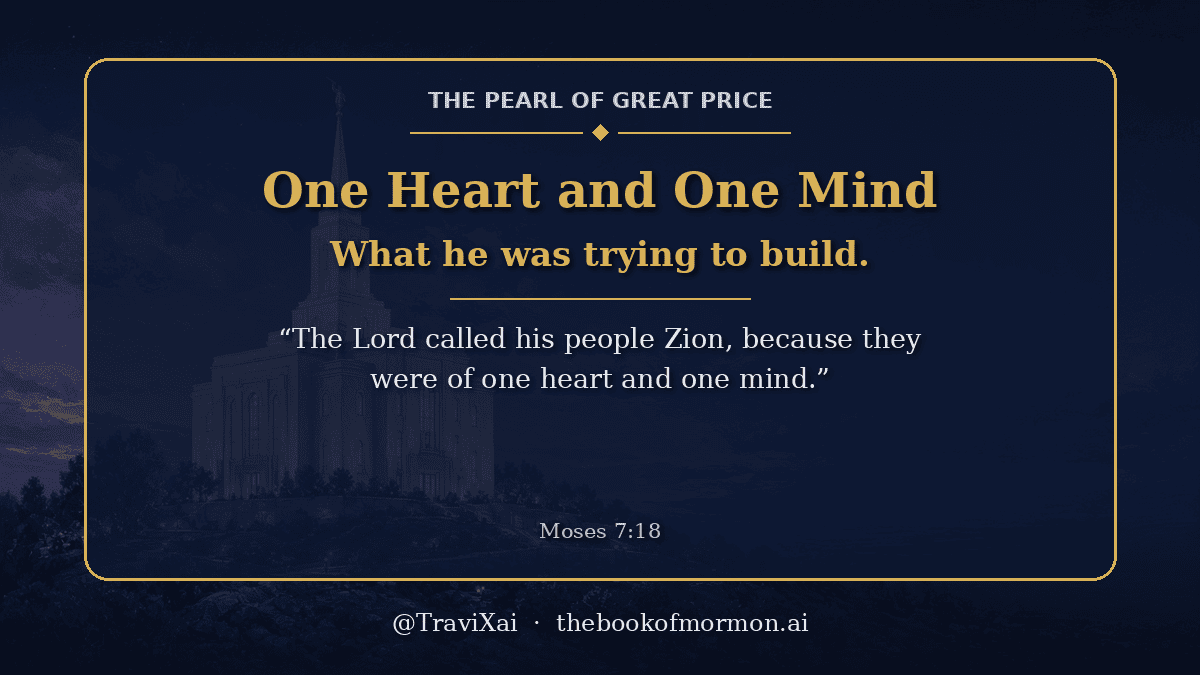
The goal behind the cooperatives, the emigrating fund and the settlements was Enoch’s: “the Lord called his people Zion, because they were of one heart and one mind, and dwelt in righteousness; and there was no poor among them. And Enoch … built a city that was called the City of Holiness, even Zion” (Moses 7:18–19). He never got there, and he said so often. He also never stopped trying.
He taught the doctrine Joseph taught at the end of his life, without softening it: God is our literal Father, He was once as we are, and His faithful children may become like Him. Brigham taught it as an unbroken order. The Father who begot our spirits is always our Father, and the line of Fathers goes back without end. See Was God Once a Man? The King Follett Discourse.
The hard partsNamed plainly
Any honest answer has to cover the parts critics raise first. Latter-day Saints do not believe prophets are infallible, and the Lord said His servants would sometimes err (“inasmuch as they erred it might be made known,” D&C 1:25).
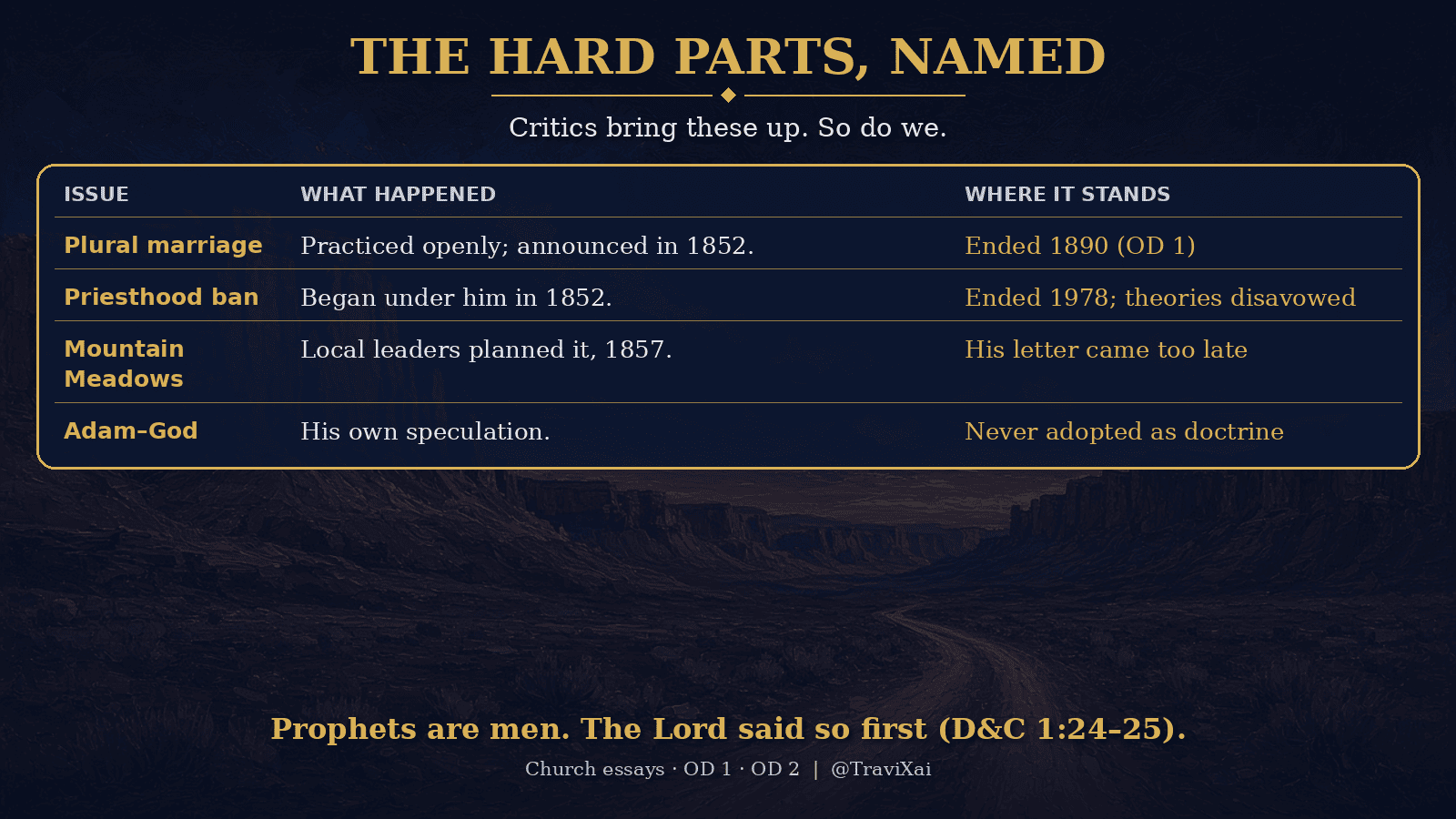
- Plural marriage. He had many wives and announced the practice publicly in 1852. It ended with the 1890 Manifesto (Official Declaration 1). See Does the Church Still Practice Polygamy?.
- The priesthood and temple restriction. It began under him in 1852. It ended by revelation in 1978 (Official Declaration 2), and the Church has disavowed the theories once used to explain it. See The Priesthood Ban and the 1978 Revelation.
- Mountain Meadows, 1857. Local leaders in southern Utah planned and carried out the massacre. Brigham Young’s letter telling them to let the emigrants pass arrived too late. See What Was the Mountain Meadows Massacre?.
- Adam–God. Some of his sermons speculated about Adam’s identity. It was never adopted as Church doctrine. See What Is the Adam–God Theory?.
Judge him the way the Bible asks you to judge Moses, David or Peter: by the whole record and by the fruit. The fruit includes a church that survived the loss of its founder, a people that crossed a continent, and a faith now in nearly every nation. “By their fruits ye shall know them” (Matthew 7:20).
Check the premiseThe presuppositions baked into the question
Before this question can be answered fairly, the person asking has to justify a few assumptions packed inside it:
- That Brigham Young took over the Church by force of personality. The Twelve led as a quorum, as D&C 107:24 provides, and the Lord had named him President of the Twelve in 1841 (D&C 124:127).
- That a prophet must be flawless. Moses, David and Peter were not. The Lord said His servants would err “that it might be made known” (D&C 1:25).
- That every sermon he gave is binding doctrine. Doctrine is what the Church canonizes and teaches together. His Adam–God speculation, for example, was never adopted.
- That he ordered the Mountain Meadows Massacre. The evidence points to local leaders. His letter urging the emigrants be let alone arrived after the massacre.
FAQQuick answers
Who was Brigham Young?
The second President of The Church of Jesus Christ of Latter-day Saints (1847–1877), who led the Saints west to the Salt Lake Valley after Joseph Smith’s death.
When was Brigham Young born and when did he die?
He was born June 1, 1801, in Whitingham, Vermont, and died August 29, 1877, in Salt Lake City.
Is Brigham Young in the Doctrine and Covenants?
Yes. D&C 124:127 names him President of the Twelve, D&C 126 commends his labors, and D&C 136 was given through him in 1847.
When did Brigham Young arrive in Salt Lake City?
He entered the Salt Lake Valley on July 24, 1847, now celebrated as Pioneer Day.
How did Brigham Young become prophet?
As President of the Quorum of the Twelve, he led the Church after Joseph Smith’s death in 1844, and the First Presidency was reorganized with him as President in December 1847.
Did Brigham Young practice polygamy?
Yes. He had many wives and publicly announced the practice in 1852. The Church ended it in 1890 (Official Declaration 1).
Did Brigham Young start the priesthood ban?
The restriction began under him in 1852. It ended by revelation in 1978, and the Church disavows the theories once used to justify it.
Is BYU named after Brigham Young?
Yes. He founded Brigham Young Academy in Provo in 1875. It became Brigham Young University.
SummaryKey takeaways
- Original apostle (1835), named President of the Twelve by revelation (D&C 124:127).
- Led the Church after 1844 and the exodus west, reaching the valley July 24, 1847.
- Received D&C 136, the only D&C section given through him.
- Founded hundreds of settlements, schools and temples.
- The hard parts are real and named; prophets are men (D&C 1:25).
Read D&C 136 tonight. For quick, sourced answers, open Galatians18, and follow me on X at @TraviXai.
Sources
- King James Bible (churchofjesuschrist.org): Exodus 13:21 · Exodus 18:21 · Isaiah 2:2–3 · Isaiah 35:1 · Matthew 7:20
- Book of Mormon: 1 Nephi 17:13 · Mosiah 24:20–21
- Doctrine and Covenants: D&C 1:25 · D&C 107:24 · D&C 124:127 · D&C 126:1–3 · D&C 136:1–4 · D&C 136:31–32 · D&C 136:37–38 · Official Declaration 1 · Official Declaration 2
- Pearl of Great Price: Moses 7:18–19
- Gospel Topics Essay, “Race and the Priesthood” · “Peace and Violence among 19th-Century Latter-day Saints” · Walker, Turley and Leonard, Massacre at Mountain Meadows (Oxford, 2008)
- Featured image and in-article graphic: original graphics by thebookofmormon.ai (painterly backgrounds; no photographs or likenesses of real people).