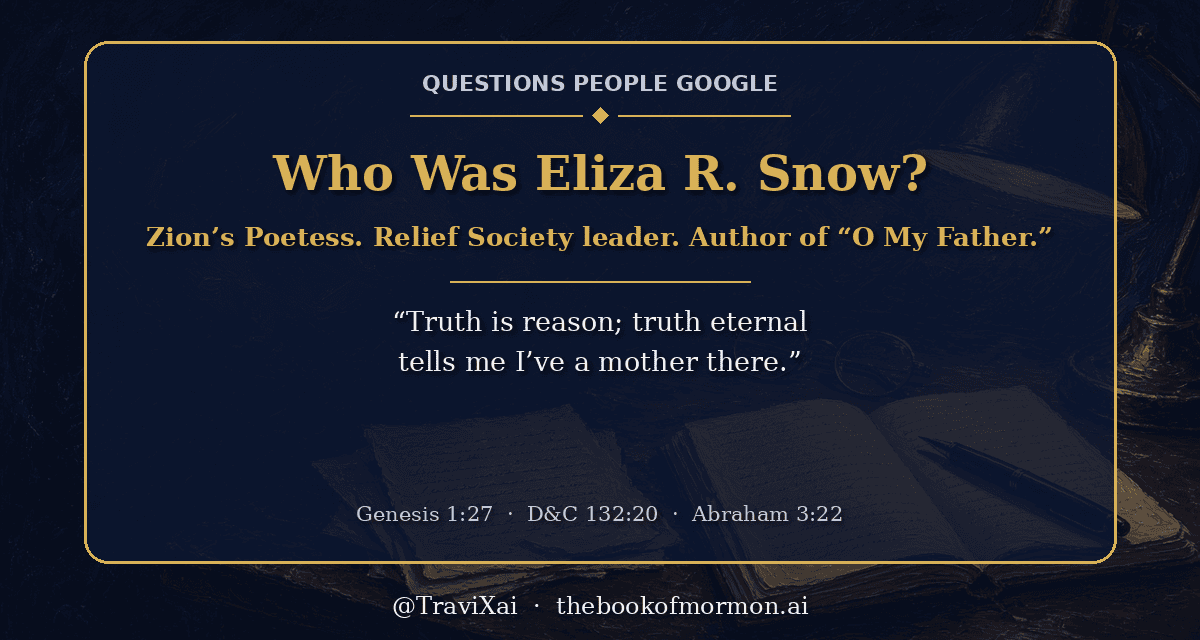

She kept Joseph Smith’s words to the Relief Society, carried them across the plains, and wrote the hymn that taught a whole Church it has a Mother in Heaven.
The question often assumes Heavenly Mother was Eliza R. Snow’s poetic invention, or that Latter-day Saints pray to her. Neither holds up. Eliza R. Snow (1804–1887) was the Church’s leading poet, secretary of the Nauvoo Relief Society, a founder of all three early women’s organizations, and the second General President of the Relief Society. Her 1845 poem, now the hymn “O My Father,” preserves what Joseph Smith taught: “Truth is reason; truth eternal Tells me I’ve a mother there.” The Church teaches that we are children of heavenly parents. We pray to the Father in Christ’s name.
Who she wasZion’s Poetess
Eliza Roxcy Snow (1804–1887) was the leading Latter-day Saint poet of the 19th century, the secretary of the first Relief Society in Nauvoo, a founder and leader of all three of the Church’s early women’s organizations, the second General President of the Relief Society, and the author of “O My Father,” the hymn that gave Latter-day Saints the doctrine of a Mother in Heaven in words they still sing. She was a plural wife of Joseph Smith and, after his death, of Brigham Young. Her younger brother Lorenzo Snow became President of the Church.
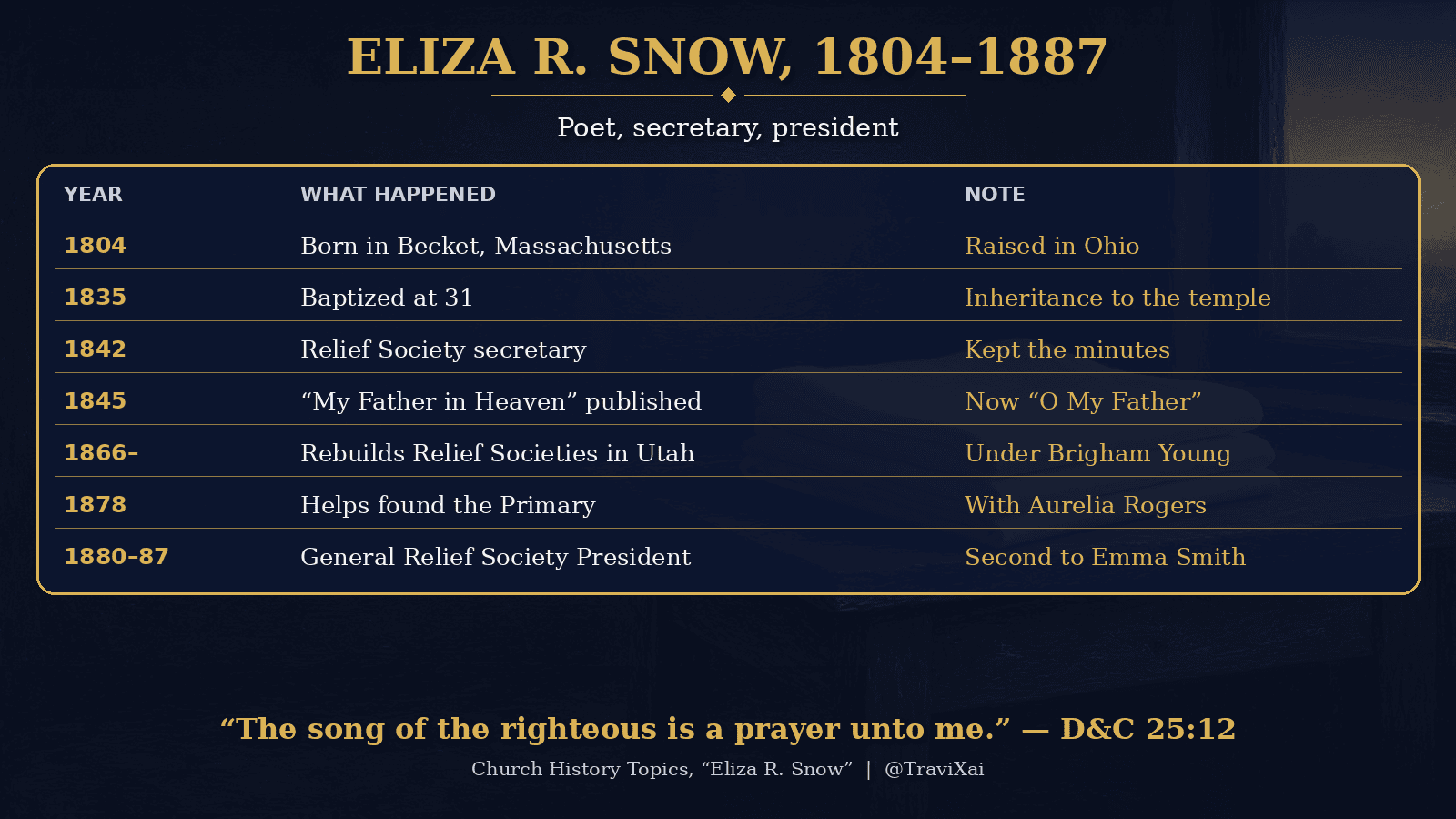
She was born in Becket, Massachusetts, in 1804 and raised in Ohio in a well-read family. Sidney Rigdon, a family friend, introduced the Snows to Joseph Smith in 1831. Her mother and sister joined quickly. Eliza took more than four years of thought and study and was baptized in 1835 at 31. In Kirtland she taught school for the Smith family, wrote a hymn for the first hymnal and gave her substantial inheritance to build the temple. See What Is the Kirtland Temple?.
Poet and leaderMore than 500 poems
During the Missouri persecutions Joseph Smith asked her to write for her people and in their defense. She did for the rest of her life, more than 500 poems, and by the 1850s she was known as “Zion’s Poetess.” Several are still sung, including “How Great the Wisdom and the Love,” “Behold the Great Redeemer Die” and “Though Deepening Trials.”
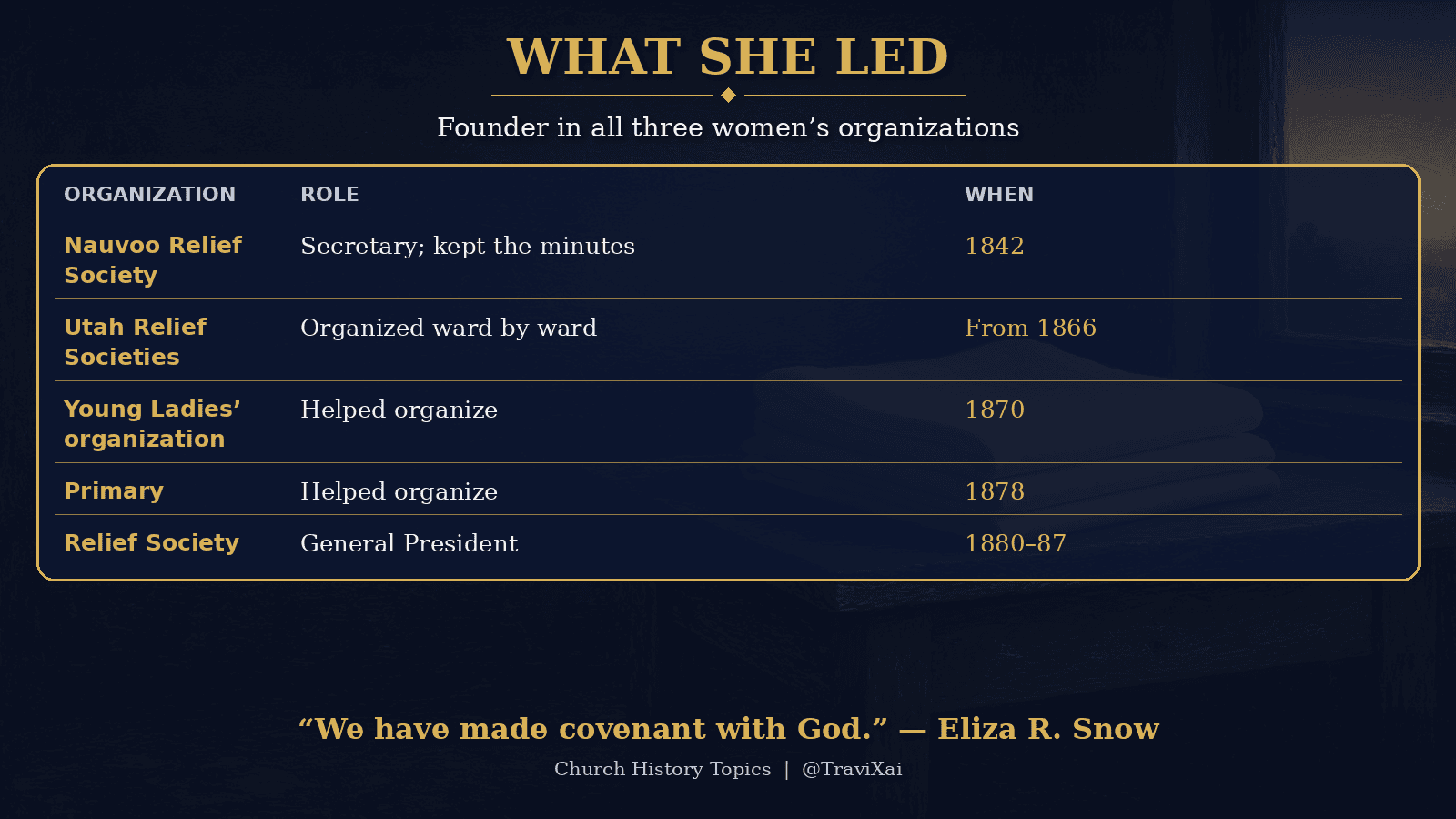
In Nauvoo in 1842 she helped organize the Female Relief Society of Nauvoo with Emma Smith and others, and as secretary recorded Joseph Smith’s teachings to the women. She carried that minute book across the plains and used it as the pattern when Brigham Young asked her to organize Relief Societies throughout Utah. She helped organize the young women’s organization in 1870 and the Primary in 1878, served as General President of the Relief Society from 1880 until her death, and for years led women through temple ordinances in the Endowment House. Her own words to the sisters: “We have made covenant with God, we understand his order.” See What Is the Relief Society? and Who Was Emma Smith?.
She was a plural wife of Joseph Smith in Nauvoo and later married Brigham Young. She had no children of her own and mentored the children of the Young household. The Church states these facts plainly in its own history. See Does the LDS Church Still Practice Polygamy?.
“O My Father”A sermon in four stanzas
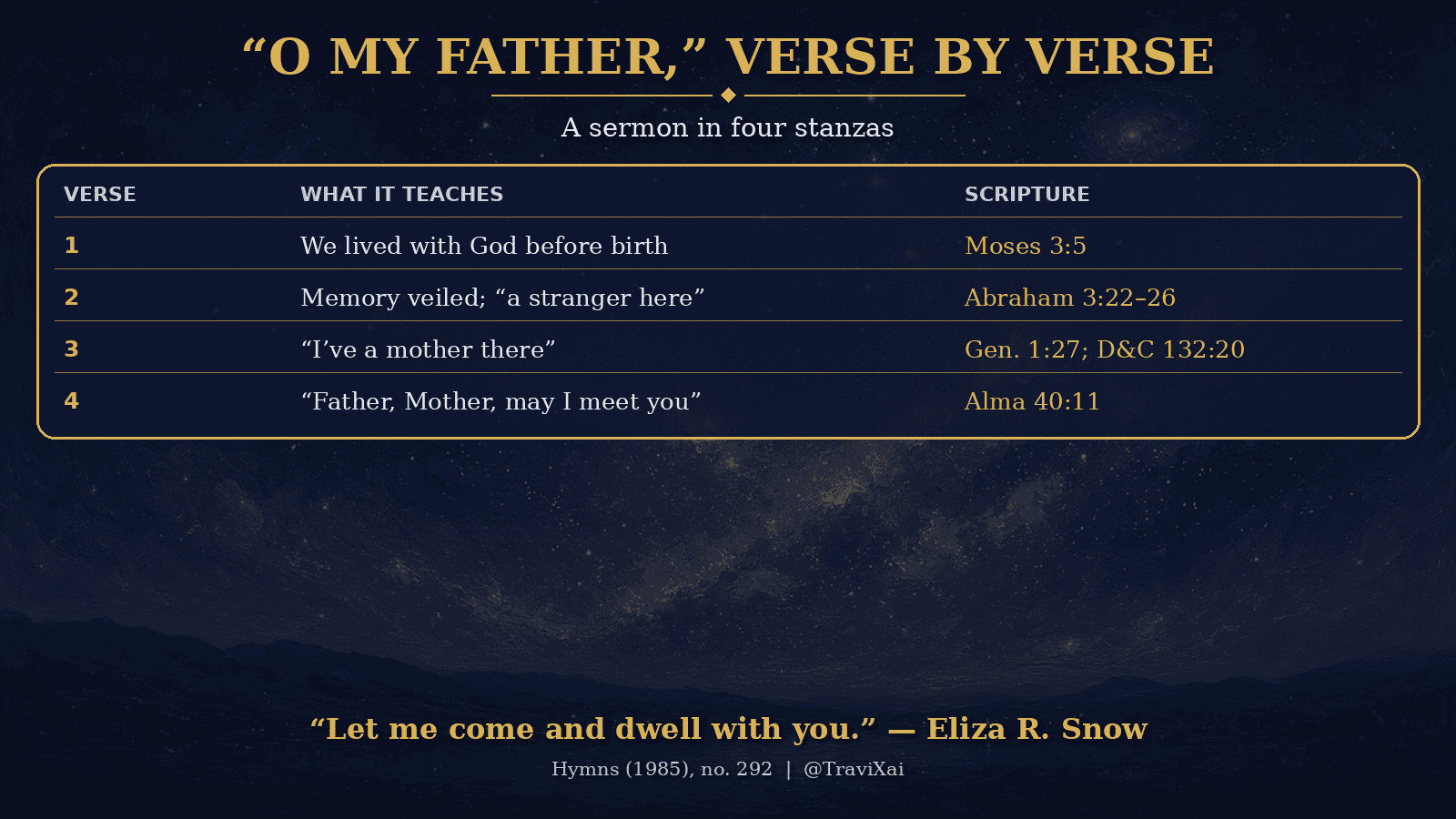
She published the poem as “My Father in Heaven” in the Times and Seasons in November 1845, a year after Joseph’s death. It is No. 292 in the 1985 hymnbook. At her funeral in 1887 the choir sang it. Read as doctrine, it covers the plan of salvation in four verses. Verse one: we lived with God before we were born. “In thy holy habitation, Did my spirit once reside? In my first primeval childhood Was I nurtured near thy side?” Verse two: the memory is veiled on purpose. “For a wise and glorious purpose Thou hast placed me here on earth And withheld the recollection Of my former friends and birth.”
Verse three is the one people search for: “I had learned to call thee Father, Thru thy Spirit from on high, But, until the key of knowledge Was restored, I knew not why. In the heav’ns are parents single? No, the thought makes reason stare! Truth is reason; truth eternal Tells me I’ve a mother there.” Verse four is the return: “When I leave this frail existence, When I lay this mortal by, Father, Mother, may I meet you In your royal courts on high? Then, at length, when I’ve completed All you sent me forth to do, With your mutual approbation Let me come and dwell with you.”
Mother in HeavenWhat the Church teaches, and what it does not
The Church teaches that every person is “a beloved spirit son or daughter of heavenly parents” (The Family: A Proclamation to the World, 1995). Its Gospel Topics essay is plain: there is no record of a formal revelation to Joseph Smith on the subject, but early Latter-day Saint women recalled that he taught it to them personally. Zina Huntington remembered Joseph comforting her after her mother died in 1839 by telling her she would see her mother again and come to know her eternal Mother. Eliza’s poem is the best-known expression of what Joseph taught. In 1909 the First Presidency wrote that “all men and women are in the similitude of the universal Father and Mother, and are literally the sons and daughters of Deity.”
Two guardrails, both from the Church. First, we do not pray to Mother in Heaven. We pray to the Father in the name of Christ, as Jesus commanded. President Gordon B. Hinckley: “The fact that we do not pray to our Mother in Heaven in no way belittles or denigrates her.” Second, what has been revealed is limited, and we do not fill the gaps with speculation. What has been revealed is enough to show the pattern. Exaltation is for a man and a woman together. Elder Dallin H. Oaks: “Our theology begins with heavenly parents. Our highest aspiration is to be like them.” That is eternal progression, from parents who walked that road before us, with our Father always our Father and always above us. See Do Latter-day Saints Believe in Heavenly Mother? and Was God Once a Man?.
The BibleLet us make man in our image
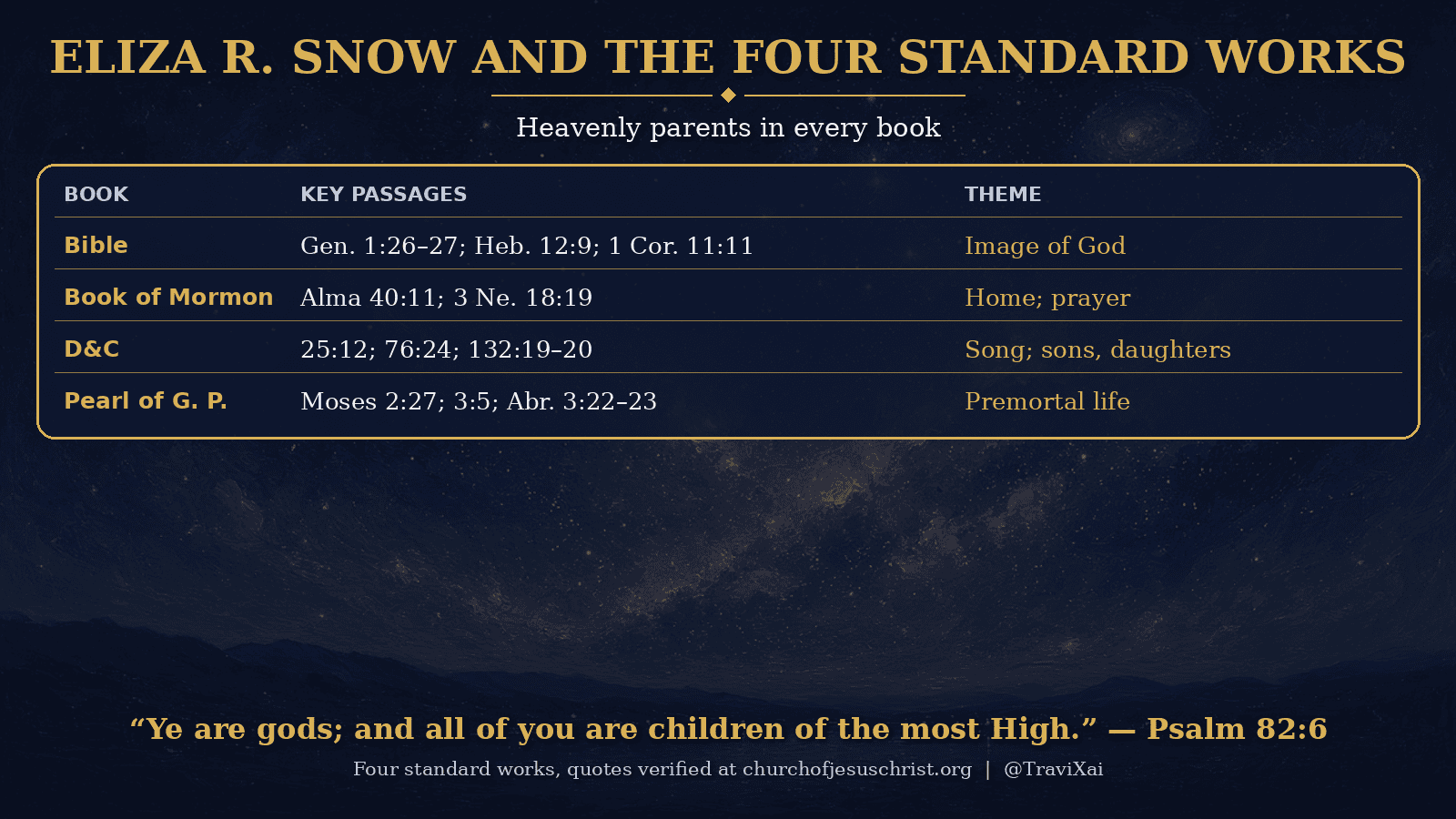
The Bible’s first description of humanity is plural on God’s side and dual on ours: “And God said, Let us make man in our image, after our likeness … So God created man in his own image, in the image of God created he him; male and female created he them” (Genesis 1:26–27). If male and female together are the image of God, it is not a stretch to believe the image has a pattern. Hebrews calls God “the Father of spirits” (Hebrews 12:9), and the psalmist says, “Ye are gods; and all of you are children of the most High” (Psalm 82:6). Paul supplies the principle: “neither is the man without the woman, neither the woman without the man, in the Lord” (1 Corinthians 11:11). Critics ask where Heavenly Mother is in the Bible. The better question is how a Father of spirits has spirit children with no mother, when reason itself, as Eliza put it, “stares” at the idea.
The Book of MormonHome to the God who gave them life
Eliza’s fourth verse is about going home, and Alma uses the same word: “the spirits of all men, as soon as they are departed from this mortal body, yea, the spirits of all men, whether they be good or evil, are taken home to that God who gave them life” (Alma 40:11). You can only go home to a place you came from. The Book of Mormon also sets the boundary on worship that the Church keeps: “ye must always pray unto the Father in my name” (3 Nephi 18:19). See What Is the Premortal Life?.
The Doctrine and CovenantsThe song of the righteous
The revelation that told Emma Smith to make the first hymnbook says why Eliza’s life work mattered: “For my soul delighteth in the song of the heart; yea, the song of the righteous is a prayer unto me, and it shall be answered with a blessing upon their heads” (D&C 25:12). Joseph’s vision states whose children we are: by Christ the worlds were created, “and the inhabitants thereof are begotten sons and daughters unto God” (D&C 76:24). And D&C 132 describes what sealed, faithful couples become: they receive “a fulness and a continuation of the seeds forever and ever. Then shall they be gods, because they have no end” (D&C 132:19–20). Continuation of the seeds means eternal parenthood. Eternal parenthood takes a father and a mother. That is what “O My Father” sings.
The Pearl of Great PriceIn heaven created I them
Eliza’s first verse rests on the Pearl of Great Price: “I, the Lord God, created all things, of which I have spoken, spiritually, before they were naturally upon the face of the earth … And I, the Lord God, had created all the children of men; and not yet a man to till the ground; for in heaven created I them” (Moses 3:5). Abraham saw those spirits: “the intelligences that were organized before the world was; and among all these there were many of the noble and great ones” (Abraham 3:22–23). And Moses records the same image as Genesis: “in the image of mine Only Begotten created I him; male and female created I them” (Moses 2:27). See What Is the Plan of Salvation?.
Check the premiseThe presuppositions baked into the question
Before this question can be answered fairly, the person asking has to justify a few assumptions packed inside it:
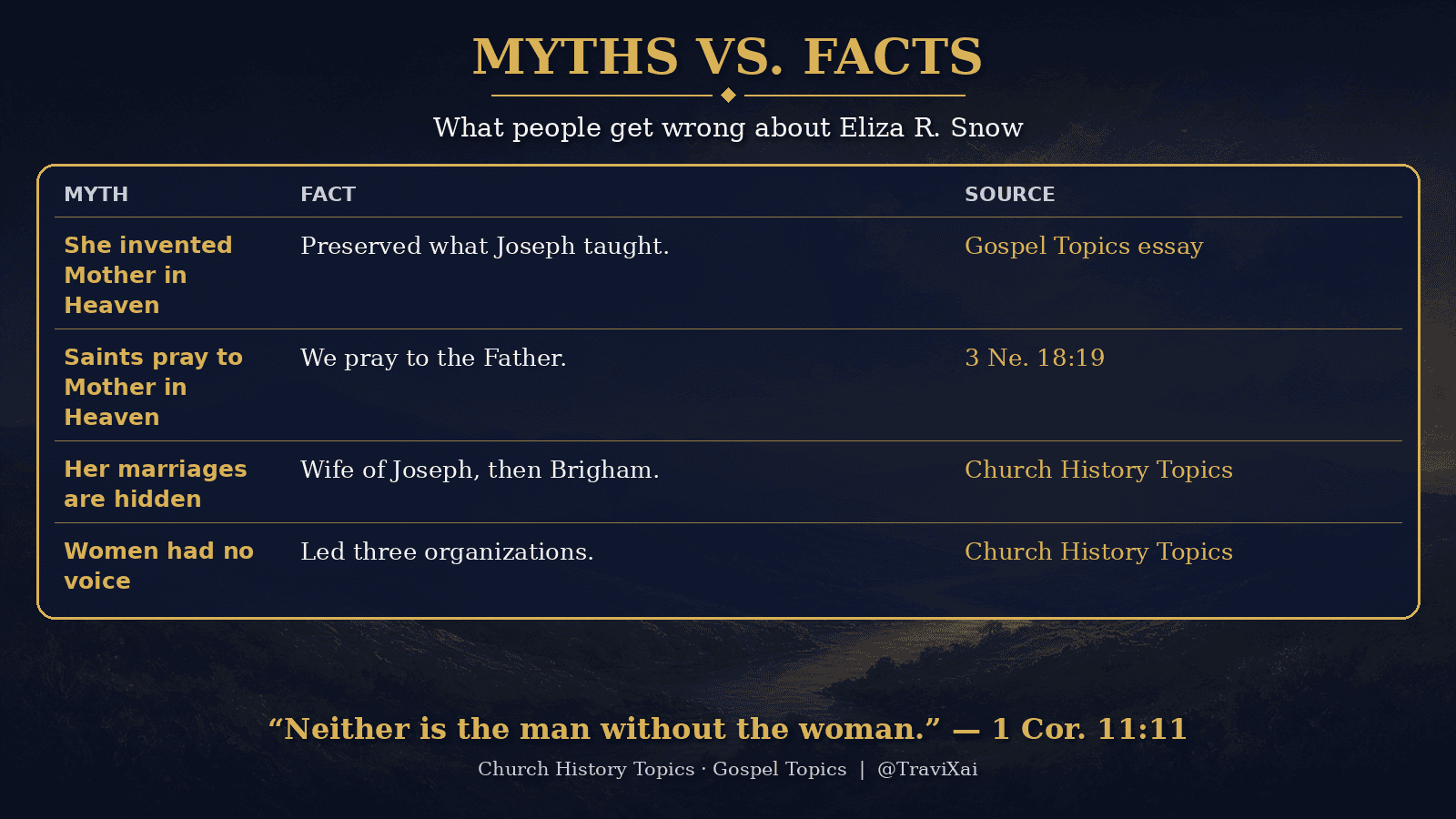
- That Heavenly Mother was Eliza R. Snow’s poetic invention. The Church teaches that Joseph Smith taught the doctrine personally. The poem preserved it, and First Presidencies affirmed it in 1909 and 1995.
- That Latter-day Saints worship or pray to Heavenly Mother. We pray to the Father in Christ’s name (3 Nephi 18:19). President Hinckley said that does not belittle her.
- That a Mother in Heaven contradicts the Bible. Genesis 1:26–27 puts male and female together in God’s image, and Hebrews 12:9 calls God “the Father of spirits.” Children of God implies heavenly parents.
- That early Latter-day Saint women had no doctrinal voice. Eliza recorded Joseph’s teachings, preached across Utah, led three organizations and wrote hymns the whole Church still sings.
FAQQuick answers
Who was Eliza R. Snow?
A Latter-day Saint poet and leader (1804–1887), secretary of the Nauvoo Relief Society, second General President of the Relief Society, and author of “O My Father.”
Why is Eliza R. Snow called Zion’s Poetess?
She wrote more than 500 poems about the Saints’ history and beliefs. Many became hymns, and by the 1850s she was widely known by that title.
Who wrote “O My Father”?
Eliza R. Snow. It was first published as “My Father in Heaven” in the Times and Seasons in November 1845.
Do Latter-day Saints believe in a Mother in Heaven?
Yes. The Church teaches that all people are spirit children of heavenly parents, a Heavenly Father and a Heavenly Mother.
Do Latter-day Saints pray to Heavenly Mother?
No. They pray to Heavenly Father in the name of Jesus Christ, following His command in 3 Nephi 18:19 and Matthew 6:9.
Did Joseph Smith teach about Heavenly Mother?
There is no recorded formal revelation, but early Latter-day Saint women, including Zina Huntington, recalled him teaching it to them personally.
Was Eliza R. Snow married to Joseph Smith?
Yes. She was a plural wife of Joseph Smith in Nauvoo and later married Brigham Young. She had no children of her own.
What did Eliza R. Snow do for the Relief Society?
She kept the Nauvoo minutes, used them to organize Relief Societies throughout Utah, and served as General President from 1880 to 1887.
SummaryKey takeaways
- Baptized in 1835; gave her inheritance to the Kirtland Temple.
- Secretary of the Nauvoo Relief Society; later its second General President.
- Wrote more than 500 poems, including “O My Father” (1845).
- The Church teaches we are children of heavenly parents, and we pray to the Father.
- A plural wife of Joseph Smith and then of Brigham Young.
Sing all four verses of “O My Father” this week and read them as doctrine. For quick, sourced answers, open Galatians18, and follow me on X at @TraviXai.
Sources
- King James Bible (churchofjesuschrist.org): Genesis 1:26–27 · Psalm 82:6 · 1 Corinthians 11:11 · Hebrews 12:9
- Book of Mormon: Alma 40:11 · 3 Nephi 18:19
- Doctrine and Covenants: D&C 25:12 · D&C 76:24 · D&C 132:19–20
- Pearl of Great Price: Moses 2:27 · Moses 3:5 · Abraham 3:22–23
- Church History Topics, “Eliza R. Snow” · Gospel Topics Essays, “Mother in Heaven”
- “O My Father,” Hymns (1985), no. 292 · Jill Mulvay Derr, “The Significance of ‘O My Father’ in the Personal Journey of Eliza R. Snow,” BYU Studies 36, no. 1 (1996–97)
- Featured image and in-article graphic: original graphics by thebookofmormon.ai (painterly backgrounds; no photographs or likenesses of real people).