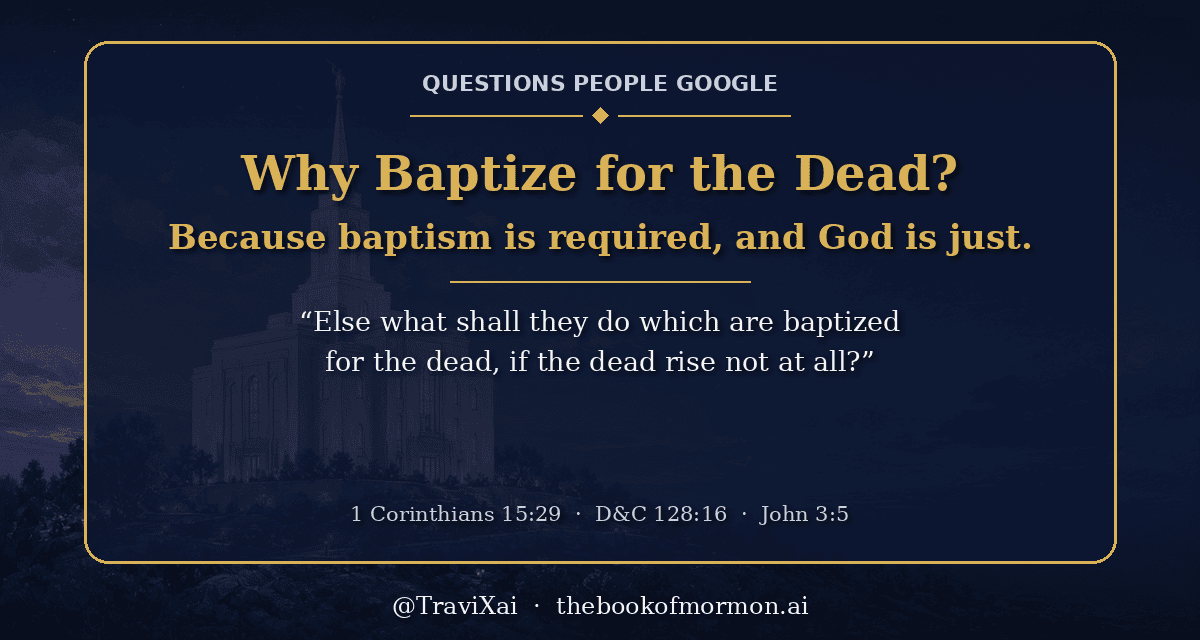

Paul asked why anyone would be baptized for the dead if the dead are not raised. The restored gospel answers him: baptism is required, God is just, and the dead keep their agency.
Latter-day Saints baptize by proxy for the dead because Jesus required baptism of water and of the Spirit, and because God will not condemn people who never had a fair chance to receive it. The ordinance is offered in temples, recorded, and left to the dead to accept or reject. It does not make them members of the Church. Paul raised the question in 1 Corinthians 15:29. Joseph Smith’s letters in D&C 127 and 128 answer it, and D&C 137 and 138 show how a just God judges those who died without the gospel.
What it isA required ordinance, offered to the dead
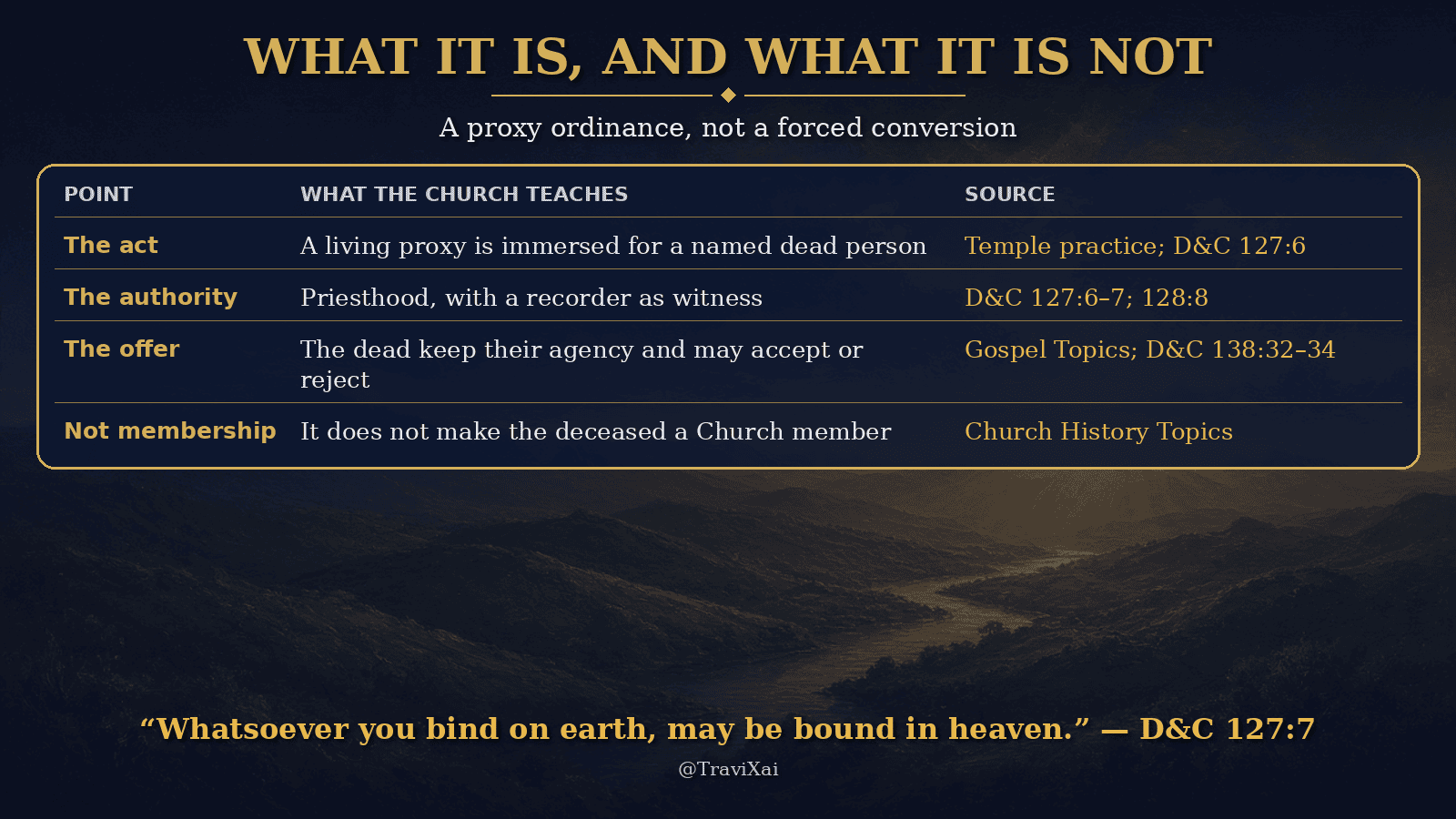
Latter-day Saints baptize living people, by proxy, for named people who have died. The proxy is immersed in a temple font under priesthood authority, with a recorder as an eyewitness, because the Lord said, “When any of you are baptized for your dead, let there be a recorder, and let him be eye-witness of your baptisms” (D&C 127:6). The Church’s own history topic states the limit as plainly as the doctrine: these baptisms “do not make deceased persons members of the Church. They simply make the ordinance available to the spirits of those who have passed away and who choose to accept it.”
The reason is not sentiment. Jesus said, “Except a man be born of water and of the Spirit, he cannot enter into the kingdom of God” (John 3:5). If that gate is real, and if millions died without a fair chance to walk through it, then either God is partial, or He provided a way. Baptism for the dead is that way. See What Happens in a Latter-day Saint Temple? and Why Do Latter-day Saints Do Family History?.
The BiblePaul asked the question. He did not duck it.
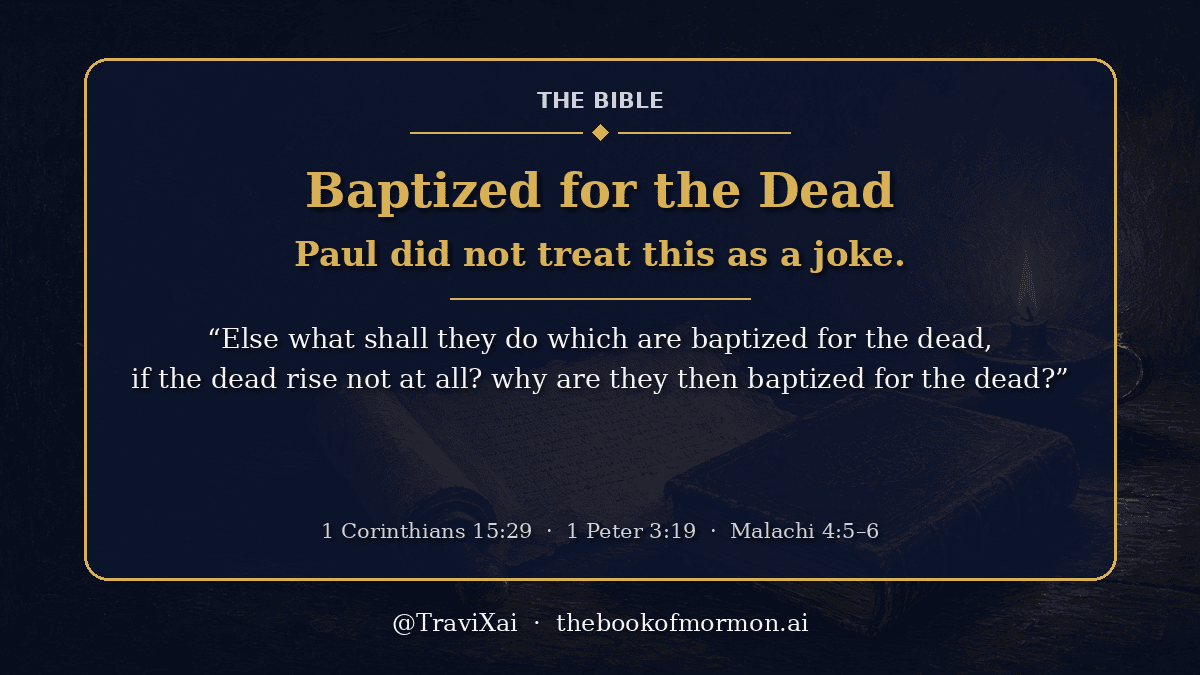
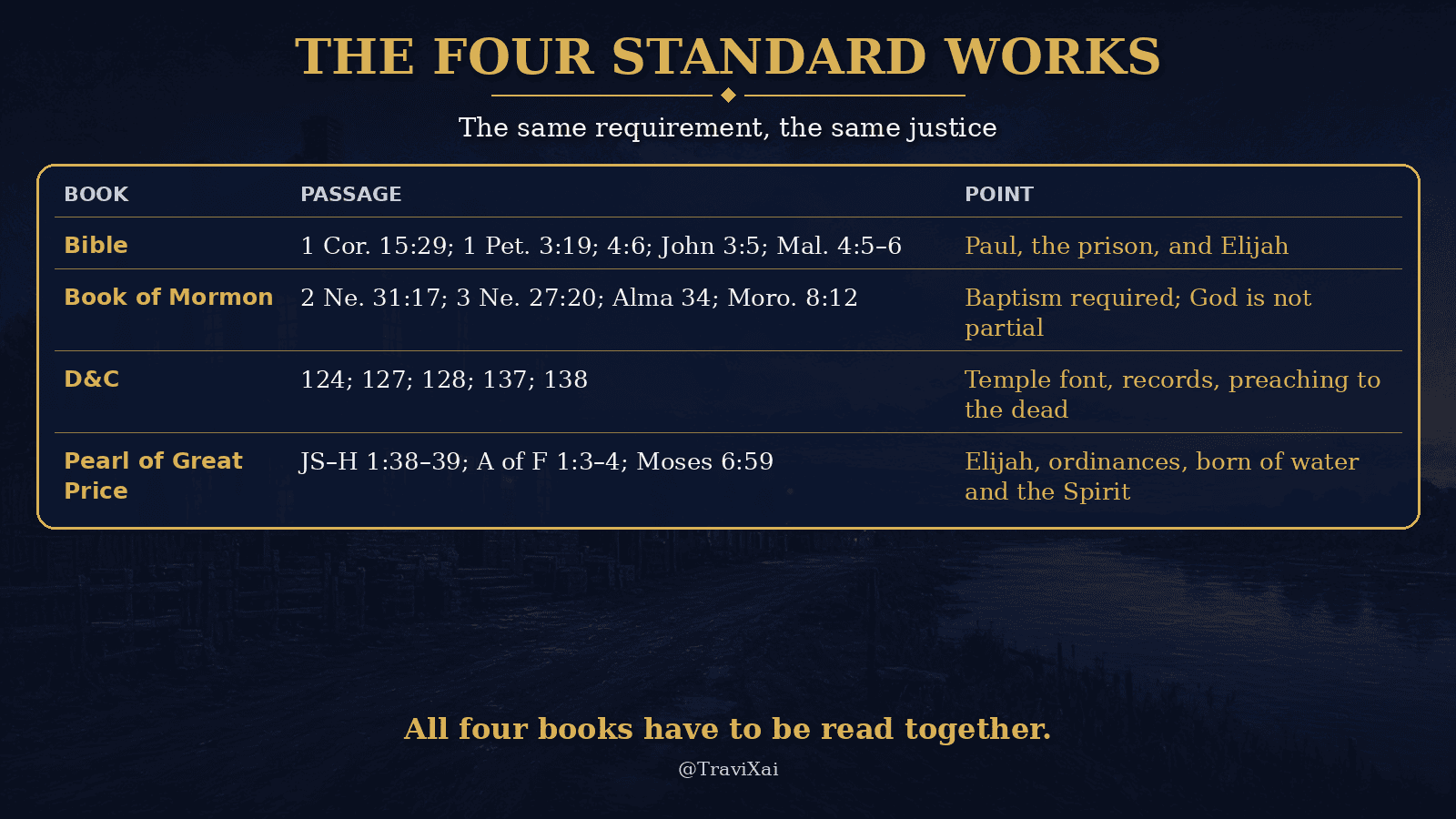
In the great resurrection chapter, Paul writes: “Else what shall they do which are baptized for the dead, if the dead rise not at all? why are they then baptized for the dead?” (1 Corinthians 15:29). Some readers lean on the pronoun “they” and conclude Paul was describing a fringe practice he rejected. That is an assumption, not a demonstration. Paul is defending the resurrection. He treats baptism for the dead as a meaningful act that becomes absurd if the dead are not raised. A man arguing for the resurrection does not grab a practice he thinks is a farce and use it as evidence. Joseph Smith later quoted the same verse in full and called it Paul’s teaching “in relation to the baptism for the dead” (D&C 128:16).
The rest of the Bible supplies the other half of the picture. Christ “went and preached unto the spirits in prison” (1 Peter 3:18–20), and “for this cause was the gospel preached also to them that are dead, that they might be judged according to men in the flesh, but live according to God in the spirit” (1 Peter 4:6). Malachi promised Elijah would “turn the heart of the fathers to the children, and the heart of the children to their fathers, lest I come and smite the earth with a curse” (Malachi 4:5–6). Hebrews says of the ancient faithful that “they without us should not be made perfect” (Hebrews 11:40). None of those verses, by itself, is a how-to manual. Together they refuse the idea that death is the end of God’s work, or that the living and the dead have nothing to do with one another.
The Book of MormonThe gate does not move. The Judge is not partial.
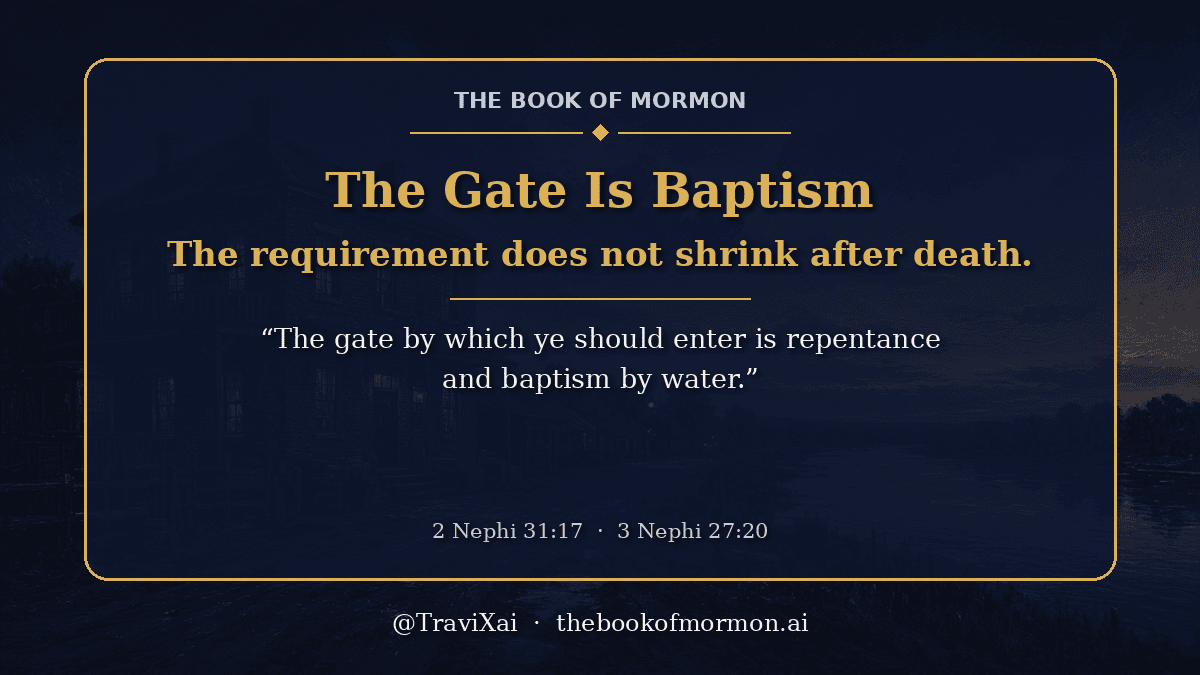
The Book of Mormon does not contain a scene of proxy baptism. It does something just as important: it refuses to lower the requirement, and it refuses to make God a respecter of persons. Nephi says, “the gate by which ye should enter is repentance and baptism by water; and then cometh a remission of your sins by fire and by the Holy Ghost” (2 Nephi 31:17). The risen Lord commands, “Repent, all ye ends of the earth, and come unto me and be baptized in my name” (3 Nephi 27:20). If that commandment is serious, the question is not whether the dead need baptism. The question is how a just God offers it to those who never heard.
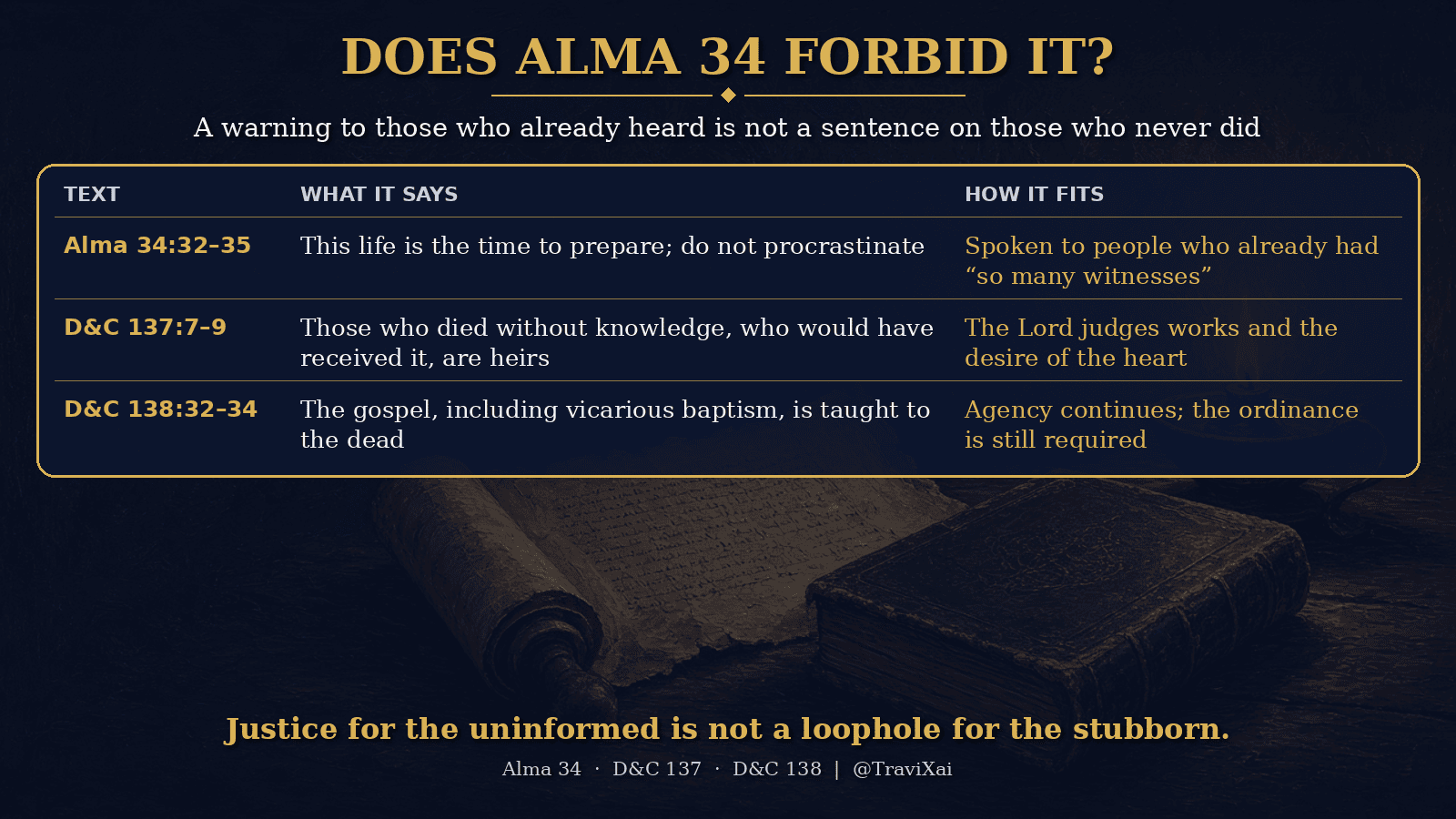
Critics often stop at Amulek: “this life is the time for men to prepare to meet God,” and “if we do not improve our time while in this life, then cometh the night of darkness wherein there can be no labor performed” (Alma 34:32–33). Read the audience. Amulek is speaking to people who “have had so many witnesses.” He is warning them not to procrastinate. That is not a sentence on the man who died in a village where no one ever preached Christ. The same book already knows the fairness problem. Moroni, condemning infant baptism, asks, “how many little children have died without baptism!” and says that if they were lost, “God is a partial God” (Moroni 8:10–12). A God who will not damn a child for want of an ordinance He never placed in that child’s reach is not a God who damns the unevangelized adult for the same lack. Alma 34 closes the loophole for the stubborn. It does not cancel justice for the uninformed.
The Doctrine and CovenantsThe ordinance belongs to the house
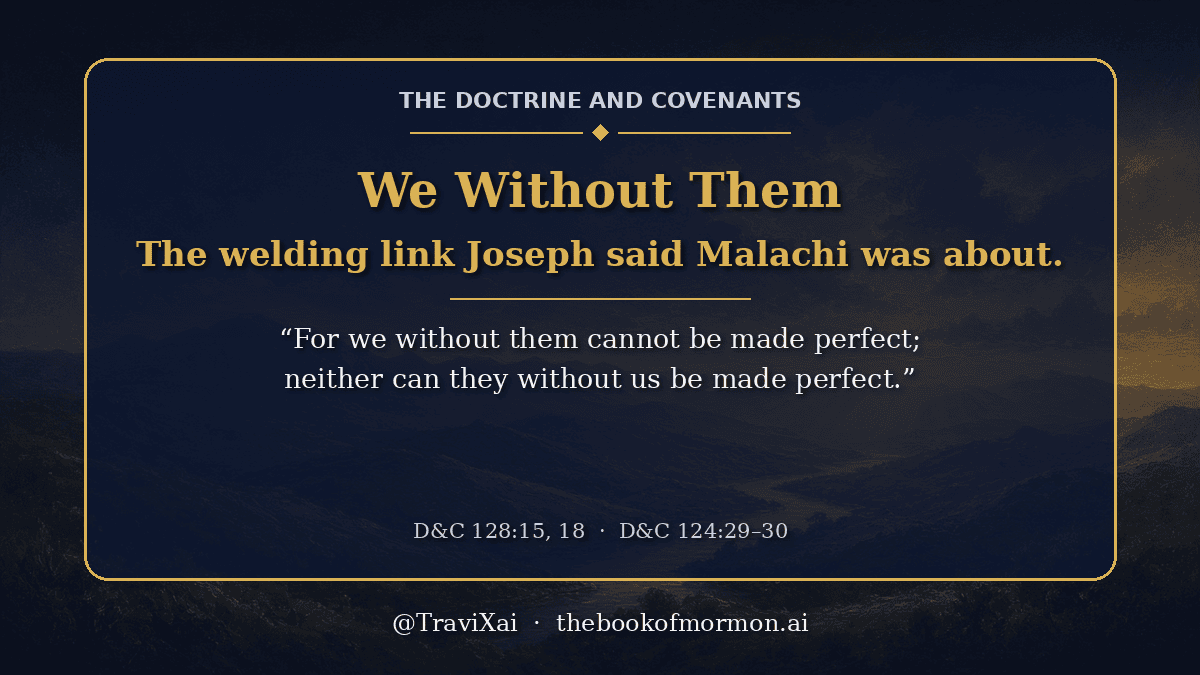
On January 19, 1841, the Lord said, “For a baptismal font there is not upon the earth, that they, my saints, may be baptized for those who are dead— For this ordinance belongeth to my house, and cannot be acceptable to me, only in the days of your poverty, wherein ye are not able to build a house unto me” (D&C 124:29–30). He also said the ordinance “was instituted from before the foundation of the world” (D&C 124:33). Temporary baptisms in the river were allowed while the Saints were poor. They were not the end of the story.
In September 1842 Joseph wrote two letters now canonized as D&C 127 and D&C 128. The font is “a similitude of the grave,” placed underneath the place where the living assemble, “that which is earthly conforming to that which is heavenly” (D&C 128:13). Then the doctrinal center: “their salvation is necessary and essential to our salvation, as Paul says concerning the fathers—that they without us cannot be made perfect—neither can we without our dead be made perfect” (D&C 128:15). He quotes 1 Corinthians 15:29, then Malachi 4:5–6, and says the “welding link” is “the baptism for the dead” (D&C 128:17–18).
Two later revelations close the fairness argument. In January 1836 Joseph saw his brother Alvin, who had died unbaptized, in the celestial kingdom, and heard: “All who have died without a knowledge of this gospel, who would have received it if they had been permitted to tarry, shall be heirs of the celestial kingdom of God; … For I, the Lord, will judge all men according to their works, according to the desire of their hearts” (D&C 137:7–9). In 1918, President Joseph F. Smith saw the dead taught “faith in God, repentance from sin, vicarious baptism for the remission of sins, the gift of the Holy Ghost by the laying on of hands” (D&C 138:32–34). The dead are taught. The ordinance is still required. Nobody is smuggled in.
Nauvoo, then the hard partA funeral sermon, a font, and later rules about names
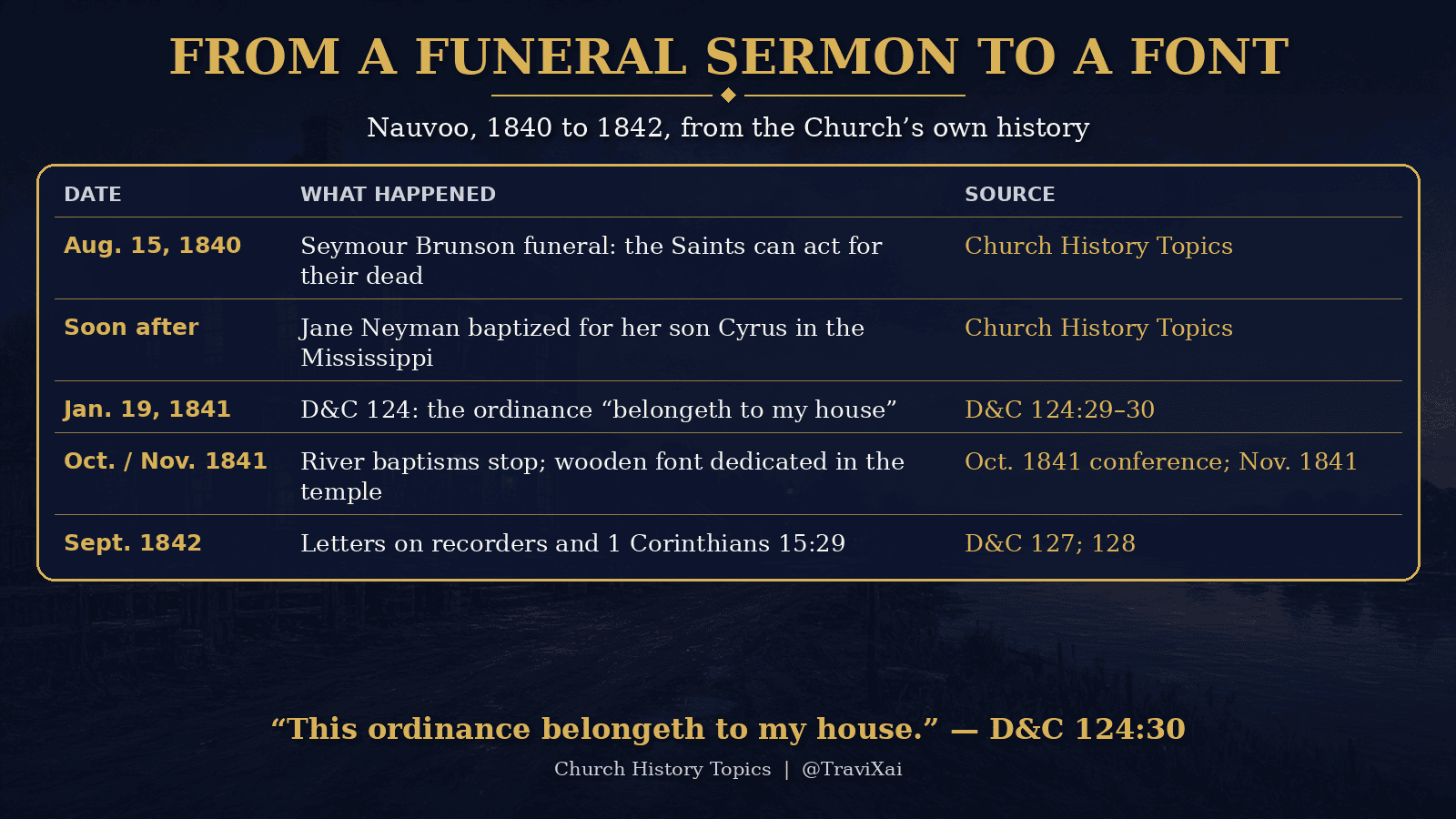
The Church’s history topic, “Baptism for the Dead,” gives the sequence. On August 15, 1840, at the funeral of Seymour Brunson in Nauvoo, Joseph taught that the Saints “could now act for their friends who had departed this life.” The first recorded baptism was Jane Neyman, baptized by Harvey Olmstead in the Mississippi River in behalf of her recently departed son, Cyrus, with Vienna Jacques as a witness. In October 1841 Joseph announced that baptisms in the river should stop until a font was ready. In November the Saints dedicated a hand-carved wooden font in the basement of the Nauvoo Temple. Between 1840 and 1845, before further direction, men sometimes acted as proxy for women and women for men. In 1845 Brigham Young announced that from then on the Saints would not “see a man go forth to be baptized for a woman, nor a woman for a man.” That change is in the record. So is the reason he gave: Joseph “did not receive everything connected with the doctrine of redemption” in his lifetime, and the Lord continued to lead the Church “here a little and there a little.”
The later controversy should be stated as the Church itself states it. In the twentieth century, members sometimes submitted names of celebrities and of people involved in events such as the Holocaust. In the 1990s, after outside concern, Church leaders “removed the names of these individuals from Church databases, issued guidelines intended to prevent the ongoing submission of their names for baptism, and encouraged Church members to focus on performing temple ordinances on behalf of their own ancestors.” A 2010 joint statement with Jewish leaders restated that counsel. The doctrine did not change. The discipline of the practice did, and it needed to. Proxy work for your own dead is the revelation. Turning the font into a public statement about famous strangers was never the point. See Who Can Enter an LDS Temple, and Why?.
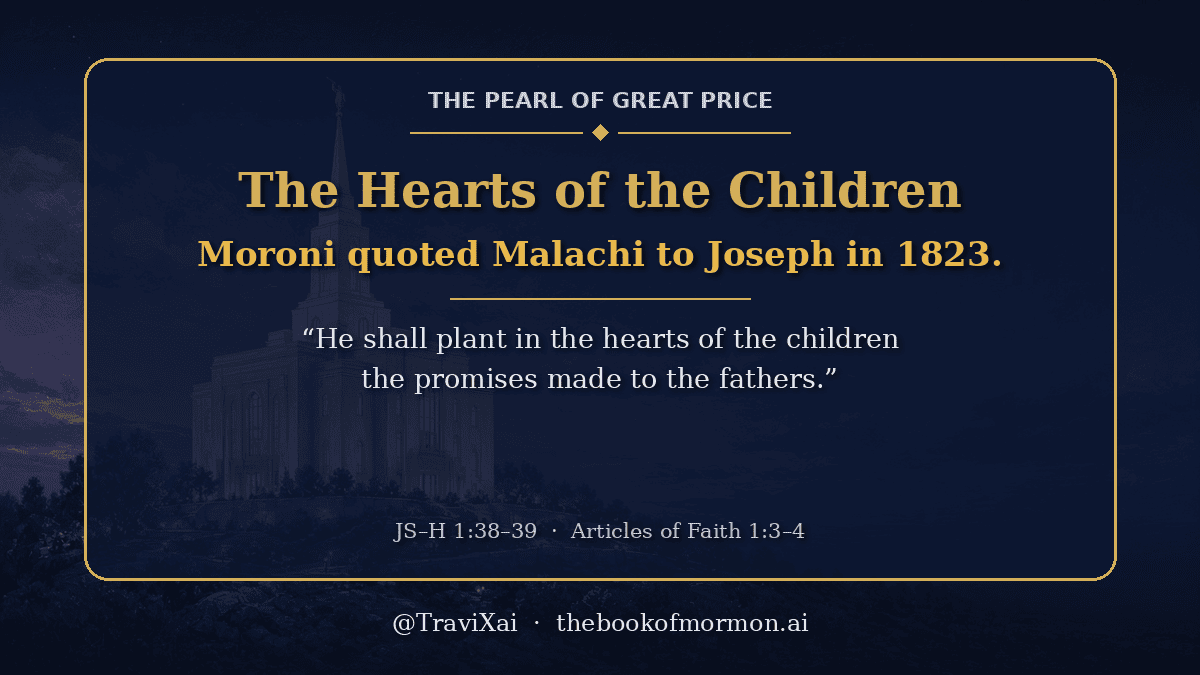
The Pearl of Great Price ties the same thread back to 1823. Moroni quoted Malachi to Joseph, with the wording, “He shall plant in the hearts of the children the promises made to the fathers, and the hearts of the children shall turn to their fathers. If it were not so, the whole earth would be utterly wasted at his coming” (JS–H 1:38–39). The Articles of Faith still list baptism by immersion among the first ordinances of the gospel, and they still say that “through the Atonement of Christ, all mankind may be saved, by obedience to the laws and ordinances of the Gospel” (Articles of Faith 1:3–4). Moses records the same requirement in the beginning: “ye must be born again into the kingdom of heaven, of water, and of the Spirit, and be cleansed by blood, even the blood of mine Only Begotten” (Moses 6:59). All mankind, not the lucky fraction who heard a missionary in time.
Check the premiseThe presuppositions baked into the question
Before this question can be answered fairly, the person asking has to justify a few assumptions packed inside it:
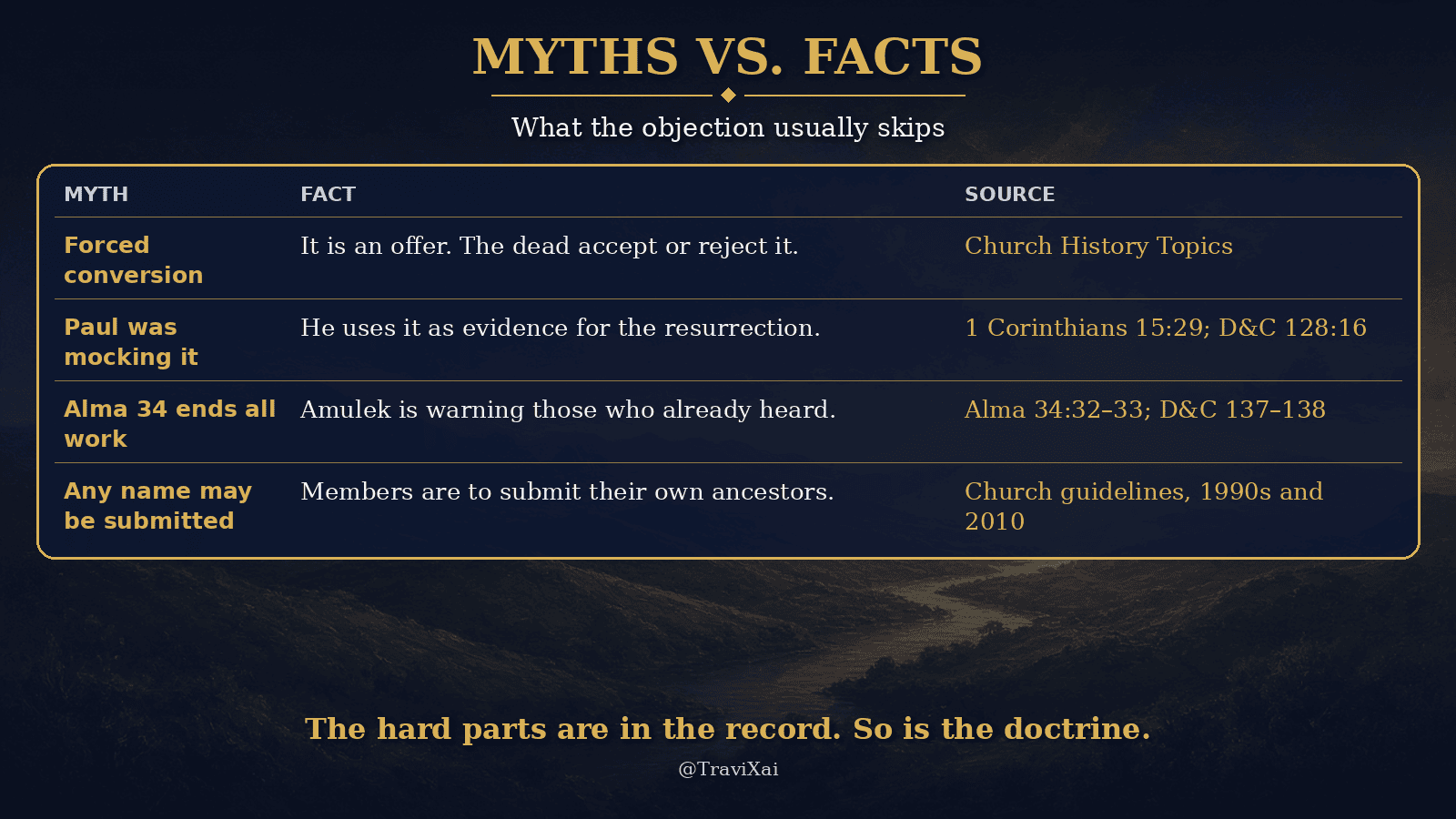
- That baptism is optional, so the dead do not need it. Jesus said a man must be born of water and of the Spirit (John 3:5). Nephi and the risen Lord say the same (2 Nephi 31:17; 3 Nephi 27:20). If the gate is real, the unevangelized still need a way through it.
- That “they” in 1 Corinthians 15:29 means Paul rejected the practice. Paul uses it as evidence for the resurrection. That is a poor way to dismiss a rite you think is false. D&C 128:16 quotes the verse as his teaching on the subject.
- That Alma 34 forbids any labor for the dead. Amulek is warning people who already had “so many witnesses” not to procrastinate. D&C 137 and 138 address those who died without a knowledge of the gospel.
- That a proxy baptism makes the dead a Latter-day Saint against their will. The Church’s published teaching is that the ordinance is an offer. The dead choose to accept or reject it. It does not confer membership.
- That members may submit any name they please. Church leaders have told members to focus on their own ancestors, and they have removed names submitted in violation of that counsel, including names connected with the Holocaust.
FAQQuick answers
Why do Latter-day Saints baptize for the dead?
Because Jesus required baptism, and God will not damn people who never had a fair chance to receive it. A living proxy is baptized in a temple for a named deceased person, who may accept or reject the ordinance.
Is baptism for the dead in the Bible?
Yes. Paul asks, “why are they then baptized for the dead?” in 1 Corinthians 15:29, in his argument for the resurrection. 1 Peter 3:18–20 and 4:6 describe the gospel being preached to the dead, and Malachi 4:5–6 promises Elijah would turn hearts between fathers and children.
Does a temple baptism make the deceased a member of the Church?
No. The Church’s history topic states that these baptisms do not make deceased persons members. They make the ordinance available to those who choose to accept it.
Doesn’t Alma 34 say there is no work after death?
Alma 34:32–35 warns people who already have the gospel not to procrastinate. It is not a ruling on those who died without knowledge of it. D&C 137 and 138 address that case and still require vicarious ordinances.
When did the practice start in this dispensation?
Joseph Smith taught it at Seymour Brunson’s funeral on August 15, 1840. The first recorded baptism was Jane Neyman for her son Cyrus, in the Mississippi River. D&C 124 later required a temple font, dedicated in November 1841.
Why does the Church care who can be submitted?
Because the work is for families, not for making a public point. After concern in the 1990s, including over names of Holocaust victims, the Church removed such names, issued tighter guidelines, and told members to submit their own ancestors.
Who can be baptized for the dead?
Temple-worthy members, including youth, act as proxies. In 2017 the Church announced that priests in the Aaronic Priesthood may perform baptisms for the dead. The work is done in temples, not in meetinghouse fonts.
How does this fit the plan of salvation?
D&C 138 teaches that the dead who lacked the gospel are taught faith, repentance, vicarious baptism, and the gift of the Holy Ghost. D&C 137 says the Lord judges them by their works and the desire of their hearts. Agency continues. The ordinance is still required.
SummaryKey takeaways
- Jesus required baptism (John 3:5; 2 Nephi 31:17). A just God also has to offer it to those who never heard.
- Paul treats baptism for the dead as evidence for the resurrection in 1 Corinthians 15:29; D&C 128:16 quotes him.
- Alma 34 warns people who already have the gospel not to procrastinate. It does not cancel D&C 137 and 138.
- The ordinance belongs to the temple (D&C 124:29–30). It began in this dispensation at Nauvoo on August 15, 1840.
- It is an offer, not a forced conversion. Members are to submit their own ancestors, not famous strangers.
Read 1 Corinthians 15:29, Alma 34, and D&C 128 tonight, then D&C 137 and 138. For quick, sourced answers, open Galatians18, and follow me on X at @TraviXai.
Sources
- King James Bible (churchofjesuschrist.org): 1 Corinthians 15:29 · 1 Peter 3:18–20 · 1 Peter 4:6 · John 3:5 · Malachi 4:5–6 · Hebrews 11:40
- Book of Mormon: 2 Nephi 31:17 · 3 Nephi 27:20 · Alma 34:32–35 · Moroni 8:10–12
- Doctrine and Covenants: D&C 124:29–33 · D&C 127:5–9 · D&C 128:12–18 · D&C 137:7–9 · D&C 138:32–34
- Pearl of Great Price: JS–H 1:38–39 · Articles of Faith 1:3–4 · Moses 6:59
- Church History Topics, “Baptism for the Dead” · Gospel Topics, “Baptism for the Dead” · “Church and Jewish Leaders Resolve Concerns over Baptisms,” Sept. 1, 2010
- Featured image and in-article graphic: original graphics by thebookofmormon.ai (painterly backgrounds; no photographs or likenesses of real people).