
Every critic’s list has it somewhere near the top: “Joseph Smith started a bank, printed his own money, and it collapsed. Con man.”
It’s a good line. It fits on a bumper sticker. It also leaves out the year. The Kirtland Safety Society failed in 1837, the year American banks went down like dominoes. Leave that out and a bank failure sounds like a swindle. Put it back and it starts to look like what it was: a frontier bank, run by men with little banking experience, that hit the worst financial panic of their lifetimes.
That’s not the whole story, though. There were real mistakes in Kirtland, and they’re worth owning. So here’s what the records show, start to finish.
Our Was Joseph Smith a Con Man? covers the Kirtland bank in a few paragraphs, alongside the money-digging trial and other charges. This post is the full look at the bank.
Why Kirtland wanted a bank
In the 1830s the federal government printed no paper money. It minted gold and silver coins, and there were never enough of them, especially out west. Paper money came from banks: state banks, private banks, and plenty of unauthorized ones, each printing its own notes. Most frontier families were rich in land and poor in cash. A local bank could turn that land into credit and give a town a currency to trade with.
Kirtland was growing fast. The Joseph Smith Papers put the number of Latter-day Saints there at about 900 in 1835 and about 1,800 by 1837. Converts were arriving with little money, the Church owed debts on the newly finished temple and its stores, and Saints who had been driven from their homes in Missouri needed help. A bank looked like the answer.
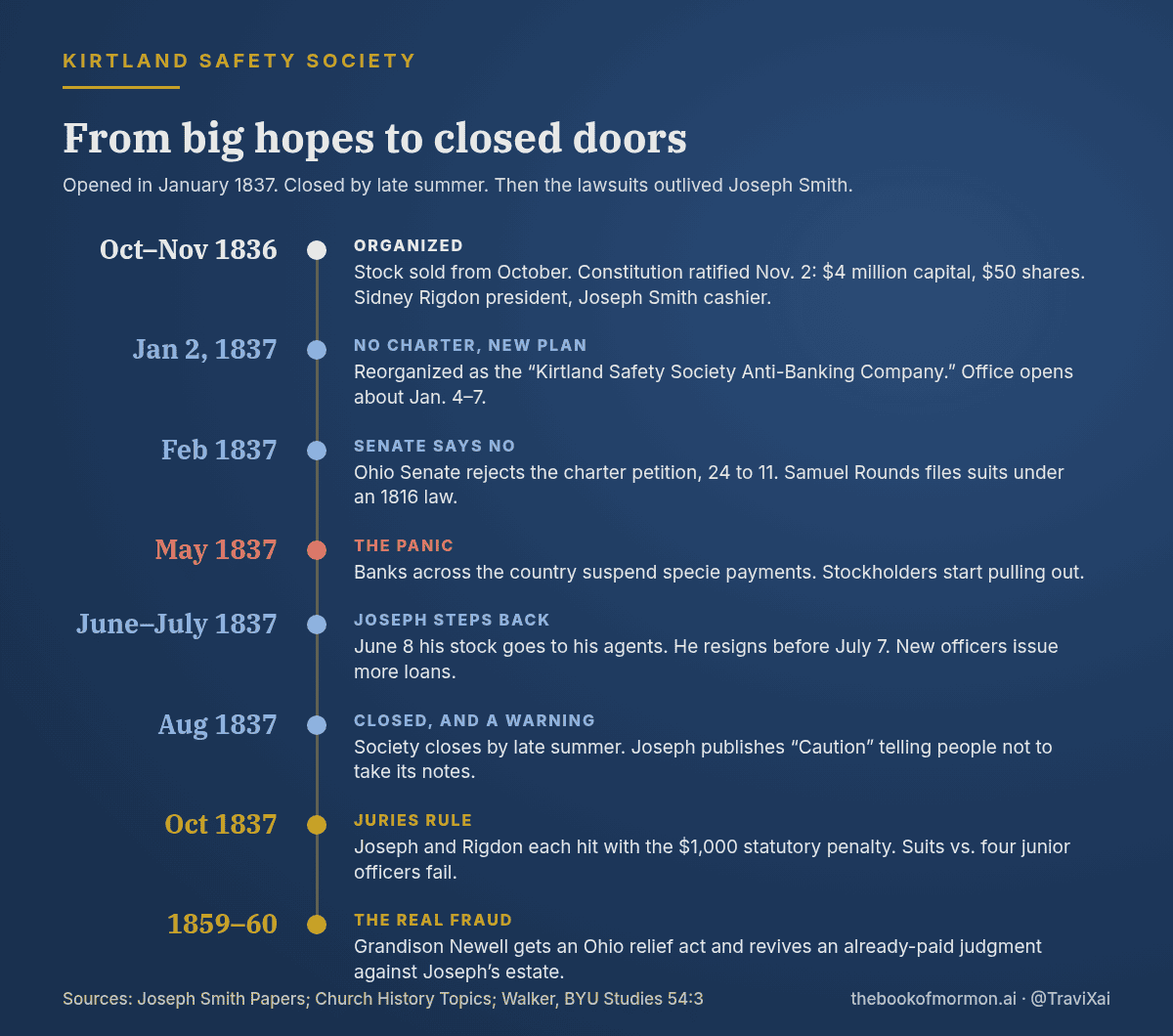
On November 2, 1836, the stockholders ratified a constitution for the Kirtland Safety Society Bank. Sidney Rigdon was president and Joseph Smith was cashier. The capital stock was set at $4 million, in $50 shares. That was ambitious. The Joseph Smith Papers note that other community banks of the period were capitalized at $100,000 to $300,000.
No charter, so an “anti-banking company”
To be a chartered bank in Ohio, you needed an act of the state legislature. Orson Hyde lobbied for one. He got the petition in front of the state senate, where it failed, 24 to 11.
Kirtland wasn’t singled out. According to the Joseph Smith Papers, the Ohio legislature “did not approve the incorporation of a single bank in its 1836–1837 session.” Nobody got a charter that year.
So on January 2, 1837, the stockholders reorganized as the “Kirtland Safety Society Anti-Banking Company,” an unincorporated joint-stock company. Critics love that name. It sounds like a wink. But the Joseph Smith Papers editors explain that it simply reflected the fact that the society was not state-chartered, and they call the term “misleading,” because the stockholders “were not opposed to banking and continued to run their institution as a bank.” This wasn’t some trick unique to Kirtland, either. The same editors write that “in Ohio, unauthorized banks had become commonplace by the 1830s,” and that the state’s banking laws contradicted each other.
Was it wise to open without a charter? No. That’s one of the real mistakes, and it gave enemies a legal weapon, as we’ll see. But a common, risky workaround in a state where nobody could get a charter is a long way from a scam.
Opposition, then the Panic of 1837
The office opened in early January 1837, and the notes circulated at first. Opposition showed up just as fast.
The loudest enemy was Grandison Newell, a Painesville businessman. A man who worked for him later said Newell “used to drive about the country and buy up all the Mormon money possible, and the next morning go to the bank and obtain the specie.” Specie means gold and silver coin. Drain a small bank’s coin and you drain the bank. In late January, Wilford Woodruff wrote that they “had been threatened by a mob from Panesville to visit us that night & demolish our Bank.” In February, Samuel Rounds of Painesville filed six lawsuits against Joseph, Sidney Rigdon, and four junior officers for running an unauthorized bank.
Then came the national crash. Banks across the country stopped redeeming their notes in gold and silver, and the depression that followed lasted for years. Jeffrey N. Walker writes in BYU Studies that every bank in Michigan closed, some temporarily and some permanently. That included the Bank of Monroe, the Michigan bank Kirtland’s leaders had bought into earlier that year, perhaps hoping to operate under its charter.
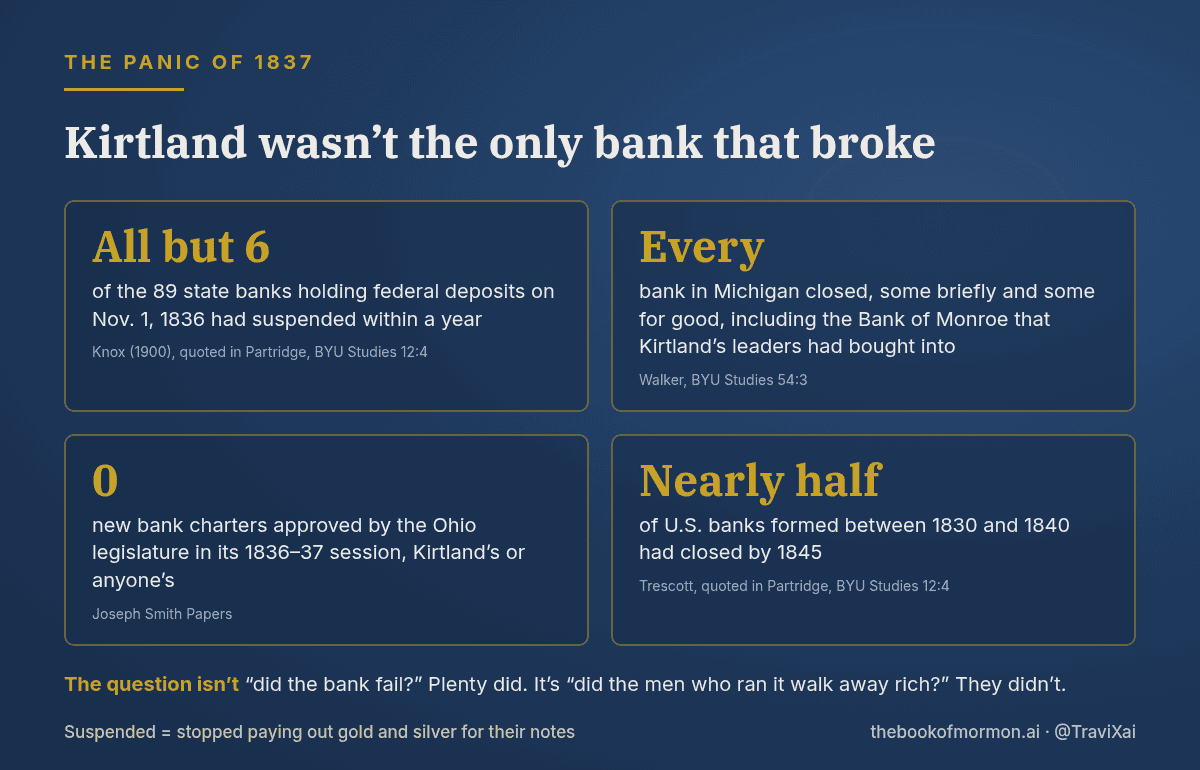
Scott H. Partridge, writing in BYU Studies, quotes the banking historian John Jay Knox on what happened to the big state banks that held federal money. On November 1, 1836, there were 89 of them. “In less than a year all but six of these had suspended.” Partridge also quotes the historian Paul Trescott: nearly half of the banks formed between 1830 and 1840 “closed by 1845.”
The Joseph Smith Papers sum it up this way: the panic “was one of the central reasons the bank failed. Other contributing factors included external opposition, limited community support, and severe funding problems.”
What Joseph Smith said, and when he got out
Did Joseph promise the bank would succeed? Here is what’s actually on record. On January 6, 1837, Wilford Woodruff wrote that Joseph said if they “would give heed to the Commandments the Lord had given this morning all would be well.” That’s a conditional promise, not a guarantee.
And the conditions weren’t kept. Warren Cowdery, editor of the Church’s own Kirtland paper, wrote in June 1837 that real estate had risen “from one to eight hundred per cent. and in many cases more,” that men “not thought worth fifty or an hundred dollars became purchasers to the amount of thousands,” and that among the causes of distress was “an inordinate desire to become suddenly and vastly rich.” The Bible had already warned them:
A faithful man shall abound with blessings: but he that maketh haste to be rich shall not be innocent.
Proverbs 28:20
Many stockholders pledged for shares and paid only a fraction. In May and June 1837, as confidence collapsed, stockholders pulled out. On June 8, Joseph’s stock was transferred to Oliver Granger and Jared Carter. That sounds like a man cashing out until you read the footnote: the Joseph Smith Papers say this “appears to be the earliest instance of Oliver Granger acting in the capacity of an agent for JS.” Granger was Joseph’s own agent, and he spent years afterward settling Joseph’s Kirtland debts.
Sometime before July 7, Joseph resigned. His history, compiled in his voice by his clerks in the 1840s, puts it this way:
Some time previous to this I resigned my office in the “Kirtland Safety Society” disposed of my interest therein, and withdrew from the institution: being fully aware, after so long an experiment, that no institution of the kind, established upon just and righteous principles, for a blessing not only to the church, but the whole nation, would be suffered to continue its operations in such an age of darkness, speculation, and Wickedness.
JS History, vol. B-1, p. 764
The new officers, Frederick G. Williams and Warren Parrish, made more loans and put more notes into circulation, which drove the notes’ value down further. Parrish was later accused of counterfeiting and embezzling, and he went on to lead a breakaway group against Joseph. The society closed by late summer 1837.
When Joseph came home from Canada in late August, he published a warning in the Messenger and Advocate. He told people to “beware of speculators, renegadoes” who were “duping the unsuspecting and the unwary, by palming upon them, those bills, which are of no worth, here. I discountenance and disapprove of any and all such practices.” A con man spreads worthless paper. Joseph told people not to take it. Some Saints, by Nathan Tanner’s later account, even traded their own goods for the notes to pull them out of circulation and lift the burden off Joseph and Sidney.
The lawsuits, and the real fraud
In October 1837, juries found against Joseph and Sidney in the Rounds cases. The penalty under the 1816 Ohio statute was $1,000, split between the man who sued and the state. The cases against the four junior officers failed. Walker, whose article is a legal examination of these cases, argues the convictions themselves were on shaky ground, because an 1824 Ohio act had “superseded the Act of 1816.”
Joseph paid. Personal property worth $716.25 was sold, and in 1838 Newell, who now held the judgments, assigned them to Joseph’s agents William Marks and Oliver Granger for $1,600. The Joseph Smith Papers conclude this “effectively paid judgments for both cases in full.”
Then the story turns. Joseph was killed in 1844. In 1859, Newell got the Ohio legislature to pass “An Act for the Relief of Grandison Newell,” and in 1860 he revived the already-paid judgment against Joseph’s estate. The administrator appointed over that estate was Henry Holcomb, the husband of Newell’s granddaughter. Walker’s verdict: Newell “had collected more than 100 percent of the judgments” and then “used the law to commit a fraud on the state of Ohio long after the death of Joseph Smith.” So there was fraud in the Kirtland bank story. It just wasn’t Joseph’s.
Failure isn’t fraud
Want to see what a real 1837 bank fraud looked like? Partridge describes a Michigan bank that “filled its specie kegs with glass, lead, and ten-penny nails, topping these materials off with silver to fool the examiners.” That’s a con: fake reserves dressed up as real ones.
Kirtland shows the reverse. The leaders signed the notes in their own names, got sued in their own names, and paid. The Church’s history topic says “many Saints incurred financial setbacks as a result, particularly Joseph Smith, whose losses were substantial.” He carried Kirtland debts for the rest of his life, and when he filed for bankruptcy in 1842, his debts were never discharged. In January 1838 he left Kirtland for Missouri with enemies at his back, not money in his pockets.
Jesus gave the test:
Wherefore by their fruits ye shall know them.
Matthew 7:20
A swindle’s fruit is a rich swindler. The fruit of the Kirtland Safety Society was a poorer, sued, and hunted Joseph Smith.
None of this means everyone got it right. The Church’s own history says some Saints blamed leaders “for failing to anticipate problems,” others for “land speculation and overspending.” The bank was undercapitalized and unchartered, and too many people bet on boom times. Partridge says it plainly: Joseph “was partly responsible, but that fact should not be built into something more than it is.” He also found “no evidence produced to demonstrate that there was ever an intent to defraud.”
That’s the honest summary. A failed bank in a year when banks were failing everywhere. A prophet who was also a man, and who took some of the heaviest losses of all. Some members left over it. Most stayed, and the Church kept growing.
If someone throws the Kirtland bank at you, ask them one question: who got rich? Then point them to the records.
Sources
- Joseph Smith Papers, “Introduction to the Kirtland Safety Society” (capital, charter vote, legislature’s 1836–37 session, Newell, Woodruff, stock withdrawals, resignation, closing): josephsmithpapers.org
- Joseph Smith Papers, “Financial Panic of 1837” (Kirtland population; Warren Cowdery’s June 1837 editorial): josephsmithpapers.org
- Joseph Smith Papers, “Notice, circa Late August 1837” (Joseph’s warning; Granger as his agent; Nathan Tanner): josephsmithpapers.org
- Joseph Smith Papers, History, 1838–1856, vol. B-1, p. 764 (resignation): josephsmithpapers.org
- Joseph Smith Papers, “Introduction to Rounds qui tam v. JS” (the suits, the $1,000 penalty, the 1838 assignment, the 1859 act, the 1860 revival): josephsmithpapers.org
- Joseph Smith Papers, “Joseph Smith’s Application for Bankruptcy”: josephsmithpapers.org
- Church History Topics, “The Kirtland Safety Society” (losses, Woodruff’s January 6, 1837 entry, reasons for the failure): churchofjesuschrist.org
- Jeffrey N. Walker, “The Kirtland Safety Society and the Fraud of Grandison Newell: A Legal Examination,” BYU Studies 54, no. 3 (2015): byustudies.byu.edu
- Scott H. Partridge, “The Failure of the Kirtland Safety Society,” BYU Studies 12, no. 4 (1972): byustudies.byu.edu
- Further reading: Marvin S. Hill, C. Keith Rooker, and Larry T. Wimmer, “The Kirtland Economy Revisited: A Market Critique of Sectarian Economics,” BYU Studies 17, no. 4 (1977): byustudies.byu.edu; Mark L. Staker, Hearken, O Ye People: The Historical Setting of Joseph Smith’s Ohio Revelations (Greg Kofford Books), pp. 435–454, assigned reading in the Joseph Smith Papers’ Panic of 1837 lesson above.
- Scripture Central, “Why Did the Kirtland Safety Society Fail?” (KnoWhy #604): scripturecentral.org
- Proverbs 28 and Matthew 7 (KJV): Proverbs 28, Matthew 7
Need a quick answer the next time someone calls Joseph Smith a con man? Galatians18 has short, sourced comebacks to the arguments critics use most.
Follow me on X for more: @TraviXai. And if a critic hands you the Kirtland bank, send it my way. I’ll bring the stock ledger.