
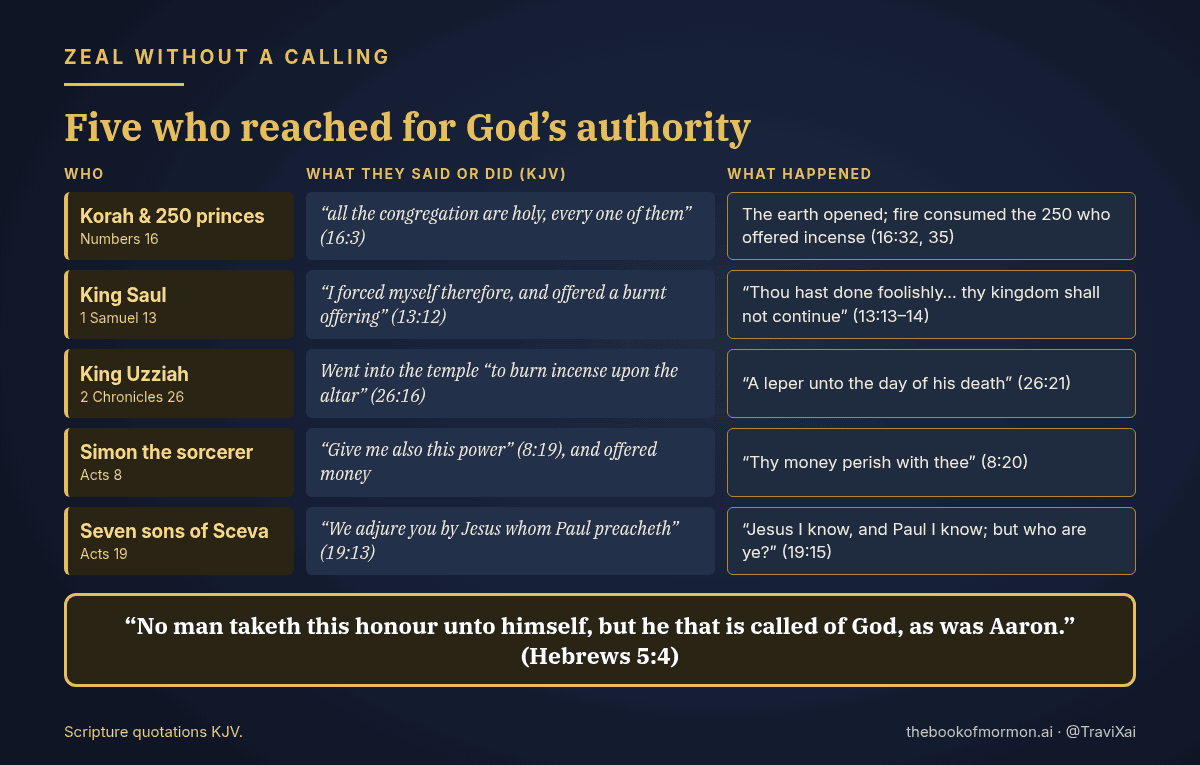
Korah was sincere. Saul had a good reason. Uzziah was one of Judah’s best kings. Simon even offered to pay. The Bible’s verdict on all of them is the same: zeal doesn’t give anyone the right to act for God. Here is the pattern from Numbers to Acts, and why Latter-day Saints teach that priesthood had to be restored by those who held it.
Ask most Christians who gave their pastor the right to baptize and you’ll hear some version of this: he loves the Lord, he knows the Bible, and a congregation asked him to lead. All good things. But the Bible is full of people who loved God, meant well, and reached for His authority anyway. It never ends well.
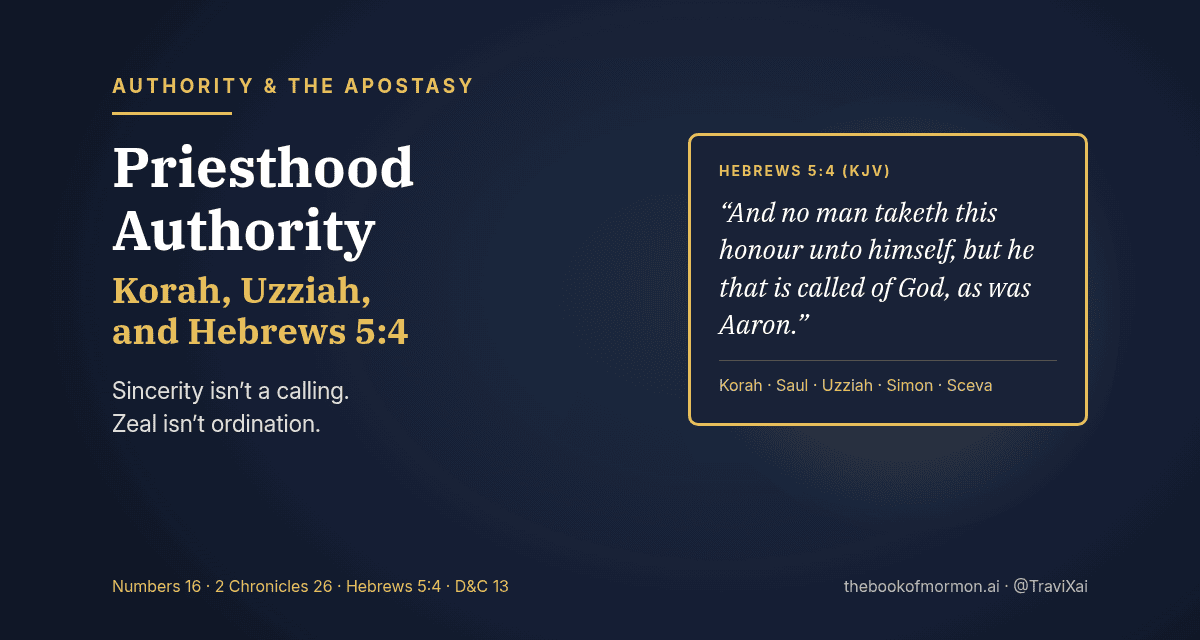
This isn’t a Latter-day Saint invention. It runs from Moses to the apostles, and Hebrews sums it up in one line: “no man taketh this honour unto himself, but he that is called of God, as was Aaron” (Hebrews 5:4). Let’s walk through the cases.
Korah“Ye take too much upon you”
Korah wasn’t a scoffer. He was a Levite already serving at the tabernacle, and with him stood “two hundred and fifty princes of the assembly, famous in the congregation, men of renown” (Numbers 16:2). And his argument sounds downright modern:
Ye take too much upon you, seeing all the congregation are holy, every one of them, and the LORD is among them: wherefore then lift ye up yourselves above the congregation of the LORD?
Numbers 16:3 (KJV)
Everyone is holy, so why should Aaron be special? Moses pointed out that the Lord had already brought the Levites near “to do the service of the tabernacle,” then asked, “and seek ye the priesthood also?” (Numbers 16:9–10). The test was left to God: “the man whom the LORD doth choose, he shall be holy” (16:7).
You know how it ended. “The earth opened her mouth, and swallowed them up” (16:32), and fire “consumed the two hundred and fifty men that offered incense” (16:35). Their censers became “a memorial… that no stranger, which is not of the seed of Aaron, come near to offer incense before the LORD; that he be not as Korah” (16:40).
SaulA good reason, the wrong hands
Saul’s case is harder, because his reasons were good. The Philistines were massing, his army was melting away, and Samuel was late. So Saul said, “Bring hither a burnt offering to me,” and offered it himself (1 Samuel 13:9).
Therefore said I, The Philistines will come down now upon me to Gilgal, and I have not made supplication unto the LORD: I forced myself therefore, and offered a burnt offering.
1 Samuel 13:12 (KJV)
He wanted to pray before battle. Samuel arrived as the smoke was rising and said, “Thou hast done foolishly: thou hast not kept the commandment of the LORD thy God… now thy kingdom shall not continue” (13:13–14).
Saul had the crown, the crisis, and the motive. He didn’t have the commission. As Samuel later put it, “to obey is better than sacrifice” (1 Samuel 15:22).
UzziahA good king with a censer
Uzziah was one of Judah’s good kings, and he “sought God” for years. Then, “when he was strong, his heart was lifted up to his destruction: for he transgressed against the LORD his God, and went into the temple of the LORD to burn incense upon the altar of incense” (2 Chronicles 26:16). Azariah and eighty priests went in after him:
It appertaineth not unto thee, Uzziah, to burn incense unto the LORD, but to the priests the sons of Aaron, that are consecrated to burn incense: go out of the sanctuary; for thou hast trespassed.
2 Chronicles 26:18 (KJV)
He got angry, and “while he was wroth with the priests, the leprosy even rose up in his forehead” right beside the altar (26:19). He was “a leper unto the day of his death” and “cut off from the house of the LORD” (26:21).
Presbyterian commentator Matthew Henry (1706) saw it clearly. Uzziah’s sin was “invading the priest’s office,” an act “for which, it is likely, he pretended an extraordinary zeal and affection,” and “the law, he knew, was express against him” (Matthew Henry’s Commentary). A king is not a priest just because he’s a king, and a devout man is not a priest just because he’s devout.
Hebrews 5:4Not even Christ took it himself
Hebrews turns these stories into a principle:
For every high priest taken from among men is ordained for men in things pertaining to God… And no man taketh this honour unto himself, but he that is called of God, as was Aaron.
Hebrews 5:1, 4 (KJV)
Then comes the remarkable part: “So also Christ glorified not himself to be made an high priest; but he that said unto him, Thou art my Son” (Hebrews 5:5). He was “called of God an high priest after the order of Melchisedec” (5:10).
If the Son of God waited on His Father’s call, a sincere man with a seminary degree can’t skip that step.
Simon and ScevaIt can’t be bought or borrowed
Acts closes the two usual loopholes. The first is money. When Simon of Samaria saw “that through laying on of the apostles’ hands the Holy Ghost was given, he offered them money, saying, Give me also this power” (Acts 8:18–19). Peter’s answer is the most quotable rejection in the Bible: “Thy money perish with thee, because thou hast thought that the gift of God may be purchased with money” (Acts 8:20). Simon got one thing right: the power came through the apostles’ hands. He just couldn’t buy a pair.
The second is borrowing: saying the right words and hoping authority comes with them. The seven sons of Sceva, sons of a chief priest no less, tried exactly that:
We adjure you by Jesus whom Paul preacheth… And the evil spirit answered and said, Jesus I know, and Paul I know; but who are ye?
Acts 19:13, 15 (KJV)
They used the right name and the right apostle. The man “leaped on them… so that they fled out of that house naked and wounded” (Acts 19:16). A name spoken without a commission is just a name.
The patternBy the laying on of hands
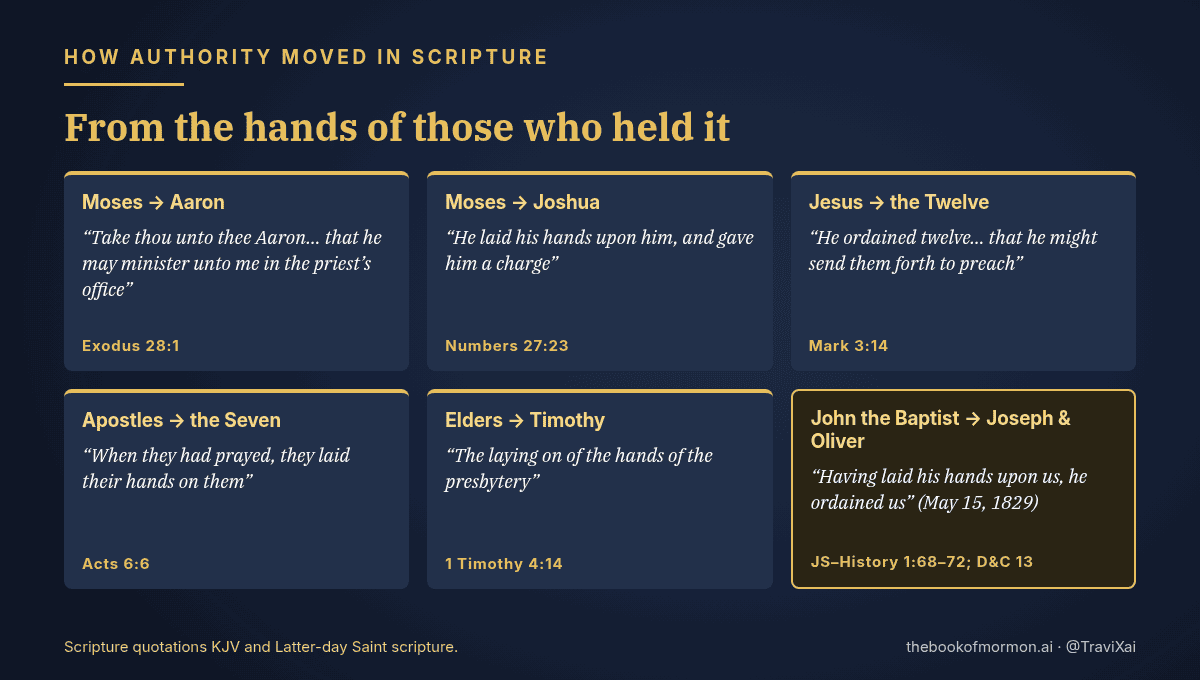
So how does anyone receive it? The same way every time: from God, through the hands of someone who already holds it. Moses “laid his hands upon” Joshua “as the LORD commanded” (Numbers 27:23). Jesus “ordained twelve” (Mark 3:14) and told them, “Ye have not chosen me, but I have chosen you, and ordained you” (John 15:16). The Seven were set before the apostles, “and when they had prayed, they laid their hands on them” (Acts 6:6). Timothy received his gift “with the laying on of the hands of the presbytery” (1 Timothy 4:14).
Paul even asked the question outright: “how shall they preach, except they be sent?” (Romans 10:15). The earliest Christians read it the same way. Clement of Rome, writing to Corinth near the end of the first century, said “the apostles by Christ” were sent “in an orderly way,” and that they “appointed” bishops and deacons and “gave instructions, that when these should fall asleep, other approved men should succeed them in their ministry” (1 Clement 42, 44).
The Catholic Church agrees on the principle, though we disagree on where the line runs today: “No one can give himself the mandate and the mission to proclaim the Gospel,” and “No one can bestow grace on himself; it must be given and offered. This fact presupposes ministers of grace, authorized and empowered by Christ” (Catechism of the Catholic Church, 875). You’ll find the verses gathered at Priesthood Authority and Apostolic Keys.
“Every believer is a priest”1 Peter 2:9 and Exodus 19:6
The most common reply is 1 Peter 2:9: “ye are a chosen generation, a royal priesthood” (1 Peter 2:9). No ordination needed, the argument goes, because every believer is already a priest.
Peter is quoting Exodus. God told all of Israel at Sinai, “ye shall be unto me a kingdom of priests, and an holy nation” (Exodus 19:6). Yet in that same kingdom of priests, only Aaron’s sons could burn incense, and “the stranger that cometh nigh shall be put to death” (Numbers 3:10). A holy people can still have offices that require a call. Korah’s mistake was treating the first as if it erased the second.
The RestorationWhy John the Baptist came back
Here’s where the pattern gets uncomfortable. If authority passes only by the hands of those who hold it, then what happens when the people holding it are gone? The apostles were killed one by one. Latter-day Saints believe that is what the Great Apostasy was: not that every Christian became wicked, but that the chain of authority broke, and sincere men kept the forms going without it. For more on how the early church changed, see What Modern Church Would a First-Century Christian Recognize?
If the chain broke, zeal can’t fix it. The only biblical fix is for God to send someone who holds the authority to lay hands on someone new. That is exactly what Joseph Smith and Oliver Cowdery testified happened in May 1829, after they went into the woods to ask about baptism:
A messenger from heaven descended in a cloud of light, and having laid his hands upon us, he ordained us, saying: Upon you my fellow servants, in the name of Messiah, I confer the Priesthood of Aaron, which holds the keys of the ministering of angels, and of the gospel of repentance, and of baptism by immersion for the remission of sins.
Joseph Smith—History 1:68–69
The messenger “said that his name was John, the same that is called John the Baptist in the New Testament, and that he acted under the direction of Peter, James and John,” and the date was “the fifteenth day of May, 1829” (Joseph Smith—History 1:72; see D&C 13). Peter, James, and John then came themselves, the Lord says, “by whom I have ordained you and confirmed you to be apostles” (D&C 27:12).
Nobody took this honor to himself. The fifth Article of Faith sums it up: “a man must be called of God, by prophecy, and by the laying on of hands by those who are in authority” (Articles of Faith 1:5). More detail is at Restoration of the Priesthood.
You don’t have to accept Joseph’s testimony to see the logic. If authority matters the way Korah and Uzziah show, a church needs either an unbroken line back to the apostles or a restoration from heaven. Joseph claimed the second, with names, a place, and a date.
SummaryKey takeaways
- Korah argued that “all the congregation are holy” (Numbers 16:3). The ground opened anyway.
- Saul had a crisis and a good motive; Uzziah had a crown. Both were rebuked for doing a priest’s work.
- Hebrews 5:4: “no man taketh this honour unto himself.” Even Christ “glorified not himself” (5:5).
- In scripture, authority always comes by the laying on of hands from those who hold it (Numbers 27:23, Acts 6:6, 1 Timothy 4:14).
- Latter-day Saints teach that the line broke and was restored the same way: John the Baptist on May 15, 1829 (D&C 13), then Peter, James, and John (D&C 27:12).
Next time someone says authority doesn’t matter if your heart is right, open Numbers 16 together and ask what Korah got wrong. Then ask who laid hands on the man who laid hands on their pastor. For quick, sourced answers on priesthood and the Apostasy, open Galatians18. And for more like this every day, follow me on X at @TraviXai.
Sources
- Scriptures (KJV and Latter-day Saint scriptures, churchofjesuschrist.org): Numbers 16 · Numbers 17:8 · Numbers 3:10 · Numbers 27:18–23 · Exodus 19:6 · Exodus 28:1 · 1 Samuel 13:8–14 · 1 Samuel 15:22 · 2 Chronicles 26:16–21 · Mark 3:14 · John 15:16 · Acts 6:6 · Acts 8:14–20 · Acts 14:23 · Acts 19:13–16 · Romans 10:15 · 1 Timothy 4:14 · Titus 1:5 · Hebrews 5:1–10 · Hebrews 7:24 · 1 Peter 2:9 · D&C 13 · D&C 27:12 · Joseph Smith—History 1:68–72 · Articles of Faith 1:5
- Clement of Rome, First Epistle to the Corinthians (1 Clement), chapters 42–44, trans. John Keith, Ante-Nicene Fathers, vol. 9 (1896): New Advent
- Catechism of the Catholic Church, paragraph 875: vatican.va
- Matthew Henry, Commentary on the Whole Bible (1706), 2 Chronicles 26:16–23: Bible Hub
- Related on this site: What Modern Church Would a First-Century Christian Recognize? · The Canon Was Never Meant to Close · Sola Scriptura: Which Verse Teaches It?
- Galatians18: Priesthood Authority and Apostolic Keys · Restoration of the Priesthood · The Great Apostasy
- Featured image and both charts: original graphics by thebookofmormon.ai (no photographs or likenesses of real people).