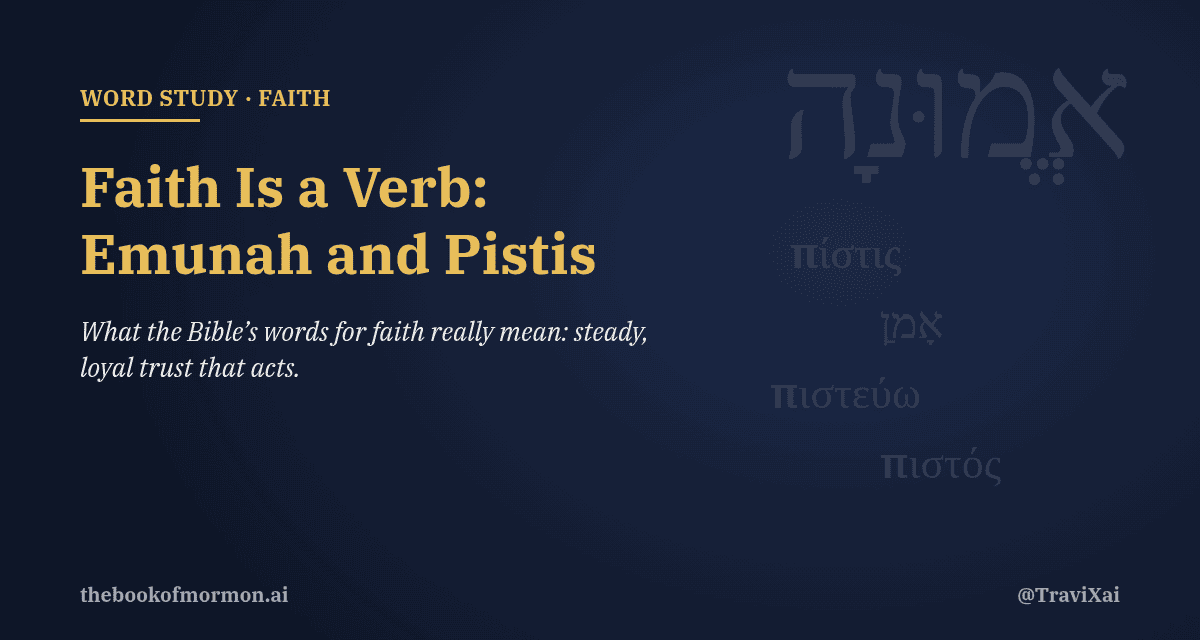

Faith isn’t a guess about things you can’t see. Here’s what the Hebrew and Greek words for faith actually meant, and why it settles a lot of the faith-versus-works debate.
Ask ten people what faith is and you’ll probably hear some version of “believing something without proof.” That definition is common. It’s also a long way from what the Bible’s words for faith meant to the people who first used them.
In Hebrew, faith is closer to steadiness: being firm, reliable, and loyal. In Greek, the word for faith covered belief, but also trust, faithfulness, and loyalty. Biblical faith isn’t mainly about what’s in your head. It’s about who you trust and how you live.
That has big consequences for one of the oldest debates in Christianity: faith versus works. Once you see what the words mean, a lot of that debate turns out to be a misunderstanding.
Part 1: Hebrew faith means holding steady
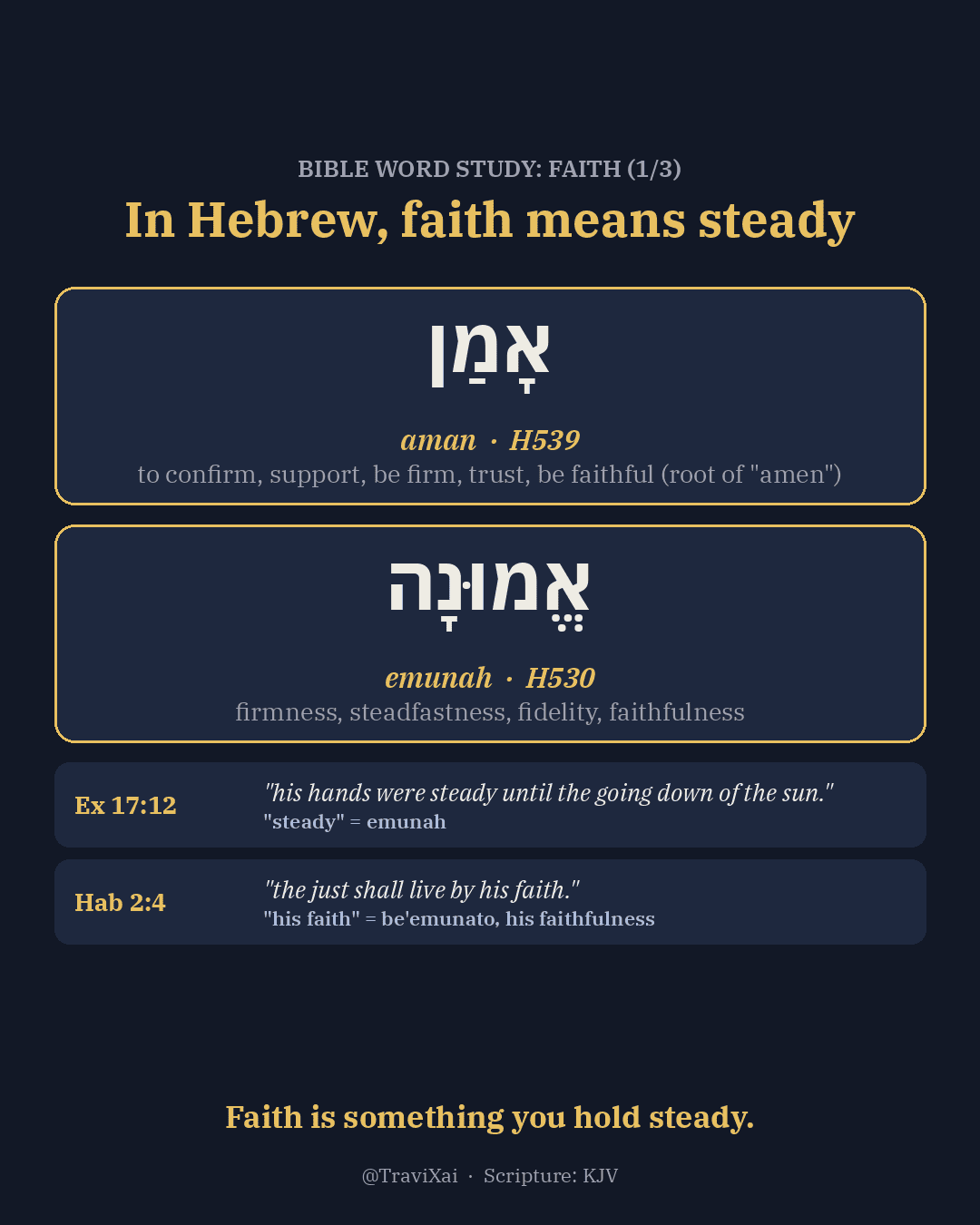
The Hebrew root behind faith is aman (אָמַן, Strong’s H539). Its meanings include to confirm, to support, to be firm, to be faithful, and to trust. The word “amen” comes from this root. When you say amen, you’re saying: this is firm, this is reliable, I stand on it.
From that root comes the noun emunah (אֱמוּנָה, Strong’s H530): firmness, steadfastness, fidelity, faithfulness.
The best way to feel what emunah means is to see it used for something physical. In Exodus 17, Israel is fighting the Amalekites. As long as Moses holds up his hands, Israel wins. When his arms get tired, Aaron and Hur sit him on a stone and hold up his hands, one on each side. Then verse 12:
“and his hands were steady until the going down of the sun.”
The word translated “steady” is emunah.
That’s the picture. Faith is arms held up all day, even when they’re tired, with help from others. It’s not a single moment of mental agreement. It’s steadiness over time.
The just shall live by his faith
Now the most important faith verse in the Old Testament. Habakkuk 2:4:
“Behold, his soul which is lifted up is not upright in him: but the just shall live by his faith.”
“By his faith” translates the Hebrew be’emunato: by his emunah, his steadfastness, his faithfulness. BibleHub’s interlinear lists the word as H530 and glosses it “by his faith.”
The New Testament quotes this verse three times: Romans 1:17, Galatians 3:11, and Hebrews 10:38. It’s at the heart of Paul’s teaching about faith. And the word behind it, in its original Hebrew setting, means faithfulness: holding steady to God.
That doesn’t mean Paul was secretly teaching salvation by human effort. It means that when Paul says “faith,” he’s drawing on a word whose roots mean trust that holds firm. In Habakkuk the righteous person lives by staying loyal to God while waiting for God to keep His promises.
Part 2: Pistis is more than believing
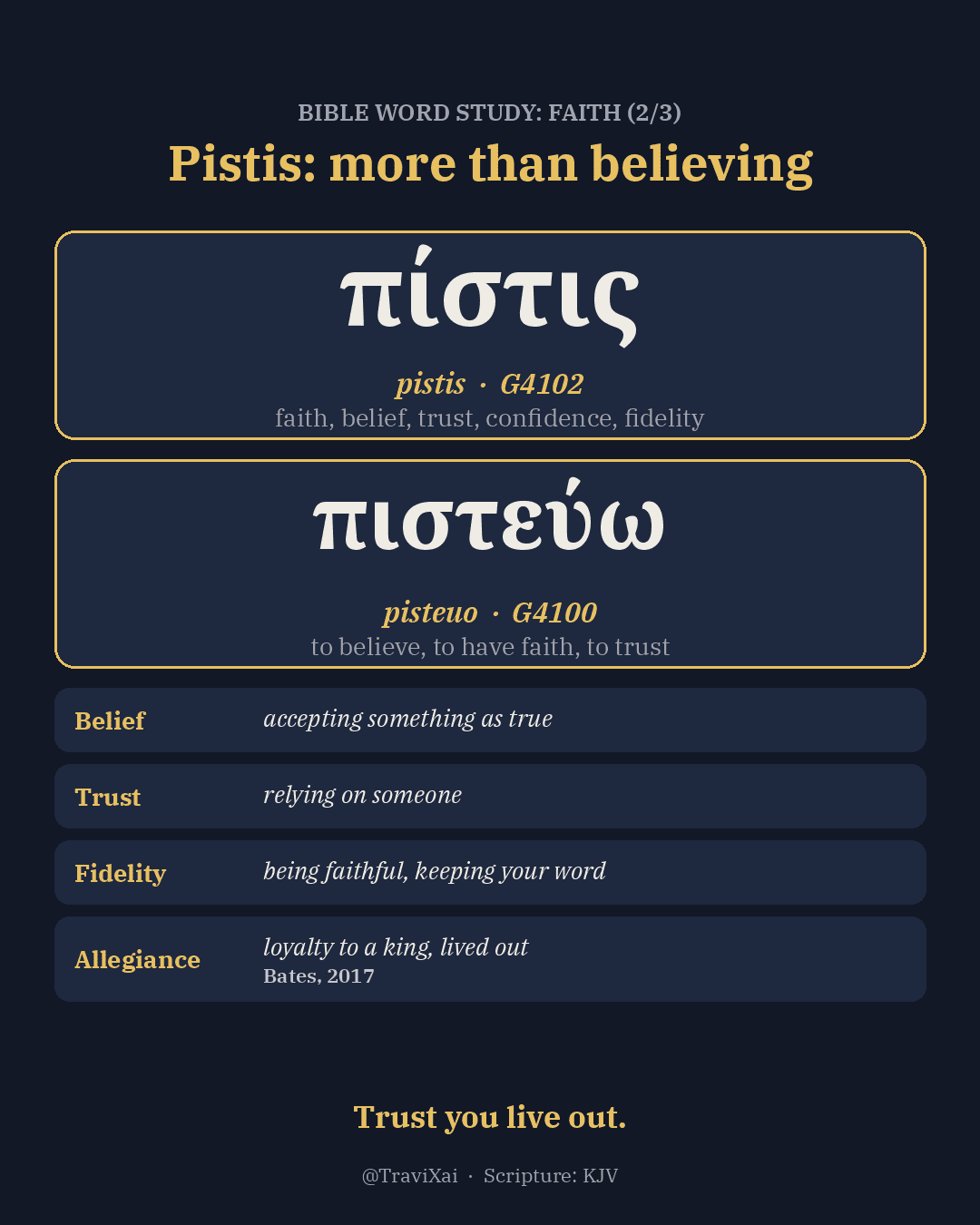
The New Testament word for faith is pistis (πίστις, Strong’s G4102). The related verb is pisteuo (πιστεύω, Strong’s G4100), “to believe, to have faith, to trust.”
In everyday Greek, pistis had a wide range:
- Belief: accepting something as true.
- Trust: relying on someone.
- Fidelity: being faithful, keeping your word.
- Pledge or proof: something that gives you grounds to rely on it.
English has to pick one word, and “faith” now leans heavily toward the first meaning. Greek speakers heard all of them at once.
You can see the overlap in English too. We say a husband is “faithful” to his wife. We don’t mean he holds correct opinions about her. We mean he’s loyal, reliable, and true. That’s much closer to what pistis meant in daily life. When the New Testament calls someone “faithful,” it uses the adjective pistos, from the same word family. Faith and faithfulness are one idea in Greek, even though English splits them into two.
What the scholars say
In the last decade or so, several major non-LDS scholars have pushed the field to take the wider meaning seriously.
Teresa Morgan, in Roman Faith and Christian Faith (Oxford University Press, 2015), studied pistis and its Latin partner fides across the Greek and Roman world. She shows that these words were mainly about trust and trustworthiness in relationships: between friends, family members, masters and servants, rulers and subjects, gods and people. Faith was relational before it was propositional.
Matthew W. Bates, in Salvation by Allegiance Alone: Rethinking Faith, Works, and the Gospel of Jesus the King (Baker Academic, 2017), argues that when the New Testament talks about the pistis that saves, “allegiance” is often the best English. The gospel announces that Jesus is the King, and saving faith is loyalty to Him. Bates is careful about the limits of his claim. He doesn’t say pistis means allegiance every time it appears. He argues it fits best where salvation is at stake.
Nijay K. Gupta, in Paul and the Language of Faith (Eerdmans, 2020), treats pistis as an elastic word. Depending on context, Paul uses it for believing faith, obeying faith, or trusting faith. Gupta resists squeezing it into any single meaning.
N. T. Wright, in Paul and the Faithfulness of God (Fortress, 2013), also stresses the covenant setting of Paul’s language: God’s faithfulness to His promises, and the faithful response of His people.
These scholars don’t agree on everything. But they agree on this much: biblical faith is not just agreeing that a statement is true. It’s trust you live out.
Part 3: Faith that agrees vs. faith that acts
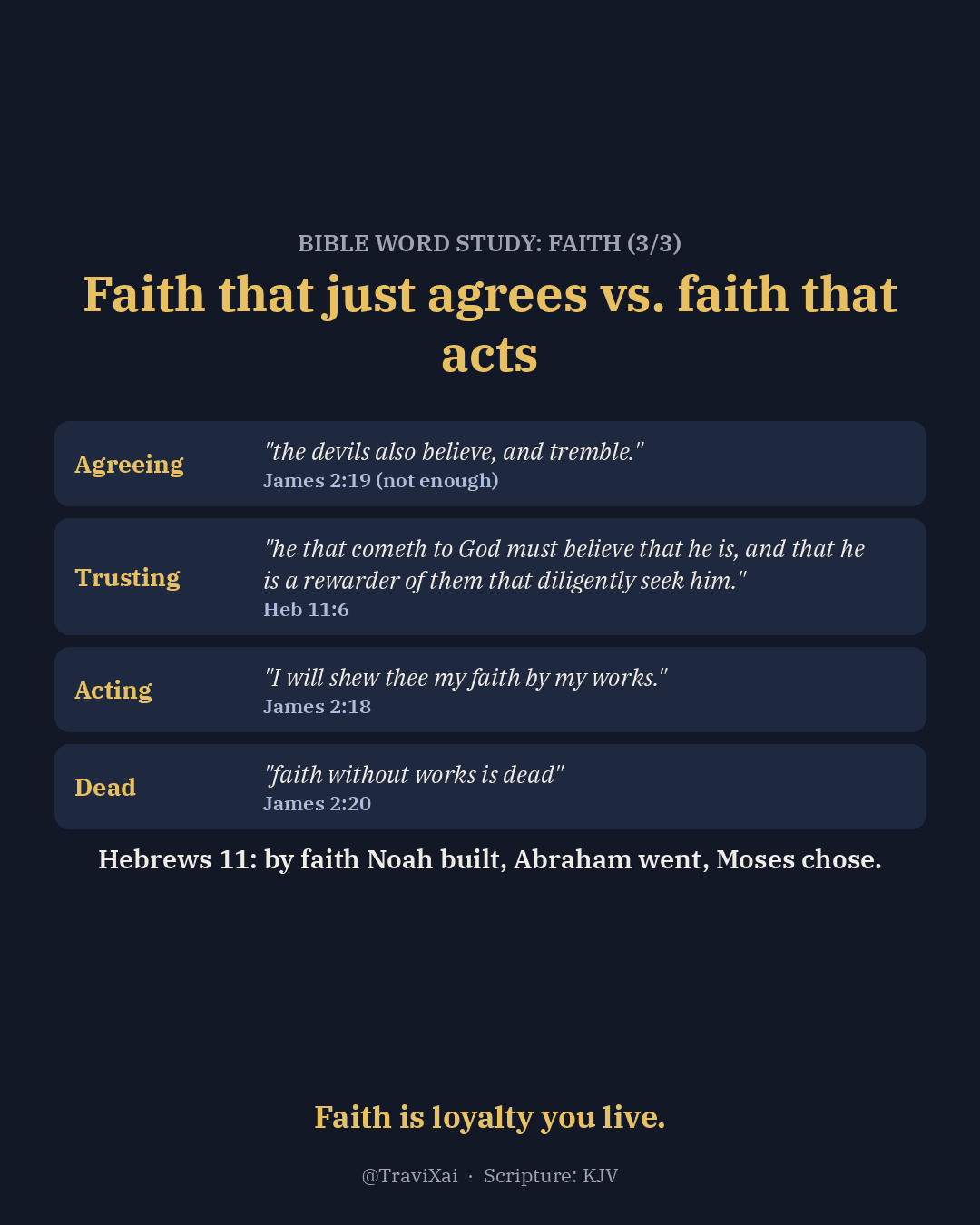
The New Testament itself draws a line between two kinds of “faith.” James does it most bluntly:
“Even so faith, if it hath not works, is dead, being alone.” (James 2:17)
“Yea, a man may say, Thou hast faith, and I have works: shew me thy faith without thy works, and I will shew thee my faith by my works.” (James 2:18)
“Thou believest that there is one God; thou doest well: the devils also believe, and tremble.” (James 2:19)
“But wilt thou know, O vain man, that faith without works is dead?” (James 2:20)
James isn’t against faith. He’s against a counterfeit of it. The devils have correct beliefs: they know God is one. What they don’t have is loyalty. Their “faith” agrees with the facts and changes nothing.
Hebrews 11: faith is always doing something
Hebrews 11 opens with the famous definition:
“Now faith is the substance of things hoped for, the evidence of things not seen.” (Hebrews 11:1)
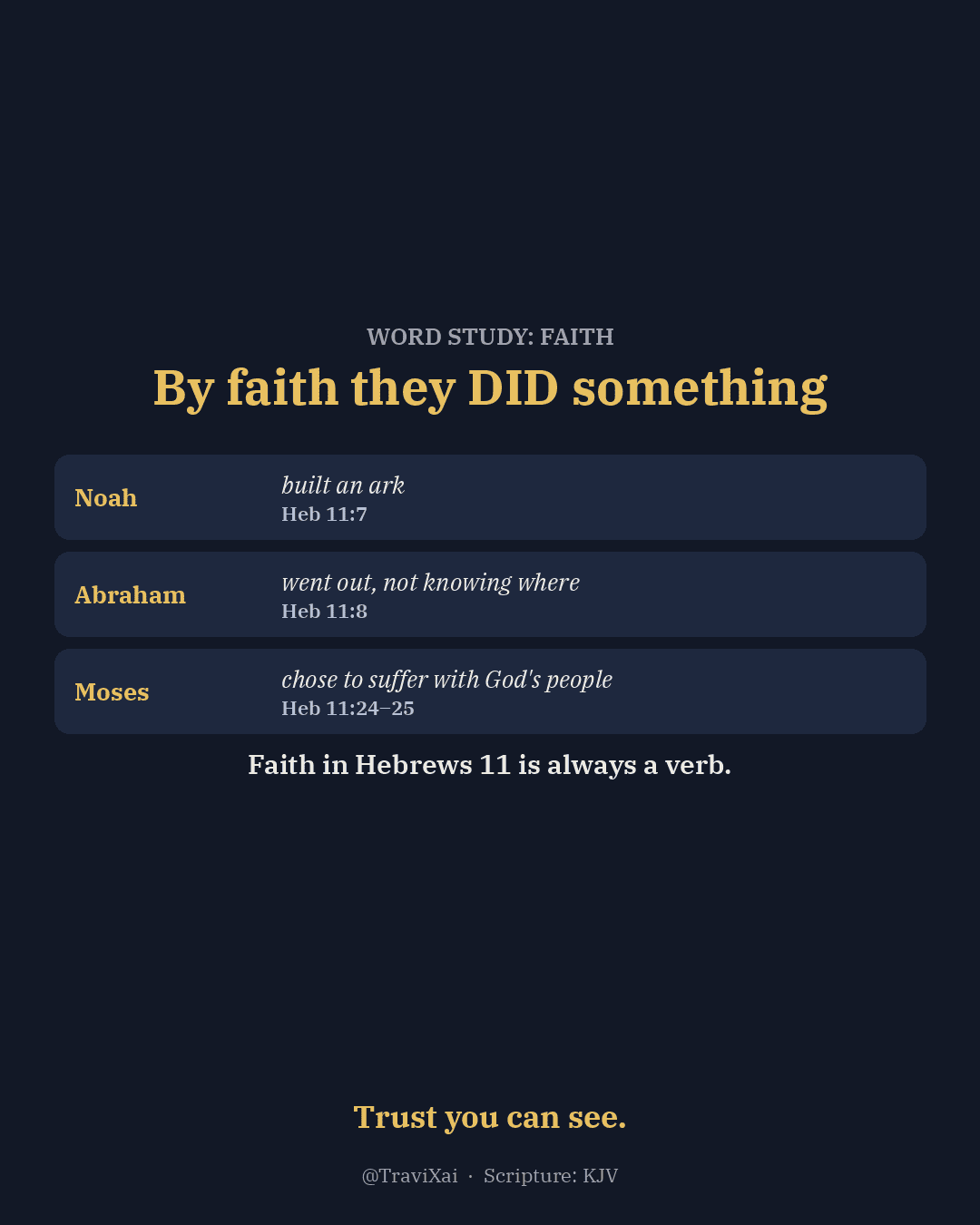
Then it spends the rest of the chapter showing what faith looks like. And every example is an action. By faith Noah prepared an ark (11:7). By faith Abraham obeyed and went out, not knowing where he was going (11:8). By faith Moses chose to suffer with God’s people rather than enjoy the pleasures of sin (11:24–25).
Faith in Hebrews 11 is always a verb.
And verse 6 joins belief and action:
“But without faith it is impossible to please him: for he that cometh to God must believe that he is, and that he is a rewarder of them that diligently seek him.”
You have to believe. And you have to diligently seek. Both are part of faith.
What about Ephesians 2?
Someone will rightly point to Ephesians 2:8–9: “For by grace are ye saved through faith; and that not of yourselves: it is the gift of God: Not of works, lest any man should boast.”
Latter-day Saints believe that verse completely. Nobody earns salvation. Nobody boasts. But verse 10 continues: “For we are his workmanship, created in Christ Jesus unto good works, which God hath before ordained that we should walk in them.”
Faith receives the gift. Faith also walks in the good works the gift was meant to produce. Paul and James aren’t fighting. Paul is saying works can’t earn salvation. James is saying faith that never acts isn’t real faith. Both are true.
Faith in the Book of Mormon
The Book of Mormon teaches faith in the same relational, active way, and it adds a picture of how faith grows.
Alma compares the word of God to a seed. He starts by clearing away a false idea:
“And now as I said concerning faith—faith is not to have a perfect knowledge of things; therefore if ye have faith ye hope for things which are not seen, which are true.” (Alma 32:21)
Notice the last three words: “which are true.” Faith isn’t believing whatever you like. It’s trusting things that are real but not yet seen. Then Alma tells his listeners to plant the seed, nourish it, and watch it grow. Faith, in his sermon, is something you do with your hands as much as your mind. You plant, water, wait, and tend.
Moroni adds that faith is tested before it’s confirmed:
“I would show unto the world that faith is things which are hoped for and not seen; wherefore, dispute not because ye see not, for ye receive no witness until after the trial of your faith.” (Ether 12:6)
That’s emunah again: steady through the trial. Moroni echoes Hebrews 11:1 and then, just like Hebrews, goes on to list what people did by faith. The pattern is the same in both books of scripture. Faith hopes, trusts, acts, and holds firm until the witness comes.
The strongest case for the Latter-day Saint view
Latter-day Saints are sometimes accused of believing in salvation by works. That isn’t what we teach. We teach that faith in Jesus Christ is the first principle of the gospel, and that real faith moves you to act. Here’s why the biblical words support that view.
- Faith is covenant loyalty. In Hebrew, emunah is steadfastness and faithfulness. Habakkuk’s “the just shall live by his faith” is about staying loyal to God. Latter-day Saints understand faith inside a covenant: God makes promises, and we bind ourselves to Him and keep holding steady.
- Non-LDS scholarship backs the relational reading. Morgan shows pistis was about trust in relationships. Bates argues saving faith is allegiance to Jesus the King. Gupta shows pistis includes obeying faith. None of these scholars are Latter-day Saints, and none of them are arguing for our position. But their work fits the Latter-day Saint description of faith as active trust very well.
- Faith includes obedience without earning anything. Paul himself frames his mission as bringing the nations to “the obedience of faith” (Romans 16:26; compare “obedience to the faith,” Romans 1:5). Obedience is how faith shows itself. It doesn’t pay God back. It’s what trust looks like.
- James and Hebrews define faith by action. Faith without works is dead. Hebrews 11 defines faith and then lists what faith did. The Bible doesn’t separate believing from living.
- Latter-day Saint scholars have made this case carefully. Brent J. Schmidt’s Relational Faith (BYU Studies, 2022) traces pistis in the ancient world and argues it meant faithfulness within a covenant relationship.
The bottom line
Faith in the Bible isn’t a guess about things you can’t see. It’s steady trust in a God you know, the kind that keeps your arms up until the sun goes down. It begins with believing, but it doesn’t end there. It trusts, obeys, keeps covenants, and keeps going.
The just shall live by his faith. That means living by faithfulness, one steady day at a time.
Next time someone says Latter-day Saints believe in salvation by works, ask them what emunah meant in Exodus 17:12, and why every example in Hebrews 11 is something somebody did. For quick, sourced answers on faith and works, open Galatians18. And for more word studies like this, follow me on X at @TraviXai.
Sources
- Strong’s H539 (aman), H530 (emunah), G4102 (pistis), G4100 (pisteuo). BibleHub, including the interlinear for Habakkuk 2:4 and Exodus 17:12.
- Teresa Morgan, Roman Faith and Christian Faith: Pistis and Fides in the Early Roman Empire and Early Churches (Oxford: Oxford University Press, 2015). Non-LDS.
- Matthew W. Bates, Salvation by Allegiance Alone: Rethinking Faith, Works, and the Gospel of Jesus the King (Grand Rapids: Baker Academic, 2017). Non-LDS.
- Nijay K. Gupta, Paul and the Language of Faith (Grand Rapids: Eerdmans, 2020). Non-LDS.
- N. T. Wright, Paul and the Faithfulness of God (Minneapolis: Fortress, 2013). Non-LDS.
- Brent J. Schmidt, Relational Faith: The Transformation and Restoration of Pistis as Knowledge, Trust, Confidence, and Covenantal Faithfulness (Provo, UT: BYU Studies, 2022). LDS.
- Scripture quotations: King James Version, churchofjesuschrist.org.
- Featured image, word cards, and charts: original graphics by thebookofmormon.ai (no photographs or likenesses of real people).