
Critics say Latter-day Saints twist the Bible. Run the cherry-picking test on Psalm 82, 1 Corinthians 15:29, James 2:24, and Ephesians 4, and see whose position needs verses to disappear.
Say you believe in living prophets, temples, and a God who still speaks, and someone will tell you, usually within minutes: “You twist the Bible.” Fair enough. That’s a serious charge, and it deserves a serious test.
Here’s the test. Cherry-picking means grabbing the verses that help you and quietly stepping around the ones that don’t. So the question isn’t who quotes the Bible. Everybody quotes the Bible. The question is whose position needs certain verses to go away.
Let’s open the book and see.
First, a word about who’s reading
Latter-day Saints don’t come to this conversation as Bible tourists. The Church’s home and Sunday study program, Come, Follow Me, runs on a four-year cycle, and two of those four years are spent in the Bible: one in the Old Testament and one in the New. 2026 is an Old Testament year.
We also don’t treat the Bible as an idol. Scripture is the record of God speaking to His prophets. It isn’t God, it never claims to be inerrant, and the scribes and translators who handed it down weren’t infallible. What we believe is that the same God who spoke to Moses and Paul still speaks today. That’s exactly why we take every page seriously, including the pages that don’t fit a tidy system.
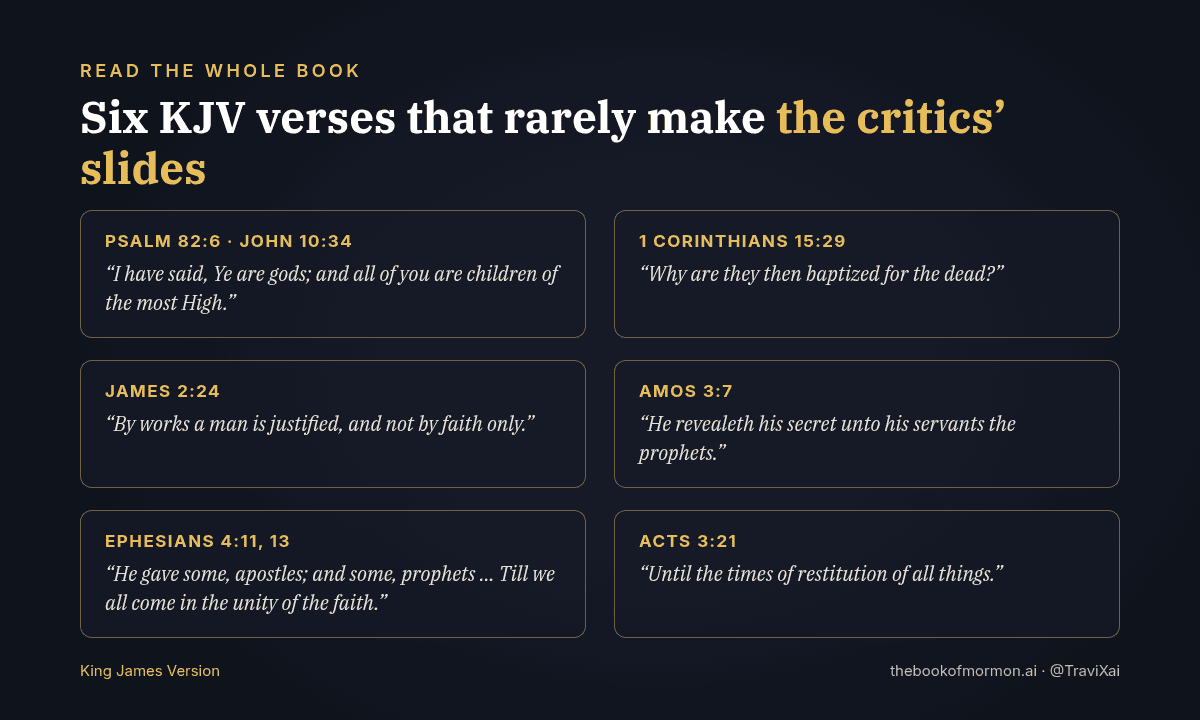
“Ye are gods”: the verse Jesus quoted
Psalm 82 opens in God’s council:
God standeth in the congregation of the mighty; he judgeth among the gods. … I have said, Ye are gods; and all of you are children of the most High.
Psalm 82:1, 6 (KJV)
Now watch what Jesus does with it. Accused of blasphemy for calling Himself the Son of God, He doesn’t back away from Psalm 82. He leans on it:
Jesus answered them, Is it not written in your law, I said, Ye are gods? If he called them gods, unto whom the word of God came, and the scripture cannot be broken; Say ye of him, whom the Father hath sanctified, and sent into the world, Thou blasphemest; because I said, I am the Son of God?
John 10:34–36 (KJV)
The usual reply is that Psalm 82 is only about corrupt human judges. Grant that reading. The critic still has to explain why Jesus used the verse to defend His own divine sonship, and why He added “the scripture cannot be broken.” Calling it cherry-picking to quote a verse Jesus quoted is a strange place to stand.
And the Bible keeps walking in the same direction. Paul says we are “the children of God: And if children, then heirs; heirs of God, and joint-heirs with Christ” (Romans 8:16–17). Jesus promises, “To him that overcometh will I grant to sit with me in my throne” (Revelation 3:21). Latter-day Saints didn’t write those verses. We just refuse to skip them. For the longer case, see Exaltation and Becoming Like God.
Baptized for the dead: Paul’s argument nobody quotes
Else what shall they do which are baptized for the dead, if the dead rise not at all? why are they then baptized for the dead?
1 Corinthians 15:29 (KJV)
In his great chapter on the Resurrection, Paul argues: if the dead don’t rise, why are people being baptized for them? He uses the practice as evidence. He doesn’t condemn it, correct it, or warn anyone away from it.
The common answer is that Paul was describing a pagan custom. Read the verse again. There’s nothing in it about pagans. That explanation has to be imported from outside the text, and it only shows up because the plain reading is inconvenient. Inventing a reason to dismiss one verse, only because your system needs it gone, is an ad hoc rescue.
Peter fills in the rest. Christ “went and preached unto the spirits in prison” (1 Peter 3:19), “For for this cause was the gospel preached also to them that are dead” (1 Peter 4:6). The gospel reaching the dead isn’t a Latter-day Saint add-on. It’s in the New Testament, and it’s how a fair God keeps the door open for everyone who died without hearing it. More on that at Baptism for the Dead.
James 2:24: the only “faith only” in the Bible
Ye see then how that by works a man is justified, and not by faith only. … For as the body without the spirit is dead, so faith without works is dead also.
James 2:24, 26 (KJV)
In the King James Version, the phrase “faith only” appears exactly once. That’s it, right there, with “not by” in front of it.
That doesn’t mean works earn salvation. Latter-day Saints believe we are saved by the grace of Jesus Christ. The Book of Mormon says no flesh can dwell in the presence of God “save it be through the merits, and mercy, and grace of the Holy Messiah” (2 Nephi 2:8).
Now run the cherry-picking test on a favorite proof text. Ephesians 2:8–9 is quoted constantly, and it’s true. But it has a verse 10:
For by grace are ye saved through faith; and that not of yourselves: it is the gift of God: Not of works, lest any man should boast. For we are his workmanship, created in Christ Jesus unto good works, which God hath before ordained that we should walk in them.
Ephesians 2:8–10 (KJV)
Stopping at verse 9 is the cherry pick. So is treating Romans 3:28 as plain and final while telling James 2:24 that it “needs context.” One rule for your verse and a different rule for mine is special pleading. Read both in context and they agree: we’re saved by grace through faith in Christ, and real faith does something. Paul says it in one breath: “work out your own salvation with fear and trembling. For it is God which worketh in you both to will and to do of his good pleasure” (Philippians 2:12–13). See Grace and Works for the full set of verses.
Apostles and prophets “till we all come”
Surely the Lord GOD will do nothing, but he revealeth his secret unto his servants the prophets.
Amos 3:7 (KJV)
That’s how God works in the Old Testament. Ephesians tells us it’s how He works in the Church too, and for how long:
And he gave some, apostles; and some, prophets; and some, evangelists; and some, pastors and teachers; For the perfecting of the saints, for the work of the ministry, for the edifying of the body of Christ: Till we all come in the unity of the faith, and of the knowledge of the Son of God, unto a perfect man, unto the measure of the stature of the fulness of Christ: That we henceforth be no more children, tossed to and fro, and carried about with every wind of doctrine.
Ephesians 4:11–14 (KJV)
“Till we all come in the unity of the faith.” Look around the Christian world and ask whether we’ve arrived. Verse 14 even names what apostles and prophets protect against: being “tossed to and fro” by “every wind of doctrine.” And Peter looked forward, not backward, when he said heaven would receive Christ “until the times of restitution of all things” (Acts 3:21).
The usual reply is Hebrews 1:1–2: God “hath in these last days spoken unto us by his Son.” Amen. Jesus is the center of everything. But the same New Testament names prophets working in the Church after His ascension, like Agabus, who “signified by the Spirit that there should be great dearth throughout all the world” (Acts 11:27–28; see also Acts 21:10). Assuming prophets have ceased in order to prove that prophets have ceased is begging the question. More at Living Prophets.
The verse that isn’t there
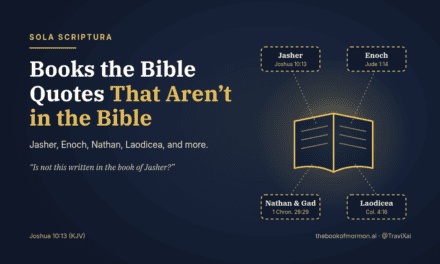
The idea most often used to call Latter-day Saints Bible-twisters is sola scriptura, the Bible alone. So where does the Bible teach it? The verse usually offered is this one:
All scripture is given by inspiration of God, and is profitable for doctrine, for reproof, for correction, for instruction in righteousness: That the man of God may be perfect, throughly furnished unto all good works.
2 Timothy 3:16–17 (KJV)
It says scripture is inspired and profitable. It doesn’t say “only.” And the verse just before it tells us which scriptures Timothy had known “from a child” (2 Timothy 3:15): the Hebrew scriptures. If this passage proved that the scriptures Timothy had were all God would ever give, it would prove too much. It would rule out most of the New Testament itself. (We walked through every common proof text in Sola Scriptura: Which Verse Teaches It?)
Inerrancy has the same problem. The Bible never calls itself inerrant. John even admits the record is incomplete: “there are also many other things which Jesus did, the which, if they should be written every one, I suppose that even the world itself could not contain the books” (John 21:25). And Peter tells us where scripture’s authority comes from: “holy men of God spake as they were moved by the Holy Ghost” (2 Peter 1:21). The authority is God speaking through prophets, not the binding of a book. Treating the book as if it were God is the real twist. See Is the Bible Infallible?
A field guide to the fallacies
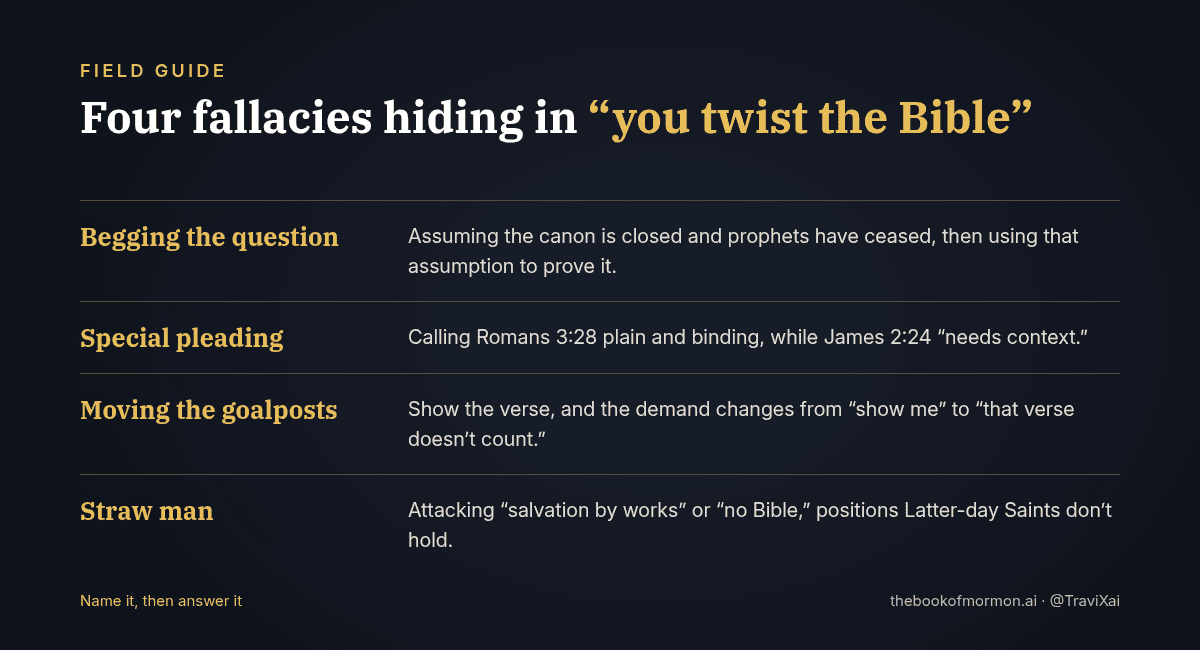
When this conversation goes sideways, it’s usually one of these. Name it, then answer it:
- Begging the question: assuming the canon is closed and prophets have ceased, then using that assumption as the proof.
- Special pleading: Romans 3:28 is “plain,” but James 2:24 “needs context.” 1 Corinthians 15:29 gets an outside explanation no other verse would be given.
- Ad hoc rescue: inventing a backstory (a “pagan practice”) that the verse never mentions, because the plain reading is inconvenient.
- Moving the goalposts: “Show me a verse.” Here’s the verse. “Well, that verse doesn’t count.”
- Straw man: attacking “salvation by works” or “Mormons don’t use the Bible,” positions Latter-day Saints don’t actually hold.
And to keep ourselves honest: “you do it too” isn’t an argument either. The point isn’t that critics also pick cherries, so we’re off the hook. The point is that a position that has to skip verses is weaker than one that can read them all out loud.
Key takeaways
- Cherry-picking isn’t quoting verses. It’s needing other verses to disappear.
- Jesus quoted “Ye are gods” and said “the scripture cannot be broken” (John 10:34–35).
- Paul used baptism for the dead as evidence for the Resurrection and never condemned it (1 Corinthians 15:29).
- The only “faith only” in the KJV is preceded by “not by” (James 2:24). We’re saved by grace, and real faith acts.
- Apostles and prophets were given “till we all come in the unity of the faith” (Ephesians 4:11–13).
- No verse teaches the Bible alone or calls the Bible inerrant. Scripture is God speaking through prophets, and He still speaks.
Next time someone tells you that you twist the Bible, smile and open it together. Read Psalm 82:6, 1 Corinthians 15:29, James 2:24, and Ephesians 4:11–13 out loud, and ask which of them you’re allowed to skip. For quick, sourced answers on every one of these, open Galatians18. And for daily answers to common attacks, follow me on X at @TraviXai.
Sources
- Scripture quotations: King James Version and the Book of Mormon, churchofjesuschrist.org: Psalm 82; Amos 3:7; John 10:34–36; 21:25; Acts 3:21; 11:27–28; 21:10; Romans 3:28; 8:16–17; 1 Corinthians 15:29; Ephesians 2:8–10; 4:11–14; Philippians 2:12–13; 2 Timothy 3:15–17; Hebrews 1:1–2; James 2:24, 26; 1 Peter 3:19; 4:6; 2 Peter 1:21; Revelation 3:21; 2 Nephi 2:8.
- Come, Follow Me—For Home and Church: Old Testament 2026, churchofjesuschrist.org.
- Galatians18 topic pages: Exaltation and Becoming Like God, Baptism for the Dead, Grace and Works, Living Prophets, Is the Bible Infallible?
- Related on this blog: Sola Scriptura: Which Verse Teaches It? and The Canon Was Never Meant to Close.
- Featured image and cards: original graphics by thebookofmormon.ai (no photographs or likenesses of real people).