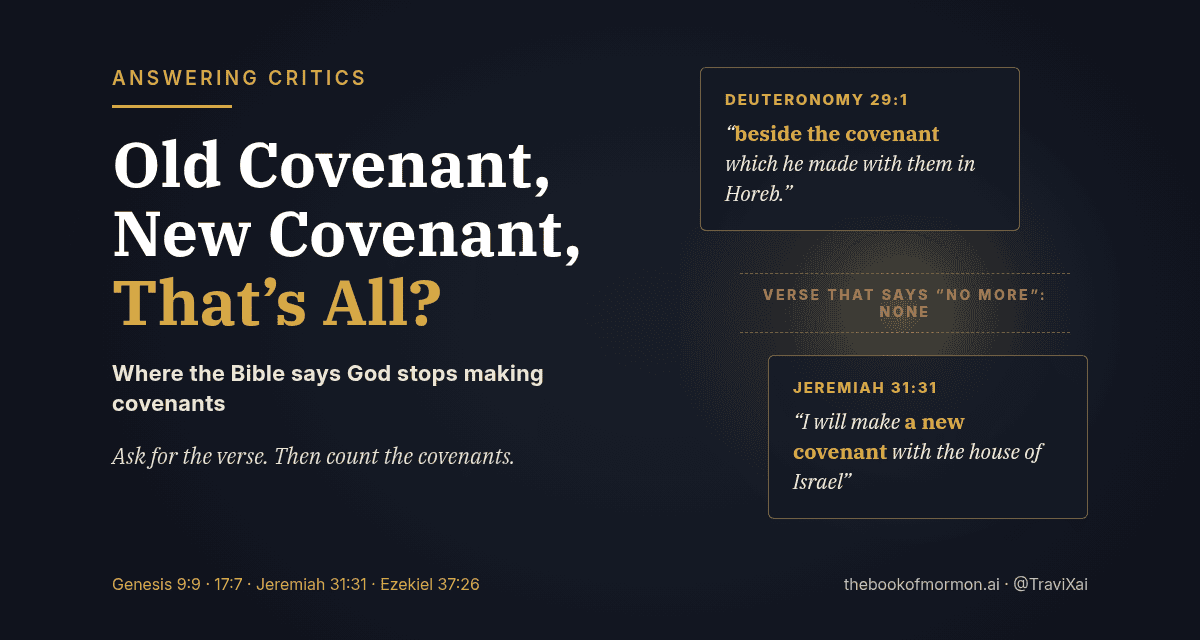

Critics say there’s the Old Covenant and the New Covenant, and that’s all we need. Ask for the verse. Then count how many covenants God actually made.
Talk about the Restoration long enough and somebody will say it: “There’s the Old Covenant and the New Covenant. That’s all we need. Anything after that is a false church.”
It sounds tidy. There’s just one problem: the Bible never says it. And when you count the covenants God actually made, “two” isn’t even close.
“That’s all we need”
The argument goes like this: Sinai was the Old Covenant. Then Jesus made the New Covenant with His own blood:
For this is my blood of the new testament, which is shed for many for the remission of sins.
Matthew 26:28 (KJV)
We agree with every word. Latter-day Saints take the sacrament every Sunday to remember that blood. The question isn’t whether Christ’s covenant is real. It’s whether the Bible teaches that God would never again make, renew, or restore a covenant. Let’s test it.
Chapter and verse, please
Here’s the simple question: where does the Bible say there would never be any new covenants?
Not a verse saying the New Covenant is wonderful or that Christ’s sacrifice is enough. We agree with both. A verse saying God is finished making covenants. Read from Genesis to Revelation. It isn’t there.
Awkward, because the people making this argument usually live by sola scriptura: if it isn’t in the Bible, it isn’t binding. Then “two covenants and that’s all” isn’t binding either. That’s a double standard.
Count the covenants
Now look at what the Bible does say. God doesn’t make one covenant and retire. He makes them again and again.
Noah
After the flood, God said, “And I, behold, I establish my covenant with you, and with your seed after you” (Genesis 9:9). That covenant is neither Sinai nor the New Covenant. One stop in, and “two” is already in trouble.
Abraham
And I will establish my covenant between me and thee and thy seed after thee in their generations for an everlasting covenant, to be a God unto thee, and to thy seed after thee.
Genesis 17:7 (KJV)
Paul treated Abraham’s covenant as its own covenant, separate from the law of Moses, and said the law couldn’t cancel it:
And this I say, that the covenant, that was confirmed before of God in Christ, the law, which was four hundred and thirty years after, cannot disannul, that it should make the promise of none effect.
Galatians 3:17 (KJV)
Sinai, and then Moab
At Sinai, God told Israel, “if ye will obey my voice indeed, and keep my covenant, then ye shall be a peculiar treasure unto me” (Exodus 19:5), and Moses sealed it with “the blood of the covenant” (Exodus 24:8). Deuteronomy calls that mountain Horeb (Deuteronomy 5:2). Now read this:
These are the words of the covenant, which the Lord commanded Moses to make with the children of Israel in the land of Moab, beside the covenant which he made with them in Horeb.
Deuteronomy 29:1 (KJV)
“Beside the covenant which he made with them in Horeb.” Even the “Old Covenant” wasn’t one covenant. God made another with the next generation in Moab.
Phinehas and David
God gave Phinehas “my covenant of peace” and “the covenant of an everlasting priesthood” (Numbers 25:12–13). He made a promise to David, and David called it “an everlasting covenant, ordered in all things, and sure” (2 Samuel 23:5).
That’s why Paul said the covenants, plural, belonged to Israel: “to whom pertaineth the adoption, and the glory, and the covenants” (Romans 9:4). Gentiles had been “strangers from the covenants of promise” (Ephesians 2:12). Plural.
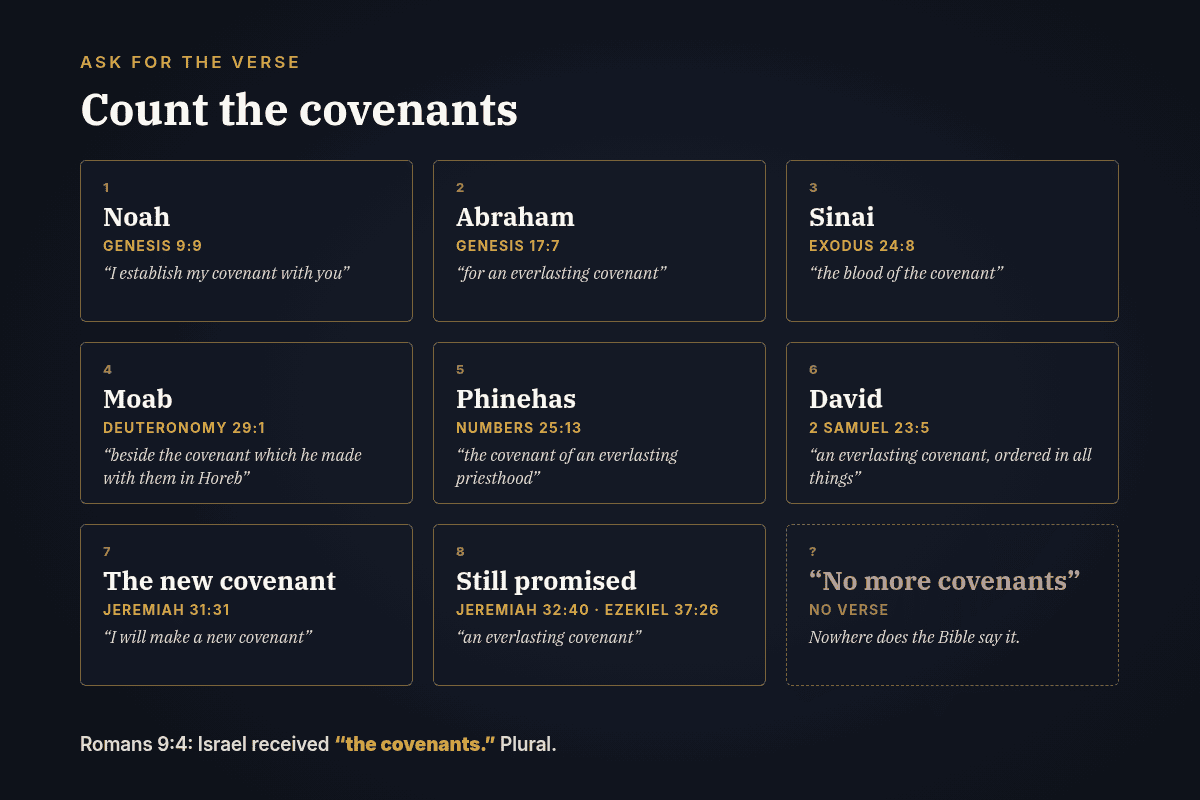
The Bible’s pattern isn’t “two and done.” It’s a God who keeps reaching for His people with covenants.
The prophets promised more, not less
Here’s what sinks the argument. The prophets didn’t say, “Sinai is all we need.” They said God would make more.
Behold, the days come, saith the Lord, that I will make a new covenant with the house of Israel, and with the house of Judah: Not according to the covenant that I made with their fathers in the day that I took them by the hand to bring them out of the land of Egypt; which my covenant they brake, although I was an husband unto them, saith the Lord:
Jeremiah 31:31–32 (KJV)
Jeremiah’s audience had the law, a temple, a priesthood, and centuries of scripture. If anyone could say, “That’s all we need,” it was them. God promised a new covenant anyway, because they broke the old one.
Jeremiah wasn’t finished. Next chapter, God promised to gather Israel and “make an everlasting covenant with them” (Jeremiah 32:40).
Ezekiel 37: two sticks, a gathering, then a covenant
Past the dry bones, God tells Ezekiel to join two sticks, one for Judah and one for Joseph:
Say unto them, Thus saith the Lord God; Behold, I will take the stick of Joseph, which is in the hand of Ephraim, and the tribes of Israel his fellows, and will put them with him, even with the stick of Judah, and make them one stick, and they shall be one in mine hand.
Ezekiel 37:19 (KJV)
Then God promises to gather the children of Israel “from among the heathen” (Ezekiel 37:21). And then:
Moreover I will make a covenant of peace with them; it shall be an everlasting covenant with them: and I will place them, and multiply them, and will set my sanctuary in the midst of them for evermore.
Ezekiel 37:26 (KJV)
Latter-day Saints have plenty to say about that stick of Joseph (spoiler: if you own a Book of Mormon, you’re holding it). For today, notice the order: records joined, Israel gathered, then an everlasting covenant. The prophets weren’t closing the door on covenants. They were pointing to more.
“He hath made the first old”
The New Testament doesn’t freeze covenants in place either. Hebrews quotes Jeremiah’s promise and draws the conclusion:
In that he saith, A new covenant, he hath made the first old. Now that which decayeth and waxeth old is ready to vanish away.
Hebrews 8:13 (KJV)
God made a covenant, then made it old. The critic’s favorite proof that God is finished is a verse about God changing a covenant. (We covered Hebrews, including the question of who wrote it, in Who Wrote Hebrews? The Unsigned Letter Critics Use to Close Heaven, so I won’t repeat that here.)
Now the hypocrisy, plainly. The critic loves Hebrews 8:13 when it retires the Sinai covenant. He just won’t let the principle behind it apply to anything after the first century. God could make a new covenant in Jeremiah’s day. God could make a new covenant through Jesus. But if anyone says God restored His covenant in 1830, suddenly a covenant from God is proof of a false church. Which is it?
Jesus heard this argument first
“We already have our covenant” isn’t new. John the Baptist cut it off before they could say it:
Bring forth therefore fruits worthy of repentance, and begin not to say within yourselves, We have Abraham to our father: for I say unto you, That God is able of these stones to raise up children unto Abraham.
Luke 3:8 (KJV)
Jesus heard it too: “We be Abraham’s seed” (John 8:33). Then:
They answered and said unto him, Abraham is our father. Jesus saith unto them, If ye were Abraham’s children, ye would do the works of Abraham.
John 8:39 (KJV)
They had a real, everlasting covenant, and used it as their reason to reject what God was doing in front of them. “We have Abraham. That’s all we need.”
Swap “Abraham” for “the Old and New Covenants” and you have the modern version. If adding a covenant proves a false church, Jeremiah was a false prophet and the apostles’ church was false too. The critic would never accept that argument against Jesus. He shouldn’t use it against anyone else.
Who brings a covenant?
Every one of these covenants arrived the same way. Not by committee. God spoke to someone He called.
Surely the Lord God will do nothing, but he revealeth his secret unto his servants the prophets.
Amos 3:7 (KJV)
A covenant takes revelation and authority. Jesus told Peter, “flesh and blood hath not revealed it unto thee, but my Father which is in heaven” (Matthew 16:17). The rock was revelation (see Matthew 16:18 and the Gates of Hell). And authority can’t be taken, because “no man taketh this honour unto himself, but he that is called of God, as was Aaron” (Hebrews 5:4; see Priesthood Authority: Korah, Uzziah, and Hebrews 5:4).
The apostles did their best to keep their numbers filled. They chose Matthias to replace Judas (Acts 1:26). But as the apostles were rejected and killed, just as Jesus warned (“whosoever killeth you will think that he doeth God service,” John 16:2), replacing them became impossible. No apostles. No revelation. Just bishops voting. (That story is in The Great Apostasy in the New Testament’s Own Words.)
So restoring the covenant had to come the way covenants always come: God calling a prophet.
What Latter-day Saints actually claim
So what do we claim? Not a rival to Christ’s covenant. We believe the covenant He established was broken by men and restored by God. Isaiah saw the breaking coming:
The earth also is defiled under the inhabitants thereof; because they have transgressed the laws, changed the ordinance, broken the everlasting covenant.
Isaiah 24:5 (KJV)
In 1831 the Lord used nearly the same words about the world before the Restoration: “For they have strayed from mine ordinances, and have broken mine everlasting covenant” (D&C 1:15). And He called what He restored “mine everlasting covenant, even the fulness of my gospel” (D&C 66:2), a revelation dated October 29, 1831, 195 years ago today. The Doctrine and Covenants even calls the Book of Mormon “the new covenant” (D&C 84:57).
To be straight: those statements come from modern revelation, not a Bible proof text. But the pattern is pure Bible. A covenant broken, a prophet called, a covenant renewed. That’s Jeremiah 31, Ezekiel 37, and Hebrews 8.
Adding a covenant isn’t proof of a false church. It’s the most biblical thing God does. So ask which prophet the critic wants to throw out first. Jeremiah? Ezekiel? Isaiah?
Key takeaways
- No verse says God would never make another covenant. Ask for it. It isn’t there.
- The Bible names covenants with Noah, Abraham, Sinai, Moab (Deuteronomy 29:1), Phinehas, and David. Paul calls them “the covenants” (Romans 9:4).
- The prophets promised more covenants, not fewer: Jeremiah 31:31; 32:40; Ezekiel 37:26.
- Hebrews 8:13 shows God making a covenant old and replacing it on His own timing.
- “We have Abraham, that’s all we need” was the argument used against John the Baptist and Jesus (Luke 3:8; John 8:33, 39).
- Latter-day Saints claim Christ’s everlasting covenant was restored by revelation, not replaced (Isaiah 24:5; D&C 1:15; 66:2).
Next time someone tells you, “Old Covenant, New Covenant, that’s all,” ask for the verse. Then read them Deuteronomy 29:1. For quick, sourced answers on continuing revelation, the Great Apostasy, Jude 3 and “the faith once delivered”, and Revelation 22 and adding to the Bible, open Galatians18, and follow me on X at @TraviXai for daily answers.
Sources
- Scripture quotations: King James Version and the Doctrine and Covenants, churchofjesuschrist.org: Genesis 9:9; 17:7; Exodus 19:5; 24:8; Numbers 25:12–13; Deuteronomy 5:2; 29:1; 2 Samuel 23:5; Isaiah 24:5; Jeremiah 31:31–32; 32:40; Ezekiel 37:19, 21, 26; Amos 3:7; Matthew 16:17; 26:28; Luke 3:8; John 8:33, 39; 16:2; Acts 1:26; Romans 9:4; Galatians 3:17; Ephesians 2:12; Hebrews 5:4; 8:13; D&C 1:15; 66:2; 84:57.
- Revelation dates from the section headings: D&C 1 (November 1, 1831) and D&C 66 (October 29, 1831).
- Galatians18 topic pages: Continuing Revelation and an Open Canon, The Great Apostasy, Jude 3: The Faith Once Delivered?, Revelation 22: You Can’t Add to the Bible?.
- Related on this blog: Who Wrote Hebrews? The Unsigned Letter Critics Use to Close Heaven; The Great Apostasy in the New Testament’s Own Words; Matthew 16:18 and the Gates of Hell: What the Promise Really Means; Priesthood Authority: Korah, Uzziah, and Hebrews 5:4.
- Featured image and graphic: original graphics by thebookofmormon.ai (no photographs or likenesses of real people).