
Let’s talk about a passage that quietly wrecks one of the biggest assumptions people bring to the Old Testament. Monotheism, the idea that only one divine being exists and every other “god” is a statue or a figment, is NOT what the Old Testament teaches. Deuteronomy 32:8-9 shows it, and the oldest Hebrew copy of that verse shows it even more clearly.
I posted a short version on X. This is the long version, with the receipts.
The verse as most people have read it
Here is Deuteronomy 32:8-9 in the King James Version:
“When the most High divided to the nations their inheritance, when he separated the sons of Adam, he set the bounds of the people according to the number of the children of Israel. For the LORD’s portion is his people; Jacob is the lot of his inheritance.” (Deuteronomy 32:8-9, KJV)
Read that slowly. The Most High is setting the borders of the nations, and he does it “according to the number of the children of Israel”? Israel didn’t exist yet. This is the dividing of the nations after the flood, the world of Genesis 10, which ends this way:
“These are the families of the sons of Noah, after their generations, in their nations: and by these were the nations divided in the earth after the flood.” (Genesis 10:32, KJV)
Jacob hadn’t been born. Abraham hadn’t been called. So how do you set the borders of every nation by the number of a people who don’t exist? And YHWH, “the LORD” in verse 9, isn’t a child of Israel. The KJV verse just doesn’t hang together.
Jeffrey Tigay, in the Jewish Publication Society’s commentary on Deuteronomy, asks why God would base the number of nations on the number of Israelites, and points out that verse 9 implies a contrast, Israel was God’s share while the other peoples were somebody else’s share, “but verse 8 fails to note whose share they were.” (Quoted in Michael Heiser’s article, linked below.) Great question. Whose share were they?
What the Dead Sea Scrolls say
Among the Dead Sea Scrolls is a manuscript of Deuteronomy called 4QDeut-j (catalogued as 4Q37). Scholars date it to roughly 160-60 BC. That’s well over a thousand years older than the medieval Masoretic manuscripts our Hebrew Bibles are printed from. And at Deuteronomy 32:8 it does NOT say “children of Israel.” It says the borders were set according to the number of the “sons of God,” the Hebrew bene elohim.
So in the oldest Hebrew copy we have, the verse reads like this: the Most High divides the nations according to the number of the sons of God, and the LORD’s portion is his people, Jacob is the lot of his inheritance.
NOW it makes sense. The Most High has sons. Each son gets a nation. And YHWH is one of those sons, and he RECEIVES Israel. That’s the contrast Tigay was looking for. The other nations were the share of the other sons of God.
Emanuel Tov, who served as editor-in-chief of the official Dead Sea Scrolls publication project and is one of the biggest names in Hebrew Bible textual criticism, says the reading in 4QDeut-j “seems more logical than that of the Masoretic Text.” He goes further and suggests the original may have referred to “the sons of the God E(l),” and that a scribe “did not feel at ease with this polytheistic picture and replaced ‘sons of El’ with ‘the sons of Israel,’ thus giving the text a different direction by the change of a single word.” To be fair to Tov, he labels that last reconstruction “no more than speculation,” but he’s clear the scrolls recover “the original text in one important detail.”
The Greek Old Testament agrees
The Septuagint, the Greek translation of the Old Testament that the early Christians used, also does NOT read “sons of Israel.” Most Septuagint manuscripts read “angels of God” (angelōn theou), and some read “sons of God” (huiōn theou). Both of those presuppose a Hebrew text that said “sons of God,” not “sons of Israel.”
The NET Bible’s notes put it bluntly: “‘Sons of God’ is undoubtedly the original reading; the MT and LXX have each interpreted it differently.” The Hebrew turned the sons of God into Israel and the Greek turned them into angels, softening the same original.
And the “angels” reading isn’t neutral either. John William Wevers, the editor of the standard critical Göttingen edition of the Greek Deuteronomy, called the majority “angels of God” reading “clearly a later attempt to avoid any notion of lesser deities in favor of God’s messengers.” (Quoted in Heiser.) Notice the pattern. Every change runs the SAME direction, away from other gods.
One honest caveat. You’ll often see the Greek papyrus Rahlfs 848 cited as reading “sons of God,” but a 2025 study by Chrissy M. Hansen in TC: A Journal of Biblical Textual Criticism points out it breaks off after “sons” before “God” appears, so I won’t lean on it. Hansen still says that today “few scholars would doubt that the ‘sons of Israel’ reading is a theological modification.” That’s a 2025 peer-reviewed journal saying it, not me.
It’s not just verse 8. Look at verse 43
If one verse changed, maybe you could chalk it up to an accident. But the end of the same song, Deuteronomy 32:43, has the same problem. Here’s the KJV, which follows the Masoretic Text:
“Rejoice, O ye nations, with his people: for he will avenge the blood of his servants, and will render vengeance to his adversaries, and will be merciful unto his land, and to his people.” (Deuteronomy 32:43, KJV)
Another Dead Sea Scroll, 4QDeut-q, has a longer version of this verse. Tigay’s translation of that scroll, as laid out in Heiser’s article, opens “O heavens, rejoice with Him; Bow to Him, all divinities,” and the Septuagint has a similar line. The Masoretic version is missing the very line that mentions divine beings. Heiser, following Tigay, argues the poetic structure shows the Masoretic text is “demonstrably incomplete” and that the divine-beings line was “deliberately eliminated.”
Two places in the same poem, both missing their divine beings in the later text. Not a coincidence. Heiser’s conclusion is that it’s “inconceivable” a scribe would change a harmless “sons of Israel” into a “potentially explosive” “sons of God.” It only makes sense in the other direction.
Even modern Protestant Bibles agree with the Dead Sea Scrolls
This should end the argument. Evangelical and mainline Protestant translations have ALREADY switched to the Dead Sea Scrolls reading:
- ESV: “he fixed the borders of the peoples according to the number of the sons of God.” The footnote says: “Compare Dead Sea Scroll, Septuagint; Masoretic Text sons of Israel.”
- NRSV Updated Edition: “he fixed the boundaries of the peoples according to the number of the gods.” Yes, “the gods.”
- NET: “according to the number of the heavenly assembly,” with the note I quoted above, “‘Sons of God’ is undoubtedly the original reading.”
The ESV is about as conservative an evangelical translation as you’ll find. If the ESV committee is comfortable printing “sons of God” in Deuteronomy 32:8, nobody gets to call that reading a Mormon invention.
Deuteronomy says this more than once
Deuteronomy 32 isn’t the only place this idea shows up in the book. Here’s Deuteronomy 4:19-20:
“And lest thou lift up thine eyes unto heaven, and when thou seest the sun, and the moon, and the stars, even all the host of heaven, shouldest be driven to worship them, and serve them, which the LORD thy God hath divided unto all nations under the whole heaven. But the LORD hath taken you, and brought you forth out of the iron furnace, even out of Egypt, to be unto him a people of inheritance, as ye are this day.” (Deuteronomy 4:19-20, KJV)
The host of heaven has been “divided unto all nations.” Israel, on the other hand, is the LORD’s “people of inheritance.” Same picture, same vocabulary. Then look at Deuteronomy 29:26:
“For they went and served other gods, and worshipped them, gods whom they knew not, and whom he had not given unto them:” (Deuteronomy 29:26, KJV)
“Whom he had not GIVEN unto them.” The sin isn’t worshipping something that doesn’t exist. The sin is Israel going after gods that weren’t assigned to Israel. That only makes sense if the other nations had gods that WERE assigned to them.
Psalm 82 says the same thing
Psalm 82 is the divine council in action:
“God standeth in the congregation of the mighty; he judgeth among the gods.” (Psalm 82:1, KJV)
“I have said, Ye are gods; and all of you are children of the most High. But ye shall die like men, and fall like one of the princes. Arise, O God, judge the earth: for thou shalt inherit all nations.” (Psalm 82:6-8, KJV)
The gods are “children of the most High,” sons of Elyon, the exact same title used in Deuteronomy 32:8. And the closing line, “thou shalt inherit all nations,” uses inheritance language again. The nations had been handed out to these sons; now God is called on to take them all.
People love to say the “gods” of Psalm 82 are just human judges. Heiser, an evangelical scholar, quotes Elmer Smick: “if they are going to die like mortals, they are not mortals.” Yeah. Tell a human judge he’s going to die like a man and he’ll say, “Ok… and?”
Mark S. Smith, a leading scholar of the Ugaritic texts, reads Psalm 82 the way I do. In his summary of The Origins of Biblical Monotheism (Oxford, 2001), he writes that the psalm “presents the god El presiding in a divine assembly at which Yahweh stands up and makes his accusation against the other gods.”
The Ugaritic background: El and his seventy sons
The clay tablets from the ancient city of Ugarit in Syria gave us the religious texts of Israel’s near neighbors, in a language very close to biblical Hebrew. In those texts the high god is El, the head of the pantheon presides over an assembly called the “sons of El,” and the Baal Cycle says El fathered seventy sons (Heiser cites the line as KTU 1.4 VI 46).
Now count the nations in Genesis 10. Allen Ross and Umberto Cassuto count seventy (some count seventy-one). Seventy nations, seventy sons of El. It even explains the Masoretic reading: Genesis 46:27 and Exodus 1:5 say seventy of Jacob’s household went into Egypt, so “sons of Israel” could keep the number seventy on paper.
Mark Smith says it outright: “In the earliest stage, it would appear that Yahweh was one of these seventy children, each of whom was the patron deity of the seventy nations… El is the head of the divine family, and each member of the divine family receives a nation of his own: Israel is the portion of Yahweh.” And on the Masoretic reading: “The Masoretic Text, evidently uncomfortable with the polytheism expressed in the phrase ‘according to the number of the divine sons,’ altered the reading.”
That’s an Oxford-published Ugaritic scholar, not a Latter-day Saint, describing exactly what I described in my post.
“But Elyon IS YHWH!” Fair enough, let’s look at it
Here’s the strongest counterargument, and I want to be fair to it. Plenty of scholars, Heiser included, agree that “sons of God” is the original reading but argue that the “Most High” (Elyon) in verse 8 and “the LORD” (YHWH) in verse 9 are the same God. The NET notes say Elyon is short for “El Elyon” and that “Elyon has to do with the nations in general whereas in v. 9, by contrast, Yahweh relates specifically to Israel,” one God, two roles. Heiser wrote a whole paper titled “Are Yahweh and El Distinct Deities in Deut. 32:8-9 and Psalm 82?” and his answer was no. He points out that later in the Bible, El and YHWH are clearly identified (Genesis 14:22, for example, has Abram swearing by “the LORD, the most high God”).
I take that seriously, and Latter-day Saints have no problem with later Israel blending these titles over time. But look at what the text of Deuteronomy 32:8-9 itself actually does:
- The Most High DIVIDES the nations among the sons of God.
- YHWH’s portion is Jacob, the lot of HIS inheritance.
You don’t “receive an inheritance” from yourself. An inheritance comes from a father. The verb in verse 8 is the giving of inheritances, and verse 9 tells you what YHWH got. If YHWH is the Most High here, then he’s handing out the nations to his sons and then… handing himself a nation like he’s one of the boys? That’s a strange way to describe the sovereign over everything. Read naturally, verse 9 puts YHWH in the SAME category as the others in verse 8, a son who receives a portion.
Scholars have pushed back on Heiser too. One response notes nowhere in Deuteronomy 32 are the other gods said to be “under Yahweh’s authority,” and Yahweh judging Israel is just what any patron god does for his own people. So no, “Elyon = YHWH” is not some settled fact you get to assume. It’s a theological move, and usually it’s being made because the plain reading is uncomfortable.
King Josiah, the Deuteronomists, and the theory of a merger
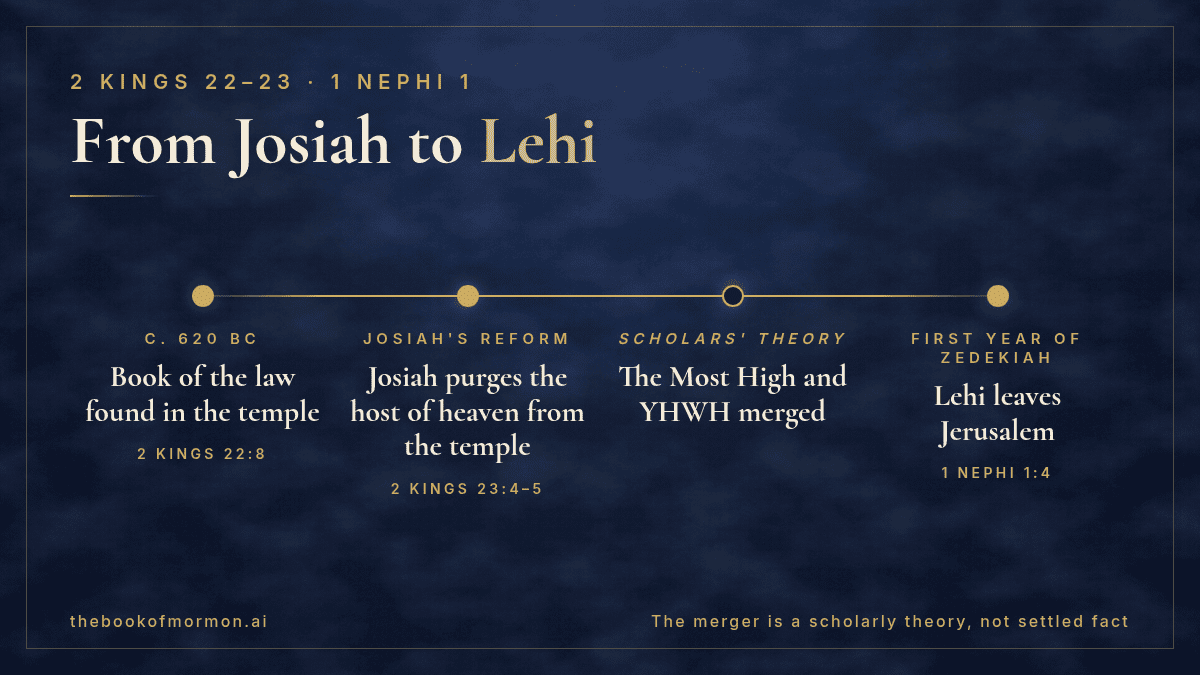
So if the Most High and YHWH started out as two different figures, how did they end up as one? Scholars have a theory, and it points straight at King Josiah. I want to be clear that this is a THEORY, not settled fact. But it’s a theory serious scholars hold, and it fits what we just saw.
Around 620 BCE, Josiah’s men were repairing the temple when something turned up:
“And Hilkiah the high priest said unto Shaphan the scribe, I have found the book of the law in the house of the LORD. And Hilkiah gave the book to Shaphan, and he read it.” (2 Kings 22:8, KJV)
Then Josiah cleaned house, and look at what he threw out:
“And the king commanded Hilkiah the high priest, and the priests of the second order, and the keepers of the door, to bring forth out of the temple of the LORD all the vessels that were made for Baal, and for the grove, and for all the host of heaven: and he burned them without Jerusalem in the fields of Kidron, and carried the ashes of them unto Beth-el.” (2 Kings 23:4, KJV)
The verse right after it adds the priests who burned incense “to all the host of heaven” (2 Kings 23:5). Those things were sitting INSIDE the temple of the LORD.
Now bring in the scholars. Mark Smith, of NYU, notes that the Bible’s clearest monotheistic statements show up in the seventh and sixth centuries, mostly in Deuteronomy, in the “Deuteronomistic History (Joshua through Kings),” and in Jeremiah. He says most scholars have tied the rise of monotheism to “a deuteronomistic movement of this period.” Smith also says that “by some point in the late monarchy, it is evident that the god El was identified with Yahweh.” The other gods “became mere expressions of Yahweh’s power,” and in his words, “the head god became the godhead.”
Margaret Barker, a Methodist preacher and former president of the Society for Old Testament Study, goes further. She writes that Josiah’s reform let one group, the Deuteronomists, “dominate the religious scene in Jerusalem,” that their scribes “influenced much of the form of the Old Testament we have today,” and that they “had no place for angels.” In her view the older temple faith held that “Yahweh, the Lord, was the Son of God Most High.” In The Great Angel: A Study of Israel’s Second God (1992), she argues that El Elyon and YHWH were originally distinct, with YHWH being a son of El Elyon.
Here is where it gets interesting for us. Barker points out that the Book of Mormon opens in “the first year of the reign of Zedekiah” (1 Nephi 1:4), just one generation after Josiah’s purge. She asks whether the wickedness Lehi saw in Jerusalem included parts of those purges. Lehi left Jerusalem right after the very era when, according to this theory, the Son of the Most High was being folded into one God. Is that a coincidence? Look it up and see for yourself.
Israel’s God, Israel’s book
So why does the Old Testament say over and over that Israel has no other god beside YHWH? Because YHWH is THEIR God. These are ISRAEL’S scriptures. Of course they write about their dealings with him. Deuteronomy 29:26 tells you the problem wasn’t that other gods didn’t exist, it’s that Israel went after gods “whom he had not given unto them.” The other nations belonged to the other sons.
Exclusive worship isn’t monotheism. Israel was commanded to worship ONE God, which is a completely different claim from “only one divine being exists.”
Where Latter-day Saints come in
None of this surprises a Latter-day Saint. We believe in a Heavenly Father who has divine sons, and that we’re his children too. We believe Jesus Christ is Jehovah, the YHWH of the Old Testament. Our own Bible Dictionary says it plainly: “Jehovah is the premortal Jesus Christ and came to earth being born of Mary.” So when Deuteronomy 32 shows a Most High Father dividing the nations, and YHWH, a Son, receiving Israel as his inheritance, that’s not a problem for us. That’s the Father and the Son.
Abraham 3 describes the premortal council: “Now the Lord had shown unto me, Abraham, the intelligences that were organized before the world was; and among all these there were many of the noble and great ones,” and “there stood one among them that was like unto God.” And when the Lord asks “Whom shall I send?” it is one “like unto the Son of Man” who answers, “Here am I, send me.” A council of God’s sons, one of whom is like unto God and is chosen for Israel and for all of us. Joseph Smith published that long before anyone read 4QDeut-j.
I’m not going to overclaim. Deuteronomy 32 isn’t spelling out the plan of salvation, our doctrine doesn’t depend on any scholar’s reconstruction of Canaanite religion, and Heavenly Father is not El with a new nametag. But the basic shape, a Most High Father, a council of divine sons, and YHWH as a Son who receives Israel, is right there in the oldest text. And it fits what was restored a lot better than it fits the creeds.
Turn their own standard around
Critics love to say Joseph Smith changed scripture, so he can’t be trusted. Ok, let’s apply that test. Your Old Testament, the Masoretic Text behind the KJV and the NIV, contains a reading that the ESV, the NRSV, the NET, Emanuel Tov, Mark Smith, Michael Heiser, and a 2025 textual criticism journal all say is NOT the original. A scribe almost certainly changed it on purpose, for theological reasons, to remove other gods from the text. And it’s not just verse 8, it’s verse 43 too.
So which is it? Is a theologically motivated change to scripture a deal breaker, or not? If it is, you’ve got some explaining to do about your own Old Testament. If it isn’t, stop holding us to a standard you don’t hold yourself to. And while you’re at it, tell me where that standard came from in the first place.
So ask them
When someone tells you the Old Testament is monotheistic, don’t argue. Just ask two questions.
Who was the Most High handing nations out to?
And why did YHWH have to RECEIVE Israel from a Most High God that isn’t YHWH?
Look it up and see for yourself. The scrolls are older than the creeds.
Sources
- ESV, NRSVUE, NET renderings and NET textual notes for Deut 32:8-9: https://www.biblegateway.com/passage/?search=Deuteronomy%2032%3A8-9&version=ESV;NRSVUE;NET
- Michael S. Heiser, “Deuteronomy 32:8 and the Sons of God,” Bibliotheca Sacra 158 (2001): https://www.thedivinecouncil.com/DT32BibSac.pdf
- Emanuel Tov, “Searching for the ‘Original’ Bible: Do the Dead Sea Scrolls Help?” in BAS, The Dead Sea Scrolls: Past, Present, and Future: https://www.biblicalarchaeology.org/wp-content/uploads/2022/08/the_dead_sea_scrolls_past_present_and_future.pdf
- 4Q37 (4QDeut-j) text and date: https://intertextual.bible/text/deuteronomy-32.8/4q37-32.8
- Chrissy M. Hansen, “A Note on the ‘Sons of God’ in Latin Quotations of Deut 32:8d,” TC 30 (2025): https://doi.org/10.15699/tc.30.2025.06
- Mark S. Smith, summary of The Origins of Biblical Monotheism: https://bibleinterp.arizona.edu/articles/MSmith_BiblicalMonotheism
- Response to Heiser on Elyon and Yahweh: http://religionatthemargins.com/2011/07/the-most-heiser-yahweh-and-elyon-in-psalm-82-and-deuteronomy-32/
- Heiser, “Are Yahweh and El Distinct Deities in Deut. 32:8-9 and Psalm 82?”: https://digitalcommons.liberty.edu/lts_fac_pubs/278
- Bible Dictionary, “Jehovah”: https://www.churchofjesuschrist.org/study/scriptures/bd/jehovah?lang=eng
- Abraham 3: https://www.churchofjesuschrist.org/study/scriptures/pgp/abr/3?lang=eng
- Barker, “Joseph Smith and Preexilic Israelite Religion,” BYU Studies 44:4 (2005): https://byustudies.byu.edu/article/joseph-smith-and-preexilic-israelite-religion