If Joseph made it all up, a con man would have pointed at every hit and said SEE, PROOF. He never pointed to Nahom, Bountiful, chiasmus, or the verse with his name in it. His witnesses broke with him and never denied it. He died in debt and went back to Carthage. So what exactly was the con?
About 2580 words · 11-minute read
Critics love two lines about Joseph Smith. The first is that he was a con man. The second is that he “wrote himself into the Bible.” I actually like both of those lines, because they make a prediction we can test. A con man has one job…. get people to believe him so he can get something out of them. So a con man with good material uses it, early and loudly, and a con man who sells a religion ends up with money, comfort, and an exit plan.
So let’s run the con-man test. If Joseph made it all up, he would have pointed at every hit he planted and said SEE, PROOF. Every single one. So what did he point to? What did his witnesses do when they turned on him? And what did he get out of it in the end? Put it all together and the con-man theory has a problem it has never answered.
✦ ✦ ✦
Part IThe hits he never pointed to
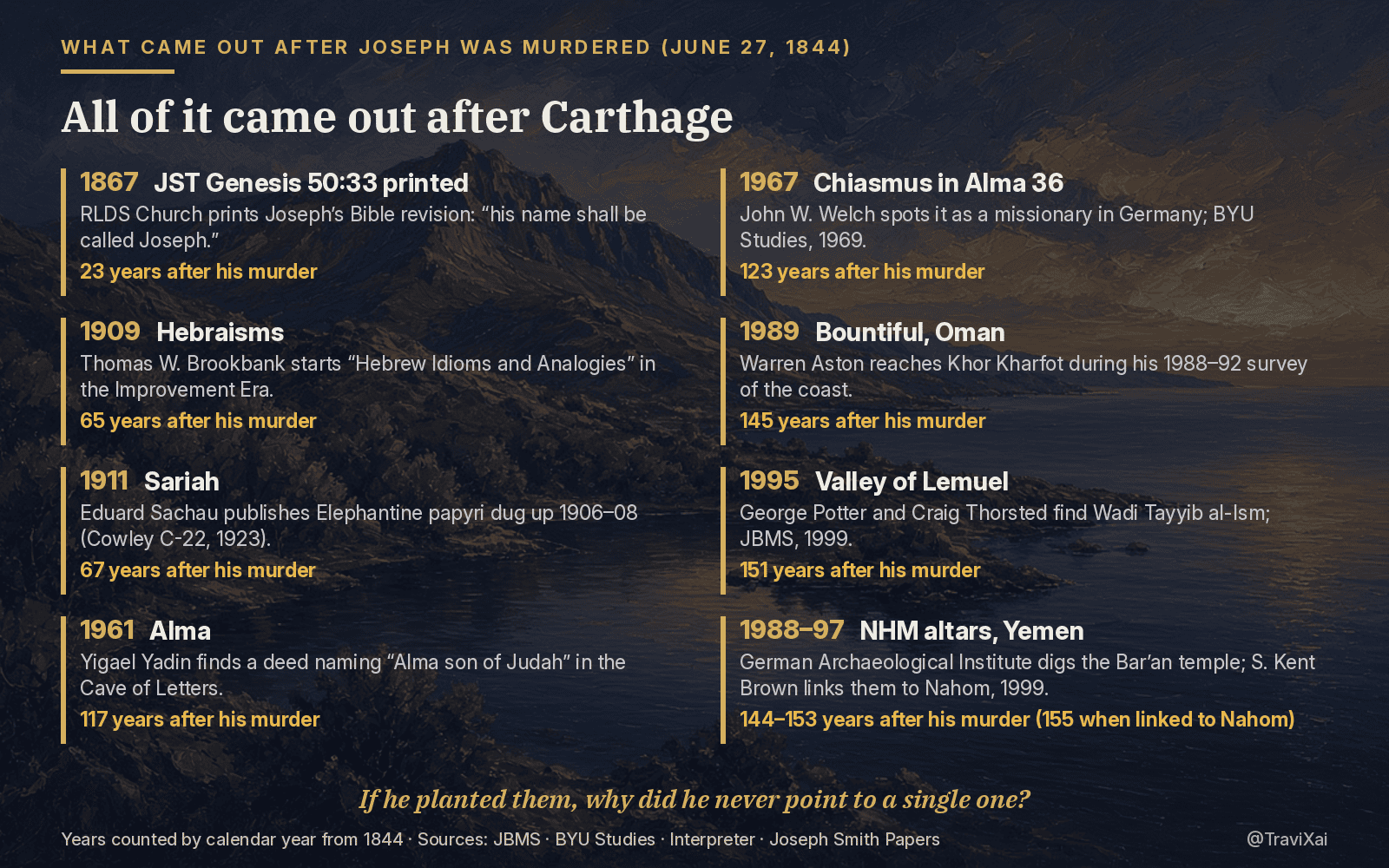
Here is a short list of things that came out after Joseph died in 1844. Any one of them would have been front-page news in the Church’s paper if he had planted it, and he never said one word about any of them.
1867JST Genesis 50:33 printed The Reorganized Church prints Joseph’s Bible revision, including the verse “his name shall be called Joseph.” 23 years after his murder. Our Church didn’t put it in its Bible footnotes and appendix until 1979 (135 years).
1909Hebraisms Thomas W. Brookbank begins “Hebrew Idioms and Analogies in the Book of Mormon” in the Improvement Era (December 1909), one of the first studies of Hebrew-style idioms in the English text. 65 years after his murder.
1911Sariah The Aramaic papyri that German excavators dug up at Elephantine, Egypt, in 1906–08 are published by Eduard Sachau in Berlin. One list of donors, dated about 419 BC, names “Sariah daughter of Hoshea” (partly reconstructed). A. E. Cowley’s 1923 English edition numbers it C-22, and Jeffrey Chadwick pointed it out in 1993. 67 years after his murder (79 for Cowley, 149 for Chadwick). Later work found an ostracon with the woman’s name and “daughter” spelled out in full.
1961Alma On March 15, 1961, Yigael Yadin pulls a bundle of Bar Kokhba–era papyri from the Cave of Letters at Nahal Hever. A land deed near En-gedi names “Alma son of Judah,” a Jewish man. Yadin printed it in his 1971 book Bar-Kokhba, and Hugh Nibley pointed it out in BYU Studies in 1973. 117 years after his murder.
1967Chiasmus John W. Welch, a missionary in Regensburg, Germany, notices the inverted Hebrew-style structure of Alma 36 and publishes “Chiasmus in the Book of Mormon” in BYU Studies in 1969. 123 years after his murder (125 to print).
1989Bountiful Warren and Michaela Aston’s 1988–92 survey of the Oman and Yemen coast reaches Khor Kharfot at the mouth of Wadi Sayq in October 1989: timber trees, fresh water, a mountain by the sea and a sheltered inlet. BYU/FARMS teams examined it in 1993. 145 years after his murder. Oman made it an archaeological reserve in 2021.
1995Valley of Lemuel George Potter and Craig Thorsted find Wadi Tayyib al-Ism near the Gulf of Aqaba in May 1995, a granite canyon with a stream that runs year-round, a fit for Nephi’s “river of water” that “emptied into the fountain of the Red Sea” (1 Nephi 2:6–9). Published in the Journal of Book of Mormon Studies in 1999. 151 years after his murder.
1988–97NHM altars The German Archaeological Institute excavates the Bar’an temple near Marib, Yemen, from 1988 to 1997. An altar dated to the 7th–6th century BC names a donor’s grandfather “Naw’um the Nihmite,” and it went on tour in Europe in 1997. S. Kent Brown connected it to Nahom in 1999, and Warren Aston, Lynn Hilton and Gregory Witt examined a second altar at the site in September 2000. 144–153 years after his murder (155 when LDS scholars connected it).
1830–1844Joseph Smith cites any of it Never. None of it existed yet, and I can’t find a single place where he even hints at it.
What came out after June 27, 1844, and how many years after his murder. Joseph never pointed to any of it. Original graphic by thebookofmormon.ai.
Here’s the same list as a table, so nobody has to take my word for the dates. Every one of these came out between 23 and 155 years after a mob shot him at Carthage on June 27, 1844.
Discovery
When
Found or published by
Years after Carthage
Did Joseph cite it?
JST Genesis 50:33 in print
1867
Reorganized Church (RLDS)
23
Never
Hebrew-style idioms studied
1909
Thomas W. Brookbank, Improvement Era
65
Never
Sariah as a woman’s name
Dug up 1906–08; published 1911
German excavators; Eduard Sachau (Cowley C-22, 1923; Chadwick, 1993)
62–67
Never
Alma as a Jewish man’s name
Found 1961; book 1971
Yigael Yadin (Hugh Nibley noted it, 1973)
117
Never
Chiasmus in Alma 36
Noticed 1967; published 1969
John W. Welch, BYU Studies
123
Never
Bountiful candidate, Khor Kharfot
1989 (survey 1988–92)
Warren and Michaela Aston; BYU/FARMS teams 1993
145
Never
Valley of Lemuel candidate
Found 1995; published 1999
George Potter and Craig Thorsted, JBMS
151
Never
NHM altars, Bar’an temple
Dug 1988–97; linked 1999
German Archaeological Institute; S. Kent Brown, JBMS
144–155
Never
Years counted by calendar year from 1844. Bountiful and the Valley of Lemuel are candidate sites, not proven locations. Sources are listed at the end of the post.
Nahom deserves a closer look because it is the strongest one and also the easiest to overstate. Nephi says it plainly:
And it came to pass that Ishmael died, and was buried in the place which was called Nahom.
Then the family traveled “nearly eastward from that time forth” (1 Nephi 17:1). Notice Nephi says the place “was called” Nahom. The family didn’t name it. Somebody already lived there. The altars confirm that a tribe named NHM was in that region in about Lehi’s time, and the inscription even lists the donor’s grandfather as a Nihmite, so the name is older still.
South Arabian script writes consonants, so the match is NHM to NHM, a tribe and its region in Lehi’s century, with a fertile coast “nearly eastward” from it. Nobody had that dated stone until the 1990s.
Which leaves the obvious question. If Joseph had pulled NHM off an old map and planted it in 1 Nephi on purpose, that would have been the best card in his hand. And he never played it. He never wrote a word about Nahom, Arabia, Bountiful, chiasmus, or the names. In 1842 the Church’s paper was excitedly reprinting a travel book about Central American ruins as “so much proof.” That’s how hungry they were for evidence, and the Arabian hits still never came up, because nobody knew they existed. Either he planted his best evidence and then forgot about it for fifteen years, or he didn’t know it was there.
Either Joseph planted his best evidence and then forgot about it for fifteen years, or he didn’t know it was there.
This is the critics’ favorite, so let’s read it straight. In the Joseph Smith Translation of Genesis 50, Joseph of Egypt prophesies about a latter-day seer:
And that seer will I bless, and they that seek to destroy him shall be confounded; for this promise I give unto you; for I will remember you from generation to generation; and his name shall be called Joseph, and it shall be after the name of his father; and he shall be like unto you; for the thing which the Lord shall bring forth by his hand shall bring my people unto salvation.
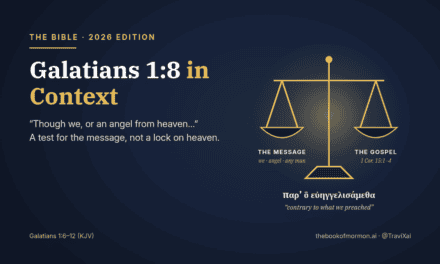
Joseph Smith’s father was named Joseph. So yes, Latter-day Saints believe that verse is about him. Nobody is hiding that. But think about it from the con-man side for a second. A verse in Genesis that names you and your father is the greatest advertisement a fake prophet could ever write. If the goal is to get people to believe you, you print that on the first page of everything.
Joseph never published it. The Bible translation sat in manuscript during his whole life, and the full text was first printed in 1867 by the Reorganized Church, 23 years after Carthage. Our Church didn’t put it in the footnotes and appendix of its Bible until 1979. I have looked, and I can’t find a single sermon where Joseph tells anyone to believe him because Genesis has his name in it. Brilliant strategy…. write the perfect ad and then lock it in a drawer.
The same idea is in 2 Nephi 3:15 (“his name shall be called after me; and it shall be after the name of his father”), printed in the Book of Mormon in 1830. Latter-day Saints believe both passages are about him. But Joseph never made “my name is in Genesis” his sales pitch. The invitation he actually gave was the Book of Mormon itself, its witnesses, and its promise that you can ask God.
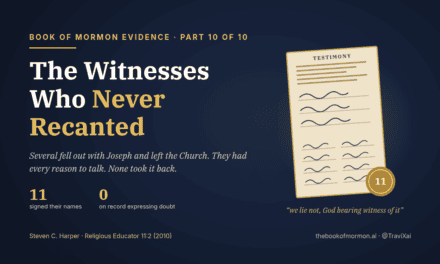
A con needs accomplices who stay loyal, or at least stay quiet. Joseph had neither. All three of the Three Witnesses broke with him: Martin Harris was excommunicated in December 1837, and Oliver Cowdery and David Whitmer in April 1838. Those are the exact men who could have ended the whole thing with one sentence.
Not one of them ever denied what he saw. Oliver and Martin later came back and were rebaptized. David never came back, lived fifty more years outside the Church, and still published this in the Richmond Conservator:
That I have never at any time denied that testimony, or any part thereof, which has so long since been published with that Book, as one of the three witnesses.
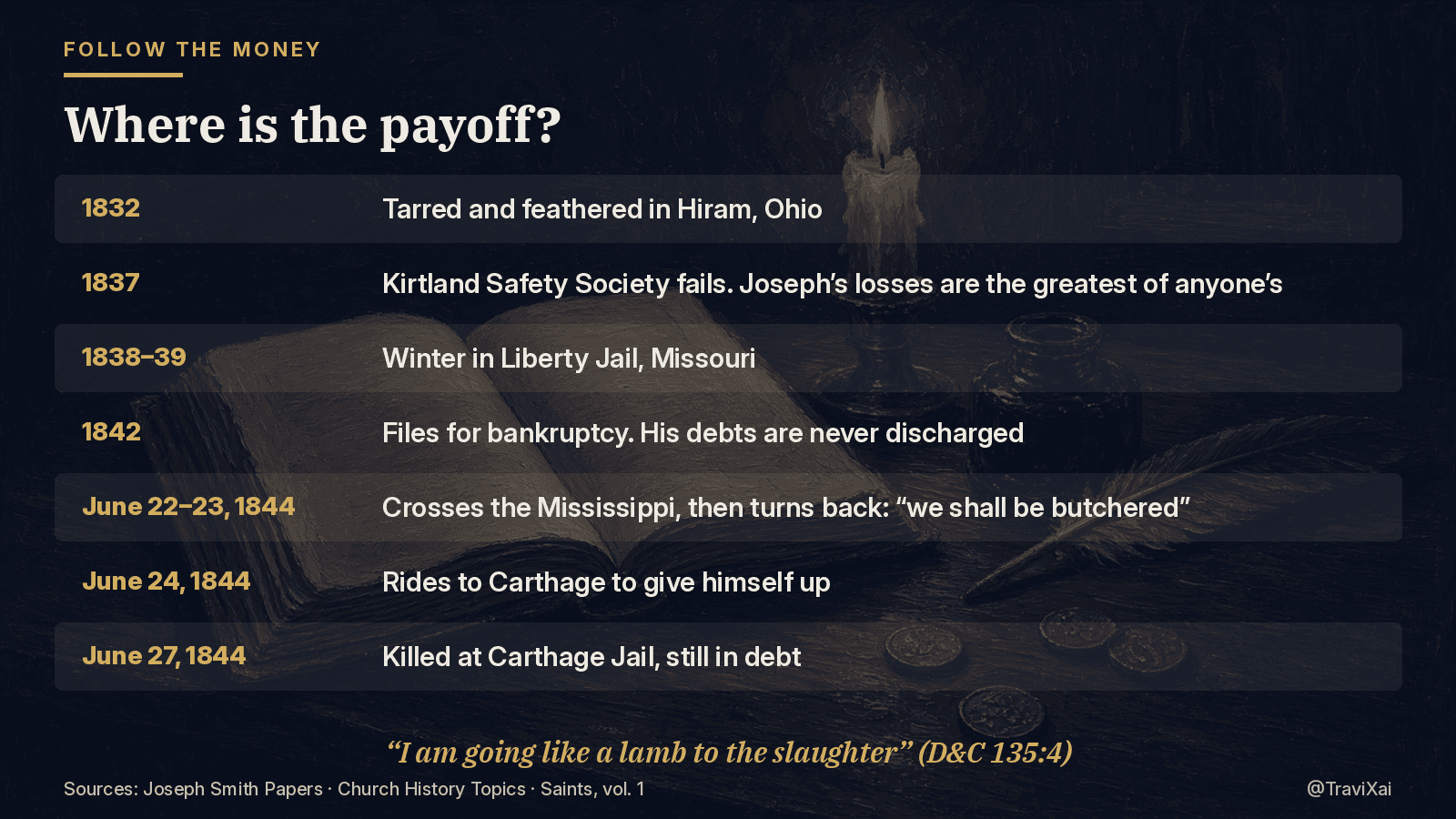
The Kirtland Safety Society, the bank-like company Joseph and Sidney Rigdon helped start in 1836, collapsed by late summer 1837 under a missing state charter, outside opposition, bad decisions, and the national Panic of 1837. I won’t pretend that was anyone’s finest hour. A Church manual says “poor financial decisions made by Joseph Smith and other Church leaders” were part of it, and many Saints lost money and blamed him. But Church histories also say Joseph’s own losses were the greatest of anyone’s. Con men don’t usually lose the most in their own scheme.
By 1842 he was carrying debts from the Kirtland stores, the temple, and land bought after the Saints were driven out of Missouri. He applied for bankruptcy on April 18, 1842. The Joseph Smith Papers note that, unlike his brothers and other Nauvoo residents, “Joseph Smith’s debts were never successfully discharged in bankruptcy.” He died in debt.
And the “payoff” years look like this: tarred and feathered in Hiram, Ohio in 1832; driven out of Ohio and then Missouri; the winter of 1838–39 in Liberty Jail; years of arrests, lawsuits, and threats in Illinois. If that’s the con, it is the worst-paying con in American history.
Follow the money: what the “payoff” years actually looked like. Original graphic by thebookofmormon.ai.
Here is the part critics skip, and the part that matters most. On the night of June 22, 1844, Joseph actually DID run. He, Hyrum, Willard Richards, and Porter Rockwell crossed the Mississippi into Iowa in a leaky skiff, and his history says he planned to head for the Rocky Mountains. That was his way out, and it was right there.
Then some of his friends came across and called him a coward for leaving the Saints exposed. His answer is in the history:
If my life is of no value to my friends it is of none to myself.
He asked Hyrum what they should do. Hyrum said go back and give themselves up. Joseph’s reply: “If you go back I will go with you, but we shall be butchered.” And he went back anyway. On the way to Carthage he said:
I am going like a lamb to the slaughter; but I am calm as a summer’s morning; I have a conscience void of offense towards God, and towards all men. I shall die innocent, and it shall yet be said of me—he was murdered in cold blood.
On June 27 he and Hyrum were shot by a mob with painted faces. A con man who was out of the state with a plan for the West does not row back across the river because his friends hurt his feelings. Not unless he actually believed what he had been saying for twenty years.
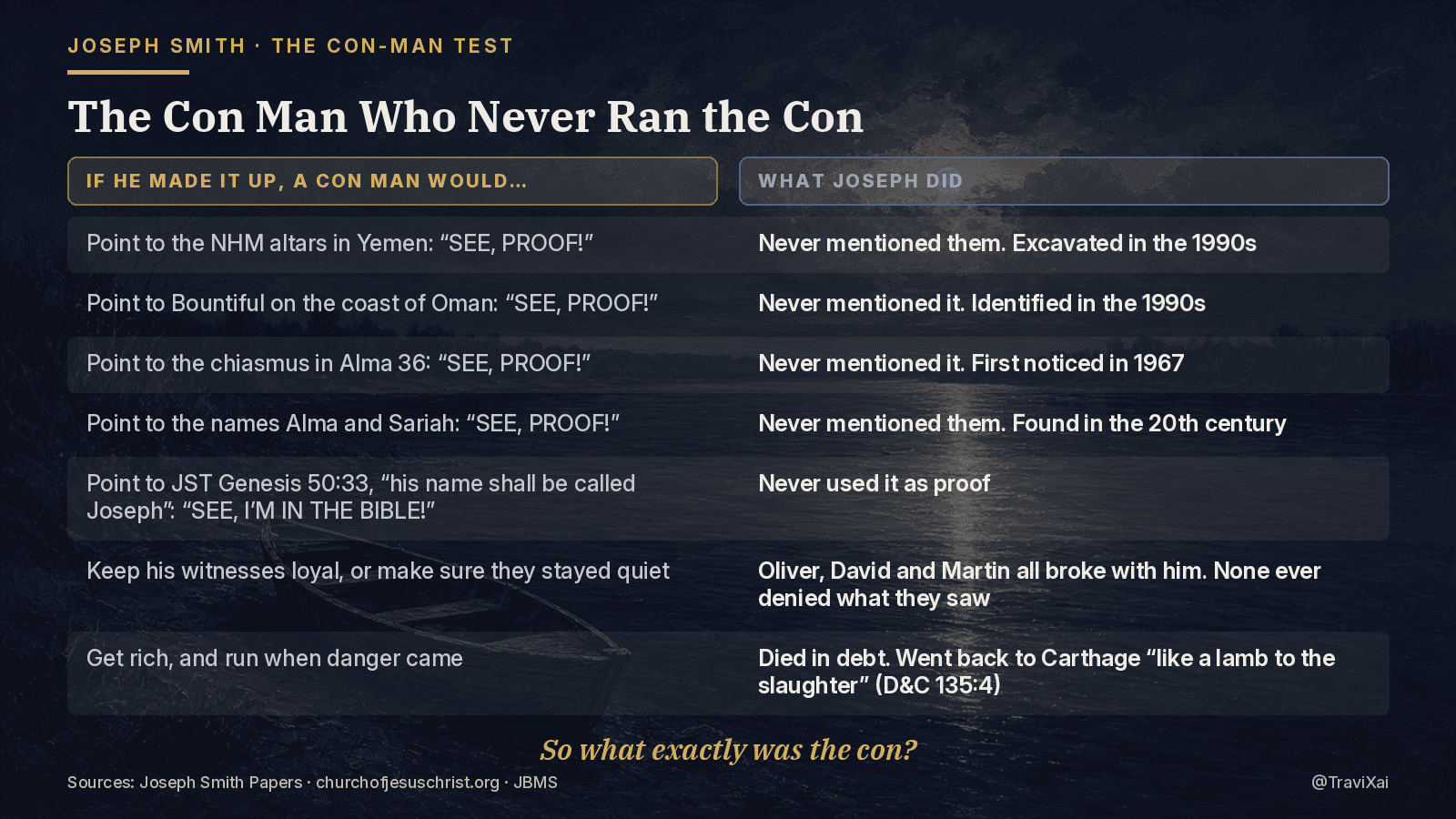
The con-man test: what a con man would have pointed to, and what Joseph did. Original graphic by thebookofmormon.ai.
One argument at a time, a critic can always find a way out. So don’t take them one at a time. Weigh them together:
He never mentioned his best evidence. Nahom, Bountiful, chiasmus, Alma, Sariah: not one word, because none of it had been found.
He never said SEE, I’M IN THE BIBLE. JST Genesis 50:33 wasn’t even printed until 1867.
His witnesses broke with him and still never denied what they saw.
He never got rich. He took the biggest loss in Kirtland and died with debts that were never discharged.
He had a way out and gave it up. He crossed the Mississippi, then came back knowing “we shall be butchered.”
So a con man who never pointed to his best evidence, never used the verse with his own name in it, whose witnesses broke with him and still never denied what they saw, who died in debt and walked back to the men who were going to kill him. So what exactly was the con?
Joseph’s answer was never “look at my evidence.” It was “read the book and ask God.” That still works: Moroni 10:4–5.
Husband, Father, Small Business Owner, Audio/Video/Tech, Lakers, Carnivore/Fasting, Weightlifting, Unschool, Liberty, Church of Jesus Christ of Latter-day Saints.