
“Cult” is one of the first words people search next to “LDS.” Here’s what the word means, how the first Christians were labeled, and how Latter-day Saints measure up on the checklist.
No. The Church of Jesus Christ of Latter-day Saints is not a cult. Its members worship God the Father and Jesus Christ, read the Bible alongside the Book of Mormon, live ordinary public lives, and are free to leave. “Cult” is a label, not an argument: the first Christians were called “the sect of the Nazarenes” and “heresy” too (Acts 24:5, 14).
The wordWhat people mean by “cult”
The word gets used two different ways, and the person using it rarely says which. The first is sociological: a high-control group built around a leader, where members are isolated, can’t ask questions, and pay a heavy price for leaving. The second is theological: some Protestant writers use “cult” for any group that claims to be Christian but doesn’t accept the creeds of the fourth and fifth centuries. Walter Martin’s 1965 book The Kingdom of the Cults made that second meaning popular, and Latter-day Saints were on his list.
Those are very different charges. One says we’re dangerous. The other says we don’t sign the Nicene Creed. So the first fair question back is simple: which one do you mean? Let’s answer both.
Acts 24The first Christians got the same label
If being called a cult made a church false, Christianity would have failed its first test. When Paul stood trial before Felix, the prosecutor’s lawyer called him “a pestilent fellow, and a mover of sedition among all the Jews throughout the world, and a ringleader of the sect of the Nazarenes” (Acts 24:5). Paul didn’t argue with the label. He answered it:
But this I confess unto thee, that after the way which they call heresy, so worship I the God of my fathers, believing all things which are written in the law and in the prophets.
Acts 24:14
In Rome the Jewish leaders told Paul, “as concerning this sect, we know that every where it is spoken against” (Acts 28:22). Jesus Himself was dismissed the same way: “He hath a devil, and is mad; why hear ye him?” (John 10:20). Even His own relatives said, “He is beside himself” (Mark 3:21).
New, small, unpopular, and spoken against everywhere. That was the church of the apostles. So “everyone says you’re a cult” isn’t evidence of anything except that the critics have a word they like.
The checklistRun the high-control checklist honestly
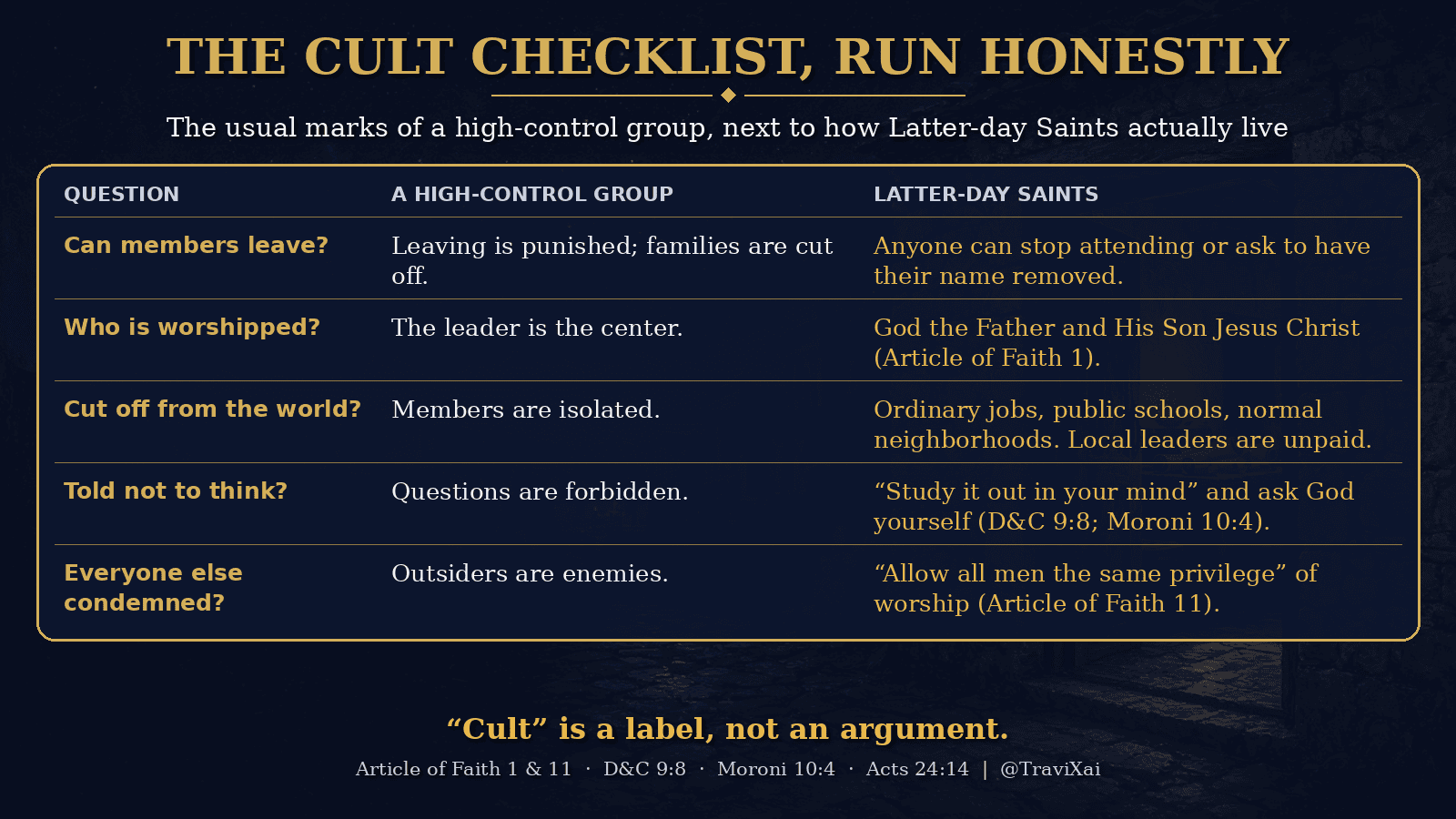
Take the sociological definition seriously and test it against how Latter-day Saints actually live.
Can you leave?
Yes. Anyone can stop attending, and anyone who wants off the records can ask to have their name removed. There’s no wall, no compound, and no penalty but the one every church has: people who love you will miss you.
Who gets worshipped?
Not Joseph Smith. “We believe in God, the Eternal Father, and in His Son, Jesus Christ, and in the Holy Ghost” (Article of Faith 1). The risen Christ told the Nephites, “ye must always pray unto the Father in my name” (3 Nephi 18:19), and that’s how every Latter-day Saint prayer ends. Joseph is honored as a prophet the way Moses and Peter are. Nobody prays to him.
Are members cut off from the world?
Latter-day Saints work ordinary jobs, send their kids to public schools, serve in the military, and run for office in both parties. The bishop who leads a congregation is a volunteer with a day job, as the post on whether LDS bishops get paid explains.
Are members told not to think?
The opposite. The Lord told Oliver Cowdery, “you must study it out in your mind; then you must ask me if it be right” (D&C 9:8). The Book of Mormon ends by telling every reader to ask God directly, “with a sincere heart, with real intent, having faith in Christ” (Moroni 10:4). A group that wants blind followers doesn’t hand them a promise to check the claims with God themselves. I walk through that promise in Read It and Ask.
Is everyone else the enemy?
Joseph Smith wrote this into the Articles of Faith: “We claim the privilege of worshiping Almighty God according to the dictates of our own conscience, and allow all men the same privilege, let them worship how, where, or what they may” (Article of Faith 11). The Doctrine and Covenants adds that men “are amenable to him, and to him only, for the exercise of it” (D&C 134:4).
1 Nephi 8The Book of Mormon saw the mocking coming
Lehi’s dream has a scene that fits this question almost too well. People who reach the tree of life and taste its fruit look up at “a great and spacious building” full of well-dressed people “in the attitude of mocking and pointing their fingers” (1 Nephi 8:27). Then comes the tragedy:
And after they had tasted of the fruit they were ashamed, because of those that were scoffing at them; and they fell away into forbidden paths and were lost.
1 Nephi 8:28
The pressure wasn’t an argument. It was mockery. And the invitation in the Book of Mormon is the opposite of a closed group: the Lord “inviteth them all to come unto him and partake of his goodness; and he denieth none that come unto him, black and white, bond and free, male and female” (2 Nephi 26:33).
The creedsThe theological charge: “outside historic Christianity”
When a pastor calls us a cult, he usually means the second definition: we don’t accept the Trinity as defined at Nicaea in 325 and Chalcedon in 451. That’s true, and we say it openly. But notice what the charge assumes. It makes a council held three centuries after Christ, called by an emperor, the test of who counts as Christian. I covered that council in Nicaea 325, and the question of who gets to define “Christian”.
By that test, Peter, Paul, and every Christian who died before 325 would fail, because none of them ever used the creed’s language. What we do share with them is the testimony itself: Jesus Christ is the Son of God, crucified for the world, risen, and coming again. Joseph Smith wrote, “this is the testimony, last of all, which we give of him: That he lives!” (D&C 76:22).
Check the premiseThe presuppositions baked into the question
Before this question can be answered fairly, the person asking has to justify a few assumptions packed inside it:
- That “cult” has one clear meaning. The asker has to say which definition he’s using. If it’s the sociological one, the checklist above answers it. If it’s the theological one, he’s really saying “you don’t accept my creed,” which is a different conversation.
- That small, new, or unpopular means false. The church in Acts was all three and was “every where … spoken against” (Acts 28:22). Popularity isn’t a test the Bible uses.
- That the fourth-century creeds define Christianity. The asker has to show where the Bible says a later council gets to set the boundary. The New Testament’s own test is confessing that Jesus Christ came in the flesh (1 John 4:2).
- That ex-member stories speak for everyone. Every church has people who leave, including the first one: “They went out from us, but they were not of us” (1 John 2:19). Hard stories deserve a hearing, but they aren’t a definition.
FAQQuick answers
Is the LDS Church a cult?
No. The Church of Jesus Christ of Latter-day Saints is a worldwide Christian church whose members worship God the Father and Jesus Christ, read the Bible and the Book of Mormon, live ordinary public lives, and are free to leave.
Why do some Christians call Latter-day Saints a cult?
Usually because Latter-day Saints don’t accept the Trinity as defined by the councils of Nicaea (325) and Chalcedon (451). Books like Walter Martin’s The Kingdom of the Cults (1965) use “cult” in that theological sense, meaning a group outside those creeds.
Can you leave the LDS Church?
Yes. Members can stop attending at any time, and anyone who wants to can ask to have their name removed from Church records.
Do Latter-day Saints worship Joseph Smith?
No. They worship God the Father and His Son Jesus Christ and pray to the Father in Christ’s name (Article of Faith 1; 3 Nephi 18:19). Joseph Smith is honored as a prophet, not worshipped.
Were the first Christians called a cult?
In their own words, yes: they were called “the sect of the Nazarenes” and followers of “the way which they call heresy” (Acts 24:5, 14), a sect “every where … spoken against” (Acts 28:22).
What do Latter-day Saints believe about God and Jesus Christ?
The first Article of Faith says it plainly: “We believe in God, the Eternal Father, and in His Son, Jesus Christ, and in the Holy Ghost” (Articles of Faith 1:1).
Are Latter-day Saints allowed to question or study Church history?
Yes. The Church publishes its history openly, including the Joseph Smith Papers and the Gospel Topics essays, and the Book of Mormon invites every reader to “ask God” whether it is true (Moroni 10:4).
Why is the Church named after Jesus Christ?
Because Christ said His church should bear His name: “how be it my church save it be called in my name?” (3 Nephi 27:8). The full name is The Church of Jesus Christ of Latter-day Saints.
SummaryKey takeaways
- “Cult” is used two ways: a high-control group, or a church outside the fourth-century creeds. Ask which one is meant.
- The apostles’ church was called a “sect,” “heresy,” and “every where … spoken against” (Acts 24:5, 14; 28:22).
- On the high-control checklist, Latter-day Saints can leave, worship the Father and the Son, live public lives, and are told to ask God themselves.
- The theological charge only works if a council held in 325 gets to define “Christian.”
Next time someone calls the Church a cult, ask which definition they mean, then read Acts 24:14 together. For quick, sourced answers, open Galatians18, and follow me on X at @TraviXai.
Sources
- King James Bible (churchofjesuschrist.org): Acts 24:5 · Acts 24:14 · Acts 28:22 · John 10:20 · Mark 3:21 · 1 John 2:19 · 1 John 4:2
- Book of Mormon: 1 Nephi 8:27–28 · 2 Nephi 26:33 · 3 Nephi 18:19 · Moroni 10:4
- Doctrine and Covenants and Pearl of Great Price: D&C 9:8 · D&C 76:22 · D&C 134:4 · Article of Faith 1 · Article of Faith 11
- Walter Martin, The Kingdom of the Cults (Bethany Fellowship, 1965)
- Featured image and in-article graphic: original graphics by thebookofmormon.ai (painterly backgrounds; no photographs or likenesses of real people).