
North America? Mesoamerica? South America? Here’s what the Book of Mormon says, what Joseph Smith thought, and what the Church officially teaches.
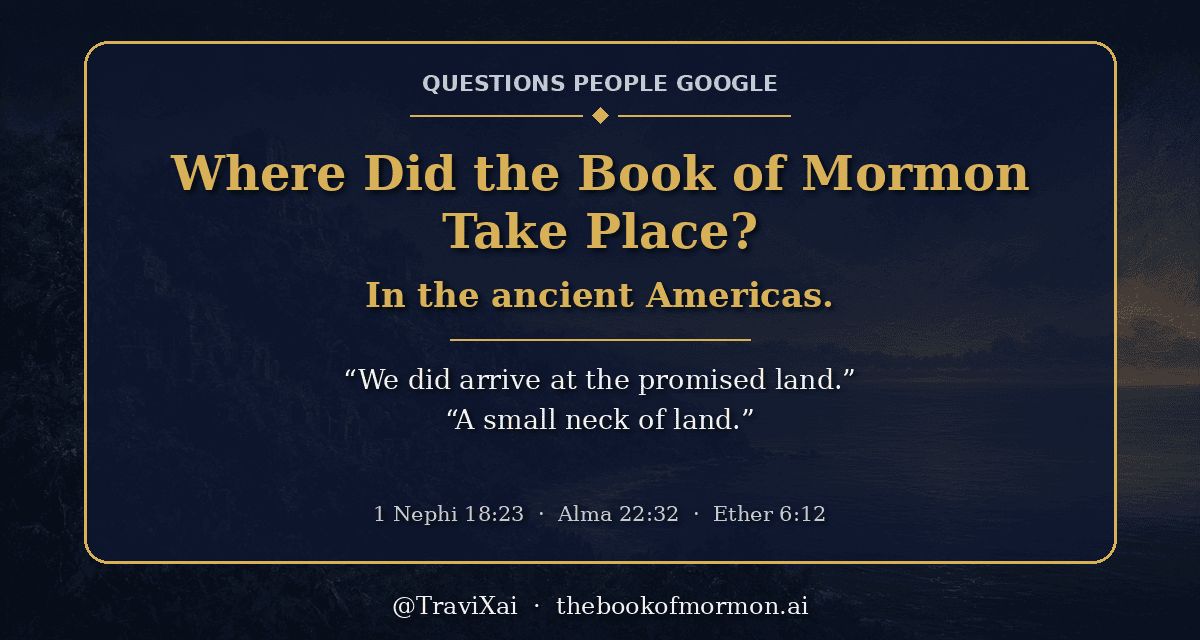
The Book of Mormon took place in the ancient Americas, and that is the Church’s only official position. The Church “does not take a position on the specific geographic locations.” The text describes three migrations from the Old World (Ether 6:12; 1 Nephi 18:23; Omni 1:15–16), a land northward and southward joined by “a small neck of land” (Alma 22:32), and seas on the east and west, all described with striking internal consistency. Members hold theories ranging from North America to Mesoamerica, but leaders ask that no theory be presented as Church doctrine.
The short versionThe ancient Americas, and that’s the Church’s only position
The Church’s Topics and Questions entry says: “Although Church members continue to discuss such theories today, the Church’s only position is that the events the Book of Mormon describes took place in the ancient Americas.” It adds: “The Church does not take a position on the specific geographic locations of Book of Mormon events in the ancient Americas” (Book of Mormon Geography).
Some members place the events in North America, others in Central or South America. The First Presidency and the Quorum of the Twelve “urge leaders and members not to advocate those personal theories in any setting or manner that would imply either prophetic or Church support for those theories.”
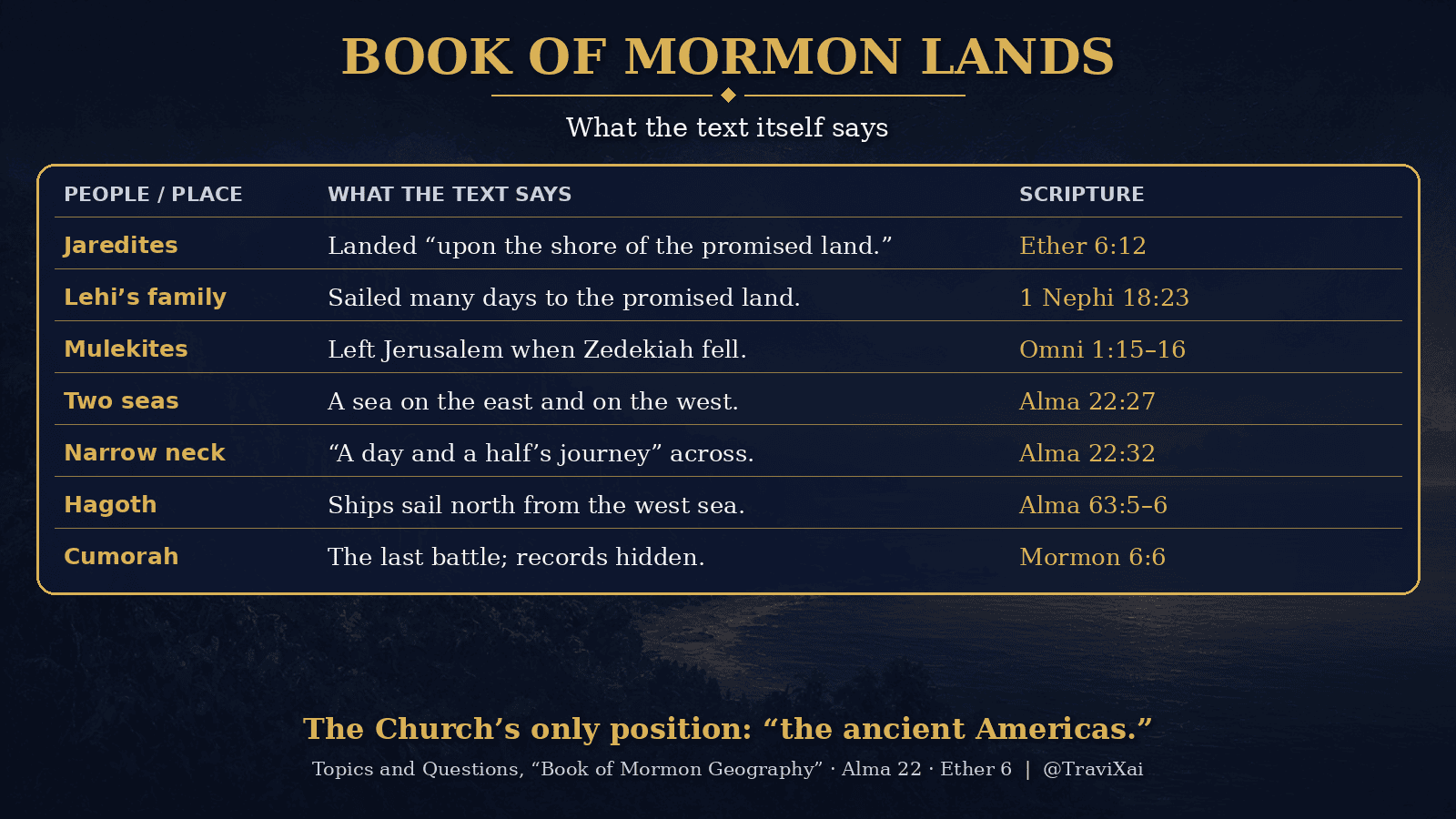
The textWhat the Book of Mormon says about its lands
The book describes three migrations from the Old World. The Jaredites, after the tower of Babel, “did land upon the shore of the promised land” (Ether 6:12). Lehi’s family left Jerusalem around 600 B.C.: “after we had sailed for the space of many days we did arrive at the promised land” (1 Nephi 18:23). A third group, the people of Zarahemla (often called Mulekites), “came out from Jerusalem at the time that Zedekiah, king of Judah, was carried away captive into Babylon” (Omni 1:15–16). Lehi said the Lord had covenanted the land to his children “and also all those who should be led out of other countries by the hand of the Lord” (2 Nephi 1:5).
The book gives a consistent internal geography. There is a land southward and a land northward, with seas on the east and west, and “a small neck of land between the land northward and the land southward,” only “a day and a half’s journey for a Nephite” across (Alma 22:32). A “narrow strip of wilderness” ran “from the sea east even to the sea west” (Alma 22:27). Hagoth built ships “by the narrow neck” and sailed north (Alma 63:5–6). The Church notes that “the internal consistency of these descriptions is one of the striking features of the Book of Mormon.” Joseph Smith dictated it in about three months, without notes.
Joseph SmithWhat Joseph Smith thought
According to the Church’s entry, Joseph Smith “accepted what he felt was evidence of Book of Mormon civilizations in both North America and Central America.” In 1834 he wrote to Emma of “wandering over the plains of the Nephites,” and in 1842 the Church newspaper, under his editorship, “identified the ruins of ancient native civilizations in Mexico and Central America as further evidence of the Book of Mormon’s historicity.”
Revelations to Joseph Smith identified the Lamanites as a people whose descendants lived in his day: “that the Lamanites might come to the knowledge of their fathers, and that they might know the promises of the Lord” (D&C 3:16–20), and in 1830 missionaries were sent “unto the Lamanites” (D&C 28:8). The Pearl of Great Price records Moroni telling Joseph the plates gave “an account of the former inhabitants of this continent” (Joseph Smith—History 1:34). None of these give a map.
Why no map?Why the Church stays neutral
The entry warns that “speculation on the geography of the Book of Mormon may mislead instead of enlighten; such a study can be a distraction from its divine purpose.” President Russell M. Nelson taught: “Interesting as these matters may be, study of the Book of Mormon is most rewarding when one focuses on its primary purpose—to testify of Jesus Christ. By comparison, all other issues are incidental” (Book of Mormon Geography).
The Bible has the same issue. Scholars still debate the route of the Exodus and the location of Mount Sinai, and Christians don’t treat that as proof the Bible is false (see “No Archaeology for the Book of Mormon”?). Paul said God “hath determined the times before appointed, and the bounds of their habitation” for all nations (Acts 17:26), and Jacob blessed Joseph as a bough “whose branches run over the wall” (Genesis 49:22). The Book of Mormon is the story of one of those branches. Its truth is found the way Moroni promised, by asking God (Moroni 10:4).
Check the premiseThe presuppositions baked into the question
Before this question can be answered fairly, the person asking has to justify a few assumptions packed inside it:
- That the Church has an official map of Book of Mormon lands. “The Church does not take a position on the specific geographic locations” (Topics and Questions, “Book of Mormon Geography”).
- That not knowing exact locations proves the book is fiction. The Exodus route and Mount Sinai are still debated, yet the Bible isn’t dismissed for it.
- That the Book of Mormon claims Lehi’s family were the only people in the Americas. The book itself describes three migrations and speaks of others “led out of other countries by the hand of the Lord” (2 Nephi 1:5).
- That geography is the main issue. “Study of the Book of Mormon is most rewarding when one focuses on its primary purpose—to testify of Jesus Christ” (Russell M. Nelson).
FAQQuick answers
Where did the Book of Mormon take place?
In the ancient Americas. That is the Church’s only official position. It takes no position on specific locations.
Where is Zarahemla today?
No one knows for certain, and the Church takes no position. Members hold various theories in North, Central and South America.
Is the hill Cumorah in New York?
Joseph Smith found the plates in a hill in New York, which early Latter-day Saints called Cumorah. Whether that hill is the site of the Book of Mormon’s final battles (Mormon 6:6) is debated among members; the Church takes no geographic position.
What is the narrow neck of land in the Book of Mormon?
A strip of land between the land northward and the land southward, “a day and a half’s journey for a Nephite” across (Alma 22:32). Its real-world location isn’t known.
Why doesn’t the Church say where the Book of Mormon happened?
Because the Lord hasn’t revealed it, and speculation “may mislead instead of enlighten.” The book’s purpose is to testify of Jesus Christ.
Did Lehi’s family sail to the Americas?
Yes. After building a ship and crossing the sea, Nephi wrote, “we did arrive at the promised land” (1 Nephi 18:23).
Is there evidence for the Book of Mormon’s route through Arabia?
Yes. Nephi mentions “the place which was called Nahom” (1 Nephi 16:34), and altars inscribed with the tribal name NHM have been found in the same region of Yemen, dating to Lehi’s era.
Does the Book of Mormon claim the Americas were empty?
No. The text doesn’t say Lehi’s family were the only people in the land. Since 2006 the introduction says the Lamanites are “among the ancestors” of the American Indians, rather than the principal ancestors.
SummaryKey takeaways
- The Church’s only position is that the events took place in the ancient Americas.
- The text describes three migrations and a consistent geography (Alma 22:27–32).
- Joseph Smith saw evidence in both North and Central America; no revelation gives a map.
- The book’s purpose is to testify of Christ; geography is “incidental” (Russell M. Nelson).
Read Alma 22 with a pencil and sketch the map yourself, then read 3 Nephi 11. For quick, sourced answers, open Galatians18, and follow me on X at @TraviXai.
Sources
- King James Bible (churchofjesuschrist.org): Genesis 49:22 · Acts 17:26
- Book of Mormon: 1 Nephi 18:23 · 2 Nephi 1:5 · Omni 1:15–16 · Alma 22:27 · Alma 22:32 · Alma 63:5–6 · Mormon 6:6 · Ether 6:12 · Moroni 10:4
- Doctrine and Covenants: D&C 3:16–20 · D&C 28:8
- Pearl of Great Price: Joseph Smith—History 1:34
- “Book of Mormon Geography,” Topics and Questions, churchofjesuschrist.org
- Featured image and in-article graphic: original graphics by thebookofmormon.ai (painterly backgrounds; no photographs or likenesses of real people).