
“Families can be together forever” is one of the best-known Latter-day Saint beliefs. Here’s the scripture behind it, and the answer to Matthew 22:30.
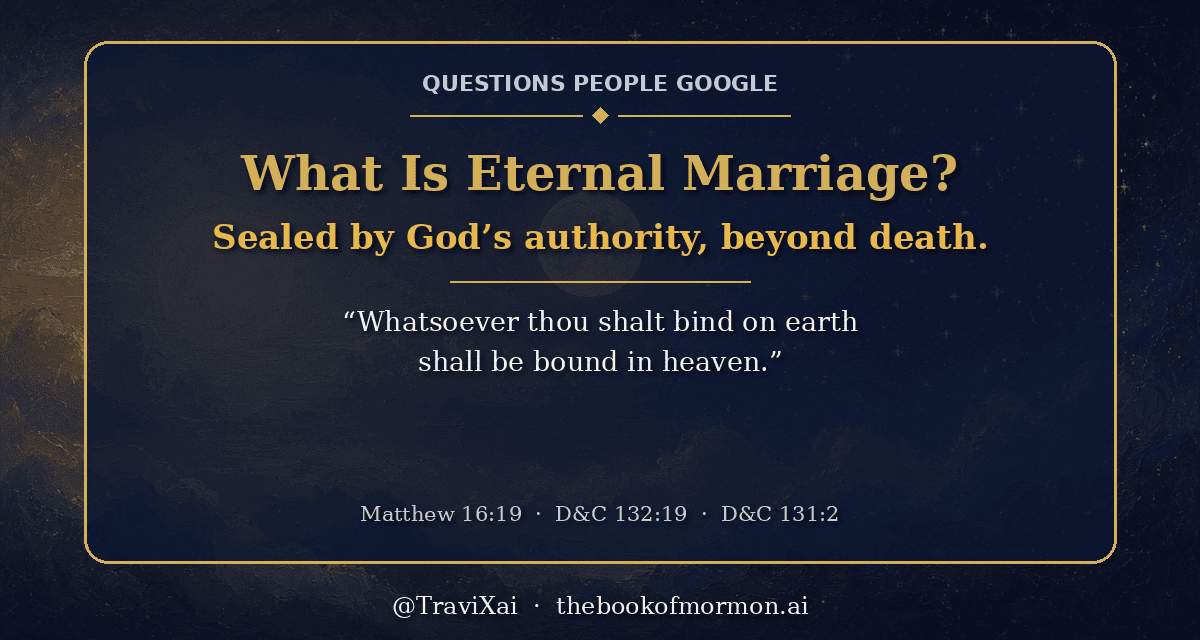
Eternal marriage is a marriage sealed in the temple by priesthood authority, meant to last beyond death. It rests on the power Jesus gave Peter: “whatsoever thou shalt bind on earth shall be bound in heaven” (Matthew 16:19), restored when Elijah came in 1836 (D&C 110). A sealed marriage is “of full force when they are out of the world” (D&C 132:19), and it is required for the highest degree of celestial glory (D&C 131:1–4), where faithful couples receive “a continuation of the seeds forever and ever.”
The short answer“Bound in heaven”
Latter-day Saints believe a husband and wife can be married not just “until death do you part,” but for eternity. In a temple sealing, a couple is married by the same priesthood power Jesus promised Peter: “whatsoever thou shalt bind on earth shall be bound in heaven” (Matthew 16:19). Children born to them, or sealed to them later, become part of an eternal family.
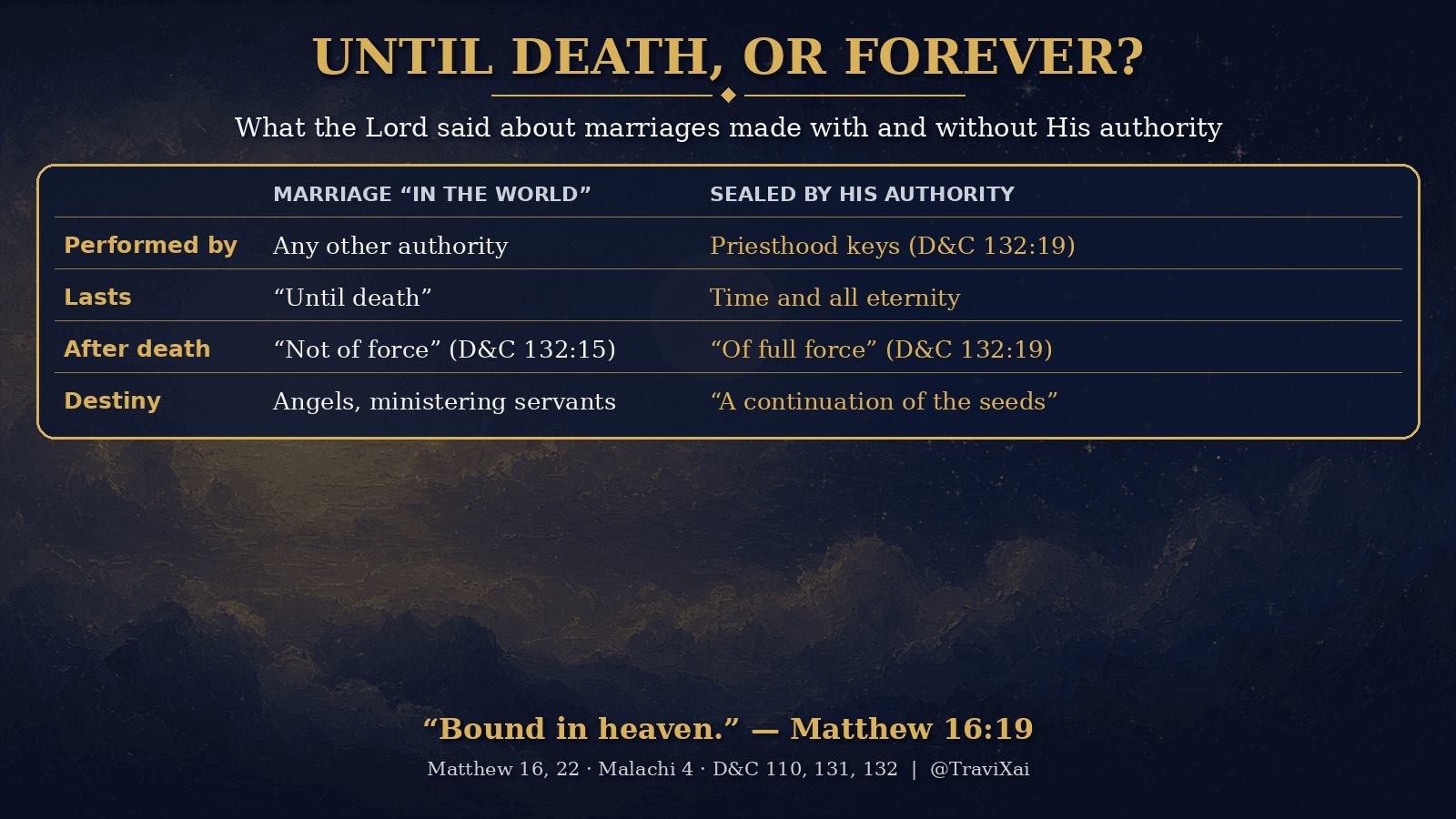
The Lord revealed that a marriage made “by my word, which is my law, and by the new and everlasting covenant,” and “sealed unto them by the Holy Spirit of promise,” will be “of full force when they are out of the world” (D&C 132:19). The Family proclamation (1995) teaches that “the divine plan of happiness enables family relationships to be perpetuated beyond the grave.”
The Bible’s view of marriage“What God hath joined together”
From the beginning, marriage was God’s idea: “it was not good that the man should be alone” (Moses 3:18), and “they shall be one flesh” (Genesis 2:24). Jesus said, “What therefore God hath joined together, let not man put asunder” (Matthew 19:6). Paul taught, “neither is the man without the woman, neither the woman without the man, in the Lord” (1 Corinthians 11:11), and Peter called husbands and wives “heirs together of the grace of life” (1 Peter 3:7).
And “whatsoever God doeth, it shall be for ever” (Ecclesiastes 3:14). If God joins a couple by His authority, why would death undo it?
What about Matthew 22:30?“They neither marry, nor are given in marriage”
Critics quote Jesus: “in the resurrection they neither marry, nor are given in marriage, but are as the angels of God in heaven” (Matthew 22:30). Latter-day Saints agree: no marriages are performed after the resurrection. Marriages must be made, and sealed, in this life. The question the Sadducees asked was about a woman married seven times under the law of Moses, not by the sealing power.
Modern revelation explains Jesus’ words: “if a man marry him a wife in the world, and he marry her not by me nor by my word … their covenant and marriage are not of force when they are dead … Therefore, when they are out of the world they neither marry nor are given in marriage; but are appointed angels in heaven” (D&C 132:15–16). Matthew 22:30 describes those not sealed. It doesn’t cancel marriages God Himself has bound.
Elijah and the sealing powerMalachi’s promise kept
Malachi’s last prophecy is that Elijah would come “before the coming of the great and dreadful day of the Lord” to “turn the heart of the fathers to the children, and the heart of the children to their fathers” (Malachi 4:5–6). The risen Christ repeated it word for word to the Nephites (3 Nephi 25:5–6). On April 3, 1836, in the Kirtland Temple, Elijah appeared to Joseph Smith and Oliver Cowdery: “the time has fully come … the keys of this dispensation are committed into your hands” (D&C 110:14–16). Those keys are why temples seal families today. See What Happens in a Latter-day Saint Temple?.
Why it matters: exaltation“Then shall they be gods”
Eternal marriage is not a sentimental extra. It is required for the highest glory: “In the celestial glory there are three heavens or degrees; and in order to obtain the highest, a man must enter into this order of the priesthood [meaning the new and everlasting covenant of marriage] … He may enter into the other, but that is the end of his kingdom; he cannot have an increase” (D&C 131:1–4).
For sealed couples who keep their covenants, the promise is the fulness of what the Father has: they “shall inherit thrones, kingdoms, principalities, and powers … which glory shall be a fulness and a continuation of the seeds forever and ever. Then shall they be gods, because they have no end” (D&C 132:19–20). Abraham’s seed would continue “both in the world and out of the world … as innumerable as the stars” (D&C 132:30), “for herein is the work of my Father continued, that he may be glorified” (D&C 132:63).
This is what Joseph Smith taught in the King Follett sermon: that we must learn “how to be gods yourselves … the same as all gods have done before you,” and in the Sermon in the Grove, that the Father Himself “had a Father.” Exalted couples become like our Heavenly Parents: eternal increase, worlds without number, yet always the Father’s children, always worshipping Him. See Was God Once a Man? and Do Latter-day Saints Believe in Heavenly Mother?.
Check the premiseThe presuppositions baked into the question
Before this question can be answered fairly, the person asking has to justify a few assumptions packed inside it:
- That Jesus taught all marriages end at death. Matthew 22:30 says no marriages are performed in the resurrection; D&C 132:15–16 explains it applies to marriages not made by God’s authority.
- That Jesus never gave authority that binds in heaven. “Whatsoever thou shalt bind on earth shall be bound in heaven” (Matthew 16:19).
- That eternal marriage is about romance alone. It is a covenant tied to exaltation and “a continuation of the seeds forever” (D&C 132:19).
- That the sealing power is a modern invention. Malachi 4:5–6 promised Elijah; D&C 110 records his coming in 1836.
FAQQuick answers
What is eternal marriage?
A marriage sealed in the temple by priesthood authority, meant to last “for time and for all eternity” (D&C 132:18) rather than “until death.”
What is a temple sealing?
The ordinance that binds husband, wife and children together forever by the authority Jesus described in Matthew 16:19.
Doesn’t Matthew 22:30 say there’s no marriage in heaven?
It says no marriages are performed in the resurrection. D&C 132:15–16 explains it describes those not married by God’s authority.
Is eternal marriage required for exaltation?
Yes. D&C 131:1–4 says the highest degree of celestial glory requires “the new and everlasting covenant of marriage.”
What is promised to sealed couples?
Thrones, kingdoms, “a continuation of the seeds forever and ever,” and to be gods, always under our Father (D&C 132:19–20).
Does the Bible teach that a marriage can be bound in heaven?
Jesus gave Peter the sealing power: “whatsoever thou shalt bind on earth shall be bound in heaven” (Matthew 16:19). Latter-day Saints believe temple sealings use that same authority.
What does Paul say about husband and wife “in the Lord”?
“Nevertheless neither is the man without the woman, neither the woman without the man, in the Lord” (1 Corinthians 11:11).
Where are eternal marriages performed?
In temples, by men holding the sealing authority. Couples married civilly can be sealed in the temple later, and children born to sealed parents are born in the covenant.
SummaryKey takeaways
- A temple sealing binds a couple “for time and all eternity.”
- It rests on the sealing power of Matthew 16:19, restored by Elijah (D&C 110).
- Matthew 22:30 describes marriages not made by God’s authority (D&C 132:15–16).
- Eternal marriage leads to exaltation and eternal increase (D&C 131–132).
Visit a temple open house when one comes near you. For quick, sourced answers, open Galatians18, and follow me on X at @TraviXai.
Sources
- King James Bible (churchofjesuschrist.org): Genesis 2:24 · Ecclesiastes 3:14 · Malachi 4:5–6 · Matthew 16:19 · Matthew 19:6 · Matthew 22:30 · 1 Corinthians 11:11 · 1 Peter 3:7
- Book of Mormon: 3 Nephi 25:5–6
- Doctrine and Covenants: D&C 110:14–16 · D&C 131:1–4 · D&C 132:15–20 · D&C 132:30 · D&C 132:63
- Pearl of Great Price: Moses 3:18
- The Family: A Proclamation to the World (1995)
- Joseph Smith, King Follett sermon (HC 6:305–306) and Sermon in the Grove (HC 6:476), BYU Studies online edition
- Featured image and in-article graphic: original graphics by thebookofmormon.ai (painterly backgrounds; no photographs or likenesses of real people).