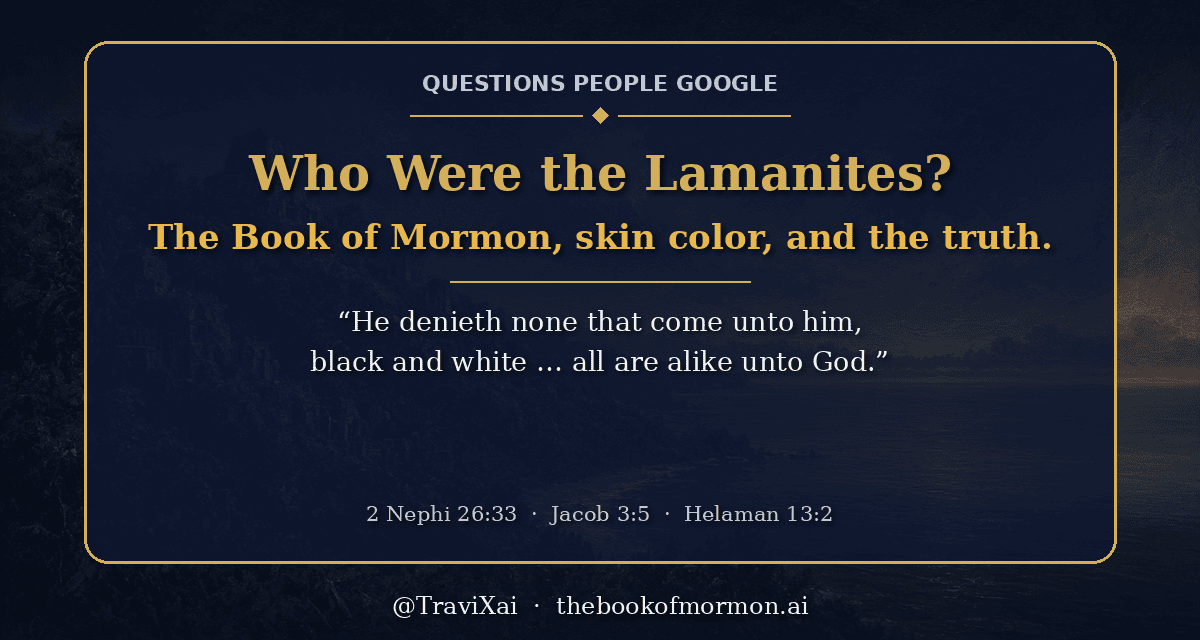

Critics quote one verse about skin color. Here’s the whole Book of Mormon story of the Lamanites, and what the Church teaches today.
The Lamanites are the descendants of Laman, Lehi’s eldest son, in the Book of Mormon. The book does describe a “skin of blackness” (2 Nephi 5:21), but it defines the curse as being “cut off from the presence of the Lord,” tells the Nephites the Lamanites “are more righteous than you” and to “revile no more” (Jacob 3:5, 9), and declares “all are alike unto God” (2 Nephi 26:33). The Church today “disavows the theories advanced in the past that black skin is a sign of divine disfavor or curse.”
The short answerA family that became a people
In the Book of Mormon, the Lamanites are the descendants and followers of Laman, the eldest son of the prophet Lehi, who rebelled against his younger brother Nephi. For much of the book they are at war with the Nephites, but the story is far more complex than “good guys and bad guys”: at key moments the Lamanites are more righteous than the Nephites, produce prophets, and convert by the thousands. The current introduction to the Book of Mormon says the Lamanites “are among the ancestors of the American Indians.”
The hard question is the “skin of blackness.” The Church answers it plainly: “Today, the Church disavows the theories advanced in the past that black skin is a sign of divine disfavor or curse … Church leaders today unequivocally condemn all racism, past and present, in any form” (Gospel Topics Essay, “Race and the Priesthood”).
What the text actually saysThe curse was separation from God
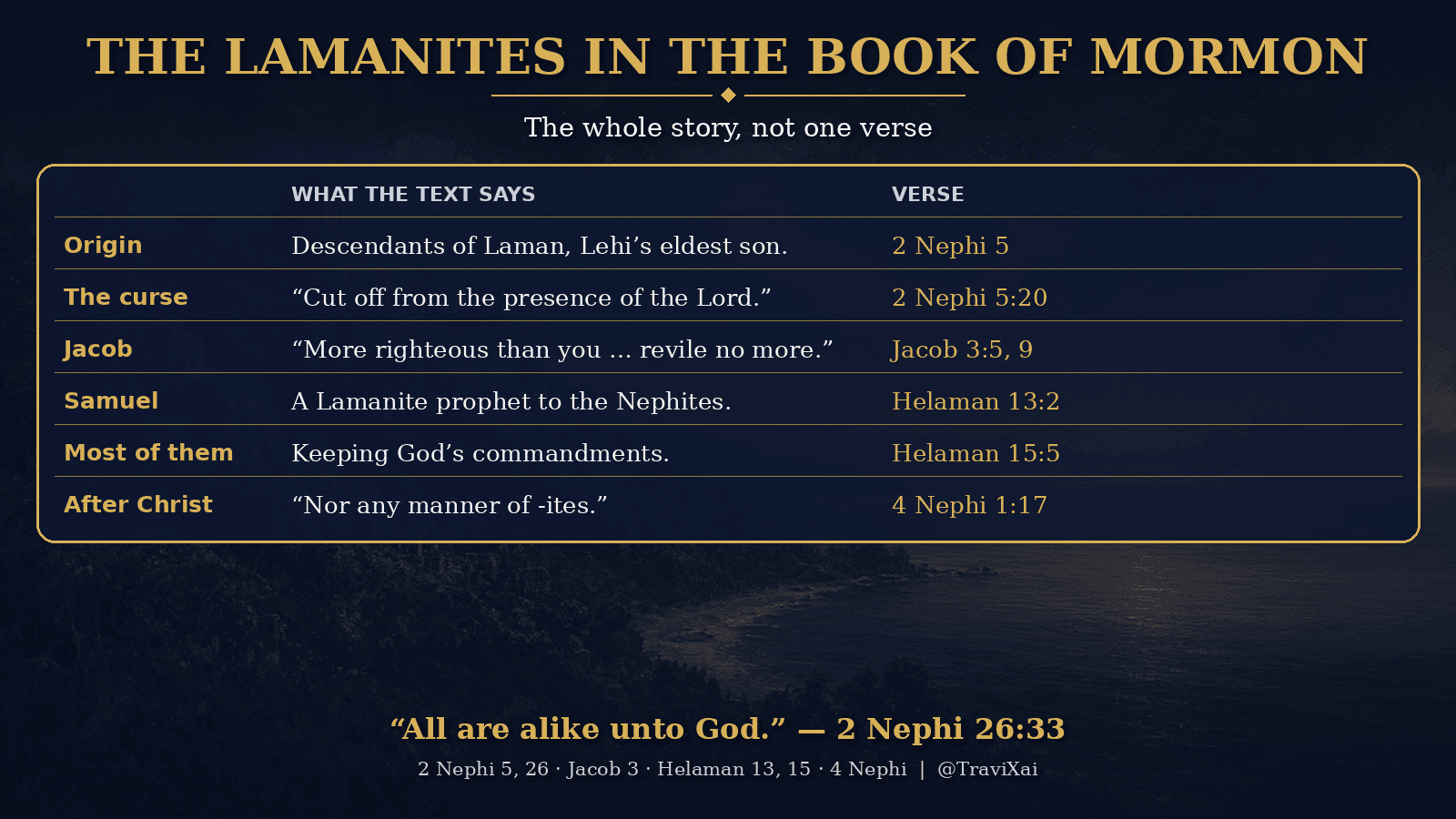
Nephi records the Lord’s word: “Inasmuch as they will not hearken unto thy words they shall be cut off from the presence of the Lord. And behold, they were cut off from his presence.” He then describes a “sore cursing” and says “the Lord God did cause a skin of blackness to come upon them” (2 Nephi 5:20–21). Faithful readers have understood the skin language in different ways, but the text itself defines the curse first as being “cut off from his presence.” Separation from God could come upon anyone who rejected Him, and by the end of the book it was the Nephites who were destroyed for it.
The Book of Mormon itself immediately undercuts any racial pride. The prophet Jacob told the Nephites: “the Lamanites your brethren, whom ye hate because of their filthiness and the cursing which hath come upon their skins, are more righteous than you,” and “I fear that unless ye shall repent of your sins that their skins will be whiter than yours, when ye shall be brought with them before the throne of God. Wherefore, a commandment I give unto you … that ye revile no more against them because of the darkness of their skins” (Jacob 3:5–9).
Lamanite heroesSamuel, the Anti-Nephi-Lehies, and more
Some of the book’s greatest heroes are Lamanites. Samuel the Lamanite climbed the wall of Zarahemla to call the Nephites to repentance and prophesied Christ’s birth (Helaman 13:2). He told them that “the more part of them are in the path of their duty, and they do walk circumspectly before God” (Helaman 15:4–7). The converted Lamanites who buried their weapons rather than shed blood, and their sons, the stripling warriors, are held up as models of faith for every reader.
After Christ visited the Americas, the division disappeared entirely: “neither were there Lamanites, nor any manner of -ites; but they were in one, the children of Christ, and heirs to the kingdom of God” (4 Nephi 1:17). That is the Book of Mormon’s vision for every people.
“All are alike unto God”The book’s own verdict
The Book of Mormon contains one of the strongest statements of racial equality in scripture: the Lord “inviteth them all to come unto him and partake of his goodness; and he denieth none that come unto him, black and white, bond and free, male and female; and he remembereth the heathen; and all are alike unto God, both Jew and Gentile” (2 Nephi 26:33). The Church’s race essay calls that verse the epitome of its teaching.
The Bible agrees: “God is no respecter of persons: But in every nation he that feareth him, and worketh righteousness, is accepted with him” (Acts 10:34–35), and He “hath made of one blood all nations of men” (Acts 17:26). God promised Abraham that through his seed “all the families of the earth” would be blessed “with the blessings of the Gospel” (Abraham 2:11).
The promise to the LamanitesThe record was preserved for them
The Book of Mormon was preserved largely for the Lamanites’ descendants. The Lord told Joseph Smith that “for this very purpose are these plates preserved … that the Lamanites might come to the knowledge of their fathers, and that they might know the promises of the Lord, and that they may believe the gospel and rely upon the merits of Jesus Christ, and be glorified through faith in his name” (D&C 3:18–20). A book that exists to bless a people isn’t a book that despises them. See The 1978 Revelation on the Priesthood and Where Did the Book of Mormon Take Place?.
Check the premiseThe presuppositions baked into the question
Before this question can be answered fairly, the person asking has to justify a few assumptions packed inside it:
- That one verse is the Book of Mormon’s whole view of race. Jacob 3:5–9, Helaman 15:5 and 2 Nephi 26:33 show Lamanites as more righteous at times, and “all are alike unto God.”
- That the Church still teaches skin color reflects God’s favor. It “disavows the theories advanced in the past that black skin is a sign of divine disfavor or curse” (Race and the Priesthood).
- That the Lamanites are the villains of the book. Samuel the Lamanite and the converted Anti-Nephi-Lehies are among its greatest heroes.
- That the curse was mainly physical. 2 Nephi 5:20 defines it first: “they were cut off from his presence.”
FAQQuick answers
Who were the Lamanites?
Descendants and followers of Laman, Lehi’s eldest son; the current Book of Mormon introduction says they “are among the ancestors of the American Indians.”
What is the “skin of blackness” in the Book of Mormon?
2 Nephi 5:21 describes it alongside a curse defined as being “cut off from the presence of the Lord.” The Church disavows the idea that black skin is a sign of divine disfavor.
Is the Book of Mormon racist?
Its own verdict is “all are alike unto God” (2 Nephi 26:33), it rebukes Nephite racial pride (Jacob 3:9), and it presents Lamanite prophets and saints as heroes.
Who was Samuel the Lamanite?
A Lamanite prophet who preached repentance to the Nephites from the wall of Zarahemla and prophesied Christ’s birth (Helaman 13–16).
What happened to the Lamanites after Christ came?
For about two centuries there were no “-ites”; all “were in one, the children of Christ” (4 Nephi 1:17).
Were the Lamanites ever more righteous than the Nephites?
Yes. By about 30 B.C., “the Lamanites had become, the more part of them, a righteous people, insomuch that their righteousness did exceed that of the Nephites” (Helaman 6:1).
Who were the Anti-Nephi-Lehies?
Lamanite converts who vowed never to shed blood again. They took their weapons “and they did bury them up deep in the earth” (Alma 24:17).
Who were the stripling warriors?
Their sons, 2,000 young men who fought to defend their families. “They had been taught by their mothers, that if they did not doubt, God would deliver them” (Alma 56:47).
SummaryKey takeaways
- The Lamanites descend from Laman, Lehi’s eldest son.
- The curse is defined as being “cut off from the presence of the Lord.”
- Jacob 3 condemns Nephite racial contempt; Samuel the Lamanite is a prophet.
- The Church disavows race-curse theories and condemns all racism.
Read Jacob 3 and Helaman 13–15 yourself. For quick, sourced answers, open Galatians18, and follow me on X at @TraviXai.
Sources
- King James Bible (churchofjesuschrist.org): Acts 10:34–35 · Acts 17:26
- Book of Mormon: 2 Nephi 5:20–21 · 2 Nephi 26:33 · Jacob 3:5–9 · Helaman 13:2 · Helaman 15:4–7 · 4 Nephi 1:17
- Doctrine and Covenants: D&C 3:18–20
- Pearl of Great Price: Abraham 2:11
- Gospel Topics Essay, “Race and the Priesthood”
- Book of Mormon, Introduction
- Featured image and in-article graphic: original graphics by thebookofmormon.ai (painterly backgrounds; no photographs or likenesses of real people).