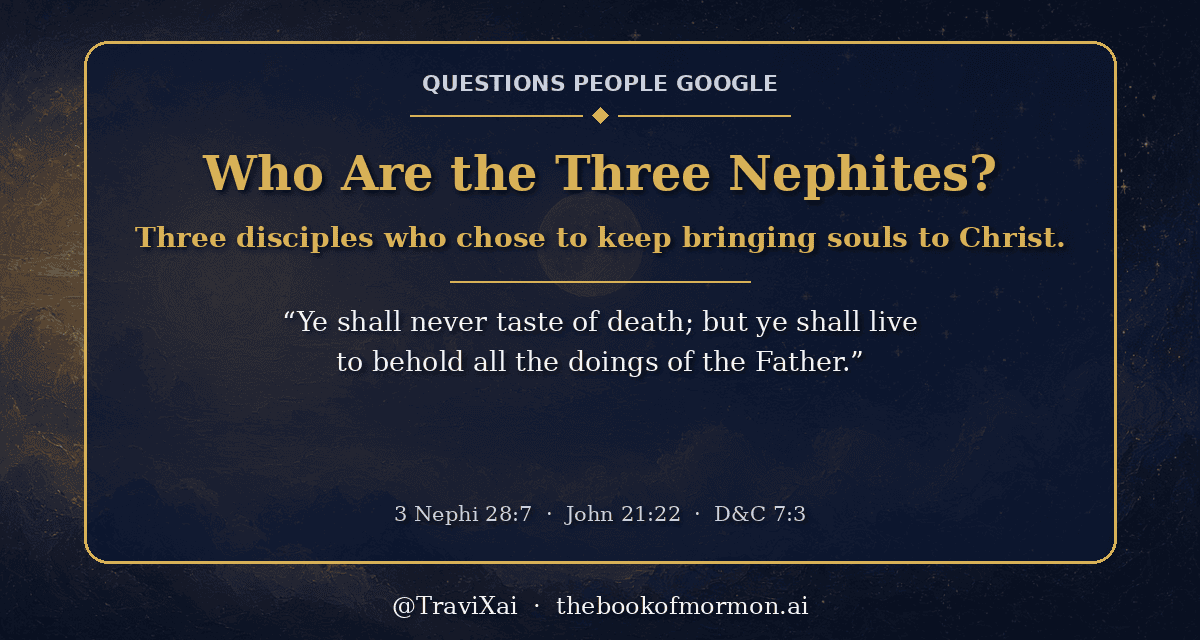

Three disciples asked Jesus for the hardest assignment there is. Here is what scripture says about them, and what is just folklore.
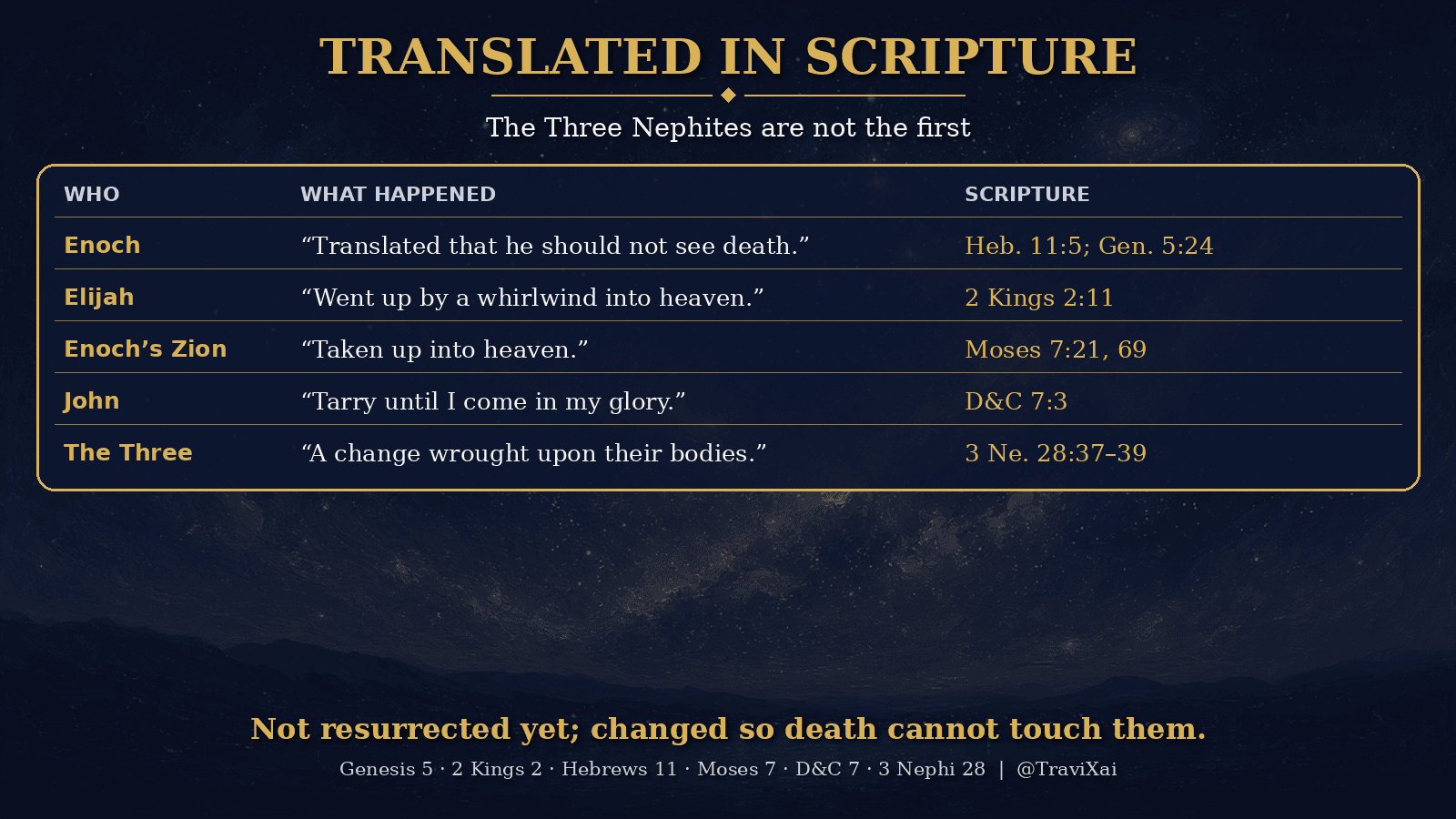
The question often assumes this is Latter-day Saint folklore with no scriptural basis. It is in the text, and the Bible has the same category of person. The Three Nephites are three of the twelve disciples Jesus chose in the Americas. They asked for what John the Beloved asked, and Jesus promised, “ye shall never taste of death; but ye shall live to behold all the doings of the Father” until He comes in glory (3 Nephi 28:6–7). A “change was wrought upon their bodies” (3 Nephi 28:38), as with Enoch (Hebrews 11:5) and John (D&C 7:3).
Who they areThree of the twelve
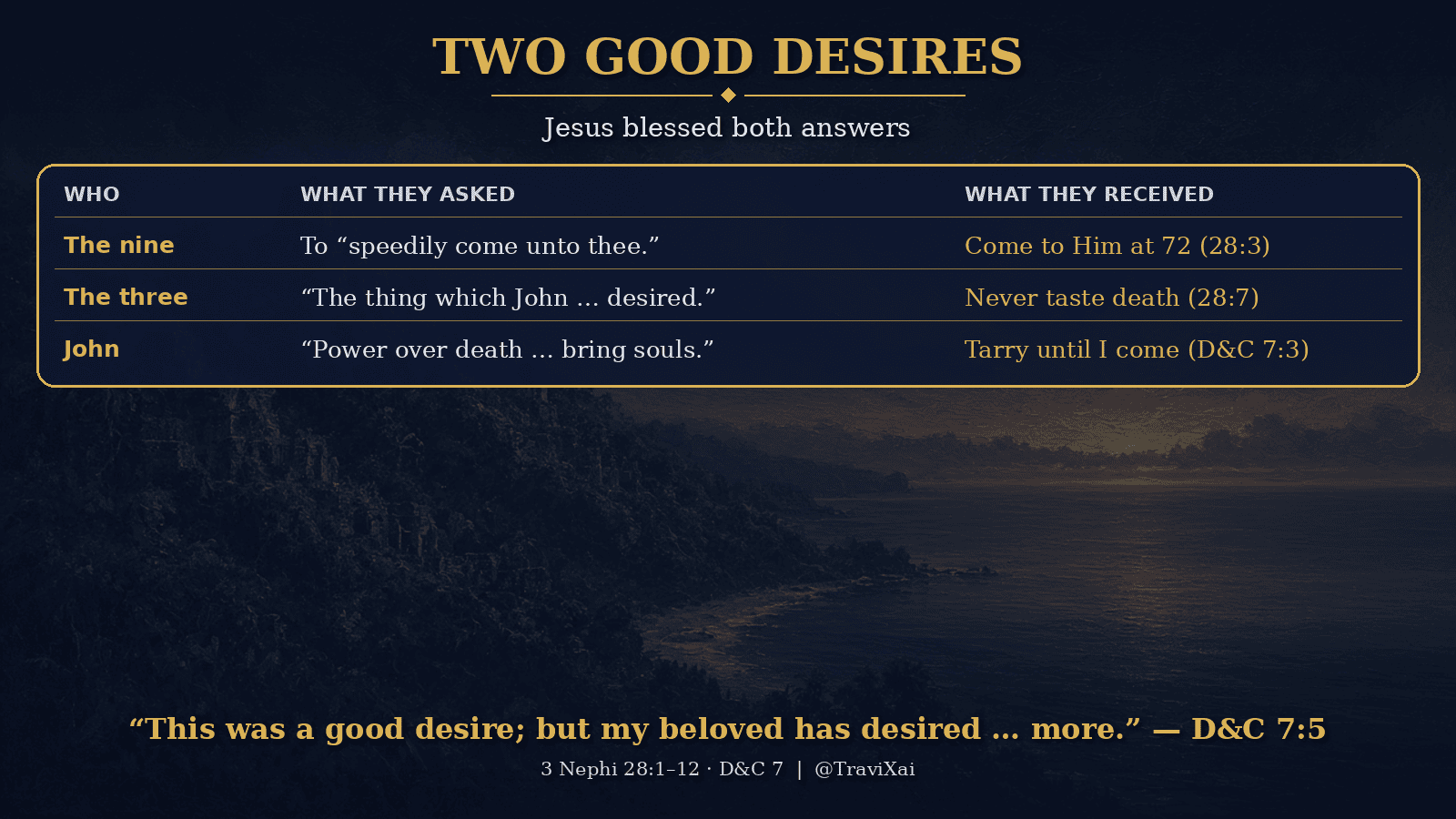
Near the end of His visit to the Americas, the risen Christ asked each of His twelve Nephite disciples: “What is it that ye desire of me, after that I am gone to the Father?” Nine asked that “after we have lived unto the age of man, that our ministry … may have an end, that we may speedily come unto thee in thy kingdom.” He blessed them, promising that “after that ye are seventy and two years old ye shall come unto me in my kingdom” (3 Nephi 28:1–3).
Three “durst not speak unto him the thing which they desired.” He knew already: “ye have desired the thing which John, my beloved, who was with me in my ministry, before that I was lifted up by the Jews, desired of me. Therefore, more blessed are ye, for ye shall never taste of death; but ye shall live to behold all the doings of the Father unto the children of men, even until all things shall be fulfilled according to the will of the Father, when I shall come in my glory with the powers of heaven” (3 Nephi 28:4–7).
Their names are deliberately withheld: “I was about to write the names of those who were never to taste of death, but the Lord forbade; therefore I write them not, for they are hid from the world” (3 Nephi 28:25). The twelve are named in 3 Nephi 19:4, but the text never says which three stayed.
The promiseWhat their lives are like
“Ye shall never endure the pains of death; but when I shall come in my glory ye shall be changed in the twinkling of an eye from mortality to immortality,” and “ye shall not have pain while ye shall dwell in the flesh, neither sorrow save it be for the sins of the world; and all this will I do because of the thing which ye have desired of me, for ye have desired that ye might bring the souls of men unto me, while the world shall stand” (3 Nephi 28:8–9).
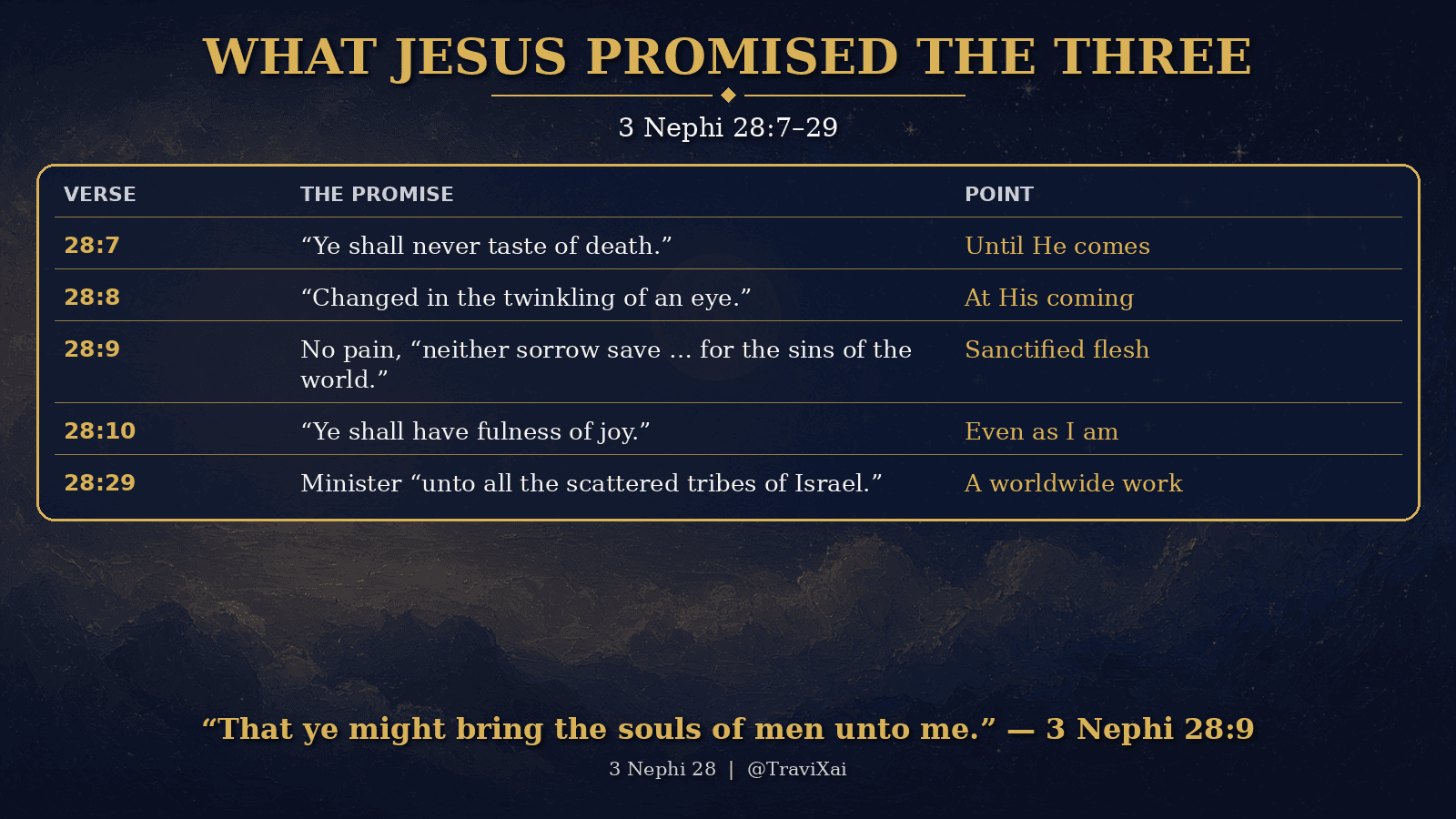
Then comes the promise that defines the whole Latter-day Saint view of where discipleship leads: “ye shall have fulness of joy; and ye shall sit down in the kingdom of my Father; yea, your joy shall be full, even as the Father hath given me fulness of joy; and ye shall be even as I am, and I am even as the Father; and the Father and I are one” (3 Nephi 28:10–11). They become as Christ, who is as the Father, and they sit down “in the kingdom of my Father.” It is always His kingdom, and He is always their Father. See The Three Degrees of Glory.
The Bible“If I will that he tarry”

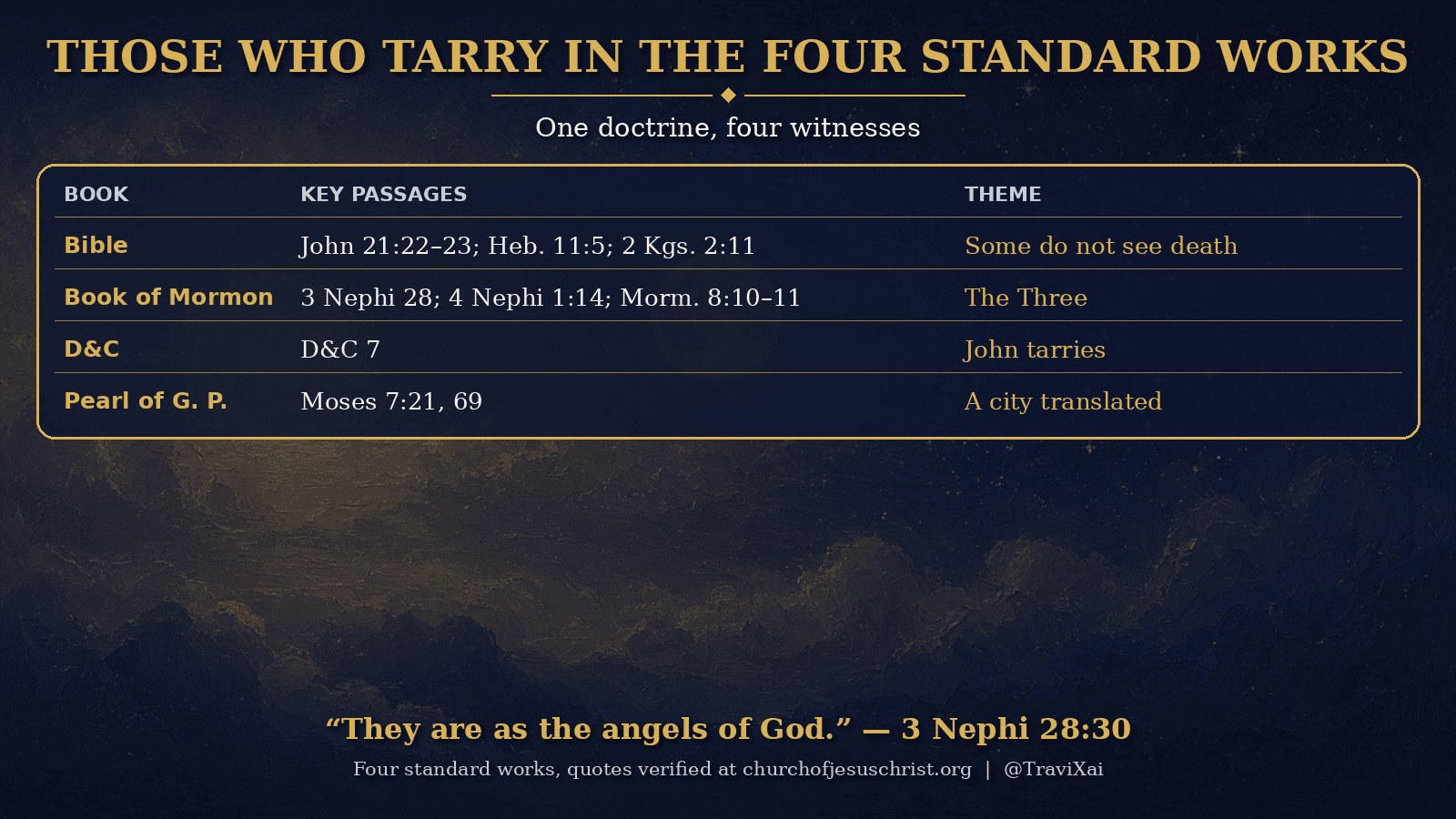
After the Resurrection, Peter asked about John: “Lord, and what shall this man do? Jesus saith unto him, If I will that he tarry till I come, what is that to thee? follow thou me. Then went this saying abroad among the brethren, that that disciple should not die” (John 21:21–23). John adds that Jesus did not say flatly “He shall not die.” The early church still took it to mean John would remain. Jesus had also said, “There be some standing here, which shall not taste of death, till they see the Son of man coming in his kingdom” (Matthew 16:28).
The Bible already has people who did not die. “Enoch walked with God: and he was not; for God took him” (Genesis 5:24), and “By faith Enoch was translated that he should not see death” (Hebrews 11:5). “Elijah went up by a whirlwind into heaven” (2 Kings 2:11). Hebrews uses the word Latter-day Saints use: translated.
The Book of MormonA change upon their bodies
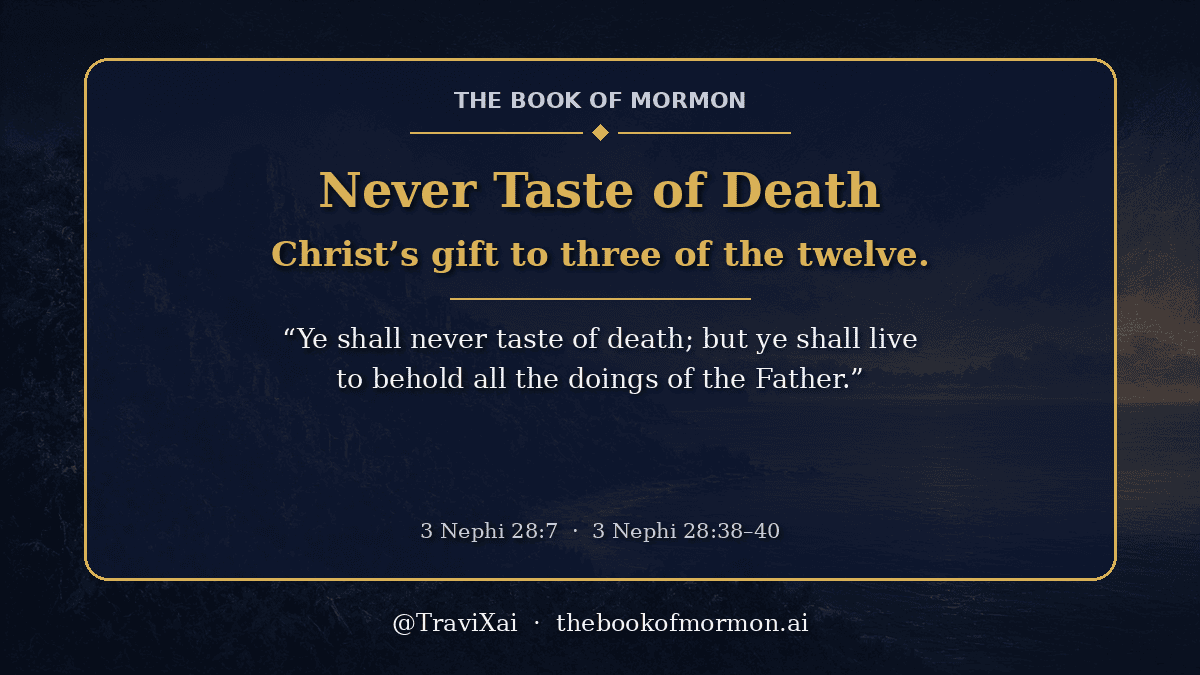
Mormon asked the Lord what happened to them physically: “there must needs be a change wrought upon their bodies, or else it needs be that they must taste of death; therefore, that they might not taste of death there was a change wrought upon their bodies … Now this change was not equal to that which shall take place at the last day; but there was a change wrought upon them, insomuch that Satan could have no power over them, that he could not tempt them; and they were sanctified in the flesh, that they were holy, and that the powers of the earth could not hold them” (3 Nephi 28:36–39). They stay that way “until the judgment day of Christ,” when they will “receive a greater change, and … be received into the kingdom of the Father to go no more out” (3 Nephi 28:40).
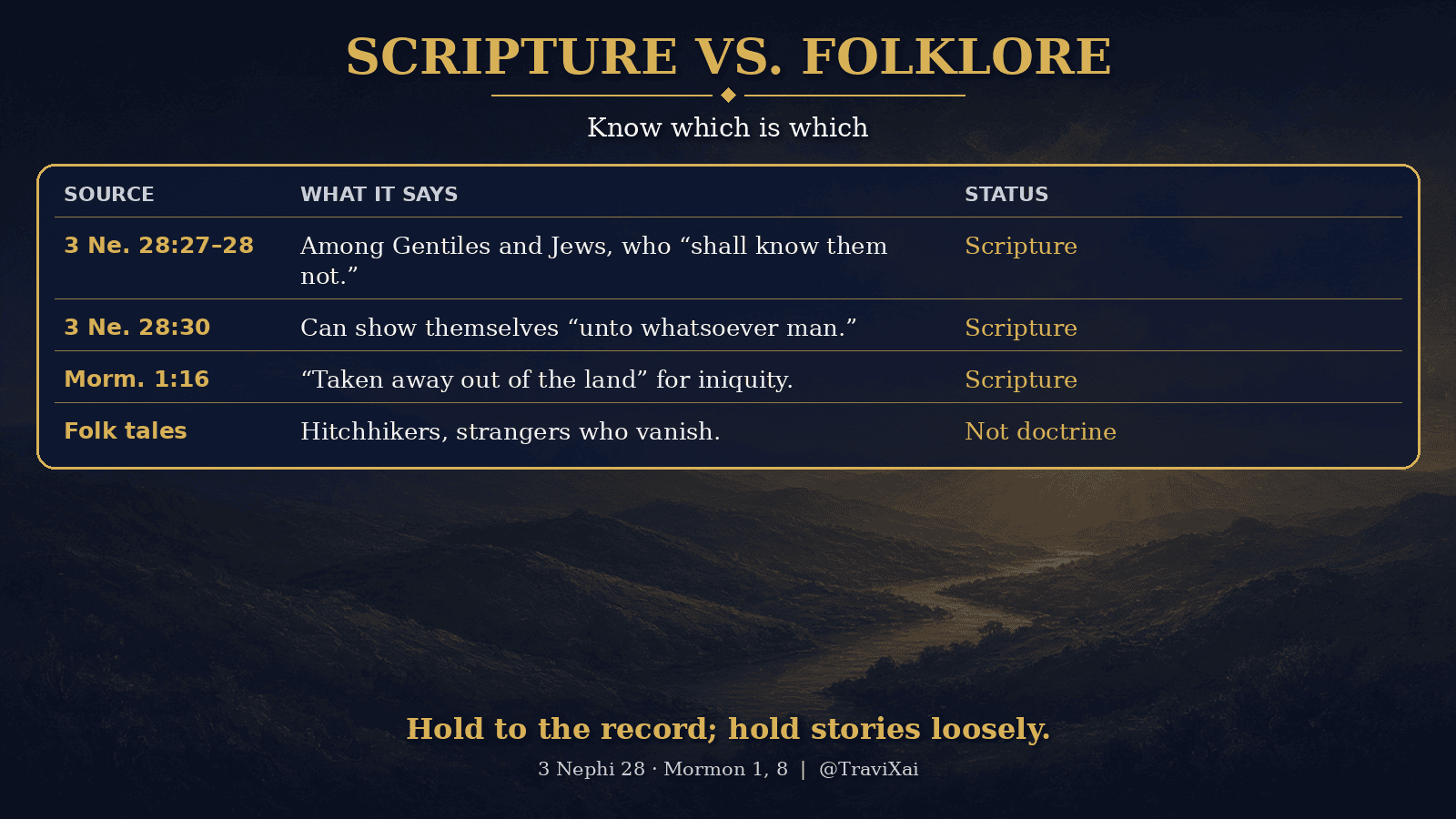
Their ministry: “they will be among the Gentiles, and the Gentiles shall know them not. They will also be among the Jews, and the Jews shall know them not,” and in the Lord’s time “they shall minister unto all the scattered tribes of Israel, and unto all nations, kindreds, tongues and people.” “They are as the angels of God, and if they shall pray unto the Father in the name of Jesus they can show themselves unto whatsoever man it seemeth them good” (3 Nephi 28:27–30).
The record tracks them. A century after the visit, all the disciples “had all gone to the paradise of God, save it were the three who should tarry” (4 Nephi 1:14). As the Nephites fell, “the beloved disciples were taken away out of the land, because of their iniquity” (Mormon 1:16). Moroni wrote, “whether they be upon the face of the land no man knoweth. But behold, my father and I have seen them, and they have ministered unto us” (Mormon 8:10–11).
The Doctrine and CovenantsJohn the Beloved, confirmed
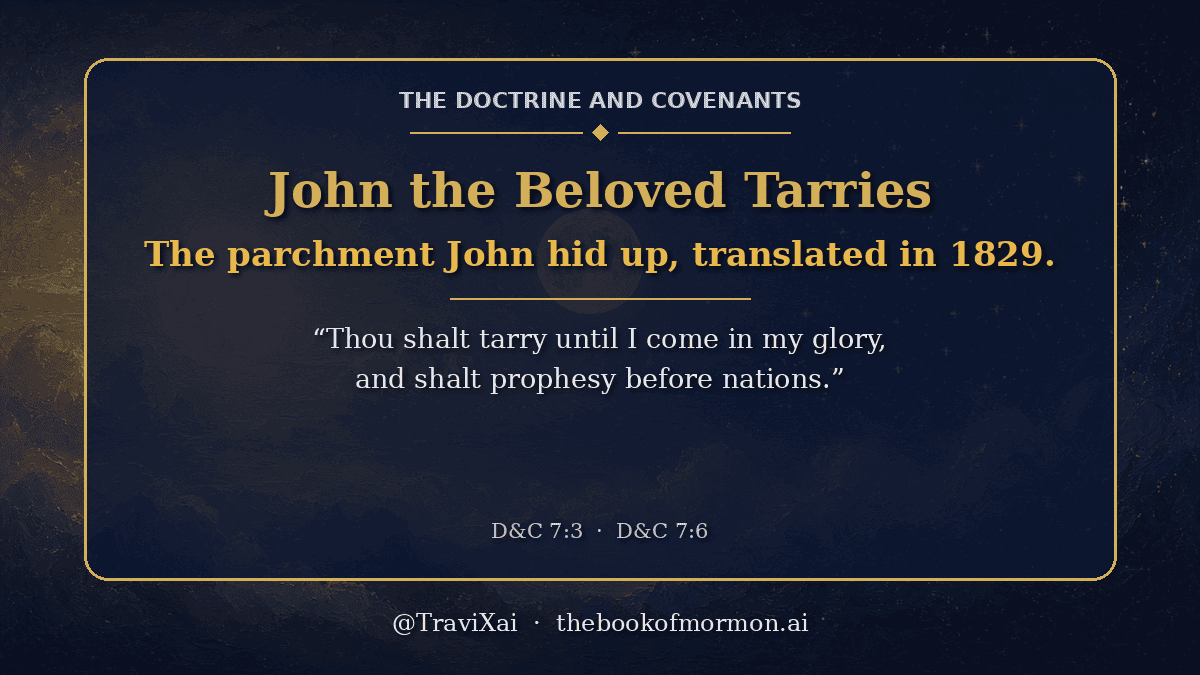
In April 1829 Joseph Smith received the translated text of a parchment written by John. Peter’s question is answered directly: “John, my beloved, what desirest thou? … And I said unto him: Lord, give unto me power over death, that I may live and bring souls unto thee. And the Lord said unto me: Verily, verily, I say unto thee, because thou desirest this thou shalt tarry until I come in my glory, and shalt prophesy before nations, kindreds, tongues and people” (D&C 7:1–3). The Lord told Peter that his own desire “was a good desire; but my beloved has desired that he might do more,” and of John, “I will make him as flaming fire and a ministering angel” (D&C 7:4–6). John 21 and 3 Nephi 28 now explain each other.
The Pearl of Great PriceA whole city translated
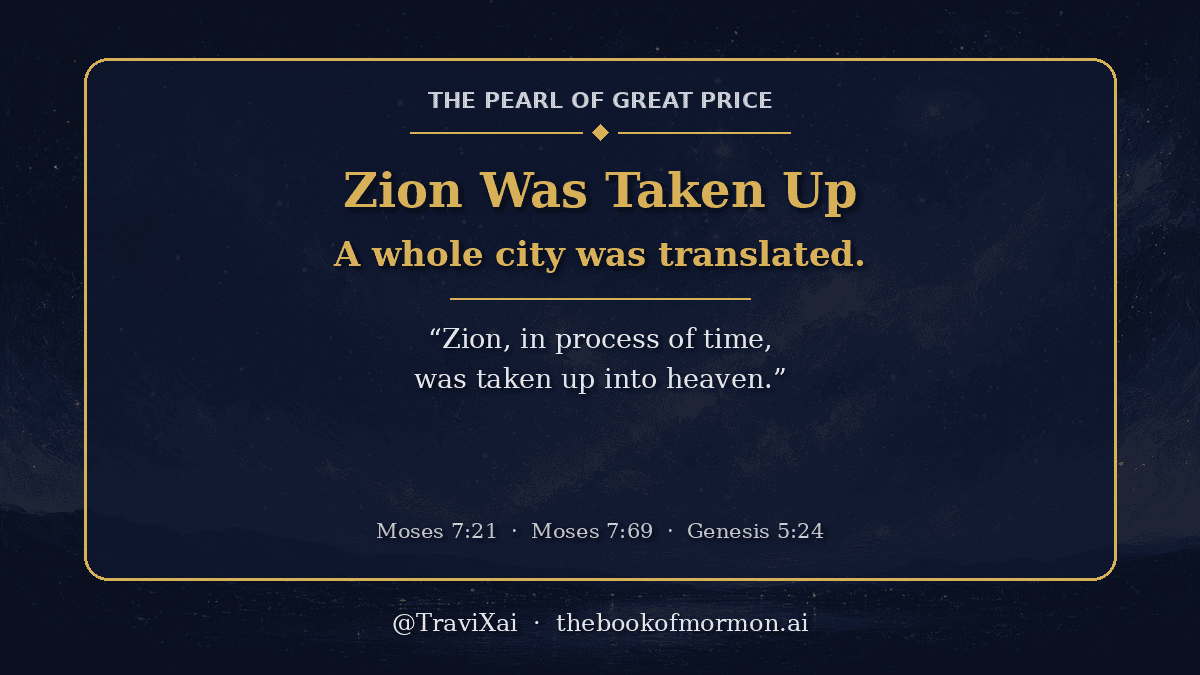
The Book of Moses shows translation on a scale bigger than three men: “the Lord showed unto Enoch all the inhabitants of the earth; and he beheld, and lo, Zion, in process of time, was taken up into heaven. And the Lord said unto Enoch: Behold mine abode forever” (Moses 7:21). “Enoch and all his people walked with God … and it came to pass that Zion was not, for God received it up into his own bosom; and from thence went forth the saying, Zion is Fled” (Moses 7:69). Genesis 5:24, “he was not; for God took him,” is the one-line summary of that story.
Scripture and folkloreWhere the stories come from
Latter-day Saint culture has many stories about a kind stranger who helps and then disappears, and some get attributed to the Three Nephites. Scripture does say they can “show themselves unto whatsoever man it seemeth them good” and that they move unknown among Gentiles and Jews (3 Nephi 28:27–30). It does not confirm any particular modern story, and the Church does not teach any of them as doctrine. Hold to the record, and judge any claimed experience the way Moroni says to judge everything: “every thing which inviteth to do good, and to persuade to believe in Christ, is sent forth by the power and gift of Christ” (Moroni 7:16).
The real point is not mystery. It is the desire. The three asked for the hardest assignment: to stay in a fallen world, feel sorrow “for the sins of the world,” and keep bringing souls to Christ until He returns. Jesus called them “more blessed” for asking. See Did Jesus Visit the Americas?.
Check the premiseThe presuppositions baked into the question
Before this question can be answered fairly, the person asking has to justify a few assumptions packed inside it:
- That immortality without death is unbiblical. Enoch “was translated that he should not see death” (Hebrews 11:5), and Elijah “went up by a whirlwind” (2 Kings 2:11).
- That John 21 settles that John died. John says Jesus did not say flatly that he would not die, and the saying went abroad that he would not (John 21:23). D&C 7:3 resolves it.
- That Latter-day Saints treat every Three Nephites story as doctrine. Only scripture defines them. Folk stories are not Church teaching.
- That the Three were resurrected. No. A change was “wrought upon their bodies,” not equal to resurrection; a “greater change” comes at the judgment (3 Nephi 28:39–40).
FAQQuick answers
Who are the Three Nephites?
Three of the twelve disciples Christ chose in the Americas, who asked to remain on earth to bring souls to Him. He promised they would “never taste of death” (3 Nephi 28:4–7).
Where are the Three Nephites in the Book of Mormon?
3 Nephi 28; also 4 Nephi 1:14, 30, 37; Mormon 1:16; and Mormon 8:10–11.
What are the names of the Three Nephites?
Scripture does not say. “The Lord forbade; therefore I write them not, for they are hid from the world” (3 Nephi 28:25).
Are the Three Nephites still alive?
Scripture says they will remain “until all things shall be fulfilled … when I shall come in my glory” (3 Nephi 28:7).
What is a translated being?
A person changed so that death and Satan cannot touch them, “sanctified in the flesh,” but not yet resurrected (3 Nephi 28:37–40; Hebrews 11:5).
Is John the Beloved still alive?
Yes, according to D&C 7:3: “thou shalt tarry until I come in my glory.” This matches John 21:22–23 and 3 Nephi 28:6.
Are Three Nephites stories true?
Scripture says they can appear to whom they choose (3 Nephi 28:30). Specific modern stories are folklore, not doctrine.
What did Jesus promise the other nine disciples?
That at seventy-two they would “come unto me in my kingdom; and with me ye shall find rest” (3 Nephi 28:3).
SummaryKey takeaways
- Three of Christ’s twelve Nephite disciples asked to remain and bring souls to Him (3 Nephi 28:4–9).
- They were translated, not resurrected (3 Nephi 28:37–40).
- John the Beloved received the same blessing (John 21:22–23; D&C 7:3).
- Their names are deliberately withheld (3 Nephi 28:25).
- Folk stories are not doctrine; the record is.
Read 3 Nephi 28 alongside John 21 and D&C 7. For quick, sourced answers, open Galatians18, and follow me on X at @TraviXai.
Sources
- King James Bible (churchofjesuschrist.org): Genesis 5:24 · 2 Kings 2:11 · Matthew 16:28 · John 21:21–23 · Hebrews 11:5
- Book of Mormon: 3 Nephi 19:4 · 3 Nephi 28:1–12 · 3 Nephi 28:25–30 · 3 Nephi 28:36–40 · 4 Nephi 1:14 · Mormon 1:16 · Mormon 8:10–11 · Moroni 7:16
- Doctrine and Covenants: D&C 7:1–6
- Pearl of Great Price: Moses 7:21 · Moses 7:69
- Featured image and in-article graphic: original graphics by thebookofmormon.ai (painterly backgrounds; no photographs or likenesses of real people).