
Built by one day of labor in ten, finished while mobs burned homes, used by 6,000 Saints in one winter, burned by an arsonist, and rebuilt 154 years later.
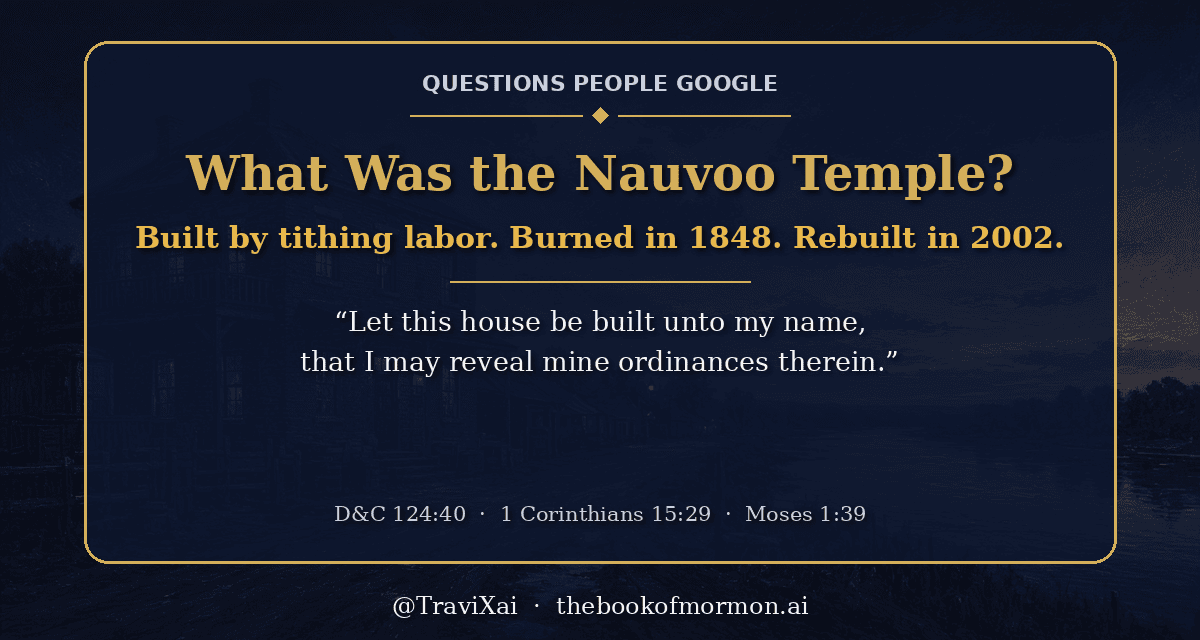
The question often assumes the Nauvoo Temple was a grand monument to Joseph Smith, or that its ordinances were invented on the spot. Neither holds up. The Nauvoo Temple was commanded in D&C 124 in 1841 and built by the Saints’ tithing labor so the Lord could “reveal mine ordinances therein”: baptism for the dead, the endowment and eternal marriage. Joseph Smith was killed before it was used for the endowment. More than 6,000 Saints were endowed there before the 1846 exodus. It was burned in 1848, toppled in 1850 and rebuilt in 2002.
What it wasA temple-centered city
The Nauvoo Temple was the second temple built by Latter-day Saints, after Kirtland. It stood on the bluff above the Mississippi River in Nauvoo, Illinois, and was built between 1841 and 1846 almost entirely by donated labor and tithing. It was the first temple built for the ordinances Latter-day Saints associate with temples today: baptism for the dead, the endowment and eternal marriage. More than 6,000 Saints were endowed there in the winter of 1845–46, just before they were driven west. It was burned in 1848, toppled by a tornado in 1850 and rebuilt on the same footprint in 2002.
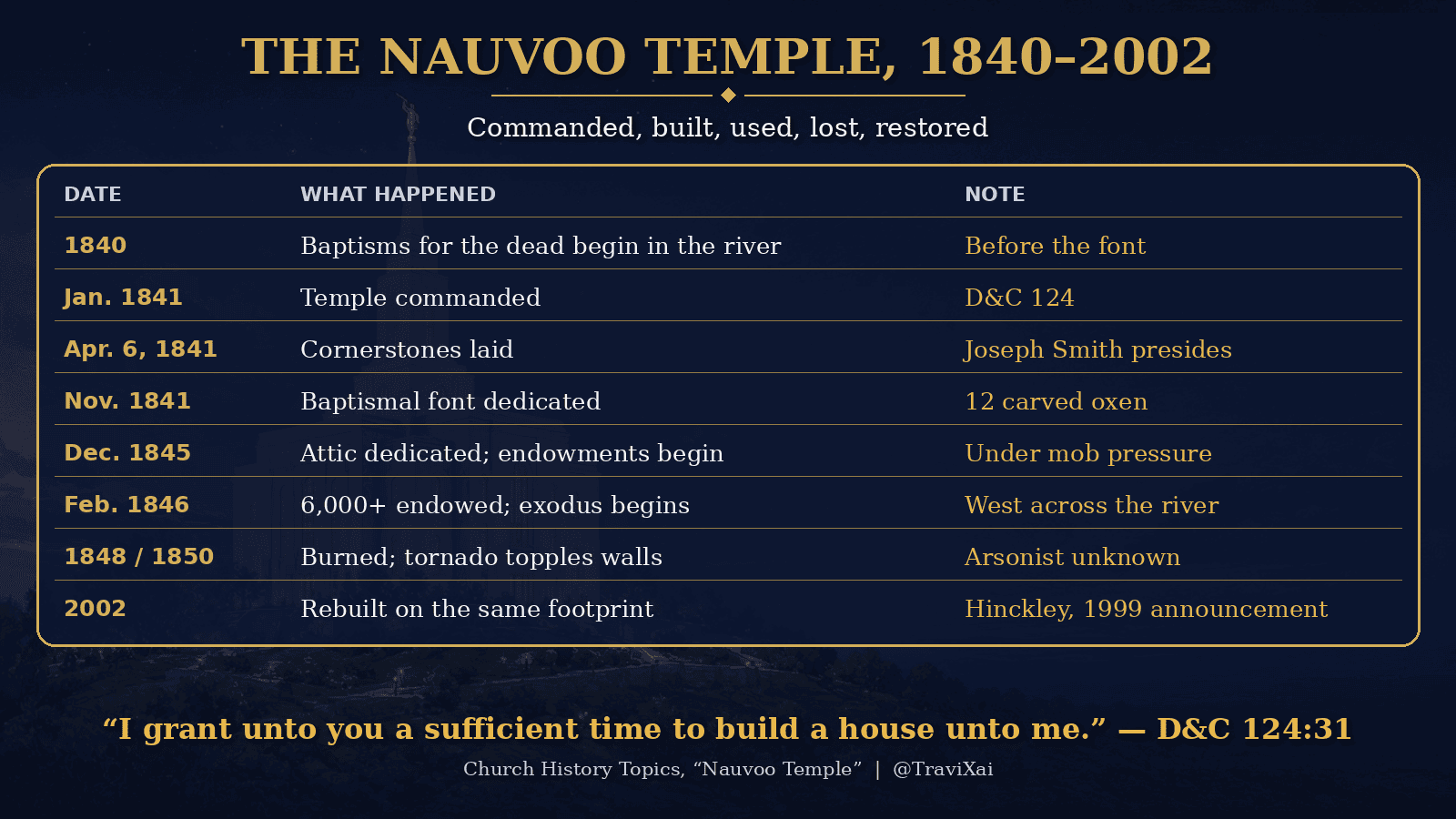
The Saints had been driven out of Missouri before they could build the temples they planned at Independence, Far West and Adam-ondi-Ahman. They settled at Commerce, Illinois, in 1839, renamed it Nauvoo, and secured land for a temple in 1840. In January 1841 the revelation now in Doctrine and Covenants 124 commanded the building. Cornerstones were laid on April 6, 1841. See What Is the Kirtland Temple? and Why Did the Saints Settle in Utah?.
How it was builtOne day in ten
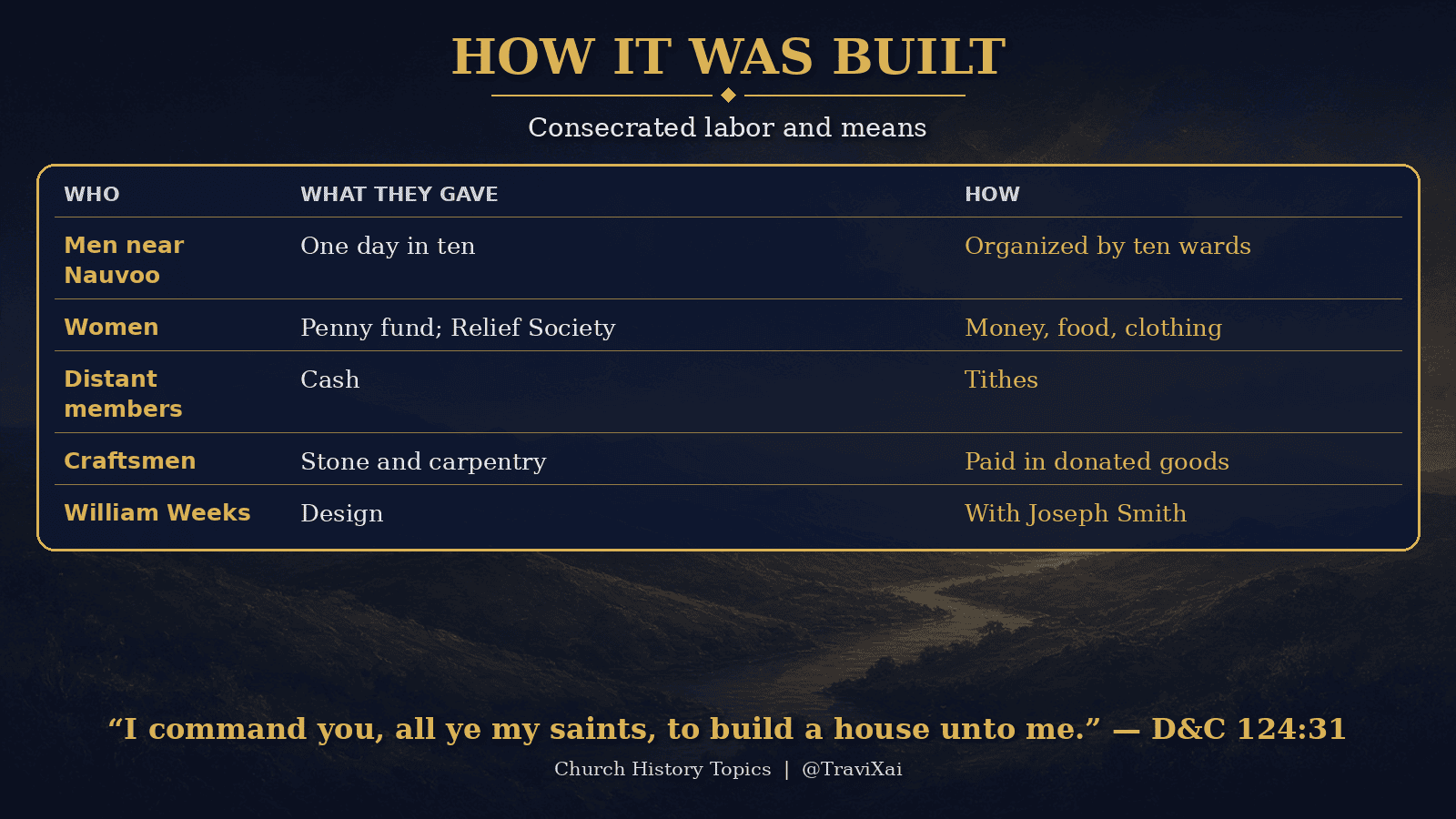
At the October 1840 conference Joseph Smith announced that the temple would be built by the tithes of the members. Men in and near Nauvoo quarried and hauled limestone, and the city was divided into ten wards so that each man could give one day’s labor in ten. That is where Latter-day Saint wards began. Women gave through a penny fund, and the Relief Society was organized in 1842 partly to help build the temple. Members farther away sent money. Skilled stonecutters and carpenters were paid in donated goods. Paying tithing became part of being worthy to use the font and receive the endowment. See What Is the Relief Society? and Why Do Latter-day Saints Pay Tithing?.
The architect, William Weeks, worked with Joseph Smith on a design carved with sunstones, moonstones and starstones, symbols of Joseph Smith’s temple-related teachings and revelations. The building was roughly 128 by 88 feet with a tower above the west end. In the basement, a baptismal font rested on the backs of twelve carved oxen. Brigham Young dedicated it on November 8, 1841, and baptisms for the dead moved there from the river.
What happened insideThe temple’s purpose grew
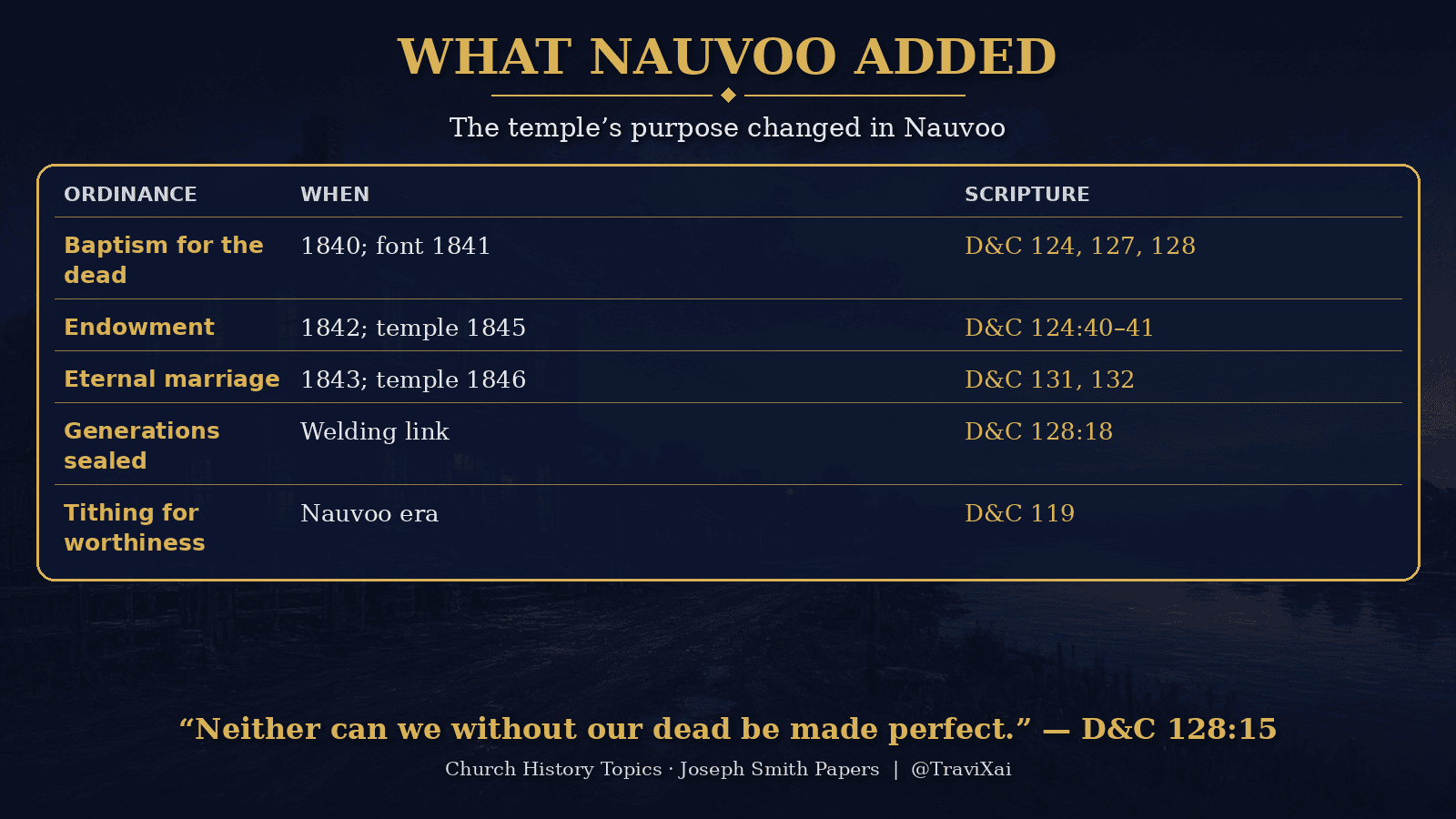
While the walls went up, Joseph Smith revealed and taught the ordinances the building was meant to hold. He taught baptism for the dead in 1840, and the Saints at first did it in the Mississippi. He first gave the endowment to a small group in 1842, in the upper room of his store, and taught eternal marriage. The Lord said the font belonged in His house and that the river baptisms were accepted only “in the days of your poverty” and for “a sufficient time” while the house was built (D&C 124:30–31). Joseph did not live to see the temple used for the endowment. He was killed at Carthage in June 1844. See Carthage: Like a Lamb to the Slaughter.
In the fall of 1845 mobs were burning outlying Latter-day Saint homes, and the state made clear the Saints had to leave. They kept building anyway. The attic was dedicated in December 1845 and endowments and sealings began. Brigham Young and the Twelve worked in the temple nearly day and night. By early February 1846, more than 6,000 Latter-day Saints had been endowed. Sarah Pea Rich later said that without “the faith and knowledge that was bestowed upon us in that Temple,” crossing the plains “would have been like one taking a leap in the dark.” The whole building was dedicated on May 1, 1846, after most of the Saints had already left. See What Happens in a Latter-day Saint Temple?.
Lost and rebuiltFire, wind, and a resurrection
The Church tried to sell the abandoned temple to fund the move west and could not find a buyer at a workable price. On October 9, 1848, an arsonist set it on fire; by morning only the stone walls stood. Who did it was never established. The Icarians, a French communal group, bought the shell to rebuild it as a school, and on May 27, 1850, a tornado knocked down the north wall. The remaining walls were taken down for safety and the stone was carried off for other buildings.
The Church began buying back the temple block in 1937. At the April 1999 general conference President Gordon B. Hinckley announced the temple would be rebuilt. The Nauvoo Illinois Temple, built on the original footprint with an exterior matched to drawings and photographs of the first one, was dedicated in June 2002. At the cornerstone ceremony President Boyd K. Packer said the temple “in effect, was dead. … But now, this day, it has come to a resurrection.”
The BibleBaptized for the dead
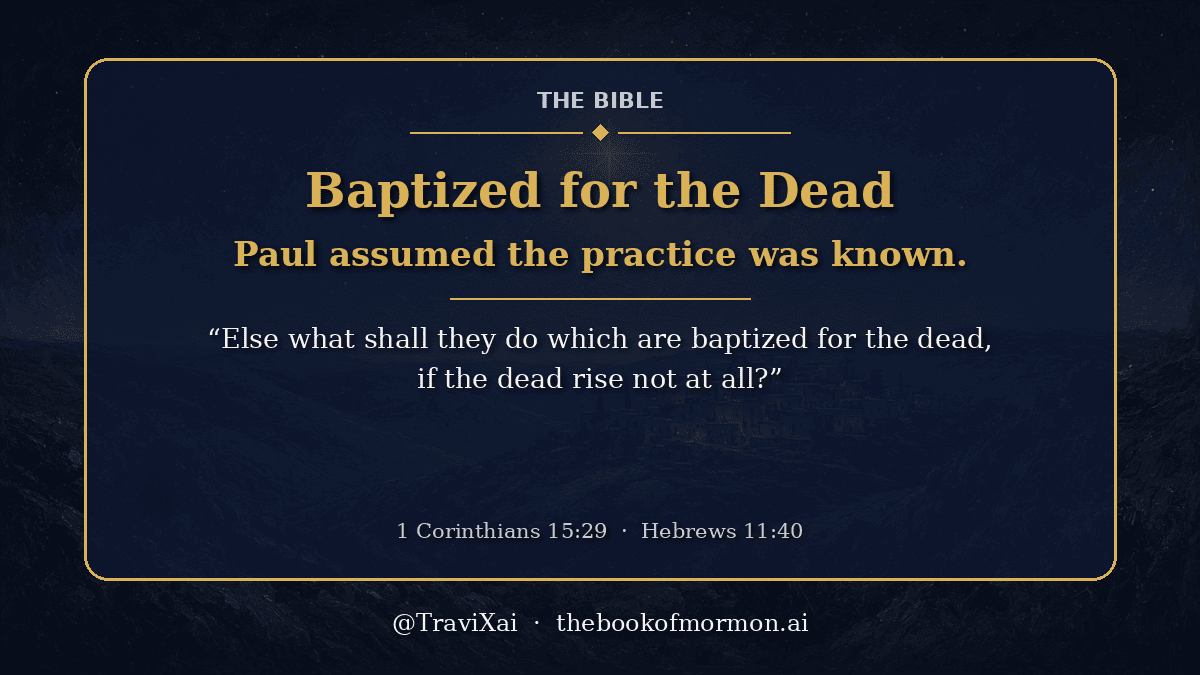
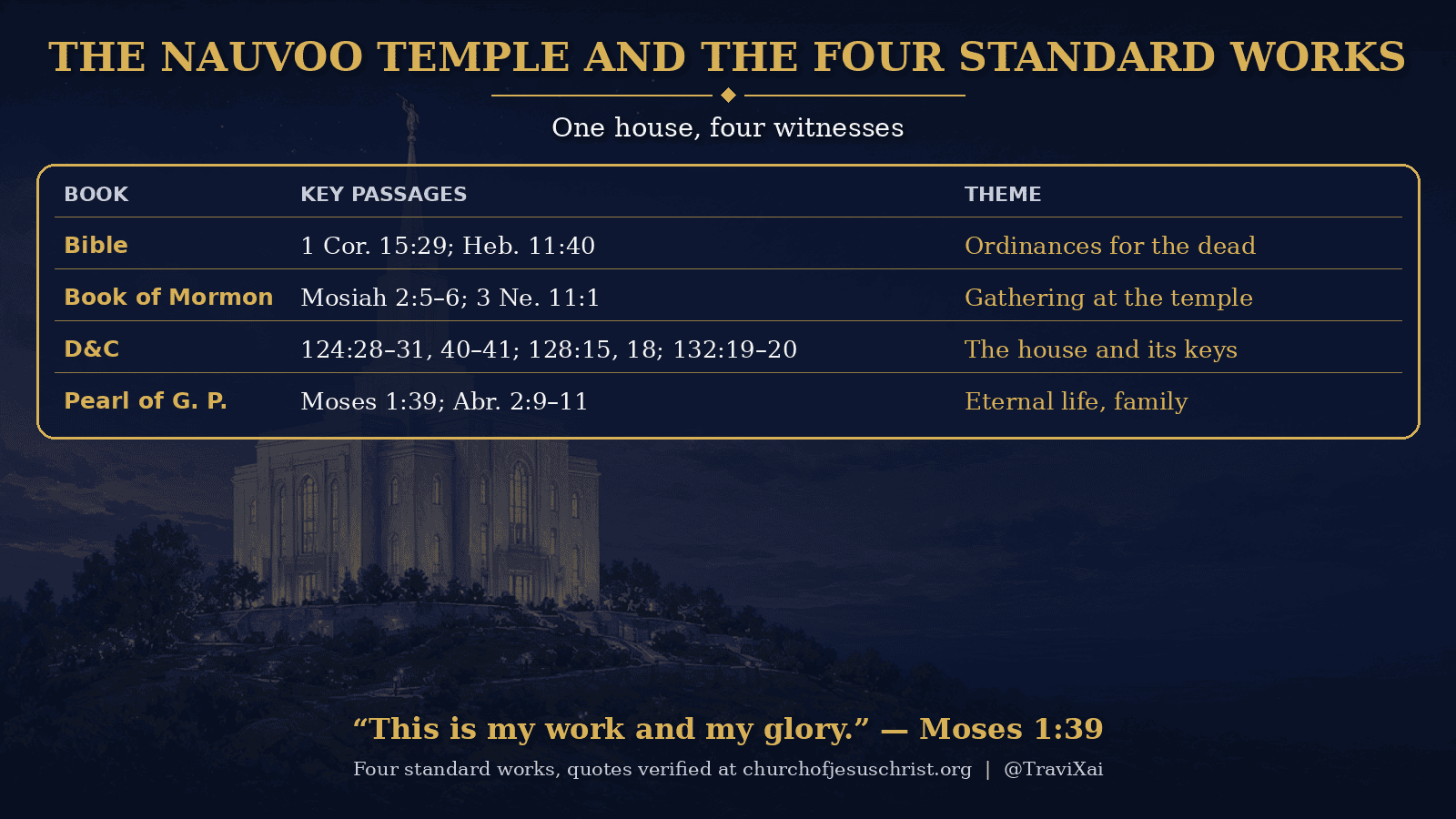
Critics call proxy baptism a Mormon invention. Paul used it as an argument for the resurrection: “Else what shall they do which are baptized for the dead, if the dead rise not at all? why are they then baptized for the dead?” (1 Corinthians 15:29). You can debate who “they” were. You cannot pretend the verse is not there, or that Paul condemned the practice. He used it as evidence.
Hebrews ends its list of the faithful dead with this: “God having provided some better thing for us, that they without us should not be made perfect” (Hebrews 11:40). Joseph Smith quoted that verse when he wrote to the Saints about the font. See Why Do Latter-day Saints Do Family History?.
The Book of MormonA people gathered at the temple
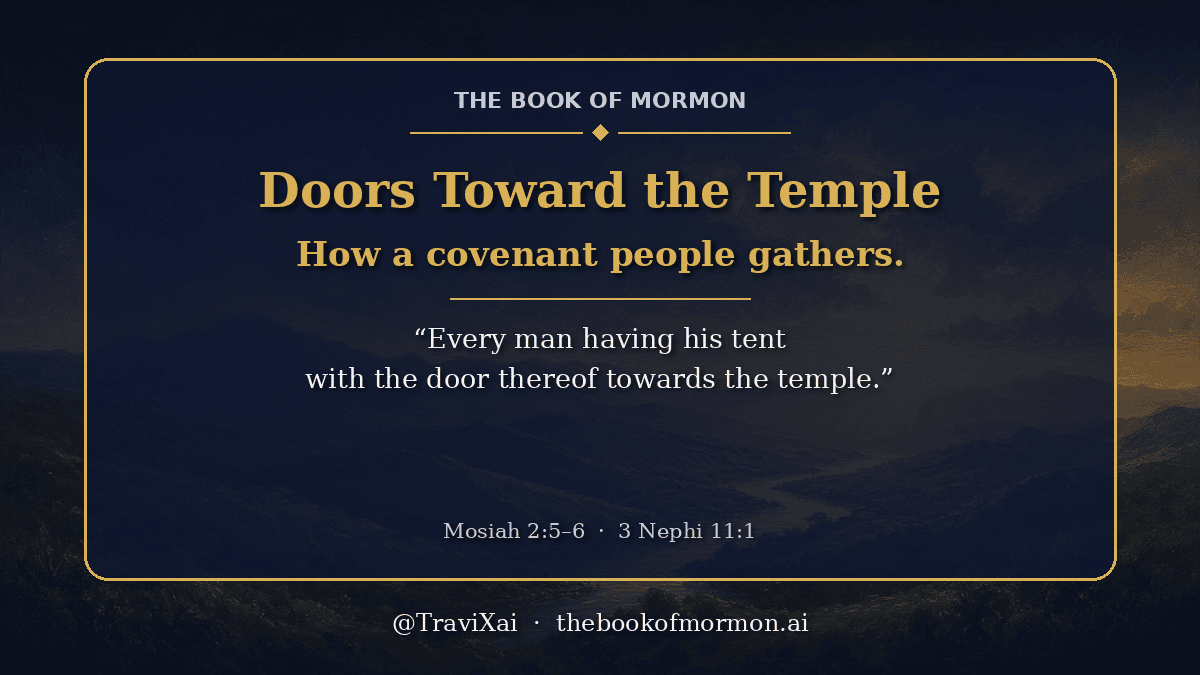
The Nauvoo Saints pitched their lives around a temple the way King Benjamin’s people did: “they pitched their tents round about the temple, every man having his tent with the door thereof towards the temple, that thereby they might remain in their tents and hear the words which king Benjamin should speak unto them” (Mosiah 2:6). They came “every man according to his family,” from “the eldest down to the youngest” (Mosiah 2:5). Families, generations, the temple at the center. That is Nauvoo.
When the resurrected Christ came to the Nephites, the crowd was “gathered together … round about the temple which was in the land Bountiful” (3 Nephi 11:1). The Book of Mormon places its high point at a temple. See Is the Book of Mormon True?.
The Doctrine and CovenantsWhy the Lord wanted the house
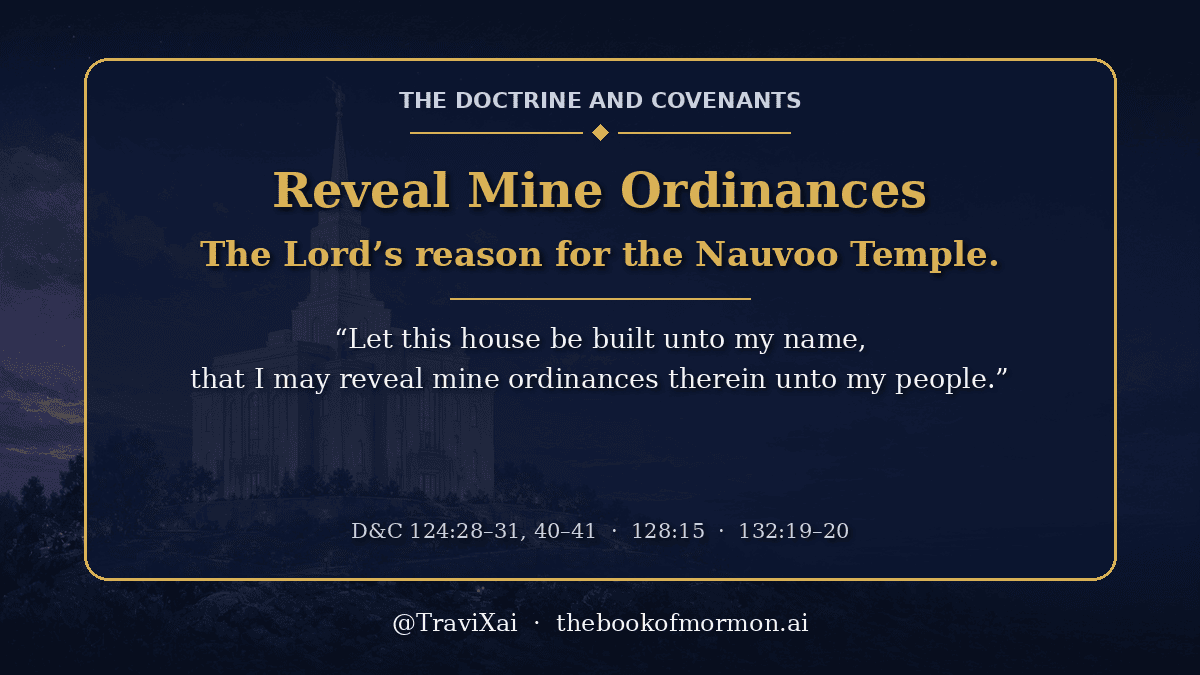
The reason is stated plainly: “For there is not a place found on earth that he may come to and restore again that which was lost unto you, or which he hath taken away, even the fulness of the priesthood. For a baptismal font there is not upon the earth, that they, my saints, may be baptized for those who are dead” (D&C 124:28–29). And: “let this house be built unto my name, that I may reveal mine ordinances therein unto my people; For I deign to reveal unto my church things which have been kept hid from before the foundation of the world” (D&C 124:40–41).
Joseph explained why it mattered so much: “their salvation is necessary and essential to our salvation, as Paul says concerning the fathers—that they without us cannot be made perfect—neither can we without our dead be made perfect” (D&C 128:15). He called it “a welding link of some kind or other between the fathers and the children” (D&C 128:18).
And the endpoint of the sealing ordinances is not a pleasant afterlife. Of a couple sealed by proper authority who keep the covenant: “Then shall they be gods, because they have no end” (D&C 132:20). That is exaltation and eternal increase, the same course our Father in Heaven walked, with Him always our Father and always above us. See What Is Eternal Marriage? and Was God Once a Man?.
The Pearl of Great PriceThe work and the glory
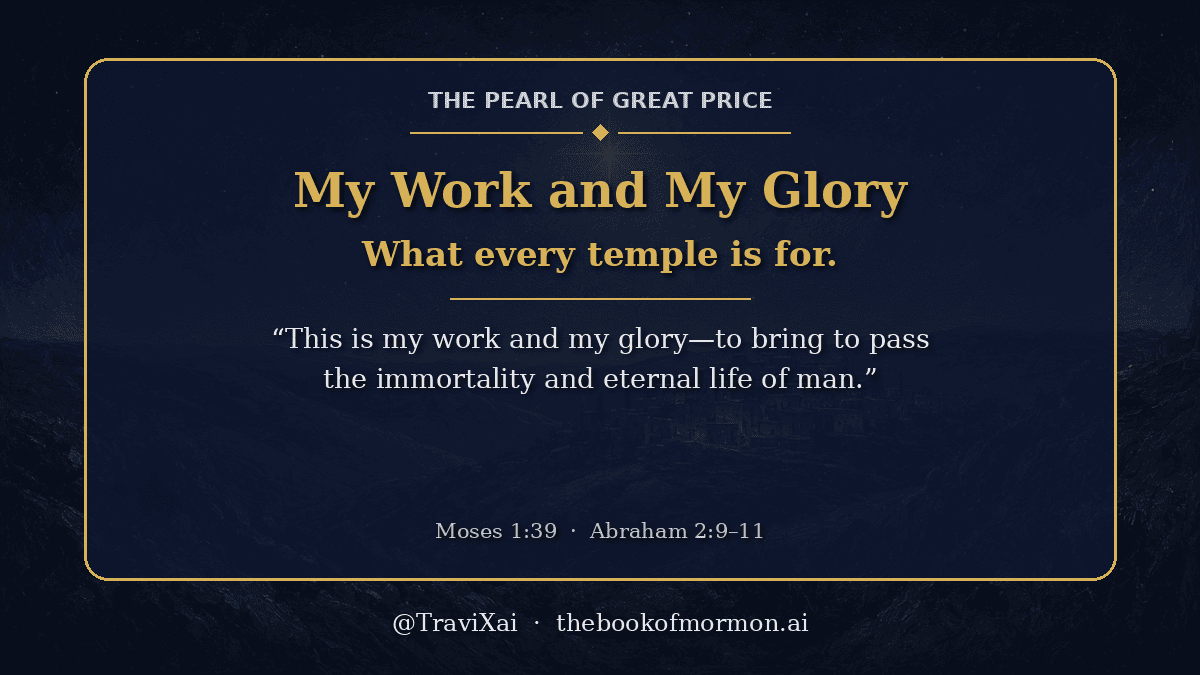
Every temple exists for one purpose the Lord stated to Moses: “For behold, this is my work and my glory—to bring to pass the immortality and eternal life of man” (Moses 1:39). The covenant with Abraham reaches every family: “as many as receive this Gospel shall be called after thy name, and shall be accounted thy seed,” and through his seed “shall all the families of the earth be blessed, even with the blessings of the Gospel, which are the blessings of salvation, even of life eternal” (Abraham 2:10–11). All the families of the earth includes the ones already dead. That is why Nauvoo built a font before it finished the roof. See What Is the Pearl of Great Price?.
Check the premiseThe presuppositions baked into the question
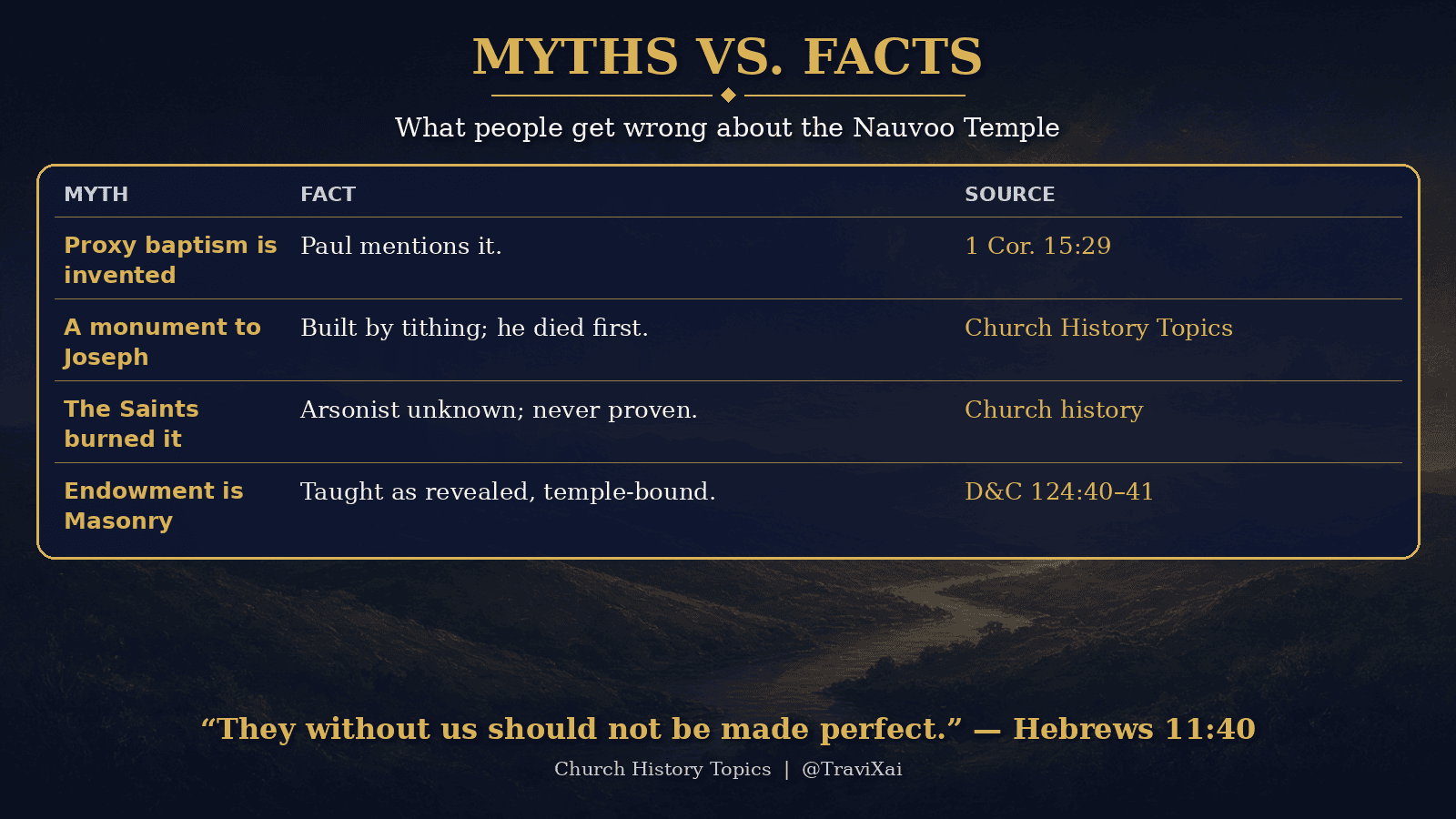
Before this question can be answered fairly, the person asking has to justify a few assumptions packed inside it:
- That baptism for the dead is a Latter-day Saint invention. Paul cites it in 1 Corinthians 15:29 as evidence for the resurrection, without condemning it.
- That the temple was a monument to Joseph Smith. It was built by the Saints’ tithing labor at the Lord’s command (D&C 124), and Joseph was killed a year and a half before it was used for the endowment.
- That the Saints burned it themselves on the way out. The arsonist is unknown. The Saints had been trying to sell it, and the charge was never proven.
- That temple ordinances are optional extras. D&C 128:15 says “neither can we without our dead be made perfect,” and D&C 132 ties exaltation to the sealing ordinances.
FAQQuick answers
What was the Nauvoo Temple?
The temple Latter-day Saints built in Nauvoo, Illinois, from 1841 to 1846, the first built for baptism for the dead, the endowment and eternal marriage.
When was the Nauvoo Temple built?
Cornerstones were laid April 6, 1841. The attic was dedicated in December 1845 and the whole building on May 1, 1846.
How was the Nauvoo Temple paid for?
By tithing: men gave one day’s labor in ten, women gave through a penny fund, and distant members sent money.
How many people received the endowment in the Nauvoo Temple?
More than 6,000 Latter-day Saints by early February 1846, before the exodus west.
What happened to the original Nauvoo Temple?
An unknown arsonist burned it on October 9, 1848, and a tornado toppled its walls on May 27, 1850.
When was the Nauvoo Temple rebuilt?
President Gordon B. Hinckley announced it in April 1999, and the Nauvoo Illinois Temple was dedicated in June 2002 on the original footprint.
Is baptism for the dead in the Bible?
Yes. Paul mentions it in 1 Corinthians 15:29 as part of his argument for the resurrection.
Why did the Nauvoo Temple have twelve oxen?
The baptismal font rested on twelve carved oxen, a design echoing the molten sea of Solomon’s temple in 1 Kings 7.
SummaryKey takeaways
- Commanded in D&C 124 (1841); cornerstones laid April 6, 1841.
- Built by tithing labor: one day in ten, organized by the first wards.
- First temple built for baptism for the dead, the endowment and sealings.
- More than 6,000 endowed before the exodus; dedicated May 1, 1846.
- Burned 1848, toppled 1850, rebuilt and dedicated 2002.
Go do a family name in the temple this month. For quick, sourced answers, open Galatians18, and follow me on X at @TraviXai.
Sources
- King James Bible (churchofjesuschrist.org): 1 Corinthians 15:29 · Hebrews 11:40
- Book of Mormon: Mosiah 2:5–6 · 3 Nephi 11:1
- Doctrine and Covenants: D&C 124:28–31 · D&C 124:40–41 · D&C 128:15 · D&C 128:18 · D&C 132:19–20
- Pearl of Great Price: Moses 1:39 · Abraham 2:9–11
- Church History Topics, “Nauvoo Temple” · Ensign, “Nauvoo Temple Milestones, 1840–1850” (July 2002)
- Church History Museum, “The Nauvoo Temple: Destruction and Rebirth” · Matthew S. McBride, A House for the Most High (Greg Kofford Books, 2006)
- Featured image and in-article graphic: original graphics by thebookofmormon.ai (painterly backgrounds; no photographs or likenesses of real people).