
The SEC found 13 shell companies and fined the Church and its investment manager $5 million. Here is what that means, what it does not, and what the scriptures say about a storehouse.
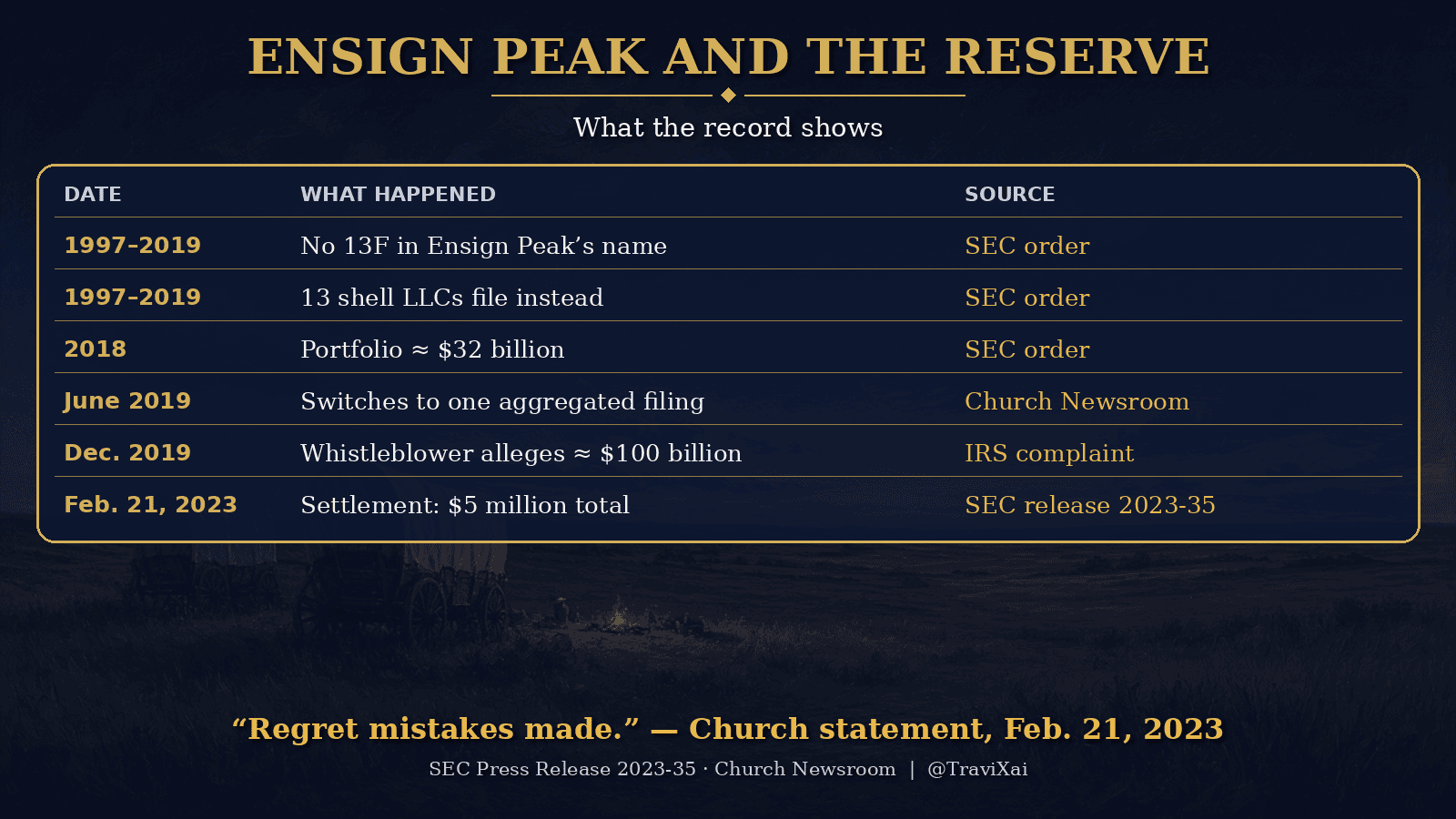
The question often assumes that a wealthy church must be a corrupt one. That doesn’t follow, but the hard facts deserve a straight telling. The Church does not publish a total. The SEC says its stock portfolio, managed by Ensign Peak Advisers, reached about $32 billion by 2018; a 2019 whistleblower alleged about $100 billion overall. In 2023 the SEC found Ensign Peak had used 13 shell LLCs to obscure the portfolio; Ensign Peak paid $4 million and the Church $1 million. The Church reports $1.45 billion in welfare and humanitarian spending for 2024.
The short answerTens of billions, and nobody outside knows the exact total
Nobody outside the Church knows the exact figure, because the Church does not publish a full balance sheet. Here is what is on the public record. The SEC’s 2023 order says the Church’s investment portfolio, managed by Ensign Peak Advisers, “by 2018 grew to approximately $32 billion” in the equities it should have reported. A 2019 whistleblower complaint alleged that Ensign Peak held roughly $100 billion in total. Since mid-2019 Ensign Peak has filed one public quarterly Form 13F, so anyone can see its U.S. stock holdings. On top of that the Church owns meetinghouses, temples, farms, commercial real estate and businesses held through separate entities. The Church describes all of it as a reserve that exists “for no other reason than to support the Church’s divinely appointed mission.”
The 2019 whistleblowerWhat David Nielsen alleged
In December 2019 The Washington Post reported that David A. Nielsen, a former Ensign Peak portfolio manager, had filed a complaint with the IRS. He alleged the fund held between $99 billion and $101 billion. He argued the Church should owe taxes on the returns because the money was not being spent on charity, and he challenged two payments: about $600 million to support Beneficial Life, a Church-owned insurer, during the 2008–09 financial crisis, and about $1.4 billion connected to the City Creek development in Salt Lake City. He sought a whistleblower reward. No public IRS action has followed.
The First Presidency answered on December 17, 2019: “The vast majority of these funds are used immediately to meet the needs of the growing Church including more meetinghouses, temples, education, humanitarian work and missionary efforts throughout the world. Over many years, a portion is methodically safeguarded through wise financial management and the building of a prudent reserve for the future.” It added that “the Church complies with all applicable law governing our donations, investments, taxes, and reserves.”
The 2023 SEC settlementWhat the SEC actually found
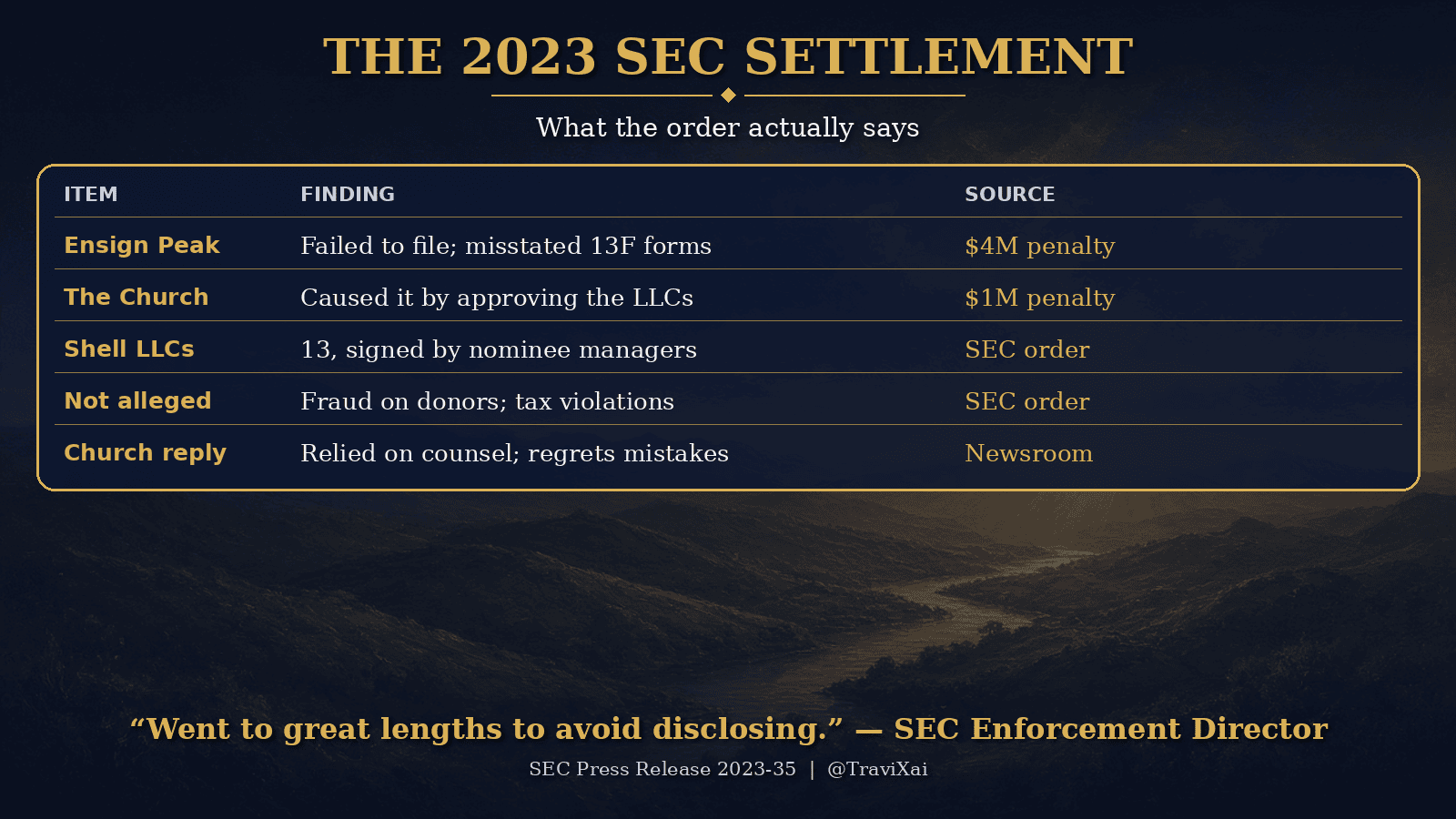
This is the part to get exactly right. On February 21, 2023, the SEC charged Ensign Peak Advisers and the Church. The order found that from 1997 through 2019 Ensign Peak failed to file Forms 13F, the quarterly forms large investment managers must file to disclose their stock holdings. In the SEC’s words, the Church “was concerned that disclosure of its portfolio … would lead to negative consequences,” and “to obscure the amount of the Church’s portfolio, and with the Church’s knowledge and approval, Ensign Peak created thirteen shell LLCs.” Those LLCs filed in their own names, signed by nominee “business managers,” most of them Church employees. The filings stated that the LLCs controlled the investments. The SEC found that Ensign Peak controlled them all.
The penalty: Ensign Peak agreed to pay $4 million and the Church $1 million, $5 million in total. Ensign Peak settled a violation of Section 13(f) of the Securities Exchange Act; the Church settled the allegation that it caused Ensign Peak’s violation. They settled without admitting or denying the findings. The Church’s statement said Ensign Peak had “received and relied upon legal counsel” since 2000, believed all required securities were included across the separate filings, changed to a single aggregated report in June 2019 when the SEC raised concerns, and filed 13 compliant quarterly reports after that. Its conclusion: “We affirm our commitment to comply with the law, regret mistakes made, and now consider this matter closed.”
The honest assessment: this was a real violation, and the SEC’s description is not flattering. Splitting one portfolio across 13 shell companies so outsiders could not see its size was a deliberate choice to keep the total private, and the forms misstated who controlled the money. Relying on lawyers explains it; it does not make it right, and the Church said it regretted the mistakes. Notice also what the SEC did not find. The order is about how stock holdings were reported. It does not charge fraud on donors, misuse of tithing or any tax violation. Critics who describe it as proof that tithing was stolen are claiming more than the SEC did.
What the Church givesThe official numbers
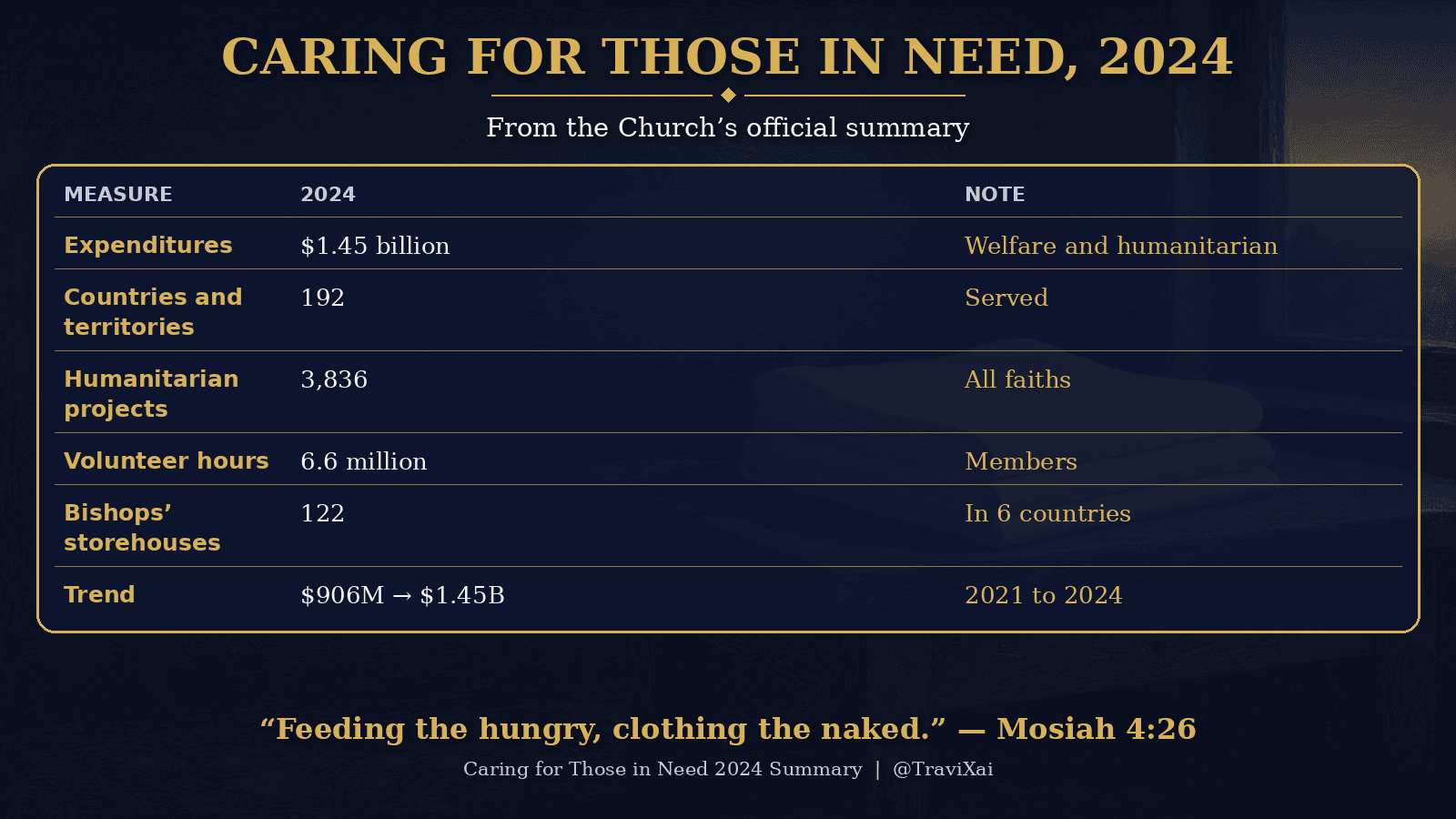
The Church’s official “Caring for Those in Need” summary for 2024 reports $1.45 billion in welfare and humanitarian expenditures, in 192 countries and territories, with 3,836 humanitarian projects and 6.6 million volunteer hours. It runs 122 bishops’ storehouses in six countries, and in 2024 donated more than 39 million pounds of food through food banks and charities. The figure has grown each year it has been published: $906 million in 2021, $1.02 billion in 2022, $1.36 billion in 2023. It does not include what the Church spends on education, meetinghouses, temples and missionary work, or what members give and do on their own. See Why Do Latter-day Saints Fast? and Why Do Latter-day Saints Pay Tithing?.
Critics compare $1.45 billion to a reserve of $100 billion or more and conclude the Church gives too little. That is a fair debate to have about proportion. It is not evidence of corruption, and it leaves out that a reserve is meant to be held, not spent in one year. Joseph stored grain for seven years before he gave any of it out.
The BibleJoseph’s seven years
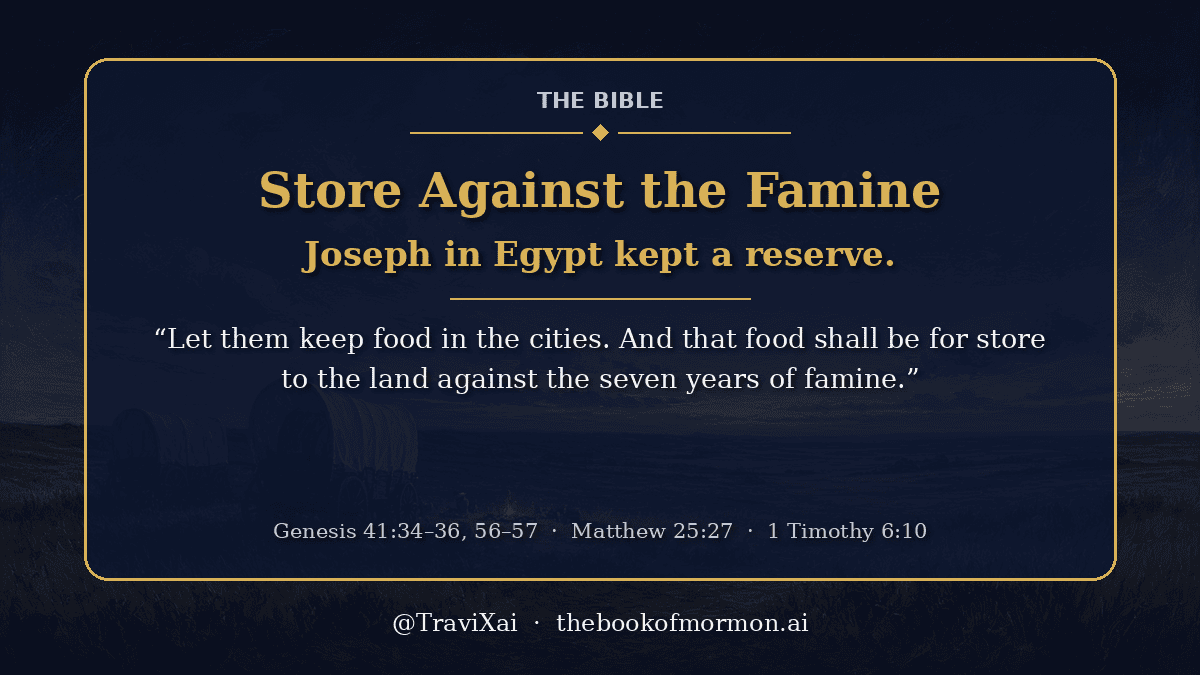
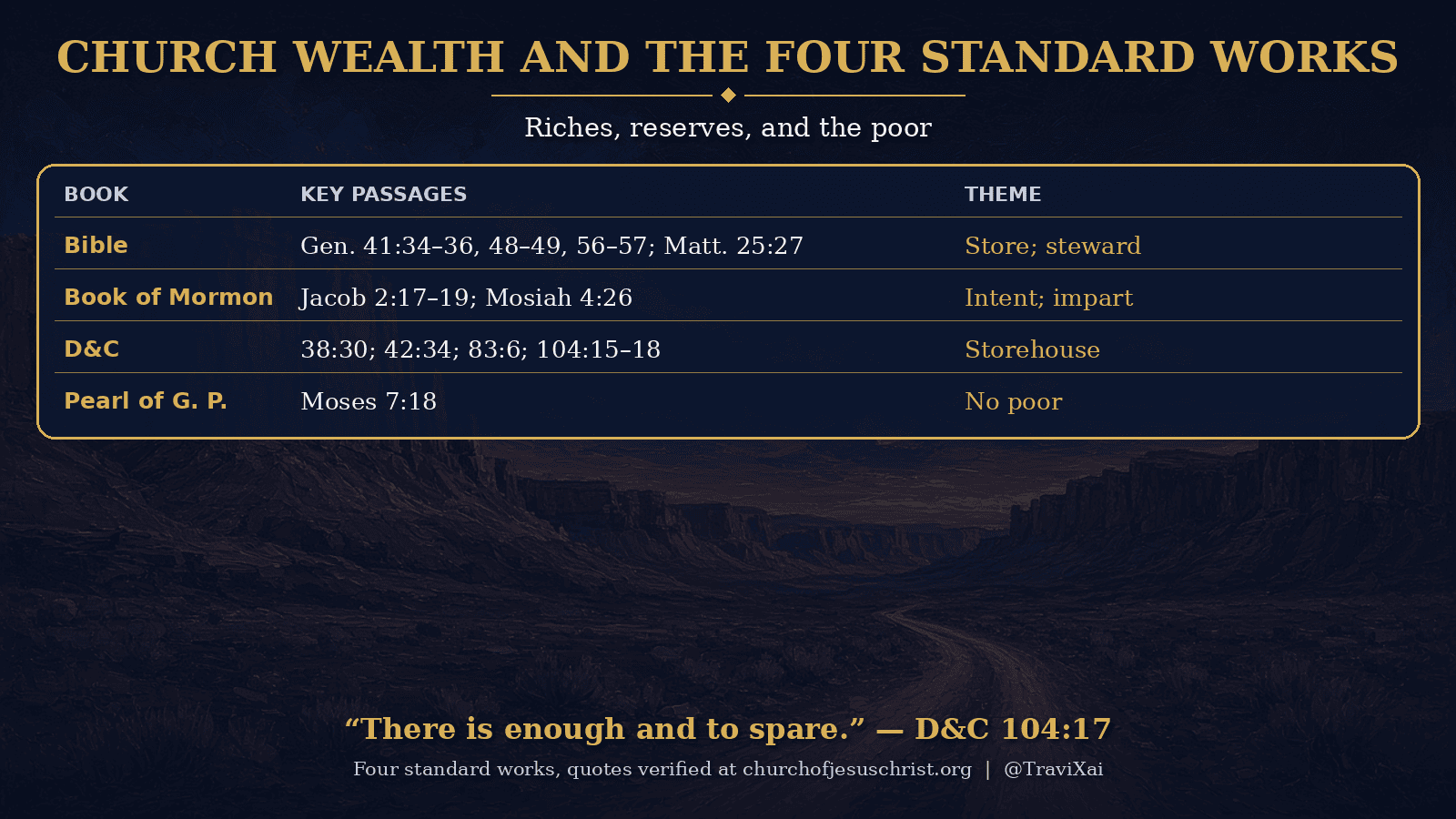
The Bible’s clearest example of a godly reserve is Joseph in Egypt. Joseph advised Pharaoh to “take up the fifth part of the land of Egypt in the seven plenteous years. And let them gather all the food of those good years … and that food shall be for store to the land against the seven years of famine, which shall be in the land of Egypt; that the land perish not through the famine” (Genesis 41:34–36). He did, “until he left numbering; for it was without number” (Genesis 41:49). Then “the famine was over all the face of the earth: And Joseph opened all the storehouses … And all countries came into Egypt to Joseph for to buy corn” (Genesis 41:56–57). Anyone watching Egypt in year six would have seen an enormous, unexplained hoard. In year eight they would have seen why.
The Savior’s parable of the talents praises investing what the master entrusted: “Thou oughtest therefore to have put my money to the exchangers, and then at my coming I should have received mine own with usury” (Matthew 25:27). And the Bible names the actual sin, which is not money: “the love of money is the root of all evil” (1 Timothy 6:10).
The Book of MormonRiches for the intent to do good
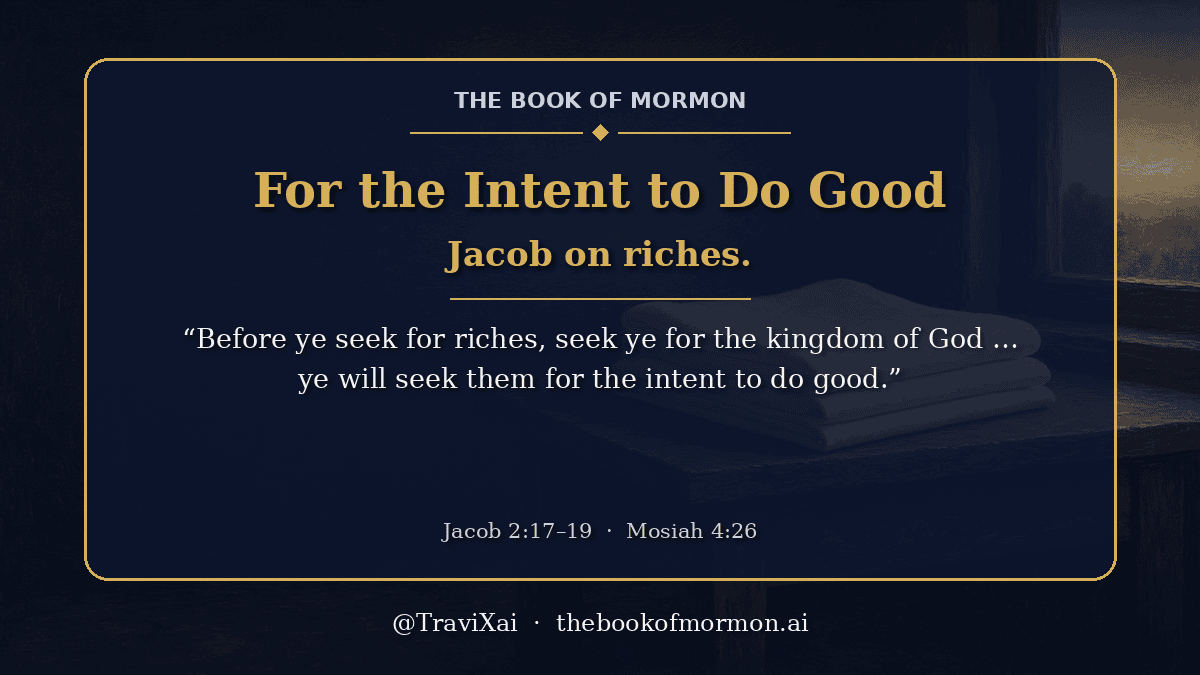
Jacob gives the test for wealth: “Think of your brethren like unto yourselves, and be familiar with all and free with your substance, that they may be rich like unto you. But before ye seek for riches, seek ye for the kingdom of God. And after ye have obtained a hope in Christ ye shall obtain riches, if ye seek them; and ye will seek them for the intent to do good—to clothe the naked, and to feed the hungry, and to liberate the captive, and administer relief to the sick and the afflicted” (Jacob 2:17–19). Wealth is not the accusation. Pride and neglect of the poor are. King Benjamin says the same: “impart of your substance to the poor, every man according to that which he hath” (Mosiah 4:26). Judge the Church by that standard, which is exactly where the welfare numbers belong in the discussion.
The Doctrine and CovenantsThe storehouse and preparation
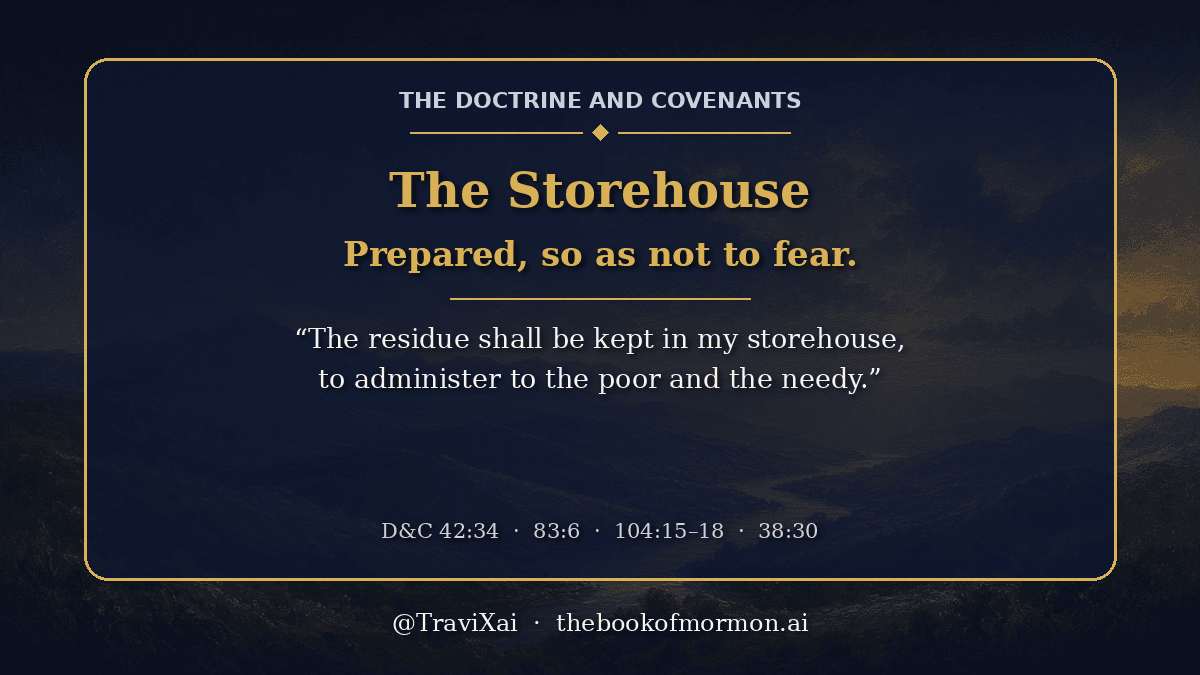
The Lord commanded the Church to keep a storehouse from its earliest years: “the residue shall be kept in my storehouse, to administer to the poor and the needy” (D&C 42:34), and “the storehouse shall be kept by the consecrations of the church; and widows and orphans shall be provided for, as also the poor” (D&C 83:6). He also told the Saints why to prepare: “if ye are prepared ye shall not fear” (D&C 38:30). And He set the standard that judges every rich person and institution: “it is my purpose to provide for my saints, for all things are mine. But it must needs be done in mine own way … For the earth is full, and there is enough and to spare … Therefore, if any man shall take of the abundance which I have made, and impart not his portion … unto the poor and the needy, he shall, with the wicked, lift up his eyes in hell” (D&C 104:15–18). The scripture that commands a storehouse also warns about failing to use it. See What Is the Law of Consecration?.
The Pearl of Great PriceNo poor among them
The goal is Enoch’s city: “And the Lord called his people Zion, because they were of one heart and one mind, and dwelt in righteousness; and there was no poor among them” (Moses 7:18). A Church that tithes, fasts monthly, runs storehouses and holds a reserve against hard times is building toward that. A Church that hoarded for its own sake would be working against it. That is the right question to ask about the money, and the answer depends on how it is used, not on how much there is. See Do LDS Bishops Get Paid?.
Check the premiseThe presuppositions baked into the question
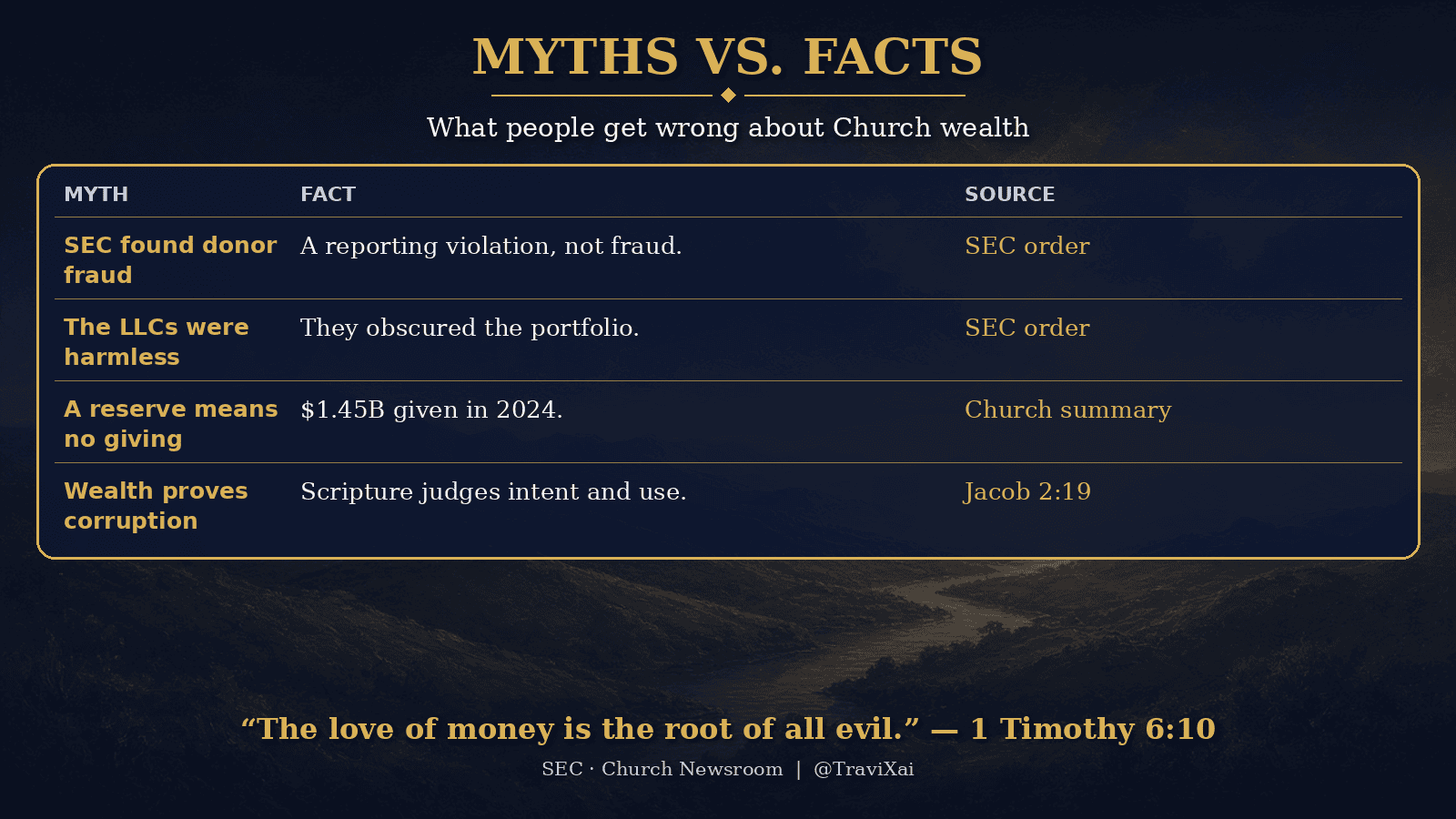
Before this question can be answered fairly, the person asking has to justify a few assumptions packed inside it:
- That great wealth by itself proves corruption. Scripture judges riches by intent and use (Jacob 2:17–19; D&C 104:18). Joseph in Egypt held a reserve “without number” and saved nations with it.
- That the SEC found the Church defrauded its members or misused tithing. The SEC’s order is about how stock holdings were reported on Forms 13F. It does not allege donor fraud or tax violations.
- That the SEC matter was a technicality. It was not. The SEC found 13 shell companies were used, with the Church’s approval, to obscure the portfolio and misstate who controlled it. The Church paid $1 million, Ensign Peak $4 million, and the Church said it regretted the mistakes.
- That holding a reserve means the Church gives nothing away. The Church’s official 2024 summary reports $1.45 billion in welfare and humanitarian spending in 192 countries and territories.
FAQQuick answers
How much is the LDS Church worth?
There is no public total. The SEC said its stock portfolio reached about $32 billion by 2018, and a 2019 whistleblower alleged about $100 billion in its Ensign Peak reserve.
What is Ensign Peak Advisors?
The Church’s affiliated nonprofit investment manager, which manages its reserve funds.
What did the 2019 whistleblower claim?
David Nielsen, a former Ensign Peak manager, told the IRS the fund held about $100 billion and argued it should owe taxes. No public IRS action followed.
What was the SEC settlement in 2023?
The SEC found Ensign Peak failed to properly file Forms 13F from 1997 to 2019 and used 13 shell LLCs to obscure the portfolio. Ensign Peak paid $4 million and the Church $1 million.
Did the SEC say the Church committed fraud?
No. The order concerns disclosure filings, not fraud on donors or tax violations. The Church settled without admitting or denying the findings.
What did the Church say about the SEC settlement?
That it relied on legal counsel, switched to a single filing in June 2019, regretted mistakes made, and considered the matter closed.
How much does the Church give to humanitarian aid?
Its official 2024 summary reports $1.45 billion in welfare and humanitarian expenditures in 192 countries and territories.
Why does the Church keep a reserve?
The First Presidency calls it a prudent reserve for the future, following principles like Joseph’s storehouses in Egypt and the command to be prepared (D&C 38:30).
SummaryKey takeaways
- No public total; the SEC put the stock portfolio at about $32 billion in 2018.
- The 2019 whistleblower alleged about $100 billion; no public IRS action followed.
- 2023 SEC settlement: 13 shell LLCs; Ensign Peak $4 million, the Church $1 million.
- The order concerns disclosure, not donor fraud or taxes; the Church said it regretted the mistakes.
- 2024 welfare and humanitarian spending: $1.45 billion in 192 countries and territories.
Read Jacob 2:17–19 and apply the same test to your own money. For quick, sourced answers, open Galatians18, and follow me on X at @TraviXai.
Sources
- King James Bible (churchofjesuschrist.org): Genesis 41:34–36 · Genesis 41:48–49 · Genesis 41:56–57 · Matthew 25:27 · 1 Timothy 6:10
- Book of Mormon: Jacob 2:17–19 · Mosiah 4:26
- Doctrine and Covenants: D&C 38:30 · D&C 42:34 · D&C 83:6 · D&C 104:15–18
- Pearl of Great Price: Moses 7:18
- SEC Press Release 2023-35 (Feb. 21, 2023) · Church Newsroom, “Church Issues Statement on SEC Settlement”
- First Presidency Statement on Church Finances (Dec. 17, 2019) · Caring for Those in Need 2024 Summary · Deseret News, Dec. 17, 2019, and Mar. 25, 2025
- Featured image and in-article graphic: original graphics by thebookofmormon.ai (painterly backgrounds; no photographs or likenesses of real people).