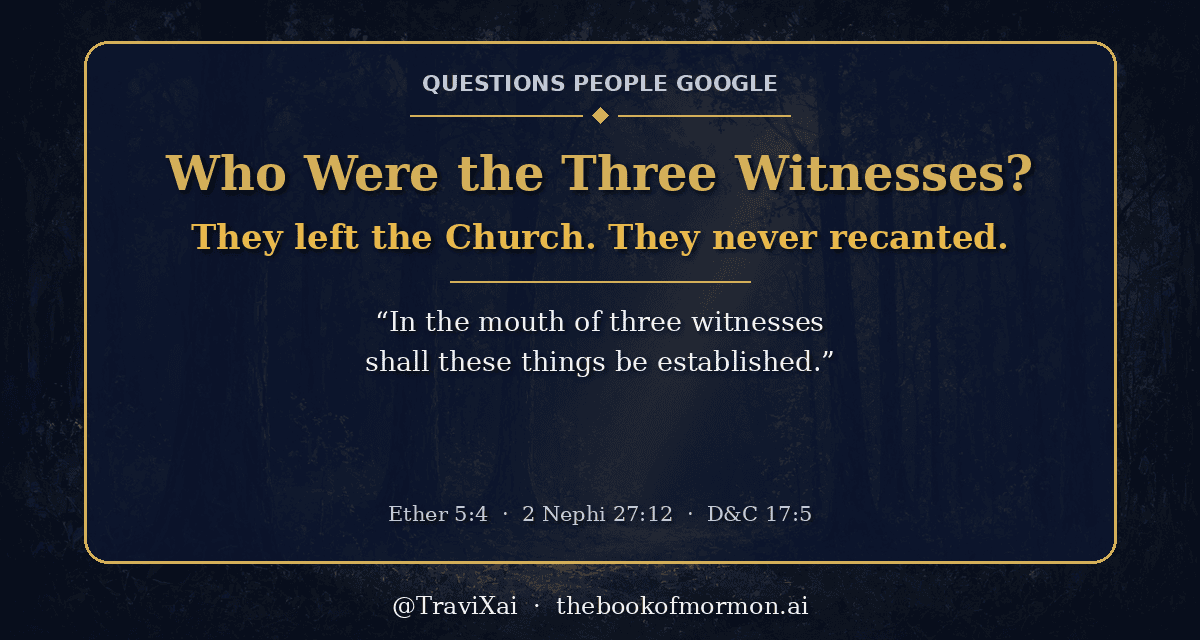

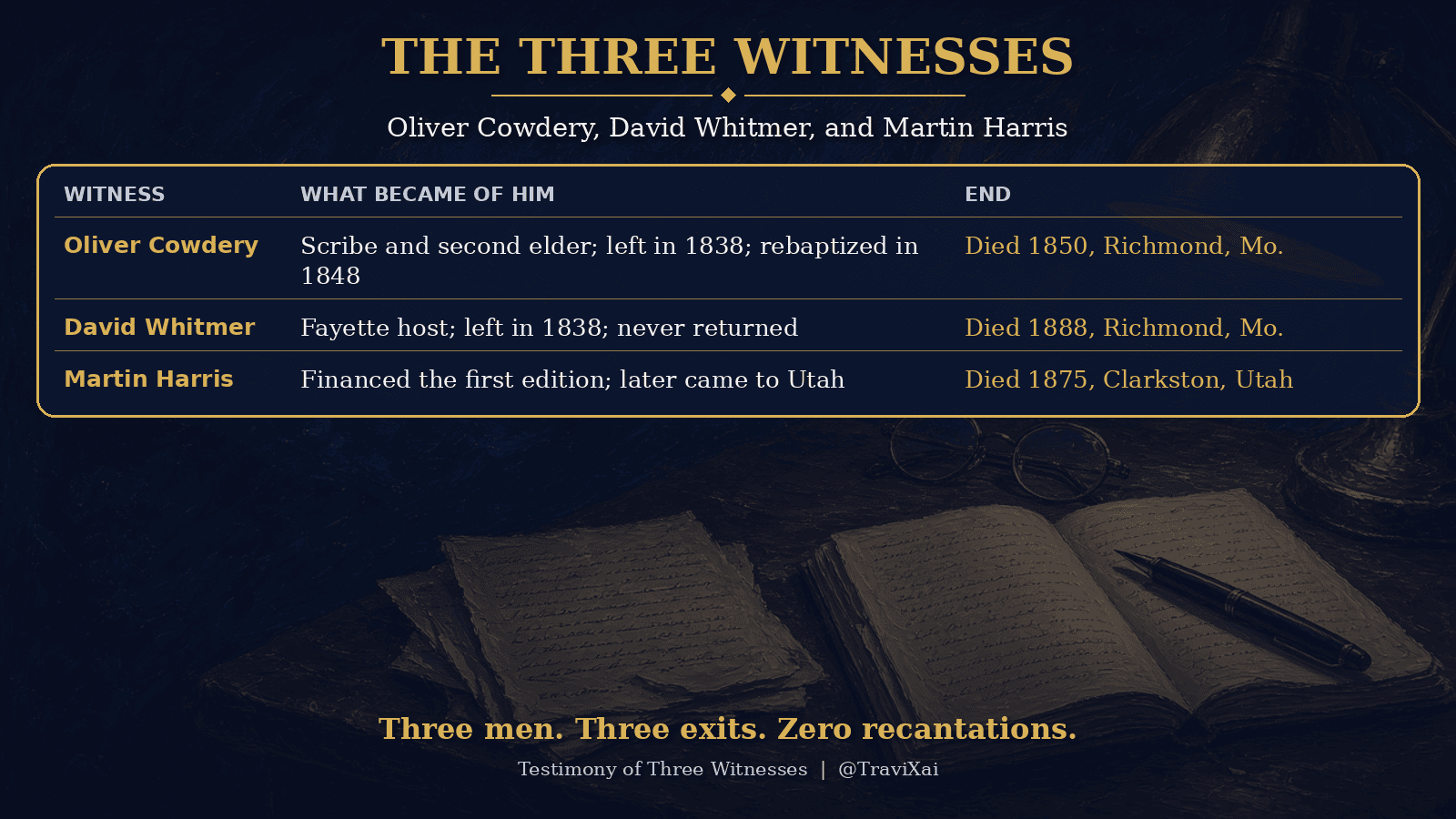
Oliver Cowdery, David Whitmer, and Martin Harris saw the plates in 1829, then went their separate ways. None of them recanted. The break is the evidence, not the escape hatch.
The Three Witnesses were Oliver Cowdery, David Whitmer, and Martin Harris. In June 1829, near the Whitmer home in Fayette, New York, they testified that an angel showed them the gold plates and that the voice of God declared the translation true. Their statement has been printed in the Book of Mormon since 1830. All three later left the Church. Oliver and Martin returned; David did not. None recanted. As President Dallin H. Oaks put it, they had “ample reason and opportunity to renounce” the testimony if it had been false, and “not one of these witnesses deviated from his published testimony.”
Who they wereThree names, one printed testimony
The Three Witnesses of the Book of Mormon are Oliver Cowdery, David Whitmer, and Martin Harris. In June 1829, near the Peter Whitmer Sr. home in Fayette, New York, they testified that an angel of God showed them the gold plates and that the voice of the Lord declared Joseph Smith’s translation had been done “by the gift and power of God.” Their signed statement, the Testimony of Three Witnesses, has been printed with the Book of Mormon since the first edition in 1830. Church History Topics summarizes that event in those terms, and the statement is still in the book. See Who Was Oliver Cowdery?, Who Was David Whitmer?, and Who Was Martin Harris?.
They were not a matched set. Oliver was the principal scribe and the second elder of the Church. David’s family hosted the end of the translation, and he was later president of the Church in Missouri. Martin was the Palmyra farmer who mortgaged his land to pay E. B. Grandin for the first edition. All three later left the Church. Oliver and Martin came back. David did not. None of them recanted the published testimony. That pattern is the argument. It is also the part most casual dismissals leave out.
The book required them firstEther, Nephi, and the law of witnesses
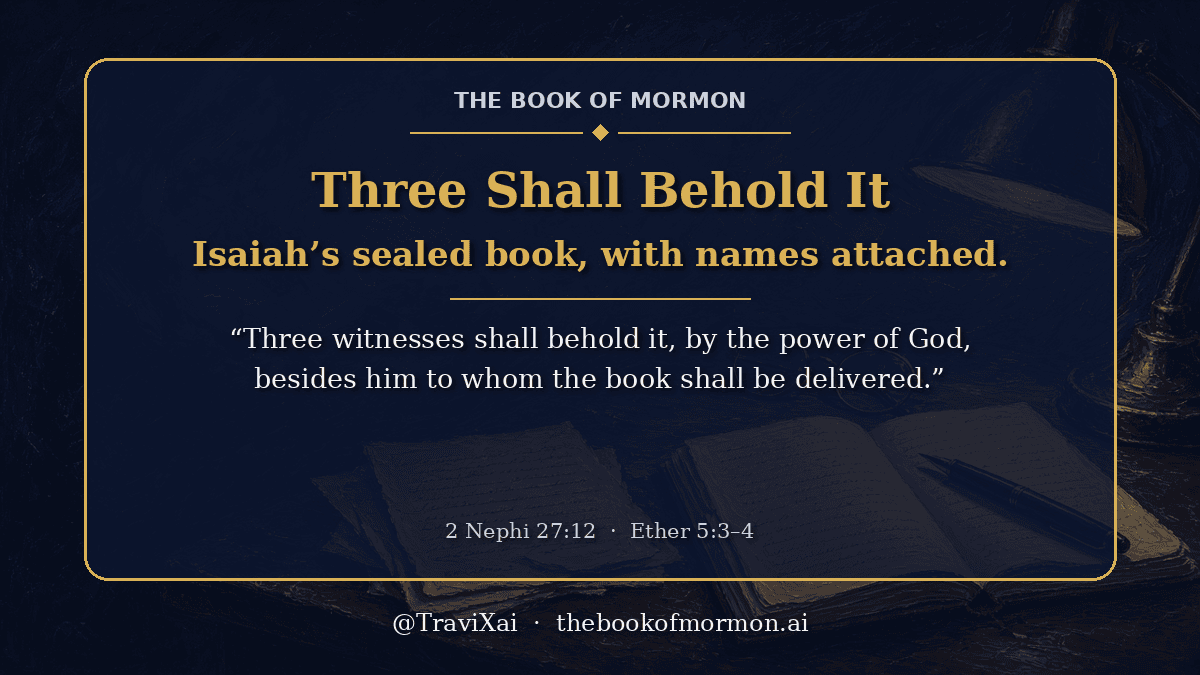
This was not an afterthought invented to quiet critics. The book itself demanded it. “Unto three shall they be shown by the power of God; wherefore they shall know of a surety that these things are true. And in the mouth of three witnesses shall these things be established” (Ether 5:3–4). Nephi had already said the book would be “hid from the eyes of the world, that the eyes of none shall behold it save it be that three witnesses shall behold it, by the power of God, besides him to whom the book shall be delivered; and they shall testify to the truth of the book and the things therein” (2 Nephi 27:12). He also wrote, “by the words of three, God hath said, I will establish my word. Nevertheless, God sendeth more witnesses, and he proveth all his words” (2 Nephi 11:3). The “more witnesses” are the Eight, treated in a companion essay. The three come first because the book said they would.
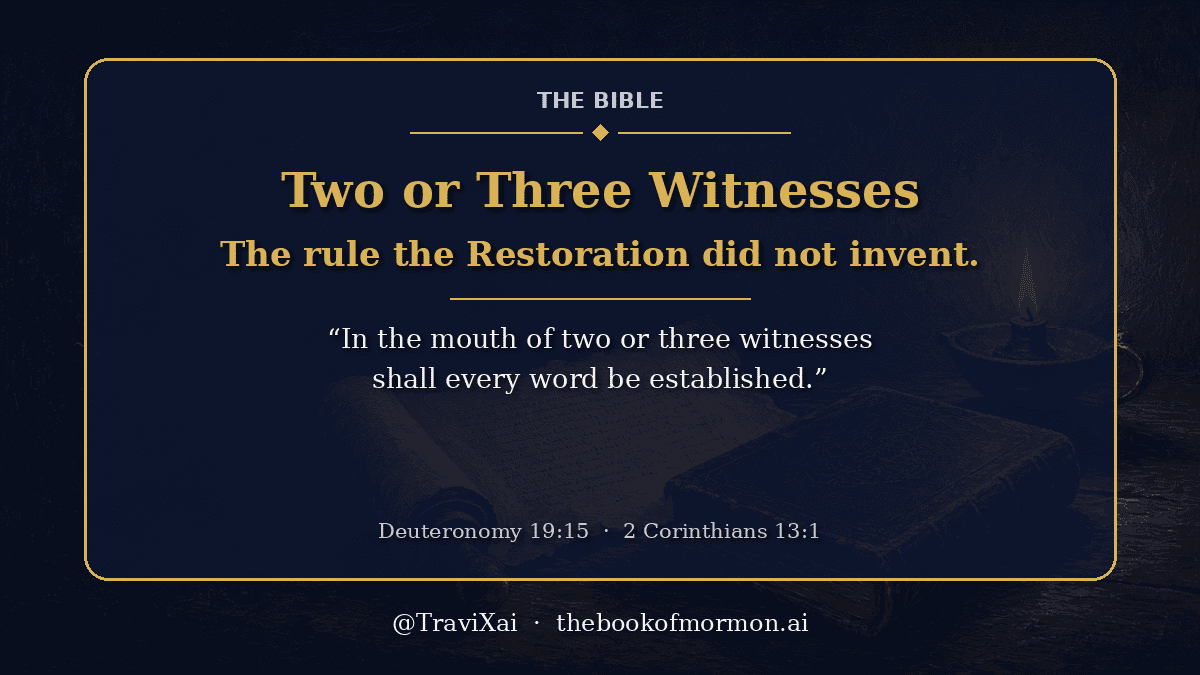
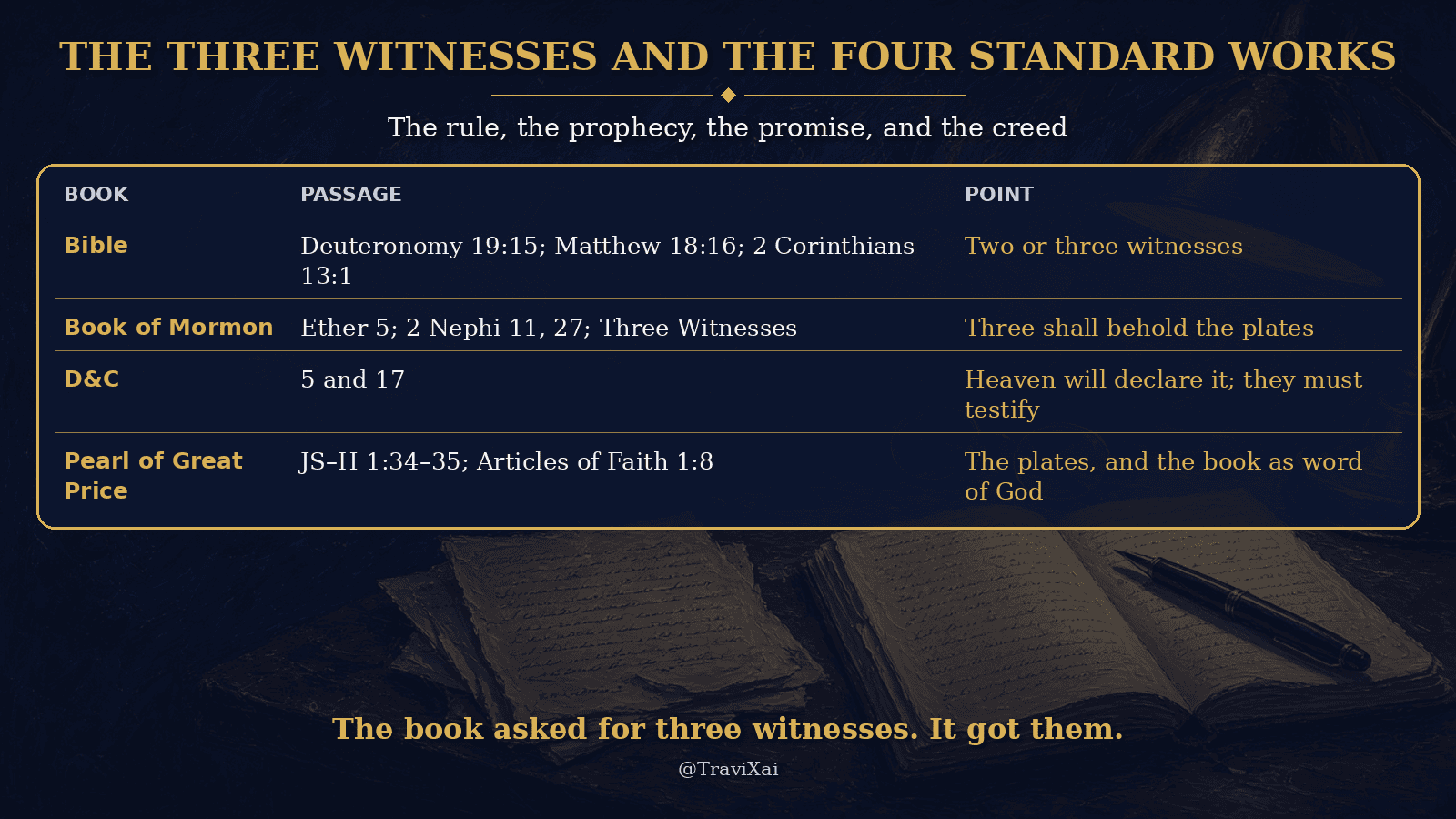
The Bible had already set the standard the book was invoking. “At the mouth of two witnesses, or at the mouth of three witnesses, shall the matter be established” (Deuteronomy 19:15). Jesus repeated it (Matthew 18:16). Paul did too: “In the mouth of two or three witnesses shall every word be established” (2 Corinthians 13:1). If that rule is good enough to found a charge, it is good enough to found a book. See Is the Book of Mormon True? and Who Wrote the Book of Mormon?.
June 1829An angel, a voice, and a command to testify
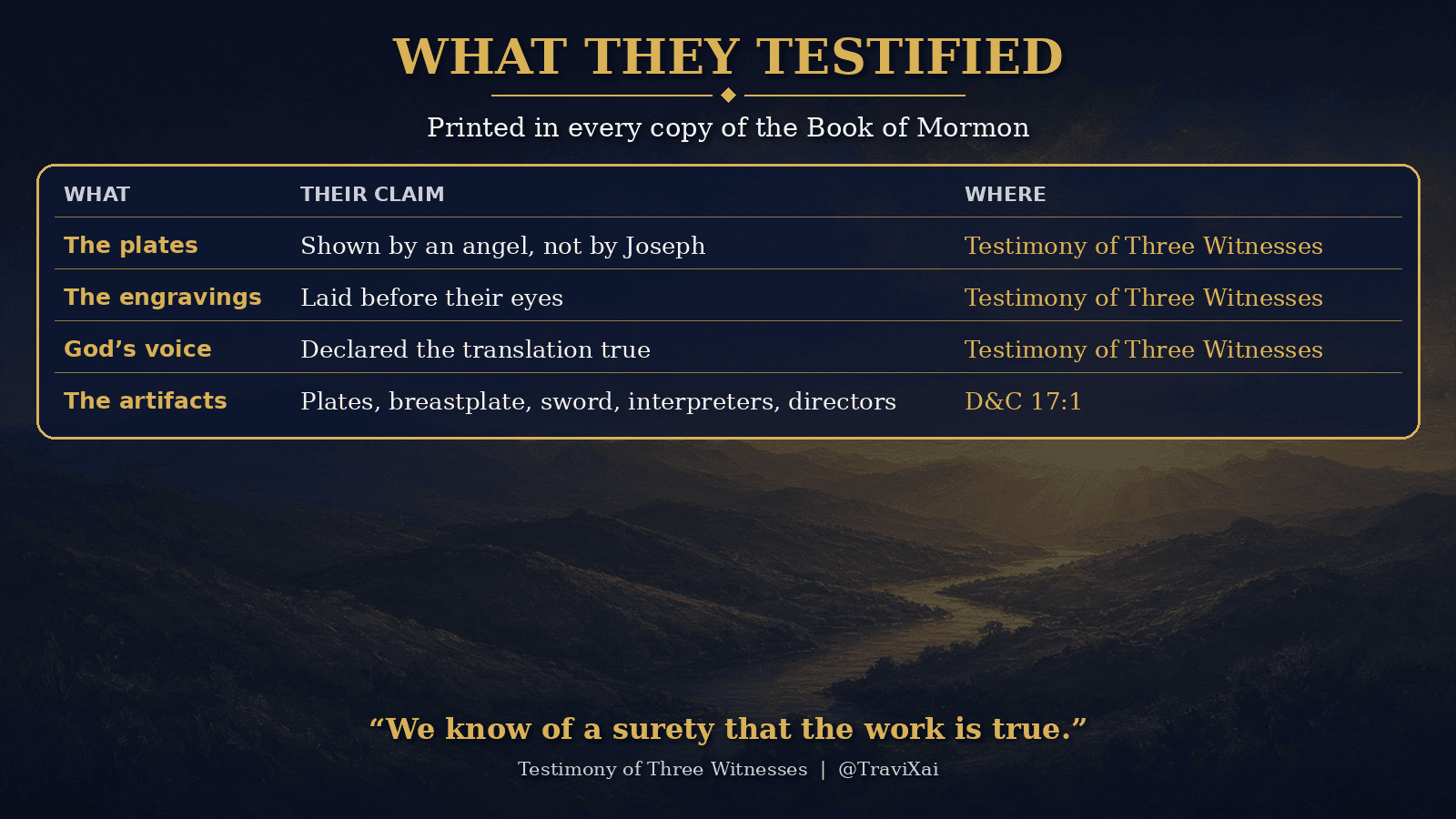
Come Follow Me, Appendix C, records the sequence simply: the three men asked to be the witnesses of whom the book had prophesied; the Lord granted it in Doctrine and Covenants 17; and He sent an angel, who showed them the plates. The revelation is more specific than a vague spiritual impression. “You shall have a view of the plates, and also of the breastplate, the sword of Laban, the Urim and Thummim, which were given to the brother of Jared upon the mount,” and “the miraculous directors which were given to Lehi” (D&C 17:1). “It is by your faith that you shall obtain a view of them.” After they had “seen them with your eyes,” they were to “testify of them, by the power of God,” and to testify “that you have seen them, even as my servant Joseph Smith, Jun., has seen them” (D&C 17:2–5). The Lord added, “as your Lord and your God liveth it is true” (D&C 17:6).
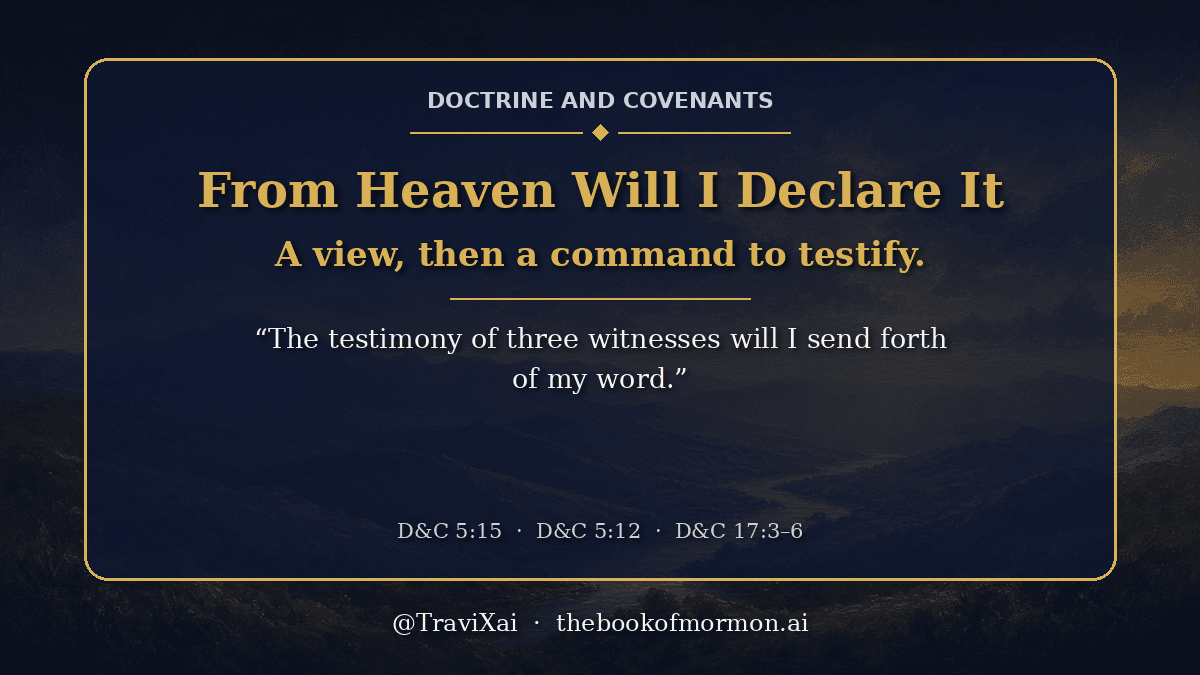
An earlier revelation had already promised this. “The testimony of three of my servants, whom I shall call and ordain, unto whom I will show these things,” would go forth, “for from heaven will I declare it unto them.” “The testimony of three witnesses will I send forth of my word” (D&C 5:11–12, 15). The published testimony matches that assignment: they saw the plates and the engravings, “shown unto us by the power of God, and not of man”; “an angel of God came down from heaven, and he brought and laid before our eyes, that we beheld and saw the plates”; and “his voice hath declared it unto us; wherefore we know of a surety that the work is true.”
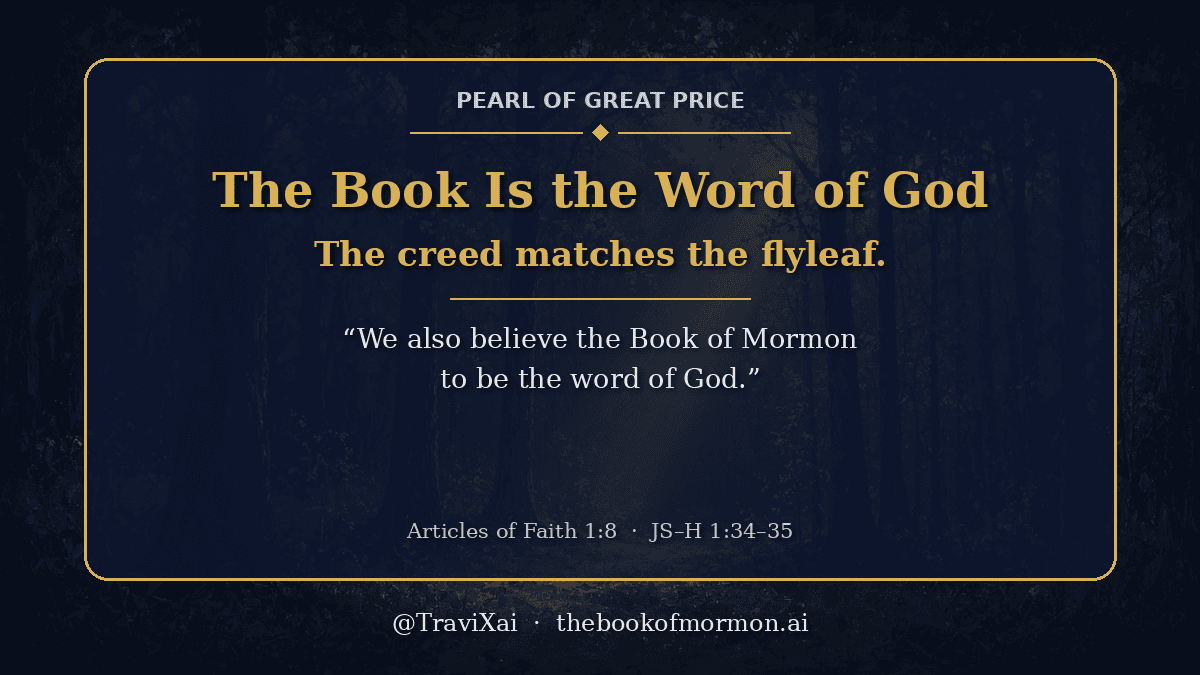
Joseph Smith—History had already described what Moroni said was in that record: “a book deposited, written upon gold plates, giving an account of the former inhabitants of this continent,” with the Urim and Thummim “deposited with the plates” (Joseph Smith—History 1:34–35). The Articles of Faith put the conclusion in one sentence: “We also believe the Book of Mormon to be the word of God” (Articles of Faith 1:8). The Three Witnesses are how that claim left Joseph’s own mouth and entered other men’s names.
Why the later break is the pointNo shared interest, and no recantation
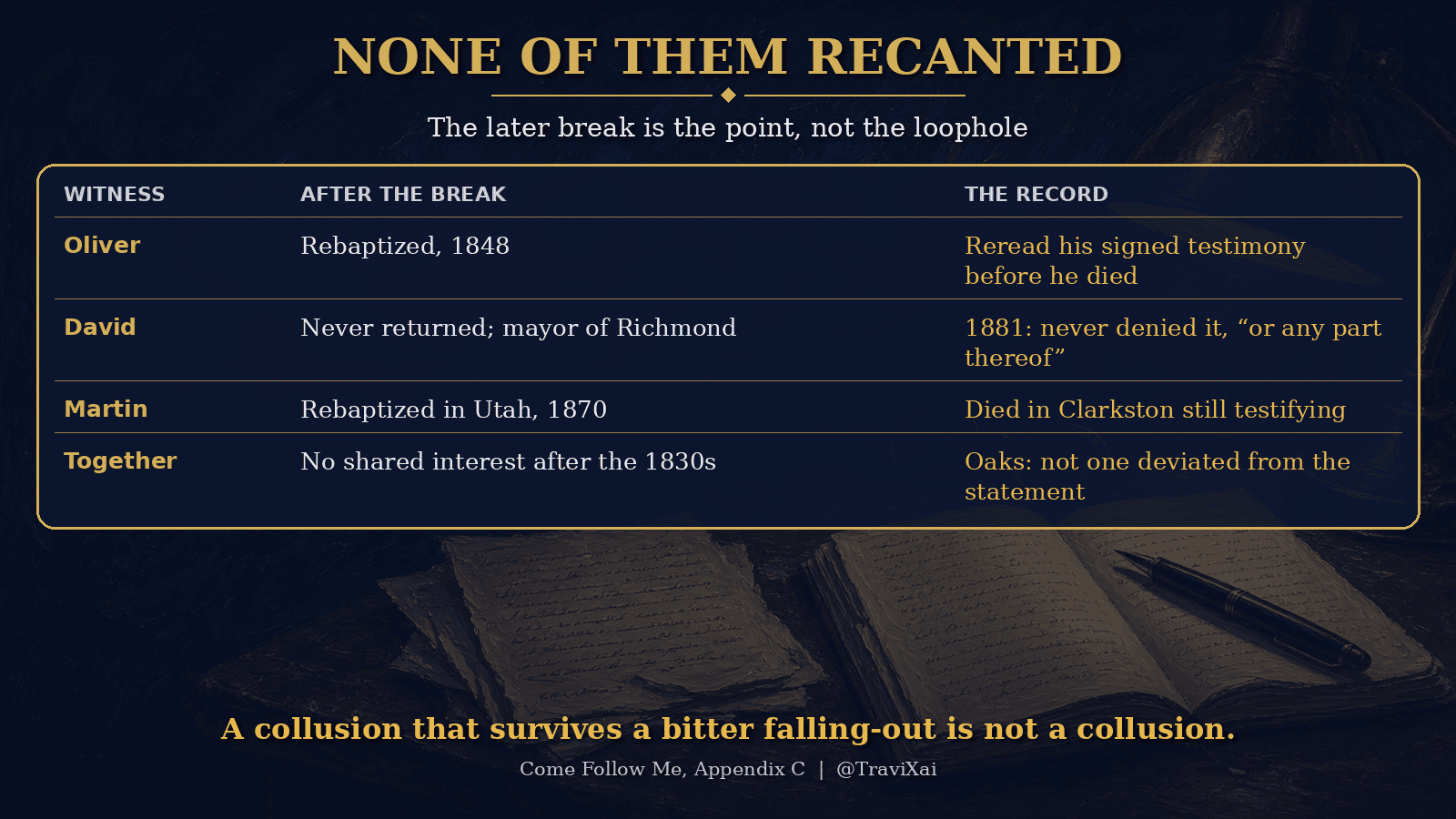
President Dallin H. Oaks stated the issue with the precision it deserves: “Each of the three had ample reason and opportunity to renounce his testimony if it had been false, or to equivocate on details if any had been inaccurate.” Each “was excommunicated from The Church of Jesus Christ of Latter-day Saints by about eight years after the publication of their testimony. All three went their separate ways, with no common interest to support a collusive effort. Yet to the end of their lives—periods ranging from 12 to 50 years after their excommunications—not one of these witnesses deviated from his published testimony or said anything that cast any shadow on its truthfulness” (“The Witness: Martin Harris,” Ensign, May 1999, quoted in Come Follow Me, Appendix C).
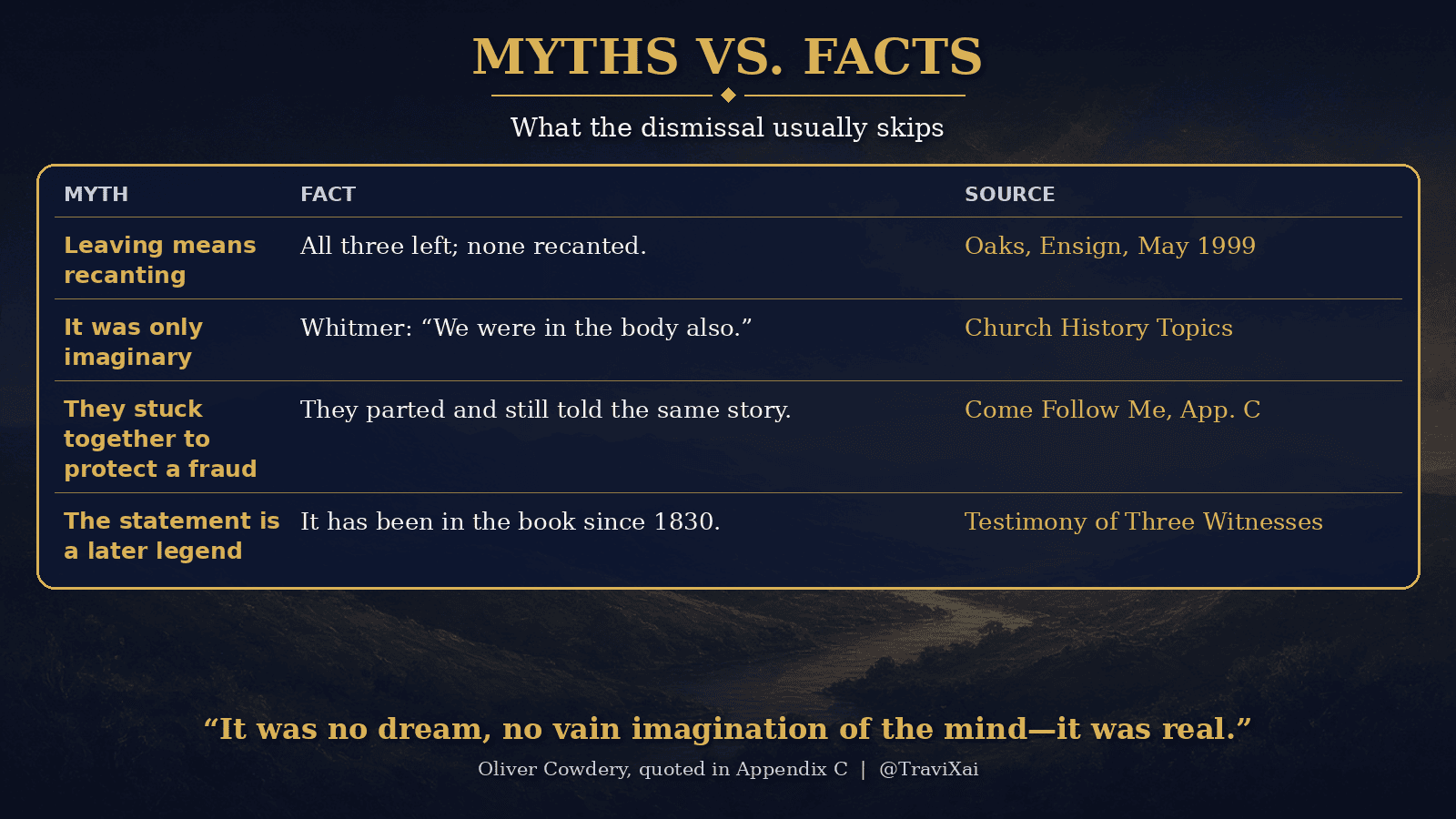
The later statements stay in that lane. Come Follow Me quotes Oliver, near the end of his life, rereading his signed testimony from a first-edition Book of Mormon and saying, “It was no dream, no vain imagination of the mind—it was real.” It quotes David’s 1881 letter in the Richmond Conservator: he had “never at any time denied that testimony, or any part thereof,” and “it was no delusion!” It quotes Martin: “I know the Book of Mormon to be verily true.” Church History Topics also records Whitmer’s clarification when people tried to turn “spiritual” into “imaginary”: “we were in the body also, and everything was as natural to us, as it is at any time.”
The usual counter is that they left, so the testimony is void. That is a category error. Leaving a church and denying a vision are different acts. All three did the first. None of them did the second. A hoax that cannot be walked back, even after the hoaxers have fallen out with the man who supposedly invented it, is not a very good hoax. See Was Joseph Smith a Prophet? and Where Are the Golden Plates Now?.
Check the premiseThe presuppositions baked into the question
Before this question can be answered fairly, the person asking has to justify a few assumptions packed inside it:
- That a witness who left the Church must have recanted. All three left. Oliver and Martin returned; David never did. No denial of the signed testimony is on record. Oaks’s point stands: they had motive and time, and they did not use either to recant.
- That “by the power of God” means the plates were imaginary. The testimony says an angel laid the plates before their eyes. Whitmer added that they were “in the body also, and everything was as natural to us, as it is at any time.”
- That the three men kept the story because they still had something to gain. After the 1830s they had no common interest, as Oaks noted. David spent fifty years outside the Church still affirming the book.
- That Joseph’s word alone was supposed to be enough. The book itself refused that standard. It required three witnesses, then “a few” more, and then the reader’s own inquiry of God.
FAQQuick answers
Who were the Three Witnesses of the Book of Mormon?
Oliver Cowdery, David Whitmer, and Martin Harris. In June 1829 they testified that an angel showed them the plates and that the voice of God declared the translation true.
Where and when did the Three Witnesses see the plates?
In June 1829, near the Peter Whitmer Sr. home in Fayette, New York, as Church History Topics records.
What does the Testimony of Three Witnesses say?
That they saw the plates and the engravings, shown by the power of God and not of man; that an angel laid the plates before their eyes; and that the Lord’s voice declared the work is true.
Did the Three Witnesses leave the Church?
Yes. All three were separated from the Church within about eight years of the testimony. Oliver was rebaptized in 1848, Martin in 1870. David never returned.
Did any of the Three Witnesses recant?
No. President Dallin H. Oaks wrote that not one “deviated from his published testimony or said anything that cast any shadow on its truthfulness.”
Was the experience only a vision, not a real view of the plates?
They described an angelic encounter, and they also described it as real. Whitmer said they were “in the body also, and everything was as natural to us, as it is at any time.”
How is their testimony different from that of the Eight Witnesses?
The Three were shown the plates by an angel and heard God’s voice. The Eight were shown the plates by Joseph Smith and handled them. The book promised both kinds of witness (2 Nephi 27:12–13).
Where can I read their testimony?
In every copy of the Book of Mormon, under “The Testimony of Three Witnesses,” and in Doctrine and Covenants 17, which promised the view and commanded them to testify.
SummaryKey takeaways
- The Three Witnesses were Oliver Cowdery, David Whitmer, and Martin Harris, June 1829, Fayette, New York.
- The Book of Mormon itself required them (Ether 5:3–4; 2 Nephi 27:12; 2 Nephi 11:3).
- D&C 5 and 17 promised a view by faith and a command to testify; their printed testimony matches that assignment.
- All three later left the Church. None recanted the signed statement.
- The Eight Witnesses are the additional “few” of 2 Nephi 27:13: they handled the plates themselves.
Read Ether 5, D&C 17 and the Testimony of Three Witnesses tonight. For quick, sourced answers, open Galatians18, and follow me on X at @TraviXai.
Sources
- King James Bible (churchofjesuschrist.org): Deuteronomy 19:15 · Matthew 18:16 · 2 Corinthians 13:1
- Book of Mormon: Ether 5:2–4 · 2 Nephi 11:3 · 2 Nephi 27:12–14 · The Testimony of Three Witnesses
- Doctrine and Covenants: D&C 5:11–18 · D&C 17:1–9
- Pearl of Great Price: JS–H 1:34–35 · Articles of Faith 1:8
- Come Follow Me, Appendix C: The Three Witnesses · Church History Topics, “Witnesses of the Book of Mormon” · Dallin H. Oaks, “The Witness: Martin Harris,” Ensign, May 1999
- Featured image and in-article graphic: original graphics by thebookofmormon.ai (painterly backgrounds; no photographs or likenesses of real people).