
He was a fourth-century prophet who abridged the plates, named the book, and pointed a remnant to Christ. He was not the Church, and he was not the angel.
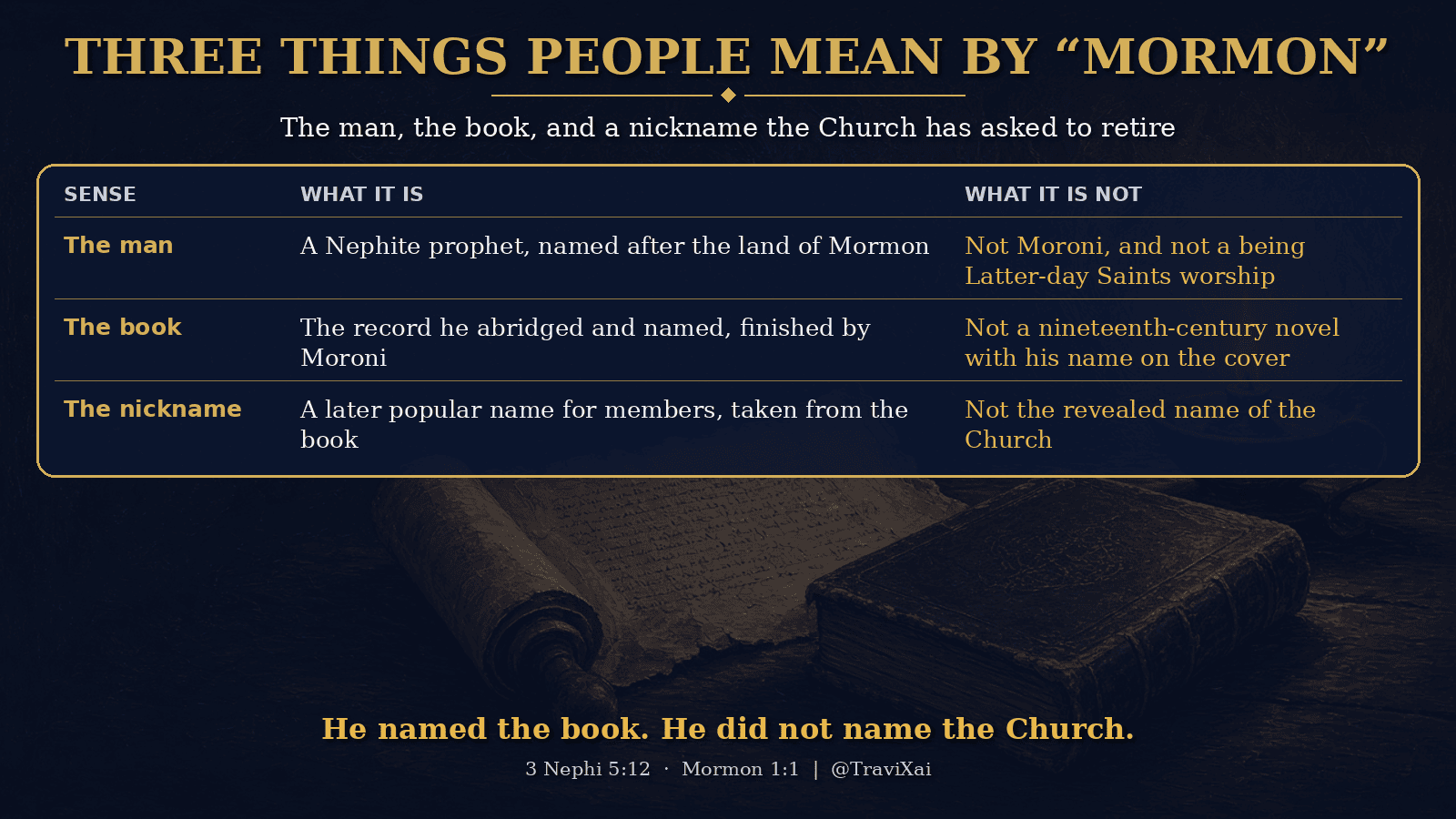
Mormon was a Nephite prophet and historian, born about A.D. 310, who abridged earlier records, named the book, and was later killed after the last battle at Cumorah. He was “called after the land of Mormon,” and he “call[ed] it the Book of Mormon.” His son Moroni finished the record. Latter-day Saints do not worship him. The later nickname for Church members was taken from the book, not from the man, and the Church asks to be called by its revealed name.
Who he wasNot the Church, not Moroni, and not a man anyone is asked to worship
Mormon was a Nephite prophet and historian, born about A.D. 310, a descendant of Nephi, whose father was also named Mormon. He is the compiler of the book that bears his name. He is not the founder of The Church of Jesus Christ of Latter-day Saints, and he is not the angel who delivered the plates to Joseph Smith. That was his son, Moroni. The confusion is old, and it is lazy. Mormon told you who he was: “Behold, I am a disciple of Jesus Christ, the Son of God. I have been called of him to declare his word among his people, that they might have everlasting life” (3 Nephi 5:12–13). He also told you he was “called after the land of Mormon, the land in which Alma did establish the church among the people.” The man is named after a place. The book is named after the man. The later nickname for Church members was taken from the book. See Is LDS the Same as Mormon? and What Is the Book of Mormon About?.
His lifeA sober child, a young commander, then a witness
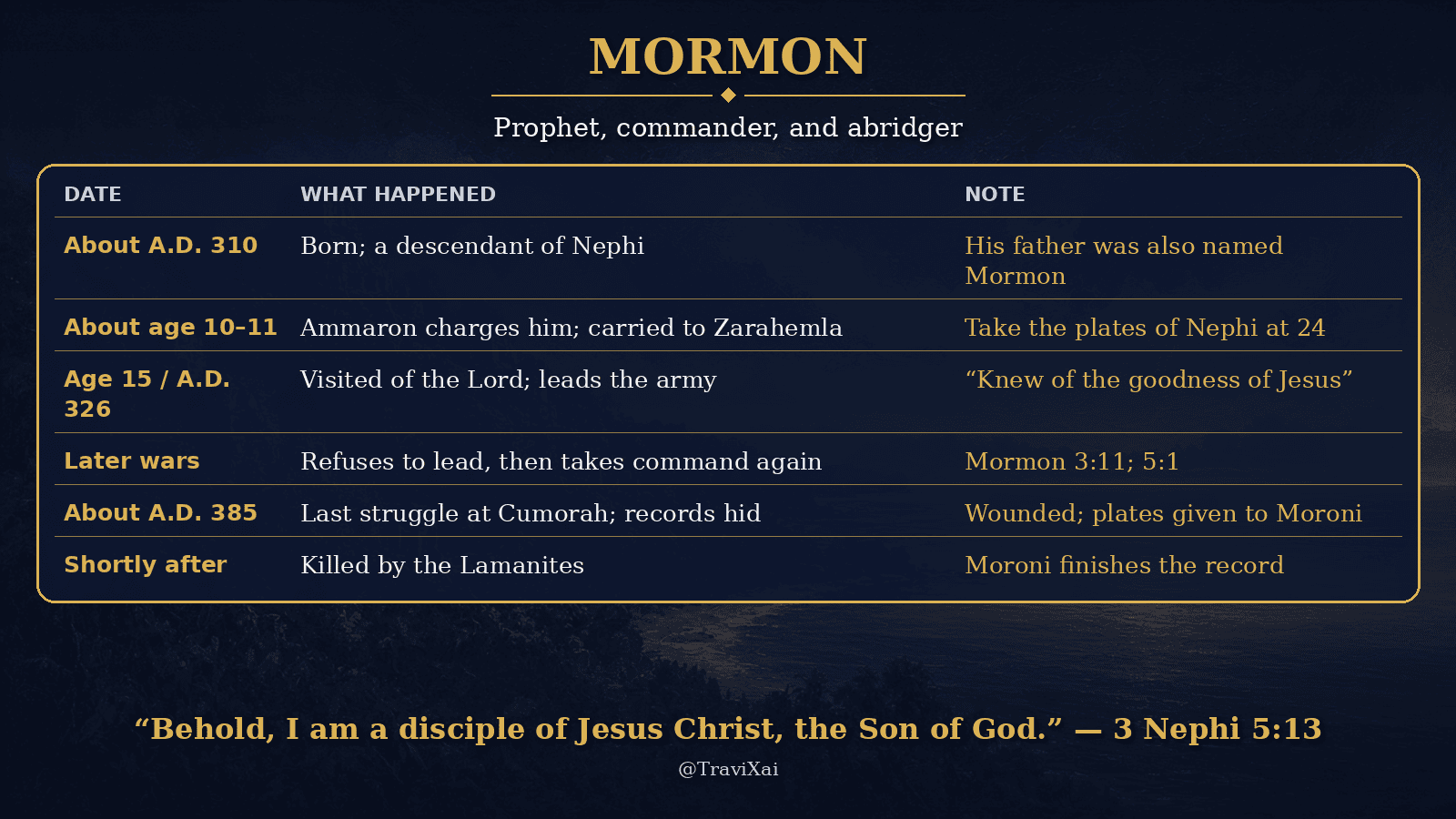
When Mormon was “about ten years of age,” Ammaron came to him, called him “a sober child, and … quick to observe,” and charged him, at age twenty-four, to take the plates of Nephi and engrave what he had observed (Mormon 1:2–5). At eleven he was “carried by my father into the land southward, even to the land of Zarahemla” (Mormon 1:6). At fifteen, “being somewhat of a sober mind, therefore I was visited of the Lord, and tasted and knew of the goodness of Jesus” (Mormon 1:15). That is not the opening of a military chronicle. It is a conversion. The wars come after.
“In my sixteenth year I did go forth at the head of an army of the Nephites, against the Lamanites; therefore three hundred and twenty and six years had passed away” (Mormon 2:1–2). He was large in stature and still a boy. Later, “because of their wickedness and abomination,” he “did utterly refuse from this time forth to be a commander and a leader of this people” and stood “as an idle witness” (Mormon 3:11, 16). He later “did repent of the oath” and took command again, “for they looked upon me as though I could deliver them from their afflictions” (Mormon 5:1). He could not. He could keep the record.
The abridgmentHe did not write every page, and he said so
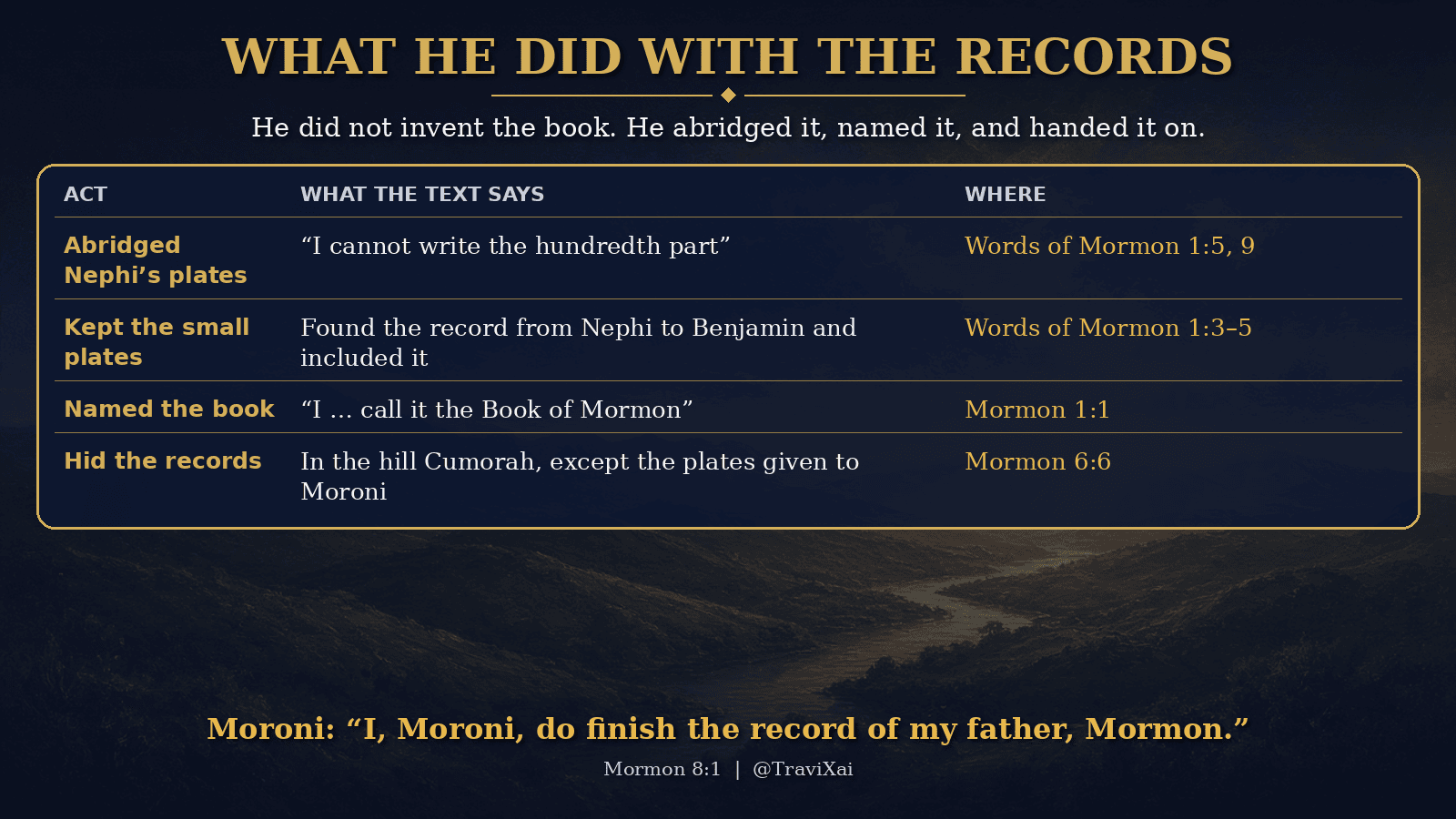
Mormon’s own title is exact: “I, Mormon, make a record of the things which I have both seen and heard, and call it the Book of Mormon” (Mormon 1:1). In the short book called the Words of Mormon, he tells you how the larger volume was built. He had already “made an abridgment from the plates of Nephi, down to the reign of this king Benjamin.” Then he “found these plates,” the small account “of the prophets, from Jacob down to the reign of this king Benjamin, and also many of the words of Nephi,” and he included them because of “the prophecies of the coming of Christ.” Of his own abridgment he says, “I cannot write the hundredth part of the things of my people” (Words of Mormon 1:3–5). He then proceeded “to finish out my record, which I take from the plates of Nephi … according to the knowledge and the understanding which God has given me” (Words of Mormon 1:9).
That is a compiler’s preface, not a novelist’s. Large stretches of the Book of Mormon are earlier voices he abridged: Nephi, Jacob, Benjamin, Mosiah, Alma, Helaman, the risen Christ in 3 Nephi. Mormon writes in his own name in the Words of Mormon, in editorial seams, and in the book of Mormon itself. His sermons and letters also survive in Moroni 7 through 9, which his son copied into the record. See Who Wrote the Book of Mormon? and Who Is the Angel Moroni?.
CumorahHe hid the records, was wounded, and was later killed
“When three hundred and eighty and four years had passed away, we had gathered in all the remainder of our people unto the land of Cumorah” (Mormon 6:5). Mormon, “began to be old,” and knowing this was “the last struggle of my people,” hid up in the hill Cumorah “all the records which had been entrusted to me by the hand of the Lord, save it were these few plates which I gave unto my son Moroni” (Mormon 6:6). He was wounded in the battle: “my ten thousand who were with me, and I fell wounded in the midst; and they passed by me that they did not put an end to my life” (Mormon 6:10). Twenty-four survived with him, “among whom was my son Moroni” (Mormon 6:11). From the top of the hill he counted the fallen by their leaders, ten thousand at a time: his own, Moroni’s, Gidgiddonah’s, then Lamah, Gilgal, Limhah, Jeneum, Cumenihah, Moronihah, Antionum, Shiblom, Shem, and Josh, and “ten more … with their ten thousand each” (Mormon 6:11–15). That is twenty-three units of ten thousand, 230,000 of his people hewn down, besides a few who had fled south or deserted.
His last chapter is not a casualty list. It is a sermon to “the remnant of the house of Israel.” “Know ye that ye must come unto repentance, or ye cannot be saved. … believe in Jesus Christ, that he is the Son of God, and that he was slain by the Jews, and by the power of the Father he hath risen again.” He tells them to “repent, and be baptized in the name of Jesus, and lay hold upon the gospel of Christ, which shall be set before you, not only in this record but also in the record which shall come unto the Gentiles from the Jews” (Mormon 7:1–10). The last Nephite historian’s closing counsel is to believe the Bible, then this book, and to come to Christ.
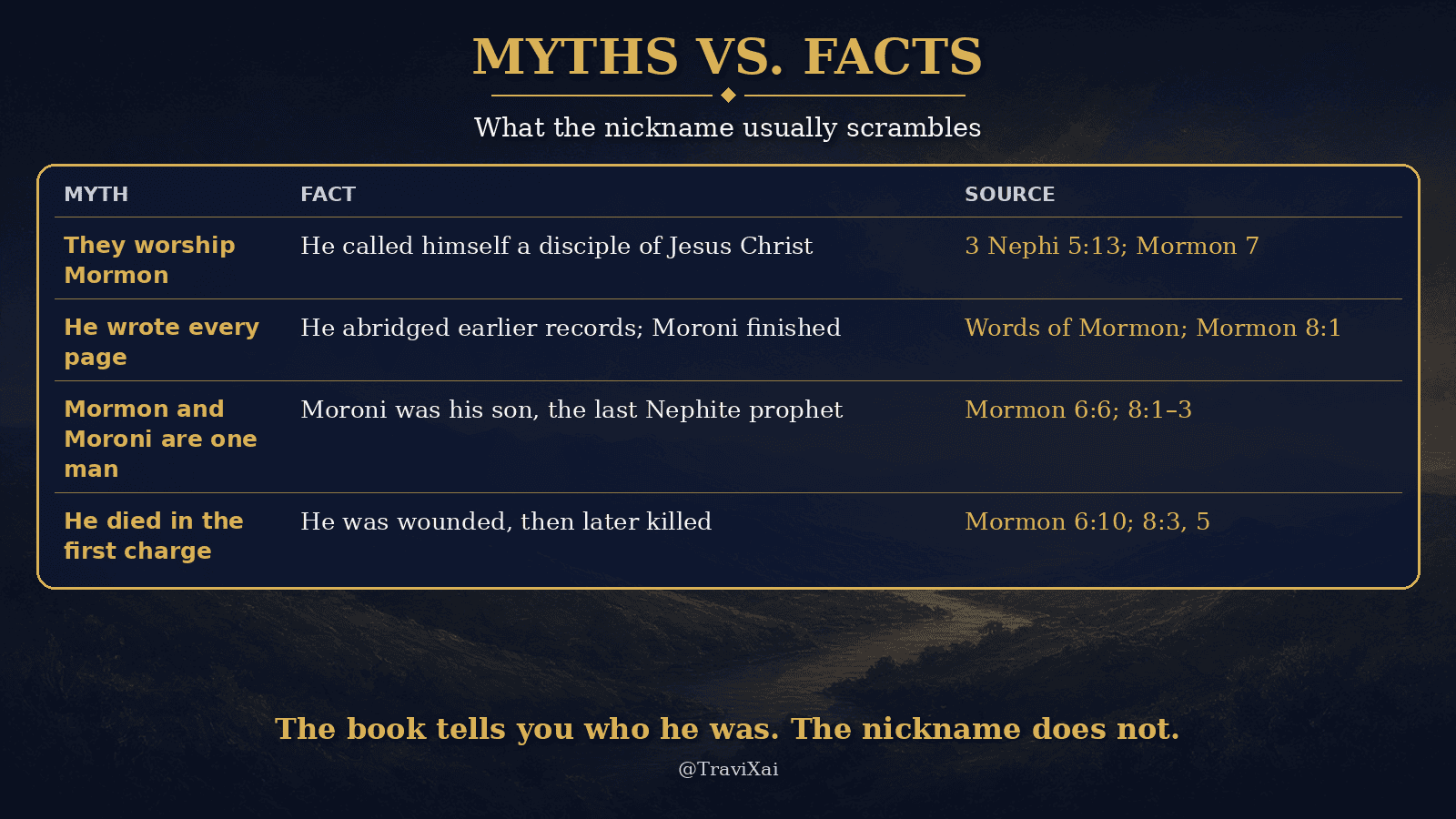
Moroni takes the pen: “Behold I, Moroni, do finish the record of my father, Mormon.” After the battle, the Nephites who had fled south “were hunted by the Lamanites, until they were all destroyed. And my father also was killed by them, and I even remain alone to write the sad tale of the destruction of my people.” Later he repeats it: “My father hath been slain in battle, and all my kinsfolk” (Mormon 8:1–5). Mormon was wounded at Cumorah about A.D. 385 and was later killed. He did not die in the first charge, and he did not live to see the record delivered in New York. That work fell to Moroni. See Who Are the Three Nephites? and Did Jesus Visit the Americas?.
The other standard worksA second record, other sheep, and a book deposited
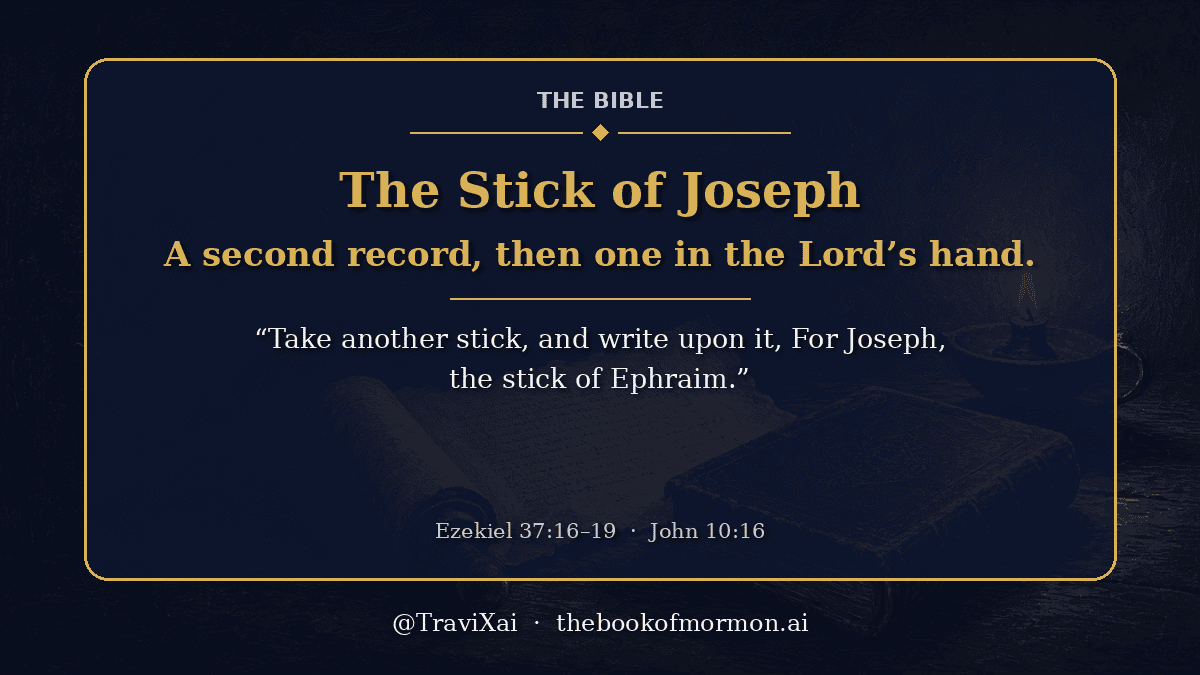
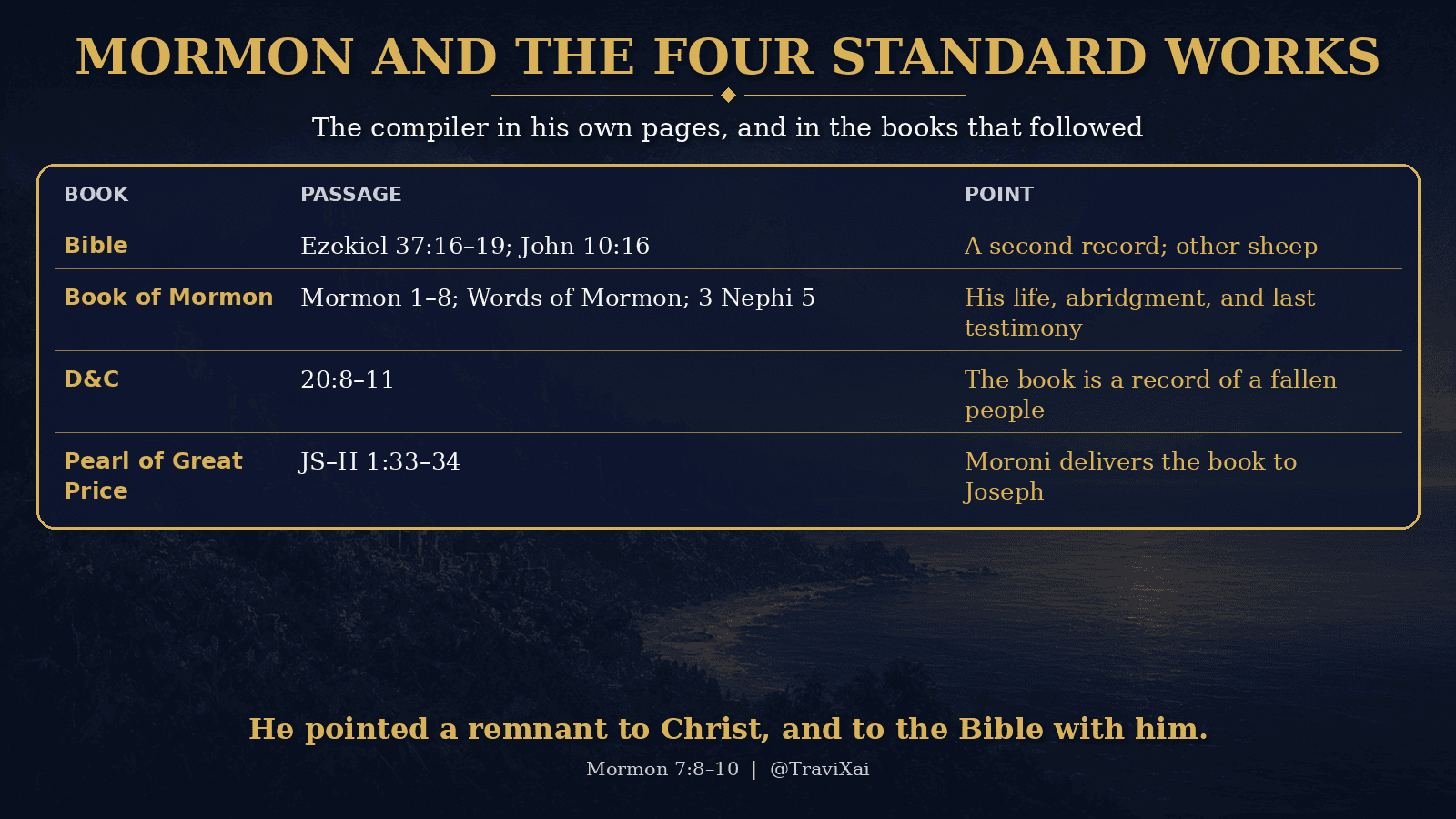
The Bible never names Mormon. It does name a second record, and it does name other sheep. The Lord told Ezekiel, “take another stick, and write upon it, For Joseph, the stick of Ephraim, and for all the house of Israel his companions: And join them one to another into one stick; and they shall become one in thine hand” (Ezekiel 37:16–19). Jesus said, “other sheep I have, which are not of this fold: them also I must bring, and they shall hear my voice; and there shall be one fold, and one shepherd” (John 10:16). Latter-day Saints read the Book of Mormon as that second record, and 3 Nephi as the visit those other sheep were promised. You can reject the identification. You cannot say the Bible left no room for another book, or for another fold.
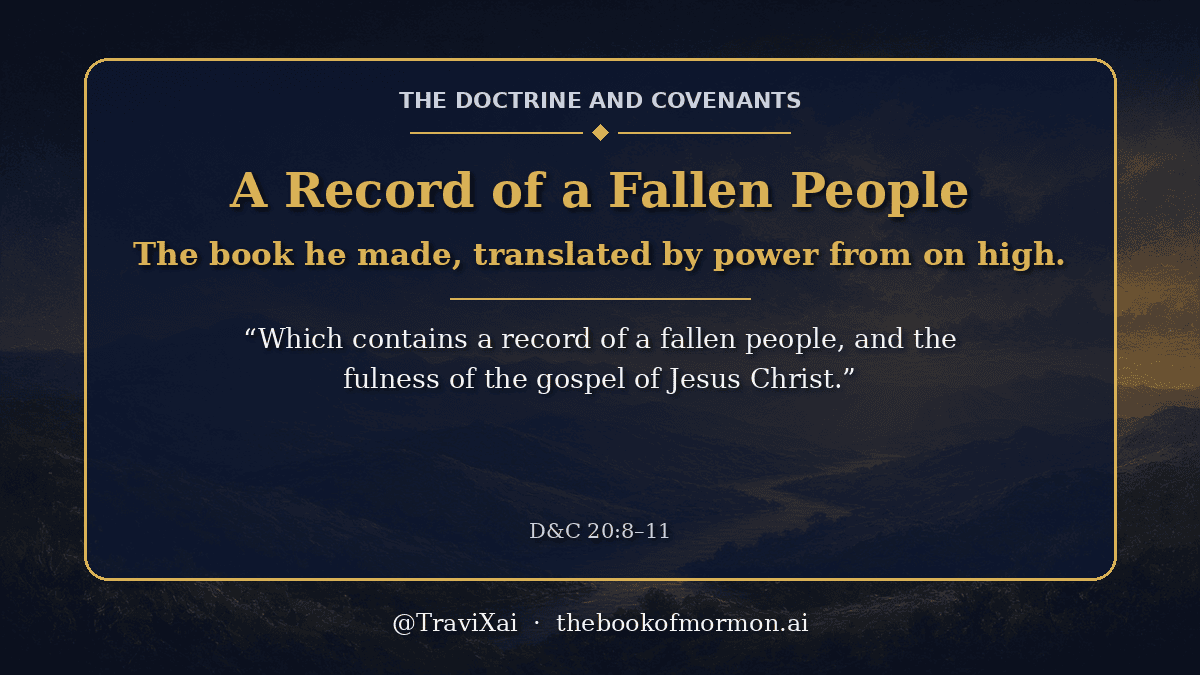
The Doctrine and Covenants calls the volume Mormon named “a record of a fallen people, and the fulness of the gospel of Jesus Christ to the Gentiles and to the Jews also,” given by inspiration, “proving to the world that the holy scriptures are true” (D&C 20:8–11). That is the same claim Mormon made in his last chapter: this record is written so that if you believe the Jewish record, “ye will believe this also” (Mormon 7:8–9).
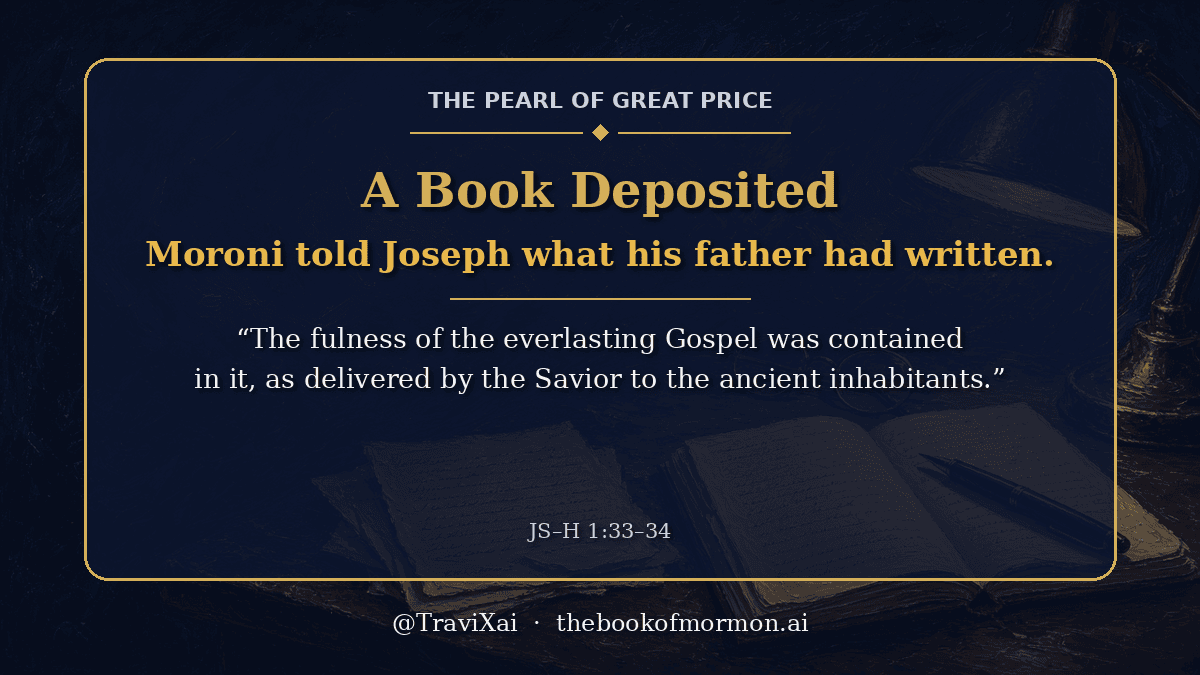
In the Pearl of Great Price, Moroni tells Joseph “that he was a messenger sent from the presence of God,” and “that there was a book deposited, written upon gold plates, giving an account of the former inhabitants of this continent, and the source from whence they sprang. He also said that the fulness of the everlasting Gospel was contained in it, as delivered by the Savior to the ancient inhabitants” (JS–H 1:33–34). The son delivers what the father hid. The nickname came later, and it never was the point. See Is the Book of Mormon in the Bible? and Is the Book of Mormon True?.
Check the premiseThe presuppositions baked into the question
Before this question can be answered fairly, the person asking has to justify a few assumptions packed inside it:
- That “Mormon” is the name of the Church, or of the God Latter-day Saints worship. Mormon was a disciple of Jesus Christ (3 Nephi 5:13). The Church’s revealed name is The Church of Jesus Christ of Latter-day Saints. The nickname was taken from the book, not from a man being worshipped.
- That Mormon wrote every word of the Book of Mormon. He abridged earlier records, included the small plates, wrote his own book, and his son Moroni finished the record (Words of Mormon 1:3–9; Mormon 8:1).
- That Mormon and Moroni are the same person. Moroni was his son. Mormon gave him the plates and was later killed. Moroni finished the record and, centuries later, delivered it.
- That a book named for a fourth-century prophet cannot be a second witness of Christ. Mormon’s last chapter sends the remnant to Christ and to “the record which shall come unto the Gentiles from the Jews” (Mormon 7:8). He is arguing for the Bible, not around it.
FAQQuick answers
Who was Mormon?
A Nephite prophet and historian, born about A.D. 310, a descendant of Nephi. He abridged the plates, named the book the Book of Mormon, was wounded at Cumorah about A.D. 385, and was later killed. His son Moroni finished the record.
Did Mormon write the whole Book of Mormon?
No. He abridged the large plates of Nephi, found and included the small plates, wrote his own book, and Moroni finished the record and added his own books, including Ether.
Why is he called Mormon?
He says he was “called after the land of Mormon,” the place where Alma established the church (3 Nephi 5:12). He then “call[ed] it the Book of Mormon” (Mormon 1:1). The later nickname for Church members came from the book.
Are Mormon and Moroni the same person?
No. Moroni was Mormon’s son, one of the twenty-four survivors at Cumorah, the man who finished the record, and the angel who later delivered the plates to Joseph Smith.
Do Latter-day Saints worship Mormon?
No. Mormon called himself “a disciple of Jesus Christ, the Son of God.” His last chapter tells the remnant to repent, believe in Christ, and be baptized. The Church is named after Jesus Christ.
What happened at Cumorah?
About A.D. 385 the remaining Nephites gathered there for a last struggle. Mormon hid the records, was wounded, and counted 230,000 of his people fallen. Moroni later wrote that his father was killed and that he remained alone.
Is Mormon mentioned in the Bible?
Not by name. Latter-day Saints read Ezekiel 37:16–19, the stick of Joseph joined to the stick of Judah, and John 10:16, the “other sheep,” as biblical room for the record he abridged.
Is “Mormon” the right name for the Church?
It is a nickname taken from the book. The Church’s revealed name is The Church of Jesus Christ of Latter-day Saints, and its leaders have asked that that name be used.
SummaryKey takeaways
- A Nephite prophet-historian, about A.D. 310 to 385, a descendant of Nephi, and a disciple of Jesus Christ (3 Nephi 5:12–13).
- He abridged the plates, included the small plates, and named the record the Book of Mormon (Mormon 1:1; Words of Mormon 1:3–9).
- Visited of the Lord at fifteen; led the Nephite armies from his sixteenth year; later refused, then led again.
- Wounded at Cumorah about A.D. 385; hid the records; gave a few plates to Moroni; later killed (Mormon 6; 8:1–5).
- The nickname for Church members comes from the book. The Church’s name is The Church of Jesus Christ of Latter-day Saints.
Read Mormon 1, Mormon 6–8, and the Words of Mormon tonight, then 3 Nephi 5:12–13. For quick, sourced answers, open Galatians18, and follow me on X at @TraviXai.
Sources
- King James Bible (churchofjesuschrist.org): Ezekiel 37:16–19 · John 10:16
- Book of Mormon: Mormon 1:1–6 · Mormon 1:15 · Mormon 2:1–2 · Mormon 3:11, 16 · Mormon 5:1 · Mormon 6:5–15 · Mormon 7:1–10 · Mormon 8:1–5 · Words of Mormon 1:1–9 · 3 Nephi 5:10–13
- Doctrine and Covenants: D&C 20:8–11
- Pearl of Great Price: JS–H 1:33–34
- Guide to the Scriptures, “Mormon, Nephite Prophet” · Gospel Topics, “Book of Mormon” · Is LDS the Same as Mormon?
- Featured image and in-article graphic: original graphics by thebookofmormon.ai (painterly backgrounds; no photographs or likenesses of real people).