
Critics use Deuteronomy 18:22 as a pass-fail test for Joseph Smith. Run it on Ezekiel and Tyre, and the Bible needs the same grace they refuse to give.
Home › Answering Critics › Start here: Deuteronomy 18:22 Cuts Both Ways · Was Joseph Smith a Prophet?
Ezekiel said Nebuchadnezzar would plunder Tyre and it would be “built no more.” Sixteen years later, God told Ezekiel that Nebuchadnezzar “had no wages” for Tyre and gave him Egypt instead. Tyre was rebuilt, and it’s still there. Bible believers explain that with conditions, stages, and God’s own revision. Good. That’s the same grace Joseph Smith gets denied.
“Joseph Smith gave a prophecy that didn’t come true. Deuteronomy 18:22. False prophet. Done.” I hear it every week. Ok. Let’s use that test…. On Ezekiel.
I’m not here to tear Ezekiel down. I believe Ezekiel was a prophet of God. I’m here to show that the hair-trigger version of Deuteronomy 18:22 can’t survive the Bible, and that the people swinging it at Joseph Smith quietly put it away when the name on the prophecy is Ezekiel.
Check the assumptions first
The “one miss and he’s a false prophet” argument leans on assumptions the Bible itself doesn’t share:
- That every prophecy is unconditional. God says otherwise in Jeremiah 18:7–10.
- That a prophecy has to land all at once, on the first try, in the way it reads. Bible defenders reject that the moment Tyre comes up.
- That God never adjusts a word after He gives it. Ezekiel 29:18 is God adjusting a word, on the record.
- That one standard works for both books. Ezekiel gets footnotes. Joseph gets a verdict.
The testDeuteronomy 18:22, no exceptions
Here’s the verse critics quote:
When a prophet speaketh in the name of the LORD, if the thing follow not, nor come to pass, that is the thing which the LORD hath not spoken, but the prophet hath spoken it presumptuously: thou shalt not be afraid of him.
Deuteronomy 18:22 (KJV)
Read the way critics read it, there are no exceptions. No conditions. No “later.” No “in stages.” If the words as written didn’t happen as written, the man is a fraud.
I already showed in Deuteronomy 18:22 Cuts Both Ways that this reading sinks Jonah, Elisha, and Isaiah’s word to Hezekiah. Today it’s Ezekiel, and Ezekiel is a better test case for one reason: God Himself comments on the prophecy afterward, in the same book.
Exhibit ATyre: “built no more”
In the eleventh year of the captivity, about 586 B.C., Ezekiel prophesied against Tyre, the rich Phoenician port that sat on an island just off the coast. He named the attacker:
For thus saith the Lord GOD; Behold, I will bring upon Tyrus Nebuchadrezzar king of Babylon, a king of kings, from the north, with horses, and with chariots, and with horsemen, and companies, and much people.
Ezekiel 26:7 (KJV)
Then the details. “They shall make a spoil of thy riches, and make a prey of thy merchandise” (Ezekiel 26:12). And the ending:
And I will make thee like the top of a rock: thou shalt be a place to spread nets upon; thou shalt be built no more: for I the LORD have spoken it, saith the Lord GOD.
Ezekiel 26:14 (KJV)
Ezekiel even adds, “though thou be sought for, yet shalt thou never be found again” (Ezekiel 26:21).
What history shows
Nebuchadnezzar did come. Josephus quotes the Phoenician records: “Nabuchodonosor besieged Tyre for thirteen years in the days of Ithobal, their king” (Against Apion 1.21). Thirteen years. But how it ended? The Cambridge Bible admits “history is silent as to the issue of the siege.”
Tyre survived. More than 250 years later, Alexander the Great found it strong enough that he had to build a mole, a causeway, from the mainland out to the island to reach it (Arrian, Anabasis 2). The siege took seven months. Tyre fell in 332 B.C.
And then it was rebuilt. Again. Jesus went “into the coasts of Tyre and Sidon” (Matthew 15:21). Paul’s ship “landed at Tyre,” and he found disciples there and “tarried there seven days” (Acts 21:3–4). Today Tyre (Sur) is a city in Lebanon. “Built no more.” “Never be found again.” I can find it on a map.
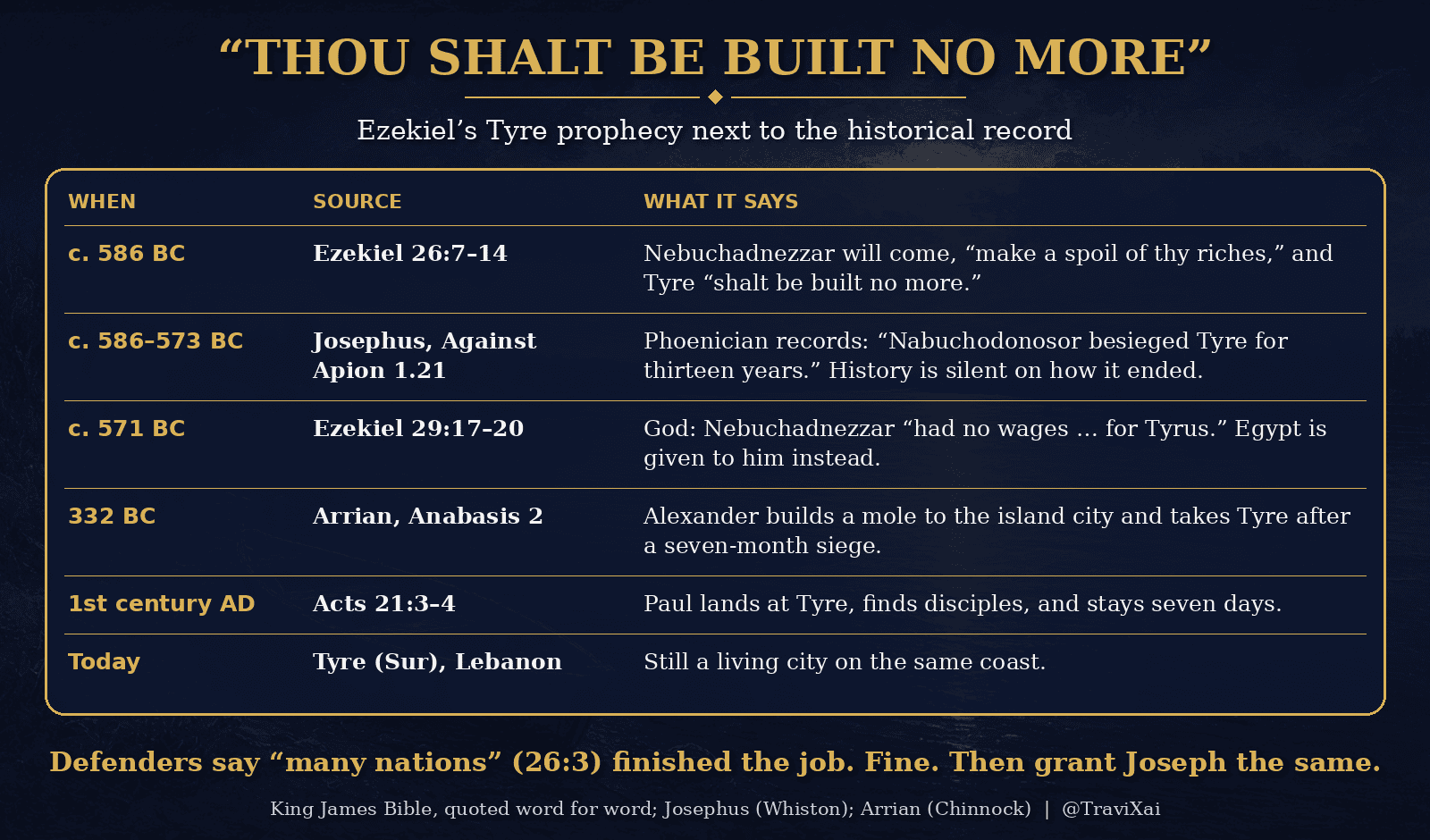
Exhibit B”Yet had he no wages”
Here’s the part critics never mention. Ezekiel was still prophesying after the siege was over. Sixteen years after the Tyre prophecy, in “the seven and twentieth year” (Ezekiel 29:17), the latest date anywhere in his book, God spoke to him again about it:
Son of man, Nebuchadrezzar king of Babylon caused his army to serve a great service against Tyrus: every head was made bald, and every shoulder was peeled: yet had he no wages, nor his army, for Tyrus, for the service that he had served against it:
Ezekiel 29:18 (KJV)
I have given him the land of Egypt for his labour wherewith he served against it, because they wrought for me, saith the Lord GOD.
Ezekiel 29:20 (KJV)
Read that slowly. Ezekiel 26 said Nebuchadnezzar’s army would “make a spoil of thy riches.” Ezekiel 29 says he got “no wages” for Tyre. So God hands him a different payday: Egypt.
That isn’t me spinning it. The commentators say it. Ellicott: “all that is meant is that he failed to obtain any considerable booty thereby.” Barnes: “It is not improbable that the Tyrians before they surrendered their island-citadel managed to remove much of their treasure.”
And on “built no more,” watch how careful they get. Gill: “this must be understood with some restriction and limitation.” Poole offers a menu: “either not this long time, or else not built in greatness and glory, or not raised to be a kingdom” (commentaries on Ezekiel 26:14).
Ezekiel gets “restriction and limitation.” Joseph gets “false prophet.”
Exhibit CEgypt: forty years empty
Then there’s Egypt, the replacement wages. Ezekiel had already prophesied this:
No foot of man shall pass through it, nor foot of beast shall pass through it, neither shall it be inhabited forty years.
Ezekiel 29:11 (KJV)
“From the tower of Syene even unto the border of Ethiopia” (Ezekiel 29:10), the whole land, empty, cities “desolate forty years,” and the Egyptians scattered “among the nations” (Ezekiel 29:12).
What does the record show? A broken Babylonian tablet in the British Museum reports a campaign “to Egypt in his 37th year,” about 568/567 B.C. (BM 33041). So Nebuchadnezzar did march on Egypt. But there’s no record of Egypt emptied of people and animals for forty years. Herodotus says the opposite about that era: “In the reign of Amasis it is said that Egypt became more prosperous than at any other time before” (Histories 2.177).
So how do defenders read it? Keil and Delitzsch calls the forty years “a symbolical term.” Others stretch the scattering over different centuries. Again: fine. That’s grace. I’m glad they have it.
The answerSame grace, both directions
Here’s the believer’s answer, and it’s a good one. God told us prophecy works this way:
At what instant I shall speak concerning a nation, and concerning a kingdom, to pluck up, and to pull down, and to destroy it; If that nation, against whom I have pronounced, turn from their evil, I will repent of the evil that I thought to do unto them.
Jeremiah 18:7–8 (KJV)
Prophecies carry conditions. They can unfold in stages: Ezekiel opened with “many nations” coming against Tyre “as the sea causeth his waves to come up” (Ezekiel 26:3). And God can revise a word and say so, which is exactly what Ezekiel 29:18–20 is. Nineveh got the same treatment: “God repented of the evil, that he had said that he would do unto them; and he did it not” (Jonah 3:10).
I accept every one of those answers. Now give Joseph Smith the same.
In 1832 the Lord said a temple in Missouri would be “reared in this generation” (D&C 84:4). Then mobs drove the Saints out of Jackson County. In 1841 the Lord spoke again:
…and their enemies come upon them and hinder them from performing that work, behold, it behooveth me to require that work no more at the hands of those sons of men, but to accept of their offerings.
D&C 124:49
Look at that next to Ezekiel 29. Men “wrought for me.” The result didn’t come the way the first word read. God speaks again, acknowledges the labor, and settles it. Same pattern. Same God.
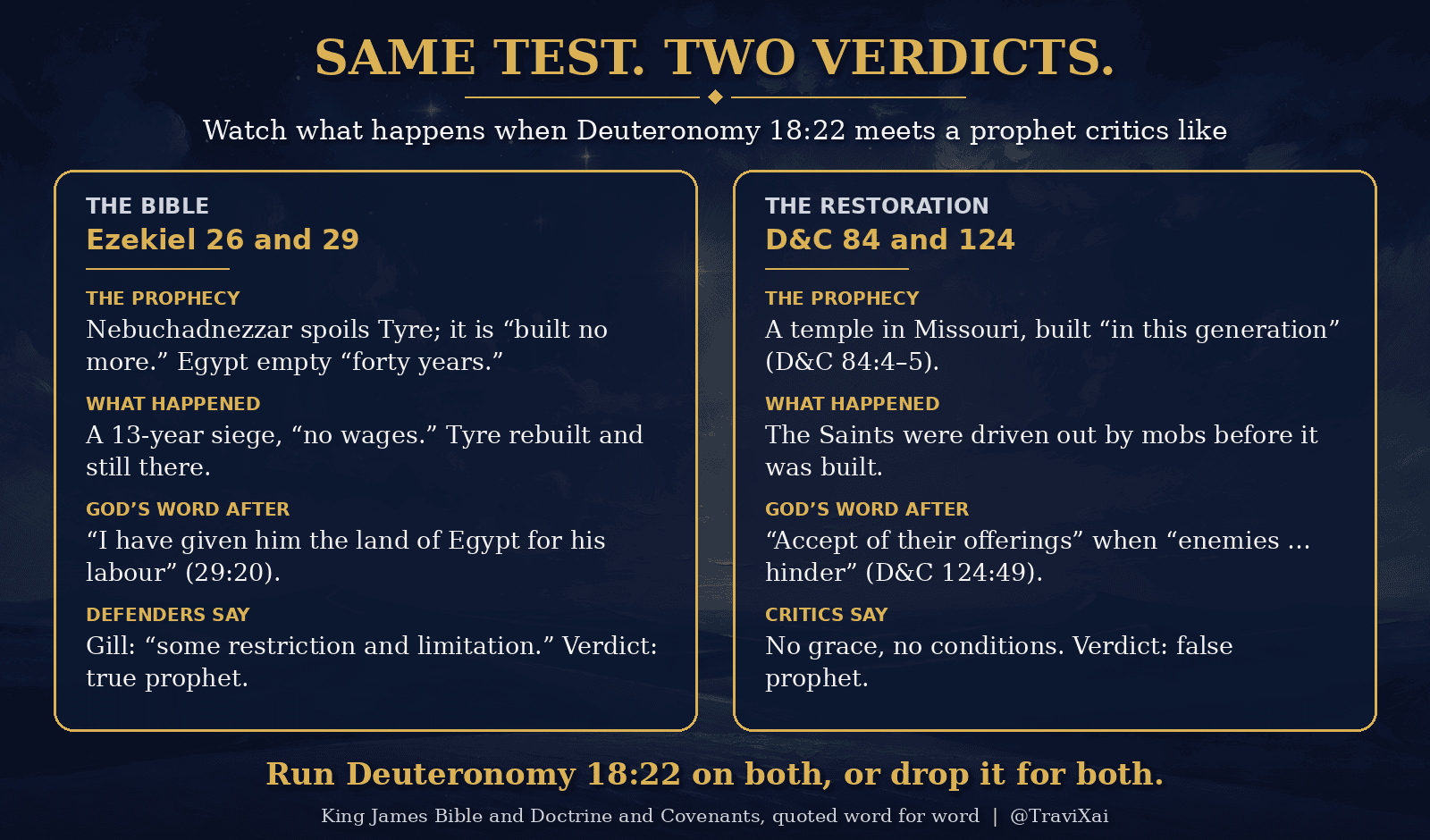
So here’s the score. Ezekiel says “built no more,” and Tyre is rebuilt: prophet. God revises the wages: inspired. Commentators add “restriction and limitation”: scholarship. Joseph says a temple, mobs stop it, God accepts the offering: FALSE PROPHET. Yeah, ok!
Pick one standard. If Deuteronomy 18:22 is a hair trigger, it hits Ezekiel first. If it allows conditions and revision, as Jeremiah 18 says it does, then it allows them for Joseph. And grade the hits while you’re at it: Joseph Smith’s fulfilled prophecies.
SummaryKey takeaways
- Ezekiel 26 says Nebuchadnezzar would plunder Tyre and it would be “built no more.”
- Josephus records a thirteen-year siege. Ezekiel 29:18 says Nebuchadnezzar “had no wages” for Tyre, and God gives him Egypt instead.
- Tyre was still standing for Alexander in 332 B.C., for Paul in Acts 21, and it’s a city today.
- No record shows Egypt empty for “forty years.” Defenders read it as symbolic or stretched over time.
- Bible believers answer with conditions (Jeremiah 18:7–10), stages, and God’s own revision. Same answers fit D&C 124:49. One standard.
Ezekiel, Tyre, and Egypt: quick answers
What did Ezekiel prophesy about Tyre?
Ezekiel 26:7–14 says Nebuchadnezzar would come against Tyre, “make a spoil of thy riches,” and that Tyre “shalt be built no more.”
Did Nebuchadnezzar destroy Tyre?
He besieged it for thirteen years, according to the Phoenician records Josephus quotes (Against Apion 1.21). The outcome isn’t recorded, and Ezekiel 29:18 says he “had no wages” for it.
What does Ezekiel 29:18 mean?
God says Nebuchadnezzar’s army labored hard against Tyre but got “no wages,” so God gave him “the land of Egypt” as payment (Ezekiel 29:19–20).
Was Egypt desolate for forty years?
No historical record shows it. A Babylonian tablet (BM 33041) records Nebuchadnezzar’s campaign against Egypt in his 37th year, and Herodotus describes Egypt as prosperous under Amasis. Commentators like Keil and Delitzsch read the forty years as symbolic.
Does Ezekiel fail the Deuteronomy 18:22 test?
Only if the test allows no conditions. Jeremiah 18:7–10 says prophecies can be conditional, and Ezekiel 29:18–20 shows God revising a word. That same grace applies to Joseph Smith (D&C 124:49).
Where can I read more?
Next time someone throws Deuteronomy 18:22 at Joseph Smith, ask them one question: “Was Tyre built again?” For quick, sourced answers on Deuteronomy 18 and false prophets, the “failed prophecies” list, Joseph’s prophecies that came true, and apparent Bible contradictions, open Galatians18. And for more like this every day, follow me on X at @TraviXai.
Sources
- Bible (KJV, churchofjesuschrist.org): Deuteronomy 18:21–22 · Ezekiel 26:3–14, 21 · Ezekiel 29:10–15 · Ezekiel 29:17–20 · Jeremiah 18:7–10 · Jonah 3:4–10 · Matthew 15:21 · Acts 21:3–4
- Doctrine and Covenants: D&C 84:4–5 · D&C 124:49–51
- Flavius Josephus, Against Apion 1.21, trans. William Whiston (Project Gutenberg)
- Arrian, The Anabasis of Alexander, book 2, trans. E. J. Chinnock (Project Gutenberg); translator’s notes cite Diodorus 17.46 for the seven-month siege
- Herodotus, Histories, book 2.177, trans. G. C. Macaulay (Project Gutenberg)
- British Museum, tablet 33041: “report of Nebuchadnezzar II’s campaign to Egypt in his 37th year”
- Ezekiel 29:18 commentaries (Ellicott, Barnes, Cambridge Bible): Bible Hub
- Ezekiel 26:14 commentaries (Gill, Poole): Bible Hub
- Ezekiel 29:12 commentaries (Keil and Delitzsch): Bible Hub
- Galatians18: Deuteronomy 18: Was Joseph a False Prophet? · Joseph Smith’s “Failed Prophecies” List · Joseph Smith’s Prophecies That Came True · Apparent Biblical Contradictions
- Featured image and charts: original graphics by thebookofmormon.ai (no photographs or likenesses of real people).