
Joseph Smith, his scribe Oliver Cowdery, and the revelations of 1828–29 all name the same instrument: the Urim and Thummim found with the plates. Here is the Joseph Smith Foundation’s case, the sources behind it, and how to weigh the later stone-in-a-hat accounts.
The question sounds simple: how did Joseph Smith translate the Book of Mormon? Ask around today and you will often hear one answer: he put a seer stone in a hat. But read what Joseph Smith wrote, what his scribe Oliver Cowdery published, and what the revelations of 1828 and 1829 say, and a different instrument appears again and again: the Urim and Thummim, the Nephite “interpreters” Joseph said were buried with the plates.
The Joseph Smith Foundation (JSF) has spent years making that case. Its reference article The Process of Translating the Book of Mormon and its 2019 book Seer Stone v. Urim & Thummim: Book of Mormon Translation on Trial make one argument at heart: listen first to the people who were actually doing the translating, and weigh later, secondhand stories accordingly. This article follows that argument, quotes the sources it rests on, and adds more primary sources that point the same way.
A note on tone. Many faithful Latter-day Saints, including careful Church historians, read the evidence differently, and our own earlier article leans toward the seer-stone view. This is not a fight with them. It is a case, made the way a historian weighs witnesses, for a view that is faithful, well sourced, and fine to hold.
Part IThe source this article follows
From JSF: The JSF reference page republishes a chapter by two BYU religion professors, Joseph Fielding McConkie and Craig J. Ostler, from their book Revelations of the Restoration (Deseret Book, 2000), pages 89–98. Its opening paragraph sets the method for everything that follows:
Explanations as to how the Book of Mormon was translated have become the source of considerable speculation and misinformation. There appears to be little interest on the part of some writers to distinguish between what might be called historical prattle and competent testimony.
Joseph Fielding McConkie and Craig J. Ostler, republished by JSF: “The Process of Translating the Book of Mormon”
Their point is a historian’s point. They call scripture, the Prophet’s own statements, and Oliver Cowdery’s testimony “the only firsthand sources we have on the matter,” and they argue that these should not be ranked below “secondhand witnesses who in thought and spirit were clearly out of harmony with the Prophet and the Church.”
From JSF: JSF’s own researchers, James F. Stoddard III and L. Hannah Stoddard, took that argument much further in Seer Stone v. Urim & Thummim (Joseph Smith Foundation, April 2019). JSF describes it as “one of the most comprehensive treatments of the translation process to date,” written for Latter-day Saints “who fear they have been ‘betrayed’ by the translation history taught by the Church for over 190 years.”
Part IIWhat Joseph Smith said, in his own words
1832: “the Lord had prepared spectacles”
Added support: Joseph’s earliest history, partly in his own hand (circa 1832), calls the instrument found with the plates “spectacles”:
… but the Lord had prepared spectacles for to read the Book therefore I commenced translating the characters …
Joseph Smith, History, circa Summer 1832, p. 5 (original spelling “spectticke spectacles” simplified)
1838: the Elders’ Journal
From JSF: Answering common questions in July 1838, Joseph wrote:
I obtained them, and the Urim and Thummim with them; by the means of which, I translated the plates; and thus came the book of Mormon.
Joseph Smith, Elders’ Journal, July 1838
1838–39: the history in the Pearl of Great Price
From JSF: Joseph’s canonized history describes the instrument three times: as Moroni explained it, as Joseph found it, and as he used it.
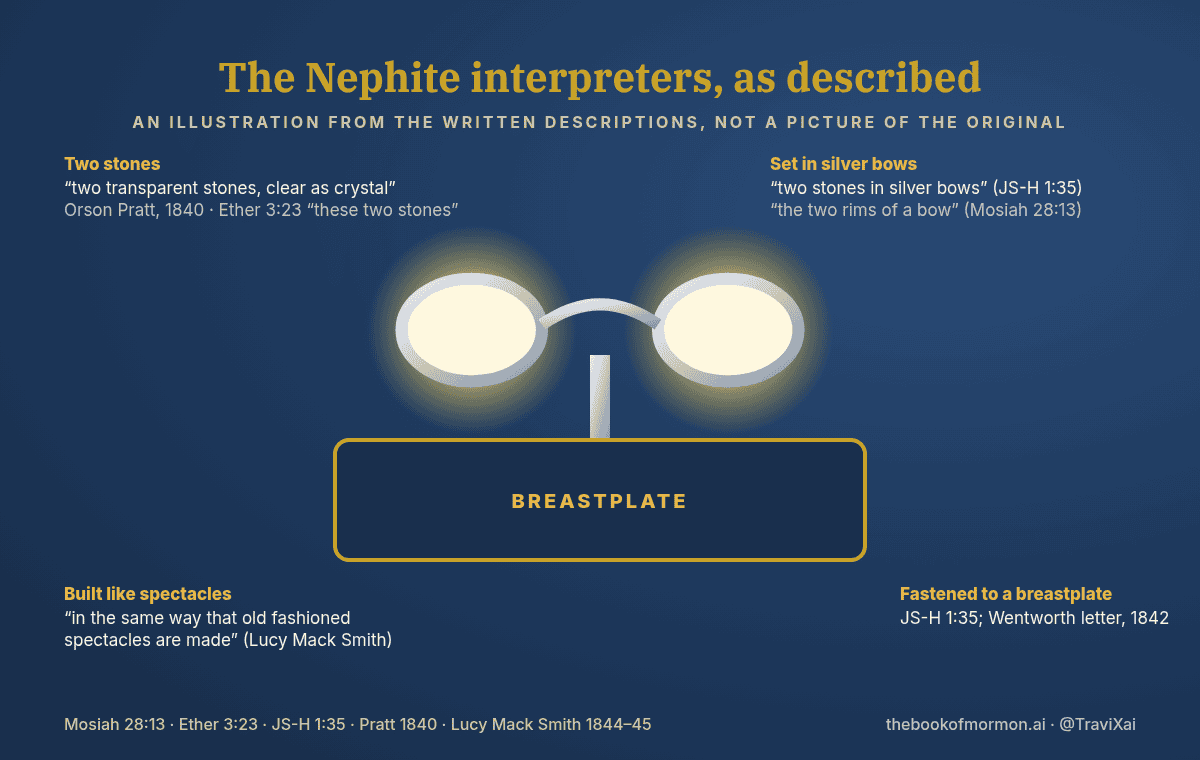
Also, that there were two stones in silver bows—and these stones, fastened to a breastplate, constituted what is called the Urim and Thummim—deposited with the plates; and the possession and use of these stones were what constituted “seers” in ancient or former times; and that God had prepared them for the purpose of translating the book.
Joseph Smith—History 1:35
I looked in, and there indeed did I behold the plates, the Urim and Thummim, and the breastplate, as stated by the messenger.
Joseph Smith—History 1:52
I copied a considerable number of them, and by means of the Urim and Thummim I translated some of them …
Joseph Smith—History 1:62
1842: the Wentworth letter
From JSF: In 1842, writing to Chicago editor John Wentworth, Joseph described the instrument and what he did with it:
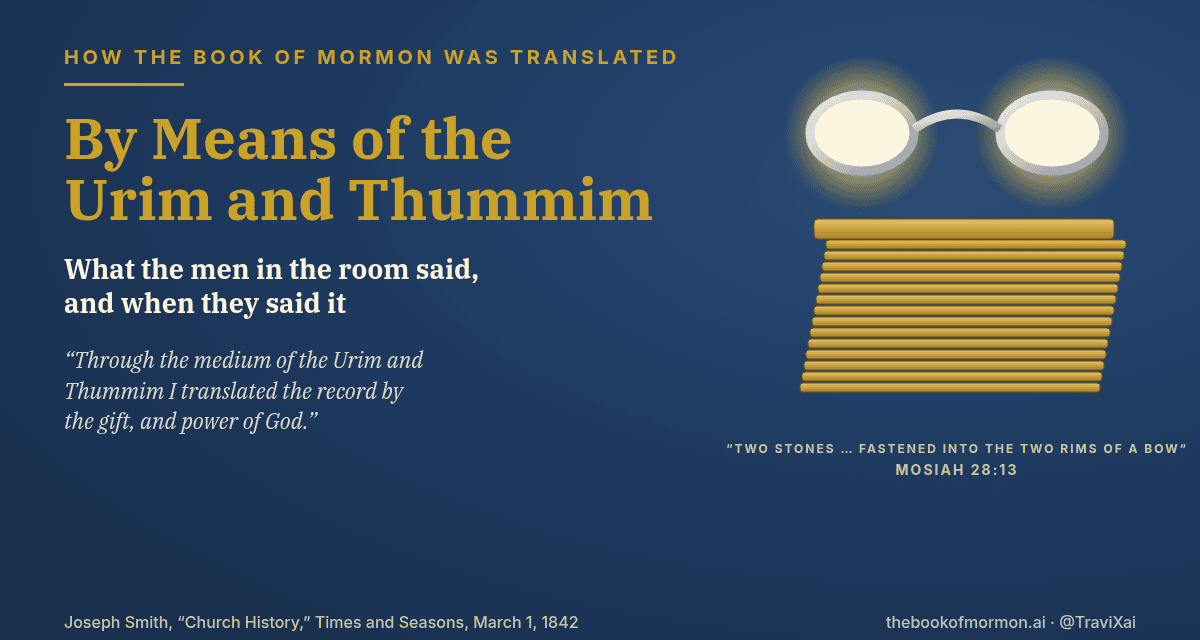
Through the medium of the Urim and Thummim I translated the record by the gift, and power of God.
Joseph Smith, “Church History,” March 1, 1842
The same letter says the instrument “consisted of two transparent stones set in the rim of a bow fastened to a breast plate.” Across ten years, three genres and four documents, Joseph never described his translation any other way.
Part IIIWhat Oliver Cowdery, the scribe, said
Oliver Cowdery arrived in Harmony on April 5, 1829, and wrote nearly all of the manuscript as Joseph dictated. He spoke to the question at least three times, years apart.
1831: under oath
Added support: The Church’s own Gospel Topics essay on translation quotes a statement Cowdery made under oath in 1831 (reported in the Evangelical Magazine and Gospel Advocate, April 19, 1831). Joseph, he said, had:
… found with the plates, from which he translated his book, two transparent stones, resembling glass, set in silver bows. That by looking through these, he was able to read in English, the reformed Egyptian characters, which were engraved on the plates.
Oliver Cowdery, 1831, as quoted in Gospel Topics Essays, “Book of Mormon Translation”
From JSF: McConkie and Ostler add an even earlier report. In June 1831, an Ohio writer named Josiah Jones said the first missionaries (Cowdery, Pratt, Whitmer and Peterson) told him the book was translated by “looking into a stone or two stones, when put into a dark place, which stones he said were found in the box with the plates.” Cowdery, Jones added, said he himself “was not permitted to look into them.”
1834: “with the Urim and Thummim”
From JSF: In October 1834, in the Church’s Kirtland newspaper, Cowdery wrote the description that the Church still prints with Joseph Smith—History:
These were days never to be forgotten—to sit under the sound of a voice dictated by the inspiration of heaven, awakened the utmost gratitude of this bosom! Day after day I continued, uninterrupted, to write from his mouth, as he translated with the Urim and Thummim, or, as the Nephites would have said, ‘Interpreters,’ the history or record called ‘The Book of Mormon.’
Oliver Cowdery, Messenger and Advocate 1 (October 1834): 14, reprinted in the note to Joseph Smith—History 1:71
1848: on his return to the Church
From JSF: Cowdery left the Church in 1838. Ten years later, at Kanesville (Council Bluffs), Iowa, he asked to come back, and he bore this testimony, as quoted on the JSF page:
I wrote with my own pen, the entire Book of Mormon (save a few pages) as it fell from the lips of the Prophet Joseph Smith, as he translated it by the gift and power of God, by means of the Urim and Thummim, or, as it is called by the book, ‘holy interpreters.’ I beheld with my eyes, and handled with my hands, the gold plates from which it was translated. I also saw with my eyes and handled with my hands the ‘holy interpreters.’
Oliver Cowdery, 1848, as cited in Joseph Fielding Smith, The Restoration of All Things, 113; quoted by JSF
After a decade outside the Church, with no position to protect, he said what he had said in 1831 and 1834.
Part IVWhat the revelations and the Book of Mormon say
From JSF: McConkie and Ostler note that one of the first things Joseph translated after Cowdery became his scribe was Ammon’s description of a seer to King Limhi. It reads like a job description for Joseph:
… for he has wherewith that he can look, and translate all records that are of ancient date; and it is a gift from God. And the things are called interpreters, and no man can look in them except he be commanded, lest he should look for that he ought not and he should perish. And whosoever is commanded to look in them, the same is called seer.
Mosiah 8:13
Added support: King Limhi answers that “these interpreters were doubtless prepared for the purpose of unfolding all such mysteries to the children of men” (Mosiah 8:19). Twenty chapters later, Mormon tells us how Mosiah actually did it:
And now he translated them by the means of those two stones which were fastened into the two rims of a bow. Now these things were prepared from the beginning, and were handed down from generation to generation, for the purpose of interpreting languages …
Mosiah 28:13–14
Mosiah then passes on “the interpreters” with the records to Alma (Mosiah 28:20). Moroni traces the same instrument back to the brother of Jared, to whom the Lord said, “these two stones will I give unto thee, and ye shall seal them up also with the things which ye shall write,” promising that “these stones shall magnify to the eyes of men these things which ye shall write” (Ether 3:23–24; see v. 28).
The Book of Mormon describes its own translation tool and why it was buried with the record. That is the heart of JSF’s argument from “the divine pattern.”
The revelations of 1828–1829
Now, behold, I say unto you, that because you delivered up those writings which you had power given unto you to translate by the means of the Urim and Thummim, into the hands of a wicked man, you have lost them.
Doctrine and Covenants 10:1
Added support: For accuracy: the earliest text read “which you had power to translate”; the words “by the means of the Urim and Thummim” appear in the 1835 edition (see the Joseph Smith Papers introduction). So in 1835, preparing his revelations for publication, Joseph chose to name the instrument.
The June 1829 revelation to the Three Witnesses promised they would see “the plates, and also of the breastplate, the sword of Laban, the Urim and Thummim, which were given to the brother of Jared upon the mount” (D&C 17:1). The section heading adds that this revelation itself “was given in answer through the Urim and Thummim.” If the interpreters had been taken away for good in 1828, as David Whitmer later said, it is hard to explain why the Lord would show them to the witnesses at the very end of the translation.
Part VThe early record outside Joseph and Oliver
Added support: Other early sources, all decades before the stone-in-hat interviews, point the same way.
- 1833, the Church’s first newspaper. W. W. Phelps wrote in The Evening and the Morning Star (January 1833) that the book “was translated by the gift and power of God, by an unlearned man, through the aid of a pair of Interpreters, or spectacles—(known, perhaps, in ancient days as Teraphim, or Urim and Thummim).” (Transcription at the B. H. Roberts Foundation.)
- 1840, the first missionary tract printed abroad. Orson Pratt’s Edinburgh pamphlet An Interesting Account of Several Remarkable Visions says Joseph “commenced translating the record, by the gift and power of God, through the means of the Urim and Thummim,” an instrument of “two transparent stones, clear as crystal, set in the two rims of a bow.” (Joseph Smith Papers, p. 14.) Joseph drew on this tract for his 1842 Wentworth letter.
- 1844–45, the Prophet’s mother. Lucy Mack Smith’s history records Joseph’s account of the lost 116 pages: “on the 22d of September, I had the joy and satisfaction of again receiving the Urim and Thummim; and have commenced translating again.” (Lucy Mack Smith, History, 1845, p. 138.) Her earlier draft describes handling the instrument through a cloth and finding “2 smooth stones con[n]ected with each other in the same way that old fashioned spectacles are made” (History, 1844–1845).
Part VIWhere the stone-in-hat accounts come from
Now the other side of the ledger, stated fairly. Four sources stand behind the stone-in-a-hat description.
Isaac Hale (1834)
Emma’s father signed an affidavit in March 1834 that was printed in E. D. Howe’s Mormonism Unvailed, one of the first books written against the Church. Hale said “the manner in which he pretended to read and interpret, was the same as when he looked for the money-diggers, with the stone in his hat, and his hat over his face, while the Book of Plates were at the same time hid in the woods!” (transcription). Hale was early, but he was openly opposed to Joseph, he called the whole work “a delusion,” and he says he was not allowed to look into the box said to hold the plates. His statement is a comparison with treasure-seeking, not a scribe’s description.
Martin Harris (1870s, as reported)
Harris was a scribe in 1828, before the 116 pages were lost. Late in his life, an associate who interviewed him recorded Harris saying that Joseph “possessed a seer stone, by which he was enabled to translate as well as from the Urim and Thummim, and for convenience he then used the seer stone” (quoted in the Gospel Topics essay). It is secondhand, recorded more than forty years later, and it still names the Urim and Thummim. And Harris’s own time as scribe was in 1828; the text we have was translated in 1829.
Emma Smith (1879)
Shortly before her death, Emma told her son Joseph Smith III that she had written “day after day, often sitting at the table close by him, he sitting with his face buried in his hat, with the stone in it, and dictating hour after hour with nothing between us” (“Last Testimony of Sister Emma,” Saints’ Herald, October 1, 1879). Emma was a firsthand witness, and her testimony that “no man could have dictated the writing of the manuscripts unless he was inspired” is precious (see Emma Smith’s Last Testimony). But her interview came 50 years after the fact, her time as scribe was mainly in 1828, and it was given through a son whose church was by then separate from the body of Saints led by Brigham Young.
David Whitmer (1869–1888)
The fullest stone-in-hat description comes from David Whitmer, one of the Three Witnesses. In his 1887 pamphlet he wrote: “Joseph Smith would put the seer stone into a hat, and put his face in the hat, drawing it closely around his face to exclude the light; and in the darkness the spiritual light would shine. A piece of something resembling parchment would appear, and on that appeared the writing” (An Address to All Believers in Christ, 1887). Whitmer saw the work at his father’s house in Fayette in June 1829. He never translated, and he wrote this almost fifty years after leaving the Church in 1838.
Part VIIWeighing the witnesses: JSF’s critique
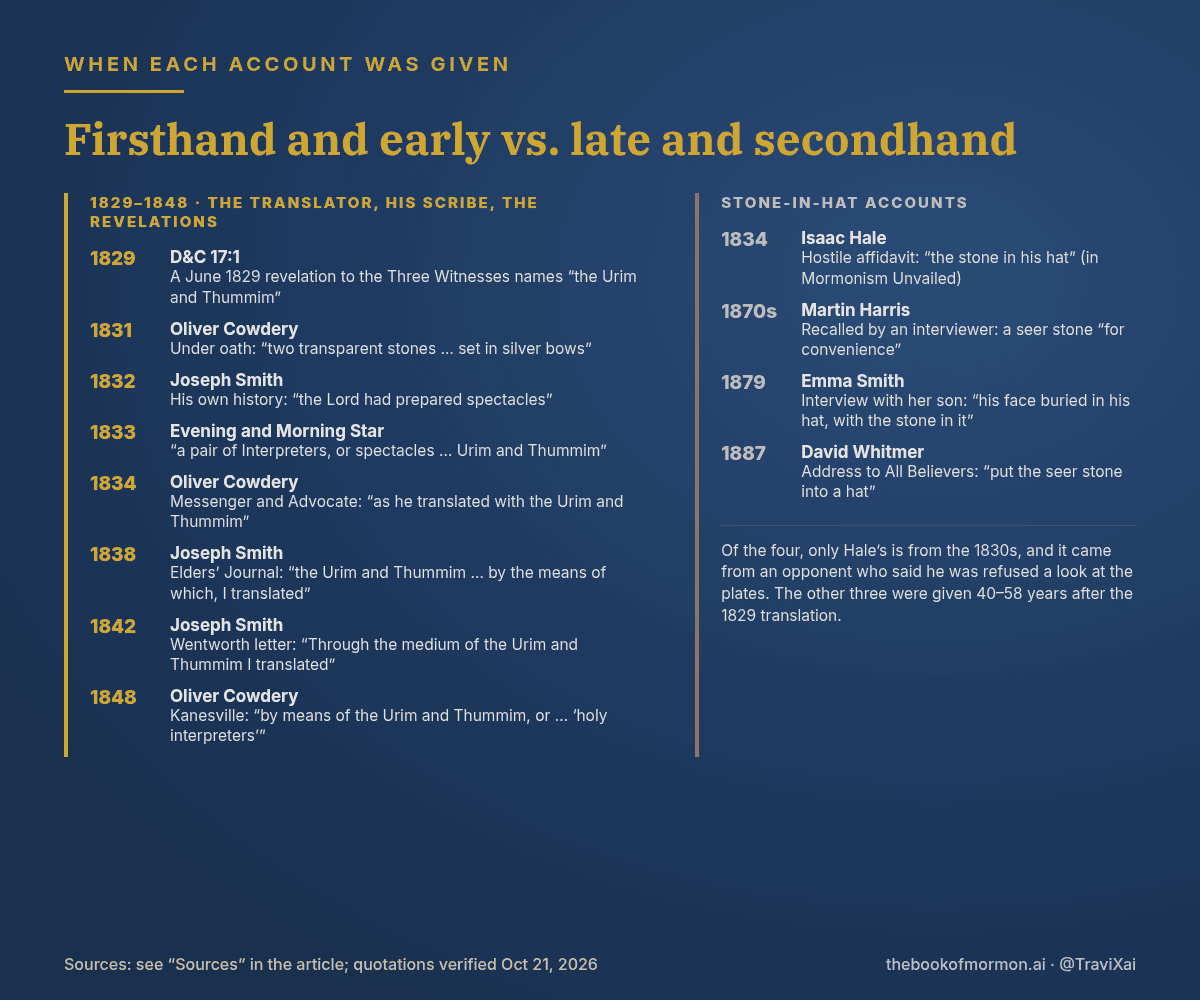
Historians ask the same questions of every source: Was the witness there? How soon did they speak? Did they know it directly? Did their account stay consistent? Put the accounts side by side and the pattern is hard to miss.
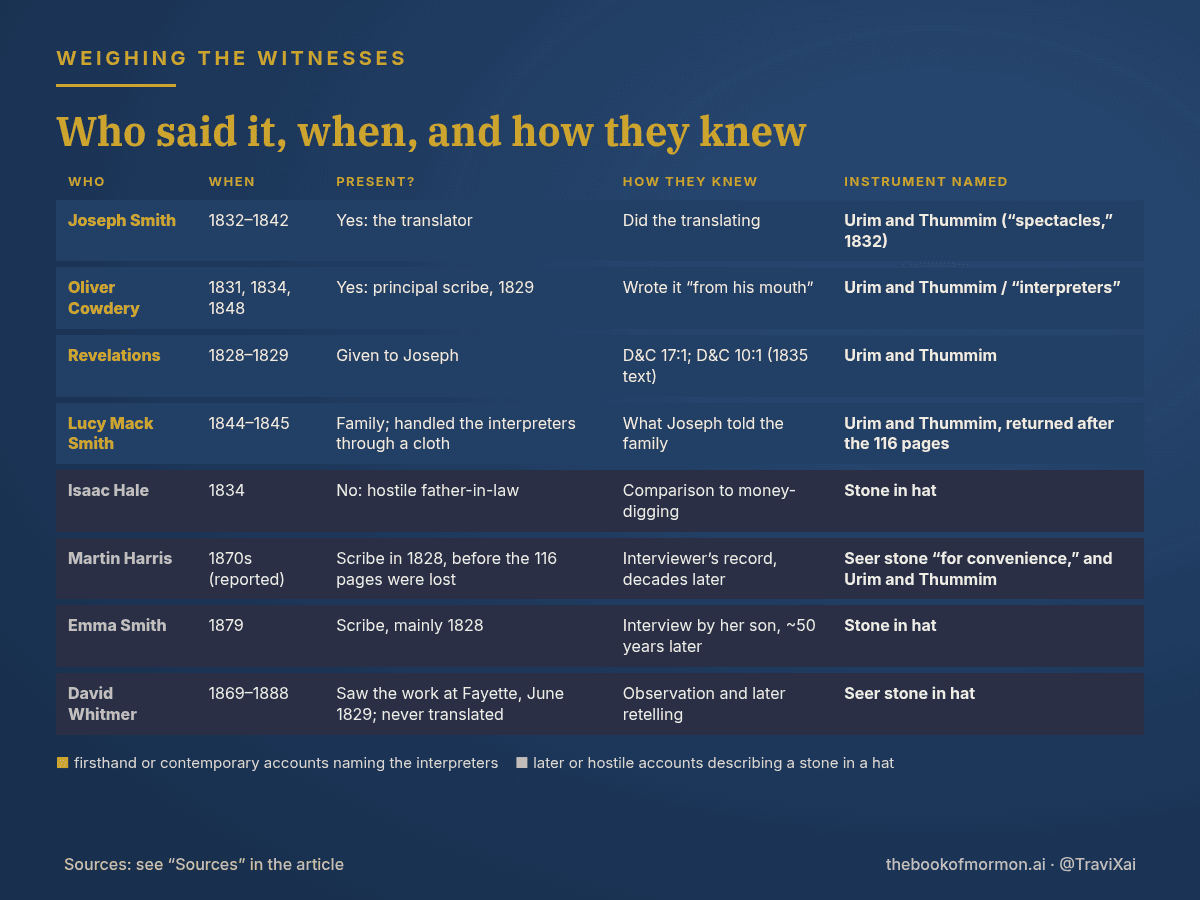
From JSF: McConkie and Ostler give six reasons not to build our understanding on Whitmer’s account. In summary:
- He never translated. “He never looked into the Urim and Thummim nor translated anything. His testimony of how the Book of Mormon was translated is hearsay.”
- His accounts conflict. Some seventy recorded statements claim Whitmer as their source between 1869 and 1888, “a number of inconsistencies” among them. Thomas Wood Smith, who interviewed Whitmer in January 1876, insisted that Whitmer told him Joseph “possessed, and used the Urim and Thummim in the translation” and had even “described the form and size” of it.
- He contradicts the revelations. Whitmer said the plates and interpreters were taken in 1828 “never to be returned.” Joseph’s history, Lucy’s history, and D&C 10 and 17 all say they came back.
- His model leaves no room for D&C 9. Whitmer described word-by-word divine dictation, spelling included. D&C 9 describes studying it out and seeking confirmation, and the text has been carefully edited since 1830, which Brigham Young said he expected: “if the Book of Mormon were now to be re-written, in many instances it would materially differ from the present translation” (Journal of Discourses 9:311).
- Oliver couldn’t do it. “If the process of translation was simply a matter of reading from a seer stone in a hat, surely Oliver Cowdery could do that as well … How then do we account for Oliver’s inability to translate?”
- It makes the plates pointless. If Joseph read everything off a stone found while digging a well, why the four years of tutoring, the duplicate small plates to replace the 116 pages, the danger of guarding the plates, and showing them to eleven witnesses?
What David Whitmer is asking us to believe is that the Lord had Moroni seal up the plates and the means by which they were to be translated hundreds of years before they would come into Joseph Smith’s possession and then decided to have the Prophet use a seer stone found while digging a well so that none of these things would be necessary after all.
McConkie and Ostler, as republished by JSF
From JSF: What about the hat? McConkie and Ostler quote an account from Joseph’s brother William Smith, published in The Rod of Iron (February 1924) and itself a late source, that the instrument “caused a strain on Joseph’s eyes, and he sometimes resorted to covering his eyes with a hat to exclude the light in part.” On that reading, a hat is not evidence of a different instrument at all.
From JSF: JSF’s book goes further on Whitmer’s later life, which it treats at length. Its video Debunked: The ‘Seer Stone Translation’ Hypothesis Originates from Unreliable Sources summarizes the case in a few minutes.
From JSF: McConkie and Ostler are careful to add that they are “entirely respectful of and grateful for” Whitmer’s witness of the Book of Mormon, which he never denied. Being a witness of the plates, they argue, “does not make him a competent witness to the process of translation.” That is the right spirit for this whole conversation.
Part VIIIWhat the manuscript and the Church’s essay add
Added support: The original manuscript, studied by Royal Skousen, shows that scribes wrote what they heard (at 1 Nephi 17:48 “weed” for “reed,” per the Gospel Topics essay). That confirms dictation, which both views accept, but cannot tell us which instrument Joseph held.
The Church’s Gospel Topics essay presents both instruments: it says “Joseph placed either the interpreters or the seer stone in a hat,” and that “most of the accounts speak of Joseph’s use of the Urim and Thummim (either the interpreters or the seer stone).” Notice the word “either.” Holding the view of Joseph, Oliver and the revelations is not a rejection of the Church’s historians. It is a judgment about which witnesses deserve the most weight.
And on what matters most, every witness agrees. Joseph said “the gift, and power of God.” Oliver said “the gift and power of God.” Whitmer said “the gift and power of God.” Emma said no man could have done it “unless he was inspired.”
- Joseph Smith named the instrument in 1832 (“spectacles”), 1838 and 1842 (“Urim and Thummim”), and never described his translation another way.
- Oliver Cowdery, who wrote nearly the whole manuscript, said “Urim and Thummim” in 1831, 1834 and 1848, including after ten years outside the Church.
- The Book of Mormon describes a two-stone instrument “prepared … for the purpose of interpreting languages” (Mosiah 28:14) and sealed up with the record (Ether 3:23).
- D&C 17:1 promised the witnesses a view of the Urim and Thummim in June 1829, at the end of the translation.
- The stone-in-hat accounts came 40–58 years later (Harris, Emma, Whitmer), or from a hostile 1834 affidavit (Hale).
- The Joseph Smith Foundation, following McConkie and Ostler, weighs the firsthand testimony most heavily. It is a faithful view, and it is fine to hold.
Part IXGo deeper with JSF
- Book: L. Hannah Stoddard and James F. Stoddard III, Seer Stone v. Urim & Thummim: Book of Mormon Translation on Trial (Joseph Smith Foundation, 2019; also on Google Play and Amazon)
- Reference article: The Process of Translating the Book of Mormon (McConkie and Ostler)
- Video: JSF, “Did Joseph Smith Study the Nephite Culture & Language to Translate the Book of Mormon?”
- Interview: Hannah Stoddard, “Joseph Smith, Treasure Digging, and The Translation of The Book of Mormon” (The Stick of Joseph)
Short versions on Galatians18: Did Joseph use a seer stone in a hat? · The gold plates · The Three and Eight Witnesses
Faithful Latter-day Saints read these sources in more than one way. Our article Seer Stones in the Bible leans toward the seer-stone accounts and shows how the Bible itself uses physical instruments of revelation. It is a different faithful view, and it is fine to hold too.
Part XSources
From the Joseph Smith Foundation
- Joseph Fielding McConkie and Craig J. Ostler, “The Process of Translating the Book of Mormon,” in Revelations of the Restoration (Deseret Book, 2000), 89–98; republished at josephsmithfoundation.org. (Source of the Josiah Jones 1831 report, the Far West Record quote, Cowdery 1848, Lucy Mack Smith’s family evenings, the Whitmer critique, Thomas Wood Smith, William Smith in The Rod of Iron, and Brigham Young, JD 9:311.)
- L. Hannah Stoddard and James F. Stoddard III, Seer Stone v. Urim & Thummim: Book of Mormon Translation on Trial (Joseph Smith Foundation, 2019): JSF store · announcement
- Joseph Smith Foundation videos: “Debunked: The ‘Seer Stone Translation’ Hypothesis Originates from Unreliable Sources” · “Did Joseph Smith Study the Nephite Culture & Language to Translate the Book of Mormon?” · channel
Scripture (churchofjesuschrist.org)
JS–H 1:35 · 1:52 · 1:62 · Mosiah 8:13–19 · Mosiah 28:13–20 · Ether 3:23–28 · D&C 9:8–9 · D&C 10:1 · D&C 17:1
Primary sources and other support added here
- Joseph Smith, History, circa Summer 1832, p. 5
- Joseph Smith, Elders’ Journal, July 1838
- Joseph Smith, “Church History” (Wentworth letter), Times and Seasons, March 1, 1842
- Oliver Cowdery, Messenger and Advocate 1 (October 1834): 14, in the note to JS–H 1:71
- Revelation, Spring 1829 [D&C 10], historical introduction
- W. W. Phelps, “The Book of Mormon,” The Evening and the Morning Star 1, no. 8 (January 1833): 58, transcription
- Orson Pratt, An Interesting Account of Several Remarkable Visions (Edinburgh, 1840), p. 14
- Lucy Mack Smith, History, 1845, p. 138; History, 1844–1845
- Gospel Topics Essays, “Book of Mormon Translation” (Cowdery 1831; Martin Harris; Skousen manuscript evidence)
- Isaac Hale, affidavit, March 20, 1834, in E. D. Howe, Mormonism Unvailed (1834), 262–66: transcription
- “Last Testimony of Sister Emma,” Saints’ Herald 26 (October 1, 1879): 289–90: BYU Religious Studies Center reprint
- David Whitmer, An Address to All Believers in Christ (Richmond, Missouri, 1887): Internet Archive
Image credits
- Featured image, timeline, comparison chart and interpreters diagram: original graphics by thebookofmormon.ai (no photographs or likenesses of real people). The interpreters diagram is drawn from the written descriptions cited in its caption and is not a picture of the original.
Read the witnesses for yourself. Start with Joseph Smith—History 1:35 and Oliver Cowdery’s note after verse 71, then pick up Seer Stone v. Urim & Thummim. For short, sourced answers to the questions people ask most, visit Galatians18.
Follow me on X for more: @TraviXai.