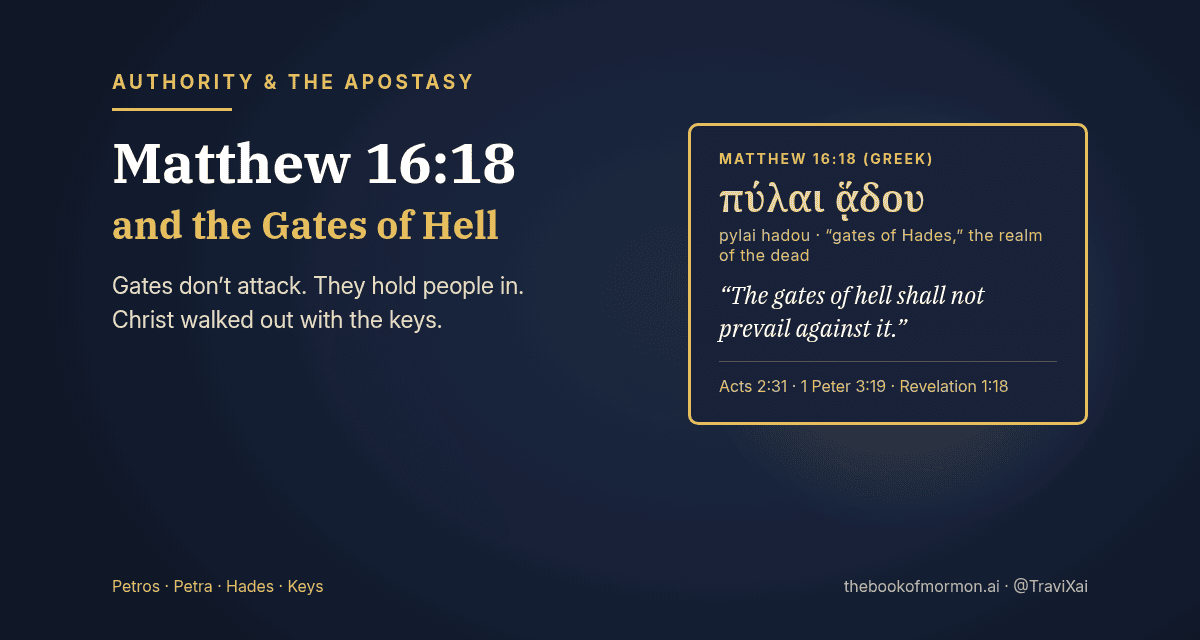

Critics quote “the gates of hell shall not prevail” as proof the church could never fall away. Read the Greek, follow the Hades verses, and the promise turns out to be bigger than that: death itself can’t keep Christ’s people locked in.
Every conversation about the Great Apostasy ends up at the same verse. “The gates of hell shall not prevail against it.” Case closed, says the critic. Jesus promised His church would never fall, so it never fell, so nothing needed restoring.
It’s a fair verse to bring. It just isn’t saying what they think. Read it slowly, in its setting and in its own Greek, and Matthew 16:18 makes a much bigger promise than “the church will never have a bad century.” It promises that death doesn’t get the last word.
Caesarea PhilippiRead the whole scene
Jesus takes the Twelve north to Caesarea Philippi and asks two questions. First, “Whom do men say that I the Son of man am?” Then the one that matters: “But whom say ye that I am?” (Matthew 16:13, 15). Peter answers, “Thou art the Christ, the Son of the living God” (16:16). And before Jesus says a word about rocks or keys, He names where that answer came from:
Blessed art thou, Simon Bar-jona: for flesh and blood hath not revealed it unto thee, but my Father which is in heaven.
Matthew 16:17 (KJV)
Peter didn’t reason his way there. Heaven told him. Joseph Smith drew the obvious line from verse 17 to verse 18: “Jesus in His teachings says, ‘Upon this rock I will build my Church, and the gates of hell shall not prevail against it.’ What rock? Revelation.” (Teachings of Presidents of the Church: Joseph Smith, ch. 16).
Petros and petraWhich rock?
And I say also unto thee, That thou art Peter, and upon this rock I will build my church; and the gates of hell shall not prevail against it.
Matthew 16:18 (KJV)
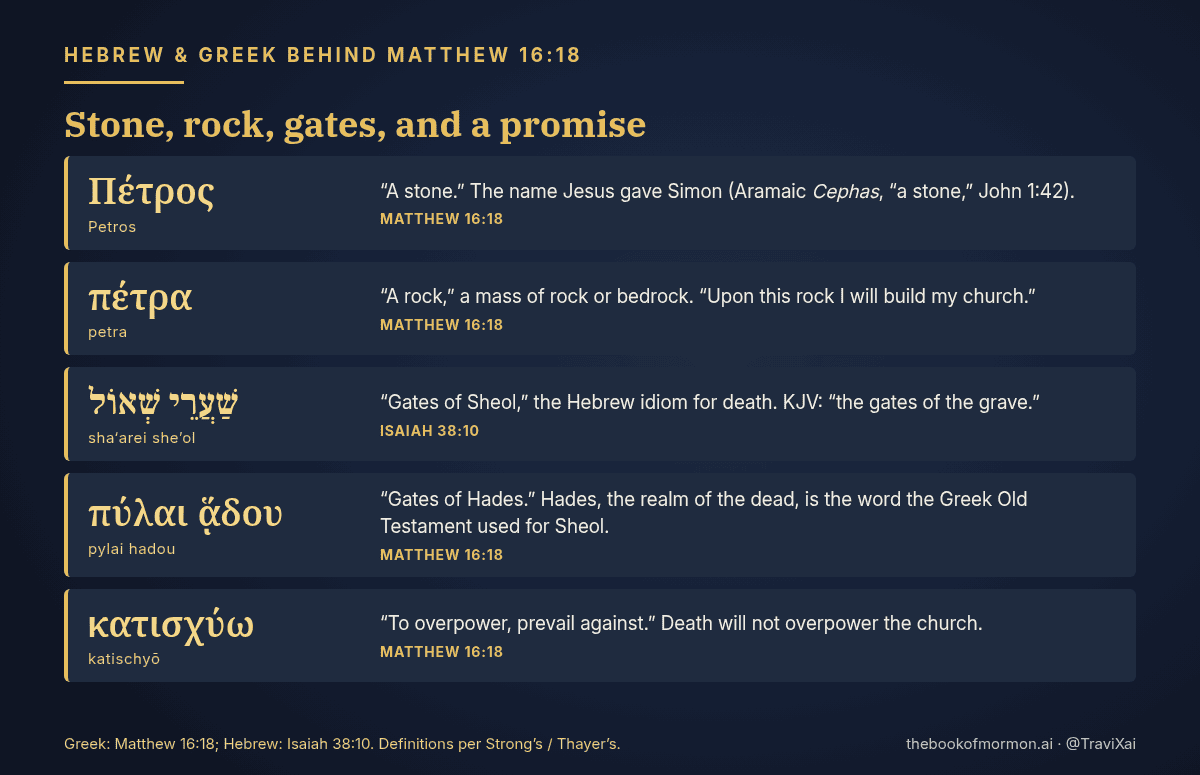
In Greek it reads sy ei Petros, kai epi tautē tē petra: “thou art Petros, and upon this petra.” Strong’s gives Petros as “a (piece of) rock” and petra as “a (mass of) rock.” The nineteenth-century Presbyterian scholar Marvin R. Vincent put it this way: petra “means a rock, as distinguished from a stone or a fragment of rock” (Word Studies in the New Testament).
To be fair, Jesus likely spoke Aramaic, and there the name was Cephas, “which is by interpretation, A stone” (John 1:42). So the wordplay is debated, and Christians have read the rock at least three ways. Catholics read it as Peter himself. Many Protestants read it as Peter’s confession, or as Christ, since “that Rock was Christ” (1 Corinthians 10:4) and the church is “built upon the foundation of the apostles and prophets, Jesus Christ himself being the chief corner stone” (Ephesians 2:20). Latter-day Saints read it, with Joseph Smith, as revelation, the very thing verse 17 just described.
Here’s what none of those readings find in the verse: a clause saying the church could never lose its apostles. Matthew 16:18 names a foundation. It doesn’t lay out a succession plan.
Pylai hadouWhat the “gates of hell” are
Now the phrase everybody quotes. “Hell” here isn’t gehenna, the place of punishment. It’s hadēs: pylai hadou, “the gates of Hades.” Vincent is blunt about what that word means: “In the New Testament, Hades is the realm of the dead.” He adds that it’s the word the Septuagint, the Greek Old Testament, used for the Hebrew Sheol.
And the Old Testament already had this exact idiom. When King Hezekiah thought he was dying, he said:
I said in the cutting off of my days, I shall go to the gates of the grave: I am deprived of the residue of my years.
Isaiah 38:10 (KJV)
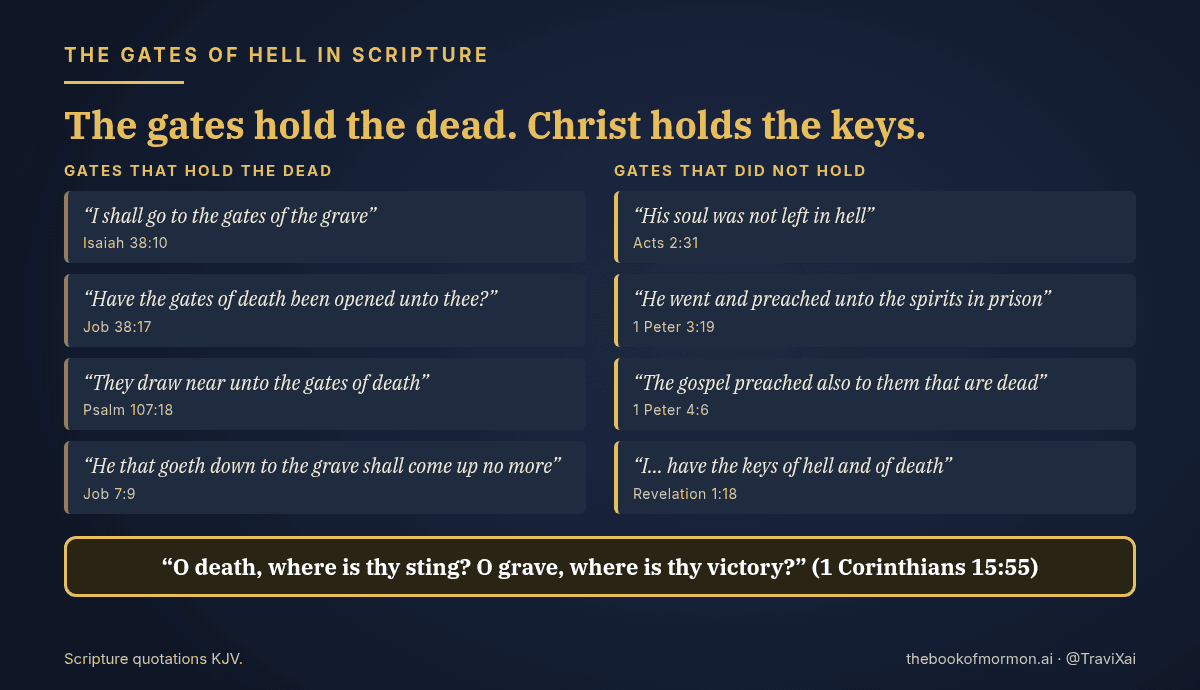
The Hebrew there is sha‘arei she’ol, “the gates of Sheol.” Job hears, “Have the gates of death been opened unto thee?” (Job 38:17), and the sick in Psalm 107 “draw near unto the gates of death” (Psalm 107:18). You reach those gates one way. You die.
Gates don’t chase anybody. They hold people in. That’s the point BYU scholar S. Kent Brown makes about the word “prevail”: the image of gates attacking is possible, “it seems instead that the gates exercise power over individuals by keeping them inside Hades” (“Peter’s Keys,” 2014). Vincent, for his part, pictured Hades as a hostile city that “confronts and assaults the church.” Either way, the enemy in this verse is death and the realm of the dead.
Friday and SundayChrist walked out with the keys
So did the gates of Hades ever get their hands on anyone in Christ’s church? Yes. They got Christ. Peter preached it on the day of Pentecost: David “spake of the resurrection of Christ, that his soul was not left in hell, neither his flesh did see corruption” (Acts 2:31). Same word, hadēs. Jesus went in. Hades couldn’t keep Him.
I am he that liveth, and was dead; and, behold, I am alive for evermore, Amen; and have the keys of hell and of death.
Revelation 1:18 (KJV)
Hades had Friday. It didn’t get Sunday.
And He didn’t just walk out. He preached while He was there. Peter again, the same apostle who heard Matthew 16:18 in person:
For Christ also hath once suffered for sins, the just for the unjust, that he might bring us to God, being put to death in the flesh, but quickened by the Spirit: By which also he went and preached unto the spirits in prison.
1 Peter 3:18–19 (KJV)
“For this cause was the gospel preached also to them that are dead” (1 Peter 4:6). This isn’t only a Latter-day Saint reading. The Catholic Catechism says “Scripture calls the abode of the dead, to which the dead Christ went down, ‘hell’ – Sheol in Hebrew or Hades in Greek,” and that “the descent into hell brings the Gospel message of salvation to complete fulfilment” (CCC 633–634). Latter-day Saint scripture describes the same mission: from the righteous dead the Lord “organized his forces and appointed messengers, clothed with power and authority… and thus was the gospel preached to the dead” (D&C 138:30).
That’s the real force of Matthew 16:18. The gates of Hades can’t hold Christ, and they won’t get to hold His people either, living or dead. (For the short version to send a friend, see The Gates of Hell on Galatians18.)
Matthew 16:19The keys of the kingdom
Gates need keys. And the very next line hands some out:
And I will give unto thee the keys of the kingdom of heaven: and whatsoever thou shalt bind on earth shall be bound in heaven: and whatsoever thou shalt loose on earth shall be loosed in heaven.
Matthew 16:19 (KJV)
Keys in scripture mean authority to open and shut. Isaiah describes a steward who receives “the key of the house of David… so he shall open, and none shall shut” (Isaiah 22:22), and the risen Christ is the one who “hath the key of David” (Revelation 3:7). Two chapters after Peter’s promise, Jesus gives the same binding power to the Twelve together: “Whatsoever ye shall bind on earth shall be bound in heaven” (Matthew 18:18).
Brown connects the two halves of the passage neatly: “The same person holds both sets of keys, one that allows departed spirits out of Hades and the other that allows entry from prison into God’s kingdom. It is the latter set of keys that Jesus promises to entrust to Peter.” Christ keeps the keys of death. Peter gets the keys of the kingdom.
Joseph Smith read verse 19 the same direction. In D&C 128:10, while explaining ordinances for the dead, he quotes Matthew 16:18–19 “for the precedent.” Binding on earth, bound in heaven, reaching even those behind the gates. (More at Baptism for the Dead.)
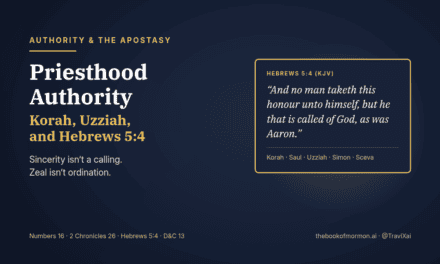
One more thing about keys: someone has to hold them. They were given to living men by a call from God, and nobody inherits them by reading the verse. “No man taketh this honour unto himself” (see Priesthood Authority: Korah, Uzziah, and Hebrews 5:4 and Priesthood Authority).
“Prevail”Does it mean “never stumble”?
The verb is katischyō, “to overpower.” It’s a promise about who wins, not a promise that nothing ever goes wrong. Scripture uses the same language for a season when the saints lose:
I beheld, and the same horn made war with the saints, and prevailed against them; Until the Ancient of days came, and judgment was given to the saints of the most High; and the time came that the saints possessed the kingdom.
Daniel 7:21–22 (KJV)
“Prevailed against them… until.” John saw the same thing: “it was given unto him to make war with the saints, and to overcome them” (Revelation 13:7). Even the wise man’s house on the rock took the rain, the floods, and the wind. It “fell not” (Matthew 7:25). Building on a rock doesn’t cancel the storm. It decides how the storm ends.
That’s how the verse sits next to the New Testament’s own warnings, which are many: “a falling away first” (2 Thessalonians 2:3), and wolves who would not spare the flock. (The full list, in the apostles’ own words, is in The Great Apostasy in the New Testament’s Own Words.) Peter, who heard Matthew 16:18 firsthand, still preached that heaven would receive Jesus “until the times of restitution of all things” (Acts 3:21). You only restore what was lost. (See The Great Apostasy.)
And there’s a dilemma waiting for anyone who uses this verse against a restoration. If Matthew 16:18 means the church could never fall into serious error, the Reformers had no reason to leave Rome. If the church could fall into error, the verse doesn’t rule out an apostasy. So which is it?
A promise that death won’t win is kept by a resurrection, not by never dying. Christ’s body went into the tomb, and came out. His church went through a falling away, and came back with apostles and keys. Either way, the gates didn’t prevail.
WatchDid the original church fall apart?
Saints Unscripted takes on the “did the church ever fall?” question here:
SummaryKey takeaways
- The rock follows a revelation from the Father (Matthew 16:17). Joseph Smith: “What rock? Revelation.”
- Petros is “a stone”; petra is “a rock.” The verse names a foundation, not a guarantee that apostles could never be lost.
- “Hell” is hadēs, the realm of the dead. The “gates of Sheol” are where the dying go (Isaiah 38:10).
- Christ went into Hades and came out with “the keys of hell and of death” (Acts 2:31; Revelation 1:18), and the gospel was preached to the dead (1 Peter 3:19; 4:6).
- “Prevail” is about the outcome. The saints could be overcome for a season (Daniel 7:21–22), then comes the “restitution of all things” (Acts 3:21).
Next time someone quotes “the gates of hell shall not prevail,” agree with them. Then ask what hadēs means, and who walked out of it holding the keys. For quick, sourced answers on the Apostasy and the Restoration, open Galatians18. And for more like this every day, follow me on X at @TraviXai.
Sources
- Scriptures (KJV and Latter-day Saint scripture, churchofjesuschrist.org): Matthew 16:13–19 · Matthew 18:18 · Matthew 7:24–25 · John 1:42 · 1 Corinthians 10:4 · Ephesians 2:20 · Isaiah 38:10 · Job 38:17 · Job 7:9 · Psalm 107:18 · Acts 2:27, 31 · Revelation 1:18 · 1 Peter 3:18–20 · 1 Peter 4:6 · 1 Corinthians 15:55 · Isaiah 22:22 · Revelation 3:7 · Daniel 7:21–22 · Revelation 13:7 · 2 Thessalonians 2:3 · Acts 3:21 · D&C 128:10 · D&C 138:30
- Greek text of Matthew 16:18 and lexicon entries (Strong’s, Thayer’s, HELPS) at Bible Hub: Matthew 16:18 Greek · Petros (4074) · petra (4073) · hadēs (86) · pylē (4439) · katischyō (2729) · Isaiah 38:10 interlinear
- Marvin R. Vincent, Word Studies in the New Testament (1886), on Matthew 16:18: Bible Hub
- S. Kent Brown, “Peter’s Keys,” in The Ministry of Peter, the Chief Apostle, ed. Frank F. Judd Jr., Eric D. Huntsman, and Shon D. Hopkin (Provo, UT: Religious Studies Center; Salt Lake City: Deseret Book, 2014), 91–102: BYU Religious Studies Center
- Catechism of the Catholic Church, paragraphs 632–634, “Christ Descended into Hell”: vatican.va
- Teachings of Presidents of the Church: Joseph Smith (2007), chapter 16, “Revelation and the Living Prophet” (discourse of Jan. 22, 1843): churchofjesuschrist.org
- Saints Unscripted, “Did the Original Church FALL APART?!”: YouTube
- Related on this site: Priesthood Authority: Korah, Uzziah, and Hebrews 5:4 · The Great Apostasy in the New Testament’s Own Words
- Galatians18: The Gates of Hell · Baptism for the Dead · Priesthood Authority · The Great Apostasy
- Featured image, word card, and chart: original graphics by thebookofmormon.ai (no photographs or likenesses of real people).