
Constantine called the council, sat in the room, and urged one Greek word into the creed. He wasn’t baptized until 337. Here’s what the ancient sources actually say happened at Nicaea, and why it looks nothing like Acts 15.
Every week someone on X tells me the real test of a Christian is a creed written in 325. Fair enough. Let’s go to 325 and look at the room.
Not the internet version, where Constantine invents the Trinity and picks the Bible’s books over lunch. That version is wrong, and we don’t need it. The real record is enough: an emperor who wasn’t baptized, a word that isn’t in the Bible, and a doctrine that was signed, enforced, reversed, and signed again over 56 years. What it doesn’t have is a prophet.
Clearing the groundWhat Nicaea didn’t do
- Nicaea didn’t pick the canon. Its twenty canons cover clergy discipline and church order. The last one says to pray standing, not kneeling, on Sundays (Canon 20). None lists the books of the Bible.
- Constantine didn’t invent the Trinity. Tertullian wrote of a “Trinity” of “three Persons” about a century earlier (Against Praxeas, ch. 2). And the 325 creed says only this about the Spirit: “And [we believe] in the Holy Ghost.”
- Nobody voted Jesus into divinity. The bishops already worshiped Christ. The fight was over how the Son relates to the Father.
Latter-day Saints, drop those myths. Critics, you’re welcome. Here’s what the sources do say.
The convenerAn emperor in the room
Eusebius of Caesarea was in the room. He says the emperor “convoked a general council” (Life of Constantine 3.6), then walked into the opening session “clothed in raiment which glittered as it were with rays of light, reflecting the glowing radiance of a purple robe,” and sat on “a low chair of wrought gold” once the bishops beckoned (3.10).
He didn’t chair the theology. The Catholic Encyclopedia says he “opened the session as honorary president,” and “the actual president seems to have been Hosius of Cordova” (“First Council of Nicaea”). But he didn’t sit quietly either. Eusebius says he went “persuading some, convincing others by his reasonings,” “until at last he succeeded in bringing them to one mind” (3.13). Before the council, he had written that the whole dispute came down to “some trifling and foolish verbal difference” (2.71). He wanted peace in his empire.
And he wasn’t baptized. The Catholic Encyclopedia again: “As a catechumen he was not permitted to assist at the sacred Eucharistic mysteries. He remained a catechumen to the end of his life” (“Constantine the Great”). The man who summoned the bishops couldn’t take the sacrament with them. In 337, dying near Nicomedia, he “now for the first time received the imposition of hands with prayer” and asked the bishops to baptize him (Life 4.61–62; Socrates 1.39).
“No man taketh this honour unto himself, but he that is called of God, as was Aaron” (Hebrews 5:4). Constantine never claimed the priesthood. He claimed something the Bible never gives a king: power to call a doctrinal council and enforce its verdict (see Priesthood Authority: Korah, Uzziah, and Hebrews 5:4).
HomoousiosOne word the Bible doesn’t have
Socrates Scholasticus preserves Eusebius’s letter home. Constantine urged everyone to sign, “with the insertion, however, of that single word homoousios (consubstantial), an expression which the emperor himself explained” (Church History 1.8). I covered his explanation, and why “same divine nature” isn’t “one substance,” in Same Divine Nature Isn’t Consubstantial. The question here is why the bishops needed a new word at all.
Athanasius, the creed’s great defender, tells us. The bishops first tried Bible language for the Son: “Image,” “always,” “in Him.” The other side kept agreeing and were “caught whispering to each other and winking with their eyes,” because the Bible says all of those things about us (De Decretis 20).
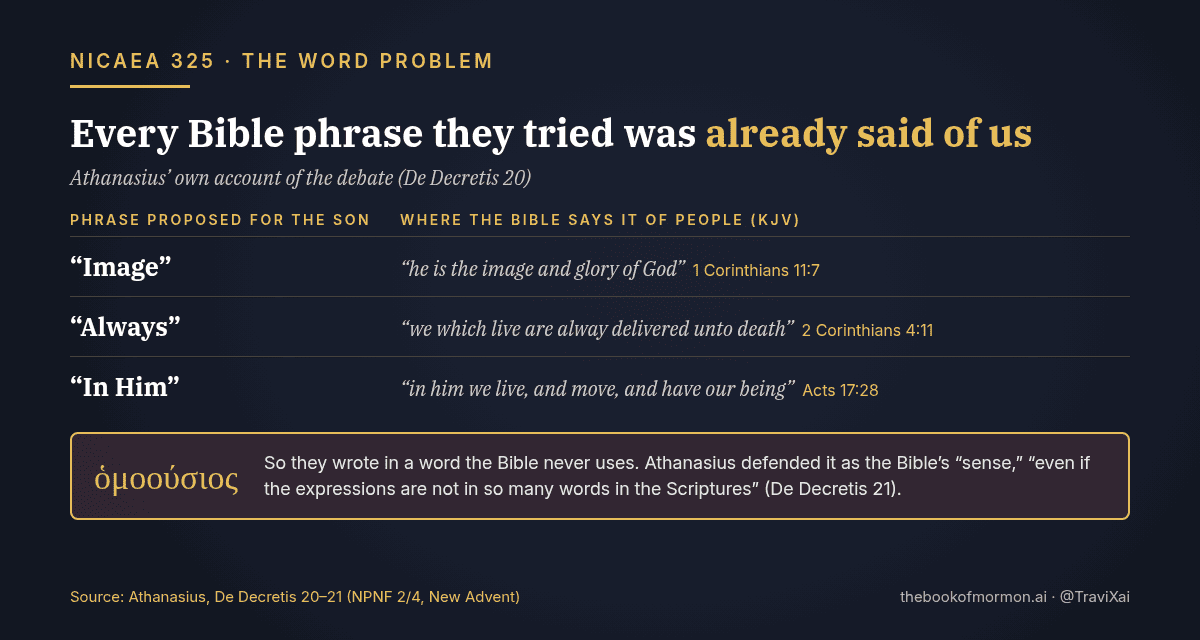
So the bishops “were again compelled on their part to collect the sense of the Scriptures” and wrote “one in essence.” Athanasius admits the terms are “not in so many words in the Scriptures” and argues they carry its “sense” (De Decretis 21). That’s honest, and it shows what this was: an inference, worded in philosophy and made binding. The Bible had its own phrase for the Son, “the express image of his person” (Hebrews 1:3). An image is always the image of someone else, which is exactly why it couldn’t do the job.
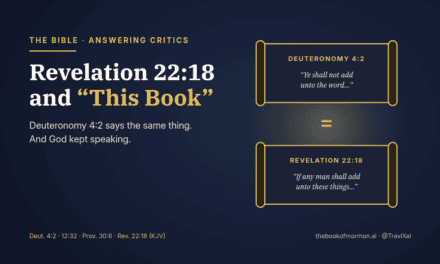
Beware lest any man spoil you through philosophy and vain deceit, after the tradition of men, after the rudiments of the world, and not after Christ.
Colossians 2:8 (KJV)
Paul wasn’t banning Greek words. The problem is a borrowed term becoming the test of faith. Even the bishops balked. Five refused at first, “objecting to the term homoousios,” and Eusebius signed only after it was explained: “nor do we cavil at the word homoousios having regard to peace” (Socrates 1.8). Signing for peace isn’t “thus saith the Lord.”
Signed and enforcedA vote, an anathema, and an edict
The creed of 325 ends with a curse:
And whosoever shall say that there was a time when the Son of God was not, or that before he was begotten he was not, or that he was made of things that were not, or that he is of a different substance or essence [from the Father] or that he is a creature, or subject to change or conversion — all that so say, the Catholic and Apostolic Church anathematizes them.
The Nicene Creed of 325
Then the state stepped in. “An edict of the emperor sent Arius himself into exile” with two bishops who backed him (Socrates 1.8). Another letter ordered Arius’s books burned: “if any one shall be detected in concealing a book compiled by Arius, and shall not instantly bring it forward and burn it, the penalty for this offense shall be death” (1.9).
How did Constantine know the council was right? “That which has commended itself to the judgment of three hundred bishops cannot be other than the doctrine of God” (Socrates 1.9). And: “whatever is determined in the holy assemblies of the bishops is to be regarded as indicative of the Divine will” (Life 3.20).
That’s an appeal to the majority, backed by an appeal to force, resting on begging the question: the assembly is right because assemblies are right. Even the headcount wobbles. Eusebius, who was there, says the bishops “exceeded two hundred and fifty” (Life 3.8). Socrates says more than three hundred (1.8).
325 to 381The settlement that didn’t settle
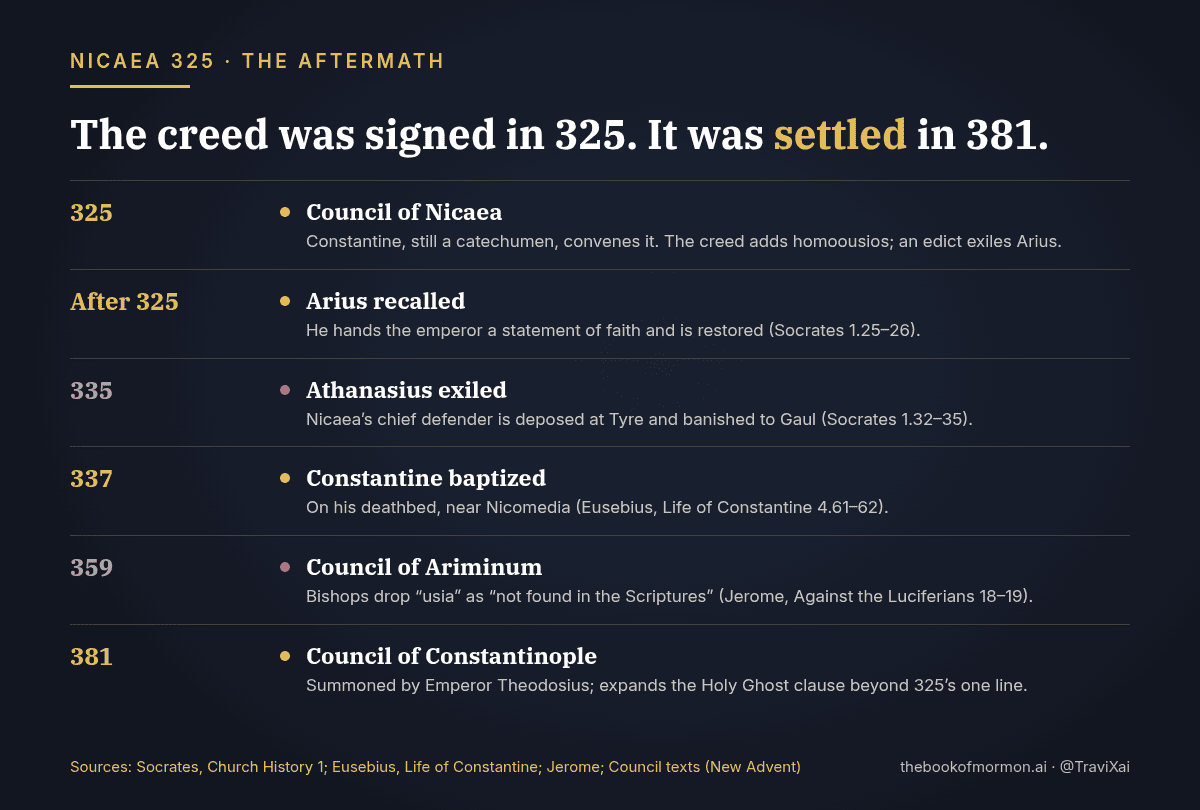
If a vote settles doctrine, Nicaea should have. The exiled bishops recanted and got their sees back (Socrates 1.14). Arius was recalled (1.25–26). Athanasius, Nicaea’s champion, was deposed at Tyre and banished to Gaul on a charge Socrates says “deceived” the emperor (1.32–35).
In 359, at Ariminum, bishops dropped the key word. Jerome, no friend of the Arians, records why: “Because it is not found in the Scriptures, they said, and its novelty is a stumbling-block to many, we have thought it best to dispense with it.” His verdict: “The whole world groaned, and was astonished to find itself Arian” (Against the Luciferians 18–19).
In 381 another emperor, Theodosius, summoned another council. At Constantinople, 150 bishops expanded the one line on the Holy Ghost to “the Lord and Giver-of-Life,” who “spoke by the prophets” (Council of Constantinople). The creed confesses that God speaks by prophets. The council just didn’t have one.
Councils overturning councils is what Paul said happens without apostles and prophets: “tossed to and fro, and carried about with every wind of doctrine” (Ephesians 4:14). See The Great Apostasy in the New Testament’s Own Words, or the Galatians18 Great Apostasy page for the short version.
Acts 15How the Bible settles a doctrine
The apostles faced a doctrinal crisis too: did Gentile converts need circumcision? Paul and Barnabas went “up to Jerusalem unto the apostles and elders about this question” (Acts 15:2). There was “much disputing” there as well. Then Peter testified that God “made choice among us” and “bare them witness, giving them the Holy Ghost,” and James added, “to this agree the words of the prophets” (15:7–8, 15). The letter they sent began with a line no Roman edict ever used:
For it seemed good to the Holy Ghost, and to us, to lay upon you no greater burden than these necessary things.
Acts 15:28 (KJV)
No emperor. No exiles. No book burning. The Holy Ghost first, and apostles holding the keys (the Galatians18 priesthood authority page traces that pattern). It’s the pattern the prophets promised:
Surely the Lord GOD will do nothing, but he revealeth his secret unto his servants the prophets.
Amos 3:7 (KJV)
Christ “gave some, apostles; and some, prophets” so “that we henceforth be no more children, tossed to and fro” (Ephesians 4:11–14). Paul’s gospel came “by the revelation of Jesus Christ” (Galatians 1:12), and he warned that people would “heap to themselves teachers” (2 Timothy 4:3). Teachers are a gift. Teachers in place of prophets is the problem.
That’s also why “just read the Bible” couldn’t end the fight. Both sides quoted the same verses. Scripture isn’t inerrant, and it was never meant to be an idol or a stand-in for the God who speaks. It’s the record of God speaking to prophets, in the Bible, in the Book of Mormon, and still today. When the speaking stops, all that’s left is arguing over words. (I asked which verse teaches sola scriptura; the Galatians18 living prophets page covers who speaks for God now.)
Jesus put the saving knowledge plainly: “this is life eternal, that they might know thee the only true God, and Jesus Christ, whom thou hast sent” (John 17:3). He prayed His disciples “may be one, even as we are one” (John 17:21–22). No council had to invent that. The Galatians18 Godhead page lays out the verses.
None of this makes the bishops villains. Many were sincere men defending Christ’s divinity, which we affirm too. Sincerity was never the question. Authority was.
SummaryKey takeaways
- Constantine convened Nicaea, opened it as honorary president, and pressed for agreement. He wasn’t baptized until his deathbed in 337.
- Nicaea didn’t choose the canon or invent the Trinity. Its one-line Holy Ghost clause was expanded in 381.
- Homoousios isn’t in the Bible. Athanasius says the bishops chose it because every scriptural phrase also applied to people.
- It was enforced by anathema, exile, and a death penalty for hiding Arius’s books, then dropped and restored over 56 years.
- In Acts 15, apostles settled doctrine by revelation: “it seemed good to the Holy Ghost, and to us.”
Next time someone says the Nicene Creed is the test, ask a simple question: which prophet revealed homoousios? For quick, sourced answers on the creeds, the Apostasy, and the Restoration, open Galatians18. And for more like this every day, follow me on X at @TraviXai.
Sources
- Scriptures (KJV, churchofjesuschrist.org): Amos 3:7 · Acts 15:2–28 · Ephesians 4:11–14 · Hebrews 1:3 · Hebrews 5:4 · Colossians 2:8 · 2 Timothy 4:3–4 · Galatians 1:11–12 · John 17:3 · John 17:21–22 · 1 Corinthians 11:7 · 2 Corinthians 4:11 · Acts 17:28
- Eusebius of Caesarea, Life of Constantine, trans. Ernest Cushing Richardson, NPNF 2nd ser., vol. 1: Book II (2.68, 2.71) · Book III (3.6–3.20) · Book IV (4.61–4.62)
- Socrates Scholasticus, Church History, Book I (ch. 8–9, 14, 25–26, 32–35, 39), trans. A. C. Zenos, NPNF 2nd ser., vol. 2: newadvent.org
- First Council of Nicaea (325): creed with anathemas and the twenty canons, NPNF 2nd ser., vol. 14: newadvent.org
- Athanasius, De Decretis (Defence of the Nicene Definition), §§19–21, NPNF 2nd ser., vol. 4: newadvent.org
- Jerome, Dialogue Against the Luciferians, §§17–19, NPNF 2nd ser., vol. 6: newadvent.org
- First Council of Constantinople (381): creed and canons, NPNF 2nd ser., vol. 14: newadvent.org
- Tertullian, Against Praxeas, ch. 2, ANF vol. 3: newadvent.org
- Catholic Encyclopedia (1908–1911): “First Council of Nicaea” · “Constantine the Great” · “Arianism” · “First Council of Constantinople”
- Related on this site: Same Divine Nature Isn’t Consubstantial · The Great Apostasy in the New Testament’s Own Words · Priesthood Authority: Korah, Uzziah, and Hebrews 5:4 · Sola Scriptura: Which Verse Teaches It?
- Galatians18: The Great Apostasy · Priesthood Authority · Living Prophets · The Godhead
- Featured image, timeline, and word card: original graphics by thebookofmormon.ai (no photographs or likenesses of real people).