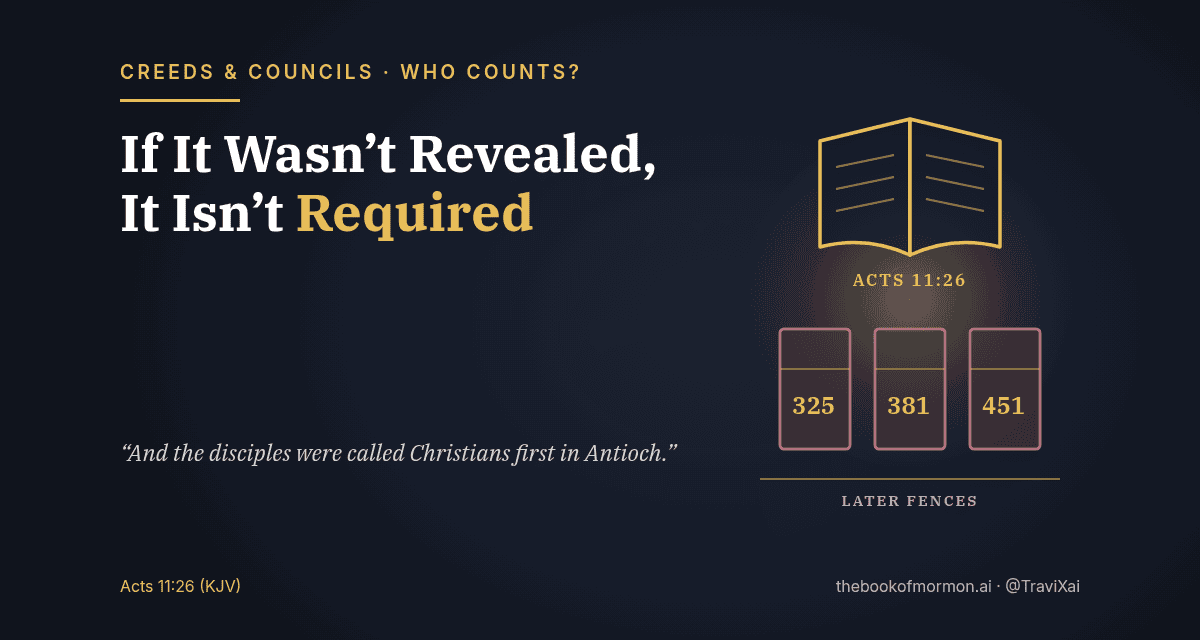

The New Testament defines a Christian in one verse: a disciple of Jesus Christ. Three councils, between 325 and 451, rewrote the entry exam in words no apostle used. Here’s why a requirement God never revealed can’t be the test.
Somewhere on X right now, a guy with a cross in his bio is explaining that I’m not a Christian. Not because I don’t follow Christ. Because I don’t sign a definition written in 451.
So let’s settle it the honest way. Open the Bible, find where it defines a Christian, and use that test. Then look at where the extra requirements came from, and whether God ever revealed them. Spoiler: the Bible’s test is short, and nobody had to vote on it.
Acts 11:26Where the word “Christian” comes from
The word “Christian” shows up three times in the whole Bible. The first one tells you exactly who earned it:
And it came to pass, that a whole year they assembled themselves with the church, and taught much people. And the disciples were called Christians first in Antioch.
Acts 11:26 (KJV)
Disciples. That’s the whole definition. People who followed Jesus Christ got called by His name. The other two uses fit: Agrippa tells Paul, “Almost thou persuadest me to be a Christian” (Acts 26:28), and Peter writes, “if any man suffer as a Christian, let him not be ashamed” (1 Peter 4:16). Paul was persuading Agrippa to believe in Christ, not to memorize vocabulary. Peter’s Christians suffered for following Jesus, not for parsing His natures.
Notice what’s missing from Antioch: a creed. That church had Barnabas and Paul teaching for a year. If affirming the right metaphysics were the price of the name, this is where you’d expect to see it charged. (The Galatians18 “Are Latter-day Saints Christian?” page makes the same point in two lines.)
Jesus’ own testsHow He said you’d know
Jesus didn’t leave His followers guessing how to spot the real thing. He gave tests, and every one of them is about how you live and whom you follow:
Ye shall know them by their fruits. … Not every one that saith unto me, Lord, Lord, shall enter into the kingdom of heaven; but he that doeth the will of my Father which is in heaven.
Matthew 7:16, 21 (KJV)
By this shall all men know that ye are my disciples, if ye have love one to another.
John 13:35 (KJV)
John, the last living apostle, wrote it as a checklist: “hereby we do know that we know him, if we keep his commandments. … He that saith he abideth in him ought himself also so to walk, even as he walked” (1 John 2:3–6). Paul put the confession plainly: “if thou shalt confess with thy mouth the Lord Jesus, and shalt believe in thine heart that God hath raised him from the dead, thou shalt be saved” (Romans 10:9).
And when the Ethiopian eunuch asked what stood between him and baptism, Philip’s answer was one sentence: “If thou believest with all thine heart, thou mayest.” The eunuch answered, “I believe that Jesus Christ is the Son of God,” and down into the water they went (Acts 8:37–38). No council. No catechism on substance. The Galatians18 “Creeds define Christian” page puts it bluntly: if Nicaea is the entry ticket, Philip let a non-Christian into the water.
Even the apostles tried gatekeeping once. John reported a man “casting out devils in thy name, and he followeth not us: and we forbad him.” Jesus answered, “Forbid him not … For he that is not against us is on our part” (Mark 9:38–40). “He followeth not us” wasn’t a disqualifier then either.
325 · 381 · 451Three councils, three new fences
Fast-forward three centuries. The apostles are gone, and the church has bishops but no one claiming to receive revelation for the whole church. Then the tests start getting longer.
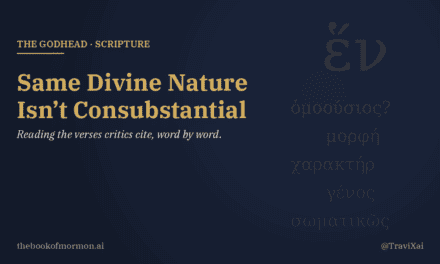
325, Nicaea. Constantine convenes the bishops, and the creed puts in a Greek word the Bible never uses, homoousios, then anathematizes anyone who says the Son is “of a different substance or essence” (Nicene Creed of 325). I covered the room, the emperor, and the word in Nicaea 325: An Unbaptized Emperor and the Word ‘Homoousios’, and why “same divine nature” isn’t the same claim as “one substance” in Same Divine Nature Isn’t Consubstantial.
380, an imperial edict. Here the question “who counts as Christian?” got answered by law. In February 380, Theodosius and Gratian ordered all their subjects to hold the faith of the bishops of Rome and Alexandria (Catholic Encyclopedia, “Theodosius I”). The edict reads: “We authorize the followers of this law to assume the title Catholic Christians,” while everyone else would be “branded with the ignominious name of heretics,” and their meetings couldn’t be called churches (Theodosian Code XVI.1.2). The name the disciples earned at Antioch by following Jesus was now a title an emperor handed out.
381, Constantinople. The next year, “on the summons of the most religious Emperor Theodosius,” the bishops met again. Canon 1: Nicaea’s faith “shall not be set aside,” and “every heresy shall be anathematized,” followed by a list of named groups (Council of Constantinople, Canon 1).
451, Chalcedon. Assembled at “the command of our most religious and Christian Emperors, Marcian and Valentinian,” somewhere between 520 and 630 bishops (the sources disagree; Catholic Encyclopedia, “Council of Chalcedon”) defined that Christ “must be confessed to be in two natures, unconfusedly, immutably, indivisibly, inseparably.” Then they closed the door behind them: “no one shall be suffered to bring forward a different faith, nor to write, nor to put together, nor to excogitate, nor to teach it to others.” Bishops and clerics who did would be deposed; monks and laymen, anathematized (Definition of Faith of Chalcedon).
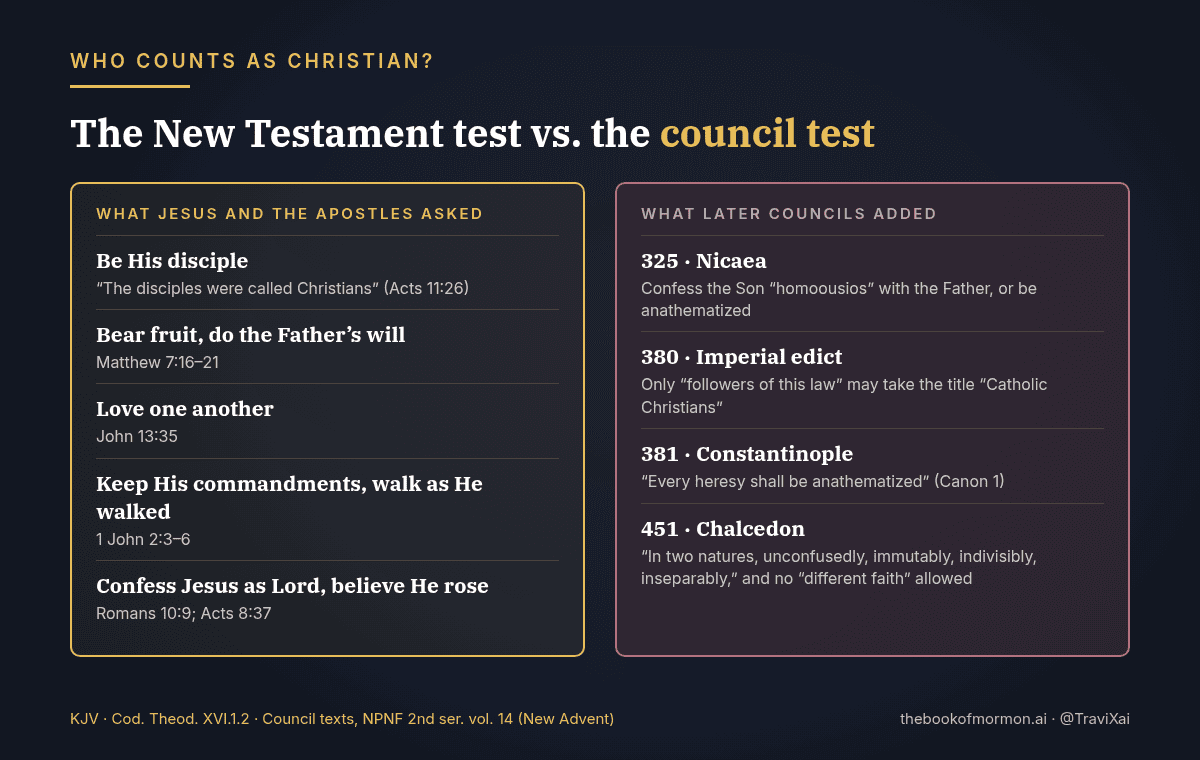
Read that Chalcedon line again. A council that had just written a longer definition than anything the apostles wrote then made it illegal to write a different one. That isn’t a revelation. That’s a ratchet: each council adds a word, and the new word becomes the new fence.
The real questionWho gets to add a requirement?
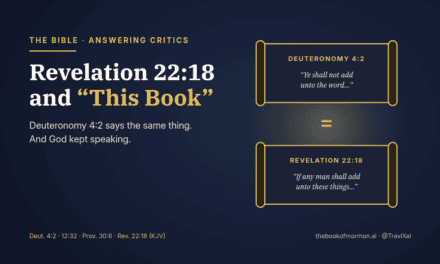
Here’s the principle in the title. A requirement for being Christ’s disciple has to come from Christ. If God didn’t reveal it, no one gets to require it. The Bible says so itself:
Ye shall not add unto the word which I command you, neither shall ye diminish ought from it, that ye may keep the commandments of the LORD your God which I command you.
Deuteronomy 4:2 (KJV)
Notice who that verse restricts: men. God kept speaking after Moses, through Isaiah, Jeremiah, and the rest. What men can’t do is add commandments of their own and call them God’s. When the apostles faced a real doctrinal dispute in Acts 15, they didn’t pile on requirements. They removed them: “For it seemed good to the Holy Ghost, and to us, to lay upon you no greater burden than these necessary things” (Acts 15:28). The Holy Ghost first, then the apostles, and the burden got lighter, not heavier.
That’s the pattern God promised: “Surely the Lord GOD will do nothing, but he revealeth his secret unto his servants the prophets” (Amos 3:7). No prophet revealed “two natures, unconfusedly, immutably.” Bishops debated it, an emperor convened it, and a council enforced it. However sincere those men were (and many were), that’s a different process than revelation.
Paul even gave the test for added gospels: “though we, or an angel from heaven, preach any other gospel unto you than that which we have preached unto you, let him be accursed” (Galatians 1:8). Fair enough. Paul preached Christ crucified and risen. He never preached homoousios or “two natures.” So which side is adding to what Paul preached? (The Galatians18 Galatians 1:8 page walks through it.)
This is also where “the Bible alone” runs out of road. Every side in these councils quoted the same Bible, which is why no verse teaches sola scriptura. Scripture isn’t inerrant, and it isn’t an idol to stand in for God. It’s the record of God speaking to prophets, in the Bible, in the Book of Mormon, and still today. The Book of Mormon’s own title page says, “if there are faults they are the mistakes of men” (Title Page). Latter-day Saints believe “all that God has revealed, all that He does now reveal” (Article of Faith 9). The question was never which vocabulary men settled on. It’s what God actually said, and through whom. That’s the whole case of the Great Apostasy in the New Testament’s own words.
Goalposts on wheelsThe test, applied evenly
Now run the Bible’s test on Latter-day Saints. Disciples of Jesus Christ? We’re baptized in His name, as Peter commanded (Acts 2:38), and take the sacrament in remembrance of Him every Sunday. Confess Him as Lord and risen? The Book of Mormon’s title page says its purpose is “the convincing of the Jew and Gentile that Jesus is the Christ, the Eternal God” (Title Page). “We talk of Christ, we rejoice in Christ, we preach of Christ” (2 Nephi 25:26). Keep His commandments, love one another, bear fruit? Judge us by our fruits. That’s His test, not mine.
So the critic moves the line. “Fine, but you’re not a real Christian, because you reject the Trinity.” That’s three fallacies in one sentence:
- Moving the goalposts. The Bible’s test is met, so a new one appears, written centuries later.
- No true Scotsman. A disciple who follows Christ is suddenly not a “true” Christian, by a definition invented to exclude him.
- Special pleading. Peter, Paul, John, and the eunuch never heard the word homoousios and never confessed “two natures.” By the council test they’d all fail, yet nobody says the apostles weren’t Christians. If they pass without the creed, so does anyone else who meets their test.
The usual comeback is “you believe in a different Jesus.” Really? Same Bethlehem, same mother, same cross, same empty tomb. You can disagree with us about the nature of the Godhead (the Galatians18 “Another Jesus” page covers that one), but a disagreement about metaphysics doesn’t move Jesus to a different manger.
SummaryKey takeaways
- The Bible’s first use of the word defines it: “the disciples were called Christians first in Antioch” (Acts 11:26).
- Jesus’ tests are fruits, doing the Father’s will, love, keeping His commandments, and confessing Him as risen Lord.
- Nicaea (325), an imperial edict (380), Constantinople (381), and Chalcedon (451) added vocabulary no apostle used and enforced it with anathemas.
- Acts 15 shows the revealed pattern: the Holy Ghost and apostles, and fewer burdens, not more.
- If it wasn’t revealed, it isn’t required. The apostles pass the Bible’s test without the creeds, and so does anyone who follows Christ the way they did.
Next time someone says you’re not a Christian, ask one question: which prophet revealed the test you’re using? Then hand them Acts 11:26. For quick, sourced answers on the creeds, the Apostasy, and the Restoration, open Galatians18. And for more like this every day, follow me on X at @TraviXai.
Sources
- Scriptures (KJV and Book of Mormon, churchofjesuschrist.org): Acts 11:26 · Acts 26:28 · 1 Peter 4:16 · Matthew 7:16–21 · John 13:35 · 1 John 2:3–6 · Romans 10:9 · Acts 8:37–38 · Mark 9:38–40 · Deuteronomy 4:2 · Acts 15:28 · Amos 3:7 · Galatians 1:8 · Acts 2:38 · 2 Nephi 25:26
- Book of Mormon Title Page · Articles of Faith 1 and 9
- First Council of Nicaea (325): creed with anathemas, NPNF 2nd ser., vol. 14: newadvent.org
- Theodosian Code XVI.1.2 (edict of 380), from Henry Bettenson, ed., Documents of the Christian Church (1943), p. 31, Internet Medieval Sourcebook: sourcebooks.fordham.edu
- Catholic Encyclopedia (1908–1912): “Theodosius I” (February 380 edict, Cod. Theod. XVI.1.2) · “Council of Chalcedon” (attendance)
- First Council of Constantinople (381): creed and canons, NPNF 2nd ser., vol. 14: newadvent.org
- Council of Chalcedon (451): extracts from the Acts and the Definition of Faith, NPNF 2nd ser., vol. 14: newadvent.org
- Related on this site: Nicaea 325: An Unbaptized Emperor and the Word ‘Homoousios’ · Same Divine Nature Isn’t Consubstantial · Sola Scriptura: Which Verse Teaches It? · The Great Apostasy in the New Testament’s Own Words
- Galatians18: Are Latter-day Saints Christian? · Creeds define Christian · Galatians 1:8 · Another Jesus
- Featured image and comparison card: original graphics by thebookofmormon.ai (no photographs or likenesses of real people).