
Home › Answering Critics › Start here: Are Latter-day Saints Christian? · The CES Letter: A Faithful Response
Yes, the Bible has anachronisms, and critics give it a pass they never give the Book of Mormon. Domesticated camels appear in Abraham’s day, Philistines in Genesis, “Ur of the Chaldees” centuries before the Chaldeans, a city called Dan before Dan existed, and “Easter” in the KJV of Acts 12:4. Latter-day Saints love the Bible. We just ask for one standard.
Let me say this up front so nobody twists it. I LOVE the Bible. Latter-day Saints read it, teach it, memorize it, and build our lives on it. Our eighth Article of Faith says it plainly: “We believe the Bible to be the word of God as far as it is translated correctly; we also believe the Book of Mormon to be the word of God.” This article is not an attack on the Bible. It is an attack on a DOUBLE STANDARD.
Here is the standard. For almost two hundred years critics have said that if the Book of Mormon mentions something that “didn’t exist yet,” the whole book is a fraud. Horses, steel, barley, cement, you know the list. We already covered how that list has been shrinking for decades in The Shrinking List of Book of Mormon Anachronisms, so I won’t repeat it here. Today we are doing something different. We are taking the critic’s own measuring stick and laying it on the Bible, and specifically on the King James Version that most English-speaking critics quote at us.
Every example below comes with the exact KJV verse, the reason scholars call it an anachronism, a real source, and the explanation Bible believers give for it. And here’s the thing…. most of those explanations are REASONABLE. That is exactly the point.
Check the assumptions first
Before running through the list, notice what the “anachronism equals fraud” argument has to assume. None of these assumptions holds up, for the Bible or for the Book of Mormon:
- That one unexplained item proves a book is fake. If that were the rule, camels in Genesis 12:16 would settle the Bible too. Nobody applies it there.
- That absence of evidence is evidence of absence. Archaeology finds only a small fraction of what existed, and the camel dates themselves have moved as new digs were published.
- That a translator’s word has to match the ancient object exactly. The KJV says “a bow of steel” in 2 Samuel 22:35 and “Easter” in Acts 12:4. Believers rightly read those as translation choices, not proof of fraud.
- That later editing disqualifies a record. Ancient Jewish tradition says Joshua wrote the last eight verses of the Torah (Bava Batra 14b–15a). The Book of Mormon openly says it was abridged by later prophets too.
- That critics are applying one standard. They aren’t. The test is simple: would you accept this argument if it were aimed at Genesis?
For the wider picture, see The CES Letter: A Faithful Response.
1. Camels in Abraham’s day
“And he entreated Abram well for her sake: and he had sheep, and oxen, and he asses, and menservants, and maidservants, and she asses, and camels.” (Genesis 12:16, KJV)
“And the servant took ten camels of the camels of his master, and departed; for all the goods of his master were in his hand: and he arose, and went to Mesopotamia, unto the city of Nahor.” (Genesis 24:10, KJV)
Camels show up all over the patriarchal stories. Abraham has them, Rebekah rides one, Joseph’s brothers sell him to a camel caravan. The problem is the archaeology. In 2013 two Tel Aviv University archaeologists, Lidar Sapir-Hen and Erez Ben-Yosef, published “The Introduction of Domestic Camels to the Southern Levant: Evidence from the Aravah Valley” in the journal Tel Aviv (vol. 40, no. 2). Studying animal bones from the copper mining sites at Timna and Wadi Faynan, they concluded that the first significant appearance of domestic camels in that region was “not earlier than the last third of the 10th century BCE.” The study made headlines in early 2014 because that date is centuries after the traditional time of Abraham.
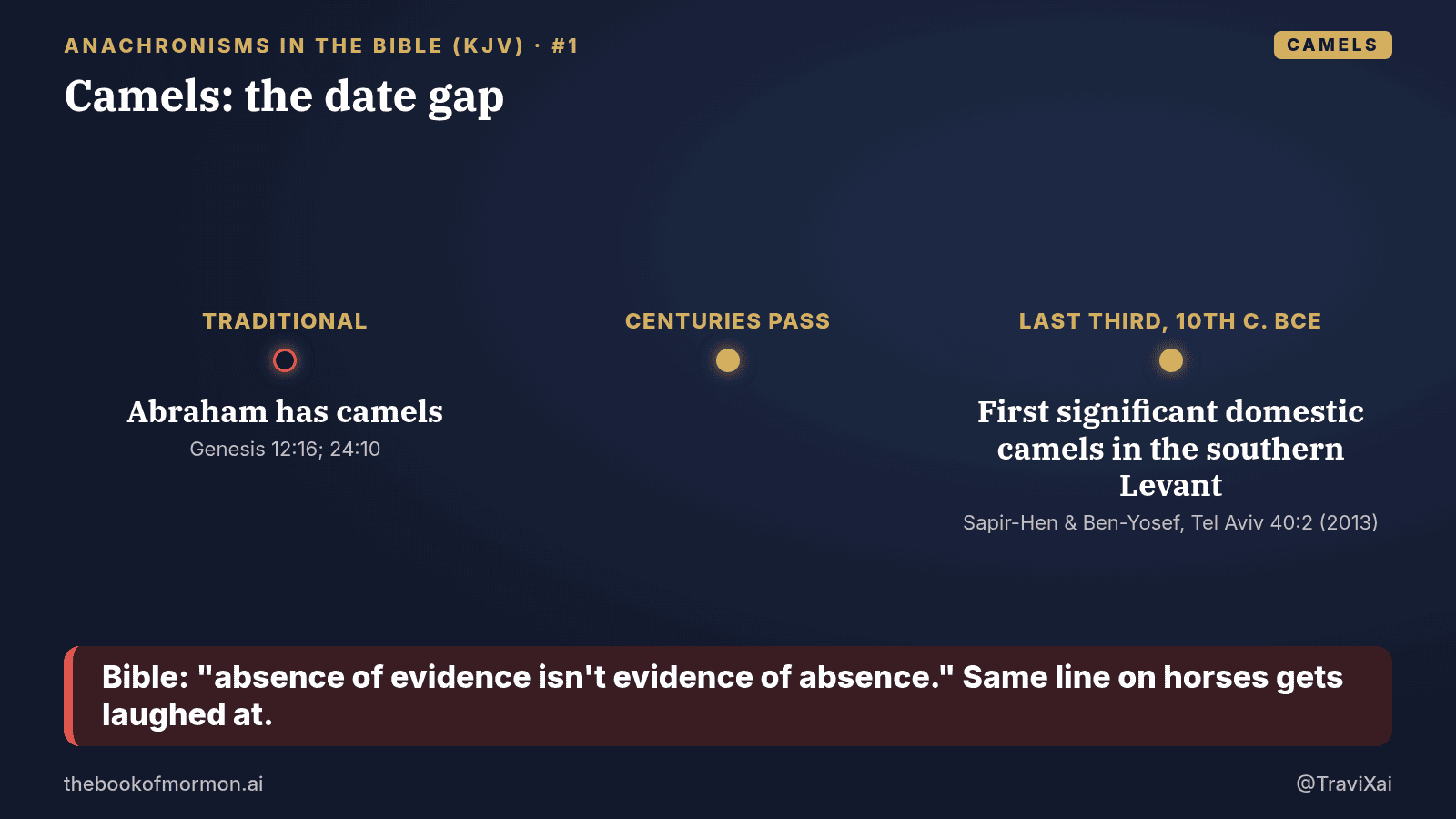
The usual apologetic answer is that camels were domesticated elsewhere earlier, that a few wealthy people could have owned them before they were common, and that “absence of evidence is not evidence of absence.”
Read that last line again. “Absence of evidence is not evidence of absence.” That’s OUR line on horses in the Book of Mormon, and critics laugh at it. When a Bible believer says it about camels it’s sober scholarship. When a Latter-day Saint says it about horses it’s desperate cope. Same argument. Different book. Different verdict.
2. Philistines in Genesis
“Thus they made a covenant at Beer-sheba: then Abimelech rose up, and Phichol the chief captain of his host, and they returned into the land of the Philistines.” (Genesis 21:32, KJV)
“And Abraham sojourned in the Philistines’ land many days.” (Genesis 21:34, KJV)
“And there was a famine in the land, beside the first famine that was in the days of Abraham. And Isaac went unto Abimelech king of the Philistines unto Gerar.” (Genesis 26:1, KJV)
The Philistines are well known to archaeology. They were one of the “Sea Peoples” who settled the southern coast of Canaan in the early 12th century BC, around the time Ramesses III recorded his battles with the Sea Peoples on the walls of his temple at Medinet Habu. Abraham is traditionally placed many centuries earlier. So a “king of the Philistines” in Genesis looks like a later name dropped into an older story.
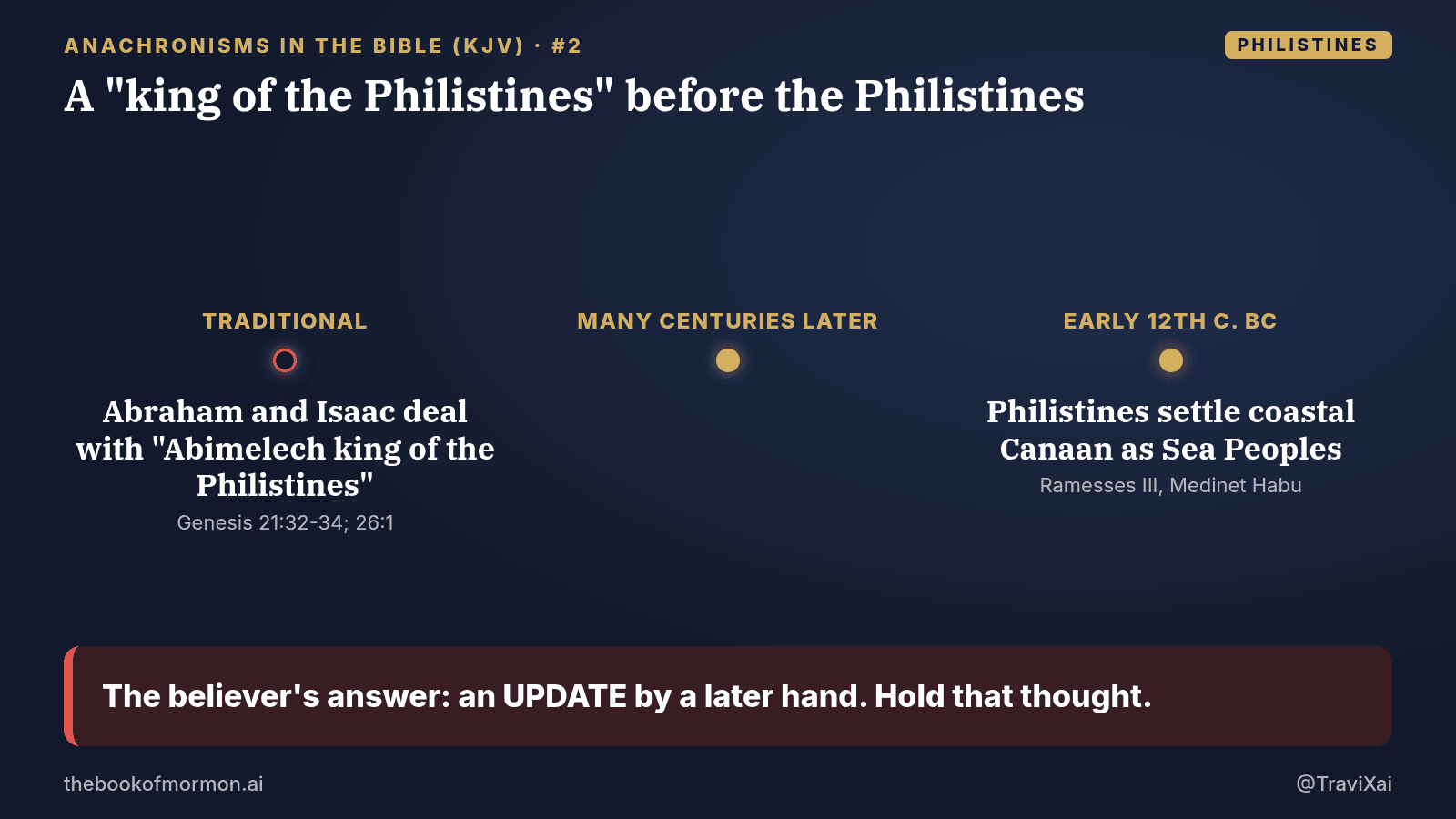
The usual answer: either these were an earlier, different group that later got called by the familiar name, or a later scribe updated the name so readers would know where Gerar was. Both are possible! But notice the move. The text says one thing, and the believer explains it as an UPDATE by a later hand. Hold that thought.
3. “Ur of the Chaldees”
“And Terah took Abram his son, and Lot the son of Haran his son’s son, and Sarai his daughter in law, his son Abram’s wife; and they went forth with them from Ur of the Chaldees, to go into the land of Canaan; and they came unto Haran, and dwelt there.” (Genesis 11:31, KJV)
“And he said unto him, I am the LORD that brought thee out of Ur of the Chaldees, to give thee this land to inherit it.” (Genesis 15:7, KJV)
The Chaldeans (Kaldu) are a real people, but they don’t show up in Mesopotamian records until the early first millennium BC, in Assyrian inscriptions of the 9th century BC, and they became famous when the Neo-Babylonian (Chaldean) dynasty of Nabopolassar and Nebuchadnezzar ruled in the 7th and 6th centuries BC. That’s over a thousand years after Abraham’s traditional date. Calling Ur a city “of the Chaldees” in Abraham’s day is like saying the Pilgrims landed in “Plymouth, USA.”
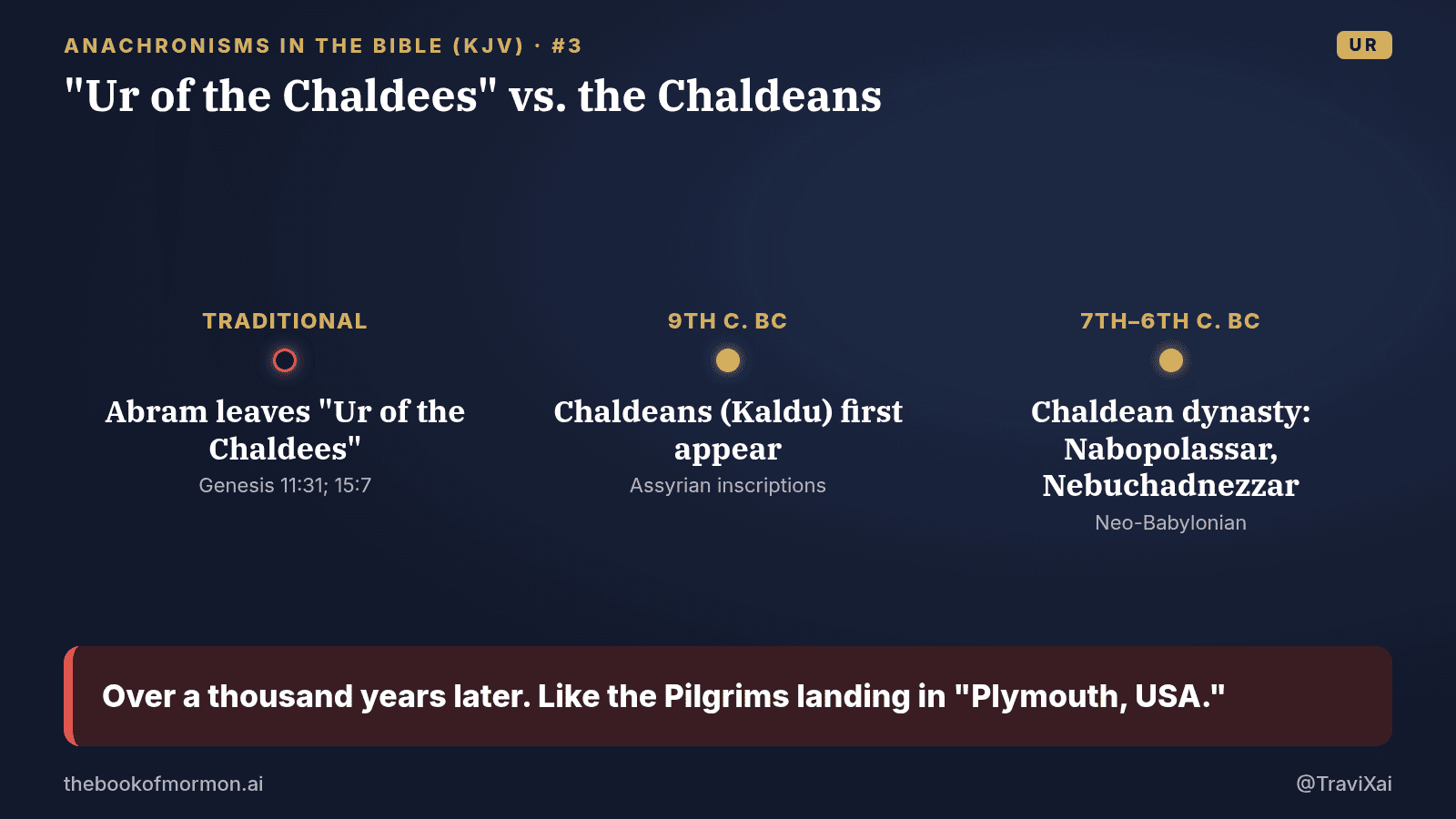
The usual answer: a later editor added “of the Chaldees” to tell readers WHICH Ur was meant. Again…. a later hand.
4. A city called Dan, before Dan existed
“And when Abram heard that his brother was taken captive, he armed his trained servants, born in his own house, three hundred and eighteen, and pursued them unto Dan.” (Genesis 14:14, KJV)
Now look at the book of Judges, which describes the tribe of Dan capturing a city long after Abraham, long after Moses, and long after the conquest under Joshua:
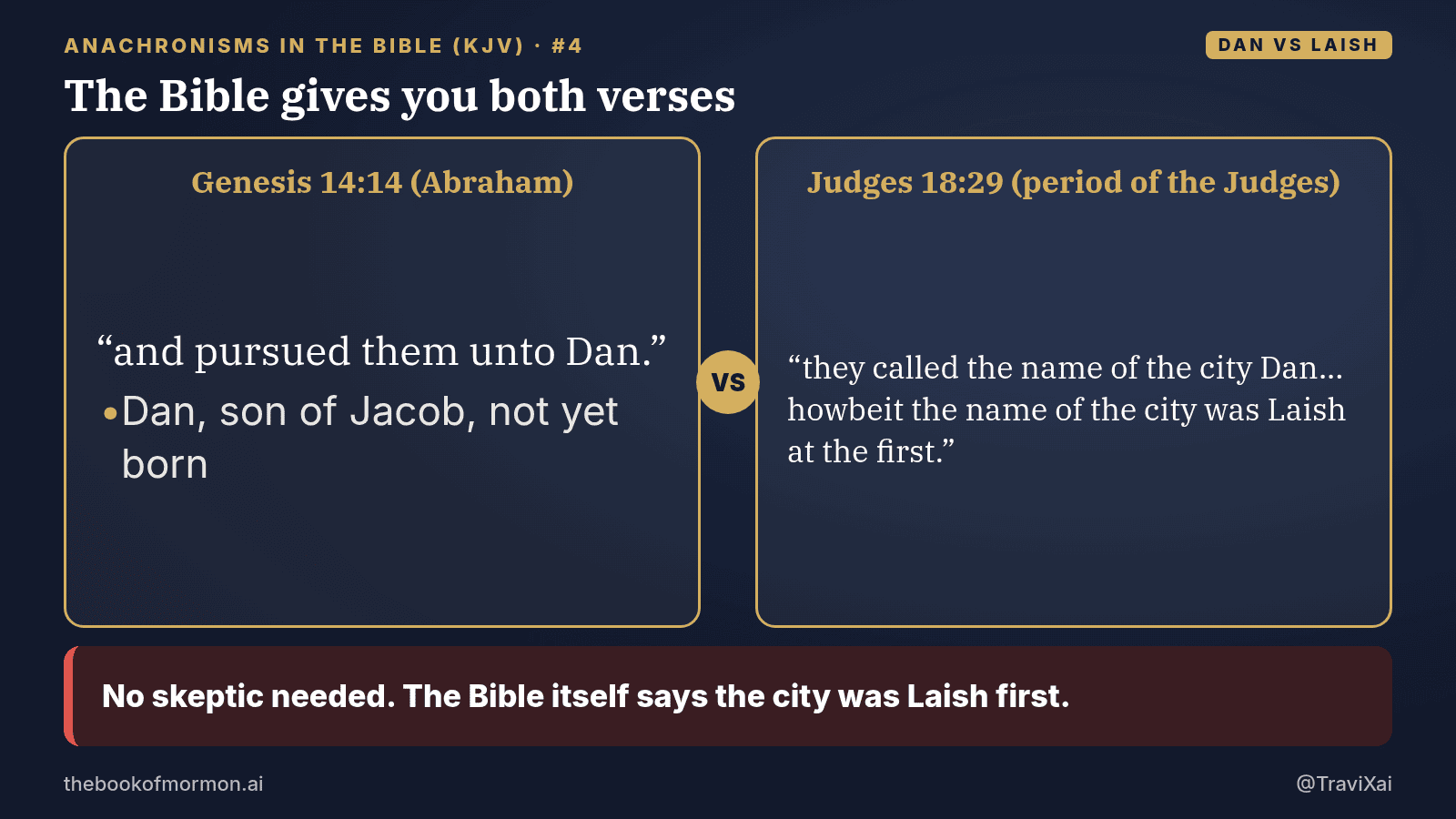
“And they called the name of the city Dan, after the name of Dan their father, who was born unto Israel: howbeit the name of the city was Laish at the first.” (Judges 18:29, KJV)
So the Bible itself tells us the city was named Dan in the period of the Judges, and that its earlier name was Laish. Yet Genesis has Abraham chasing kings “unto Dan,” and Dan, the son of Jacob it’s named after, wasn’t even born yet. This is one of the oldest anachronism observations in the book. You don’t need a modern skeptic for it. The Bible gives you both verses.
The usual answer: a scribe updated the old place name to the one readers knew. Or it’s a different Dan. Fine. Either way, the believer is allowed to say “this is a later explanatory gloss in an ancient text.” Remember that.
5. Kings over Israel, before there were kings over Israel
“And these are the kings that reigned in the land of Edom, before there reigned any king over the children of Israel.” (Genesis 36:31, KJV)
Traditionally Moses wrote Genesis. But Israel had no king until Saul, centuries after Moses. A writer in Moses’ day had no reason to say “before there reigned any king over Israel.” That phrase only makes sense from someone looking BACK at a time when Israel already had kings. The medieval Jewish commentator Abraham ibn Ezra raised questions about verses like this (and Genesis 12:6, “And the Canaanite was then in the land”), and Baruch Spinoza made the case openly in his Theological-Political Treatise (1670), chapter 8. Spinoza listed exactly these kinds of verses to argue Moses couldn’t have written the whole Pentateuch.
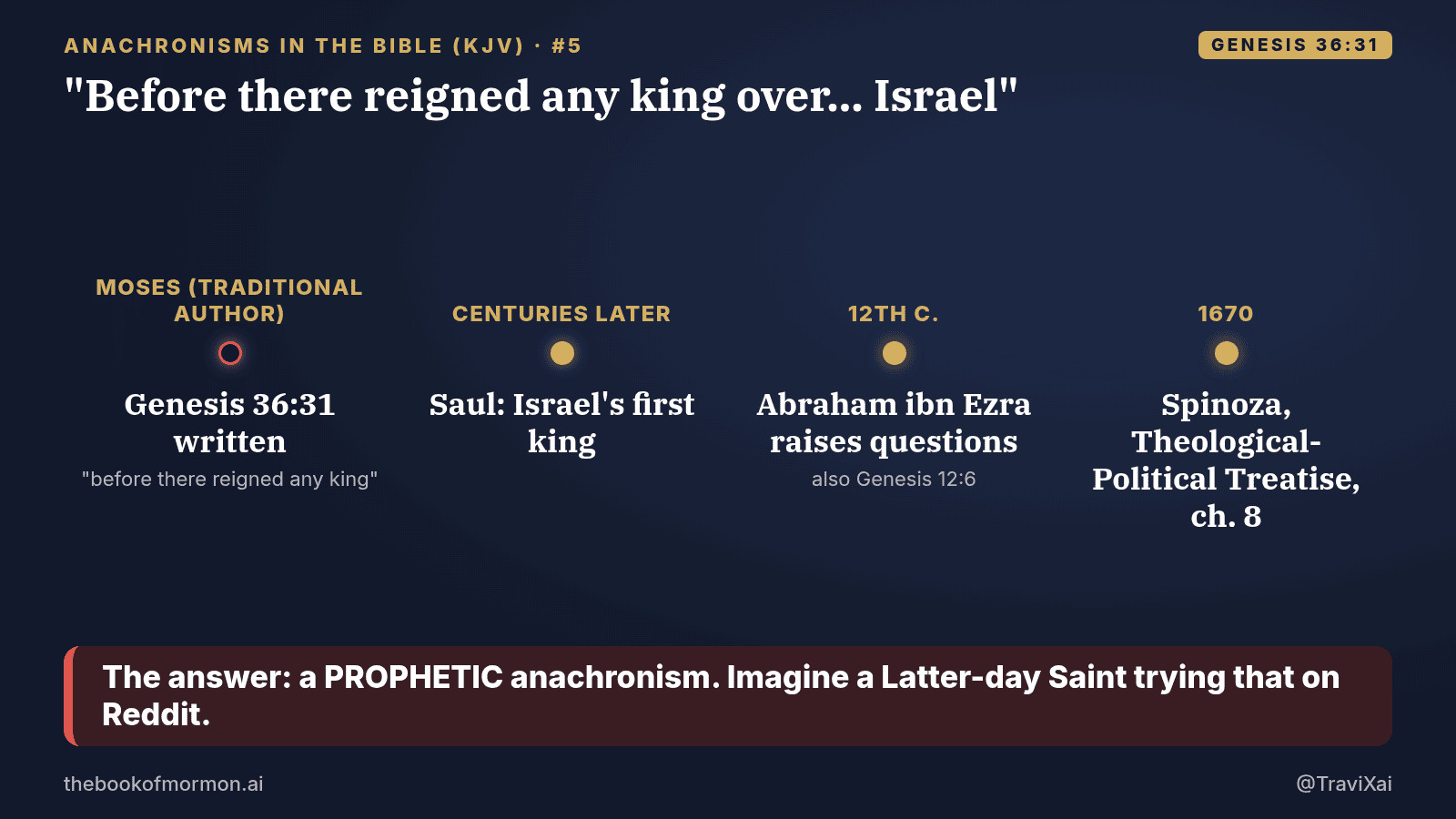
The usual answer: Moses was writing prophetically, or a later inspired editor added the line. Okay. A PROPHETIC anachronism. Imagine a Latter-day Saint trying that one on Reddit.
6. Moses writes about his own death
“So Moses the servant of the LORD died there in the land of Moab, according to the word of the LORD.” (Deuteronomy 34:5, KJV)
“And he buried him in a valley in the land of Moab, over against Beth-peor: but no man knoweth of his sepulchre unto this day.” (Deuteronomy 34:6, KJV)
“And there arose not a prophet since in Israel like unto Moses, whom the LORD knew face to face,” (Deuteronomy 34:10, KJV)
“Unto this day.” “There arose not a prophet SINCE.” Those words come from someone writing a good while after Moses died. Jewish tradition noticed this two thousand years ago. The Babylonian Talmud (Bava Batra 14b) says Joshua “wrote his own book and eight verses in the Torah,” the verses describing the death of Moses, and the rabbis debate the point on the next page (15a). So even the ancient tradition that credits Moses with the Torah openly considered that somebody else finished it.
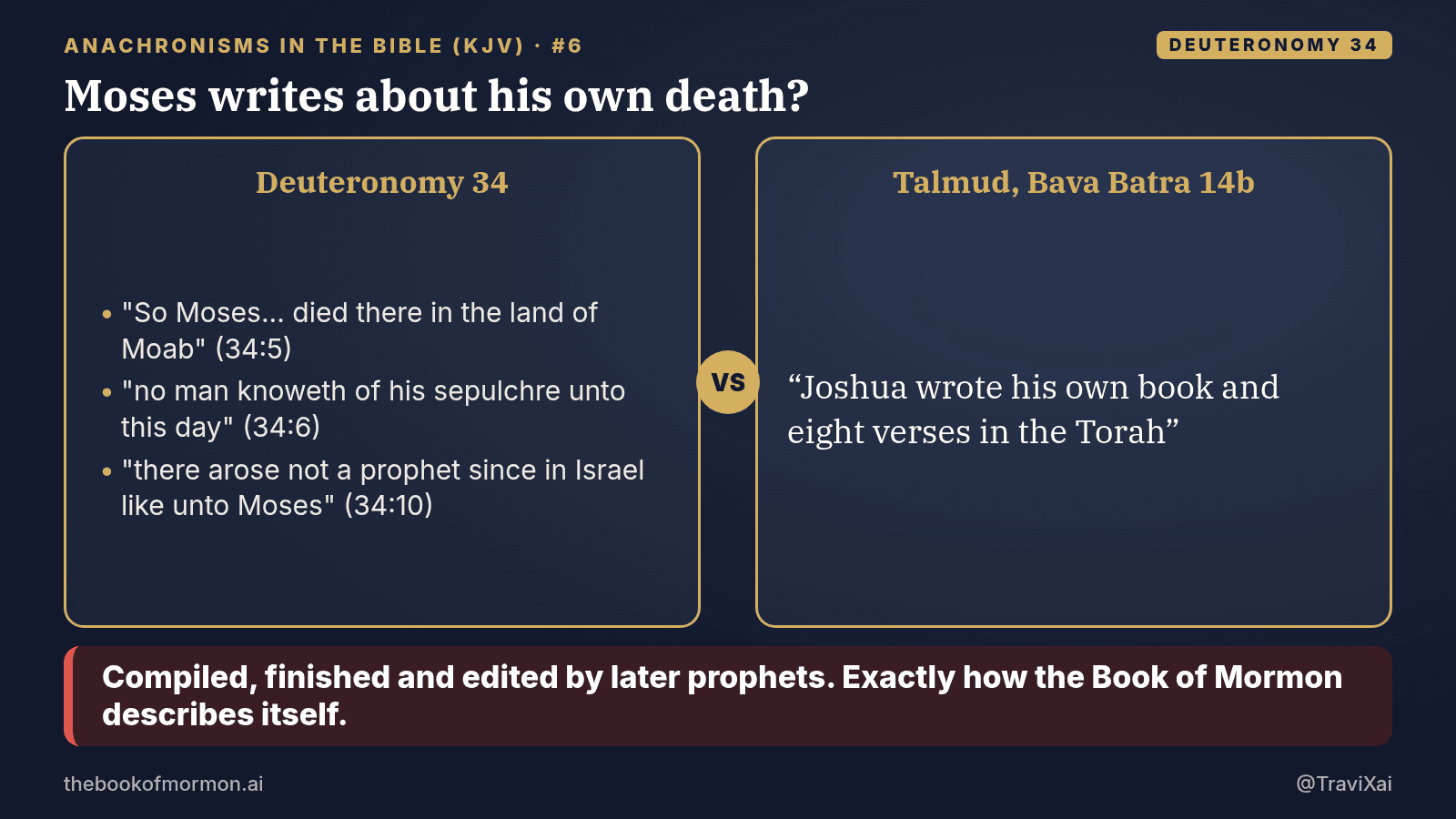
Notice I’m not saying “gotcha, the Bible is false.” I’m saying the ancient believers themselves had no problem with an inspired record that was compiled, finished, and edited by later prophets. That’s exactly how the Book of Mormon describes ITSELF. Mormon abridged, Moroni finished. Critics call that a convenient story when we say it, and call it tradition when the Talmud says it.
7. KJV translation anachronisms
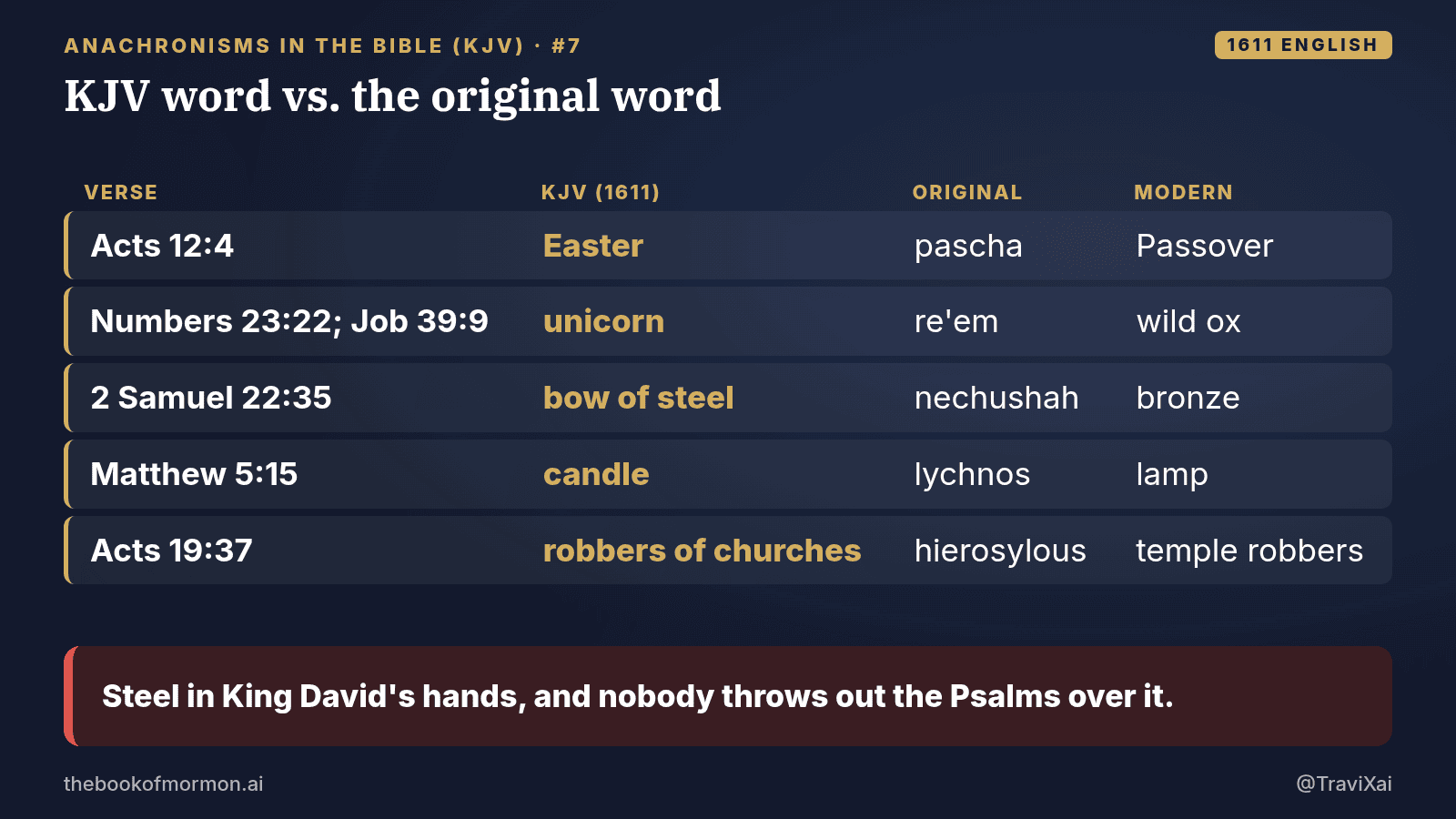
Now the King James Version itself. These aren’t problems with the original Hebrew and Greek. They are 1611 English words that put 17th-century things into the ancient world. Which is exactly the kind of thing critics attack in the 1830 English of the Book of Mormon.
Easter in Acts.
“And when he had apprehended him, he put him in prison, and delivered him to four quaternions of soldiers to keep him; intending after Easter to bring him forth to the people.” (Acts 12:4, KJV)
The Greek word is pascha, Passover. Everywhere else in the New Testament the KJV translates pascha as “passover.” Herod Agrippa was not waiting for a Christian holiday that hadn’t been named yet. Modern translations (NIV, ESV, NASB, NKJV) all read “Passover” here.
Unicorns.
“God brought them out of Egypt; he hath as it were the strength of an unicorn.” (Numbers 23:22, KJV)
“Will the unicorn be willing to serve thee, or abide by thy crib?” (Job 39:9, KJV)
The KJV has unicorns in Numbers, Deuteronomy, Job, Psalms and Isaiah. The Hebrew word is re’em, which modern translations render “wild ox” (lexicons say probably the aurochs, though the exact animal isn’t certain). The translators followed the Greek Septuagint’s monokeros, “one-horned.” Deuteronomy 33:17 even says “his horns are like the horns of unicorns,” plural horns, which tells you the original animal wasn’t one-horned at all.
Steel.
“He teacheth my hands to war; so that a bow of steel is broken by mine arms.” (2 Samuel 22:35, KJV)
The Hebrew word here is nechushah, bronze or copper. Modern translations say “bow of bronze.” So the KJV has David breaking a bow of STEEL. Critics love to mock “steel” in the Book of Mormon. The King James translators put steel in the hands of King David, and nobody throws out the Psalms over it.
Candle.
“Neither do men light a candle, and put it under a bushel, but on a candlestick; and it giveth light unto all that are in the house.” (Matthew 5:15, KJV)
The Greek lychnos is a lamp, the little clay oil lamp of the ancient world. Wax candles on candlesticks are what a 1611 English reader pictured, so that’s what the translators wrote. Modern translations say “lamp” and “lampstand.”
“Church” and “churches.”
“And I say also unto thee, That thou art Peter, and upon this rock I will build my church; and the gates of hell shall not prevail against it.” (Matthew 16:18, KJV)
“For ye have brought hither these men, which are neither robbers of churches, nor yet blasphemers of your goddess.” (Acts 19:37, KJV)
The Greek of Matthew 16:18 is ekklesia, an assembly or congregation. The English “church” carries 1600 years of buildings, bishops and steeples with it. And in Acts 19:37 it’s even stranger. The Greek is hierosylous, “temple robbers,” talking about the pagan temple of Artemis in Ephesus. The KJV turned robbers of a pagan temple into “robbers of churches.”
None of these make the Bible false. They make the KJV a TRANSLATION, done by real men, in their own language and their own world. That’s exactly what Article of Faith 8 means by “as far as it is translated correctly.” And it’s exactly why critics should think twice before mocking the Book of Mormon for using words an 1829 English reader would understand.
8. A few more, quickly
“And Abraham called the name of that place Jehovah-jireh: as it is said to this day, In the mount of the LORD it shall be seen.” (Genesis 22:14, KJV)
“As it is said to this day” points to a writer looking back, and “the mount of the LORD” is the later name for the temple mount in Jerusalem.
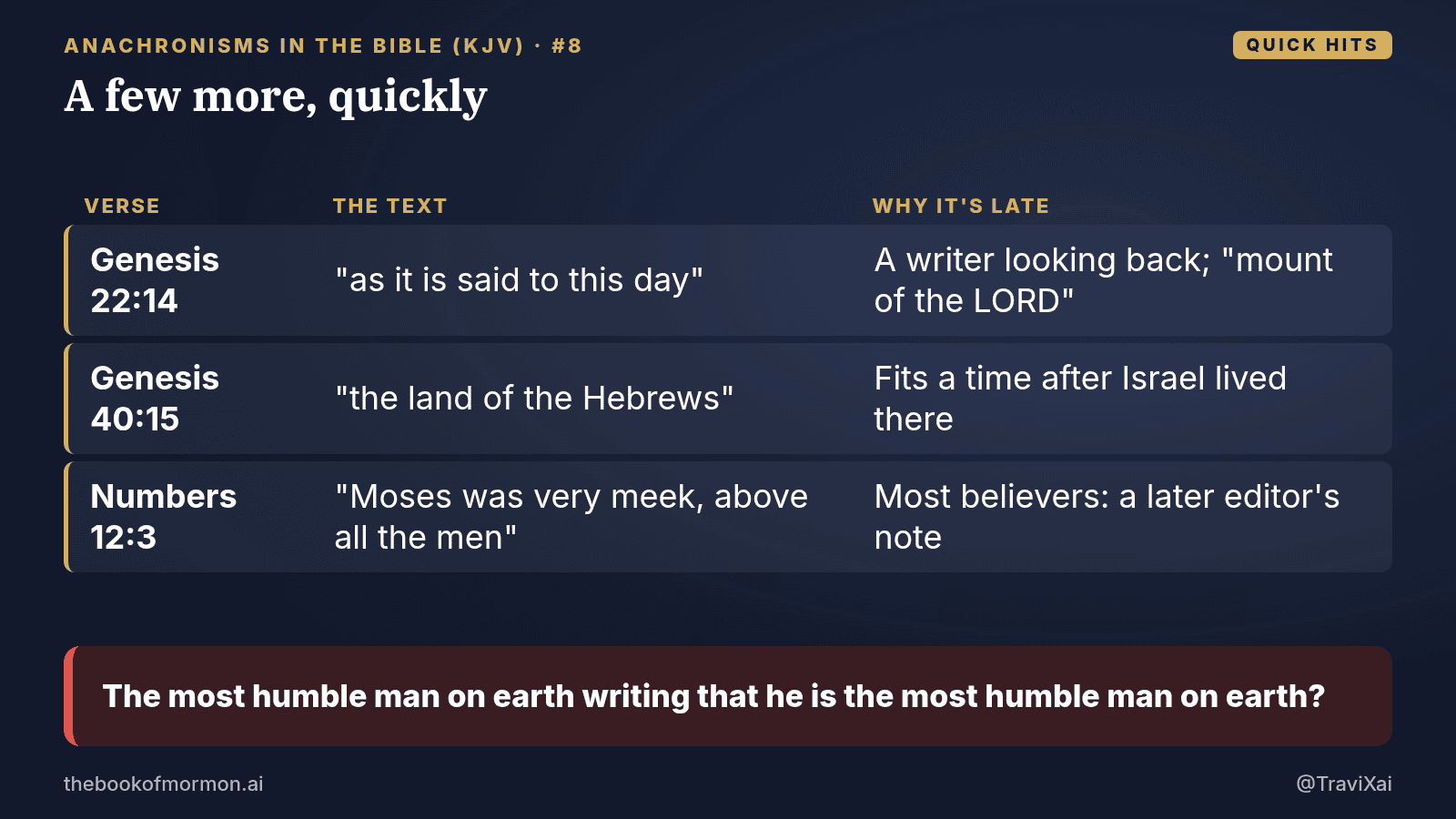
“For indeed I was stolen away out of the land of the Hebrews: and here also have I done nothing that they should put me into the dungeon.” (Genesis 40:15, KJV)
Joseph calls Canaan “the land of the Hebrews,” a name that fits a time after Israel lived there, not when it was full of Canaanites.
“(Now the man Moses was very meek, above all the men which were upon the face of the earth.)” (Numbers 12:3, KJV)
The most humble man on earth writing that he is the most humble man on earth? Most believers answer that a later editor added the note. Again.
The pattern: every Bible answer is OUR answer
Line up the excuses. Absence of evidence isn’t evidence of absence. A later editor updated the name. A scribe added a gloss for readers. A later prophet finished the record. The translator used a word from his own day. Every one of these is a fair, defensible explanation. And every one of these is an explanation critics REFUSE to allow the Book of Mormon.
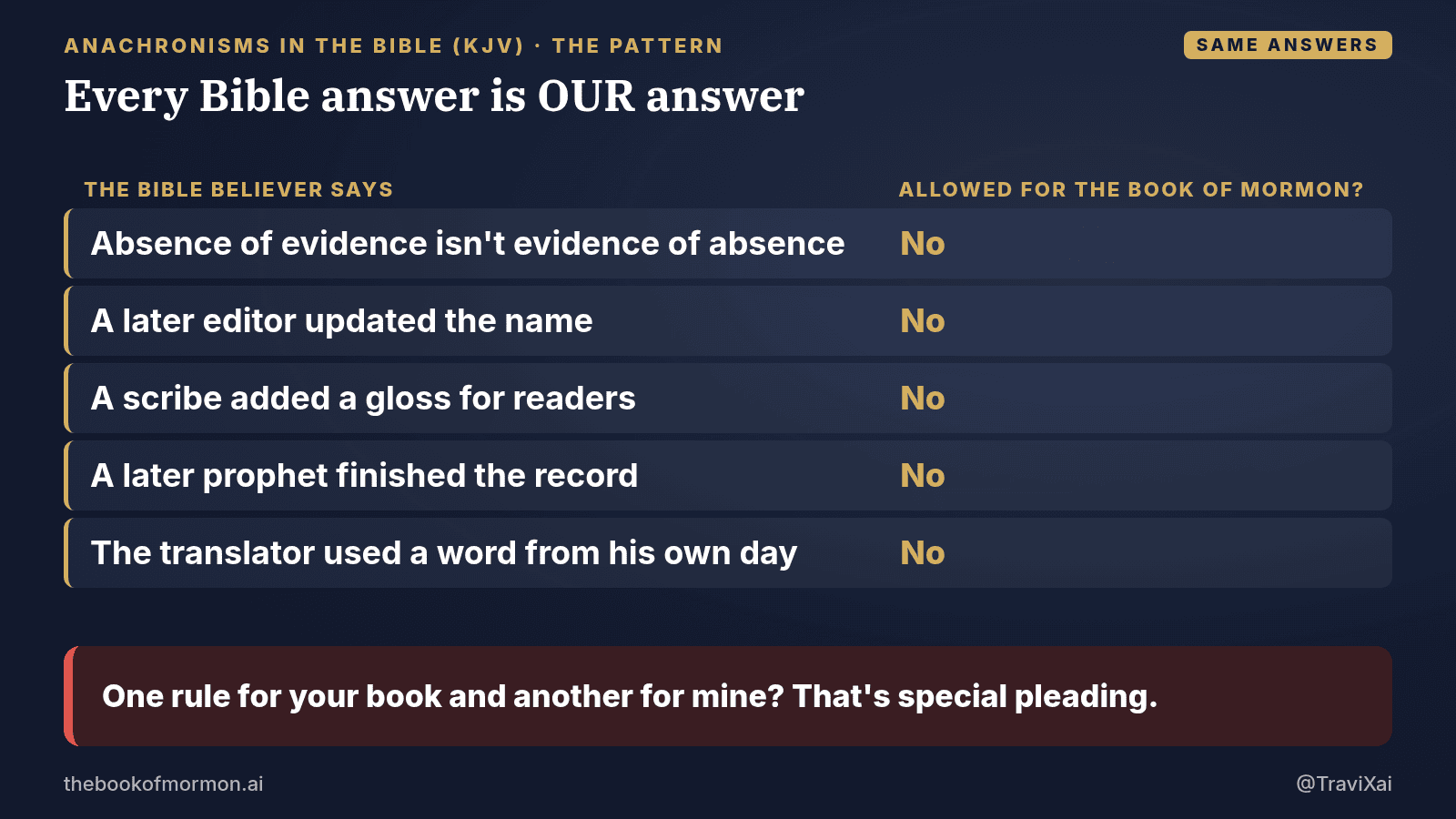
That’s not reasoning. That’s special pleading, the fallacy of applying a rule to everyone except yourself. It usually comes packaged with a little moving of the goalposts too. When horses in the Book of Mormon are the issue, the critic demands bones. When camels in Genesis are the issue, suddenly a few early camel bones somewhere else are plenty.
And here’s the part that should make every critic pause. The Book of Mormon’s anachronism list has been SHRINKING for two hundred years as research catches up. We documented that with Matthew Roper’s numbers in The Shrinking List of Book of Mormon Anachronisms. Several Bible items above were found BY BELIEVERS, centuries ago, in the text itself. Judges 18:29 is right there in the Bible. Nobody needed a dig.
So, critics, you get to pick one. Either anachronisms disprove ancient scripture, in which case you have a much bigger problem than we do. Or reasonable explanations are allowed, in which case let us have the same ones. What you DON’T get is one rule for your book and another rule for mine. If you want more of these, read “Your Church Changes”… So Does the Bible, and Moses Broke the Tablets for the missing tablets and ark.
I believe the Bible is the word of God. I believe the Book of Mormon is the word of God. And I’m happy to hold them both to the SAME standard. The question is whether you are.
What all four standard works say about human language and God’s word
Every standard work admits that God’s word comes through human hands and human language. That admission is the honest answer to every item on this list.
The Bible
But we have this treasure in earthen vessels, that the excellency of the power may be of God, and not of us.
2 Corinthians 4:7
The Book of Mormon
And if there be faults they be the faults of a man. But behold, we know no fault; nevertheless God knoweth all things;
Mormon 8:17
The Doctrine and Covenants
these commandments are of me, and were given unto my servants in their weakness, after the manner of their language, that they might come to understanding.
D&C 1:24
“After the manner of their language” is exactly why a translator writes “steel,” “Easter,” or “candle” for an ancient thing. The words serve the reader. The message comes from God.
The Pearl of Great Price
We believe the Bible to be the word of God as far as it is translated correctly; we also believe the Book of Mormon to be the word of God.
Articles of Faith 1:8
That’s one standard for both books, which is all this article asks for.
Bible anachronisms: quick answers
What are examples of anachronisms in the Bible?
Camels in Genesis, Philistines in Abraham’s time, “Ur of the Chaldees,” the city of Dan named before Dan was born, kings over Israel mentioned before Israel had kings (Genesis 36:31), and “Easter” in Acts 12:4 (KJV).
How do Bible scholars explain them?
Later scribes updating names, editors adding notes, and translators using familiar words. Every one of those answers is available to the Book of Mormon too.
Are Book of Mormon anachronisms still a problem?
Far less than critics claim. The list has shrunk from 93 of 102 unconfirmed in 1844 to about 21 of 226 today. See the shrinking list of Book of Mormon anachronisms and the steel sword.
What about archaeology?
Run the “no ruins” rule on the Exodus and Jericho and see what survives. See the Exodus and Jericho archaeology standard.
Is “steel” in the KJV an anachronism?
2 Samuel 22:35 reads “a bow of steel,” but the Hebrew word nechushah means bronze or copper. Modern translations say bronze. It’s a translation choice, and critics accept it in the Bible while rejecting “steel” in the Book of Mormon.
Why does the KJV say “Easter” in Acts 12:4?
The Greek word is pascha, Passover. The KJV translators used an English word from their own day. Bible believers call that a translation issue, not fraud.
Did Moses write about his own death?
Deuteronomy 34:5–6 describes Moses’ death and burial. The Babylonian Talmud (Bava Batra 14b–15a) says Joshua wrote those last verses. Ancient believers had no trouble with a record finished by a later prophet.
Do Latter-day Saints believe the Bible?
Yes. “We believe the Bible to be the word of God as far as it is translated correctly” (Articles of Faith 1:8). We read it, teach it, and quote it constantly. We only ask critics to hold both books to the same standard.
Sources
- King James Version for all scripture quotations: Genesis 11:31; 12:16; 14:14; 15:7; 21:32, 34; 22:14; 24:10; 26:1; 36:31; 40:15; Numbers 12:3; 23:22; Deuteronomy 33:17; 34:5-6, 10; Judges 18:29; 2 Samuel 22:35; Job 39:9; Matthew 5:15; 16:18; Acts 12:4; 19:37. Text: https://www.churchofjesuschrist.org/study/scriptures/bible?lang=eng
- Articles of Faith 1:8: https://www.churchofjesuschrist.org/study/scriptures/pgp/a-of-f/1?lang=eng
- Lidar Sapir-Hen and Erez Ben-Yosef, “The Introduction of Domestic Camels to the Southern Levant: Evidence from the Aravah Valley,” Tel Aviv 40, no. 2 (2013): 277-285: https://doi.org/10.1179/033443513X13753505864089
- Britannica, “Philistine” (Sea Peoples, 12th century BC settlement): https://www.britannica.com/topic/Philistine-people
- Britannica, “Chaldea”: https://www.britannica.com/place/Chaldea
- Baruch Spinoza, Theological-Political Treatise (1670), ch. 8 (Elwes translation, sacred-texts): https://sacred-texts.com/book/a-theologico-political-treatise/chapter-viii-of-the-authorship-of-the-pentateuch-and-the-other-historical-books-of-the-old-testament
- Babylonian Talmud, Bava Batra 14b and 15a (Sefaria, William Davidson translation): https://www.sefaria.org/Bava_Batra.14b and https://www.sefaria.org/Bava_Batra.15a
- Greek and Hebrew terms, Blue Letter Bible lexicon: pascha https://www.blueletterbible.org/lexicon/g3957/kjv/tr/0-1/ ; re’em https://www.blueletterbible.org/lexicon/h7214/kjv/tr/0-1/ ; nechushah https://www.blueletterbible.org/lexicon/h5154/kjv/tr/0-1/ ; lychnos https://www.blueletterbible.org/lexicon/g3088/kjv/tr/0-1/ ; ekklesia https://www.blueletterbible.org/lexicon/g1577/kjv/tr/0-1/ ; hierosylos https://www.blueletterbible.org/lexicon/g2417/kjv/tr/0-1/
- Matthew Roper, “Anachronisms: Accidental Evidence in Book of Mormon Criticisms,” Interpreter 65 (2025): https://interpreterfoundation.org/journal/volume/volume-65-2025