
I loved this book. Jonah R. Barnes asks the question most readers skip, what was actually on Lehi's brass plates, and chases the answer through texts that surfaced long after 1830. Here's my review, and why the critics' assumptions don't survive their own Bible.
Home › Apocrypha & Ancient Texts › Start here: Are Latter-day Saints Christian? · The CES Letter: A Faithful Response
I’ll say it up front: I loved The Key to the Keystone, and I’m giving it five stars without a twinge of guilt. Jonah R. Barnes takes the part of 1 Nephi most readers hurry past, a family nearly getting killed over a set of brass plates, and asks the obvious question almost nobody asks: what was on those plates that was worth all that? His answer runs through the apocrypha, the pseudepigrapha, and a pile of ancient texts that came out of the sand long after Joseph Smith was supposedly making everything up in upstate New York.
That last part is the whole point. A book published in 1830 made claims about Israel’s lost scripture. Texts found later either back those claims up or they don’t. Barnes puts them side by side, and the critics don’t come out of it looking good.
The book at a glance
- Full title: The Key to the Keystone: How Apocryphal Texts Unlock the Book of Mormon’s Brass Plates
- Author: Jonah R. Barnes, an independent researcher, with a foreword by D. John Butler
- Publisher: Plain and Precious Publishing, October 1, 2024
- Length: 262 pages (paperback and hardcover, per the Amazon listings)
- Extras: the physical copy unlocks the audiobook and 6+ hours of bonus videos of Barnes walking through every chapter, through QR codes at the end of each chapter
- Where to buy: Plain and Precious Publishing or Amazon
- My rating: 5 out of 5
The title plays on Joseph Smith calling the Book of Mormon “the keystone of our religion.” Barnes’s thesis, in his own words on the publisher’s page: “The brass plates are the key that unlocks the Book of Mormon.” That’s the key to the keystone. Clever, and also correct.
Check the critics’ assumptions first
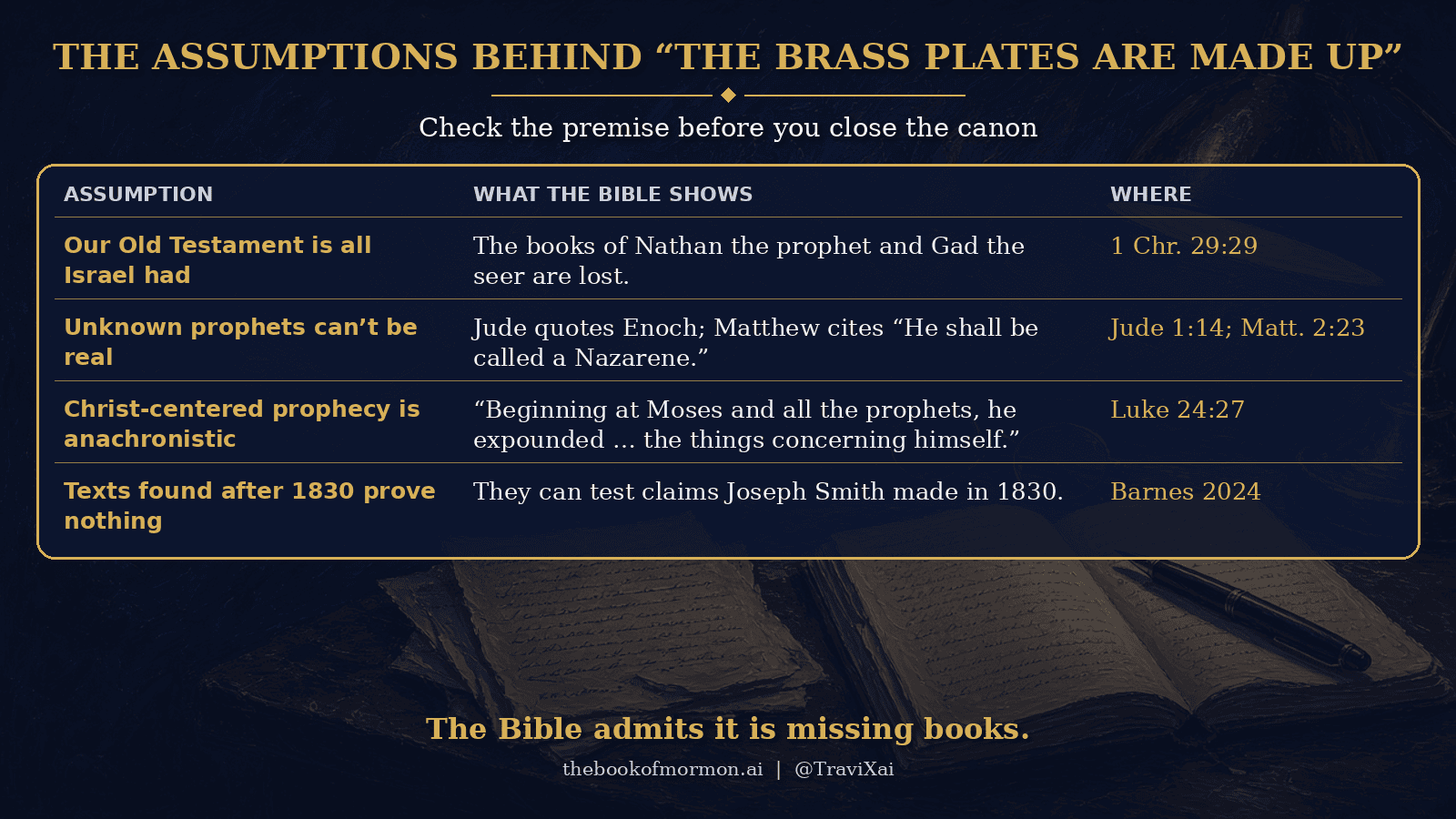
Before anyone waves this book away, look at what they have to assume to dismiss the brass plates outright. None of these assumptions is ever argued for. They’re just smuggled in:
- That our Old Testament is everything Israel had. The Bible itself says otherwise. It sends readers to the book of Nathan the prophet and the book of Gad the seer (1 Chronicles 29:29), and neither survives.
- That a prophet missing from our Bible can’t be real. Jude quotes a prophecy of Enoch found in no Old Testament book (Jude 1:14), and Matthew cites “He shall be called a Nazarene” (Matthew 2:23), which no Old Testament book says in those words. If the New Testament can quote lost prophets, the Book of Mormon can too.
- That Christ-centered Old Testament prophecy is an anachronism. Jesus Himself, “beginning at Moses and all the prophets, he expounded unto them in all the scriptures the things concerning himself” (Luke 24:27).
- That texts discovered after 1830 can’t test the Book of Mormon. They’re exactly what can. Joseph Smith couldn’t read what hadn’t been found yet.
- That the canon closed with the books we have. The Lord says otherwise: “because that ye have a Bible ye need not suppose that it contains all my words” (2 Nephi 29:10).
For more on this, see Is the Book of Mormon in the Bible? and The Canon Was Never Meant to Close.
What Barnes actually argues
Start where Barnes starts, with Nephi’s own table of contents. When Lehi searched the plates:
And he beheld that they did contain the five books of Moses, which gave an account of the creation of the world, and also of Adam and Eve, who were our first parents;
And also a record of the Jews from the beginning, even down to the commencement of the reign of Zedekiah, king of Judah;
And also the prophecies of the holy prophets, from the beginning, even down to the commencement of the reign of Zedekiah; and also many prophecies which have been spoken by the mouth of Jeremiah.
1 Nephi 5:11–13
That sounds like our Old Testament up to Jeremiah, until the Book of Mormon starts quoting prophets from those plates who aren’t in our Bible at all. Nephi names three in one verse and credits each with a specific prophecy of the Messiah:
And the God of our fathers, who were led out of Egypt, out of bondage, and also were preserved in the wilderness by him, yea, the God of Abraham, and of Isaac, and the God of Jacob, yieldeth himself, according to the words of the angel, as a man, into the hands of wicked men, to be lifted up, according to the words of Zenock, and to be crucified, according to the words of Neum, and to be buried in a sepulchre, according to the words of Zenos, which he spake concerning the three days of darkness, which should be a sign given of his death unto those who should inhabit the isles of the sea, more especially given unto those who are of the house of Israel.
1 Nephi 19:10
Zenos isn’t a one-verse cameo. Jacob 5, the allegory of the olive tree, is presented as his words. Alma asks the Zoramites, “Do ye remember to have read what Zenos, the prophet of old, has said concerning prayer or worship?” and then quotes him (Alma 33:3–4), and adds that “Zenock also spake of these things” (Alma 33:15). Nephi the son of Helaman says “the prophet Zenos did testify boldly; for the which he was slain” (Helaman 8:19), and lists Zenock and Ezias alongside Isaiah and Jeremiah (Helaman 8:20). These are prophets the Nephites read, quoted, and argued from. Our Bible has never heard of them.
Barnes’s argument is that the brass plates weren’t a museum piece the Nephites kept in a drawer. They were the source material. As the publisher puts it, their influence “permeates nearly every famous sermon given by Alma, or Lehi, or Nephi, or Jacob,” Captain Moroni reads from them, and King Benjamin builds on them. Benjamin says as much himself: “were it not for these plates, which contain these records and these commandments, we must have suffered in ignorance, even at this present time, not knowing the mysteries of God” (Mosiah 1:3).
Then comes the bold part. Barnes lines up apocryphal and pseudepigraphal texts that surfaced after 1830 against the Book of Mormon and argues that some of them share a family tree with Lehi’s brass plates. The publisher says he uses paleography and philology to reconstruct what was on them, and the questions he takes on are not timid:
- “Which books were on the brass plates stolen by Lehi in 597 BC? Can we read them?”
- “Who corrupted the Old Testament canon? And how badly?”
- “Who was Lucifer, and why does the Bible say so little about him?”
- “Who was Eve, and why are the Christian creeds so hard on women?”
- “Who was the prophet Abinadi? Where did he come from?”
- “How did the prophet Isaiah die? Who killed him and why?”
- “Why does the Book of Mormon sound too Messianic and not more Mosaic?”
- “Do the apocrypha support the authority of the Bible? Or do they support the Book of Mormon?”
And yes, the last question on the publisher’s list is whether anti-Mormons think Joseph Smith was a time-traveler, and whether they think Elvis is still alive. That tells you the tone. Barnes is funny, and he knows it. The jokes don’t replace the argument; they just make 262 pages of apocrypha go down a lot easier than you’d expect.
The Bible admits it’s missing books
The first thing a critic says is that Zenos and Zenock are made up because they aren’t in the Bible. That argument assumes the Bible is a complete record of Israel’s prophets. The Bible disagrees. The Chronicler sends readers elsewhere for David’s history:
Now the acts of David the king, first and last, behold, they are written in the book of Samuel the seer, and in the book of Nathan the prophet, and in the book of Gad the seer,
1 Chronicles 29:29 (KJV)
For Solomon, the acts are written “in the book of Nathan the prophet, and in the prophecy of Ahijah the Shilonite, and in the visions of Iddo the seer” (2 Chronicles 9:29). Joshua asks, “Is not this written in the book of Jasher?” (Joshua 10:13). We have none of those books. Jude quotes a prophecy of Enoch that appears nowhere in the Old Testament:
And Enoch also, the seventh from Adam, prophesied of these, saying, Behold, the Lord cometh with ten thousands of his saints,
Jude 1:14 (KJV)
Matthew says Jesus “came and dwelt in a city called Nazareth: that it might be fulfilled which was spoken by the prophets, He shall be called a Nazarene” (Matthew 2:23). Find that line in the Old Testament. I’ll wait. The New Testament writers clearly had prophetic material we don’t, which is exactly what the Book of Mormon claims about the brass plates.
The Book of Mormon even explains the gap. Nephi saw that the record of the Jews would lose material as it was handed down:
Wherefore, thou seest that after the book hath gone forth through the hands of the great and abominable church, that there are many plain and precious things taken away from the book, which is the book of the Lamb of God.
1 Nephi 13:28
And it predicted the exact reaction it would get: “A Bible! A Bible! We have got a Bible, and there cannot be any more Bible” (2 Nephi 29:3). The Lord’s answer is that He speaks to the Jews, the Nephites, the other tribes, and “all nations of the earth and they shall write it” (2 Nephi 29:12). If God speaks to everyone and everyone writes it down, then there are records out there that aren’t in our Bible. Barnes went looking for some of them. I’ve made a related case in The Old Testament WAS Christian, but someone altered it!
Then the sand started giving texts back
In 1830 the Book of Mormon claimed Israel once had a richer, more Christ-centered scripture than the Bible preserves. Over the next century and a half, ancient texts kept turning up. The Nag Hammadi library was found in Egypt in 1945. The Dead Sea Scrolls began turning up in caves near Qumran in 1947, and among them were Aramaic fragments of the Book of Enoch, the same Enoch tradition Jude quoted. Other pseudepigrapha, writings attributed to biblical figures, were edited, translated, and studied far more widely in the twentieth century than ever before.
That timing is what makes Barnes’s approach work. Take one of his questions: how did Isaiah die? Hebrews says of the faithful prophets that “they were sawn asunder” (Hebrews 11:37), and an ancient Jewish and Christian tradition, preserved outside the Old Testament, says that’s how Isaiah was killed. The Bible hints at it. The fuller story survived somewhere else. Helaman 8:19 says Zenos “was slain” for his testimony. The Book of Mormon’s picture of Israel, prophets killed for testifying of the Messiah, is the picture those later texts keep filling in.
The publisher calls these texts “voices from the dust.” I’d call them inconvenient witnesses. Some of these texts were known in obscure editions before 1830. The Dead Sea Scrolls and the Nag Hammadi codices were not known to anyone. A farm boy in 1829 doesn’t get to copy from scrolls still sitting in a cave.
The “too Messianic” objection, answered
This is the argument I found most compelling, because it flips a favorite criticism on its head. Critics say the Book of Mormon is “too Christian” for a pre-Christian text. Nephites centuries before Christ talk about Him by name, preach faith in Him, and look forward to His atonement. Nephi says it plainly:
And we talk of Christ, we rejoice in Christ, we preach of Christ, we prophesy of Christ, and we write according to our prophecies, that our children may know to what source they may look for a remission of their sins.
2 Nephi 25:26
Jacob says this wasn’t a family quirk. It was the testimony of every prophet before them:
For, for this intent have we written these things, that they may know that we knew of Christ, and we had a hope of his glory many hundred years before his coming; and not only we ourselves had a hope of his glory, but also all the holy prophets which were before us.
Jacob 4:4
Here’s the presupposition hiding in the objection: that real Israelite religion around 600 BC was purely “Mosaic” and had no clear expectation of a divine Redeemer. Where does that come from? Not from Jesus. On the road to Emmaus He did the opposite:
And beginning at Moses and all the prophets, he expounded unto them in all the scriptures the things concerning himself.
Luke 24:27 (KJV)
Peter agreed: “To him give all the prophets witness” (Acts 10:43). So the Christian critic has a problem. Either the Old Testament prophets testified of Christ, in which case a record that preserves those testimonies plainly is what you’d expect, or they didn’t, in which case Jesus and Peter were wrong. Pick one. Barnes takes this question on directly with texts outside our canon, and they carry far more messianic expectation than the critics’ tidy “Mosaic” model allows. The Book of Mormon isn’t too Messianic. Our surviving Old Testament is too thin.
The fair objection, and why it doesn’t sink the book
I’m not going to pretend there’s no serious pushback, because there is, and some of it comes from fellow Latter-day Saints. The strongest version goes like this: the brass plates were in Hebrew or Egyptian, the Nephites abridged and quoted them, and Joseph Smith translated the result into English, so you can’t literally “reconstruct” the plates from a modern apocryphal text. Some critics also say Barnes reads particular parallels too strongly.
Fair enough. Parallels are evidence, not proof, and any reconstruction of what was on the plates is a hypothesis, not revelation. Barnes presents it as research, and that’s how you should read it. The Lord already told us how to handle this kind of material. Of the Apocrypha, “There are many things contained therein that are true,” and also “many things contained therein that are not true, which are interpolations by the hands of men,” so “whoso readeth it, let him understand, for the Spirit manifesteth truth” (D&C 91:1–4). Read Barnes the same way: check the texts he cites, weigh each parallel on its own, and keep what holds.
But notice what the objection doesn’t touch. The core claim never rested on one parallel. The Book of Mormon said in 1830 that Israel’s scripture once held more, and held more about Christ. The Bible admits it’s missing books. The Book of Mormon quotes prophets the Bible lost. And the texts that came out of the ground afterward keep pointing the same direction. You can quibble with any single chapter of Barnes and the pattern is still sitting there, waiting for an explanation that doesn’t involve a farm boy with a time machine.
Who should read it
- Latter-day Saints who want more than “I just know it’s true.” You should know it’s true. You should also know why the critics’ favorite objections fall apart. This book gives you both.
- Anyone who has wondered what was on the brass plates. If you’ve read 1 Nephi 3–5 and never asked, now you will.
- Readers curious about the apocrypha who don’t know where to start. Barnes is an easy on-ramp to texts most members have never opened.
- People who argue with critics online. The “too Messianic” chapter alone is worth the price.
- Critics. Especially critics. If your whole case is that Joseph Smith copied the Bible, explain the prophets who aren’t in it.
My verdict: 5 out of 5
The Key to the Keystone is smart, funny, and aimed exactly where the debate needs it. Barnes takes the Book of Mormon’s own claim about its source seriously, more seriously than most of its critics have ever bothered to, and shows that the ancient world keeps backing that claim up. Once you see how much of Alma, Jacob, and Mosiah leans on the brass plates, you can’t read those sermons the same way again, because you start asking what the Nephite preachers were reading when they wrote them.
Five stars. Buy it from Plain and Precious Publishing (the physical copy unlocks the audiobook and the bonus videos) or on Amazon, read it with your scriptures open, and then go ask the next person who tells you there cannot be any more Bible where Matthew found “He shall be called a Nazarene.”
What all four standard works say about the prophets and Christ
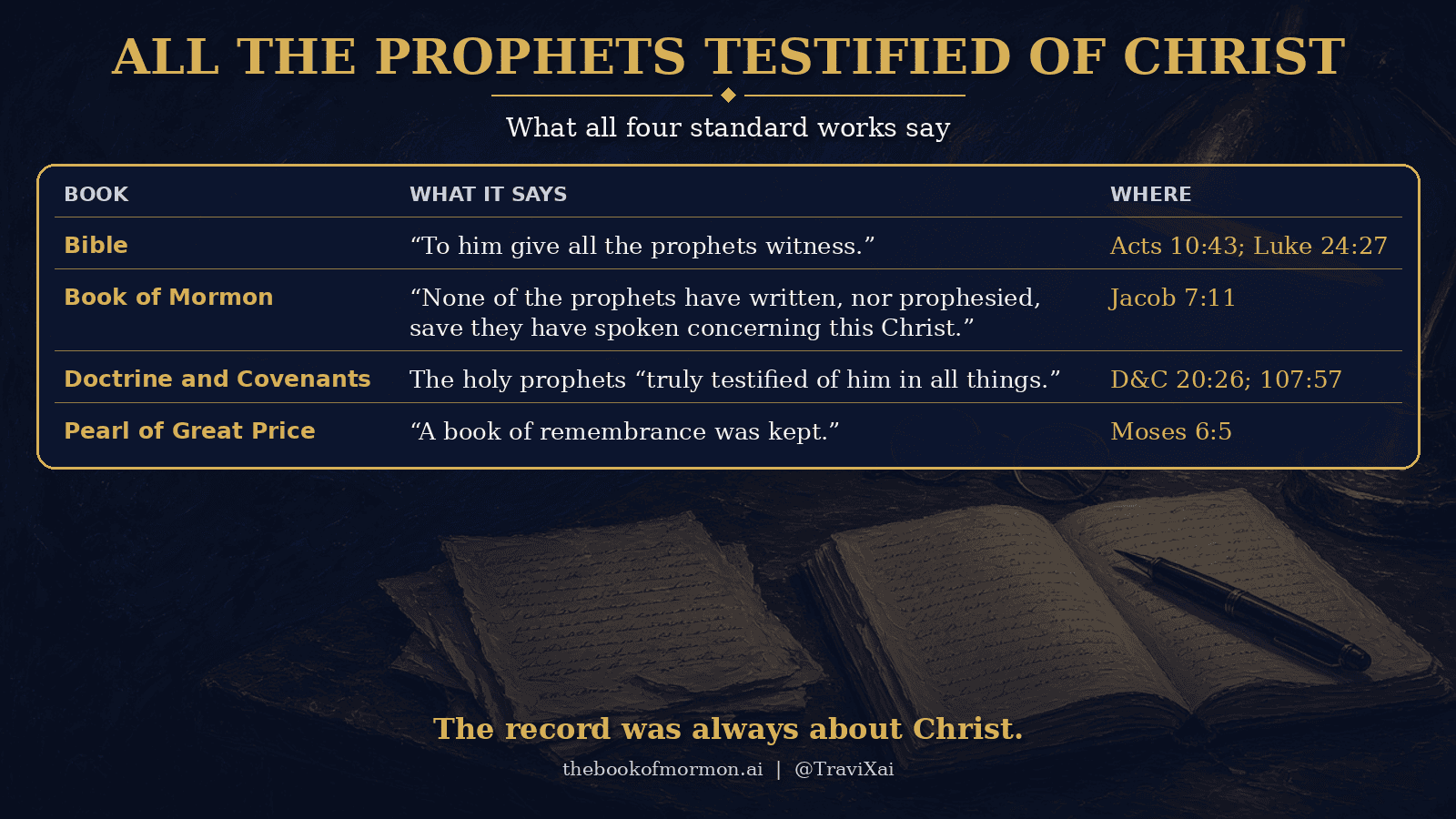
The heart of the brass-plates question is whether Israel’s prophets spoke plainly of Christ. All four standard works say they did.
The Bible
To him give all the prophets witness, that through his name whosoever believeth in him shall receive remission of sins.
Acts 10:43
The Book of Mormon
Behold, I say unto you that none of the prophets have written, nor prophesied, save they have spoken concerning this Christ.
Jacob 7:11
Nephi says the brass plates were “of great worth unto us, insomuch that we could preserve the commandments of the Lord unto our children” (1 Nephi 5:21).
The Doctrine and Covenants
all those from the beginning, even as many as were before he came, who believed in the words of the holy prophets, who spake as they were inspired by the gift of the Holy Ghost, who truly testified of him in all things, should have eternal life,
D&C 20:26
Modern revelation also names lost writings: of Adam’s blessing on his posterity, “These things were all written in the book of Enoch, and are to be testified of in due time” (D&C 107:57).
The Pearl of Great Price
And a book of remembrance was kept, in the which was recorded, in the language of Adam, for it was given unto as many as called upon God to write by the spirit of inspiration;
Moses 6:5
Record-keeping by revelation goes back to Adam. The brass plates were one link in that chain.
The Key to the Keystone: quick answers
Is The Key to the Keystone worth reading?
Yes. I rate it 5 out of 5. Jonah R. Barnes compares the Book of Mormon with apocryphal texts found after 1830 to show what was likely on Lehi’s brass plates, and he’s funny while he does it. Read it as research, not revelation, and check his sources as you go.
What is The Key to the Keystone about?
What was on Lehi’s brass plates. Barnes lines up the Book of Mormon against apocryphal and pseudepigraphal texts, such as the Dead Sea Scrolls and Enoch literature, and argues some share a family tree with the plates, including the lost prophets Zenos, Zenock, and Neum.
Who wrote The Key to the Keystone?
Jonah R. Barnes, an independent researcher, with a foreword by D. John Butler. The full title is The Key to the Keystone: How Apocryphal Texts Unlock the Book of Mormon’s Brass Plates (Plain and Precious Publishing, October 1, 2024).
What were the brass plates?
The scripture record Nephi and his brothers brought from Jerusalem. Nephi says they held the five books of Moses, a record of the Jews down to Zedekiah, and prophecies of the holy prophets (1 Nephi 5:11–13). King Benjamin says that without them his people “must have suffered in ignorance” (Mosiah 1:3).
Who were Zenos, Zenock, and Neum?
Prophets quoted from the brass plates whose writings aren’t in our Bible. Nephi credits them with prophecies of Christ’s crucifixion and burial (1 Nephi 19:10), Alma quotes Zenos and Zenock on prayer and the Son (Alma 33), and Jacob 5 preserves Zenos’s allegory of the olive tree.
How many pages is The Key to the Keystone?
262 pages, according to the Amazon listings for the paperback and hardcover editions.
Where can I buy The Key to the Keystone?
From the publisher, Plain and Precious Publishing, where the physical copy unlocks the audiobook and 6+ hours of bonus videos through QR codes, or on Amazon.
Is The Key to the Keystone an official Church publication?
No. It’s independent research, and its reconstructions are hypotheses, not revelation. Read it the way D&C 91 says to read the Apocrypha: with the Spirit, keeping what is true.
Related reading: Let’s talk about Enoch: Biblical, Extra-Biblical & Joseph Smith’s Account, books the Bible quotes that aren’t in the Bible, and Jude 1:14 and Enoch.
On the Galatians 1:8 app: the Great Apostasy, can you add to the Bible?, and is the Bible infallible?
Sources
- Jonah R. Barnes, The Key to the Keystone: How Apocryphal Texts Unlock the Book of Mormon’s Brass Plates, foreword by D. John Butler (Plain and Precious Publishing, 2024). Publisher’s page, description, and bonus-content details: plainandpreciouspublishing.com; book site: thekeytothekeystone.com
- Amazon listing (publication date October 1, 2024; 262 pages; ISBN-13 979-8990412057): amazon.com
- Jonah Barnes interview, “Key To The Keystone- Lost Books, (Apocrypha) Found In The Book of Mormon – Jonah Barnes,” Cwic Media: cwicmedia.com
- The Leon Levy Dead Sea Scrolls Digital Library (Israel Antiquities Authority), introduction to the scrolls: deadseascrolls.org.il
- Scriptures quoted: 1 Nephi 5:11–13, 21; 13:28; 19:10; 2 Nephi 25:26; 29:3, 10, 12; Jacob 4:4; 7:11; Mosiah 1:3; Alma 33:3–4, 15; Helaman 8:19–20; Doctrine and Covenants 20:26; 91:1–4; 107:57; Moses 6:5; Joshua 10:13, 1 Chronicles 29:29, 2 Chronicles 9:29, Matthew 2:23, Luke 24:27, Acts 10:43, Hebrews 11:37, and Jude 1:14 (KJV), all from churchofjesuschrist.org