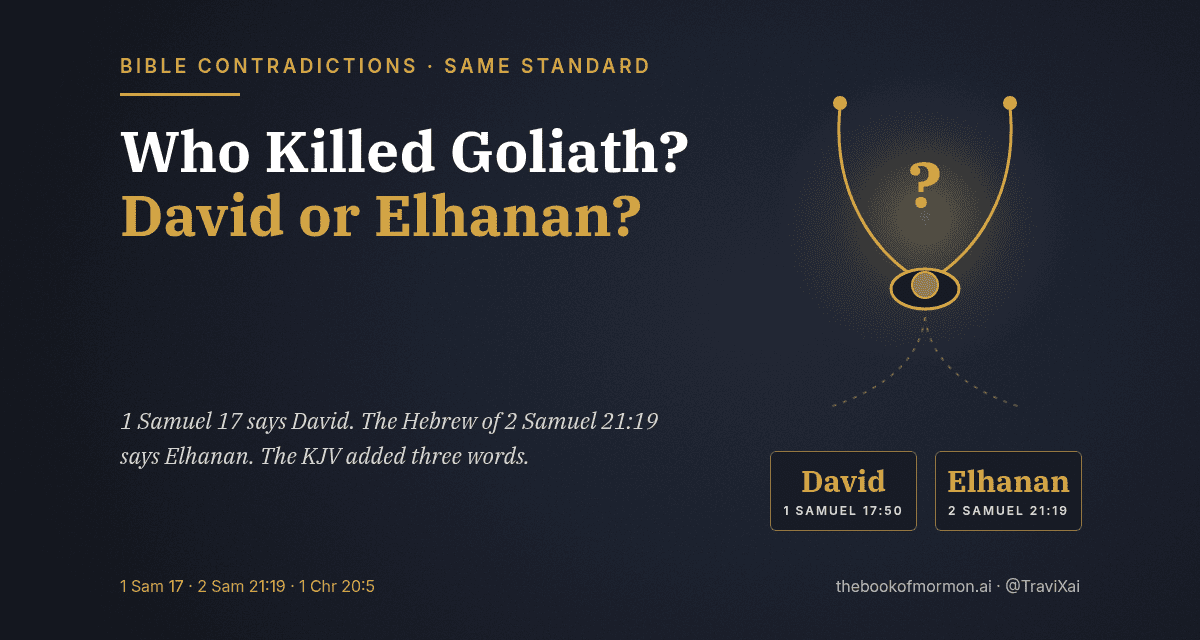

Every Sunday school kid knows David killed Goliath. The Hebrew text of 2 Samuel 21:19 says Elhanan did. Here’s how Bible defenders handle that, and why they’d never let a Latter-day Saint get away with the same answer.
Who killed Goliath? Easy. David, with a sling and a stone, and the giant face down in the dirt. Every kid in Sunday school knows that one. So the next time someone tells you the Book of Mormon can’t be from God because of a contradiction or a changed word, ask them that question. Then hand them 2 Samuel 21:19 in a modern Bible and ask them to read it out loud.
Because in the Hebrew text most English Bibles are translated from, it wasn’t David. It was a man named Elhanan. And the way Bible defenders handle that verse is exactly the way they say Latter-day Saints aren’t allowed to handle the Book of Mormon.
Exhibit ADavid, a sling, and a stone
First, let’s be fair to the story everyone knows, because 1 Samuel 17 couldn’t be clearer. The giant is named twice: “named Goliath, of Gath” (1 Samuel 17:4) and “Goliath by name” (17:23). His spear is “like a weaver’s beam” (17:7). And the kill belongs to David:
So David prevailed over the Philistine with a sling and with a stone, and smote the Philistine, and slew him; but there was no sword in the hand of David.
1 Samuel 17:50 (KJV)
Then he finishes the job with Goliath’s own sword and “cut off his head therewith” (17:51). Later the priest at Nob hands David “the sword of Goliath the Philistine, whom thou slewest in the valley of Elah” (1 Samuel 21:9). This is David’s defining moment. The women sing about it (18:7). And David is from Bethlehem, “the son of thy servant Jesse the Beth-lehemite” (17:58). Remember that last part.
Exhibit BElhanan in 2 Samuel 21:19
Now jump ahead to 2 Samuel 21, a short list of battles against Philistine giants late in David’s reign. Here’s verse 19 in the King James Version:
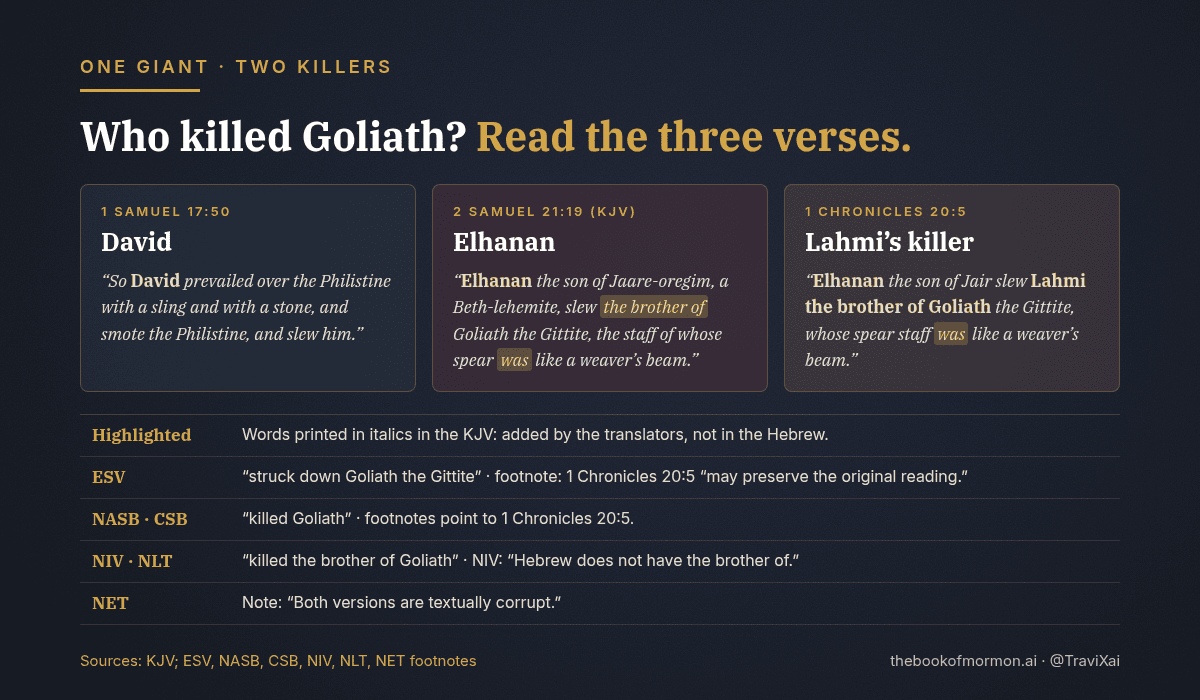
And there was again a battle in Gob with the Philistines, where Elhanan the son of Jaare-oregim, a Beth-lehemite, slew the brother of Goliath the Gittite, the staff of whose spear was like a weaver’s beam.
2 Samuel 21:19 (KJV)
See the italics? In the KJV, italic words are words the translators supplied that aren’t in the original language. So take them out and read what the Hebrew actually says: Elhanan, a Bethlehemite, slew Goliath the Gittite, the one with the spear like a weaver’s beam. Same name. Same city, since a Gittite is a man of Gath. Same weaver’s-beam spear. Different killer.
Don’t take my word for it. Look at the modern translations. The ESV says Elhanan “struck down Goliath the Gittite.” The NASB and CSB both say he “killed Goliath.” The NIV does add “the brother of,” but its own footnote admits, “Hebrew does not have the brother of.” The NLT adds it too, with a footnote that says the “Hebrew reads killed Goliath of Gath.”
That isn’t critic spin. That’s the translators telling you, in the footnotes of their own Bibles, what the text says.
The KJV didn’t preserve it. It added it.
One popular Q&A page on BibleHub says that “in older English translations (like the KJV), the phrase ‘the brother of’ is included.” Included, sure, in italics. That’s the translators’ own way of saying, “We put these words here.” They borrowed them from Chronicles to make the verses agree. That’s a fix, not a manuscript.
The patchChronicles and Lahmi
Here’s the verse they borrowed from:
And there was war again with the Philistines; and Elhanan the son of Jair slew Lahmi the brother of Goliath the Gittite, whose spear staff was like a weaver’s beam.
1 Chronicles 20:5 (KJV)
In Chronicles, “the brother of” isn’t in italics. It’s really there. So the standard defense goes like this: Chronicles kept the right reading, and a scribe copying Samuel lost a few words. Even the ESV footnote only goes so far as to say 1 Chronicles 20:5 “may preserve the original reading.” May.
But it gets worse. The NET Bible note on 2 Samuel 21:19 says plainly about these two verses: “Both versions are textually corrupt.” Their explanation is that “Lahmi” itself is probably a scribe misreading the Hebrew for “the Bethlehemite,” while the Samuel scribe misread the word for “brother.” So the verse that’s supposed to fix 2 Samuel needs fixing too. The same note says that “from a text-critical point of view the books of Samuel are the most poorly preserved of all the books of the Hebrew Bible,” and admits, “Many scholars believe that the two passages are hopelessly at variance with one another.”
Even Elhanan’s father is a problem. Samuel calls him Jaare-oregim, and Chronicles calls him Jair. The NET says “oregim,” which means “weavers,” was “probably accidentally included” because the word shows up again at the end of the verse. That’s a lot of scribal accidents in one sentence. A 2022 article in the journal Vetus Testamentum argues that a text-critical fix is “a viable option” for resolving the tension with 1 Samuel 17. Viable. Not proven.
The excusesA possible excuse isn’t evidence
GotQuestions lays out the options pretty honestly: “Unless David and Elhanan are different names for the same person—or there were two giants named Goliath—these verses seem to contradict each other.” Then it picks the copyist: “One viable theory is that, somewhere in the chain of copying the text, a scribe made a mistake.” And it ends with, “We can be confident that David killed Goliath.”
Let’s take those one at a time.
- Two names, one man. David is the son of Jesse. Elhanan is the son of Jaare-oregim, or Jair. An Elhanan “son of Dodo of Beth-lehem” even shows up in the list of David’s mighty men (2 Samuel 23:24), as one of David’s soldiers, not David himself. And the chapter wraps up by saying these giants “fell by the hand of David, and by the hand of his servants” (21:22). Elhanan is one of the servants. Where’s the evidence they’re the same person? There isn’t any.
- Two Goliaths. Both are “the Gittite.” Both carry a spear “like a weaver’s beam.” Could there be two? Sure, anything is possible. Is there any evidence? No.
- A scribal error. This is the most respectable answer, and look at what it gives away. It admits the Bible we actually have says Elhanan killed Goliath, and that you have to repair it with a verse the NET says is corrupt too.
Here’s my problem with all three. A possible excuse isn’t evidence. “It’s logically possible to harmonize” is not the same thing as “it’s probably true.” It’s far more likely the text means what it says than that your excuse is correct. So the contradiction stands.
The Chicago Statement on Biblical Inerrancy has an answer for that too. Article XIV: “We deny that alleged errors and discrepancies that have not yet been resolved vitiate the truth claims of the Bible.” In other words, even the ones we can’t fix don’t count. That isn’t a standard. That’s a hall pass. And 2 Timothy 3:16 never said what they need it to say. It says scripture is “given by inspiration of God” and “profitable.” Inspired and profitable, yes. Inerrant? It doesn’t say that.
A possible excuse isn’t evidence. It’s more likely the text means what it says.
The standardNow do Mosiah 21:28
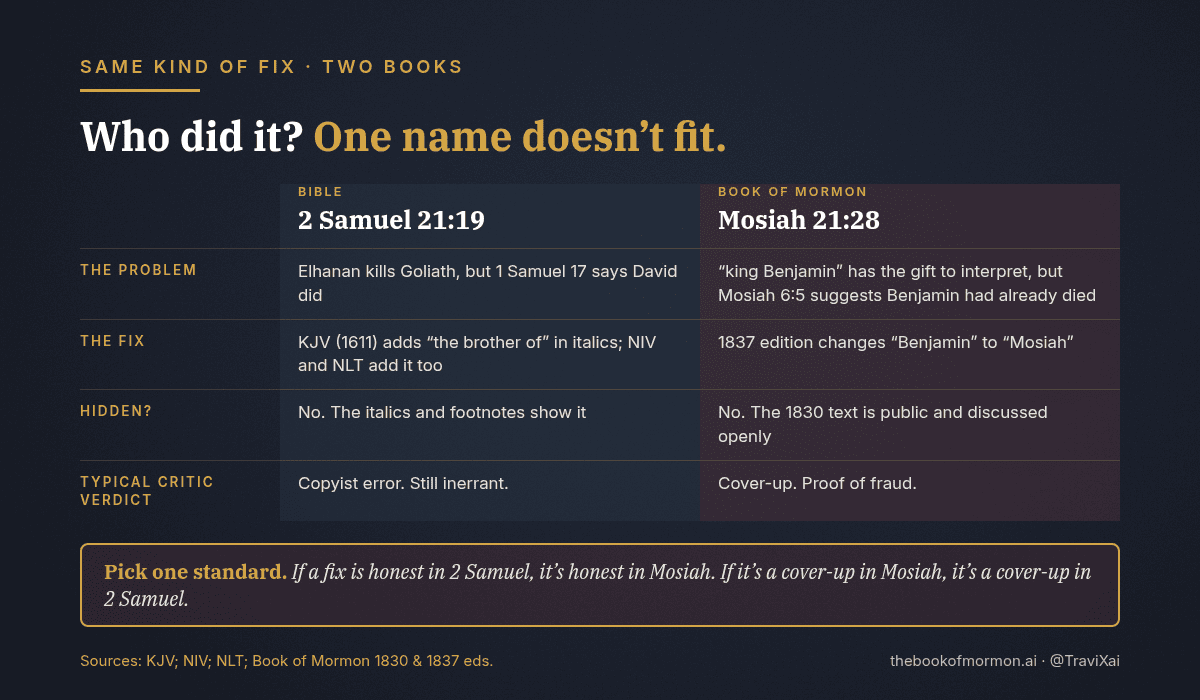
Now flip it. In the 1830 Book of Mormon, Mosiah 21:28 said Limhi learned “that king Benjamin had a gift from God, whereby he could interpret such engravings” (1830 text). The problem is the timeline. Mosiah 6:5 says, “And king Benjamin lived three years and he died,” and Ammon wasn’t sent out until “after king Mosiah had had continual peace for the space of three years” (Mosiah 7:1). So it looks like Benjamin was already dead.
The fix? The 1837 edition changed “Benjamin” to “Mosiah.” According to textual scholar Royal Skousen, as quoted by Scripture Central, the 1837 edition “made the change from Benjamin to Mosiah to avoid [an] apparent contradiction.” It’s not hidden. The 1830 text is public, and Latter-day Saint scholars write about it openly (BYU Religious Studies Center).
Critics put that change on their lists of “Book of Mormon changes” and call it a cover-up. So which is it? The KJV translators added three words in 1611 to fix who killed Goliath, and that’s a faithful translation. An 1837 edition changed one name to fix who had the interpreters, and that’s fraud? If a Latter-day Saint answered Mosiah 21:28 with “maybe Benjamin and Mosiah are two names for the same king,” or “maybe there were two King Benjamins,” you’d laugh them off the internet. Yeah, mmm hmm. Do better.
I don’t need either book to be perfect
Here’s the thing. I don’t have to explain away either one. The title page of the Book of Mormon already told you: “if there are faults they are the mistakes of men” (title page). And Article of Faith 8 says, “We believe the Bible to be the word of God as far as it is translated correctly.” Scribes are men. Translators are men. Mistakes happen, and we said so up front.
I believe David killed Goliath. I love 1 Samuel 17. But my faith isn’t in an unbroken chain of perfect copyists. The Bible isn’t God. If it were perfect, people would worship it and not have to turn to the True God. How do I know it’s true anyway? The same way I know the Book of Mormon is true. God told me, and I choose to believe Him.
So hold the Book of Mormon to the same standard you hold the Bible to. They both pass, or they both fail. You don’t get to grade one on a curve.
SummaryKey takeaways
- 1 Samuel 17:50 says David killed Goliath. The Hebrew of 2 Samuel 21:19 says Elhanan the Bethlehemite killed “Goliath the Gittite,” the one with the weaver’s-beam spear.
- The KJV’s “the brother of” is in italics, meaning the translators added it. The ESV, NASB, and CSB print “Goliath,” and the NIV and NLT footnote that the Hebrew doesn’t have “the brother of.”
- 1 Chronicles 20:5 says Elhanan killed “Lahmi the brother of Goliath,” but the NET says “both versions are textually corrupt.”
- The harmonizations (same man, two Goliaths, a copyist error) are possible, not proven. A possible excuse isn’t evidence.
- Critics accept a copyist fix for 2 Samuel 21:19 and call the 1837 Benjamin-to-Mosiah change in Mosiah 21:28 a cover-up. Pick one standard.
Next time someone hands you a list of Book of Mormon “changes,” hand them 2 Samuel 21:19 and ask who killed Goliath. For quick, sourced answers on apparent Bible contradictions, Bible inerrancy, and the Joseph Smith Translation, open Galatians18. And for more like this every day, follow me on X at @TraviXai.
Sources
- Bible (KJV, churchofjesuschrist.org): 1 Samuel 17:4–58 · 1 Samuel 18:7 · 1 Samuel 21:9 · 2 Samuel 21:19–22 · 2 Samuel 23:24 · 1 Chronicles 20:5–8 · 2 Timothy 3:16
- 2 Samuel 21:19 in modern translations (Bible Gateway, with footnotes): ESV · NASB · CSB · NIV · NLT
- NET Bible translators’ notes on 2 Samuel 21:19: 2 Samuel 21 (NET), Bible.com
- Kaspars Ozolins, “Killing Goliath? Elhanan the Bethlehemite and the Text of 2 Samuel 21:19,” Vetus Testamentum 72:4–5 (2022): 716–733: Brill
- GotQuestions: “Who killed Goliath, David or Elhanan?” · BibleHub: “Did David or Elhanan kill Goliath?”
- The Chicago Statement on Biblical Inerrancy (1978), Articles XIII–XIV
- Book of Mormon: Title page · Mosiah 6:4–5 · Mosiah 7:1 · Mosiah 21:28 · Mosiah 21:28, 1830 vs. current text (bookofmormon.com)
- Scripture Central, “Which Nephite King Had the Gift of Interpretation?” · BYU Religious Studies Center, “King Benjamin or King Mosiah?”
- Pearl of Great Price: Articles of Faith 1:8
- Galatians18: Apparent Biblical Contradictions · Is the Bible Infallible? · The Joseph Smith Translation
- Featured image and comparison cards: original graphics by thebookofmormon.ai (no photographs or likenesses of real people).