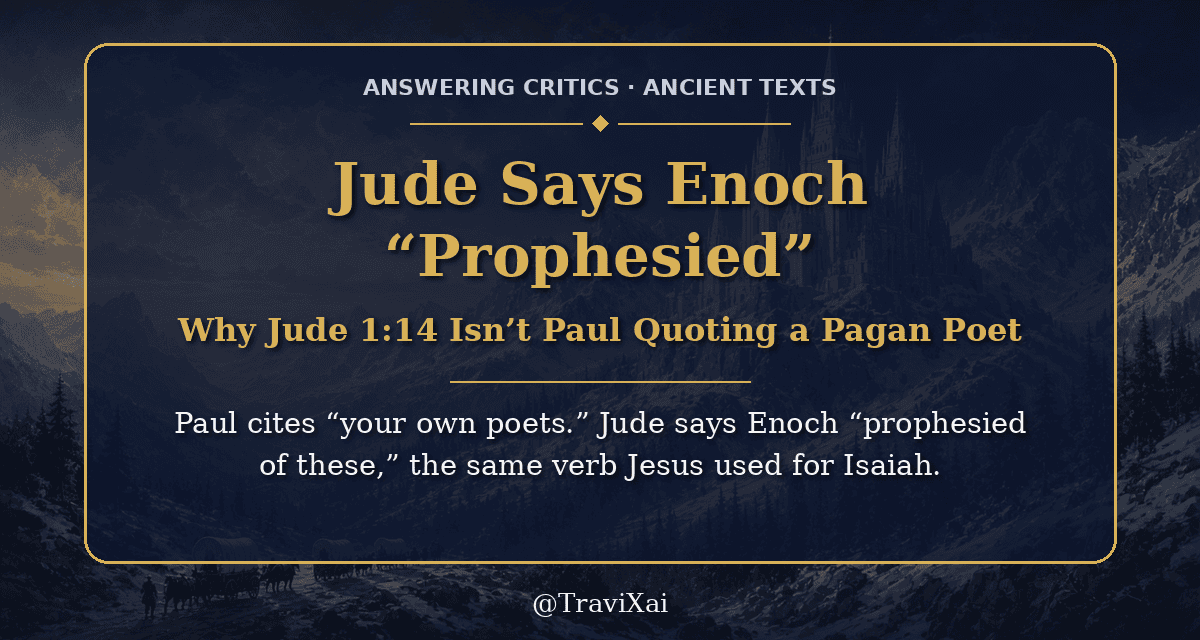

When the Bible’s Enoch quote went viral, the fast answer was that Paul quoted pagan poets too. Read how each author introduces his source. Paul cites “your own poets.” Jude says Enoch “prophesied.”
On November 6, the Book of Enoch had its day on X. Boxer Ryan Garcia posted “The Bible quotes the Book of Enoch / Interesting 🧐” (link), and well over 100,000 people saw it. The fast answer showed up the same morning, and it’s the one you’ll hear from every Bible-only apologist: relax, Paul quoted pagan poets too.
That answer sounds airtight for about ten seconds. Then you open Jude and read the one word it skips: prophesied.
Part IThe fast answer, and its own test
Evangelical apologist Wes Huff, who has about 191,000 followers on X, replied to Garcia:
It’s not a matter of *if* a book is quoted but *why* and *how* a book is quoted. Don’t forget Paul’s quotes the pagan philosophers Menander (1 Cor. 15:33), Epimenides (Titus 1:12), and Aratus (Acts 17:28) in the Bible.
@WesleyLHuff on X, November 6, 2026
He went on: “just because something is quoted neither means that the biblical author thought it was true nor is advocating for its credibility, merely referencing material familiar to the audience,” and he filed Jude’s Enoch in the same drawer as Paul’s Greeks.
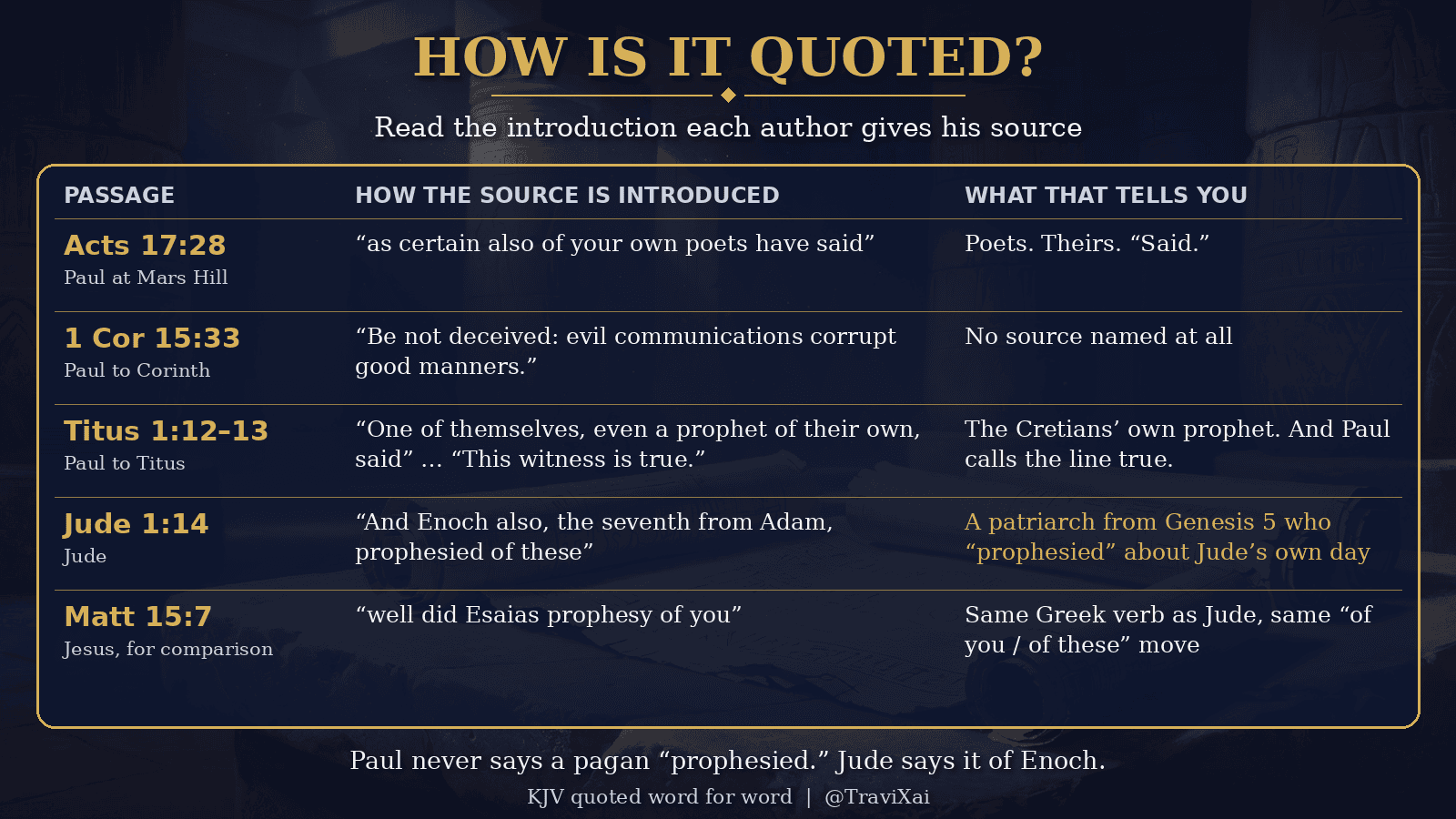
I’ll take the first sentence. How and why a book is quoted is exactly the right question. So let’s actually do it: read how Paul introduces each of his three sources, then read how Jude introduces his one. Same test, four passages.
Part IIHow Paul cites his pagans
Acts 17:28: “your own poets”
For in him we live, and move, and have our being; as certain also of your own poets have said, For we are also his offspring.
Acts 17:28
Paul is on Mars Hill talking to Athenians, and he tags the source three ways: certain poets, your own poets, and they said it. But he doesn’t treat the line as flavor text. The very next verse builds doctrine on it: “Forasmuch then as we are the offspring of God” (Acts 17:29). (More on that verse in We Are God’s Offspring.)
1 Corinthians 15:33: no name at all
Be not deceived: evil communications corrupt good manners.
1 Corinthians 15:33
No author. No “as it is written.” No “thus saith.” It’s a proverb, and nobody in Corinth thought Paul just added a prophet to their library.
Titus 1:12–13: “a prophet of their own”
One of themselves, even a prophet of their own, said, The Cretians are alway liars, evil beasts, slow bellies. This witness is true.
Titus 1:12–13
Huff’s best example, so let’s be fair: Paul does use the word “prophet” here. But read the fence he builds around it: one of themselves, a prophet of their own. The Cretians’ prophet, not the Lord’s. And he “said,” he didn’t prophesy.
Then look at verse 13: “This witness is true.” Paul quotes a pagan and immediately vouches for the line. So Huff’s own example breaks his own rule. Quoting “neither means that the biblical author thought it was true”? In Titus, Paul literally says it’s true. In Acts, he builds the next sentence on it.
Part IIIHow Jude cites Enoch
And Enoch also, the seventh from Adam, prophesied of these, saying, Behold, the Lord cometh with ten thousands of his saints, To execute judgment upon all, and to convince all that are ungodly among them of all their ungodly deeds which they have ungodly committed, and of all their hard speeches which ungodly sinners have spoken against him.
Jude 1:14–15
Same test. Here’s what Jude does that Paul never does with a pagan.
He puts Enoch in the sacred line
“The seventh from Adam” isn’t a tag for a Greek playwright. It’s a genealogy. Count Genesis 5: Adam, Seth, Enos, Cainan, Mahalaleel, Jared, Enoch (Genesis 5:3–18). This is the same Enoch who “walked with God: and he was not; for God took him” (Genesis 5:24), and who “pleased God” (Hebrews 11:5). Paul says “your own poets.” Jude says, in effect, our forefather.
He uses the prophecy verb
Paul’s sources “said.” Jude’s Enoch “prophesied.” The Greek is proephēteusen (Jude 1:14), the same verb Jesus used when He told the Pharisees, “Ye hypocrites, well did Esaias prophesy of you” (Matthew 15:7; Greek here). Mark’s version reads “Well hath Esaias prophesied of you hypocrites, as it is written” (Mark 7:6).
Isaiah prophesied of you. Enoch prophesied of these. Nobody says Jesus was “merely referencing material familiar to the audience” when He said Isaiah prophesied.
He says the prophecy was about his own day
“Of these” points back to the “certain men crept in unawares … ungodly men” of Jude 1:4, and forward to the “murmurers, complainers” of verse 16. Jude’s claim: Enoch, before the Flood, saw the very people troubling Jude’s readers. That’s predictive prophecy with a fulfillment attached. Paul never claims Aratus foresaw anybody.
Then Jude sets Enoch beside the apostles: “But, beloved, remember ye the words which were spoken before of the apostles of our Lord Jesus Christ” (Jude 1:17).
And the wording isn’t loose. In R. H. Charles’s translation, 1 Enoch 1:9 has Him coming “with ten thousands” to “execute judgement upon all,” right down to “the hard things which ungodly sinners” have spoken “against Him” (1 Enoch 1). I lined the two up side by side in Books the Bible Quotes That Aren’t in the Bible.
“Familiar to the audience” might explain why Jude picked Enoch. It doesn’t explain how he cited him. If Enoch were only familiar folklore, “as the old books say” would have done it. He chose “prophesied.”
Part IVThe assumption under the answer
The “Paul quoted pagans” reply only works if you’ve already drawn the line between scripture and everything else, then read Jude through it.
The logic runs in a circle. Enoch isn’t scripture because it isn’t in the Bible. Jude’s “prophesied” can’t mean Enoch was a real prophecy, because Enoch isn’t scripture. Round and round, and Jude never gets to mean what he wrote.
The early church didn’t see it that cleanly. Jerome, writing around the end of the fourth century, said Jude’s letter “is rejected by many” “because in it he quotes from the apocryphal Book of Enoch.” And how did Jude stay in? “Nevertheless by age and use it has gained authority and is reckoned among the Holy Scriptures” (Jerome, De Viris Illustribus 4).
By age and use. Not by a prophet. Not by a revelation. Not by a verse listing the books. And there isn’t one original manuscript of Jude on earth to check any of it against. I read Jude as scripture. I just want the critic to admit his canon line was drawn by people, over centuries, and Jude’s own words strained against it. That’s the faith claim hiding under “it’s not in the Bible.”
Part VThe Enoch the Restoration gave back
Genesis gives Enoch a handful of verses. Hebrews gives him one. Jude gives him a prophecy and then moves on. If Enoch really prophesied, where’s the rest of it?
Joseph Smith answered that question in November and December 1830 in what we now call Moses 6–7, part of the Pearl of Great Price. There, Enoch isn’t a name in a list. He gets a call, and the call uses Jude’s word:
And he heard a voice from heaven, saying: Enoch, my son, prophesy unto this people, and say unto them—Repent, for thus saith the Lord: I am angry with this people, and my fierce anger is kindled against them; for their hearts have waxed hard, and their ears are dull of hearing, and their eyes cannot see afar off;
Moses 6:27
The people say “A seer hath the Lord raised up unto his people” (Moses 6:36). He builds “the City of Holiness, even Zion” (Moses 7:19), and then he sees exactly what Jude’s quote is about, the Lord’s coming:
And it came to pass that Enoch saw the day of the coming of the Son of Man, in the last days, to dwell on the earth in righteousness for the space of a thousand years;
Moses 7:65
Jude has the Lord coming “with ten thousands of his saints.” Moses 7 has the Lord telling Enoch that he “and all thy city” will meet the gathered elect at His coming (Moses 7:62–63). Jude preserved one line. The Restoration put the prophet back around it.
How were a pre-Flood prophet’s words written down? “A book of remembrance was kept” (Moses 6:5). And the Doctrine and Covenants says more Enoch is coming: “These things were all written in the book of Enoch, and are to be testified of in due time” (D&C 107:57).
So a farm boy in 1830 hands the world an Enoch who prophesies, sees, and builds Zion, while Bible-only Christianity is still explaining why Jude didn’t mean “prophesied.” For the names in Moses 6–7 that line up with Enoch texts found long after Joseph died, see Let’s Talk About Enoch.
Part VIEnoch gets a pass. Zenos gets mocked.
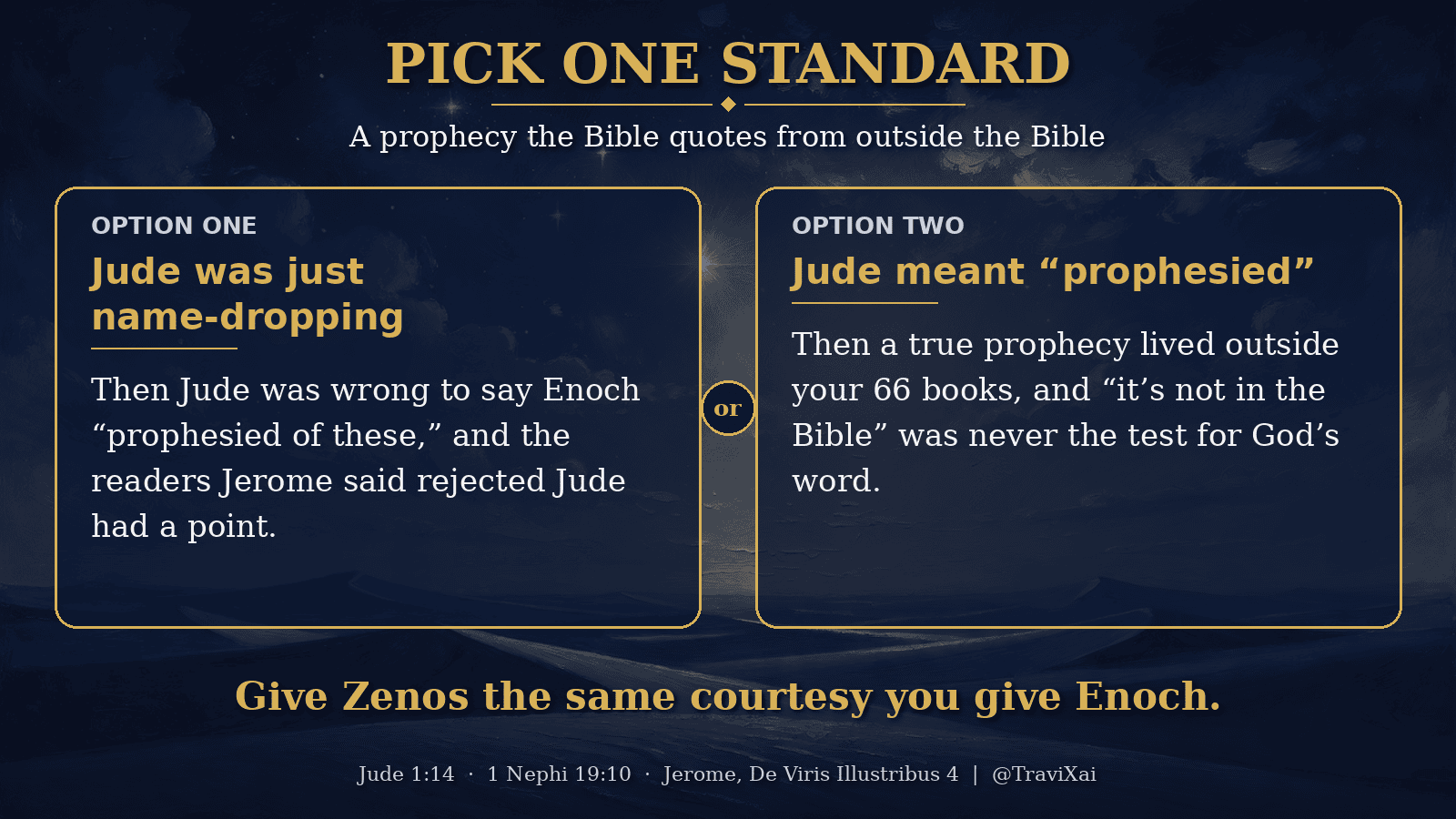
Here’s the double standard, plain. When the Book of Mormon quotes prophets outside the Bible, critics laugh. Nephi says the God of Israel would be “lifted up, according to the words of Zenock,” “crucified, according to the words of Neum,” and “buried in a sepulchre, according to the words of Zenos” (1 Nephi 19:10). The response: never heard of them, not in the Bible, made up.
Jude does the exact same thing. He quotes a prophet’s words from a record outside the Hebrew Bible, calls it prophecy, and applies it to his own day. If “not in my Bible” disqualifies Zenos, it disqualifies Jude’s Enoch. If Jude gets to quote a real prophecy from outside the canon, then “it’s not in the Bible” was never the test for God’s word.
That leaves two options:
- Jude was just name-dropping. Then calling it prophecy was a mistake, and the readers Jerome mentioned who rejected his letter had a point.
- Jude meant what he wrote. Then a true prophecy existed outside the 66 books, the canon was never a complete catalog of every prophet God used, and the question about Zenos is not “Is he in the Bible?” but “Did God speak through him?”
Option two is the one the Bible itself takes. It’s also the one Latter-day Saints take: the canon is open because God never stopped talking (more in The Canon Was Never Meant to Close). And the way to know whether a book is from God is the same for the Book of Mormon as for Jude: “If any of you lack wisdom, let him ask of God” (James 1:5).
SummaryKey takeaways
- How a book is quoted matters. Paul’s sources are “your own poets,” an unnamed proverb, and “a prophet of their own.” Jude’s Enoch is “the seventh from Adam” who “prophesied.”
- Jude’s verb is the one Jesus used for Isaiah (Matthew 15:7; Mark 7:6): a prophet who foresaw the people in front of you.
- Even Huff’s own example cuts the other way: after quoting Epimenides, Paul says “This witness is true” (Titus 1:13).
- The reply assumes the canon line first. Jerome says Jude was “rejected by many” for quoting Enoch and stayed in “by age and use.”
- Moses 6–7 (1830) restores Enoch as a called prophet and seer who saw “the coming of the Son of Man,” and D&C 107:57 says the book of Enoch will be “testified of in due time.”
- If Enoch can prophesy outside the 66 books, so can Zenos (1 Nephi 19:10). Same standard, both directions.
Next time someone answers Jude 1:14 with “Paul quoted pagans too,” ask them to read the introductions out loud: “your own poets,” “a prophet of their own,” and then “Enoch also, the seventh from Adam, prophesied.” For quick, sourced answers on continuing revelation and an open canon, Jude 3 and “the faith once delivered”, “you can’t add to the Bible”, and Bible inerrancy, open Galatians18. And for more like this every day, follow me on X at @TraviXai.
Sources
- King James Bible (Church of Jesus Christ of Latter-day Saints edition): Jude 1:1–18 · Acts 17:22–29 · 1 Corinthians 15:33 · Titus 1:12–13 · Genesis 5:3–24 · Hebrews 11:5 · Matthew 15:7–8 · Mark 7:6 · James 1:5
- Greek text (Bible Hub interlinear): Jude 1:14 · Matthew 15:7 · Titus 1:12
- Pearl of Great Price and Doctrine and Covenants: Moses 6:5 · Moses 6:26–36 · Moses 7:19–21 · Moses 7:62–65 · D&C 107:48–57 · 1 Nephi 19:10
- 1 Enoch 1:9, R. H. Charles translation: The Book of Enoch, chapter 1 (Sacred Texts)
- Jerome, De Viris Illustribus (Lives of Illustrious Men), chapter 4, “Jude” (New Advent)
- Wes Huff, reply to Ryan Garcia, X, November 6, 2026; Ryan Garcia, “The Bible quotes the Book of Enoch”, X, November 6, 2026
- Galatians18: Continuing Revelation and an Open Canon · Jude 3: The Faith Once Delivered? · Revelation 22: You Can’t Add to the Bible? · Is the Bible Infallible?
- Featured image and in-article graphics: original graphics by thebookofmormon.ai (painterly backgrounds; no photographs or likenesses of real people).