
It’s the shortest book we have, but it holds some of the biggest ideas in Latter-day Saint belief. Here’s a quick tour.
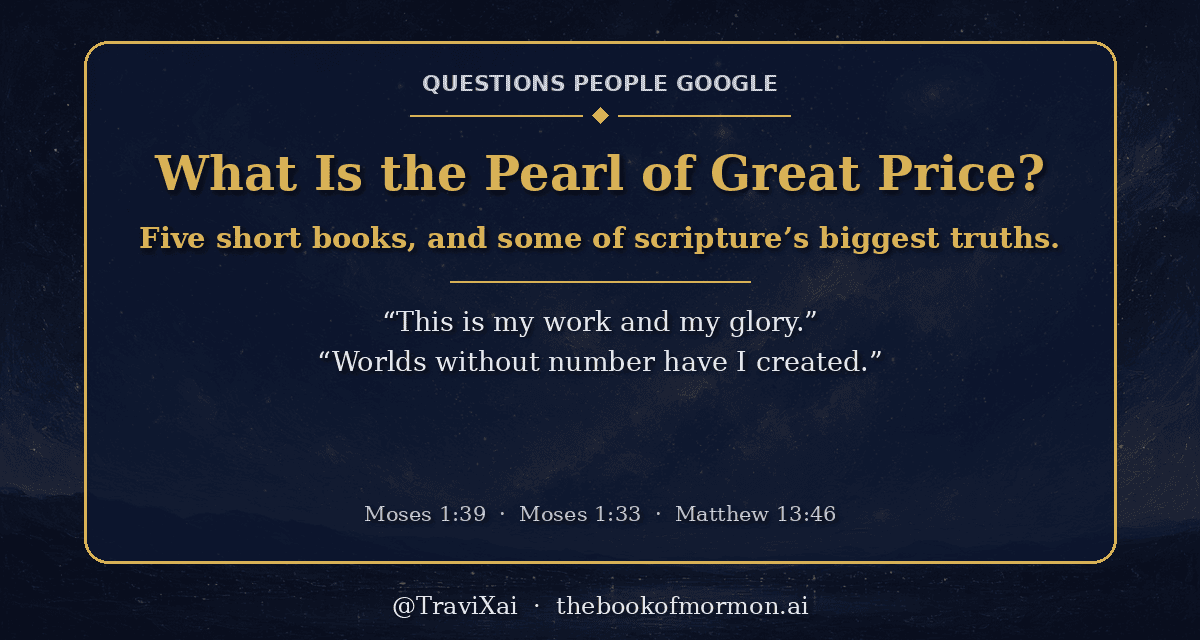
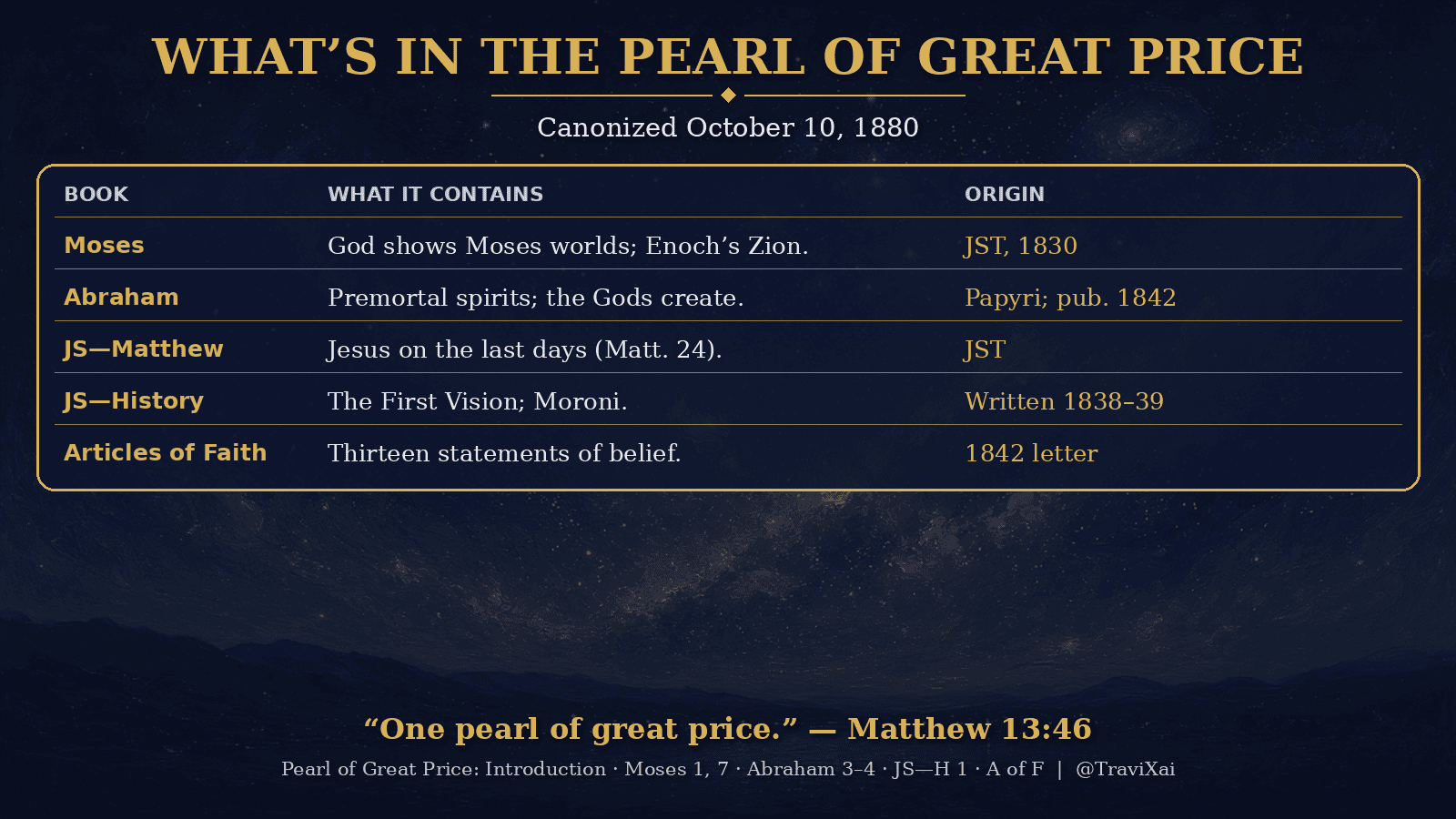
The Pearl of Great Price is the shortest of the four Latter-day Saint books of scripture. It contains five parts, all produced by Joseph Smith: the Book of Moses (from his inspired translation of Genesis), the Book of Abraham (translated from Egyptian papyri), Joseph Smith—Matthew, Joseph Smith—History and the Articles of Faith. It became scripture on October 10, 1880. It’s where we read, “worlds without number have I created” (Moses 1:33) and “this is my work and my glory—to bring to pass the immortality and eternal life of man” (Moses 1:39).
The short answerThe shortest book of Latter-day Saint scripture
Its introduction says: “The Pearl of Great Price is a selection of choice materials touching many significant aspects of the faith and doctrine of The Church of Jesus Christ of Latter-day Saints. These items were translated and produced by the Prophet Joseph Smith” (Introduction). It’s one of the four standard works, with the Bible, the Book of Mormon and the Doctrine and Covenants.
Elder Franklin D. Richards first compiled it in England in 1851, and it “became a standard work of the Church by action of the First Presidency and the general conference in Salt Lake City on October 10, 1880” (Introduction). The name comes from Jesus’s parable of the merchant who, “when he had found one pearl of great price, went and sold all that he had, and bought it” (Matthew 13:45–46). As the Book of Mormon says, “because that ye have a Bible ye need not suppose that it contains all my words; neither need ye suppose that I have not caused more to be written” (2 Nephi 29:10).
The Book of MosesMoses sees God, and worlds without number
The Book of Moses comes from Joseph Smith’s inspired translation of Genesis, begun in June 1830 (Introduction). It opens with a vision Genesis doesn’t record. God tells Moses, “behold, thou art my son … my works are without end” (Moses 1:4), and shows him the scope of creation: “worlds without number have I created … and by the Son I created them, which is mine Only Begotten” (Moses 1:33).
Then comes one of the most quoted verses in Latter-day Saint teaching: “For behold, this is my work and my glory—to bring to pass the immortality and eternal life of man” (Moses 1:39). Later chapters expand the story of Enoch, whom the Bible mentions only briefly (Hebrews 11:5; Jude 1:14). His city became Zion, “because they were of one heart and one mind, and dwelt in righteousness; and there was no poor among them” (Moses 7:18).
The Book of AbrahamPremortal life, and the Gods who organized the earth
Joseph Smith began translating it “in 1835 after obtaining some Egyptian papyri,” and it was published in 1842 (Introduction). Jesus said, “Your father Abraham rejoiced to see my day” (John 8:56), and here Abraham sees the premortal world: “the intelligences that were organized before the world was; and among all these there were many of the noble and great ones … Abraham, thou art one of them; thou wast chosen before thou wast born” (Abraham 3:22–23).
The Lord teaches Abraham that intelligences exist one above another: “there shall be another more intelligent than they; I am the Lord thy God, I am more intelligent than they all” (Abraham 3:19). Joseph built on this in his 1844 Sermon in the Grove, saying “I learned it by translating the papyrus,” and teaching that “God the Father of Jesus Christ had a Father” in an endless line (History of the Church 6:476). Abraham’s Creation account is told by “the Gods,” who “organized and formed the heavens and the earth” (Abraham 4:1), and God’s purpose for us is stated plainly: “we will prove them herewith … and they who keep their second estate shall have glory added upon their heads for ever and ever” (Abraham 3:25–26). For the papyri questions, see What Is the Book of Abraham?.
Joseph Smith—Matthew and Joseph Smith—HistoryJesus on the last days, and the Restoration
Joseph Smith—Matthew comes from the New Testament translation the Lord told Joseph to begin (D&C 45:60–61). It is his inspired version of Matthew 24, Jesus’s teaching on the last days, with the promise: “whoso treasureth up my word, shall not be deceived” (Joseph Smith—Matthew 1:37).
Joseph Smith—History is his own account, written in 1838–39 (Introduction), of the First Vision, Moroni’s visits, the gold plates and the restoration of the priesthood. It contains the words that began it all: “This is My Beloved Son. Hear Him!” (Joseph Smith—History 1:17). See What Is the First Vision?.
The Articles of FaithThirteen statements of belief
The Articles of Faith come from an 1842 letter to Chicago newspaper editor John Wentworth (Introduction). Many children in the Church memorize them. The first reads: “We believe in God, the Eternal Father, and in His Son, Jesus Christ, and in the Holy Ghost” (Articles of Faith 1:1).
The thirteenth sums up the Latter-day Saint outlook: “We believe in being honest, true, chaste, benevolent, virtuous, and in doing good to all men … If there is anything virtuous, lovely, or of good report or praiseworthy, we seek after these things” (Articles of Faith 1:13).
Check the premiseThe presuppositions baked into the question
Before this question can be answered fairly, the person asking has to justify a few assumptions packed inside it:
- That the Pearl of Great Price is a secret or hidden book. It’s published free online and printed with the Doctrine and Covenants in every Latter-day Saint triple combination.
- That it’s one book. It’s five: Moses, Abraham, Joseph Smith—Matthew, Joseph Smith—History and the Articles of Faith.
- That it adds a different God. Moses 1:6 says “there is no God beside me,” and the Articles of Faith begin with the Father, Son and Holy Ghost (Articles of Faith 1:1).
- That its teachings are new inventions. It restores what Jesus and the apostles pointed to: Abraham saw Christ’s day (John 8:56) and Enoch prophesied (Jude 1:14).
FAQQuick answers
What is the Pearl of Great Price?
The shortest book of Latter-day Saint scripture, containing the Book of Moses, the Book of Abraham, Joseph Smith—Matthew, Joseph Smith—History and the Articles of Faith.
When did the Pearl of Great Price become scripture?
It was first compiled in 1851 by Franklin D. Richards and was accepted as a standard work on October 10, 1880.
Why is it called the Pearl of Great Price?
After Jesus’s parable of the merchant who sold all he had for “one pearl of great price” (Matthew 13:45–46).
What is the Book of Moses?
Joseph Smith’s inspired translation of the early chapters of Genesis, including a vision of Moses and expanded accounts of Adam and Enoch.
What are the Articles of Faith?
Thirteen statements of Latter-day Saint belief Joseph Smith wrote in 1842 in a letter to John Wentworth.
What does Moses 1:39 say?
“For behold, this is my work and my glory—to bring to pass the immortality and eternal life of man.” It is one of the most quoted verses in Latter-day Saint teaching.
What is Joseph Smith—Matthew?
Joseph Smith’s inspired revision of Matthew 24 (and the last verse of Matthew 23), in which Jesus teaches about the destruction of Jerusalem and the signs of His Second Coming.
What does the Book of Moses say about Enoch’s city?
That Enoch’s people became so united that “the Lord called his people Zion, because they were of one heart and one mind” (Moses 7:18).
SummaryKey takeaways
- The Pearl of Great Price has five parts, all produced by Joseph Smith.
- It became a standard work on October 10, 1880.
- Moses 1:39 and Abraham 3 reveal God’s purpose and our premortal life.
- It includes the First Vision account and the Articles of Faith.
Read Moses 1 and Abraham 3 tonight; it takes 15 minutes. For quick, sourced answers, open Galatians18, and follow me on X at @TraviXai.
Sources
- King James Bible (churchofjesuschrist.org): Matthew 13:45–46 · John 8:56 · Hebrews 11:5 · Jude 1:14
- Book of Mormon: 2 Nephi 29:10
- Doctrine and Covenants: D&C 45:60–61
- Pearl of Great Price: Introduction · Moses 1:4–6 · Moses 1:33 · Moses 1:39 · Moses 7:18 · Abraham 3:19 · Abraham 3:22–26 · Abraham 4:1 · Joseph Smith—Matthew 1:37 · Joseph Smith—History 1:17 · Articles of Faith 1:1 · Articles of Faith 1:13
- History of the Church 6:476 (Sermon in the Grove), BYU Studies
- Featured image and in-article graphic: original graphics by thebookofmormon.ai (painterly backgrounds; no photographs or likenesses of real people).