
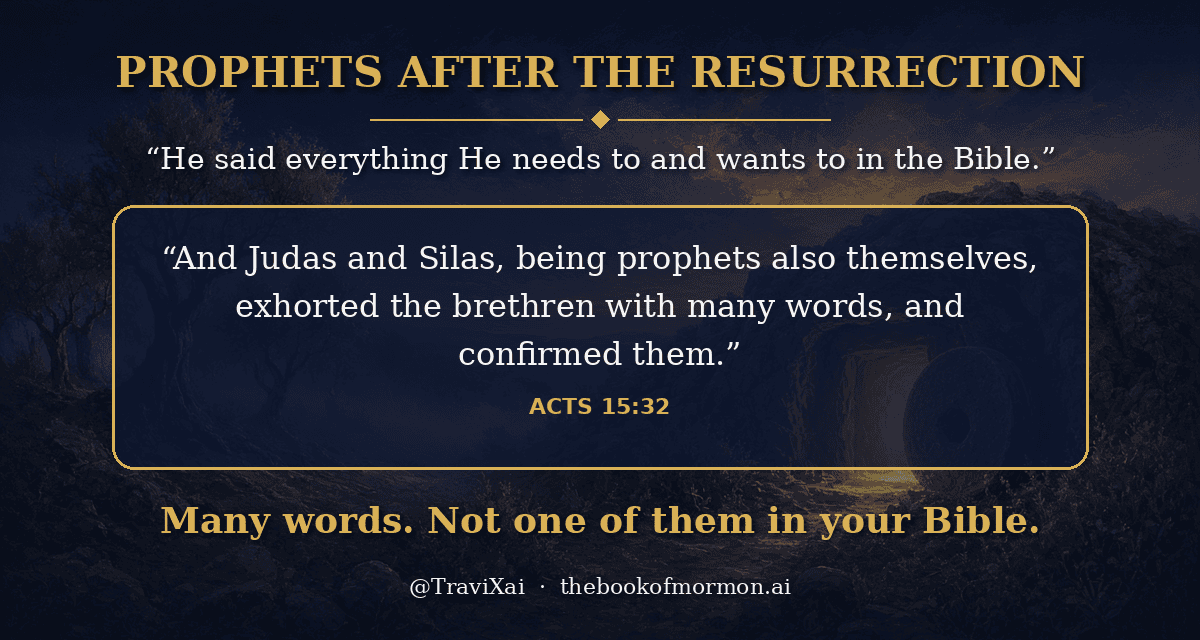

They say “He said everything He needs to and wants to in the Bible.” Then why did God keep sending prophets after the Resurrection, to people whose words never made it into the Bible? Acts names them. Paul says they stay “till we all come in the unity of the faith.”
Home › Answering Critics › Start here: The Canon Was Never Meant to Close
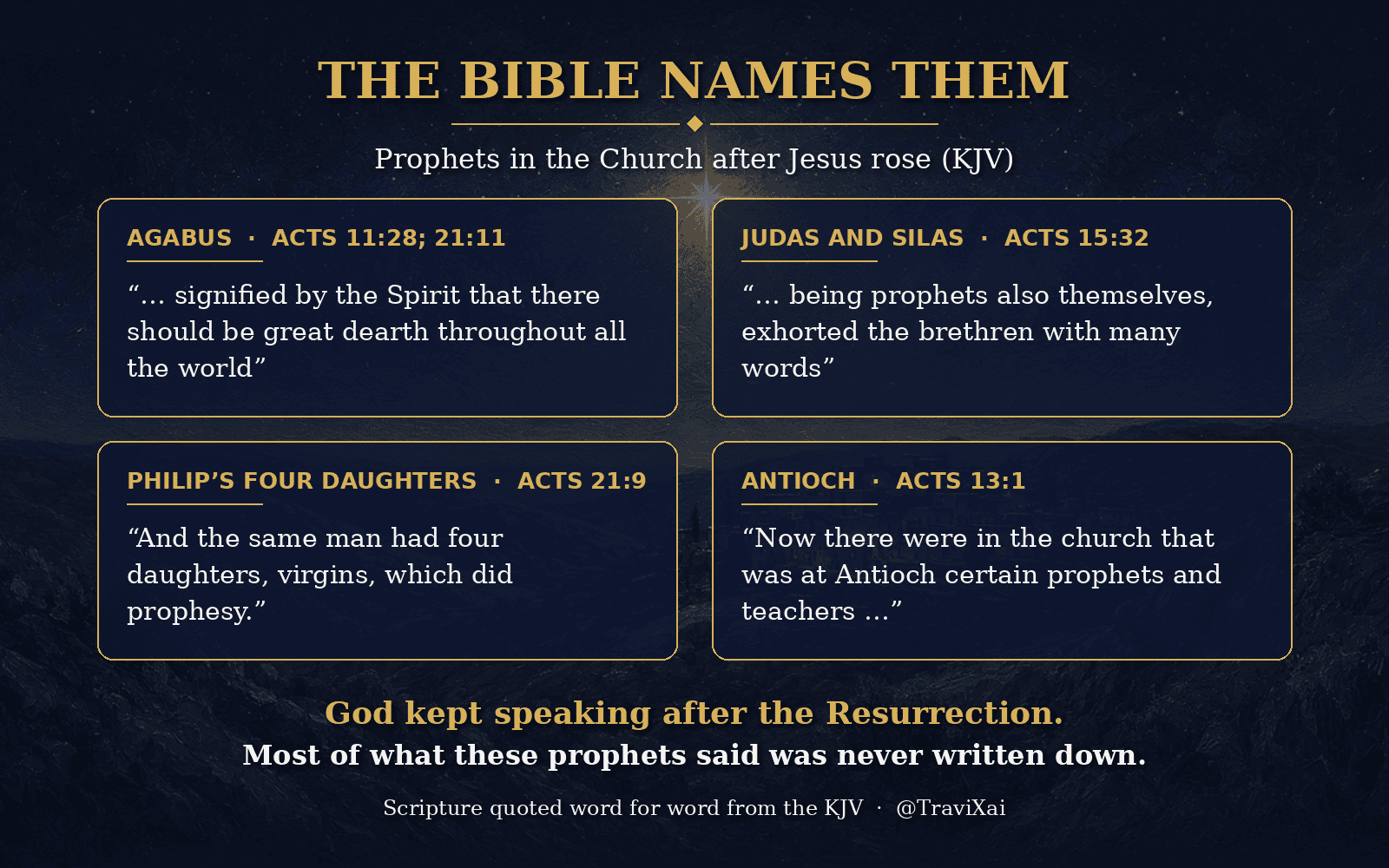
After Jesus rose, His Church still had prophets: Agabus, Judas and Silas, and Philip’s four daughters (Acts 11, 15, 21). Christ gave prophets “till we all come in the unity of the faith” (Ephesians 4:13). Most of what they said was never written down, and no prophet ever announced that prophets were finished.
“He said everything He needs to and wants to in the Bible.” I hear it every week. Ok. Then explain the Book of Acts. Jesus rose, ascended, and His Church kept getting messages from God through prophets. Most of them never wrote a word of scripture. Luke doesn’t even quote most of them. God was talking, and the Bible just tells you He was.
The real questionWho announced the end of prophets?
Start with the biggest problem, because everything else hangs on it. Paul says who put prophets in the Church:
And God hath set some in the church, first apostles, secondarily prophets, thirdly teachers, after that miracles, then gifts of healings, helps, governments, diversities of tongues.
1 Corinthians 12:28 (KJV)
“God hath set.” Not the apostles. Not a council. God. And only God can take out what God set. So if prophets ended, God made the biggest change in how He deals with man since the Atonement. For all of recorded history, from Adam to Moses to Malachi to John the Baptist to Agabus, God spoke to the world through men and women He called.
And every change that big came the same way: a revelation to a prophet with authority, written down with his name, the place, what God said, and why. Sinai. Peter on the roof in Joppa. The council in Acts 15. I lay out that pattern in detail in The Canon Was Never Meant to Close.
So where is that revelation? Which prophet received there will be no more prophets? What year? Where is it written? It doesn’t exist. And the Bible’s own rule says it would have to: “Surely the Lord God will do nothing, but he revealeth his secret unto his servants the prophets” (Amos 3:7). Nothing. That includes ending prophets.
To know for sure that God stopped sending prophets, you’d need a prophet to tell you. That’s the whole problem in one sentence.
Prophet #1Agabus: a famine, a relief fund, and Paul’s belt
Acts 11. Jesus has risen and ascended, and the disciples have just been “called Christians first in Antioch” (Acts 11:26). Then this:
And in these days came prophets from Jerusalem unto Antioch. And there stood up one of them named Agabus, and signified by the Spirit that there should be great dearth throughout all the world: which came to pass in the days of Claudius Cæsar.
Acts 11:27–28 (KJV)
“Prophets,” plural, traveling from Jerusalem. One predicts a famine, and Luke adds that it “came to pass.” The response: “the disciples, every man according to his ability, determined to send relief” to Judea, and sent it “by the hands of Barnabas and Saul” (Acts 11:29–30).
The Church changed its plans and sent money because a prophet said so, with the future apostle Paul carrying it.
Agabus shows up again years later. He takes Paul’s belt, ties his own hands and feet, and says:
Thus saith the Holy Ghost, So shall the Jews at Jerusalem bind the man that owneth this girdle, and shall deliver him into the hands of the Gentiles.
Acts 21:11 (KJV)
“Thus saith the Holy Ghost.” That’s the same voice as “Thus saith the Lord” from Jeremiah and Isaiah, coming out of a New Testament prophet decades after the Resurrection. And look who he’s talking to. Paul, the man credited with 13 of the New Testament’s 27 books. God had something to tell Paul that Paul didn’t already have, and He sent it through a prophet who never wrote a book of the Bible.
So if He said everything He needs to and wants to in the Bible, why was He still sending new messages to the Bible’s own authors?
Prophets #2 and #3Judas and Silas: “many words,” zero verses
Acts 15 is the Jerusalem council, the biggest doctrinal decision in the New Testament Church. The apostles and elders send their letter to Antioch with “Judas surnamed Barsabas, and Silas, chief men among the brethren” (Acts 15:22). The letter explains why the men are coming along:
We have sent therefore Judas and Silas, who shall also tell you the same things by mouth.
Acts 15:27 (KJV)
“By mouth.” The letter is the short version. The men carry the rest. Then Luke tells you who these men are:
And Judas and Silas, being prophets also themselves, exhorted the brethren with many words, and confirmed them.
Acts 15:32 (KJV)
“Being prophets also themselves.” Luke drops it in like a job title, because in that Church it was one. And they “exhorted the brethren with many words.” How many of those many words are in your Bible? Not one sentence. Luke records that the prophets spoke and that the Church was strengthened by it. The words themselves are gone.
That’s the New Testament’s own pattern. John says the same about Jesus Himself: if everything were written, “even the world itself could not contain the books that should be written” (John 21:25). The Bible never claims to be everything God said.
Prophets #4 through #7Philip’s four daughters, and a church full of prophets
Acts 21. Paul’s company stays in Caesarea at the house of “Philip the evangelist, which was one of the seven” (Acts 21:8). Then one line:
And the same man had four daughters, virgins, which did prophesy.
Acts 21:9 (KJV)
Four prophets in one house. Four women. And Luke doesn’t record a single word any of them said. That’s a problem for anyone who says God only speaks through the Bible.
It’s also exactly what Peter promised at Pentecost, quoting Joel: “And on my servants and on my handmaidens I will pour out in those days of my Spirit; and they shall prophesy” (Acts 2:18). Philip’s daughters are that promise being kept, in the “last days” Peter said it would happen in.
And this wasn’t rare. Antioch had “certain prophets and teachers,” and while they fasted, “the Holy Ghost said, Separate me Barnabas and Saul for the work whereunto I have called them” (Acts 13:1–2). Paul’s missionary journeys, and the letters that came out of them, started with a revelation in a room full of prophets. In Corinth, Paul had to limit how many spoke in one meeting: “Let the prophets speak two or three, and let the other judge” (1 Corinthians 14:29). And: “Despise not prophesyings” (1 Thessalonians 5:20).
How long?Ephesians 4:11–13: “Till we all come”
So were prophets just scaffolding for the first generation? Paul answers that directly. He tells you who gave them, why, and for how long:
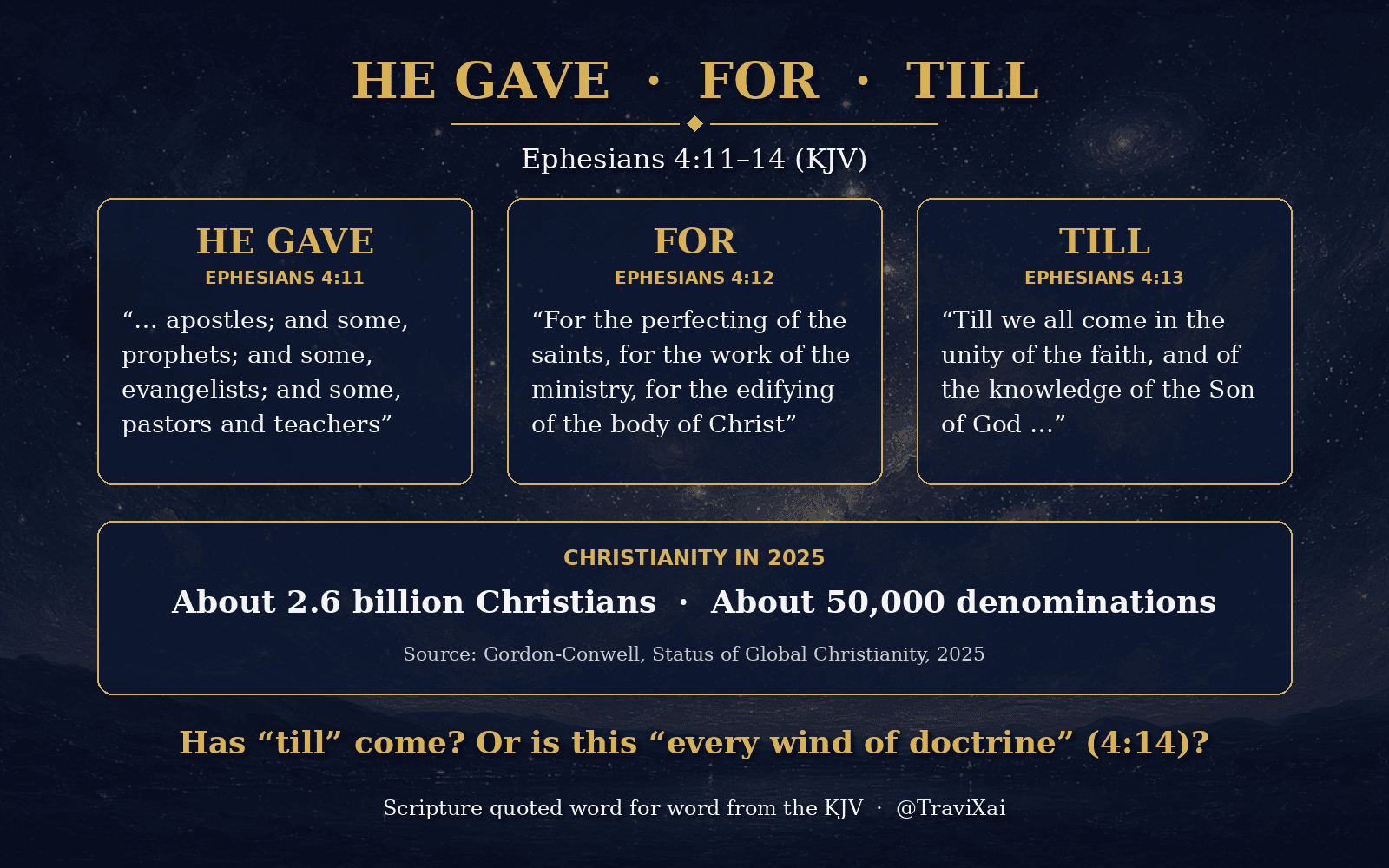
And he gave some, apostles; and some, prophets; and some, evangelists; and some, pastors and teachers; For the perfecting of the saints, for the work of the ministry, for the edifying of the body of Christ: Till we all come in the unity of the faith, and of the knowledge of the Son of God, unto a perfect man, unto the measure of the stature of the fulness of Christ:
Ephesians 4:11–13 (KJV)
Three words do all the work. “He gave.” Christ gave prophets, the same Christ critics say spoke the final word. “For.” The perfecting of the saints, the work of the ministry, the edifying of the body. Is that work finished? “Till.” Until we all come in the unity of the faith, “unto the measure of the stature of the fulness of Christ.”
So look around. The Center for the Study of Global Christianity at Gordon-Conwell counts about 2.6 billion Christians and roughly 50,000 denominations in 2025. Is that “the unity of the faith”? Paul tells you what happens without them in the next verse: “tossed to and fro, and carried about with every wind of doctrine” (Ephesians 4:14). Fifty thousand denominations is what “every wind of doctrine” looks like.
The “till” hasn’t come. So the gift hasn’t expired.
You might think: “A foundation is only laid once”
The best comeback I get is Ephesians 2:20: the Church is “built upon the foundation of the apostles and prophets.” A foundation is laid once, they say. Ok. But two chapters later, in the same letter, Paul says apostles and prophets are given “till we all come in the unity of the faith.” Not till the foundation is poured. Till unity.
And in between he tells you what the foundation does: the mystery of Christ “is now revealed unto his holy apostles and prophets by the Spirit” (Ephesians 3:5). Now. By revelation. Pull the foundation out and see what happens to the building. That’s the Great Apostasy, and the New Testament describes it in its own words (see The Great Apostasy in the New Testament’s Own Words).
Their proof textHebrews 1:1–2, and the prophets still to come
Now the verse they quote most:
God, who at sundry times and in divers manners spake in time past unto the fathers by the prophets, Hath in these last days spoken unto us by his Son, whom he hath appointed heir of all things, by whom also he made the worlds;
Hebrews 1:1–2 (KJV)
True, and beautiful. Christ is the greatest revelation the Father ever gave. But it says God has spoken “by his Son.” It never says and now He will never speak through anyone else. And the Son is the one who “gave some, apostles; and some, prophets” (Ephesians 4:11). Sending prophets is how the Son speaks.
Hebrews itself doesn’t read it their way. One chapter later it says God was “bearing them witness, both with signs and wonders, and with divers miracles, and gifts of the Holy Ghost” (Hebrews 2:3–4). Gifts of the Holy Ghost, after the Son spoke. And “these last days” is the same window Peter said would be full of prophesying sons and daughters (Acts 2:17–18).
Hebrews was written in the same generation that had Agabus, Judas, Silas, and Philip’s daughters. Its first readers didn’t hear “no more prophets.” They had prophets. Who wrote Hebrews, and why that matters, is in Who Wrote Hebrews?.
And Revelation, the book they say closed everything, has two witnesses who “shall prophesy a thousand two hundred and threescore days,” and calls them “these two prophets” (Revelation 11:3, 10). Future prophets, in the last book of the Bible. If you’ve been handed 1 Corinthians 13:10 next, I took that one apart yesterday in “That Which Is Perfect”.
The Restoration“Because that ye have a Bible”
Here’s the part I love. In 1830, the Book of Mormon answered the exact sentence critics use today. The Lord says, “because that I have spoken one word ye need not suppose that I cannot speak another; for my work is not yet finished” (2 Nephi 29:9). Then:
Wherefore, because that ye have a Bible ye need not suppose that it contains all my words; neither need ye suppose that I have not caused more to be written.
2 Nephi 29:10
That’s “He said everything He needs to and wants to in the Bible,” answered almost word for word, 196 years ago.
In 1842 Joseph Smith put it in our Articles of Faith: “We believe in the same organization that existed in the Primitive Church, namely, apostles, prophets, pastors, teachers, evangelists, and so forth” (Articles of Faith 1:6). That’s Ephesians 4:11, nearly in order.
So line it up. The Church in Acts had apostles, and it had prophets who spoke for God to the Church. Name another church today that even claims both. Christianity™ took the prophets out and called it maturity. Jesus had a phrase for that: “Making the word of God of none effect through your tradition” (Mark 7:13).
I love the Bible. It’s the record of God talking to prophets, and Acts proves He kept talking after the Resurrection. He still does. Read Acts again, then ask Him.
SummaryKey takeaways
- After the Resurrection the Church had prophets: Agabus (Acts 11:27–28; 21:10–11), Judas and Silas (Acts 15:32), Philip’s four daughters (Acts 21:9), and the prophets at Antioch (Acts 13:1).
- Most of what they said was never written down. Judas and Silas “exhorted the brethren with many words,” and the Bible records none of them.
- “God hath set” prophets in the Church (1 Corinthians 12:28). Ending them would be the biggest change since the Atonement, and no prophet ever received that revelation (Amos 3:7).
- Christ gave prophets “till we all come in the unity of the faith” (Ephesians 4:13). With roughly 50,000 denominations in 2025, that hasn’t happened.
- Hebrews 1:1–2 says God spoke by His Son, never that He stopped speaking through others. Hebrews 2:4 names “gifts of the Holy Ghost” right after.
- In 1830 the Book of Mormon answered it directly: “because that ye have a Bible ye need not suppose that it contains all my words” (2 Nephi 29:10).
Prophets after the Resurrection: quick answers
Were there prophets in the Church after Jesus rose?
Yes. Acts names Agabus (Acts 11:27–28; 21:10–11), Judas and Silas, “being prophets also themselves” (Acts 15:32), and Philip’s “four daughters, virgins, which did prophesy” (Acts 21:9). Acts 13:1 lists “certain prophets and teachers” at Antioch.
Who was Agabus in the Bible?
A prophet from Judea who foretold “great dearth throughout all the world,” which Luke says “came to pass in the days of Claudius Cæsar” (Acts 11:28). The Church sent relief because of it. Later he bound his own hands and feet with Paul’s belt and said, “Thus saith the Holy Ghost” (Acts 21:11).
Does Ephesians 4:11–13 mean prophets continue?
Paul says Christ gave apostles and prophets “till we all come in the unity of the faith” (Ephesians 4:13). That unity hasn’t come, so the reason Paul gives for prophets hasn’t ended.
Doesn’t Hebrews 1:1–2 say God only speaks through His Son now?
It says God “hath in these last days spoken unto us by his Son.” It never says He stopped speaking through prophets. The Son is the one who gives prophets (Ephesians 4:11), and Acts records them after the Resurrection.
Where can I read more?
Next time someone tells you “He said everything He needs to and wants to in the Bible,” hand them Acts 15:32 and ask what Judas and Silas said. They can’t tell you. It isn’t in the Bible. For quick, sourced answers on “no more prophets after Jesus”, living prophets, continuing revelation, and the Great Apostasy, open Galatians18. And for more like this every day, follow me on X at @TraviXai.
Sources
- Bible (KJV, churchofjesuschrist.org): Amos 3:7 · Mark 7:13 · John 21:25 · Acts 2:17–18 · Acts 11:26–30 · Acts 13:1–3 · Acts 15:22, 27, 32 · Acts 21:8–11 · 1 Corinthians 12:28 · 1 Corinthians 14:29 · Ephesians 2:20 · Ephesians 3:5 · Ephesians 4:11–14 · 1 Thessalonians 5:20 · Hebrews 1:1–2 · Hebrews 2:3–4 · Revelation 11:3, 10
- Book of Mormon: 2 Nephi 29:9–10
- Pearl of Great Price: Articles of Faith 1:6
- Center for the Study of Global Christianity, Gordon-Conwell Theological Seminary, Status of Global Christianity, 2025, in the Context of 1900–2050 (Christians and denominations, 2025 column)
- Galatians18: Hebrews 1: No More Prophets After Jesus? · Living Prophets · Continuing Revelation and an Open Canon · The Great Apostasy
- Featured image and charts: original graphics by thebookofmormon.ai on reused painted backgrounds (no photographs or likenesses of real people; Jesus is not depicted).