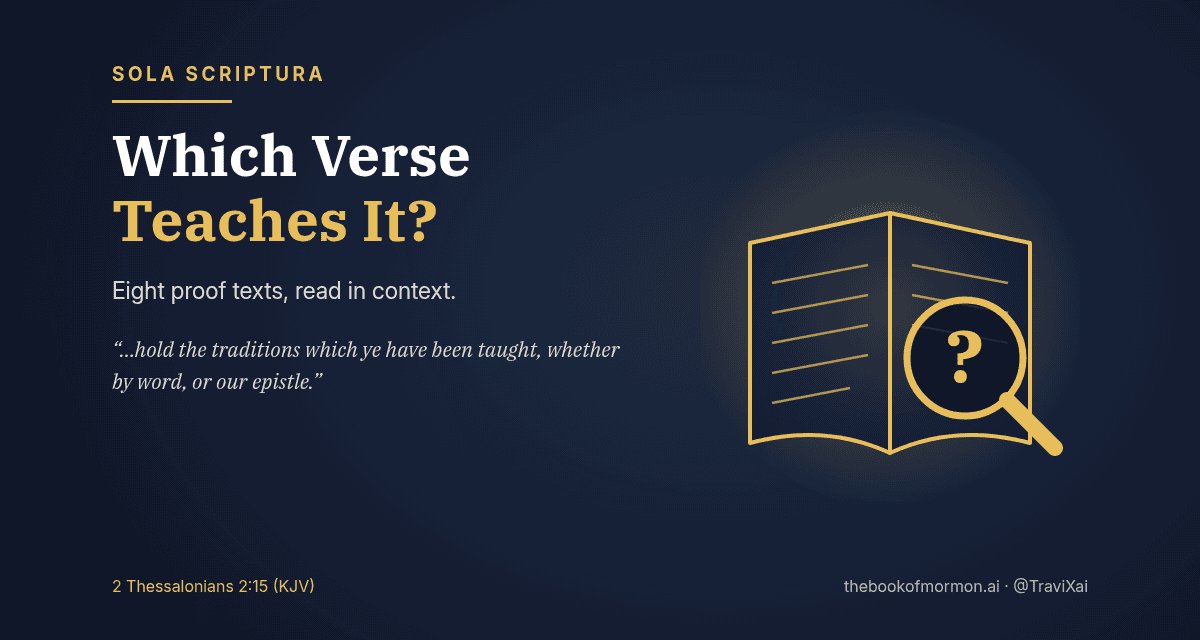

If the Bible alone is the only infallible rule, the Bible should say so. Here are the eight verses people quote for it, what each one actually says, and where the doctrine really comes from.
Here’s a simple request that should take thirty seconds: show me the verse that teaches sola scriptura. Not a verse that praises scripture; the Bible is full of those, and I love them. A verse that says the written books are the only infallible authority God will ever give. If “the Bible alone” is the rule for everything, the Bible alone should establish it. Otherwise the rule fails its own test.
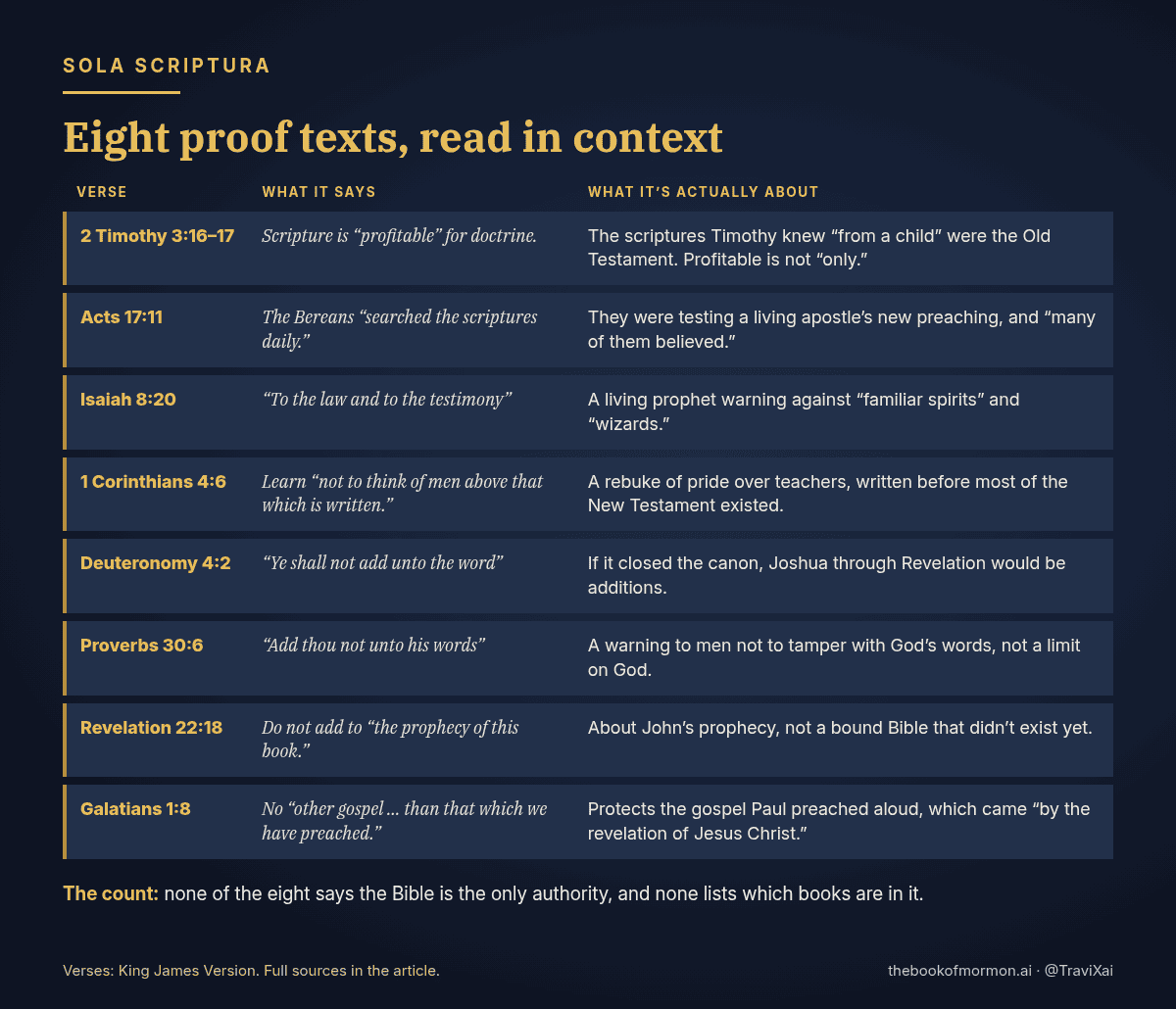
So let’s run the test. Here are the eight proof texts I see quoted most often, each read in context, then what the New Testament actually tells believers to hold on to, and when “Scripture alone” was finally written down as a doctrine. (Spoiler: about fifteen centuries after the apostles.)
The claim“Scripture alone,” in its own words
First, a fair definition. The Lutheran Formula of Concord (1577) puts it this way: “the sole rule and standard according to which all dogmas together with [all] teachers should be estimated and judged are the prophetic and apostolic Scriptures of the Old and of the New Testament alone.” The Westminster Confession of Faith (1646) is even more specific. It says nothing is to be added to Scripture “at any time,” “whether by new revelations of the Spirit, or traditions of men,” because “those former ways of God’s revealing his will unto his people” are “now ceased.”
That last line is the real claim. Not that the Bible is true (we agree), but that God has stopped revealing, which is a claim about God, not about the Bible. (The Bible Alone topic on Galatians18 has the short version.)
Notice the Formula’s own proof texts: Psalm 119:105 (“Thy word is a lamp unto my feet”) and Galatians 1:8. Neither says “alone,” and neither lists any books.
Proof text 12 Timothy 3:16–17: “profitable” is not “only”
This is the heavyweight. If any verse teaches sola scriptura, it should be this one:
All scripture is given by inspiration of God, and is profitable for doctrine, for reproof, for correction, for instruction in righteousness: That the man of God may be perfect, throughly furnished unto all good works.
2 Timothy 3:16–17 (KJV)
Three problems. First, the word is profitable. Useful. Not “sufficient,” and certainly not “only.” A hammer is profitable for building a house; nobody concludes you should build with nothing but a hammer.
Second, which scriptures? One verse earlier Paul says that “from a child thou hast known the holy scriptures” (2 Timothy 3:15). When Timothy was a child there was no New Testament. If this passage proves sola scriptura, it proves Old Testament alone, and the Gospels and Paul’s own letters become “additions.” No Protestant believes that.
Third, “perfect” doesn’t mean “nothing else needed.” James says patience makes you “perfect and entire, wanting nothing” (James 1:4), and nobody preaches sola patientia. In this same letter Paul says how the faith gets passed on: “the things that thou hast heard of me among many witnesses, the same commit thou to faithful men, who shall be able to teach others also” (2 Timothy 2:2). Heard, then handed to faithful men. A living chain, not a book on a shelf.
Proof text 2Acts 17:11: the Bereans checked a living apostle
These were more noble than those in Thessalonica, in that they received the word with all readiness of mind, and searched the scriptures daily, whether those things were so.
Acts 17:11 (KJV)
I love the Bereans. But look at what they did. A living apostle walked into their synagogue preaching something their scriptures never spelled out: that Jesus of Nazareth was the Christ, crucified and risen. They “received the word,” checked it against the scriptures they had, and “therefore many of them believed” (Acts 17:12).
That’s the opposite of a closed canon. They were praised for testing new preaching and accepting it, which is exactly what we invite people to do with the Book of Mormon.
Proof text 3Isaiah 8:20: a living prophet said it
To the law and to the testimony: if they speak not according to this word, it is because there is no light in them.
Isaiah 8:20 (KJV)
Read the verse before it. Isaiah warns against those “that have familiar spirits, and unto wizards that peep, and that mutter” (Isaiah 8:19). The contrast is God’s word versus spirit mediums, not a book versus living prophets.
And who says it? A living prophet, delivering new revelation, who had just been told, “Bind up the testimony, seal the law among my disciples” (Isaiah 8:16). As proof that God would stop sending prophets, it’s an odd choice, since it comes from one.
Proof text 41 Corinthians 4:6: “that which is written”
And these things, brethren, I have in a figure transferred to myself and to Apollos for your sakes; that ye might learn in us not to think of men above that which is written, that no one of you be puffed up for one against another.
1 Corinthians 4:6 (KJV)
The topic is pride. The Corinthians were splitting into fan clubs (“I am of Paul; and I of Apollos,” 1 Corinthians 1:12), and Paul tells them not to puff up their favorite teachers. The Greek behind “above that which is written” is famously terse, and commentators read it several ways. What it doesn’t do is define a canon. Most of the New Testament didn’t exist yet, including the rest of the letter Paul was writing.
Proof texts 5–8The “don’t add” verses and Galatians 1:8
The last four usually arrive together. I’ll keep them short.
Ye shall not add unto the word which I command you, neither shall ye diminish ought from it, that ye may keep the commandments of the LORD your God which I command you.
Deuteronomy 4:2 (KJV)
If Deuteronomy 4:2 closed the canon, everything from Joshua to Revelation is an illegal addition. Proverbs 30:6 (“Add thou not unto his words”) and Revelation 22:18 (“the prophecy of this book”) follow the same pattern: a warning to men not to tamper with God’s words, not a promise that God would stop speaking. I walked through all three in Part IX of “The Canon Was Never Meant to Close”, and a full Revelation 22:18 article is coming.
Galatians 1:8 curses anyone, “we, or an angel from heaven,” who preaches “any other gospel … than that which we have preached unto you.” Notice the verb: preached. Paul defends the gospel he taught out loud, which he got “by the revelation of Jesus Christ” (Galatians 1:12). It protects the gospel’s content; it doesn’t forbid revelation. See my Galatians 1:8 post or the Another Gospel topic on Galatians18.
What it does sayHold the traditions, by word or epistle
So no verse teaches “Scripture alone.” What does the New Testament tell believers to hold on to? Paul answers directly:
Therefore, brethren, stand fast, and hold the traditions which ye have been taught, whether by word, or our epistle.
2 Thessalonians 2:15 (KJV)
By word or epistle. Spoken and written, both binding. John admits the record is a sliver: “the world itself could not contain the books that should be written” (John 21:25). The Bible even cites books it doesn’t contain, like Enoch (Jude 1:14) and Jasher (Joshua 10:13); more on those in a separate article.
And it pictures a church led by living apostles and prophets, and says how long they would last:
And he gave some, apostles; and some, prophets; and some, evangelists; and some, pastors and teachers; For the perfecting of the saints, for the work of the ministry, for the edifying of the body of Christ: Till we all come in the unity of the faith, and of the knowledge of the Son of God, unto a perfect man, unto the measure of the stature of the fulness of Christ:
Ephesians 4:11–13 (KJV)
Till we all come in the unity of the faith. Has Christianity arrived? Amos gave the pattern: “Surely the Lord GOD will do nothing, but he revealeth his secret unto his servants the prophets” (Amos 3:7). That’s why Latter-day Saints believe in living prophets. It’s the biblical pattern.
The early church didn’t treat the Bible as a stand-alone rule either. Around AD 180, Irenaeus of Lyons asked what if “the apostles themselves had not left us writings? Would it not be necessary, [in that case,] to follow the course of the tradition which they handed down”? Whatever you make of his answer, it isn’t sola scriptura.
The real originA 16th-century answer to a real problem
To be fair, sola scriptura answered a real problem: Luther saw practices he couldn’t find in the Bible. At the Diet of Worms in April 1521 he said, “Unless I am convinced by the testimony of the Scriptures or by clear reason (for I do not trust either in the pope or in councils alone, since it is well known that they have often erred and contradicted themselves), I am bound by the Scriptures I have quoted and my conscience is captive to the Word of God.” Notice that even Luther said “or by clear reason.”
But the cure carried the same disease. The confessions that turned his protest into a rule were written by sincere, learned men in assemblies, not by prophets. The rule that nothing may be added “by new revelations of the Spirit” wasn’t itself a revelation, and it isn’t in the Bible. A doctrine that limits us to what’s written has to be written somewhere. It isn’t. (Galatians18’s Continuing Revelation topic covers what the Bible says instead.)
Catholic and Orthodox Christians reject sola scriptura too, so this is aimed at Protestant critics. Vatican II says “it is not from Sacred Scripture alone that the Church draws her certainty about everything which has been revealed” (Dei Verbum 9), and the Orthodox Church in America says Holy Tradition “is not at all limited to what is written.” Their case rests on bishops holding the apostles’ authority, a different conversation: if Christ gave apostles and prophets until the unity of the faith, where are the apostles and prophets?
SummaryKey takeaways
- None of the eight usual proof texts says the Bible is the only authority or lists which books count.
- 2 Timothy 3:16 says scripture is “profitable,” and the scriptures Timothy knew “from a child” were the Old Testament.
- The New Testament says to hold traditions “by word, or our epistle,” with apostles and prophets “till we all come in the unity of the faith.”
- Sola scriptura was formalized in Protestant confessions (1577, 1646), not by Christ, the apostles, or the early church.
Next time someone says the Bible is all God will ever say, ask kindly: which verse says so? Then read it together. For who closed the canon, and when, read The Canon Was Never Meant to Close. For short answers to paste into a thread, the Galatians18 app has one for almost every verse above. And for more like this every day, follow me on X at @TraviXai.
Sources
- Formula of Concord, Epitome, “Comprehensive Summary, Rule and Norm” (1577): bookofconcord.org
- Westminster Confession of Faith (1646), chapter 1, sections 1 and 6: Orthodox Presbyterian Church text
- Martin Luther at the Diet of Worms, April 18, 1521, Luther’s Works 32:112–13, as quoted in “Luther and Conscience,” Journal of Lutheran Ethics: learn.elca.org
- Irenaeus, Against Heresies 3.4.1, Ante-Nicene Fathers, vol. 1 (1885): New Advent
- Second Vatican Council, Dei Verbum (1965), section 9: vatican.va
- Orthodox Church in America, The Orthodox Faith, vol. 1, “Tradition”: oca.org
- Scriptures (KJV): 2 Timothy 3:15–17 · 2 Timothy 2:2 · James 1:4 · Acts 17:11–12 · 1 Corinthians 1:12 · Isaiah 8:16–20 · 1 Corinthians 4:6 · Deuteronomy 4:2 · Proverbs 30:6 · Revelation 22:18 · Galatians 1:8, 12 · 2 Thessalonians 2:15 · John 21:25 · Ephesians 4:11–13 · Amos 3:7 · Jude 1:14 · Joshua 10:13 · Colossians 4:16
- Related: The Canon Was Never Meant to Close · Apologetic Rebuttal to Galatians 1:8
- Featured image and proof-text table: original graphics by thebookofmormon.ai (no photographs or likenesses of real people).