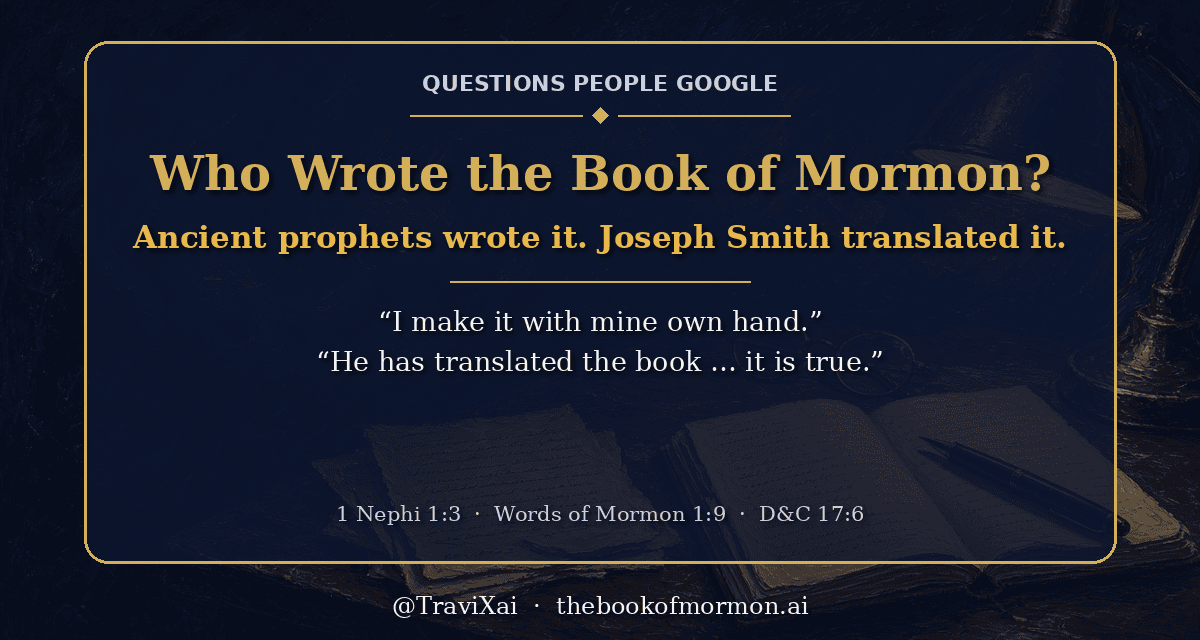

Critics say Joseph Smith wrote it. The book, its scribes and its witnesses say something else. Here’s the evidence.
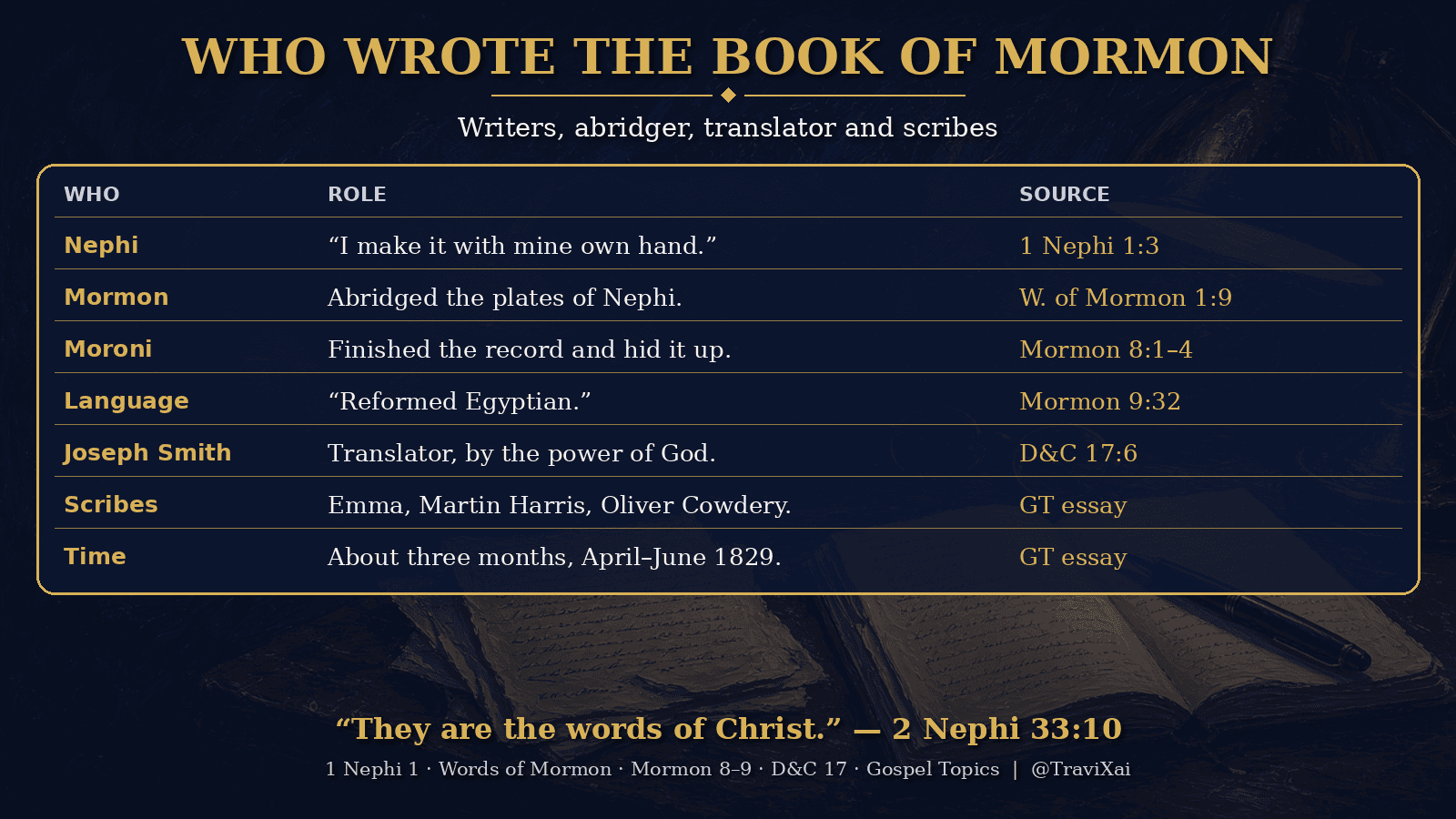
Ancient prophets wrote the Book of Mormon, and Joseph Smith translated it. Nephi wrote, “I make it with mine own hand” (1 Nephi 1:3). Mormon abridged a thousand years of records (Words of Mormon 1:9), and Moroni finished them and hid them in the earth (Mormon 8:1–4). In 1829 Joseph Smith translated the plates “by the gift and power of God,” dictating almost all of today’s text in about three months to scribes including Emma Smith and Oliver Cowdery. Eleven witnesses testified they saw the plates.
The short versionMany ancient writers, one translator
The Book of Mormon names its own authors. Its title page says it is “an abridgment of the record of the people of Nephi, and also of the Lamanites … Sealed by the hand of Moroni, and hid up unto the Lord” and brought forth “by the gift and power of God unto the interpretation thereof” (Title Page). Prophets wrote the original records on metal plates. Mormon abridged them. His son Moroni finished and buried them. Joseph Smith translated them in 1829, a book “delivered to him that is not learned” (Isaiah 29:11–12). The four Gospels, by contrast, never name their authors in the text; see who wrote the Gospels.
Joseph never claimed to be the author in the sense of composing it. The Lord told the Three Witnesses, “he has translated the book, even that part which I have commanded him, and as your Lord and your God liveth it is true” (D&C 17:6).
The writersNephi, Mormon and Moroni
The book opens in the first person: “I, Nephi, having been born of goodly parents … I make a record in the language of my father, which consists of the learning of the Jews and the language of the Egyptians. And I know that the record which I make is true; and I make it with mine own hand” (1 Nephi 1:1–3).
Around A.D. 385, the prophet Mormon abridged a thousand years of records: “I, Mormon, proceed to finish out my record, which I take from the plates of Nephi; and I make it according to the knowledge and the understanding which God has given me” (Words of Mormon 1:9). When he found the small plates of Nephi, he included them whole “because of the prophecies of the coming of Christ” (Words of Mormon 1:3–5).
His son finished alone: “Behold I, Moroni, do finish the record of my father, Mormon … I even remain alone to write the sad tale of the destruction of my people … Therefore I will write and hide up the records in the earth” (Mormon 8:1–4). Moroni explained the script: “we have written this record according to our knowledge, in the characters which are called among us the reformed Egyptian” (Mormon 9:32–33).
The translationHow Joseph Smith translated it
In 1823 the angel Moroni told Joseph Smith “there was a book deposited, written upon gold plates, giving an account of the former inhabitants of this continent,” along with interpreters “that God had prepared … for the purpose of translating the book” (Joseph Smith—History 1:34–35). The Lord later said He “gave him power from on high, by the means which were before prepared, to translate the Book of Mormon” (D&C 20:8–11).
The Church’s Gospel Topics essay explains that “almost all of the present Book of Mormon text was translated during a three-month period between April and June” 1829. Oliver Cowdery, the main scribe, wrote: “These were days never to be forgotten—to sit under the sound of a voice dictated by the inspiration of heaven.” The surviving part of the original manuscript “includes errors that suggest the scribe heard words incorrectly rather than misread words copied from another manuscript” (Book of Mormon Translation). For details on the interpreters and the seer stone, see How the Book of Mormon Was Translated.
Could Joseph have written it?The question critics ask
The essay says Joseph “had very little formal education and was incapable of writing a book on his own.” His wife Emma, who served as a scribe, insisted that at the time Joseph “could neither write nor dictate a coherent and well-worded letter, let alone dictat[e] a book like the Book of Mormon” (Book of Mormon Translation). In 1879, months before her death, she told her son that Joseph would “dictate to me hour after hour; and when returning after meals, or after interruptions, he would at once begin where he had left off, without either seeing the manuscript or having any portion of it read to him” (see Emma Smith’s Last Testimony).
The Bible’s standard for truth is witnesses: “In the mouth of two or three witnesses shall every word be established” (2 Corinthians 13:1). Eleven witnesses signed published statements about the plates. The Eight Witnesses wrote: “Joseph Smith, Jun., the translator of this work, has shown unto us the plates … and as many of the leaves as the said Smith has translated we did handle with our hands” (Testimony of Eight Witnesses). The Three Witnesses testified that “they have been translated by the gift and power of God, for his voice hath declared it unto us” (Testimony of Three Witnesses). None of them ever denied it (the witnesses never recanted). For other authorship theories and why they fail, see the “someone else wrote it” problem and one draft.
Test itHow to know for yourself
Nephi pointed past himself to the real source: “believe in Christ … for they are the words of Christ, and he hath given them unto me … and ye shall know that I have been commanded of him to write these things, notwithstanding my weakness” (2 Nephi 33:10–11).
Moroni’s closing promise lets every reader test it: “ask God, the Eternal Father, in the name of Christ, if these things are not true; and if ye shall ask with a sincere heart, with real intent, having faith in Christ, he will manifest the truth of it unto you, by the power of the Holy Ghost” (Moroni 10:3–5).
Check the premiseThe presuppositions baked into the question
Before this question can be answered fairly, the person asking has to justify a few assumptions packed inside it:
- That Joseph Smith claims to be the author. The first edition listed him as “Author and Proprietor,” a legal copyright term, but the book itself, the witnesses and the revelations all call him the translator (D&C 17:6; Testimony of Eight Witnesses).
- That a farm boy with little schooling could easily write it. His scribe and wife said he “could neither write nor dictate a coherent and well-worded letter,” and the main text was dictated in about three months (Gospel Topics essay).
- That someone else must have written it. The scribes describe live dictation without notes, and the original manuscript shows errors of hearing, not copying (Gospel Topics essay).
- That you can’t test the authorship question. Moroni invites every reader to ask God directly (Moroni 10:4–5).
FAQQuick answers
Who wrote the Book of Mormon?
Ancient American prophets, chiefly Nephi, Jacob, Mormon and Moroni, wrote it on metal plates. Mormon abridged the records and Moroni finished and buried them. Joseph Smith translated them by the gift and power of God in 1829.
Did Joseph Smith write the Book of Mormon?
He translated it; he didn’t compose it. His scribes said he dictated for hours without notes or books, and the Lord testified “he has translated the book … and … it is true” (D&C 17:6).
How long did it take to translate the Book of Mormon?
Almost all of the present text was translated in about three months, between April and June 1829 (Gospel Topics essay “Book of Mormon Translation”).
Who were Joseph Smith’s scribes?
Emma Smith and Martin Harris early on, and Oliver Cowdery for most of the present text.
What language was the Book of Mormon written in?
Moroni says “reformed Egyptian” (Mormon 9:32), and Nephi says his record used “the learning of the Jews and the language of the Egyptians” (1 Nephi 1:2).
Why was the Book of Mormon written?
Its title page says it was written “to the convincing of the Jew and Gentile that Jesus is the Christ, the Eternal God, manifesting himself unto all nations.”
Could Joseph Smith have written the Book of Mormon himself?
His wife Emma, who was one of his scribes, said that in 1829 he “could neither write nor dictate a coherent and well-worded letter.” He dictated the book in about three months, without notes, and Emma said that after breaks he began where he had left off without having any of it read back to him.
What did the Eight Witnesses testify?
That Joseph Smith showed them the plates, “which have the appearance of gold,” and that “we did handle with our hands” the leaves he had translated (Testimony of Eight Witnesses).
SummaryKey takeaways
- The writers were ancient prophets: Nephi, Jacob, Mormon, Moroni and others.
- Joseph Smith was the translator, by the gift and power of God (D&C 17:6; 20:8).
- Most of the text was dictated in about three months in 1829, without notes, according to his scribes.
- Eleven witnesses testified of the plates, and Moroni invites everyone to ask God (Moroni 10:4–5).
Read 1 Nephi 1 and Moroni 10 for yourself, then ask. For quick, sourced answers, open Galatians18, and follow me on X at @TraviXai.
Sources
- King James Bible (churchofjesuschrist.org): 2 Corinthians 13:1 · Isaiah 29:11–12
- Book of Mormon: Title Page · Testimony of Three Witnesses · Testimony of Eight Witnesses · 1 Nephi 1:1–3 · 2 Nephi 33:10–11 · Words of Mormon 1:3–9 · Mormon 8:1–4 · Mormon 9:32–33 · Moroni 10:3–5
- Doctrine and Covenants: D&C 17:6 · D&C 20:8–11
- Pearl of Great Price: Joseph Smith—History 1:34–35
- “Book of Mormon Translation,” Gospel Topics Essays, churchofjesuschrist.org
- Joseph Smith III, “Last Testimony of Sister Emma,” Saints’ Herald 26 (Oct. 1, 1879): 289–90
- Featured image and in-article graphic: original graphics by thebookofmormon.ai (painterly backgrounds; no photographs or likenesses of real people).