
The Book of Mormon’s oldest people came from the Tower of Babel. Here is their story, the brother of Jared’s vision, and why Moroni included them.
The question often assumes everyone in the Book of Mormon came with Lehi, or that it ignores the Bible’s early history. It does neither. The Jaredites were a people led by Jared and his brother “from the great tower, at the time the Lord confounded the language of the people” (Ether 1:33). They crossed the sea in eight barges, became a great nation in the Americas, and destroyed themselves through secret combinations. Their record, the book of Ether, includes the brother of Jared seeing the premortal Christ: “Seest thou that ye are created after mine own image?” (Ether 3:15).
Who they wereThe first people of the Book of Mormon
The Jaredites are the oldest people in the Book of Mormon. Their story is told in the book of Ether, near the end of the volume, but it begins long before Lehi. Jared and his brother came “from the great tower, at the time the Lord confounded the language of the people” (Ether 1:33). The book never names the brother of Jared; Latter-day Saint tradition, from a later recollection of Joseph Smith, calls him Mahonri Moriancumer. The text gives no date for the tower. Readers usually place it in the third millennium B.C.
At Jared’s request his brother prayed that their language would not be confounded, and the Lord had compassion on them, their families and their friends (Ether 1:34–37). Then came the promise: “there shall be none greater than the nation which I will raise up unto me of thy seed, upon all the face of the earth” (Ether 1:43).
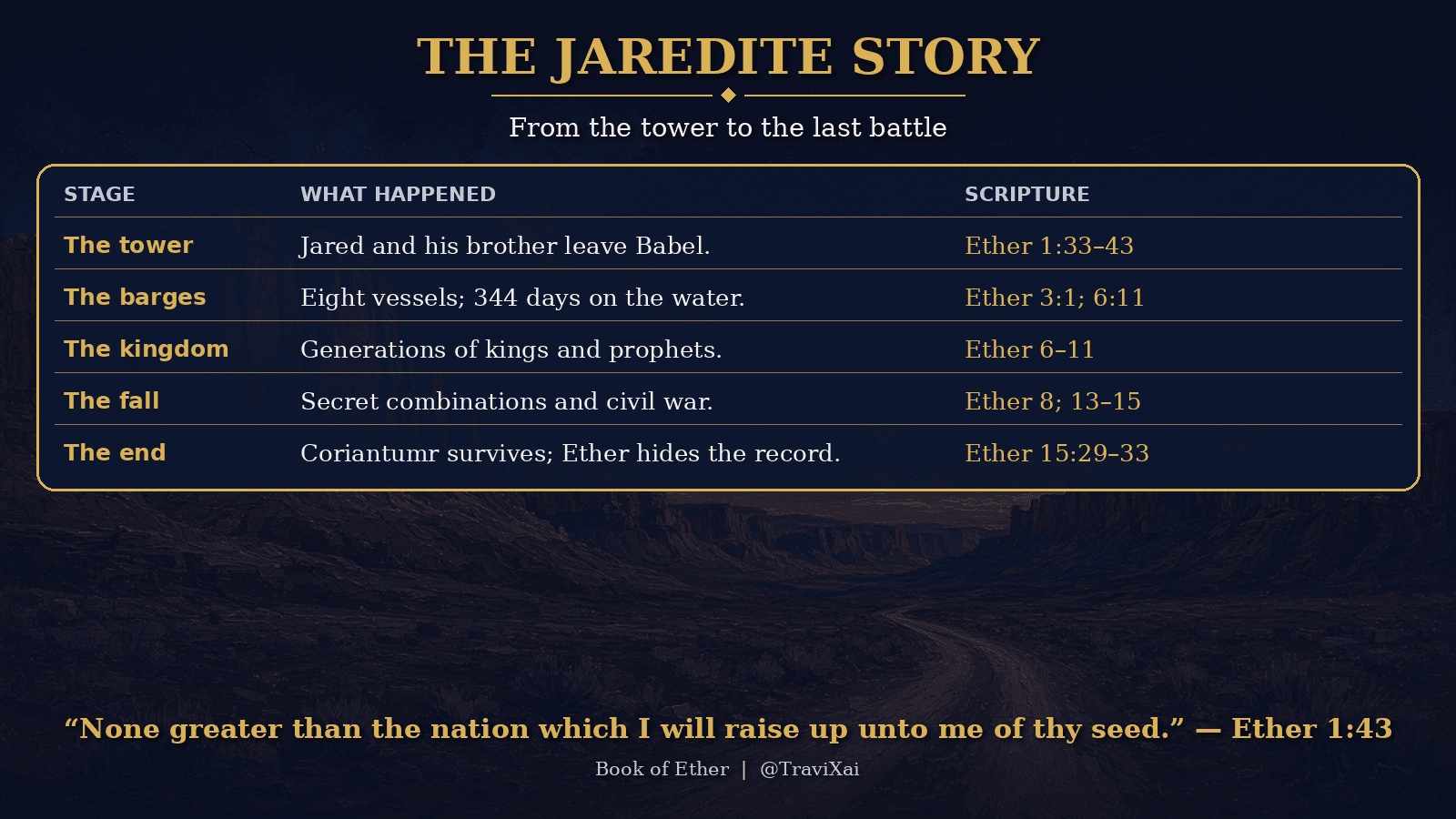
They traveled “in the wilderness, and did build barges, in which they did cross many waters, being directed continually by the hand of the Lord” (Ether 2:6). In the promised land they grew into a kingdom that lasted many generations, with good kings, bad kings and prophets who warned them. Secret combinations, oaths to get power and gain, finally tore them apart. Their last war ended with only two men left, Coriantumr and Shiz, and Coriantumr killed Shiz (Ether 15:29–33).
The BibleWhere the story starts
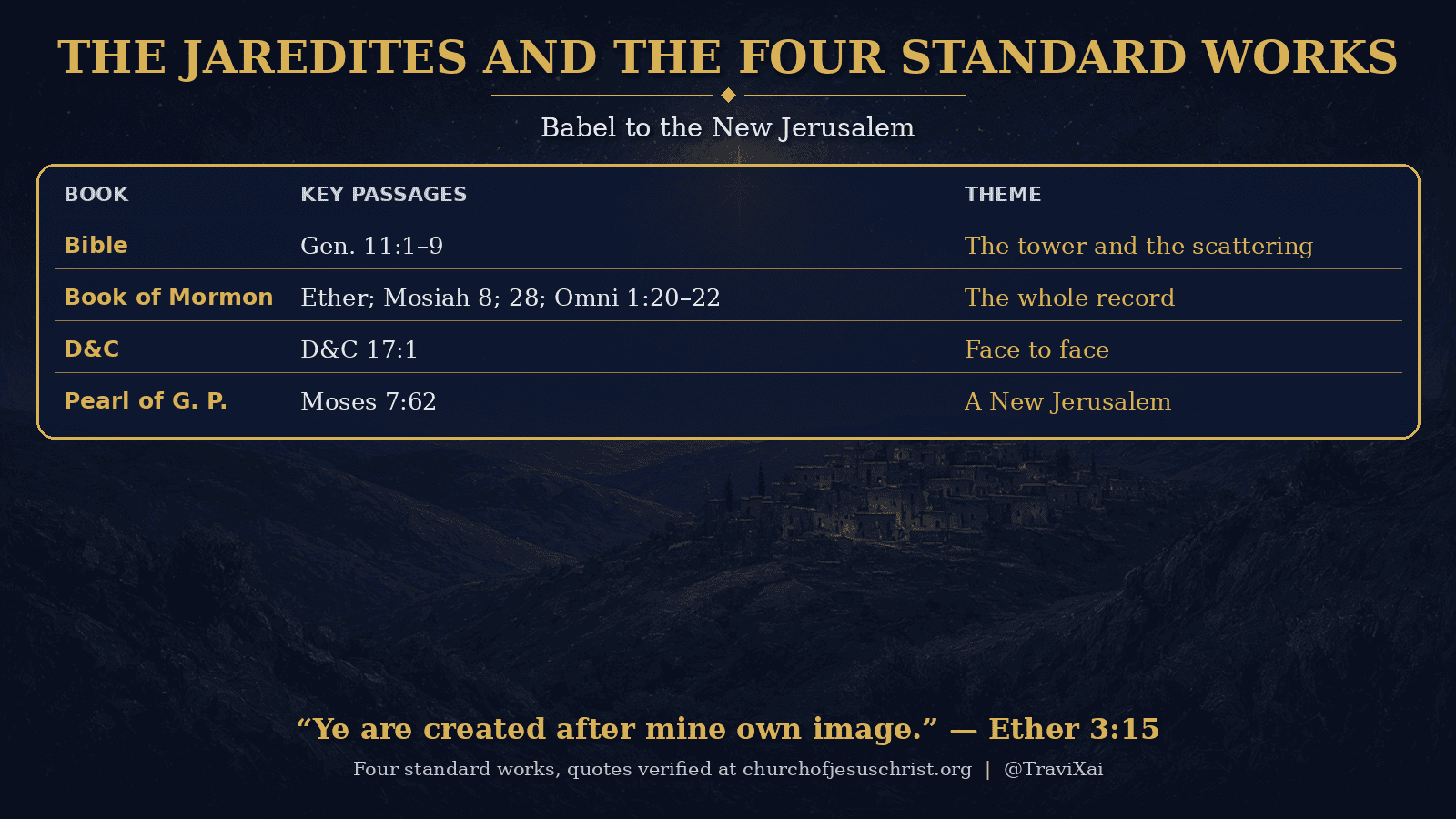
Genesis tells the tower’s side: “the Lord said, Behold, the people is one, and they have all one language … Go to, let us go down, and there confound their language … So the Lord scattered them abroad from thence upon the face of all the earth … Therefore is the name of it called Babel” (Genesis 11:6–9). The Bible follows one line out of Babel, to Abraham. The Book of Mormon follows another, across the sea. Note the “us” in Genesis 11:7. The God who scattered Babel did not work alone. See The Gods of the Bible.
The Book of MormonThe brother of Jared and the finger of the Lord
The most famous Jaredite story is about light. The brother of Jared built eight sealed barges and asked the Lord how they would see inside. The Lord asked him what he wanted done. He went up “the mount Shelem” and “did molten out of a rock sixteen small stones; and they were white and clear, even as transparent glass” (Ether 3:1), and asked the Lord to touch them.
“The Lord stretched forth his hand and touched the stones one by one with his finger. And the veil was taken from off the eyes of the brother of Jared, and he saw the finger of the Lord; and it was as the finger of a man, like unto flesh and blood” (Ether 3:6). Then the premortal Christ showed Himself: “Seest thou that ye are created after mine own image? Yea, even all men were created in the beginning after mine own image. Behold, this body, which ye now behold, is the body of my spirit; and man have I created after the body of my spirit” (Ether 3:15–16). That is the Restoration’s doctrine of God in one scene: spirits have form, and we are made in the image of a real, embodied God. See Made in His Image.
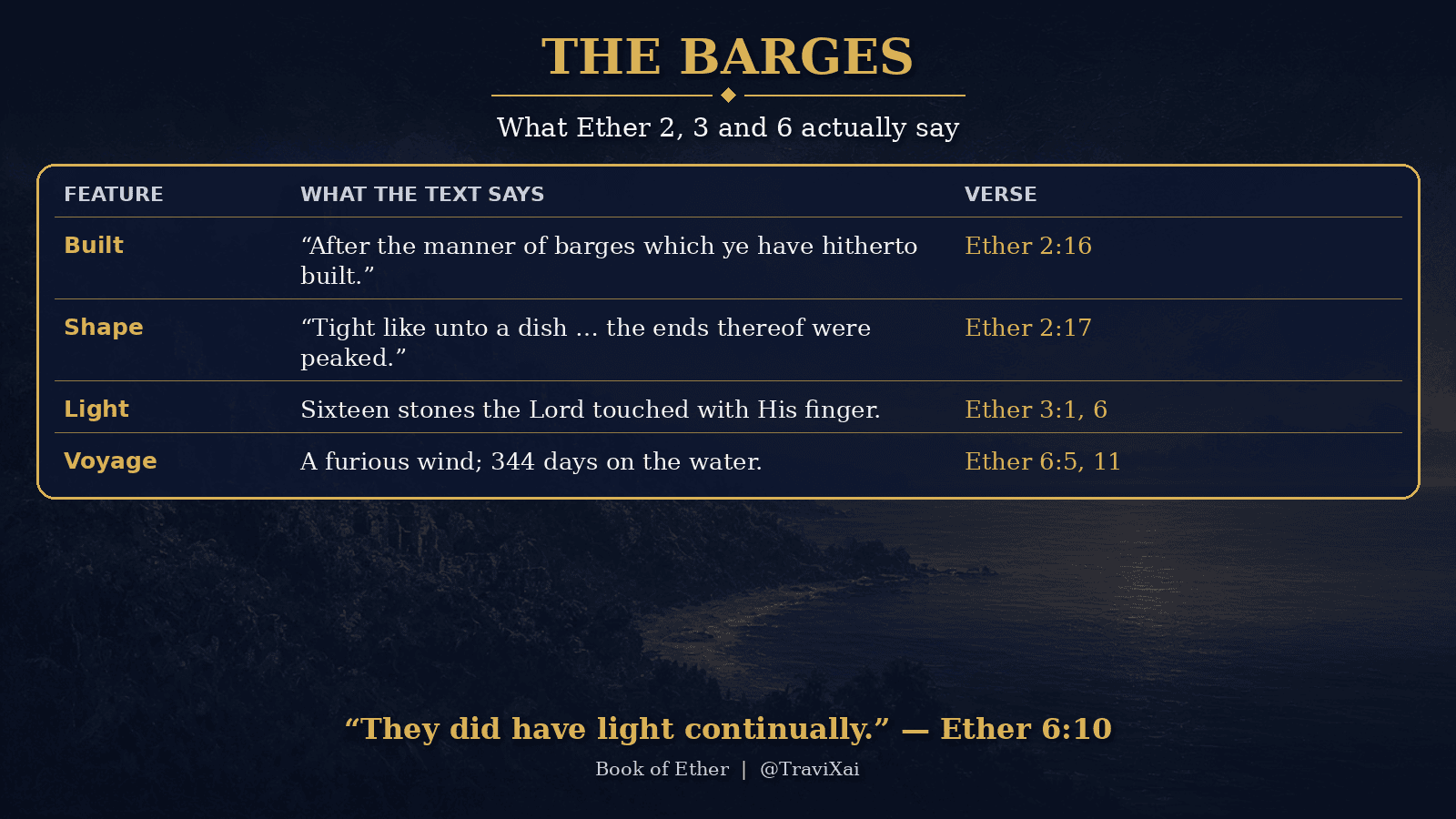
The voyage took “three hundred and forty and four days upon the water,” driven by “a furious wind,” and the vessels were “tight like unto the ark of Noah” (Ether 6:5–12). When they landed, “they did shed tears of joy before the Lord, because of the multitude of his tender mercies over them.”
How we know about themFive hands on one record
The Jaredite record reached the Nephites by accident. An expedition from Limhi’s people got lost and found “a land which was covered with bones of men, and of beasts, and was also covered with ruins of buildings,” and brought back “twenty-four plates which are filled with engravings, and they are of pure gold” (Mosiah 8:8–9). King Mosiah translated them “by the means of those two stones which were fastened into the two rims of a bow,” and “whosoever has these things is called seer” (Mosiah 28:11–17). Earlier, the people of Zarahemla had found Coriantumr himself, the last Jaredite, who lived with them “for the space of nine moons” (Omni 1:20–22).
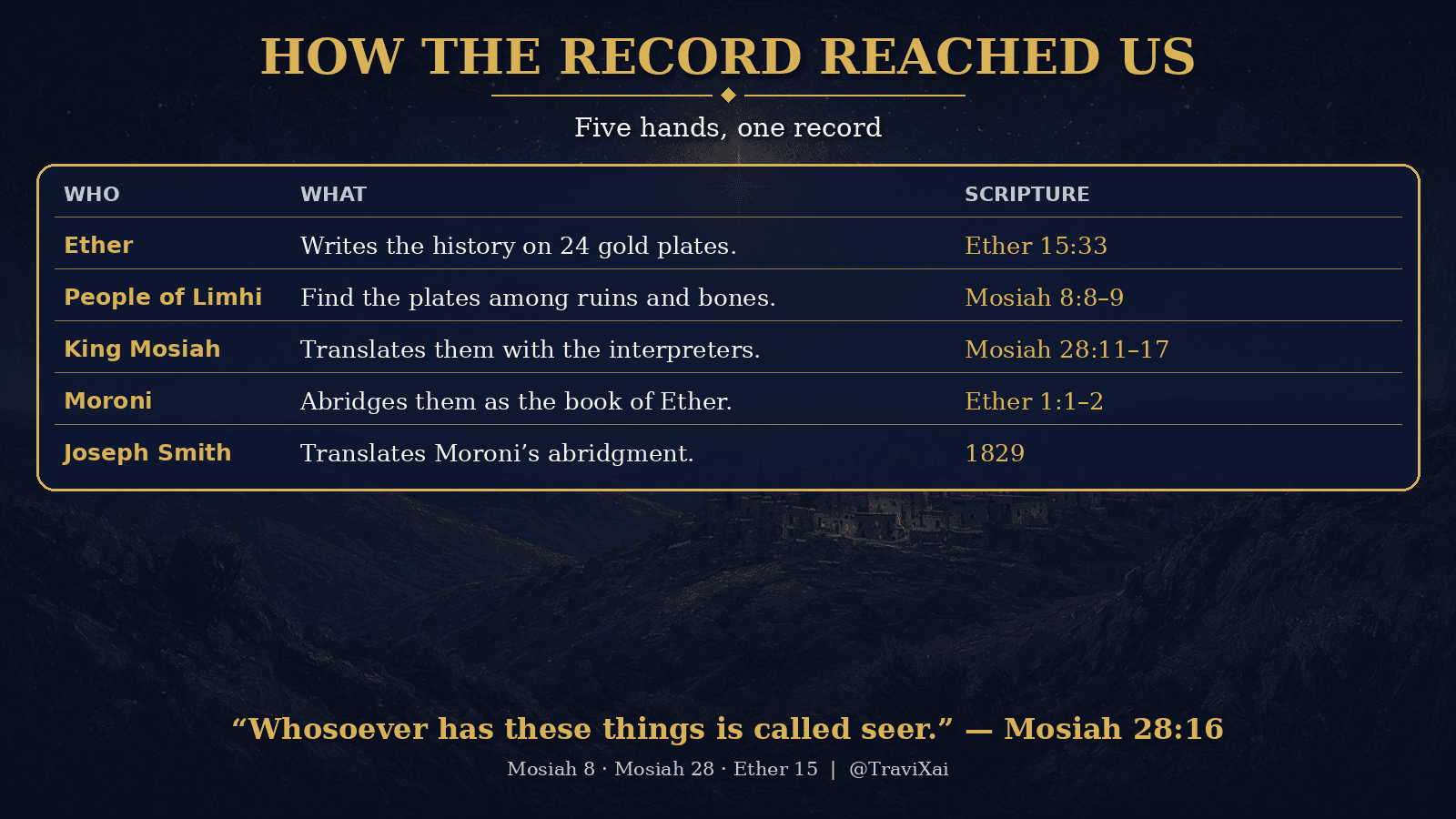
Moroni abridged the 24 plates into the book of Ether. He also says the final battles were fought around the hill Ramah, “that same hill where my father Mormon did hide up the records” (Ether 15:11), the hill the Nephites called Cumorah. See Where Did the Book of Mormon Take Place?.
The Doctrine and CovenantsThe interpreters from the mount
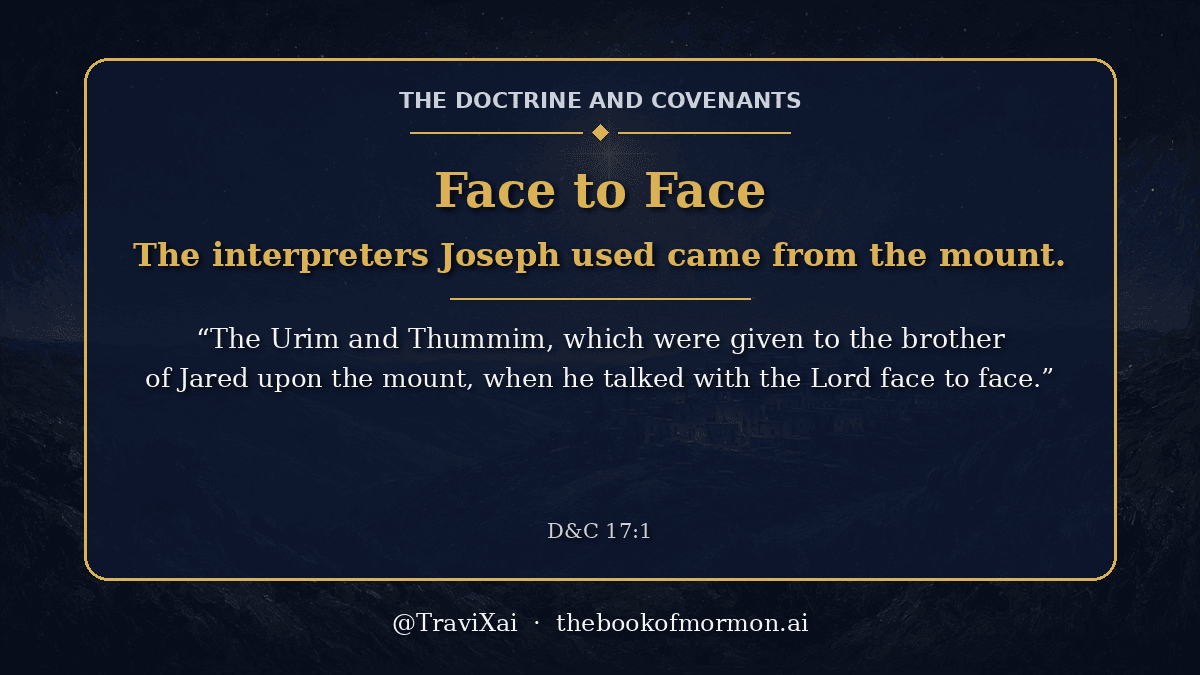
The Jaredites connect directly to the Restoration. In 1829 the Lord promised the Three Witnesses they would see “the plates, and also of the breastplate, the sword of Laban, the Urim and Thummim, which were given to the brother of Jared upon the mount, when he talked with the Lord face to face” (D&C 17:1). The instrument Joseph used to translate was first given to a man from Babel. Moroni also says the brother of Jared’s full vision was sealed: “there never were greater things made manifest than those which were made manifest unto the brother of Jared … And he commanded me that I should seal them up” (Ether 4:4–5). That is the sealed portion of the plates. See Where Are the Golden Plates Now?.
The Pearl of Great PriceA New Jerusalem
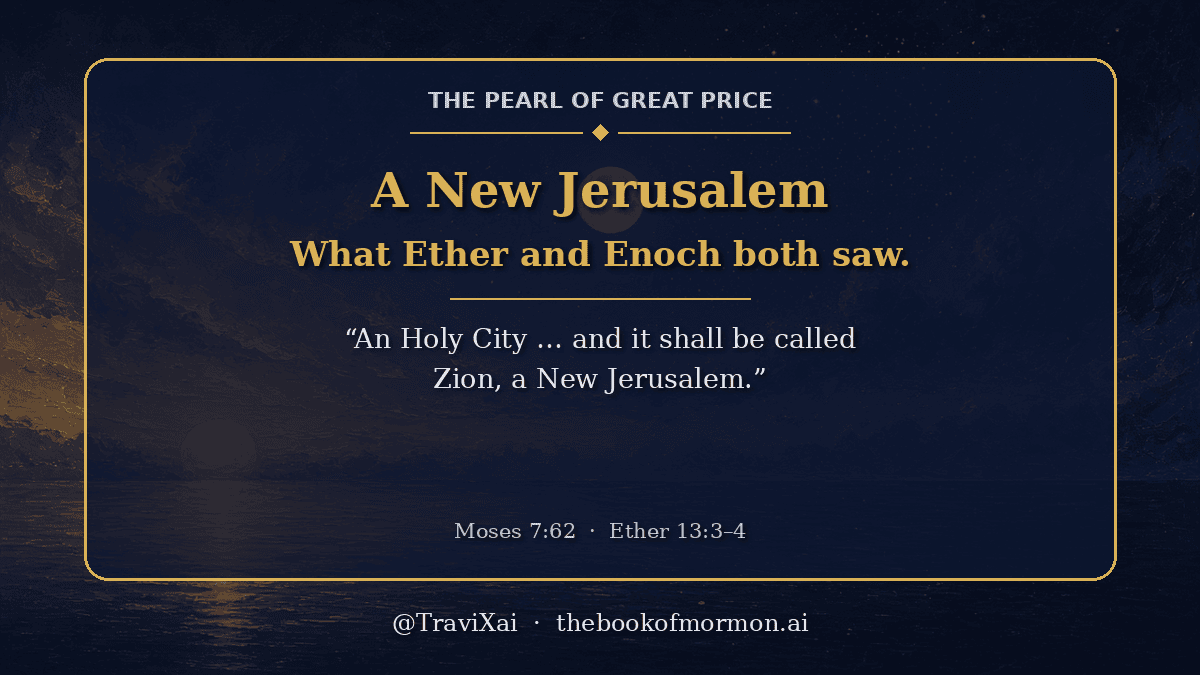
Ether, the last Jaredite prophet, “saw the days of Christ, and he spake concerning a New Jerusalem upon this land” (Ether 13:2–4). Enoch saw the same city: “an Holy City, that my people may gird up their loins, and be looking forth for the time of my coming; for there shall be my tabernacle, and it shall be called Zion, a New Jerusalem” (Moses 7:62). Two prophets, millennia apart, one destination. See What Is the Gathering of Israel?.
Why it mattersWhy Moroni included them
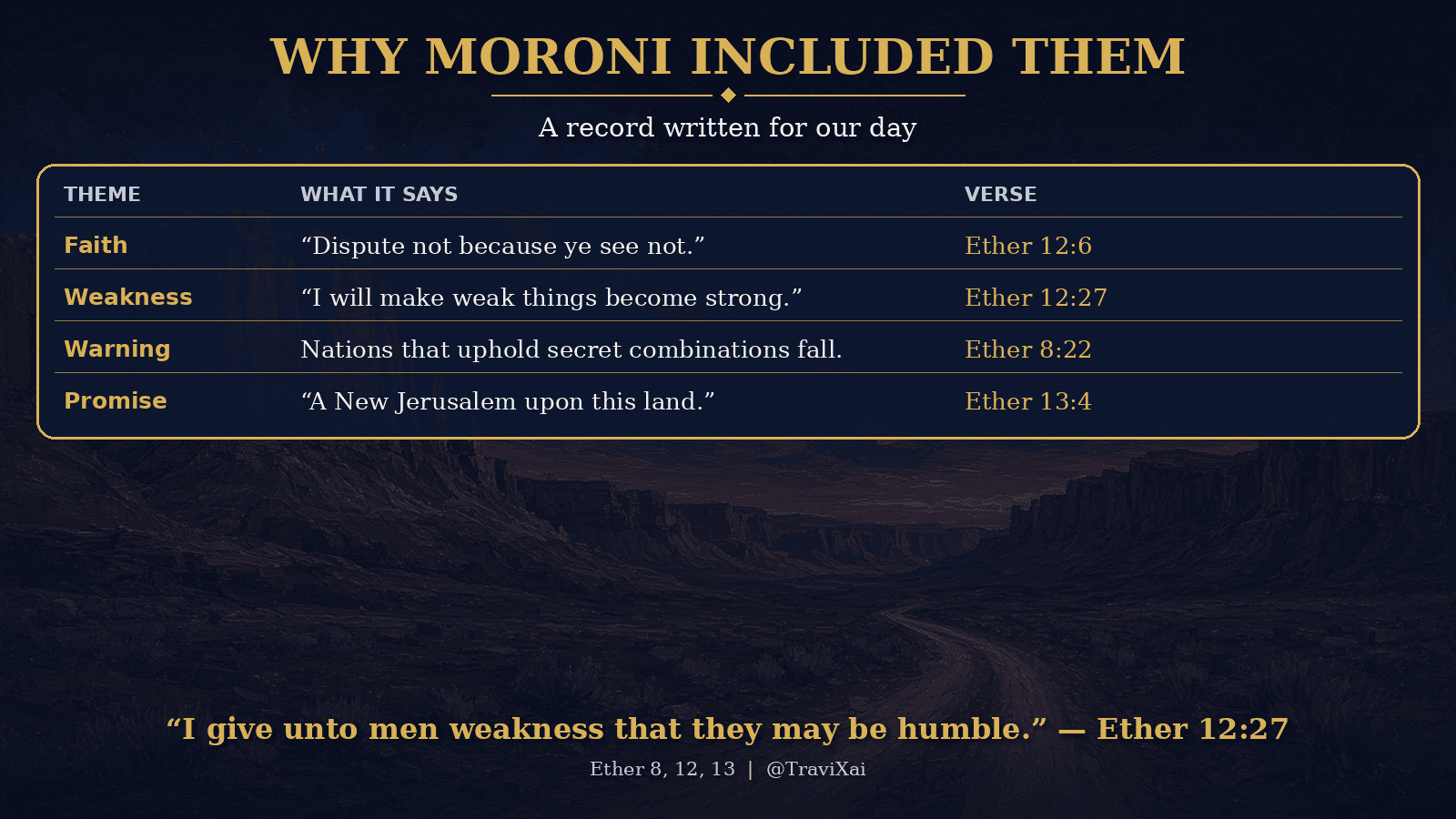
Moroni didn’t abridge the Jaredites for history’s sake. He broke into the story to teach. On faith: “dispute not because ye see not, for ye receive no witness until after the trial of your faith” (Ether 12:6). On weakness: “I give unto men weakness that they may be humble … then will I make weak things become strong unto them” (Ether 12:27). And as a warning to the land’s future inhabitants: “whatsoever nation shall uphold such secret combinations, to get power and gain … they shall be destroyed” (Ether 8:22).
Critics sometimes ask where the Jaredite ruins are. The Book of Mormon makes no claim about how large they were or what survived, and Old World parallels in Ether, from the barges to the names, were explored at length by Hugh Nibley in The World of the Jaredites (1952). The fair test of the book is the one it gives itself. See Is the Book of Mormon True?.
Check the premiseThe presuppositions baked into the question
Before this question can be answered fairly, the person asking has to justify a few assumptions packed inside it:
- That all Book of Mormon peoples came with Lehi. The Jaredites came centuries earlier, from Babel (Ether 1:33), and the Mulekites came separately (Omni 1:15).
- That the Jaredites are the ancestors of Native Americans. The text says they were destroyed (Ether 15), apart from Coriantumr. The Book of Mormon makes no claim about all ancient American peoples.
- That the Book of Mormon contradicts the Tower of Babel. It assumes Babel happened, as Genesis 11 does.
- That God has no body. The brother of Jared saw the premortal Lord’s spirit body “after mine own image” (Ether 3:15–16).
FAQQuick answers
Who were the Jaredites?
A people in the Book of Mormon who left the Tower of Babel under Jared and his brother, crossed the sea in barges and became a great nation in the Americas before destroying themselves in war.
Where is the Jaredite story in the Book of Mormon?
In the book of Ether, which Moroni abridged from 24 gold plates written by the prophet Ether.
Who was the brother of Jared?
The prophet who led the Jaredites and saw the premortal Christ (Ether 3). Latter-day Saint tradition names him Mahonri Moriancumer.
Are the Jaredites in the Bible?
Not by name. The Bible tells of the Tower of Babel (Genesis 11), where the Jaredite story begins.
How many barges did the Jaredites build?
Eight (Ether 3:1), and the voyage took 344 days (Ether 6:11).
What were the sixteen stones?
Clear stones the brother of Jared made and the Lord touched with His finger so they would give light in the barges (Ether 3:1–6; 6:2–3).
What happened to the Jaredites?
They were destroyed in a civil war driven by secret combinations. Coriantumr was the last survivor, found by the people of Zarahemla (Ether 15; Omni 1:21).
When did the Jaredites live?
The text gives no dates. They left at the time of the Tower of Babel, and their nation had ended by the time the people of Zarahemla found Coriantumr, centuries before Christ.
SummaryKey takeaways
- The Jaredites left the Tower of Babel (Ether 1:33; Genesis 11).
- The brother of Jared saw the premortal Christ’s spirit body (Ether 3:15–16).
- Eight barges, sixteen lit stones, 344 days at sea.
- They fell through secret combinations (Ether 8:22); Coriantumr was last.
- Their interpreters became the Urim and Thummim Joseph used (D&C 17:1).
Read Ether 3 tonight. For quick, sourced answers, open Galatians18, and follow me on X at @TraviXai.
Sources
- King James Bible (churchofjesuschrist.org): Genesis 11:6–9
- Book of Mormon: Ether 1:1–2 · Ether 1:33–43 · Ether 2:6 · Ether 2:16–17 · Ether 3:1–6 · Ether 3:15–16 · Ether 4:4–5 · Ether 6:2–3 · Ether 6:5–12 · Ether 8:22 · Ether 12:6 · Ether 12:27 · Ether 13:2–4 · Ether 15:11 · Ether 15:29–33 · Mosiah 8:8–9 · Mosiah 28:11–17 · Omni 1:15 · Omni 1:20–22
- Doctrine and Covenants: D&C 17:1
- Pearl of Great Price: Moses 7:62
- Hugh Nibley, Lehi in the Desert and the World of the Jaredites (Bookcraft, 1952)
- Featured image and in-article graphic: original graphics by thebookofmormon.ai (painterly backgrounds; no photographs or likenesses of real people).