
In 1844 a prophet ran for president. Here is why he ran, what he proposed, what critics claim, and how it ended.
The question often assumes he ran out of ambition or as a stunt. The record shows a man who had run out of people to ask. Joseph Smith ran for president of the United States in 1844 after the Saints were driven from Missouri and no president, Congress or major candidate would protect them or help them recover their losses. His platform, General Smith’s Views, proposed ending slavery by 1850, cutting Congress’s size and pay, prison reform and federal protection against mobs. The campaign ended when he was killed at Carthage on June 27, 1844. The Lord had told the Saints to seek redress all the way up: “let them importune at the feet of the president” (D&C 101:88).
Why he ranNo one else would protect the Saints
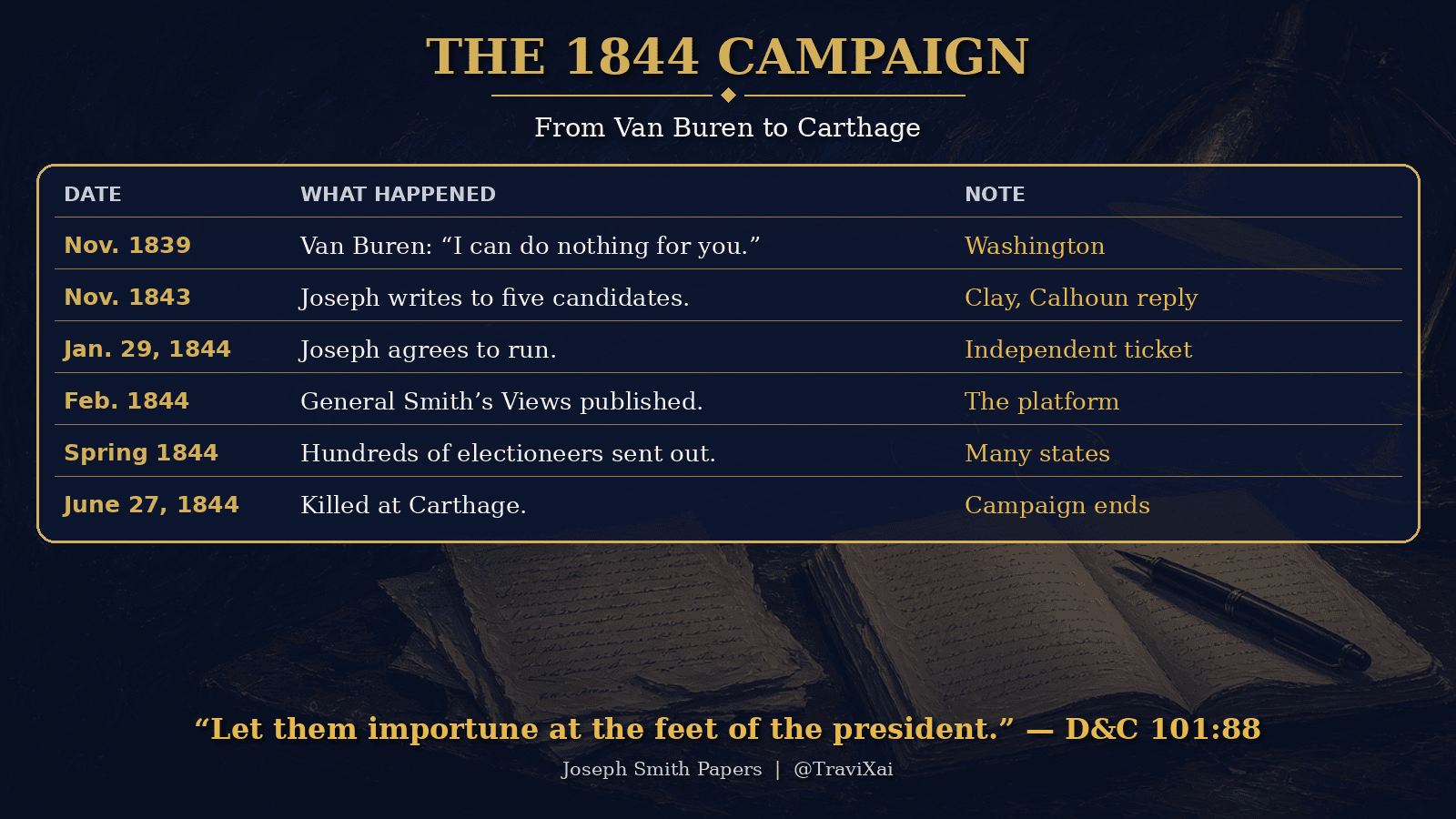
The short reason is Missouri. In 1838 the Latter-day Saints were driven from the state under a governor’s order to exterminate them, and they lost homes, land and lives. They spent years petitioning for redress. In November 1839 Joseph went to Washington and met President Martin Van Buren, who, by Joseph’s account, told him, “your cause is just, but I can do nothing for you.” Congress gave them nothing either.
In November 1843 Joseph wrote to five likely candidates for 1844, including Henry Clay and John C. Calhoun, asking what they would do for the Saints if elected. Calhoun answered that the federal government had no power over the case. Clay was noncommittal. So on January 29, 1844, Church leaders voted to run an independent ticket, and Joseph agreed. He explained a few days later that he would not have let his name be used “if I and my friends could have had the privilege of enjoying our religious and civil rights as American citizens,” but since they could not, “I feel it to be my right and privilege to obtain what influence and power I can lawfully in the United States for the protection of injured innocence.”
The platformGeneral Smith’s Views
In early February 1844 Joseph and his scribe William W. Phelps produced a pamphlet titled General Smith’s Views of the Powers and Policy of the Government of the United States, sent to the president, cabinet, Congress and newspapers across the country. It proposed ending slavery by 1850 by using the sale of public lands to pay for the freedom of enslaved people; cutting the size and pay of Congress; reforming prisons toward education and useful work; giving the president power to send troops to suppress mobs without waiting for a governor’s request; a national bank; and annexing Texas and Oregon with their consent.
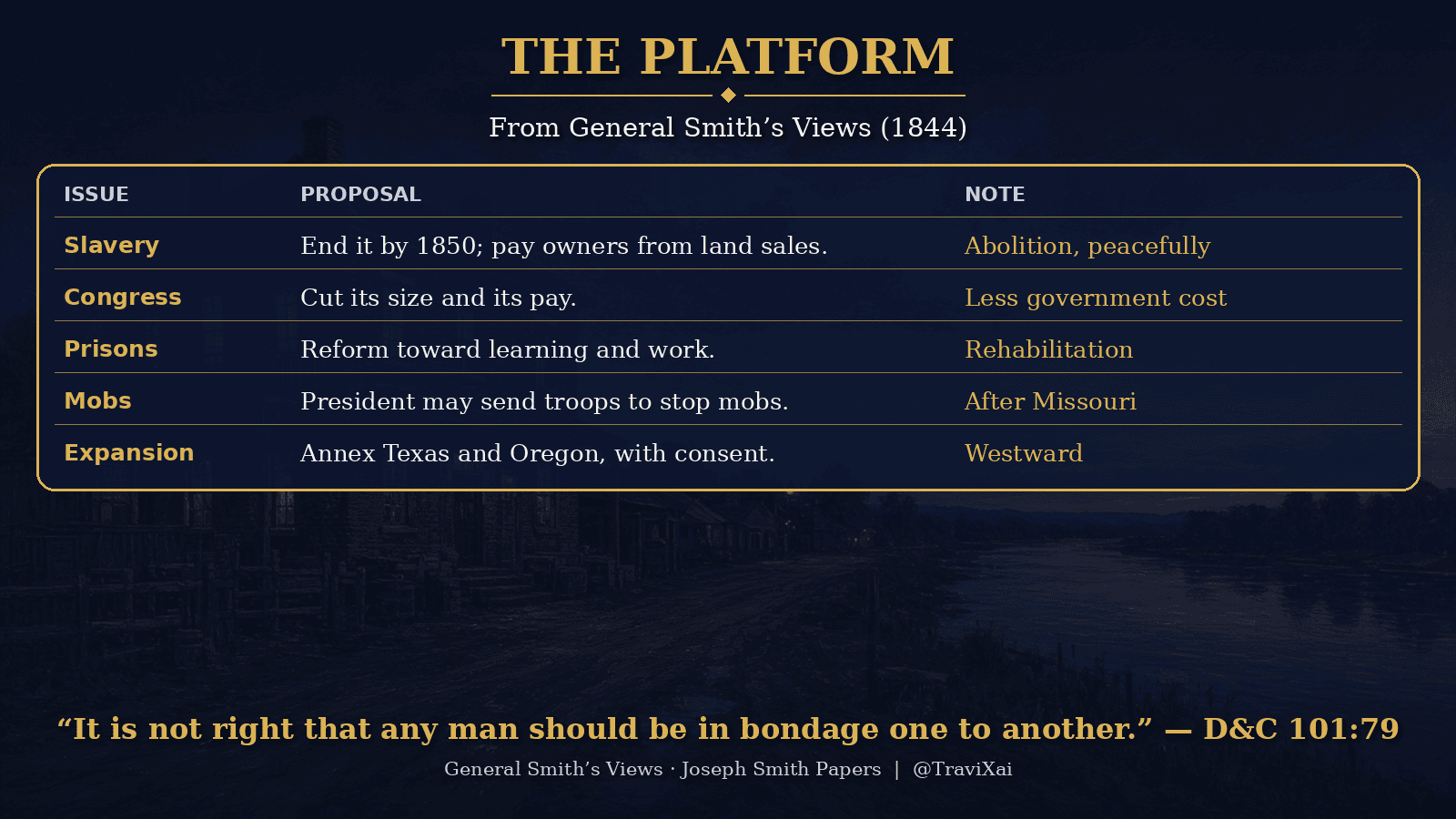
The slavery plank stands out. In 1844 no major candidate proposed ending slavery at all. Joseph proposed a date and a way to pay for it. See Did Joseph Smith Own Slaves?.
The campaign was real. At the April 1844 conference, Church leaders asked for volunteers, and eventually several hundred electioneer missionaries went out to preach the gospel and promote Joseph’s ticket in many states. Sidney Rigdon became his running mate, and a convention in Nauvoo formally nominated them on May 17, 1844. Six weeks later, on June 27, Joseph was murdered at Carthage Jail, and the campaign ended. See Carthage: Like a Lamb to the Slaughter.
The Doctrine and CovenantsThe ladder of redress
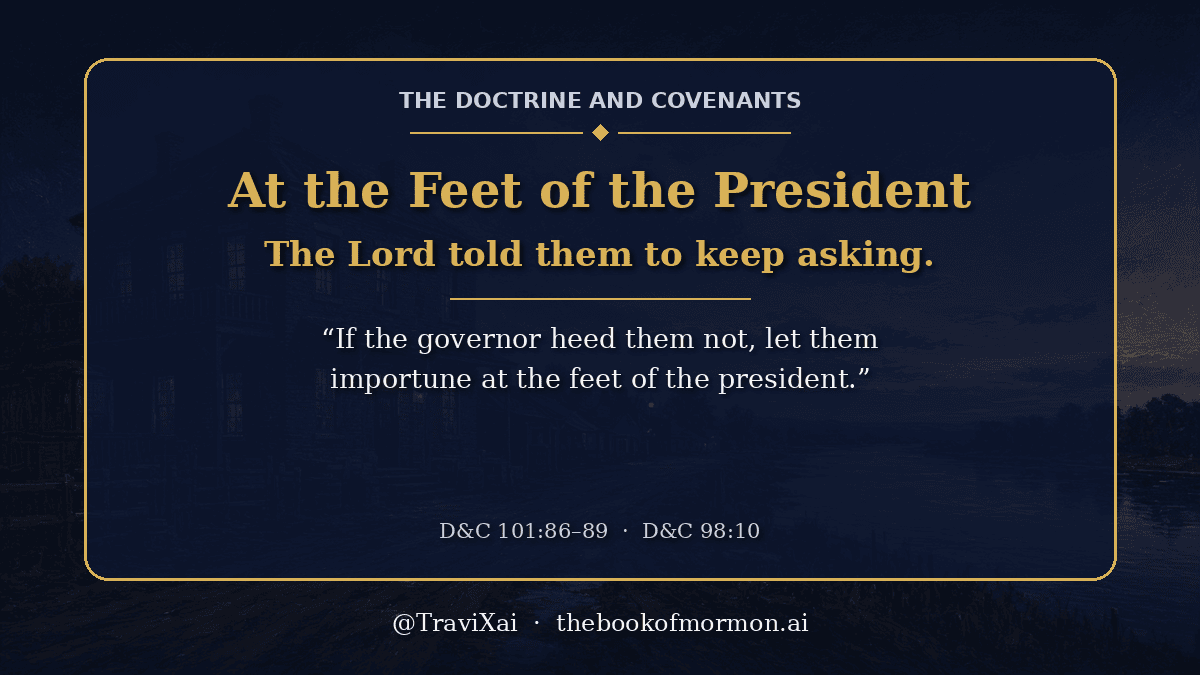
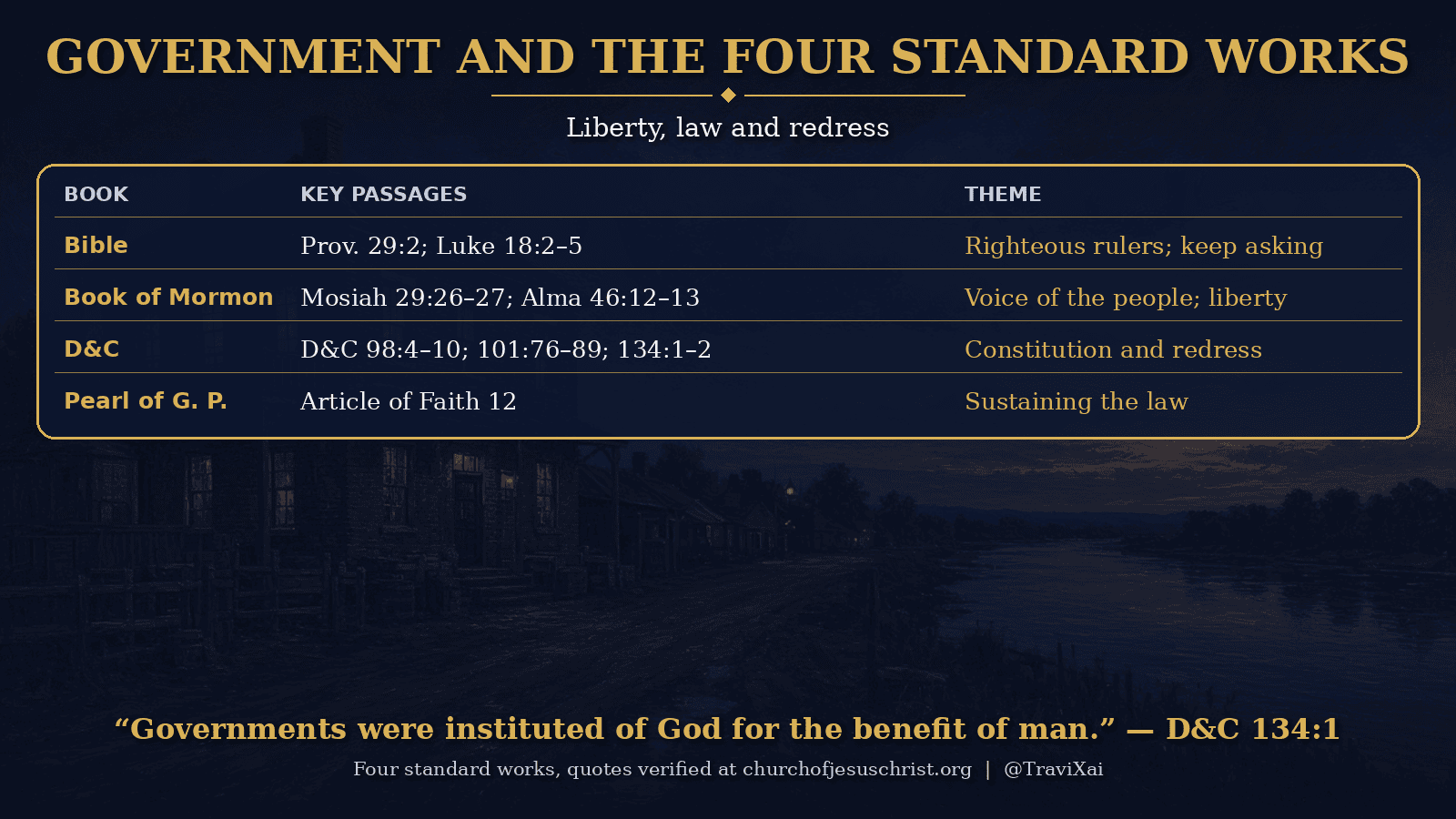
The campaign follows a revelation given in December 1833, after the Saints were driven from Jackson County. The Lord told them “to importune for redress, and redemption, by the hands of those who are placed as rulers and are in authority over you— according to the laws and constitution of the people, which I have suffered to be established … And for this purpose have I established the Constitution of this land, by the hands of wise men whom I raised up unto this very purpose” (D&C 101:76–80). Then a ladder: “Let them importune at the feet of the judge; and if he heed them not, let them importune at the feet of the governor; and if the governor heed them not, let them importune at the feet of the president” (D&C 101:85–89).
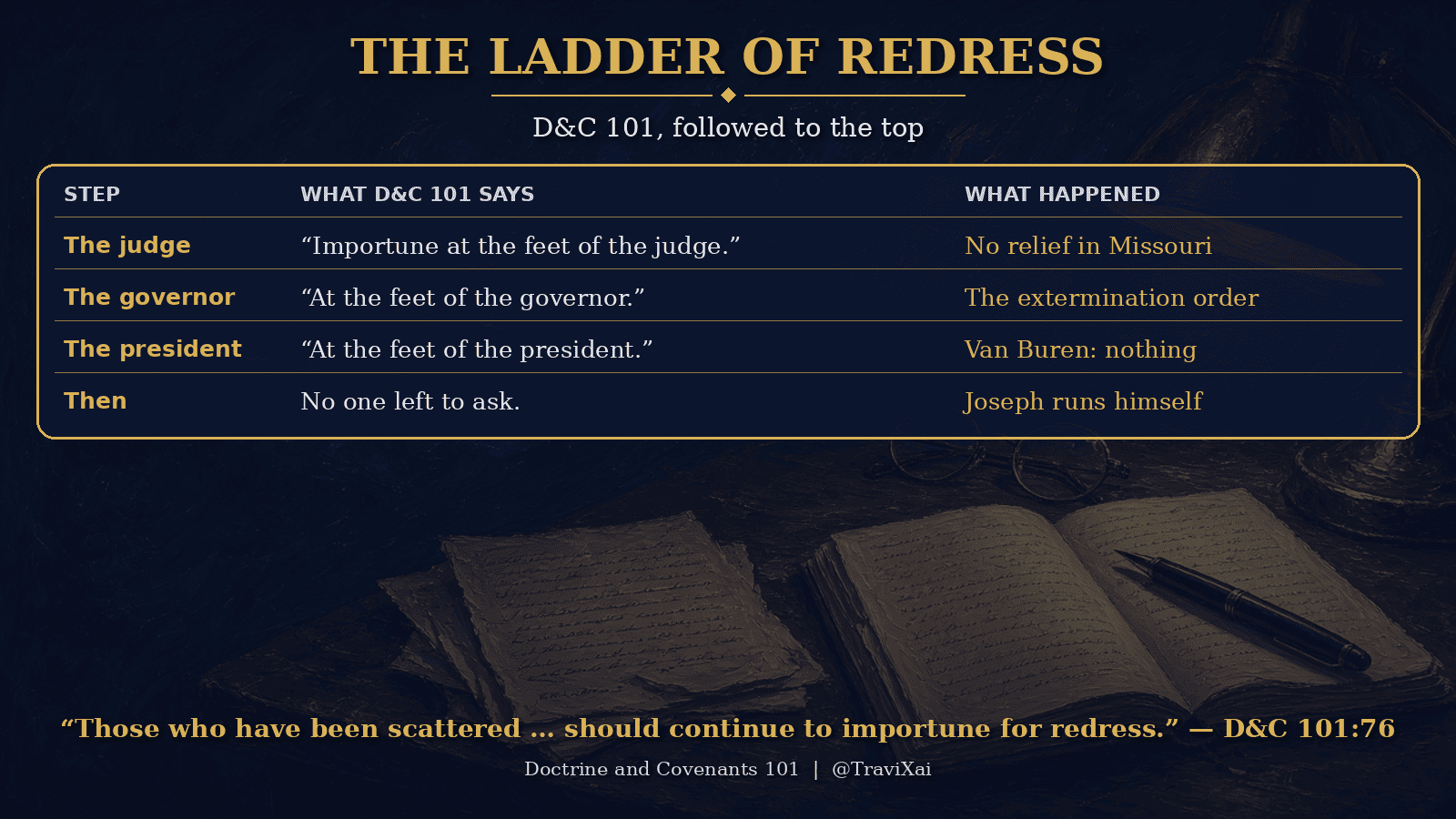
By 1844 the Saints had climbed every rung. An earlier revelation had already said what to look for in leaders: “when the wicked rule the people mourn. Wherefore, honest men and wise men should be sought for diligently, and good men and wise men ye should observe to uphold” (D&C 98:4–10). And the Church’s declaration on government states that “no government can exist in peace, except such laws are framed and held inviolate as will secure to each individual the free exercise of conscience, the right and control of property, and the protection of life” (D&C 134:1–2). Missouri had failed on all three.
The BibleThe importunate widow
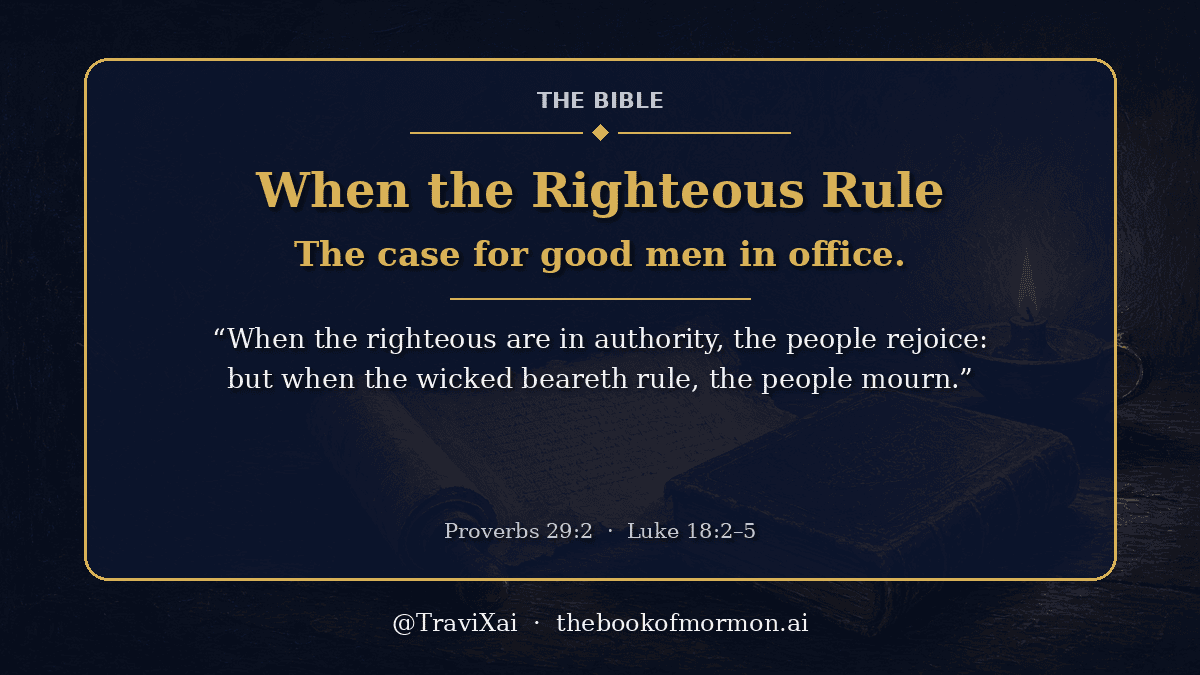
D&C 101 builds its ladder on Christ’s parable of the widow and the unjust judge: “There was in a city a judge, which feared not God, neither regarded man: and there was a widow in that city; and she came unto him, saying, Avenge me of mine adversary … because this widow troubleth me, I will avenge her” (Luke 18:2–5). The Saints were told to be that widow. And Proverbs gives the reason good men should seek office: “When the righteous are in authority, the people rejoice: but when the wicked beareth rule, the people mourn” (Proverbs 29:2), a line D&C 98:9 echoes almost word for word.
The Book of MormonThe title of liberty

The Book of Mormon is full of believers who took part in government to protect freedom. King Mosiah replaced kingship with judges chosen by the people: “it is not common that the voice of the people desireth anything contrary to that which is right … therefore this shall ye observe and make it your law—to do your business by the voice of the people” (Mosiah 29:26–27). Captain Moroni tore his coat and wrote on it, “In memory of our God, our religion, and freedom, and our peace, our wives, and our children,” and “he called it the title of liberty” (Alma 46:12–13). Joseph’s campaign was in that line: a believer using lawful means to protect his people.
The Pearl of Great PriceSustaining the law
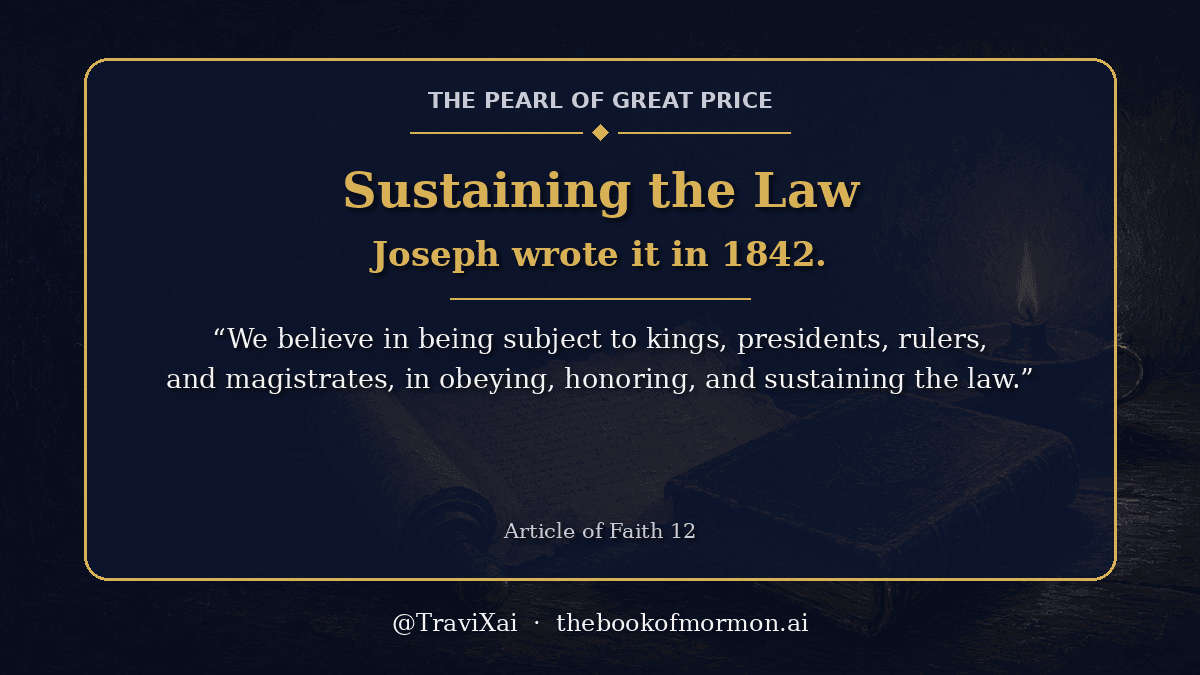
Two years before the campaign, Joseph wrote: “We believe in being subject to kings, presidents, rulers, and magistrates, in obeying, honoring, and sustaining the law” (Article of Faith 12). The campaign was the opposite of rebellion. When the law failed his people, Joseph tried to change it through the ballot box. See What Are the Articles of Faith?.
What critics sayThe Council of Fifty and the “king” charge
Critics sometimes say Joseph wanted to rule America as a king. In March 1844 he organized the Council of Fifty, a body meant to prepare for the political kingdom of God that would come with Christ’s millennial reign. Its minutes, published in 2016 by the Joseph Smith Papers, show it managing the campaign, debating a constitution for that future kingdom, and planning for a possible move west to Texas or Oregon. On April 11, 1844, the council voted to “receive from this time henceforth and forever, Joseph Smith, as our Prophet, Priest & King.” Critics read that as earthly ambition. Joseph had already explained the title in July 1843: he would advance “f[ro]m prophet to pri[e]st & then to King not to the kingdoms of this earth but of the most high god.” Four days before the vote, in the King Follett discourse, he taught that every faithful Saint must “learn how to be a God yourself & be a K[ing] & Priest to God,” the same promise John gave: Christ “hath made us kings and priests unto God and his Father” (Revelation 1:6). See Was God Once a Man? The King Follett Discourse.
Read in context, the council was planning for the Millennium and for a refuge, while the campaign platform itself was about constitutional rights, ending slavery and protecting minorities from mobs. It is fair to say Joseph believed the kingdom of God would one day govern the earth under Christ. It is not fair to say his 1844 platform proposed anything other than a stronger, fairer republic.
Check the premiseThe presuppositions baked into the question
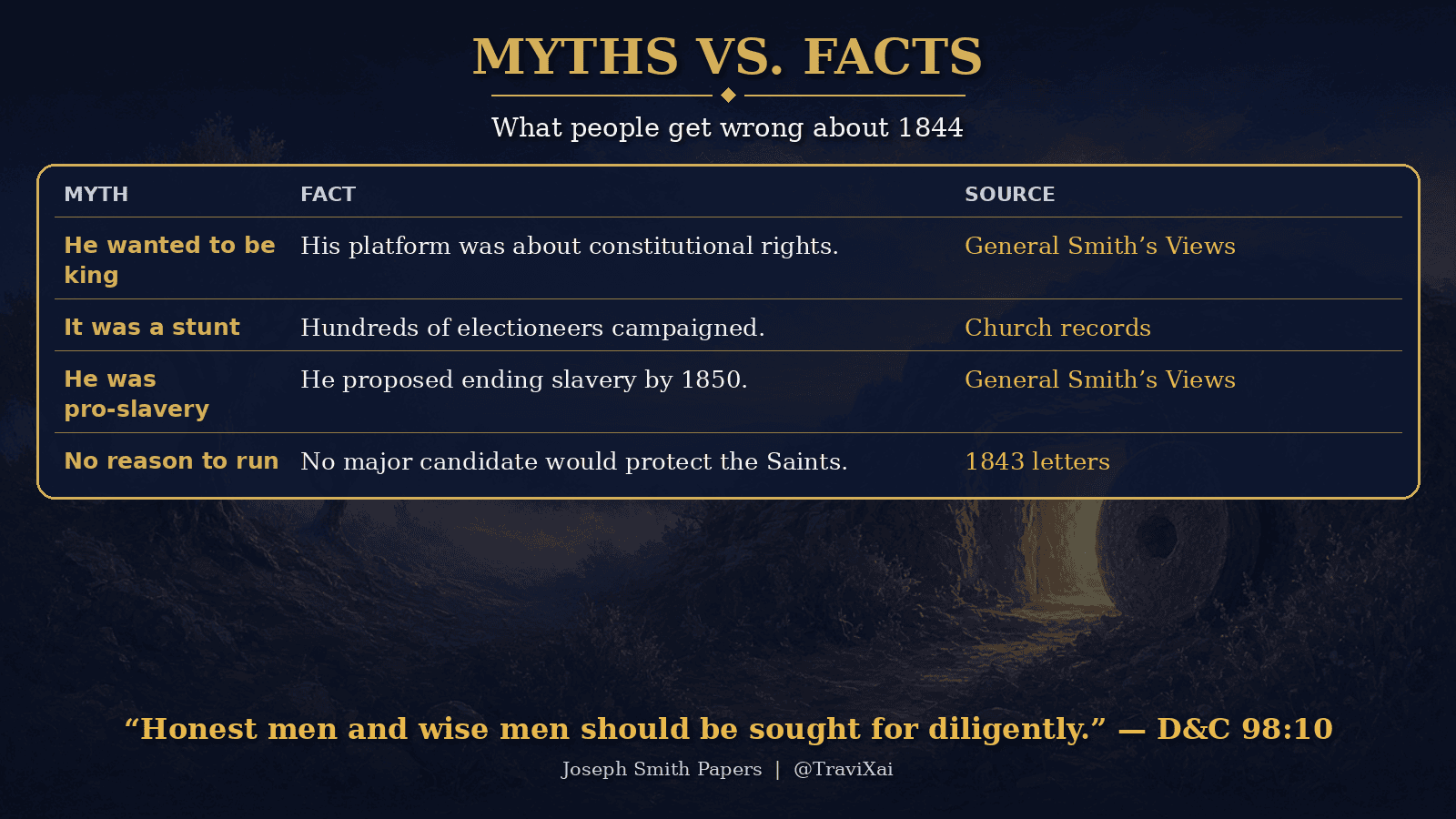
Before this question can be answered fairly, the person asking has to justify a few assumptions packed inside it:
- That a prophet running for office means he wanted power for himself. He said he ran because no candidate would protect the Saints’ “religious and civil rights as American citizens.”
- That the campaign was not serious. A platform went to every major newspaper and several hundred electioneers campaigned in many states.
- That Joseph supported slavery. His platform proposed ending slavery by 1850, paid for by public land sales.
- That seeking office contradicts the gospel. Scripture tells believers to seek “honest men and wise men” for office (D&C 98:10) and to keep asking rulers for redress (D&C 101:76–89).
FAQQuick answers
Did Joseph Smith run for president?
Yes. He ran as an independent candidate for president of the United States in 1844.
Why did Joseph Smith run for president?
Because no major candidate would commit to protecting the Saints or helping them recover their losses in Missouri, he sought lawful power “for the protection of injured innocence.”
What was Joseph Smith’s platform?
His pamphlet General Smith’s Views proposed ending slavery by 1850 with compensation, cutting Congress’s size and pay, prison reform, letting the president send troops against mobs, a national bank, and annexing Texas and Oregon.
Who was Joseph Smith’s running mate?
Sidney Rigdon, after James Arlington Bennet was thought ineligible and Solomon Copeland did not respond.
When did Joseph Smith announce his campaign?
January 29, 1844, at a meeting with the Twelve Apostles in Nauvoo.
How did Joseph Smith’s campaign end?
He was murdered at Carthage Jail on June 27, 1844, and the campaign ended.
What did Martin Van Buren tell Joseph Smith?
According to Joseph, Van Buren said in 1839, “your cause is just, but I can do nothing for you.”
Was Joseph Smith the first presidential candidate assassinated?
He is often described as the first U.S. presidential candidate to be killed during a campaign.
SummaryKey takeaways
- He ran in 1844 because no one in power would protect the Saints.
- Van Buren: “your cause is just, but I can do nothing for you.”
- His platform proposed ending slavery by 1850 and protecting people from mobs.
- Several hundred electioneers campaigned; Sidney Rigdon was his running mate.
- The campaign ended at Carthage on June 27, 1844.
Read D&C 101:76–89 tonight. For quick, sourced answers, open Galatians18, and follow me on X at @TraviXai.
Sources
- King James Bible (churchofjesuschrist.org): Proverbs 29:2 · Luke 18:2–5 · Revelation 1:6
- Book of Mormon: Mosiah 29:26–27 · Alma 46:12–13
- Doctrine and Covenants: D&C 98:4–10 · D&C 101:76–80 · D&C 101:85–89 · D&C 134:1–2
- Pearl of Great Price: Article of Faith 12
- Council of Fifty Minutes, 11 April 1844 · General Smith’s Views (Joseph Smith Papers) · Minutes and Discourse, 29 January 1844 · “The Council of Fifty and Joseph Smith’s Presidential Ambitions” (BYU Religious Studies Center)
- Featured image and in-article graphic: original graphics by thebookofmormon.ai (painterly backgrounds; no photographs or likenesses of real people).