
About 230 Saints walked 900 miles to rescue Zion and came home without a fight. Critics call it a failure. The Lord called it a trial of faith, and then He called apostles out of it.
The question often assumes Zion’s Camp was a failed army and a failed prophecy. It was neither. Zion’s Camp was the 1834 march of about 230 Latter-day Saints from Ohio and Michigan to Missouri to help the Saints driven from Jackson County. It was meant to be defensive. When the governor backed out and armed mobs gathered, a storm at Fishing River stopped an attack, and the Lord said in D&C 105 that Zion would wait, accepted their offering as “a trial of their faith,” and told them to “sue for peace.” Cholera killed 13 marchers. In 1835, most of the original Twelve and all of the first Seventies were called from its ranks.
What it wasA relief march to Missouri
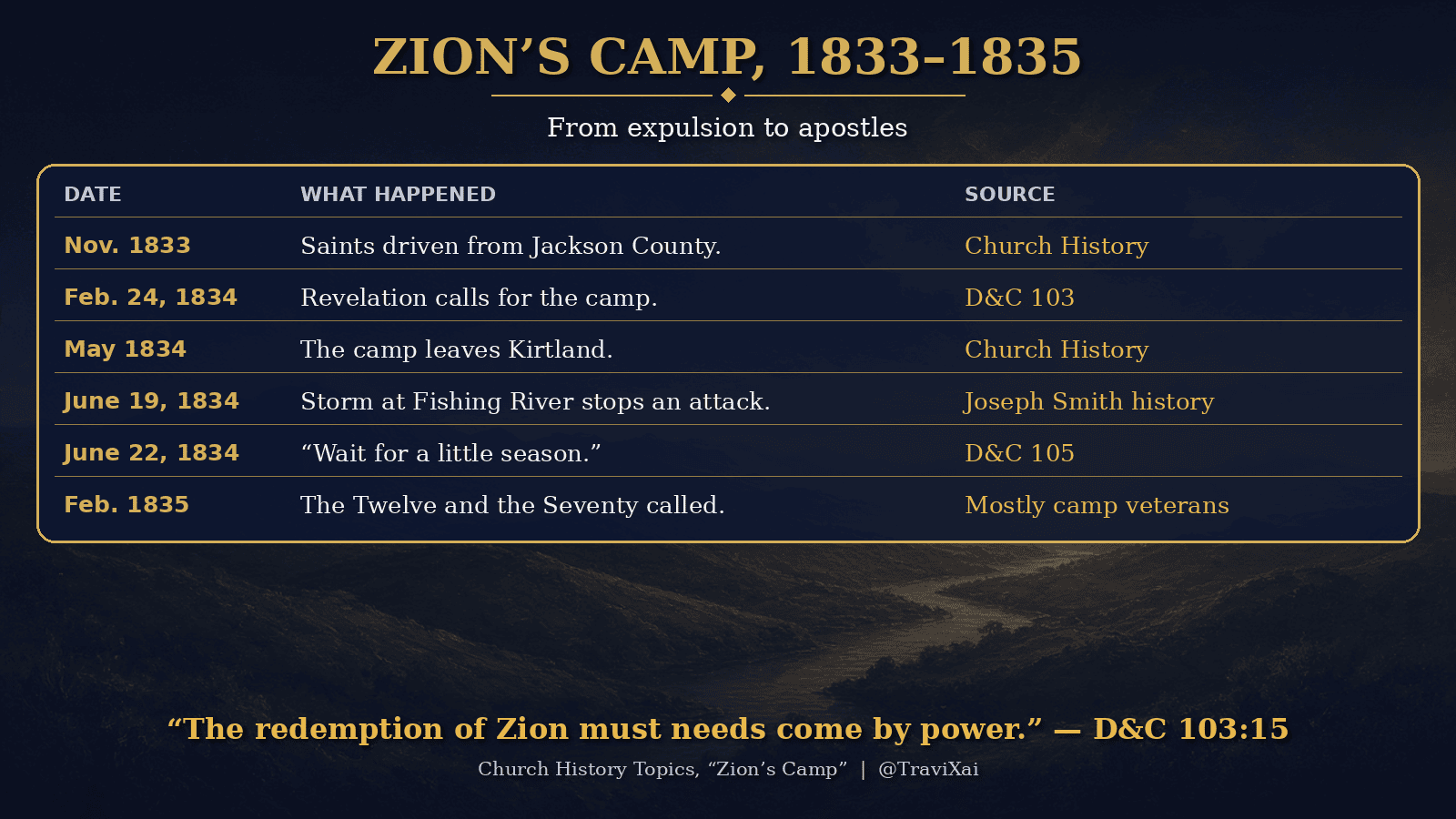
In November 1833, mobs drove the Latter-day Saints out of Jackson County, Missouri, the place the Lord had named as the center of Zion. More than a thousand people lost their homes and land and huddled across the Missouri River in Clay County. In February 1834 Joseph Smith received a revelation, now D&C 103, to “call up the strength of the Lord’s house” and go to Missouri.
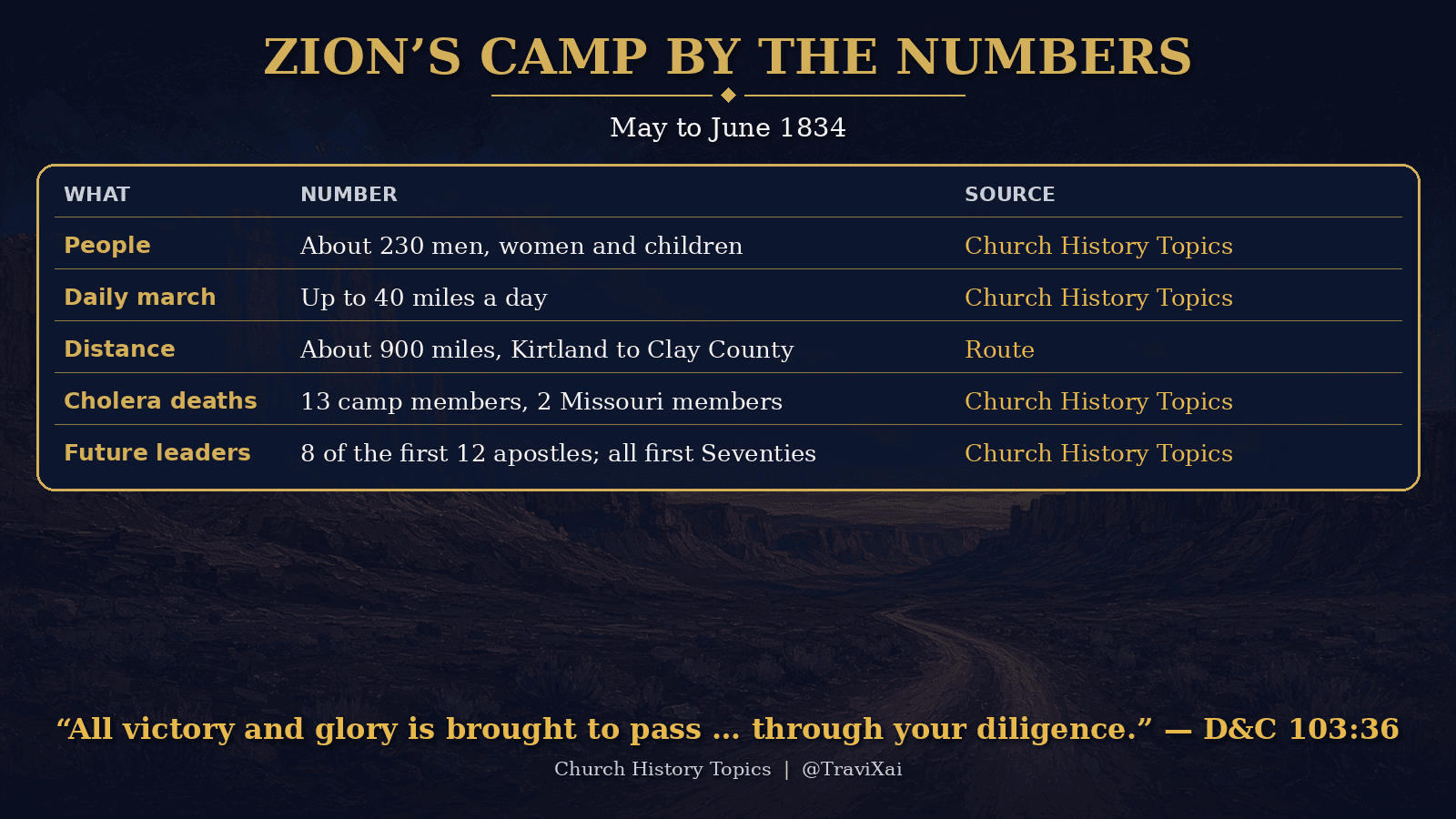
From May to June 1834, about 230 men, women and children marched roughly 900 miles from Kirtland, Ohio, and from Michigan, to Clay County. Joseph Smith led the main group; Hyrum Smith and Lyman Wight led a second group that joined them in June. They called themselves the Camp of Israel. Today it is called Zion’s Camp. They walked as much as 40 miles a day, ran short of food and water, and some complained the whole way.
The plan was defensive. Governor Daniel Dunklin had indicated he would call out the state militia to escort the Saints back to their land. The camp would march to Missouri, ask him to do it, and then stay to protect the Saints from being driven out again. Dunklin backed away from that promise. Meanwhile armed Missourians mobilized against the camp.
Fishing RiverThe storm and D&C 105
On June 19, 1834, five armed men rode into the camp at Fishing River and swore the Saints would “see hell before morning” from a force of about 400 men. That night a violent storm with huge hailstones hit, and the river rose to nearly 40 feet deep, which stopped the attack. Joseph Smith’s history recorded: “It seemed as if the mandate of vengeance had gone forth from the God of battles to protect his servants from the destruction of their enemies.”
Three days later, on June 22, Joseph received D&C 105. The Lord said the camp would not redeem Zion then, and said exactly why: “were it not for the transgressions of my people, speaking concerning the church and not individuals, they might have been redeemed even now. But behold, they have not learned to be obedient … and do not impart of their substance, as becometh saints, to the poor and afflicted among them; And are not united according to the union required by the law of the celestial kingdom” (D&C 105:2–4). The elders were to “wait for a little season … until mine elders are endowed with power from on high” (D&C 105:9–11), which happened in the Kirtland Temple in 1836. See What Is the Kirtland Temple?.
Then cholera hit the camp. It killed 13 camp members and 2 Missouri Church members, and the camp disbanded at the end of June. Most of the marchers were back in Kirtland by July.
Was it a failure?What it actually accomplished
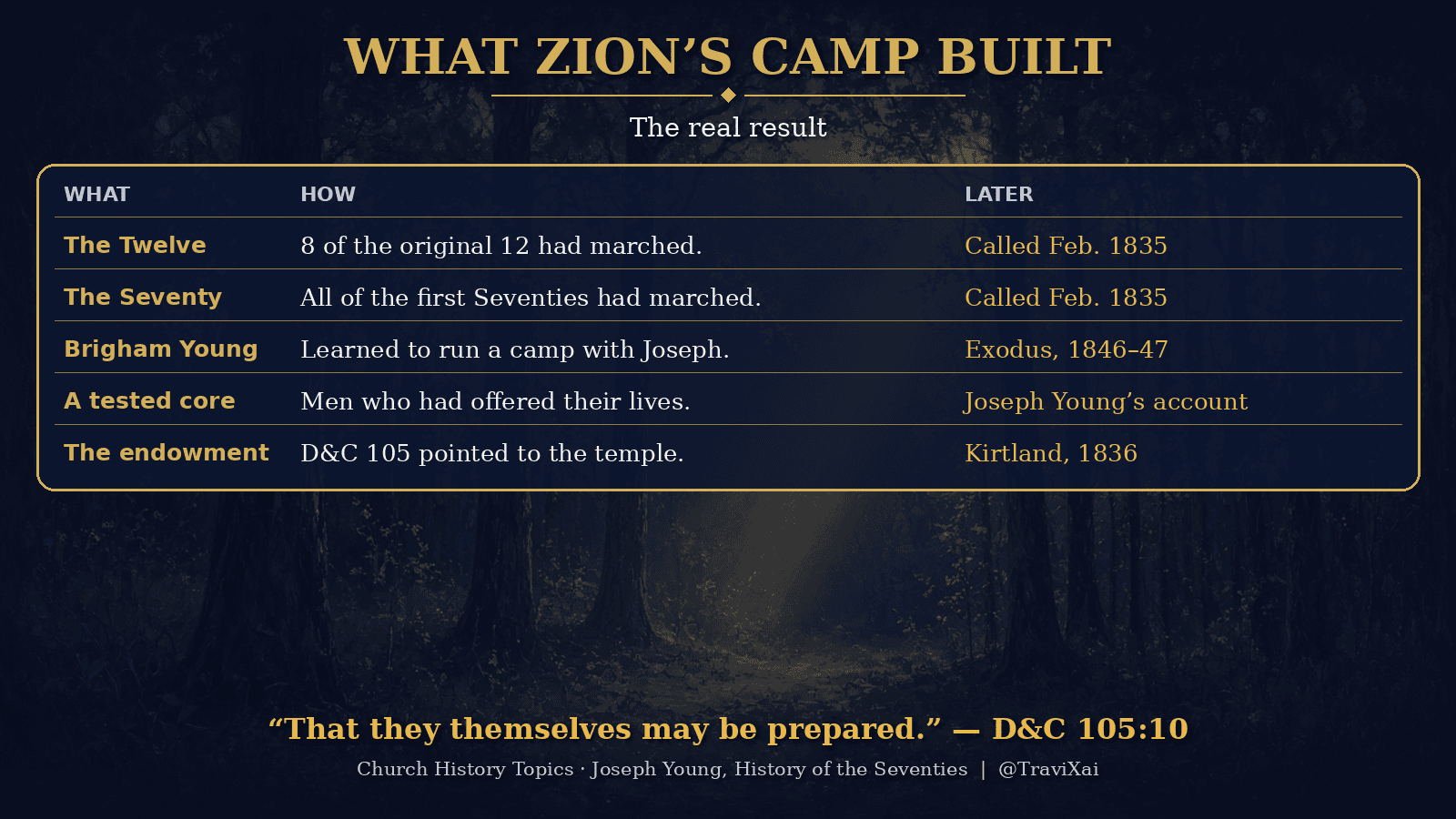
By the critics’ scorecard, yes: Zion was not redeemed and people died. By the Lord’s, no. Look at what came next. When the Quorum of the Twelve Apostles was organized in February 1835, eight of the original twelve had marched in Zion’s Camp, and every one of the first Seventies had. Joseph Young, one of them, later recalled Joseph Smith telling elders who were angry they had not fought: “God did not want you to fight. He could not organize his kingdom with twelve men to open the gospel door to the nations of the earth, and with seventy men under their direction to follow in their tracks, unless he took them from a body of men who had offered their lives, and who had made as great a sacrifice as did Abraham.”
Brigham Young treated it as a privilege. He said he learned from walking with Joseph how to lead a camp, and a dozen years later he led a whole people across the plains. See Who Was Brigham Young? and Why Did the Saints Settle in Utah?.
The BibleGideon and Abraham
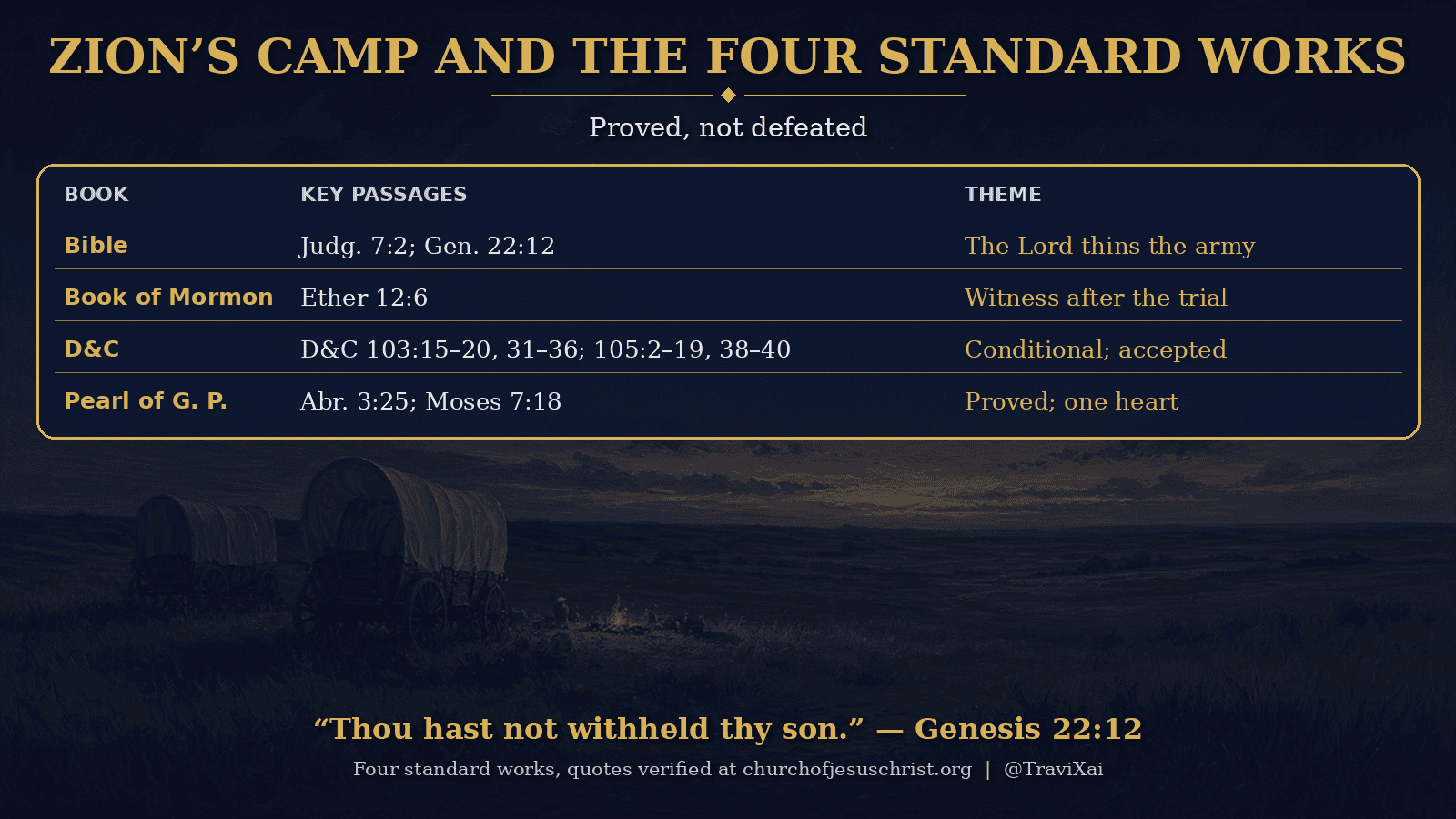
The Lord has a habit of shrinking armies. Before Gideon fought Midian, “the Lord said unto Gideon, The people that are with thee are too many for me to give the Midianites into their hands, lest Israel vaunt themselves against me, saying, Mine own hand hath saved me” (Judges 7:2). Zion’s Camp got the same lesson without even a battle: the storm at Fishing River did what their rifles could not.
And Joseph Smith compared the camp to Abraham, who was stopped at the last moment: “Lay not thine hand upon the lad … for now I know that thou fearest God, seeing thou hast not withheld thy son” (Genesis 22:12). The willingness was the point. The Lord did not need Isaac dead, and He did not need a battle in Jackson County.
The Book of MormonNo witness until after the trial
Moroni put the principle in one line: “dispute not because ye see not, for ye receive no witness until after the trial of your faith” (Ether 12:6). The men of Zion’s Camp did not see the purpose while they were limping across Illinois. They saw it the next February, when the Twelve were called out of their ranks.
The Doctrine and CovenantsWas D&C 103 a failed prophecy?
Critics say D&C 103 promised Zion would be redeemed in 1834 and it wasn’t. Read it. The Lord said “the redemption of Zion must needs come by power” and “in time ye shall possess the goodly land” (D&C 103:15–20). In time. He asked for five hundred men, then said “men do not always do my will” and lowered it to three hundred or one hundred (D&C 103:31–34). And He attached the condition: “All victory and glory is brought to pass unto you through your diligence, faithfulness, and prayers of faith” (D&C 103:36). Only about 230 came, and D&C 105 says the Church as a whole had not kept the law of consecration. A conditional promise whose condition was not met is not a failed prophecy. It is how covenants work. See What Is the Law of Consecration?.
And the Lord did not leave them empty-handed: “I have heard their prayers, and will accept their offering; and it is expedient in me that they should be brought thus far for a trial of their faith” (D&C 105:19). His instruction going forward was not war: “sue for peace, not only to the people that have smitten you, but also to all people; And lift up an ensign of peace” (D&C 105:38–40).
The Pearl of Great PriceProved, and one heart
In Abraham’s vision of the premortal council, the purpose of this life is stated plainly: “we will prove them herewith, to see if they will do all things whatsoever the Lord their God shall command them” (Abraham 3:25). Zion’s Camp was a small version of that test. And Enoch’s city shows what Zion requires: “the Lord called his people Zion, because they were of one heart and one mind, and dwelt in righteousness; and there was no poor among them” (Moses 7:18). That is the standard D&C 105 said the Church had not yet met. Zion is built by a people, not taken by a militia.
Check the premiseThe presuppositions baked into the question
Before this question can be answered fairly, the person asking has to justify a few assumptions packed inside it:
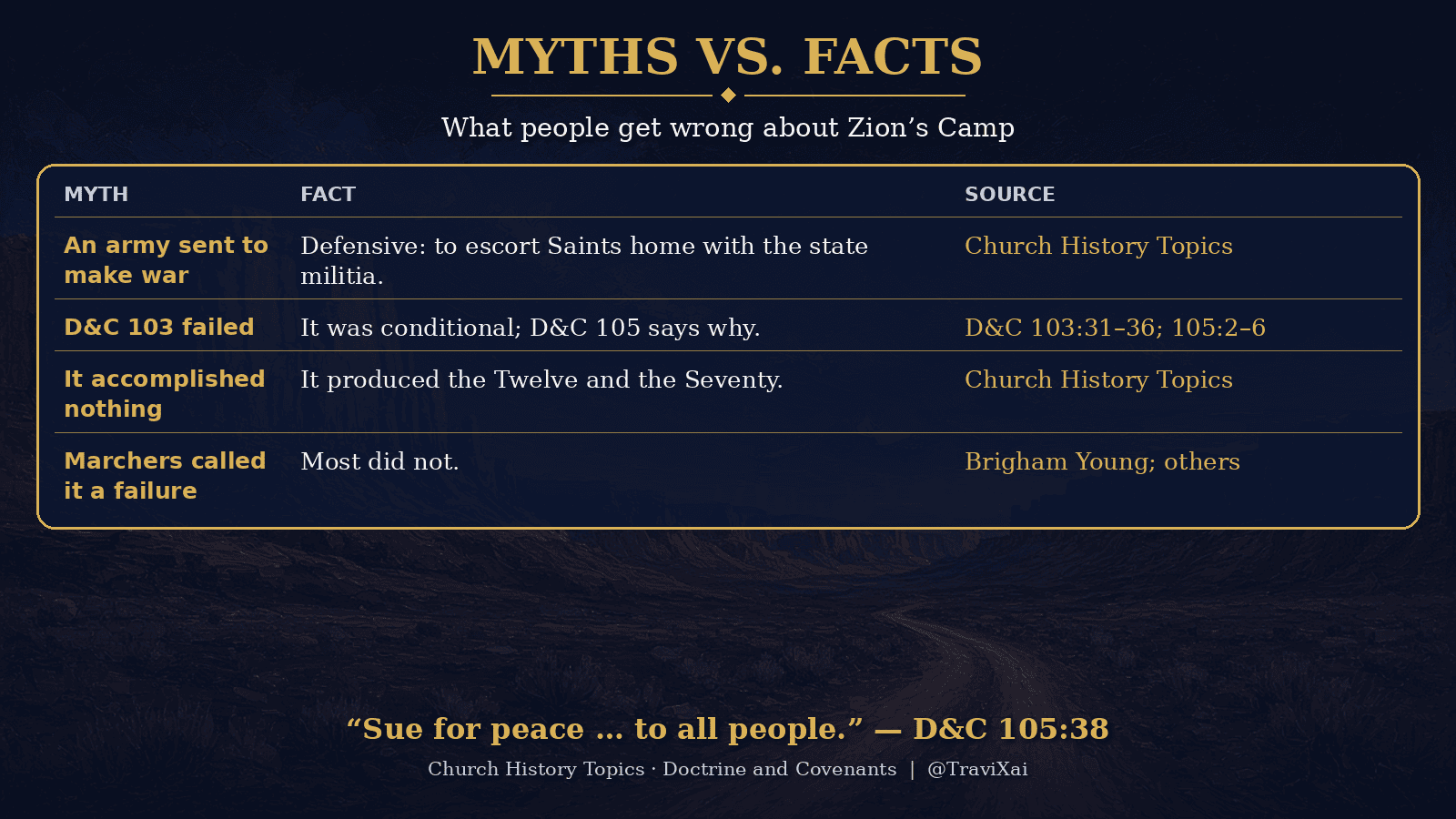
- That Zion’s Camp was an army sent to start a war. Church leaders saw it as defensive: to have the state militia escort the Saints home, then protect them. When the governor backed out, the Lord told them to “sue for peace” (D&C 105:38).
- That D&C 103 was an unconditional prophecy that failed. It said “in time,” lowered its numbers when men did not come, and tied victory to “diligence, faithfulness, and prayers of faith” (D&C 103:36). D&C 105 explains why it was delayed.
- That if Zion was not redeemed, the march was pointless. It produced most of the original Twelve and all of the first Seventies, and trained Brigham Young to lead the later exodus.
- That the participants saw it as a failure. Most did not. Church History Topics records that most marchers did not see the expedition as a failure, and some, like Brigham Young, counted it a privilege.
FAQQuick answers
What was Zion’s Camp?
A march of about 230 Latter-day Saints from Ohio and Michigan to Missouri in May and June 1834, to help the Saints driven from Jackson County.
Why was Zion’s Camp organized?
A February 1834 revelation (D&C 103) called the Church to help redeem Zion after mobs drove the Saints out of Jackson County in 1833.
What happened at Fishing River?
On June 19, 1834, a violent storm swelled the river and stopped an announced attack on the camp. Three days later Joseph received D&C 105.
How many people died in Zion’s Camp?
Cholera killed 13 camp members and 2 Missouri Church members at the end of June 1834.
Was Zion’s Camp a failure?
It did not restore the Saints to Jackson County, but the Lord accepted the offering (D&C 105:19), and it produced most of the first Twelve and all of the first Seventies.
Was D&C 103 a failed prophecy?
No. It promised Zion “in time,” and conditioned victory on faithfulness. D&C 105 says the Church had not kept the law required.
Did Brigham Young march in Zion’s Camp?
Yes. He later said it was a privilege that taught him how to lead, which he used in the 1846–47 exodus.
Who was called from Zion’s Camp?
Eight of the original twelve apostles and all of the first Seventies, called in February 1835.
SummaryKey takeaways
- May–June 1834: about 230 Saints marched from Ohio and Michigan to Missouri.
- Its purpose was defensive: help the Saints driven from Jackson County.
- A storm at Fishing River stopped an attack; D&C 105 told them to wait and sue for peace.
- Cholera killed 13 camp members and 2 Missouri members.
- It produced most of the first Twelve and all of the first Seventies.
Read D&C 105 tonight. For quick, sourced answers, open Galatians18, and follow me on X at @TraviXai.
Sources
- King James Bible (churchofjesuschrist.org): Genesis 22:12 · Judges 7:2
- Book of Mormon: Ether 12:6
- Doctrine and Covenants: D&C 103:15–20 · D&C 103:31–36 · D&C 105:2–19 · D&C 105:38–40
- Pearl of Great Price: Abraham 3:25 · Moses 7:18
- Church History Topics, “Zion’s Camp (Camp of Israel)” · “Voices of the Restoration: Zion’s Camp” (Joseph Young, History of the Organization of the Seventies, 1878)
- Featured image and in-article graphic: original graphics by thebookofmormon.ai (painterly backgrounds; no photographs or likenesses of real people).