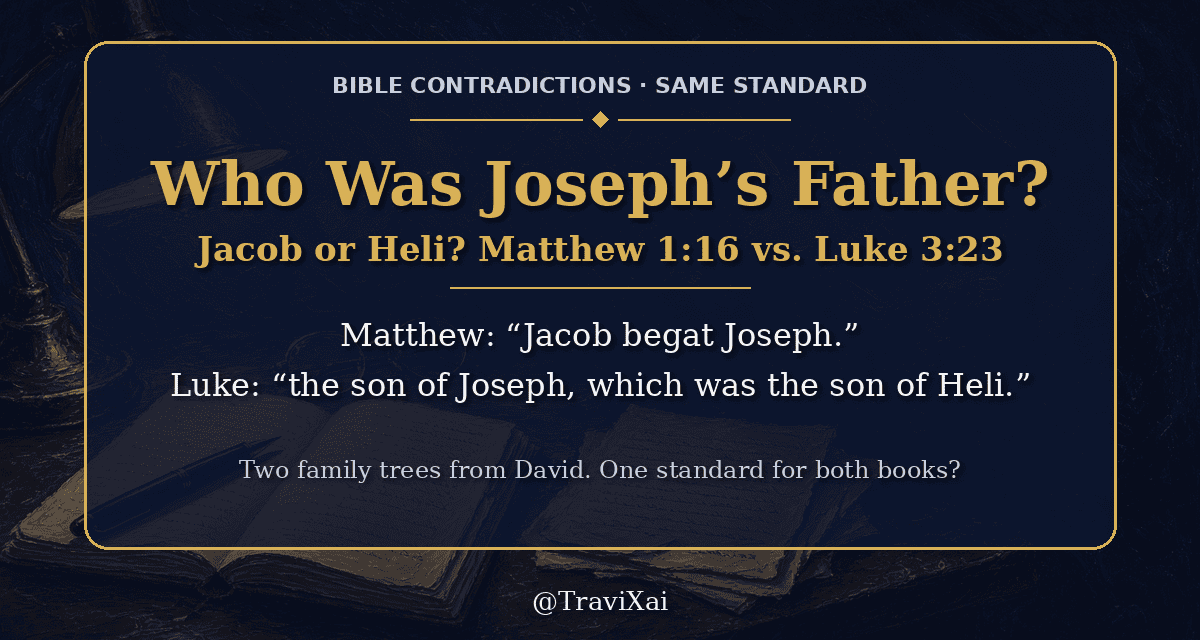

Matthew says Joseph’s father was Jacob. Luke says Heli. Two different family trees run all the way back to David. Bible defenders harmonize them with details neither gospel gives, then refuse the Book of Mormon the same charity.
Home › Answering Critics › Start here: Are Latter-day Saints Christian? · The CES Letter: A Faithful Response
Matthew and Luke name different fathers for Joseph. Matthew 1:16 says “Jacob begat Joseph.” Luke 3:23 calls Jesus “the son of Joseph, which was the son of Heli.” The two lines split at David’s sons, Solomon and Nathan. The usual fixes (levirate marriage, or Luke giving Mary’s line) are possible, but neither is in the text. Critics give the Bible that charity and refuse it to the Book of Mormon.
Who was Joseph’s father? It sounds like a Sunday School question. Open Matthew and the answer is Jacob. Open Luke and the answer is Heli. Same Joseph, same Mary, same Jesus, and two different dads. Keep reading and it gets bigger: two grandfathers, two sons of David, two family trees.
I’m not here to tear down the Bible. I love it, and I believe it. I’m here to show you what Bible defenders do with this one, because it’s the exact thing they say Latter-day Saints aren’t allowed to do with the Book of Mormon.
Check the assumptions first
Critics who say one contradiction sinks the Book of Mormon are leaning on assumptions they never apply to Matthew and Luke:
- That inspired writers can’t disagree on details. Matthew and Luke disagree on Joseph’s father. Christians accept both gospels anyway.
- That a harmony counts as proof. Levirate marriage and Mary’s line are explanations brought to the text, not found in it. Possible isn’t the same as shown.
- That every book gets the same rules. The Bible gets the benefit of the doubt. The Book of Mormon gets accused of a forgetful author.
- That scripture claims to be flawless. The Book of Mormon never claims inerrancy. Its title page says, “if there are faults they are the mistakes of men.”
Exhibit AMatthew: Jacob begat Joseph
Matthew opens his gospel with “The book of the generation of Jesus Christ, the son of David, the son of Abraham” (Matthew 1:1). He counts down from Abraham through David, then takes the royal line through Solomon: “David the king begat Solomon of her that had been the wife of Urias” (1:6). King after king follows until the exile, then a string of lesser names, until we land here:
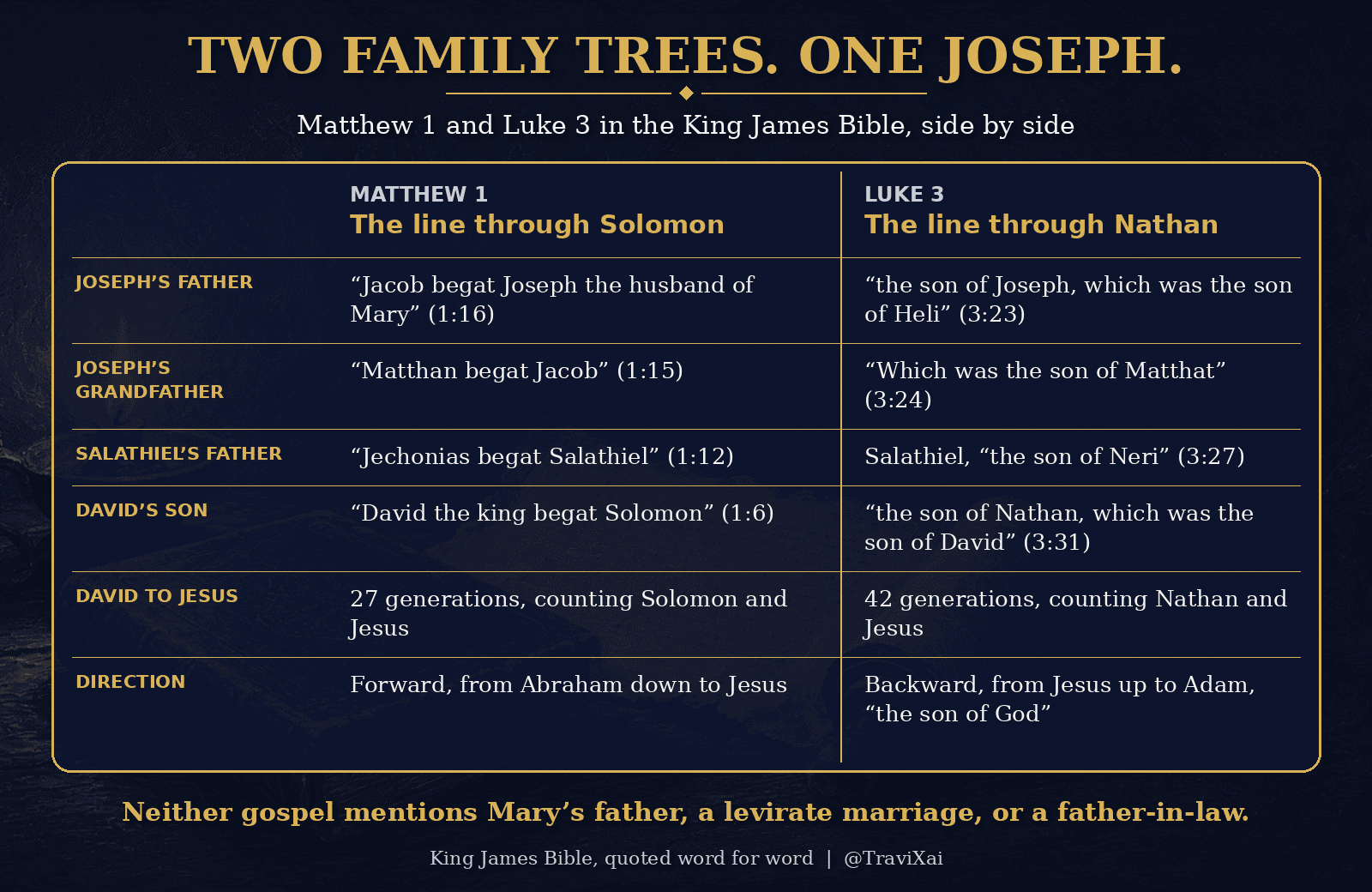
And Matthan begat Jacob; And Jacob begat Joseph the husband of Mary, of whom was born Jesus, who is called Christ.
Matthew 1:15–16 (KJV)
Joseph’s father is Jacob. His grandfather is Matthan. Matthew even does the math for you:
So all the generations from Abraham to David are fourteen generations; and from David until the carrying away into Babylon are fourteen generations; and from the carrying away into Babylon unto Christ are fourteen generations.
Matthew 1:17 (KJV)
Except the middle fourteen only work if you leave people out. Matthew says “Joram begat Ozias” (Matthew 1:8). Ozias is Uzziah, also called Azariah. But 1 Chronicles lists the kings in order: “Joram his son, Ahaziah his son, Joash his son, Amaziah his son, Azariah his son” (1 Chronicles 3:11–12). Three kings, Ahaziah, Joash, and Amaziah, are gone from Matthew’s list. Maybe Matthew was shaping a pattern. The text doesn’t say.
Exhibit BLuke: the son of Heli
Luke puts his genealogy after Jesus’ baptism, and he runs it backward, from Jesus all the way up to “Adam, which was the son of God” (Luke 3:38). Here’s how it starts:
And Jesus himself began to be about thirty years of age, being (as was supposed) the son of Joseph, which was the son of Heli, Which was the son of Matthat, which was the son of Levi, which was the son of Melchi…
Luke 3:23–24 (KJV)
Joseph’s father is Heli. His grandfather is Matthat, not Matthan. And when Luke reaches David, he doesn’t go through Solomon at all. He goes through a different son: “the son of Nathan, which was the son of David” (Luke 3:31). Nathan and Solomon were brothers, both sons of Bath-shua (1 Chronicles 3:5).
Count the generations and it gets worse. From Solomon down to Jesus, Matthew lists 27. From Nathan down to Jesus, Luke lists 42. Even where the two lists share names, they don’t agree. Both have Salathiel and Zorobabel, but Matthew says “Jechonias begat Salathiel” (Matthew 1:12), while Luke has Salathiel as “the son of Neri” (Luke 3:27).
The patchesLevirate marriage and Mary’s line
Patch 1: levirate marriage
The oldest detailed answer that survives comes from Julius Africanus, a Christian writer of the early 200s, preserved by the church historian Eusebius in Church History 1.7. Eusebius opens the chapter with an honest line. Since the two genealogies seem to clash, “every believer, in ignorance of the truth, has been zealous to invent some explanation which shall harmonize the two passages.”
Africanus builds his answer on the law of the brother-in-law. If a man died with no child, his brother married the widow, “and it shall be, that the firstborn which she beareth shall succeed in the name of his brother which is dead” (Deuteronomy 25:5–6). So, the story goes, Matthan and Melchi married the same woman, tradition calls her Estha, one after the other. Jacob and Heli were half-brothers. Heli died childless, Jacob married his widow, and Joseph was Jacob’s son by nature and Heli’s son by law.
It’s clever, and possible. Now look at what it needs. A woman neither gospel names. Two marriages neither gospel mentions. A levirate marriage neither gospel mentions. And it pairs Matthan with Melchi, when in our Luke, Heli’s father is Matthat, with Melchi two generations further back (Luke 3:24). And here’s how Africanus sums it up: “although we can urge no testimony in its support, we have nothing better or truer to offer.” No testimony. Nothing better.
Patch 2: Luke is really Mary’s line
Most defenders today go another way. GotQuestions says “most conservative Bible scholars today” hold that Luke is recording Mary’s genealogy, and Joseph is called “the son of Heli” because he married Heli’s daughter. It even admits, “Tracing a genealogy through the mother’s side is unusual, but so was the virgin birth.”
Read Luke 3:23 again. Mary isn’t in it. Luke says “the son of Joseph, which was the son of Heli.” The words “as was supposed” are about Jesus being Joseph’s son, not about Heli being Joseph’s father. If Luke meant Mary, he picked a strange way to say it, by naming the one person in the story who isn’t Jesus’ father by blood and leaving out the one who is.
GotQuestions also says “It is inconceivable that Matthew and Luke could build two entirely contradictory genealogies of the same lineage.” Notice that’s not evidence. That’s the conclusion, put first.
A possible explanation isn’t evidence. It’s a courtesy. The question is who gets it.
Could either patch be true? Sure. I’ll grant it, because I believe both men told the truth as they had it. But that’s charity. Nothing in either text forces you there.
The standardNow do Mosiah 21:28
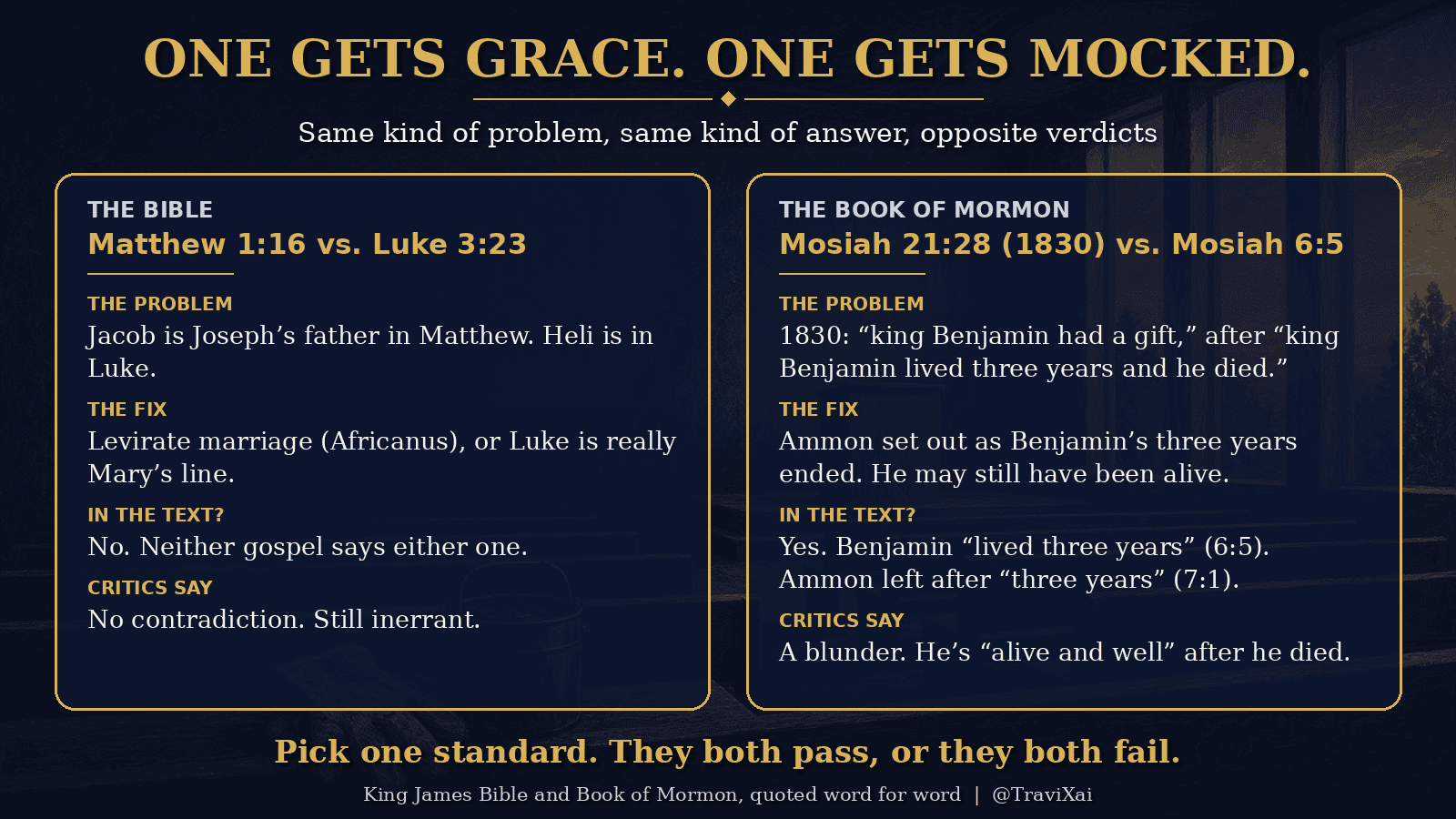
Now flip it. In the 1830 Book of Mormon, Ammon tells King Limhi that “king Benjamin had a gift from God, whereby he could interpret such engravings” (Mosiah 21:28, 1830 reading). The trouble is that six chapters earlier, “king Benjamin lived three years and he died” (Mosiah 6:5). In 1837 the name was changed to “Mosiah,” and today’s edition reads “king Mosiah” (FAIR; Scripture Central).
Critics pounce. James White wrote that “Fifteen chapters later, however, he is alive and well in the 1830 Book of Mormon” (quoted by FAIR). Case closed, right?
But look at the text. Benjamin “lived three years and he died.” The very next chapter says that “after king Mosiah had had continual peace for the space of three years,” Ammon’s party set out (Mosiah 7:1). So Ammon left Zarahemla right about the time Benjamin’s three years ran out. He could be describing the king he left behind. Royal Skousen, the leading scholar of the Book of Mormon text, put it plainly: “these seeming contradictions can be reconciled” (quoted by FAIR). His critical text even restores “Benjamin” as the original reading (Scripture Central).
So which explanation has more support? The Mosiah answer comes straight from two verses in the same book: “three years” and “three years.” The Heli answers need an unnamed widow, two unrecorded marriages, or a Mary who never appears in the verse. Yet Matthew and Luke get a pass, and Mosiah gets called a fraud. Yeah, mmm hmm. Do better.
I walked through the same double standard with who killed Goliath and how Judas died. It’s the same move every time.
The answerWhat a Latter-day Saint does with it
I don’t need an unnamed widow. Article of Faith 8 says, “We believe the Bible to be the word of God as far as it is translated correctly.” Moroni said the same about his own record: “if there be faults they be the faults of a man” (Mormon 8:17). We said up front that books written and copied by men can carry the marks of men.
The Chicago Statement on Biblical Inerrancy takes the opposite road. Article XIV: “We deny that alleged errors and discrepancies that have not yet been resolved vitiate the truth claims of the Bible.” That isn’t a standard. That’s a hall pass, and they only hand it to one book. Funny enough, Paul told Titus to “avoid foolish questions, and genealogies” (Titus 3:9). Just saying.
Here’s what matters. Both gospels agree on the big thing: Jesus is the son of David, and He is the Son of God. Whether Heli was Joseph’s father, uncle, or father-in-law doesn’t change that. We love family trees (which is why we do family history), but our faith doesn’t hang on lining up every name.
The Bible isn’t God. It shows that God can and does use imperfect people by imperfect means, which means He can use you too, if you let Him. How do I know it’s true anyway? The same way I know the Book of Mormon is true. God told me, and I choose to believe Him. So harmonize Heli if you want. Just give Mosiah the same courtesy. They both pass, or they both fail.
What all four standard works say about judging scripture fairly
All four standard works teach the same thing: judge fairly, and expect God’s word to come through human writers.
The Bible
Jesus gave the rule for every critic:
For with what judgment ye judge, ye shall be judged: and with what measure ye mete, it shall be measured to you again.
Matthew 7:2
The Book of Mormon
And if there be faults they be the faults of a man. But behold, we know no fault; nevertheless God knoweth all things; therefore, he that condemneth, let him be aware lest he shall be in danger of hell fire.
Mormon 8:17
The Doctrine and Covenants
… these commandments are of me, and were given unto my servants in their weakness, after the manner of their language, that they might come to understanding.
D&C 1:24
The Pearl of Great Price
We believe the Bible to be the word of God as far as it is translated correctly; we also believe the Book of Mormon to be the word of God.
Articles of Faith 1:8
SummaryKey takeaways
- Matthew 1:16 says “Jacob begat Joseph.” Luke 3:23 says Joseph was “the son of Heli.”
- Matthew runs the line through Solomon (1:6). Luke runs it through Nathan (3:31). Matthew lists 27 generations from Solomon to Jesus; Luke lists 42 from Nathan.
- Matthew’s “fourteen generations” (1:17) leaves out Ahaziah, Joash, and Amaziah, who are listed in 1 Chronicles 3:11–12.
- The oldest surviving fix, Africanus’ levirate marriage, admits “we can urge no testimony in its support.” The popular modern fix, Mary’s line, isn’t in Luke’s words.
- Mosiah 21:28 (1830) has a text-based answer: Benjamin “lived three years” and Ammon left after “three years.” Critics who excuse Heli should excuse Benjamin. Pick one standard.
Who was Joseph’s father? Quick answers
Who was Joseph’s father, Jacob or Heli?
Matthew 1:16 says “Jacob begat Joseph.” Luke 3:23 says Joseph was “the son of Heli.” The gospels name different fathers.
Is Luke’s genealogy Mary’s line?
Many conservative scholars say so, with Heli as Mary’s father. But Luke 3:23 names Joseph, not Mary, and Mary does not appear in Luke’s list.
What did Julius Africanus say about the genealogies?
Writing in the early 200s, he proposed that Jacob and Heli were half-brothers and that Jacob raised up seed to Heli by levirate marriage. Eusebius preserves it in Church History 1.7.
What does “as was supposed” mean in Luke 3:23?
It refers to Jesus being thought of as Joseph’s son. It does not say Heli was Joseph’s father-in-law.
Does Matthew skip kings in Jesus’ genealogy?
Yes. Matthew 1:8 says “Joram begat Ozias,” but 1 Chronicles 3:11–12 lists Ahaziah, Joash, and Amaziah in between.
Why do Matthew and Luke trace different sons of David?
Matthew goes through Solomon (Matthew 1:6). Luke goes through Nathan (Luke 3:31). Both were sons of David by Bath-shua (1 Chronicles 3:5).
What other Bible contradictions get a pass?
Do Latter-day Saints believe the Bible is inerrant?
No. We believe “the Bible to be the word of God as far as it is translated correctly” (Articles of Faith 1:8), and the Book of Mormon says any “faults” are “the faults of a man” (Mormon 8:17).
Next time someone says one Book of Mormon verse proves the whole book is fake, ask them who Joseph’s father was. For quick, sourced answers on apparent Bible contradictions, Bible inerrancy, and the Joseph Smith Translation, open Galatians18. And for more like this every day, follow me on X at @TraviXai.
Sources
- Bible (KJV, churchofjesuschrist.org): Matthew 1:1–17 · Luke 3:23–38 · 1 Chronicles 3:5, 10–17 · Deuteronomy 25:5–6 · Jeremiah 22:24–30 · Titus 3:9 · Matthew 7:2
- Eusebius, Church History 1.7, quoting Julius Africanus’ letter to Aristides (Nicene and Post-Nicene Fathers, 2nd series, vol. 1): New Advent
- GotQuestions: “Why are Jesus’ genealogies in Matthew and Luke so different?”
- The Chicago Statement on Biblical Inerrancy (1978), Article XIV
- FAIR: “Benjamin” changed to “Mosiah” · “King Benjamin or Mosiah: A Look at Mosiah 21:28” (quoting James White, Letters to a Mormon Elder)
- Scripture Central KnowHy: “Which Nephite King Had the Gift of Interpretation?” (on Royal Skousen, The Earliest Text)
- Book of Mormon: Title page · Mosiah 6:5 · Mosiah 7:1 · Mosiah 21:28 · Ether 4:1 · Mormon 8:17
- Doctrine and Covenants and Pearl of Great Price: D&C 1:24 · Articles of Faith 1:8
- Galatians18: Apparent Biblical Contradictions · Is the Bible Infallible? · The Joseph Smith Translation
- Featured image and comparison charts: original graphics by thebookofmormon.ai (no photographs or likenesses of real people).