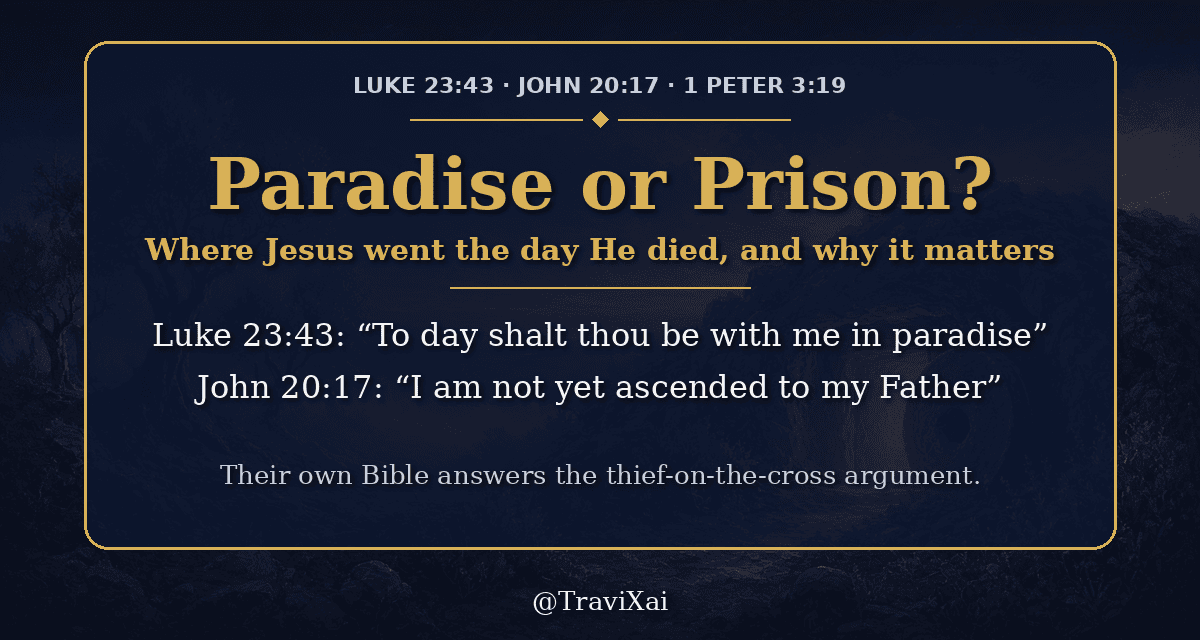

The thief on the cross is the favorite proof text against baptism. But the same Bible says Jesus hadn’t gone to the Father by Sunday, and that He went and preached to the dead.
Home › Answering Critics › Start here: What Happens After Death? · Baptism for the Dead
Jesus told the thief, “To day shalt thou be with me in paradise.” Then, on the first day of the week, He told Mary, “I am not yet ascended to my Father.” So “paradise” that day was not the Father’s presence. Peter tells us where Jesus went: He “preached unto the spirits in prison.” That’s the spirit world, and it’s exactly what Alma 40 and D&C 138 describe. The thief doesn’t cancel baptism. He shows that God reaches the dead.
“The thief on the cross wasn’t baptized, and Jesus took him straight to heaven. Checkmate, Mormons.” Ok. Let’s read the whole story…. All of it. Including the part that happens three days later.
I love the thief on the cross. A dying man, nailed next to the Son of God, rebukes the mocker, confesses his own guilt, and asks Jesus to remember him. Jesus answers with mercy. That’s beautiful. What’s not beautiful is turning that mercy into a weapon against the ordinances Jesus Himself commanded. And the funny thing is that the Bible the critics are holding answers them.
The proof textWhat Luke 23:43 says, and what it doesn’t
Here’s the passage:
And he said unto Jesus, Lord, remember me when thou comest into thy kingdom. And Jesus said unto him, Verily I say unto thee, To day shalt thou be with me in paradise.
Luke 23:42–43 (KJV)
Now read what it doesn’t say. It doesn’t say “heaven.” It doesn’t say “with my Father.” It doesn’t say “baptism is optional.” And it never tells us whether this man had been baptized or not. Luke doesn’t give us his name, his history, or anything he did before the cross. “He was never baptized” isn’t in the verse. It’s an assumption somebody brought to it.
So the critic’s whole case rests on one word: paradise. If paradise means God’s throne, they have a point. If it doesn’t, the proof text collapses. So where was paradise? Jesus answers that Himself.
Sunday morning”I am not yet ascended”
Fast forward to the first day of the week (John 20:1). The tomb is empty. Mary Magdalene sees the risen Lord, and He tells her:
Jesus saith unto her, Touch me not; for I am not yet ascended to my Father: but go to my brethren, and say unto them, I ascend unto my Father, and your Father; and to my God, and your God.
John 20:17 (KJV)
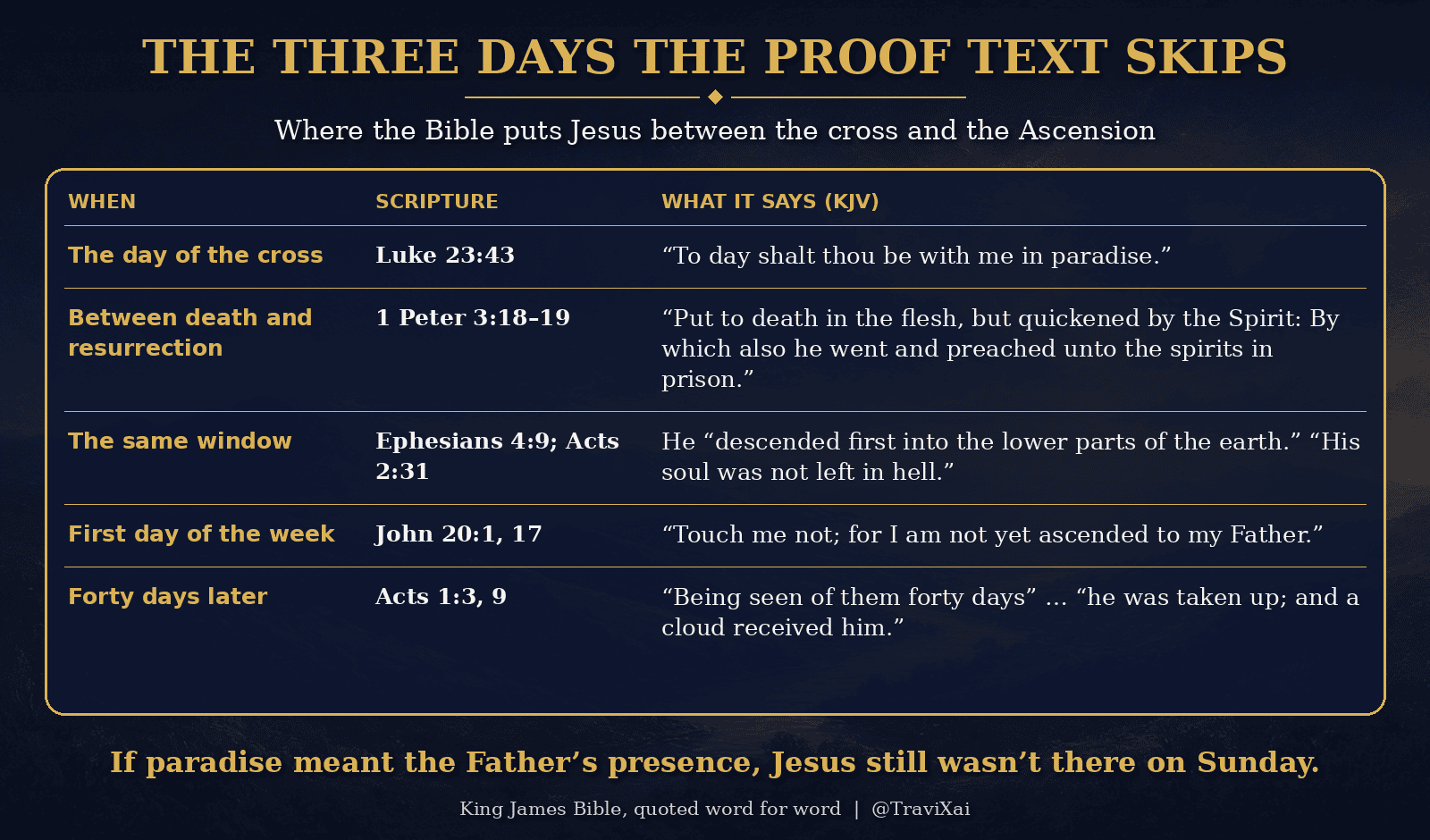
Read that slowly. “I am NOT YET ascended to my Father.” If paradise is the Father’s presence, and the thief was with Jesus in paradise “to day,” then Jesus was with the Father on the day of the cross. But Jesus says on Sunday morning that He hasn’t gone there yet.
So which is it? Either Jesus was wrong on Sunday, or “paradise” on the cross wasn’t heaven. I’ll take Jesus at His word both times. That means paradise is somewhere else. And the Ascension doesn’t come for another forty days: He was “seen of them forty days” and then “taken up” (Acts 1:3, 9).
“But Paul says paradise is the third heaven”
Fair question. Paul says he knew a man “caught up to the third heaven” and “caught up into paradise” (2 Corinthians 12:2–4). Critics read those as the same place. Maybe. But notice what that verse doesn’t do: it doesn’t tell us where Jesus’ spirit was between His death and resurrection. John 20:17 does. A vision Paul had years later can’t overrule what the risen Christ said about Himself that Sunday morning.
“To day shalt thou be with me in paradise.” Then on Sunday: “I am not yet ascended to my Father.” Both are true. So paradise isn’t the throne.
Where He wentPreaching to the spirits in prison
So where did Jesus go? Peter tells us, and he connects it to the very hours between the cross and the tomb:
For Christ also hath once suffered for sins, the just for the unjust, that he might bring us to God, being put to death in the flesh, but quickened by the Spirit: By which also he went and preached unto the spirits in prison; Which sometime were disobedient, when once the longsuffering of God waited in the days of Noah, while the ark was a preparing, wherein few, that is, eight souls were saved by water.
1 Peter 3:18–20 (KJV)
Put to death in the flesh. Then “he went and preached.” To whom? Spirits. Where? In prison. Who were they? People who were “disobedient” in Noah’s day, when only “eight souls were saved.” That’s not heaven, and it’s not a pep rally for angels. It’s a mission to the dead.
And Peter says it again a chapter later, so nobody can miss it:
For for this cause was the gospel preached also to them that are dead, that they might be judged according to men in the flesh, but live according to God in the spirit.
1 Peter 4:6 (KJV)
The rest of the New Testament points the same way. Jesus said He would be “three days and three nights in the heart of the earth” (Matthew 12:40). Paul says He “descended first into the lower parts of the earth” before He “ascended up on high” and “led captivity captive” (Ephesians 4:8–10). Peter at Pentecost says “his soul was not left in hell” (Acts 2:27, 31), using the word for the realm of the dead. Isaiah saw it coming: the Messiah would “proclaim liberty to the captives, and the opening of the prison to them that are bound” (Isaiah 61:1).
“Peter means Christ preached through Noah” (or “to fallen angels”)
Some Protestant commentators read 1 Peter 3:19 as Christ preaching through Noah while Noah was alive. Others say He announced His victory to fallen angels. I’ll let them argue with each other. But neither reading fits 4:6, where “the gospel” was preached “to them that are dead,” so they could “live according to God in the spirit.” You don’t preach the gospel to angels so they can be “judged according to men in the flesh.”
And here’s the hypocrisy part. Millions of Christians stand up on Sunday and recite the Apostles’ Creed: “He descended into hell.” The Catechism of the Catholic Church (632) says it plainly: “Jesus, like all men, experienced death and in his soul joined the others in the realm of the dead. But he descended there as Saviour, proclaiming the Good News to the spirits imprisoned there.” It even quotes 1 Peter 4:6: “The gospel was preached even to the dead.”
So the creed says He went to the dead. The Catechism says He preached to imprisoned spirits. Peter says the same. Then the same people turn around and tell me the thief went straight to the Father’s throne that afternoon. Yeah, ok!
The commaA punctuation mark Luke never wrote
Some readers try to fix Luke 23:43 by moving the comma: “Verily I say unto thee to day, thou shalt be with me in paradise.” Here’s what’s true, and what isn’t.
What’s true: the oldest copies of the New Testament were written with little or no punctuation. An article in Ministry notes that P75, the oldest copy of Luke (early third century), has no point before or after “today” in this verse, and that the comma itself came into use centuries later. Bruce Metzger’s textual commentary points out that the Curetonian Syriac, an early translation, joins “today” to “I say.” So where the comma goes in English is a translator’s decision, not something Luke wrote.
What’s also true: most modern scholars still read it the familiar way, “today you will be with me in paradise.” Thomas Farrar’s 2017 study in Neotestamentica concluded the traditional reading “is more likely, albeit not certain.”
Here’s my point. I don’t need the comma to move. Leave it right where the King James translators put it. The thief was with Jesus that day, in paradise. And Jesus, that same day, was in the world of spirits preaching to the dead, not with His Father. The comma doesn’t save the critic’s argument. John 20:17 already sank it.
The RestorationAlma 40 and D&C 138
The Bible gives the pieces. The Restoration puts them together. Alma, in the Book of Mormon, asked the exact question the critics skip: “What becometh of the souls of men from this time of death to the time appointed for the resurrection?” (Alma 40:7). An angel answered him:
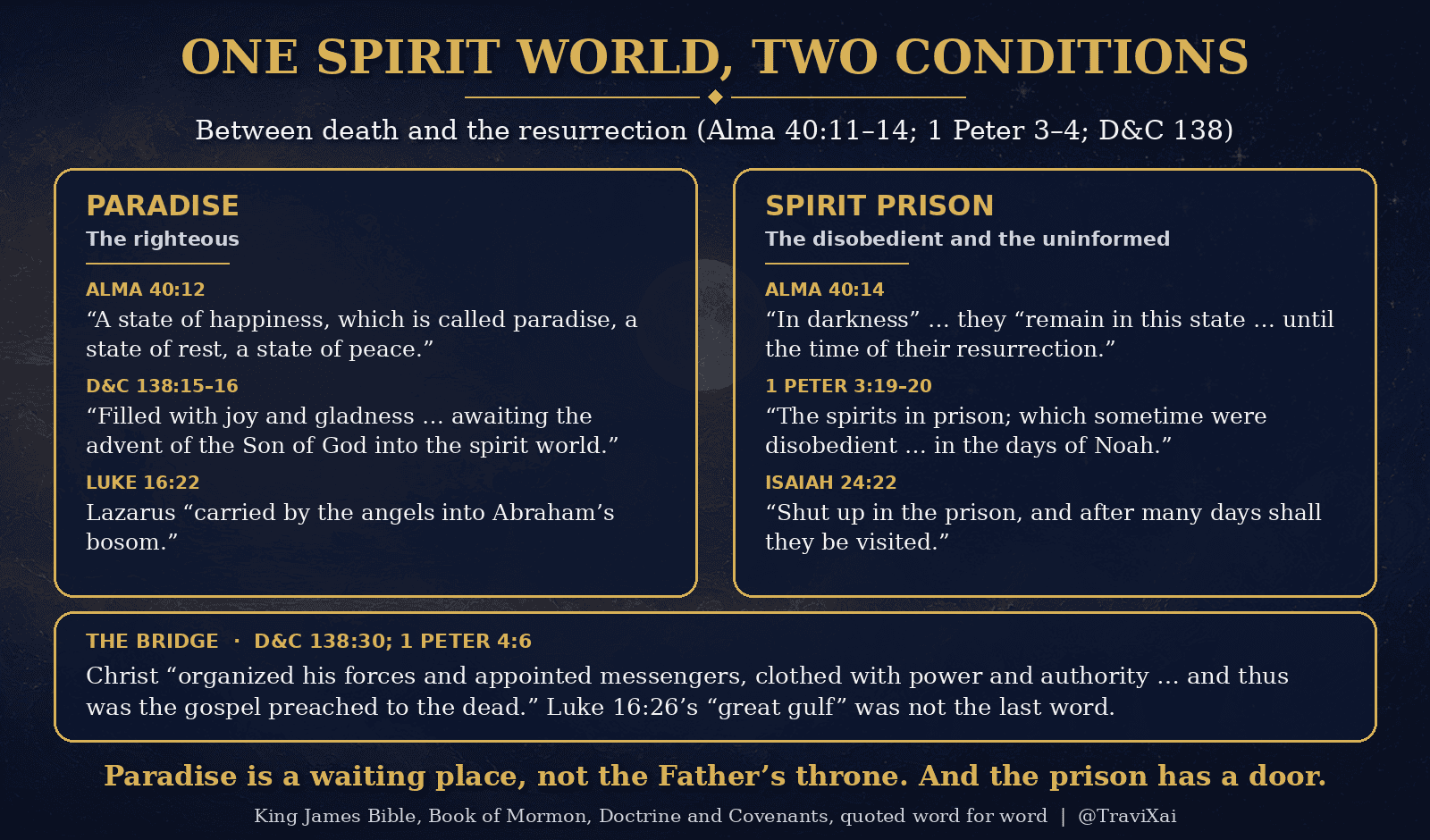
And then shall it come to pass, that the spirits of those who are righteous are received into a state of happiness, which is called paradise, a state of rest, a state of peace, where they shall rest from all their troubles and from all care, and sorrow.
Alma 40:12
The wicked go to a different state, “in darkness,” and “thus they remain in this state, as well as the righteous in paradise, until the time of their resurrection” (Alma 40:13–14). Paradise is real. It’s a place of rest. And it’s temporary, because everyone there is waiting for the resurrection. That fits Luke 23:43 and John 20:17 together with no strain at all.
Joseph Smith taught the same thing about the thief. As the Encyclopedia of Mormonism summarizes, he taught that the thief would be with Jesus “in the world of spirits,” and he said, “Hades, Sheol, paradise, spirits in prison, are all one: it is a world of spirits.”
D&C 138: what happened in those three days
On October 3, 1918, President Joseph F. Smith sat “pondering over the scriptures” (D&C 138:1). He opened his Bible to the third and fourth chapters of 1 Peter, the same verses above. Then he saw “the hosts of the dead, both small and great,” and the righteous “assembled awaiting the advent of the Son of God into the spirit world” (D&C 138:11, 16). The Savior came and “preached to them the everlasting gospel” (D&C 138:19).
He also saw why Peter’s words worked in such a short time. His ministry “was limited to the brief time intervening between the crucifixion and his resurrection” (D&C 138:27). So He organized the work:
But behold, from among the righteous, he organized his forces and appointed messengers, clothed with power and authority, and commissioned them to go forth and carry the light of the gospel to them that were in darkness, even to all the spirits of men; and thus was the gospel preached to the dead.
D&C 138:30
That’s the bridge. In Luke 16, Jesus describes “a great gulf fixed” between Abraham’s bosom and the place of torment (Luke 16:26). D&C 138 shows Christ opening the way across it, sending messengers to “proclaim liberty to the captives who were bound, even unto all who would repent of their sins and receive the gospel” (D&C 138:31), the same words Isaiah used.
For the full picture of what Latter-day Saints believe happens after death, see What Do Latter-day Saints Believe Happens After Death?.
The ordinancesSo what about baptism?
Now the question critics actually care about. Does the thief prove baptism doesn’t matter?
Look at what Peter writes two verses after “the spirits in prison”:
The like figure whereunto even baptism doth also now save us (not the putting away of the filth of the flesh, but the answer of a good conscience toward God,) by the resurrection of Jesus Christ:
1 Peter 3:21 (KJV)
The same passage critics use to argue about the dead says “baptism doth also now save us.” Jesus never retracted “Except a man be born of water and of the Spirit, he cannot enter into the kingdom of God” (John 3:5). And after the Resurrection He sent His apostles to “teach all nations, baptizing them” (Matthew 28:19).
So what happens to people who die without baptism? The thief. The people of Noah’s day. Billions who never heard the name of Jesus. God “will have all men to be saved, and to come unto the knowledge of the truth” (1 Timothy 2:4). How does that happen for someone who died in a ditch in 1200 B.C.? The Bible already told you. The gospel is “preached also to them that are dead” (1 Peter 4:6). And Paul points to the ordinance that goes with it: “Else what shall they do which are baptized for the dead, if the dead rise not at all?” (1 Corinthians 15:29).
D&C 138 says those spirits were taught “faith in God, repentance from sin, vicarious baptism for the remission of sins, the gift of the Holy Ghost by the laying on of hands” (D&C 138:33), and that “the dead who repent will be redeemed, through obedience to the ordinances of the house of God” (D&C 138:58). That’s why we build temples. I go deeper on Paul’s verse in Baptism for the Dead: 1 Corinthians 15:29, the Verse Critics Skip.
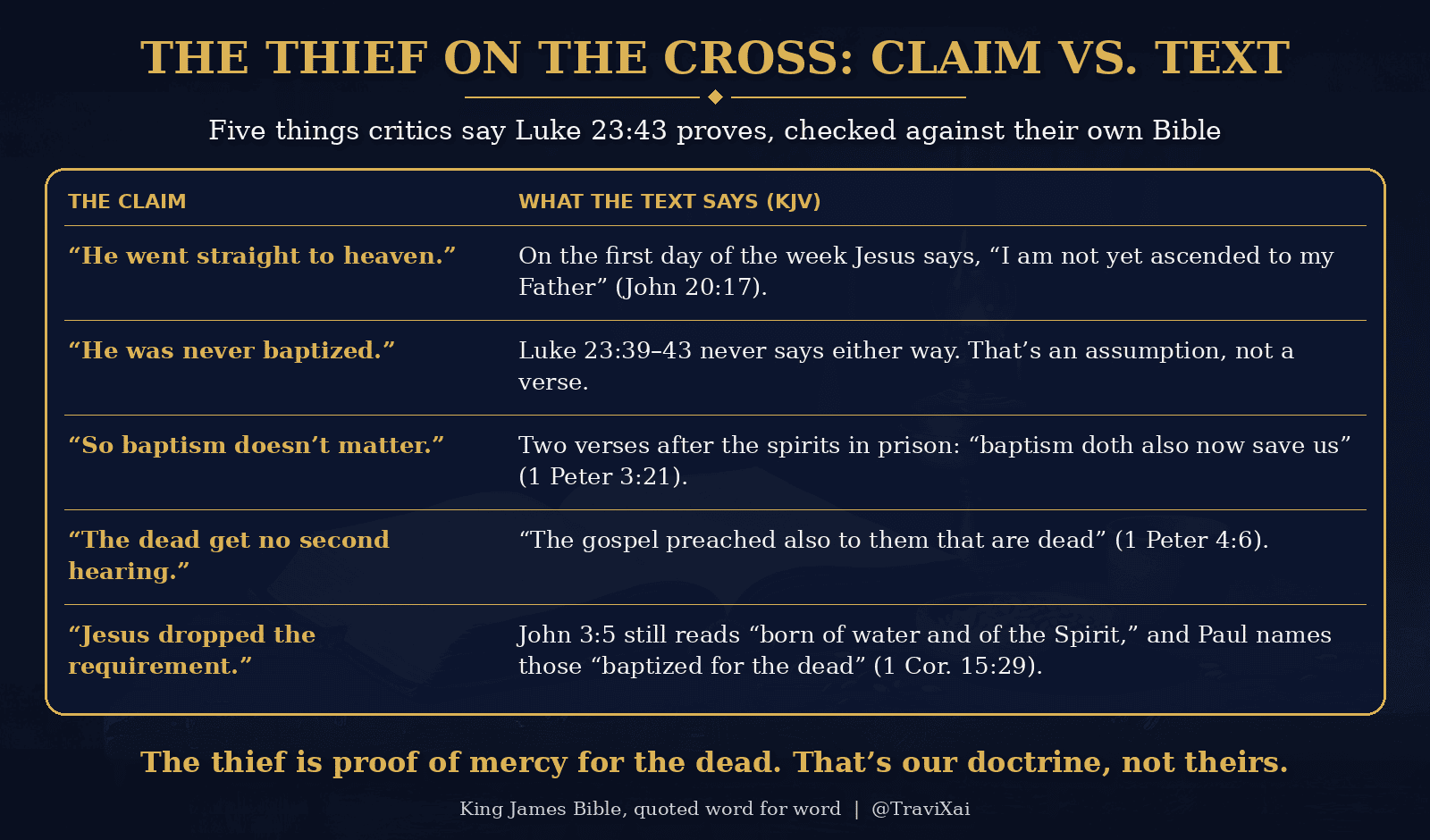
So here’s the score. The thief on the cross was never a loophole. He’s Exhibit A that God doesn’t abandon people who die before they can receive every ordinance. Critics use him to say ordinances don’t matter. The Bible uses him, plus 1 Peter 3 and 4, to show that God makes a way for the dead to hear the gospel and receive it. One of those fits John 20:17. The other has to ignore it. (More on the grace-and-works side of this argument in Works and Grace: 2 Nephi 25:23 Next to James 2.)
SummaryKey takeaways
- Luke 23:43 promises the thief paradise “to day.” It never says heaven, never says “with my Father,” and never says whether he was baptized.
- On the first day of the week Jesus said, “I am not yet ascended to my Father” (John 20:17). So paradise was not the Father’s presence.
- Between His death and resurrection, Christ “went and preached unto the spirits in prison” (1 Peter 3:19), and “the gospel” was “preached also to them that are dead” (1 Peter 4:6).
- Greek manuscripts had little or no punctuation, so the comma in Luke 23:43 is a translator’s choice. The argument here doesn’t need it moved.
- Alma 40:11–14 and D&C 138 describe one spirit world with paradise and prison, and Christ organizing the preaching to the dead. Baptism still matters, and the dead can receive it by proxy (1 Corinthians 15:29).
Paradise, prison, and the thief: quick answers
What did Jesus mean by paradise in Luke 23:43?
The place of rest in the spirit world where the righteous wait for the resurrection. Jesus wasn’t with the Father that day, because on the first day of the week He said, “I am not yet ascended to my Father” (John 20:17). Alma 40:12 calls paradise “a state of rest, a state of peace.”
Where did Jesus go between His death and resurrection?
To the spirits of the dead. Peter says He “went and preached unto the spirits in prison” (1 Peter 3:19), and that “the gospel” was “preached also to them that are dead” (1 Peter 4:6). D&C 138 describes that visit.
Does the thief on the cross prove baptism isn’t necessary?
No. Luke never says whether he was baptized, and Peter writes just after the spirits in prison that “baptism doth also now save us” (1 Peter 3:21). Those who die without baptism can hear the gospel in the spirit world and receive baptism by proxy (1 Corinthians 15:29; D&C 138:33).
Is the comma in Luke 23:43 in the original Greek?
No. The earliest manuscripts used little or no punctuation, so translators decide where it goes. Most scholars read “today you will be with me in paradise,” and the Latter-day Saint view works with that reading.
What is spirit prison?
The condition in the spirit world for those who died in darkness, disobedience, or without the gospel (Alma 40:13–14; 1 Peter 3:19–20). It isn’t permanent for those who repent: the gospel is preached there (D&C 138:30–32).
Where can I read more?
Next time someone says “But the thief on the cross!”, ask them one question: “Where was Jesus on Sunday morning?” For quick, sourced answers on the thief on the cross, baptism for the dead, the plan of salvation, and grace and works, open Galatians18. And for more like this every day, follow me on X at @TraviXai.
Sources
- Bible (KJV, churchofjesuschrist.org): Luke 23:39–43 · John 20:1, 17 · Acts 1:3, 9 · 2 Corinthians 12:2–4 · 1 Peter 3:18–21 · 1 Peter 4:6 · Matthew 12:40 · Ephesians 4:8–10 · Acts 2:27, 31 · Isaiah 61:1 · Luke 16:22–26 · John 3:5 · Matthew 28:19 · 1 Timothy 2:4 · 1 Corinthians 15:29 · Isaiah 24:22
- Book of Mormon: Alma 40:6–14, 21
- Doctrine and Covenants: D&C 138:1–37 · D&C 138:57–59 · section heading (vision of October 3, 1918)
- Catechism of the Catholic Church, paragraphs 632–637, “Christ Descended into Hell” (vatican.va)
- “The Significance of a Comma: An Analysis of Luke 23:43,” Ministry (June 2013), on P75, Codex Vaticanus, and the history of punctuation
- Bruce M. Metzger, A Textual Commentary on the Greek New Testament, on Luke 23:43 (Curetonian Syriac word order)
- Thomas Farrar, “Today in Paradise?: Ambiguous Adverb Attachment and the Meaning of Luke 23:43,” Neotestamentica 51, no. 2 (2017): 185–207
- Encyclopedia of Mormonism, “Paradise”, quoting Teachings of the Prophet Joseph Smith, pp. 309–310
- Galatians18: The Thief on the Cross · Baptism for the Dead · The Plan of Salvation · Grace and Works
- Featured image and charts: original graphics by thebookofmormon.ai on reused painted backgrounds (no photographs or likenesses of real people; Jesus is not depicted).