
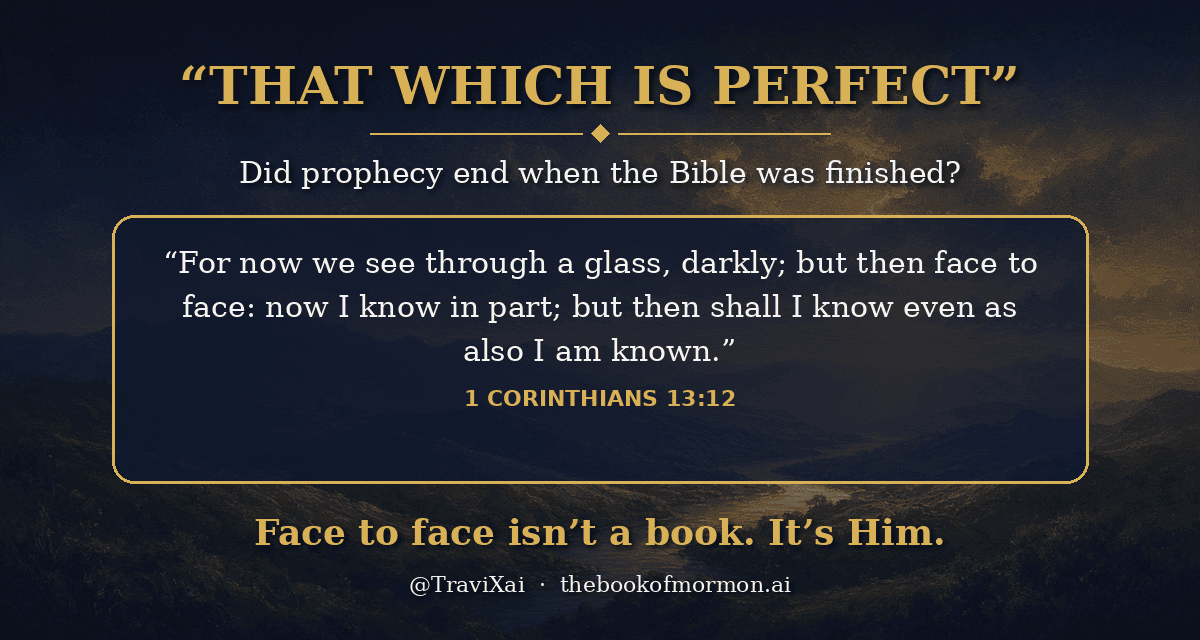

Critics say “that which is perfect” in 1 Corinthians 13:10 is the finished Bible, so prophecy ended with the canon. Read verse 12. Paul says when the perfect comes, we see “face to face.” No book has ever done that.
Home › Answering Critics › Start here: The Canon Was Never Meant to Close
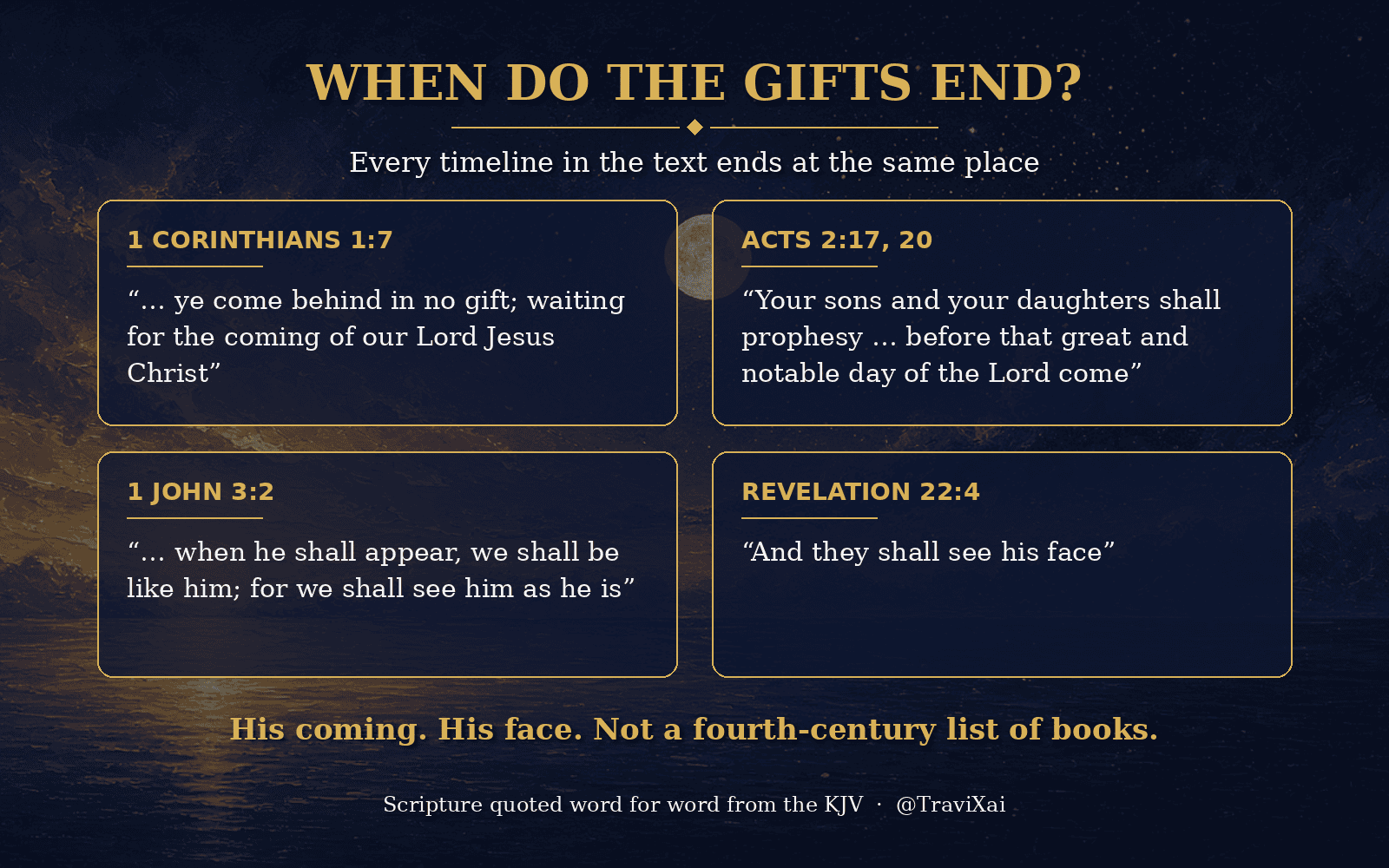
1 Corinthians 13:10 says what is “in part,” like prophecy, “shall be done away” “when that which is perfect is come.” Paul tells you what that looks like two verses later: “then face to face,” and “then shall I know even as also I am known.” That’s seeing God at His coming, not a finished Bible. Paul tells the same church they “come behind in no gift; waiting for the coming of our Lord Jesus Christ” (1 Corinthians 1:7). Every timeline ends at His coming. None of them ends at a list of books.
“Prophecy ended when the Bible was finished. 1 Corinthians 13:10. When that which is perfect is come. The perfect is the Bible. He said everything He needs to and wants to in the Bible.” Ok. Keep reading. Two more verses.
This is the verse people grab when you ask where the Bible says prophets stopped. It has the word “perfect” in it, so the perfect thing came and the prophets went home. Simple. Except Paul tells you exactly what the perfect thing is, and it isn’t a book.
The claim“The perfect is the Bible”
Here are the verses they lean on:
For we know in part, and we prophesy in part. But when that which is perfect is come, then that which is in part shall be done away.
1 Corinthians 13:9–10 (KJV)
The argument: “that which is perfect” is the complete Bible. Once the last book was written, prophecy and tongues were “done away,” so anybody claiming revelation now is a false prophet.
Now notice what the passage never says. Not “scripture.” Not “when the books are gathered.” Not “when the canon closes.” Paul wrote this to Corinth in the mid-50s AD. The first list we have that names exactly our 27 New Testament books is Athanasius’s 39th Festal Letter, in AD 367. So Paul supposedly told the Corinthians their gifts would stop at an event three centuries away that he never names. That’s not reading the verse. That’s reading the tradition into it.
Read verse 12“Then face to face”
This is the part they skip. Paul describes the moment the perfect arrives:
For now we see through a glass, darkly; but then face to face: now I know in part; but then shall I know even as also I am known.
1 Corinthians 13:12 (KJV)
“Then face to face.” Face to face with whom? In the Bible that phrase means seeing God. “And the Lord spake unto Moses face to face, as a man speaketh unto his friend” (Exodus 33:11). The Lord says He speaks with Moses “mouth to mouth, even apparently, and not in dark speeches” (Numbers 12:8). Scholars note that Paul’s “darkly” echoes those “dark speeches.” John says the same: “when he shall appear, we shall be like him; for we shall see him as he is” (1 John 3:2), and “they shall see his face” (Revelation 22:4).
So here’s the question. If the perfect came with the finished canon, then every Christian holding a Bible sees God face to face and knows Him “even as also I am known.” Has any pastor or theologian in 1,900 years seen God face to face because the book was done? Nobody claims that. So “then” hasn’t come yet.
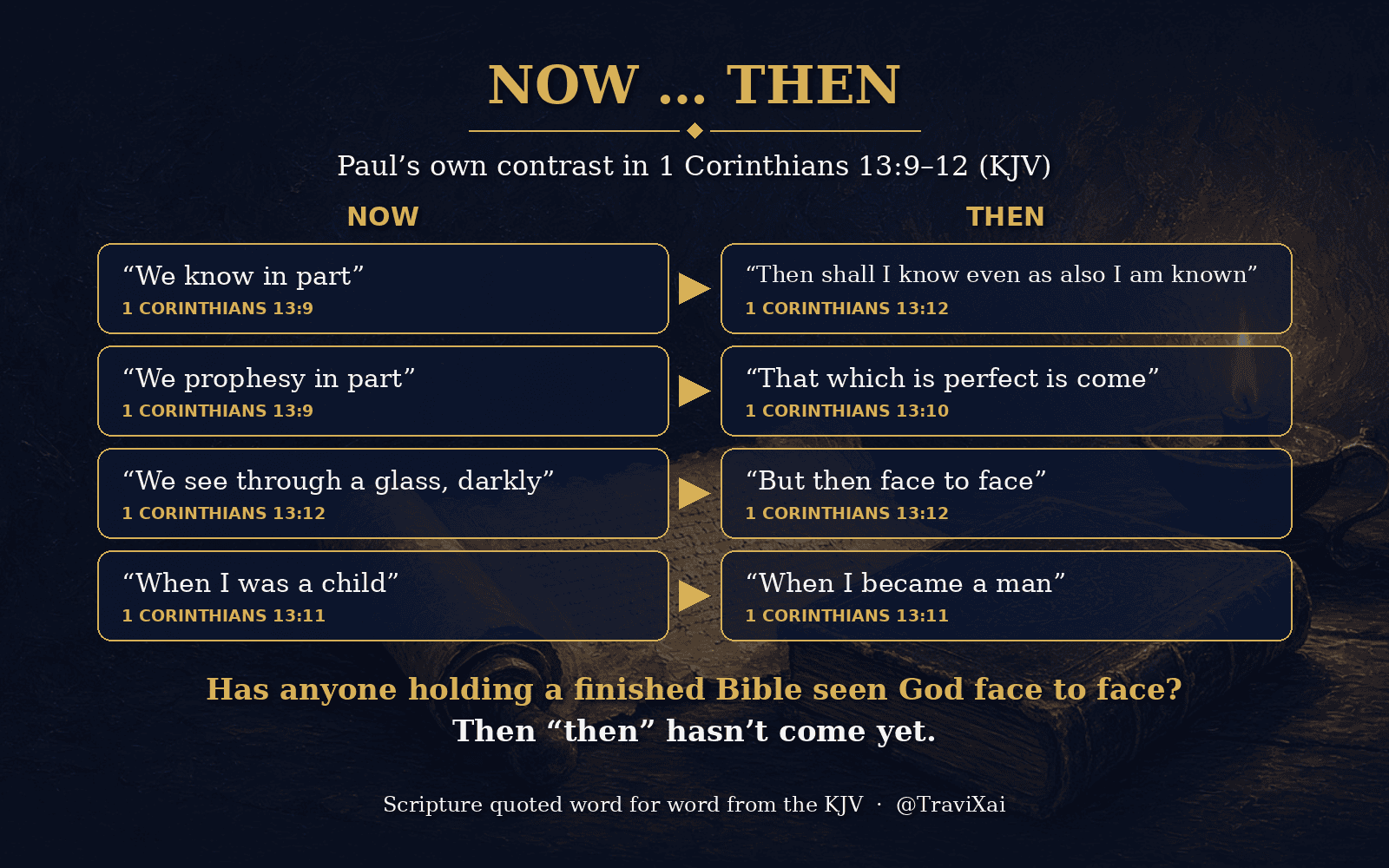
And look at the pronoun. “Then shall I know.” Paul puts himself in the sentence. He expects to be there when the perfect comes. Tradition says Paul died in the 60s AD. Revelation, the book they say finished the canon, is usually dated decades later. So on their reading, Paul never got the “then” he promised himself. On the plain reading, he gets it when every believer does: when we see Him.
“Then face to face.” A book can’t do that. Only He can. The perfect isn’t on your shelf. It’s coming in the clouds.
Their own scholarsCalvin and the cessationists who won’t use it
You don’t have to take my word for this. Take John Calvin’s. Calvin was no Latter-day Saint. Here is his comment on verse 10 in his Commentary on Corinthians:
But when will that perfection come? It begins, indeed, at death, for then we put off, along with the body, many infirmities; but it will not be completely manifested until the day of judgment, as we shall hear presently. Hence we infer, that the whole of this discussion is ignorantly applied to the time that is intermediate.
John Calvin, Commentary on 1 Corinthians 13:10 (Calvin Translation Society)
“Ignorantly applied to the time that is intermediate.” The perfect is the day of judgment, not a point in church history. And it gets better. On verse 12, Calvin says the “glass” Paul sees through is “the ministry of the word.” The knowledge we get from scripture is true, he says, but “comparatively obscure, because it comes far short of that clear manifestation to which we look forward.” So in Calvin’s reading, the Bible isn’t the perfect. The Bible is the glass. The perfect is His face.
Plenty of cessationists admit it. GotQuestions.org says it plainly: “It is our view that the ‘perfect’ thing to come is the glorification of believers in heaven, or, more properly, the eternal state.” John MacArthur, who hosted the 2013 Strange Fire conference, made the same call in his book Strange Fire: the believer entering the Lord’s presence best fits the perfect, because of verse 12. To argue the gifts stopped, he had to go to other verses.
The most famous cessationist of his generation said this verse doesn’t prove cessation, and his followers still throw it at us. It’s one more dispute Christianity™ never settles. I list it with the rest in my post on the “essentials” myth.
Gifts, not fruitsWhat actually ends, and what never does
Next, look at what Paul is contrasting. Chapter 13 sits right in the middle of a three-chapter section on the gifts of the Spirit. Chapter 12 lists them, with “prophecy” right alongside wisdom, knowledge, faith, and healing (1 Corinthians 12:8–10). Chapter 14 tells the church how to use them.
In the middle, Paul shows them “a more excellent way” (1 Corinthians 12:31): charity. Charity is a fruit of the Spirit, not a gift. “The fruit of the Spirit is love, joy, peace, longsuffering, gentleness, goodness, faith” (Galatians 5:22–23). That’s the contrast in verse 8. “Charity never faileth.” The gifts are tools for an imperfect time. Love is what we become, and it lasts forever.
So the chapter isn’t saying prophecy is temporary and the Bible is permanent. It’s saying every gift is temporary and love is permanent. That includes knowledge. Read verse 8 again: “whether there be knowledge, it shall vanish away.” Same list, same “in part” in verse 9. If prophecy ended with the canon, so did knowledge. Congratulations. Nobody has known anything since AD 95. Seminaries can close.
Nobody believes that, so they cut the verse in half. Prophecy ended, knowledge didn’t. Who decided which gifts to keep? Not Paul. In the very next chapter he says, “desire spiritual gifts, but rather that ye may prophesy” (1 Corinthians 14:1), and he ends it with “covet to prophesy, and forbid not to speak with tongues” (1 Corinthians 14:39). That’s a command. And to the Thessalonians: “Quench not the Spirit. Despise not prophesyings” (1 Thessalonians 5:19–20).
Same letterPaul already told Corinth when
Here’s what sinks the canon reading. Paul already told this church how long their gifts would last, in the opening lines of the same letter:
So that ye come behind in no gift; waiting for the coming of our Lord Jesus Christ: Who shall also confirm you unto the end, that ye may be blameless in the day of our Lord Jesus Christ.
1 Corinthians 1:7–8 (KJV)
“Come behind in no gift; waiting for the coming of our Lord Jesus Christ.” They have the gifts while they wait for His coming, and He confirms them “unto the end.” When the Corinthians got to chapter 13 and read “when that which is perfect is come,” they had already been told what they were waiting for. Not a book. Him.
Same author, same letter, same readers. Paul defined it twice: “the coming of our Lord” in 1:7, and “face to face” in 13:12.
Same timelinePeter and Joel: until the great day
Peter gives the same timeline on the day of Pentecost, quoting Joel:
And it shall come to pass in the last days, saith God, I will pour out of my Spirit upon all flesh: and your sons and your daughters shall prophesy, and your young men shall see visions, and your old men shall dream dreams:
Acts 2:17 (KJV)
How long does it run? Three verses later: “The sun shall be turned into darkness, and the moon into blood, before that great and notable day of the Lord come” (Acts 2:20). Has that happened? Has the Lord come? Then the window Peter opened is still open. You can’t close it at AD 95 when Peter said it runs until the great day.
Revelation, the book they say closed everything, says the same. It tells of two witnesses who “shall prophesy a thousand two hundred and threescore days,” and calls them “these two prophets” (Revelation 11:3, 10). Prophets still to come, in the book that supposedly ended prophets. It also calls itself “the words of this prophecy” (Revelation 1:3), which is why “this book” in 22:18 means that book (see Revelation 22:18 and “This Book”).
The Restoration“Done away”? The Book of Mormon saw this coming
Here’s the part I love. The Book of Mormon, published in 1830, names this exact argument. Moroni:
And again I speak unto you who deny the revelations of God, and say that they are done away, that there are no revelations, nor prophecies, nor gifts, nor healing, nor speaking with tongues, and the interpretation of tongues;
Mormon 9:7
“Say that they are done away.” The same phrase as 1 Corinthians 13:10, turned back on the people who misuse it. Moroni’s verdict: “he that denieth these things knoweth not the gospel of Christ; yea, he has not read the scriptures; if so, he does not understand them” (Mormon 9:8). His reason: “do we not read that God is the same yesterday, today, and forever, and in him there is no variableness neither shadow of changing?” (Mormon 9:9). It’s the Bible’s own promise (Hebrews 13:8; James 1:17).
Then Moroni closes the Book of Mormon with the same gifts as 1 Corinthians 12. And he says they “never will be done away, even as long as the world shall stand, only according to the unbelief of the children of men” (Moroni 10:19). Gifts don’t stop because God ran out of things to say. They stop when people stop believing. Joseph Smith put it in our seventh Article of Faith in 1842: “We believe in the gift of tongues, prophecy, revelation, visions, healing, interpretation of tongues, and so forth” (Articles of Faith 1:7).
We love the Bible. But the Bible isn’t God. It’s the record of God speaking to prophets, and He still does (James 1:5). For the full case against a closed canon, see Is the Bible All of God’s Words? and The Canon Was Never Meant to Close.
SummaryKey takeaways
- 1 Corinthians 13:10 never mentions scripture, books, or a canon. The first list naming exactly our 27 New Testament books came in AD 367.
- Paul defines the perfect in verse 12: “then face to face,” and “then shall I know even as also I am known.” No one with a finished Bible has that.
- John Calvin said the perfect “will not be completely manifested until the day of judgment,” and that the Word is the “glass,” not the perfect. Even leading cessationists like John MacArthur take the eternal-state view.
- The chapter contrasts temporary gifts with lasting charity, a fruit. If prophecy ended with the canon, so did “knowledge” (13:8).
- Paul told the same church they “come behind in no gift; waiting for the coming of our Lord Jesus Christ” (1:7). Peter said prophesying runs “before that great and notable day of the Lord” (Acts 2:20).
- The Book of Mormon answered the “done away” claim directly (Mormon 9:7–9; Moroni 10:19). God is the same yesterday, today, and forever.
“That which is perfect”: quick answers
What is “that which is perfect” in 1 Corinthians 13:10?
Paul describes it in verse 12: “then face to face” and “then shall I know even as also I am known.” That is seeing and knowing God fully, at Christ’s coming. Calvin said it “will not be completely manifested until the day of judgment.”
Does 1 Corinthians 13:10 say prophecy ended with the Bible?
No. The passage never mentions scripture or a canon. Paul tied the gifts to “waiting for the coming of our Lord Jesus Christ” (1 Corinthians 1:7), and Peter said prophesying continues “before that great and notable day of the Lord come” (Acts 2:20).
Isn’t “perfect” neuter in Greek, so it can’t mean Jesus?
Right, it names a complete state, not a person. But that state is the one verse 12 describes, “face to face,” which comes when He comes. The grammar can’t put a book into a verse that never mentions one.
If prophecy ceased, did knowledge cease too?
By the same logic, yes. Verse 8 lists prophecies, tongues, and knowledge together, and verse 9 says “we know in part, and we prophesy in part.” Nobody claims knowledge ended in AD 95, so the canon reading has to split the verse.
What does the Book of Mormon say about gifts being “done away”?
Mormon 9:7–8 answers those who “say that they are done away,” and Moroni 10:19 says the gifts “never will be done away, even as long as the world shall stand, only according to the unbelief of the children of men.”
Where can I read more?
Next time someone hands you 1 Corinthians 13:10, don’t argue. Just ask them to read verse 12 out loud, then ask: “Have you seen God face to face?” For quick, sourced answers on continuing revelation and an open canon, “no more prophets after Jesus”, living prophets, and the Great Apostasy, open Galatians18. And for more like this every day, follow me on X at @TraviXai.
Sources
- Bible (KJV, churchofjesuschrist.org): Exodus 33:11 · Numbers 12:6–8 · Joel 2:28–31 · Acts 2:16–20 · 1 Corinthians 1:7–8 · 1 Corinthians 12:8–10, 28, 31 · 1 Corinthians 13:8–13 · 1 Corinthians 14:1, 39 · Galatians 5:22–23 · 1 Thessalonians 5:19–20 · Hebrews 13:8 · James 1:5 · 1 John 3:2 · Revelation 1:3 · Revelation 11:3, 10 · Revelation 22:4
- Book of Mormon: Mormon 9:7–9 · Moroni 10:8–19
- Pearl of Great Price: Articles of Faith 1:7
- John Calvin, Commentary on Corinthians, Volume 1, 1 Corinthians 13:8–12 (Calvin Translation Society; Christian Classics Ethereal Library)
- GotQuestions.org, “What is the meaning of ‘perfect’ in 1 Corinthians 13:10?”
- John MacArthur, Strange Fire: The Danger of Offending the Holy Spirit with Counterfeit Worship (Thomas Nelson, 2013), on 1 Corinthians 13:10 (paraphrased, not quoted)
- Athanasius, Festal Letter 39 (AD 367), New Advent
- Galatians18: Continuing Revelation and an Open Canon · Hebrews 1: No More Prophets After Jesus? · Living Prophets · The Great Apostasy
- Featured image and charts: original graphics by thebookofmormon.ai on reused painted backgrounds (no photographs or likenesses of real people; Jesus is not depicted).