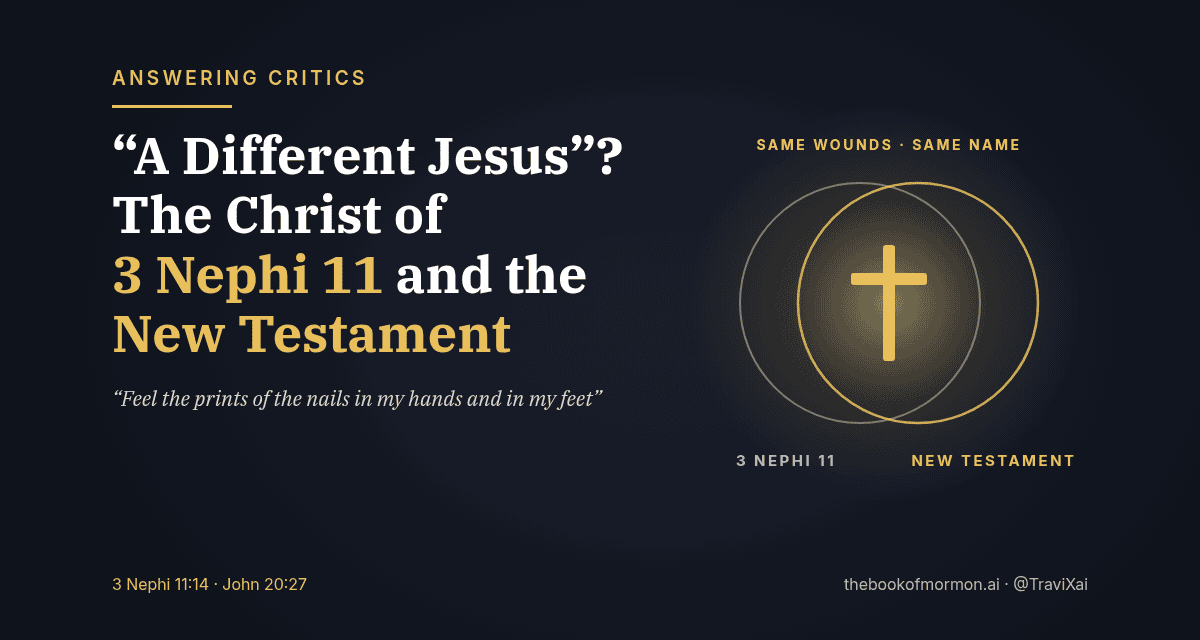

Critics say Latter-day Saints worship “another Jesus.” Put the Christ of 3 Nephi 11 next to the Christ of the New Testament, line by line, and see whose test the slogan fails.
Latter-day Saints worship a different Jesus. Different, I say! Ours was born of Mary in Bethlehem, grew up in Nazareth, was crucified under Pontius Pilate, and rose the third day. Theirs was born of Mary in Bethlehem, grew up in Nazareth, was crucified under Pontius Pilate, and rose the third day. You can see the problem.
The charge usually comes with a proof text: “if he that cometh preacheth another Jesus, whom we have not preached” (2 Corinthians 11:4). The idea is that the Book of Mormon smuggled in a counterfeit Christ with the same name. So let’s do what the verse asks: measure Him against the Jesus the apostles preached, line by line.
(For “another gospel” in Galatians 1:8, see Galatians 1:8 in Context. This post is about the person.)
What Paul actually said in 2 Corinthians 11:4
For if he that cometh preacheth another Jesus, whom we have not preached, or if ye receive another spirit, which ye have not received, or another gospel, which ye have not accepted, ye might well bear with him.
2 Corinthians 11:4 (KJV)
Paul was writing about visitors in Corinth in his own day: men he calls “false apostles, deceitful workers, transforming themselves into the apostles of Christ” (2 Corinthians 11:13). He doesn’t list everything they taught, but he gives the yardstick: “whom we have preached.”
And Paul summarized what he preached: “that Christ died for our sins according to the scriptures; And that he was buried, and that he rose again the third day according to the scriptures” (1 Corinthians 15:3–4). John gave a test that’s just as simple: “Every spirit that confesseth that Jesus Christ is come in the flesh is of God” (1 John 4:2).
Hold on to that standard. It’s the critic’s own verse, and the test isn’t “whom a council later defined.”
Put the two portraits side by side
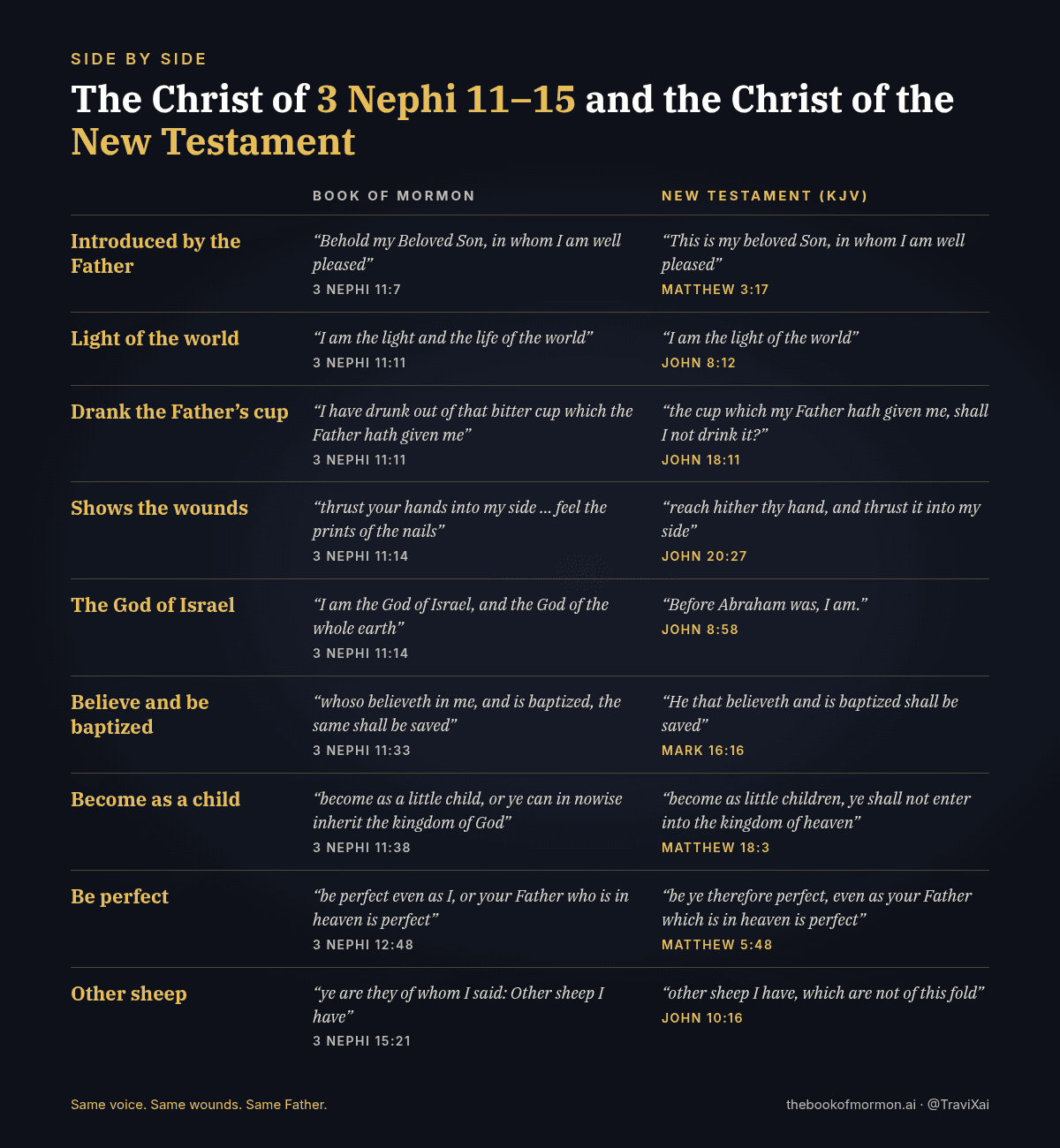
In 3 Nephi 11, a voice from heaven speaks to a crowd gathered at the temple in Bountiful: “Behold my Beloved Son, in whom I am well pleased, in whom I have glorified my name—hear ye him” (3 Nephi 11:7). If that sounds familiar, it should. It is the Father’s introduction at the Jordan: “This is my beloved Son, in whom I am well pleased” (Matthew 3:17).
Then a Man in a white robe descends and tells them who He is:
Behold, I am Jesus Christ, whom the prophets testified shall come into the world. And behold, I am the light and the life of the world; and I have drunk out of that bitter cup which the Father hath given me, and have glorified the Father in taking upon me the sins of the world, in the which I have suffered the will of the Father in all things from the beginning.
3 Nephi 11:10–11
Every phrase has a New Testament twin. “I am the light of the world” (John 8:12). “The cup which my Father hath given me, shall I not drink it?” (John 18:11). He took away “the sin of the world” (John 1:29). A counterfeit would have to work awfully hard to sound this much like the original.
The wounds are the ID
If you want to know whether this is the same Jesus, look at His hands. In the New Testament, the risen Lord proves who He is with His wounds:
Behold my hands and my feet, that it is I myself: handle me, and see; for a spirit hath not flesh and bones, as ye see me have.
Luke 24:39 (KJV)
To Thomas He says, “reach hither thy hand, and thrust it into my side: and be not faithless, but believing” (John 20:27). In 3 Nephi He does the same thing, only for a whole multitude:
Arise and come forth unto me, that ye may thrust your hands into my side, and also that ye may feel the prints of the nails in my hands and in my feet, that ye may know that I am the God of Israel, and the God of the whole earth, and have been slain for the sins of the world.
3 Nephi 11:14
They went “one by one until they had all gone forth,” and “did see with their eyes and did feel with their hands” (3 Nephi 11:15). That crowd numbered “about two thousand and five hundred souls” (3 Nephi 17:25). Thomas got one invitation; the Nephites lined up for theirs. Then they “did fall down at the feet of Jesus, and did worship him” (3 Nephi 11:17), the same response Thomas gave: “My Lord and my God” (John 20:28).
Notice what He calls Himself while they touch the wounds: “the God of Israel.” Same claim He made in Jerusalem: “Before Abraham was, I am” (John 8:58), and Paul’s “that Rock was Christ” (1 Corinthians 10:4). Earlier, His voice tells the Nephites, “I created the heavens and the earth” (3 Nephi 9:15), just as John says “All things were made by him” (John 1:3). More on this in Jehovah Is Jesus Christ.
So run John’s test. Does the Book of Mormon confess that Jesus Christ is come in the flesh? It has about 2,500 people touch it.
Same doctrine, same sermon
Next He teaches what He calls “my doctrine”: “the Father commandeth all men, everywhere, to repent and believe in me. And whoso believeth in me, and is baptized, the same shall be saved” (3 Nephi 11:32–33). Mark has it as “He that believeth and is baptized shall be saved” (Mark 16:16). He adds that whoever builds on this doctrine builds on His rock, and “the gates of hell shall not prevail against them” (3 Nephi 11:39; compare Matthew 16:18).
In chapters 12–14 He gives the Sermon on the Mount again. The small differences all point the same direction: toward Him. “Blessed are the poor in spirit who come unto me” (3 Nephi 12:3). And where Matthew has “Be ye therefore perfect, even as your Father which is in heaven is perfect” (Matthew 5:48), the risen Christ says, “be perfect even as I, or your Father who is in heaven is perfect” (3 Nephi 12:48). Before the Resurrection He pointed to the Father. After it, He includes Himself. Same Jesus, after Easter.
He even tells them who they are in His own New Testament words: “ye are they of whom I said: Other sheep I have which are not of this fold” (3 Nephi 15:21; compare John 10:16). For the charge that we don’t believe He is God, see Do Latter-day Saints Deny That Jesus Is God?
A different definition isn’t a different person
When the side-by-side doesn’t help, the argument shifts: “Same name, same wounds, sure. But you don’t define Him the way the creeds do.”
True. The Council of Chalcedon in 451 defined Christ as “one and the same Christ, Son, Lord, Only-begotten, to be acknowledged in two natures,” and “consubstantial with the Father according to the Godhead” (Chalcedonian Definition, Schaff). Latter-day Saints don’t accept that metaphysical vocabulary. (We covered where homoousios came from in Nicaea 325, and how the Bible uses “one” in “One” in the Bible and Same Divine Nature Isn’t Consubstantial.)
But a different definition is not a different person. The Coptic, Armenian, Ethiopian, and Syriac Orthodox churches have never accepted Chalcedon’s formula; they’re literally classified as “non-Chalcedonian” (Oriental Orthodox Churches). The Catholic Church teaches that Mary remained “Ever-virgin” (Catechism 499), while many Protestants read “his brethren” (Matthew 13:55) as younger half-brothers. Real disagreements about Jesus. Does anyone say a Copt, a Catholic, and a Baptist follow three different men from Nazareth?
Two biographers can disagree about a man and still be writing about the same man. When “different” means “described differently” in one sentence and “a different person” in the next, that’s equivocation. When the disagreements of Catholics, Protestants, and Copts get a pass but ours doesn’t, that’s special pleading.
And notice the yardstick quietly changed. Paul’s test was “whom we have preached.” Paul never preached a council held centuries after he died. When we pass the apostles’ test and a new one appears from 325 or 451, that’s moving the goalposts. We walked through which councils get to add requirements in Councils and Who Counts as Christian, and Galatians18 has the short version: Must You Affirm the Creeds to Be Christian?
Where the real disagreement is
To be fair, there is a real disagreement here. Latter-day Saints believe the Father and the Son are two distinct, glorified beings, one in purpose and glory. We read Stephen’s vision literally: “the Son of man standing on the right hand of God” (Acts 7:56). Hebrews calls the Son “the express image of his person,” who “sat down on the right hand of the Majesty on high” (Hebrews 1:3).
That’s a fair debate about the Godhead (we answered its “polytheist” version in “You’re Polytheists”). But a disagreement about how the Father and Son are one is a family argument about the same Lord, not evidence of a second Jesus. Turning it into “another Jesus” assumes the creed is the yardstick, which is the point in dispute. That’s begging the question.
The Church’s own answer is plain: Latter-day Saints “worship God the Eternal Father in the name of Jesus Christ” (Gospel Topics Essays). Short version on Galatians18: A Different Jesus? (2 Corinthians 11:4).
A field guide to the fallacies
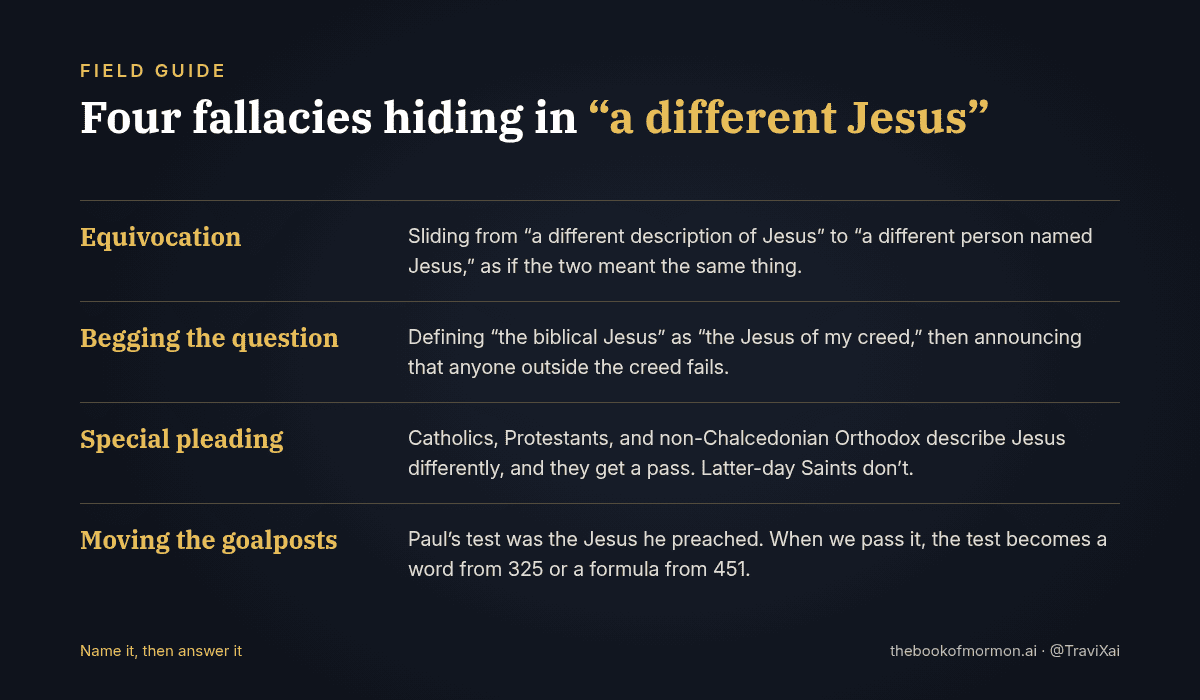
Name it, then answer it:
- Equivocation: “different” slides from “described differently” to “a different person.”
- Begging the question: “the biblical Jesus” is defined as “the Jesus of my creed,” so anyone outside the creed fails by definition.
- Special pleading: Catholics, Protestants, and non-Chalcedonian Orthodox disagree about Jesus and get a pass. Latter-day Saints don’t.
- Moving the goalposts: Paul’s test was the Jesus he preached. When we pass it, the test becomes a word from 325 or a formula from 451.
Then ask the critic to name a single verse in 3 Nephi 11–15 that teaches a Jesus Paul didn’t preach. (And if the reply is a pile of verses with the context cut off, see “You Twist the Bible”: Who’s Really Cherry-Picking?)
Key takeaways
- Paul’s test in 2 Corinthians 11:4 is “whom we have preached”: Christ who died, was buried, and rose the third day (1 Corinthians 15:3–4).
- In 3 Nephi 11 the Father introduces His Beloved Son, and Jesus speaks of Himself just as He does in the Gospels.
- He proves who He is the way He did with Thomas: by His wounds. About 2,500 people felt them (3 Nephi 11:15; 17:25).
- His doctrine and His sermon in 3 Nephi 11–14 match Matthew and Mark, and the differences point to Him.
- Disagreeing with Chalcedon’s definition isn’t worshiping a different person. Copts, Catholics, and Protestants disagree about Jesus too.
Next time someone says you worship a different Jesus, open 3 Nephi 11 and John 20 side by side, read them out loud, and ask which wounds belong to the wrong Christ. For quick, sourced answers on Christ and the creeds, open Galatians18. And for daily answers to common attacks, follow me on X at @TraviXai.
Sources
- Scripture quotations: King James Version and the Book of Mormon, churchofjesuschrist.org: Matthew 3:17; 5:48; 13:55; 16:18; 18:3; Mark 16:16; Luke 24:39; John 1:3, 29; 8:12, 58; 10:16; 18:11; 20:27–28; Acts 7:56; 1 Corinthians 10:4; 15:3–4; 2 Corinthians 11:4, 13; Hebrews 1:3; 1 John 4:2; 3 Nephi 9:15; 11:7–39; 12:3, 48; 15:21; 17:25.
- Chalcedonian Definition (451), in Philip Schaff, The Creeds of Christendom, vol. 2, CCEL.
- Catechism of the Catholic Church, para. 499, vatican.va.
- “Oriental Orthodox Churches,” Wikipedia.
- “Are ‘Mormons’ Christian?” Gospel Topics Essays, churchofjesuschrist.org.
- Galatians18 topic pages: A Different Jesus? (2 Corinthians 11:4), Jehovah Is Jesus Christ, Do Latter-day Saints Deny That Jesus Is God?, Must You Affirm the Creeds to Be Christian?
- Related on this blog: Galatians 1:8 in Context, Nicaea 325, Councils and Who Counts as Christian, Same Divine Nature Isn’t Consubstantial, “One” in the Bible, “You’re Polytheists”, “You Twist the Bible”.
- Featured image and cards: original graphics by thebookofmormon.ai (no photographs or likenesses of real people).