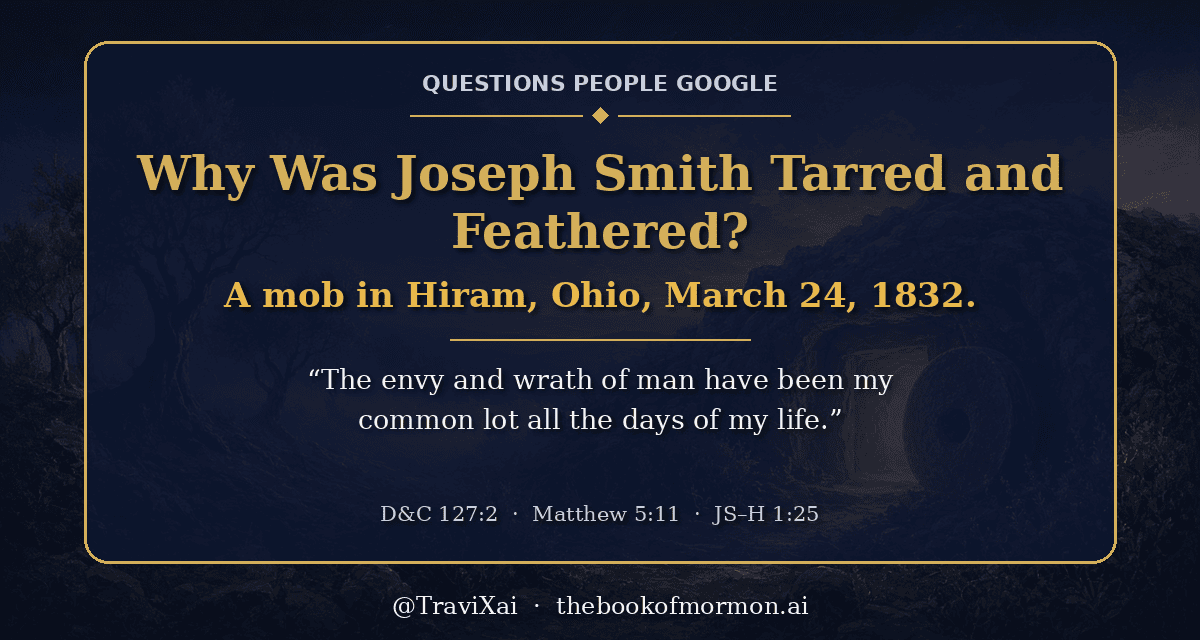

A mob dragged Joseph Smith from his bed in 1832. Here is what happened, what the sources say about why, and what he did the next morning.
The question often assumes the mob had a reason that would justify it, usually a scandal. The 1832 sources say otherwise. On the night of March 24, 1832, a mob broke into the John Johnson farmhouse in Hiram, Ohio, choked Joseph Smith, stripped him and tarred and feathered him; Sidney Rigdon was beaten too. The sources point to a former member’s published attacks, fear that the law of consecration would take local property, and religious hostility. No charge was ever brought. Joseph preached the next morning. As he later wrote, “the envy and wrath of man have been my common lot all the days of my life” (D&C 127:2).
What happenedHiram, Ohio, March 24, 1832
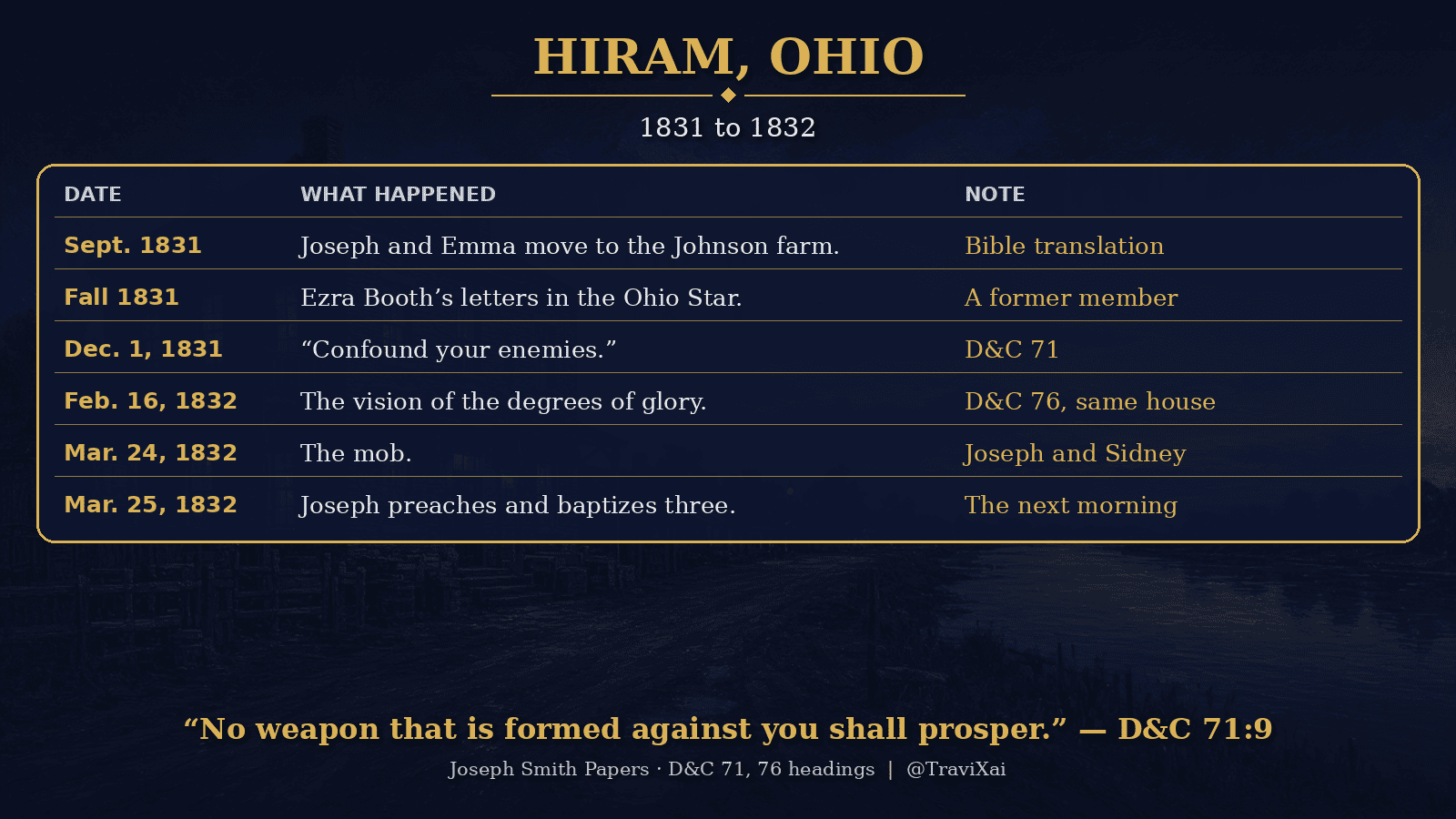
In September 1831 Joseph and Emma Smith moved into the farmhouse of John and Elsa Johnson in Hiram, Ohio, about thirty miles southeast of Kirtland. Joseph worked there on his inspired revision of the Bible, and in that house on February 16, 1832, he and Sidney Rigdon received the vision of the degrees of glory, D&C 76. Joseph and Emma were also caring for adopted eleven-month-old twins, Joseph and Julia, who had measles.
Late on the night of Saturday, March 24, 1832, a mob broke into the house while Joseph slept on a trundle bed beside his sick son. They dragged him outside, choked him until he blacked out, stripped him, scratched him, covered him with tar and feathers, and tried to force a vial of liquid into his mouth, chipping a tooth. Luke Johnson later recalled that the mob had brought a doctor to castrate him, who backed out. Sidney Rigdon, living nearby, was dragged from his house by his heels with his head bumping on the frozen ground and was delirious for days.
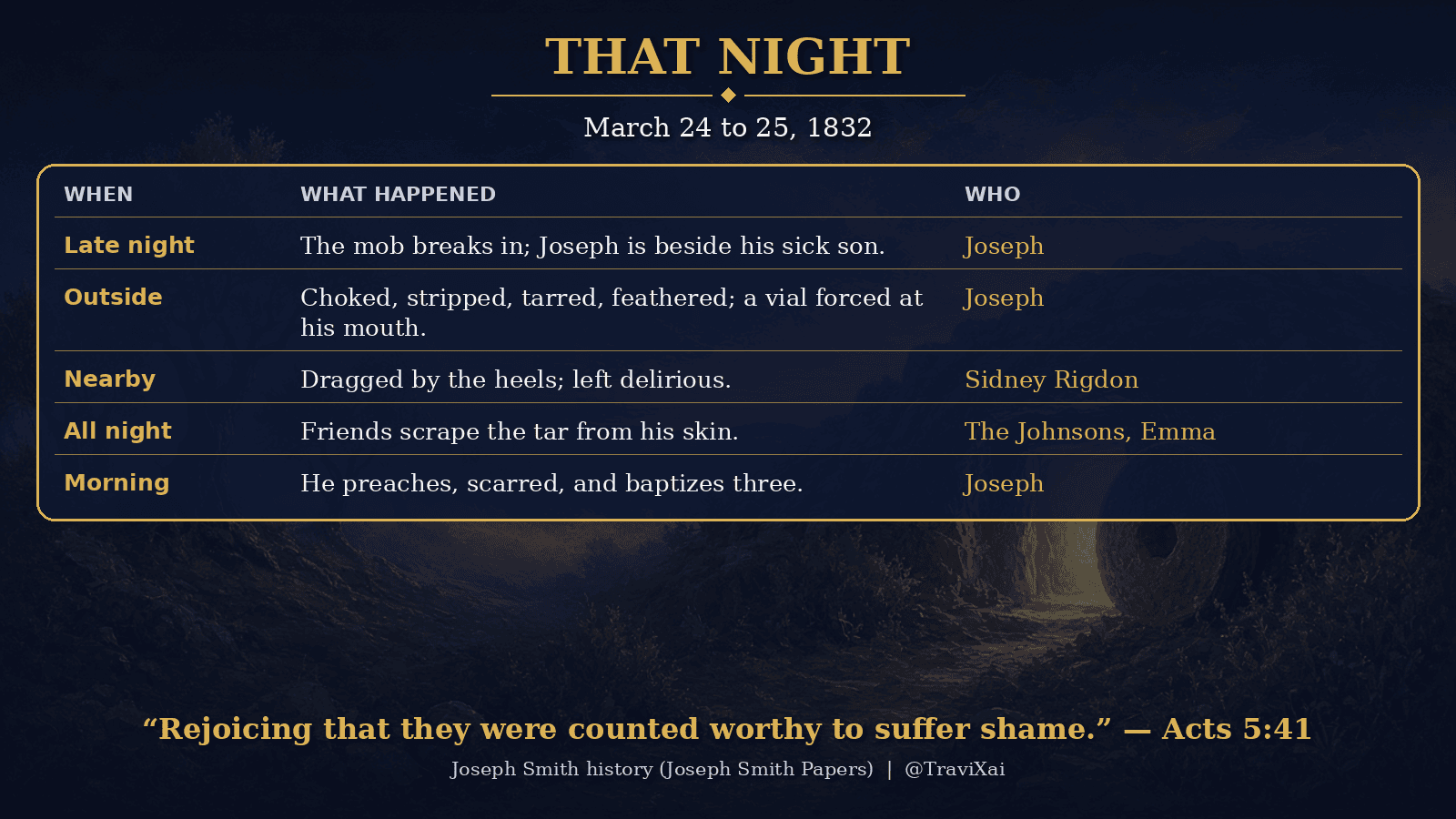
When Joseph staggered back, Emma at first thought the tar was blood and fainted. Friends spent the night scraping the tar from his skin. The next morning was Sunday. Joseph preached to a congregation that included members of the mob, and baptized three people that afternoon. The infant Joseph, exposed to the cold during the attack, died a few days later. See The Three Degrees of Glory for the vision received in that same house.
Why the mob cameWhat the sources say
No court ever charged Joseph with anything over Hiram. The sources point to three motives, and they overlap.
- Ezra Booth’s letters. Booth, a Methodist minister who joined the Church in 1831 and left that fall, published a series of letters in the Ohio Star attacking Joseph. The Lord’s response, in December 1831, was to send Joseph and Sidney out preaching: “confound your enemies … let them bring forth their strong reasons against the Lord” (D&C 71:7–10).
- Fear about property. Symonds Ryder, a former convert usually named as a leader of the mob, wrote in 1868 that local men believed they had found “a plot … to take their property from them” under the law of consecration. See What Is the Law of Consecration?.
- Religious hostility. A young prophet with new scripture, gaining converts in their own town, was enough for many neighbors.
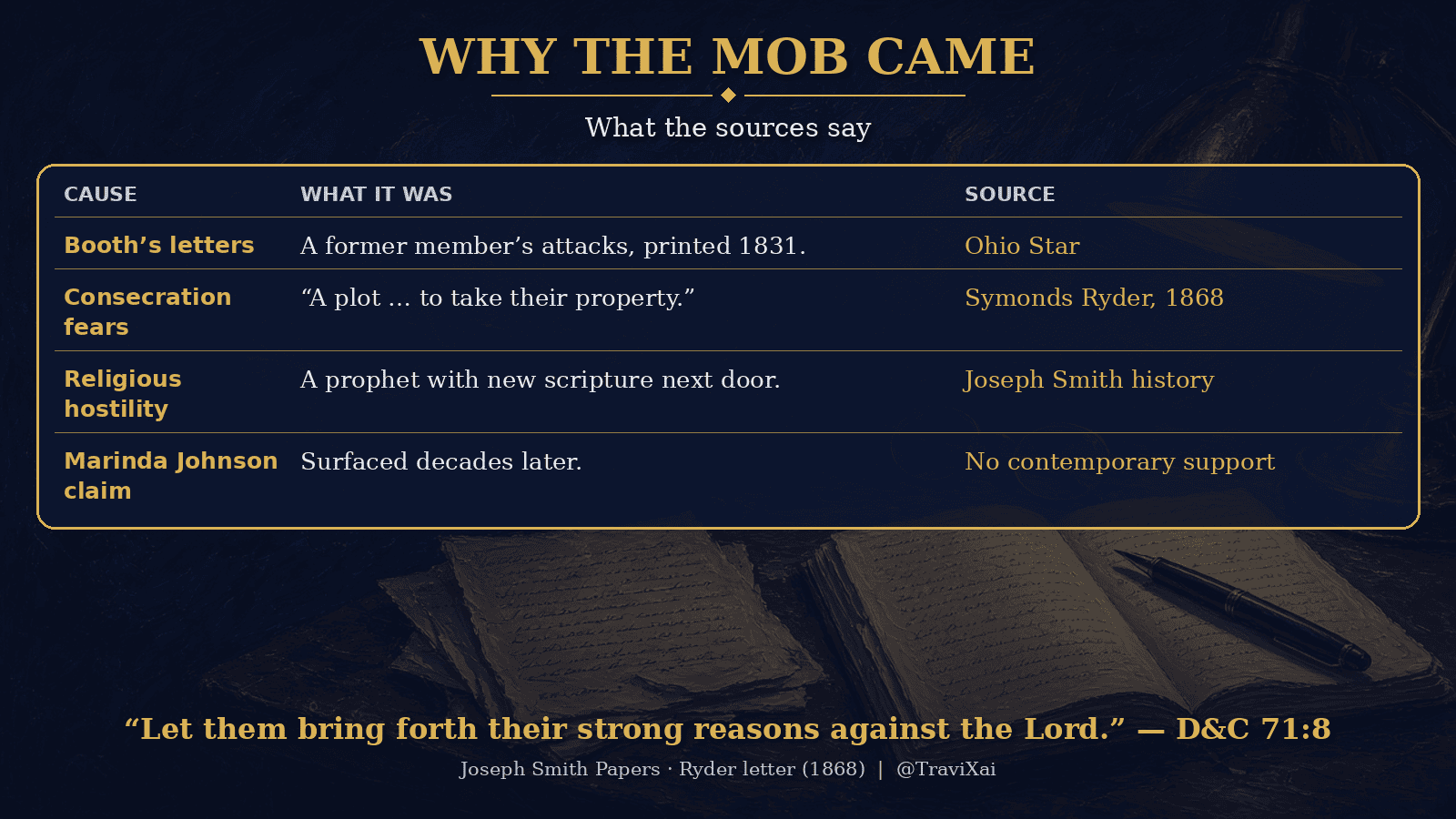
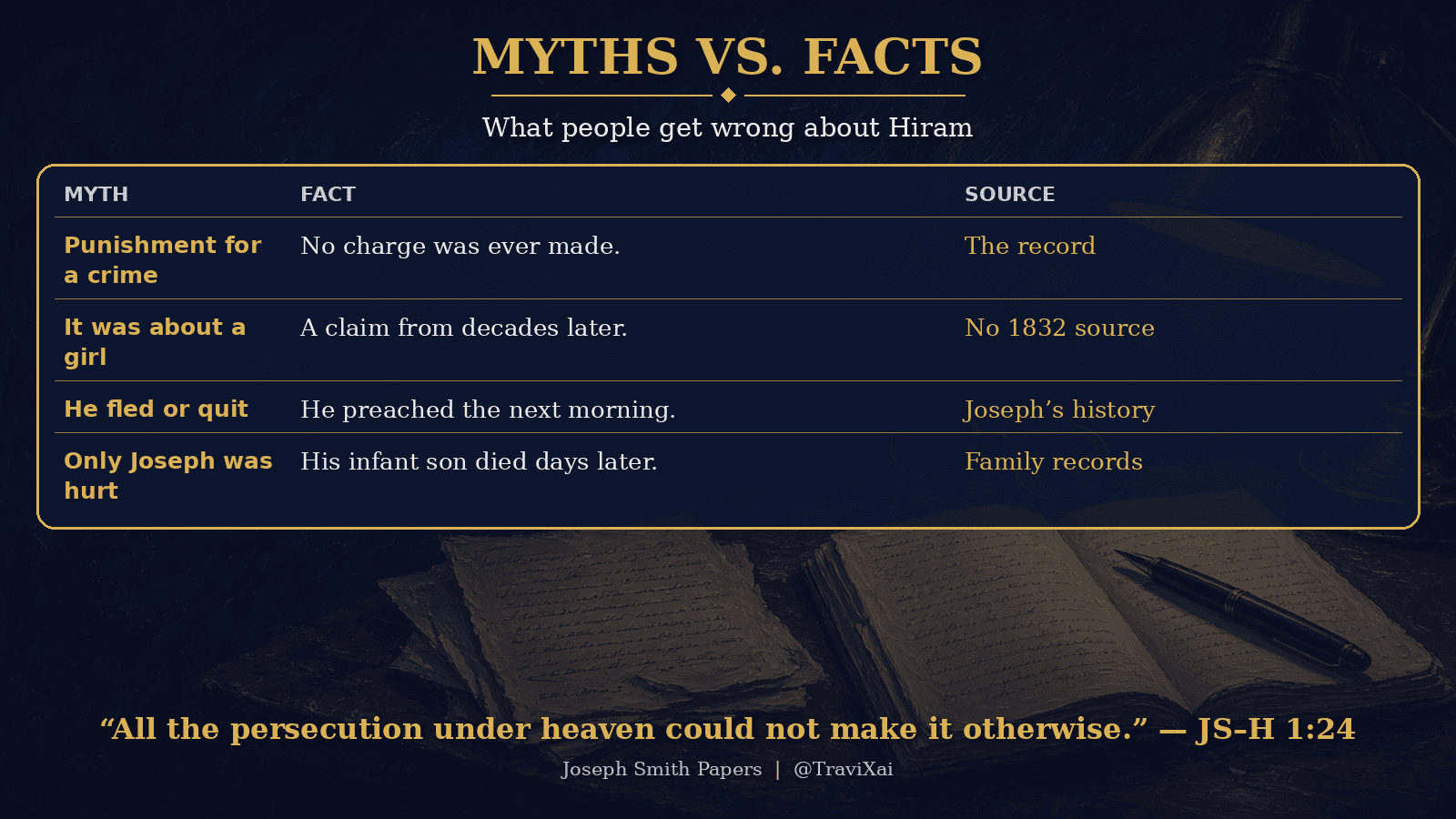
A fourth claim shows up online: that the mob was avenging Joseph’s conduct toward the Johnsons’ daughter Marinda. That story first appeared in print about fifty years later, in a hostile 1884 debate. No source from 1832 supports it. Two of Marinda’s brothers, Luke and Lyman Johnson, became original apostles in 1835, which is hard to square with brothers who had just tried to castrate him.
The BibleSo persecuted they the prophets
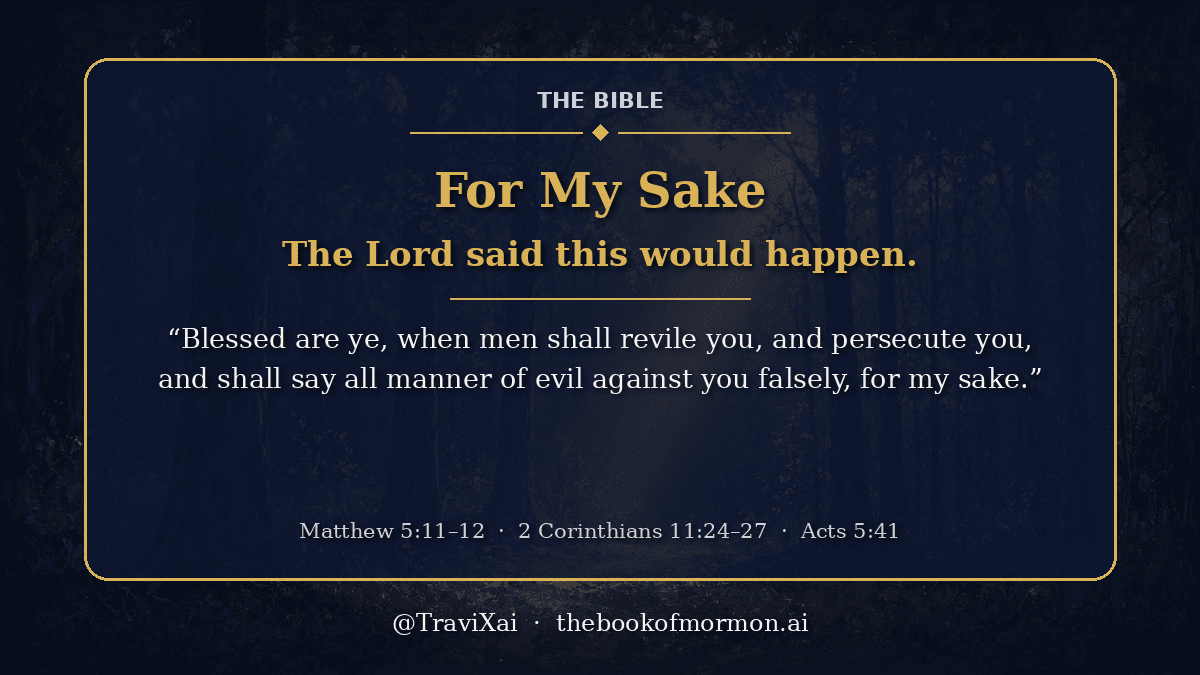
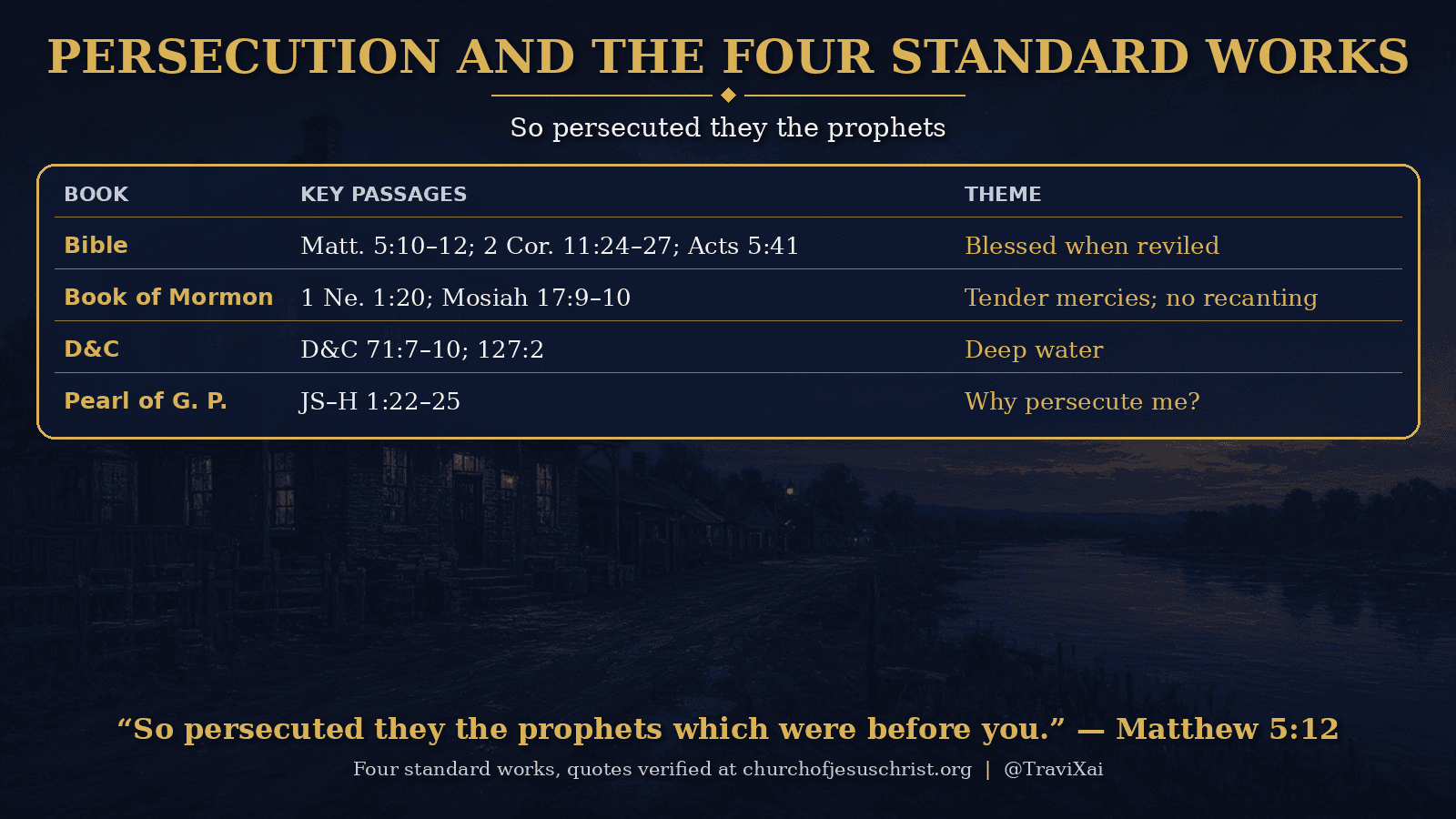
Christ told His disciples to expect exactly this: “Blessed are ye, when men shall revile you, and persecute you, and shall say all manner of evil against you falsely, for my sake. Rejoice, and be exceeding glad … for so persecuted they the prophets which were before you” (Matthew 5:10–12). Paul’s list reads like Joseph’s: “Thrice was I beaten with rods, once was I stoned … in perils by mine own countrymen … in perils among false brethren; … in cold and nakedness” (2 Corinthians 11:24–27). The apostles left their beating “rejoicing that they were counted worthy to suffer shame for his name” (Acts 5:41). Joseph preaching the next morning fits that pattern.
The Book of MormonLehi and Abinadi

The Book of Mormon opens with a prophet run out of town. When Lehi preached in Jerusalem, “they were angry with him; yea, even as with the prophets of old, whom they had cast out, and stoned, and slain … But behold, I, Nephi, will show unto you that the tender mercies of the Lord are over all those whom he hath chosen” (1 Nephi 1:20). Abinadi, threatened with death unless he took back his words, said: “I will not recall the words which I have spoken unto you concerning this people, for they are true … I will suffer even until death” (Mosiah 17:9–10). Joseph never recanted either, not in Hiram, not in Liberty, not in Carthage.
The Doctrine and CovenantsDeep water

Ten years after Hiram, hiding from arrest in Nauvoo, Joseph wrote: “the envy and wrath of man have been my common lot all the days of my life … deep water is what I am wont to swim in. It all has become a second nature to me; and I feel, like Paul, to glory in tribulation; for to this day has the God of my fathers delivered me out of them all” (D&C 127:2). The Lord had already promised it, three months before the mob: “there is no weapon that is formed against you shall prosper; and if any man lift his voice against you he shall be confounded in mine own due time” (D&C 71:9–10). See Why Was Joseph Smith in Liberty Jail?.
The Pearl of Great PriceIt started at fourteen
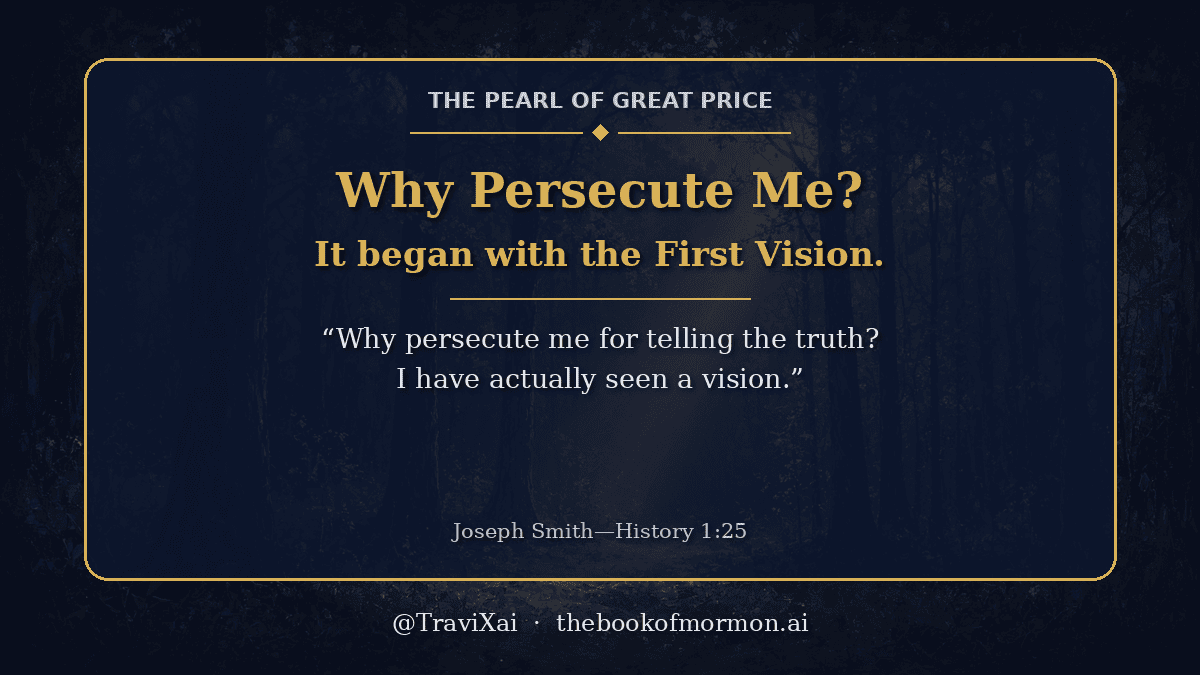
Joseph traced the hostility back to the grove. After the First Vision, “men of high standing would take notice sufficient to excite the public mind against me, and create a bitter persecution” (JS–H 1:22–23). His answer then is his answer to Hiram: “I had actually seen a light, and in the midst of that light I saw two Personages … Why persecute me for telling the truth? I have actually seen a vision; … I knew it, and I knew that God knew it, and I could not deny it” (JS–H 1:24–25). See What Is the First Vision?.
What it tells usJudge the fruit
Critics often present Joseph as a con man who got rich from religion. Hiram is part of the ledger against that: a mob, a dead child, a broken tooth, and the next morning a sermon. People don’t usually keep a con going at that price. See Was Joseph Smith a Con Man? and Joseph Smith, Con Man? He Never Used His Best Evidence.
Check the premiseThe presuppositions baked into the question
Before this question can be answered fairly, the person asking has to justify a few assumptions packed inside it:
- That a mob must have had a just cause. No charge was ever brought. Christ said His followers would be persecuted “falsely, for my sake” (Matthew 5:11).
- That it was over a scandal. The Marinda Johnson claim first appeared decades later, in a hostile 1884 debate; the 1832 sources point to Booth’s letters, fear about property and religious hostility.
- That it scared Joseph off. He preached the next morning and baptized three (D&C 71:9; JS–H 1:25).
- That it was a small prank. He was choked unconscious and nearly castrated, Sidney Rigdon was left delirious, and the Smiths’ infant son died days later.
FAQQuick answers
When was Joseph Smith tarred and feathered?
On the night of March 24, 1832, at the John Johnson farm in Hiram, Ohio.
Why was Joseph Smith tarred and feathered?
The sources point to anger stirred by former member Ezra Booth’s published letters, fear that the law of consecration would take local property, and general religious hostility. No charge was ever brought.
Who tarred and feathered Joseph Smith?
A mob of local men. Symonds Ryder, a former convert, is usually named as a leader.
Was Sidney Rigdon tarred and feathered too?
He was dragged from his house by the heels and beaten, and was delirious for several days afterward.
What happened to Joseph Smith’s baby after the mob?
His adopted infant son Joseph, sick with measles and exposed to the cold that night, died a few days later.
Was it about Nancy Marinda Johnson?
That claim first appeared about fifty years later in a hostile debate. No 1832 source supports it, and her brothers Luke and Lyman became apostles in 1835.
What did Joseph Smith do the next day?
He preached a Sunday sermon, with members of the mob in the audience, and baptized three people.
Can you visit the John Johnson farm?
Yes. The Church operates the restored John Johnson Home in Hiram, Ohio, as a historic site.
SummaryKey takeaways
- March 24, 1832, at the John Johnson farm in Hiram, Ohio.
- Joseph was choked, stripped, tarred and feathered; Sidney Rigdon was beaten.
- Motives in the sources: Booth’s letters, consecration fears, religious hostility.
- The scandal claim surfaced decades later with no 1832 support.
- Joseph preached the next morning; his infant son died days later.
Read D&C 127:2 and JS–H 1:25 tonight. For quick, sourced answers, open Galatians18, and follow me on X at @TraviXai.
Sources
- King James Bible (churchofjesuschrist.org): Matthew 5:10–12 · 2 Corinthians 11:24–27 · Acts 5:41
- Book of Mormon: 1 Nephi 1:20 · Mosiah 17:9–10
- Doctrine and Covenants: D&C 71:7–10 · D&C 127:2
- Pearl of Great Price: Joseph Smith—History 1:22–25
- The Joseph Smith Papers (History, 1838–1856) · Symonds Ryder letter (1868) · Luke Johnson, “History of Luke Johnson” (1864) · Richard L. Bushman, Joseph Smith: Rough Stone Rolling (Knopf, 2005)
- Featured image and in-article graphic: original graphics by thebookofmormon.ai (painterly backgrounds; no photographs or likenesses of real people).